
2 Chronicles 28:8

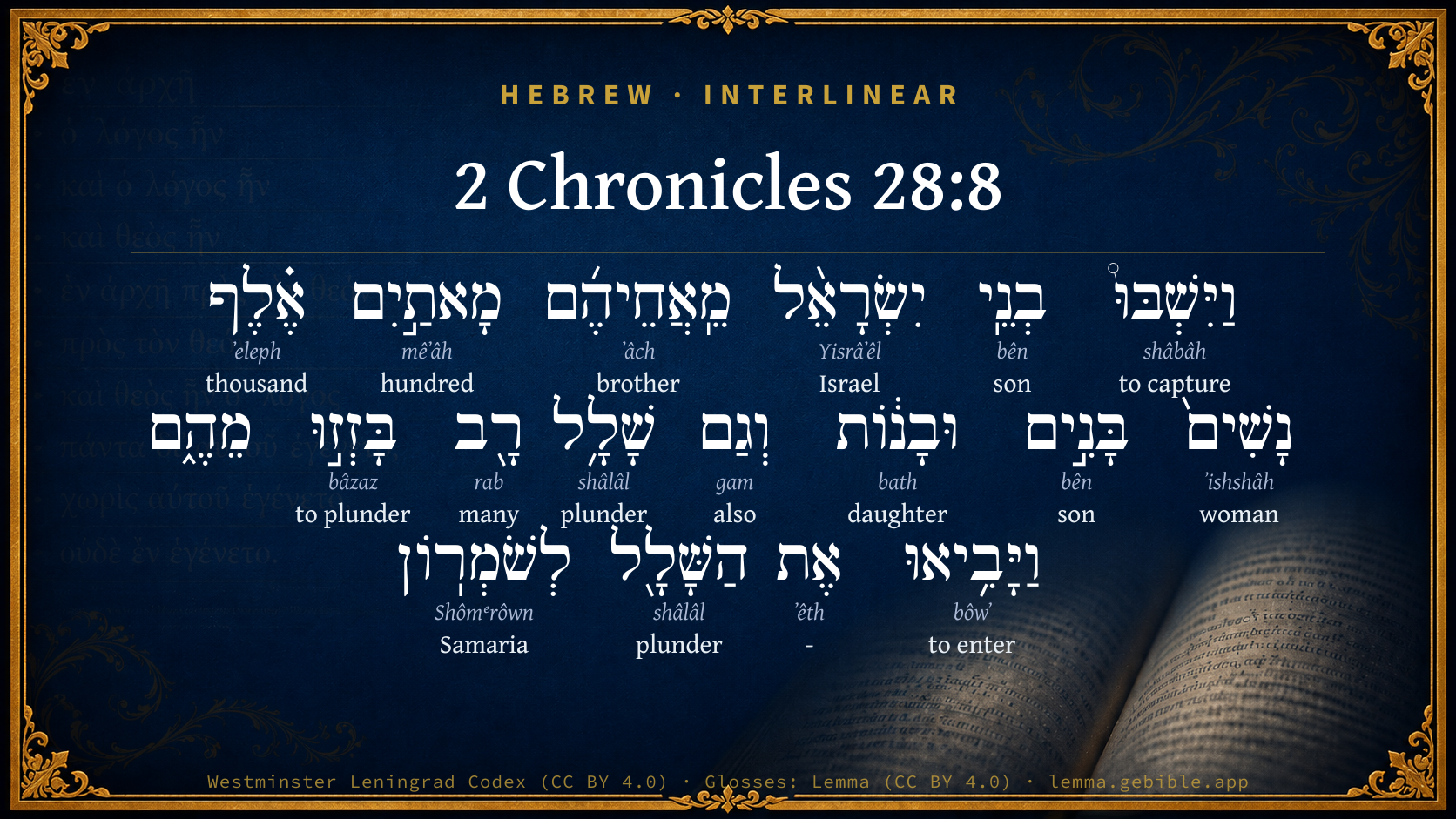
Hebrew (Westminster Leningrad Codex) 2 Chronicles 28:8 appears in the Hebrew Old Testament. The text above is from the Westminster Leningrad Codex. Each word links to its Strong’s number, a concise gloss, and parsing drawn from the Open Scriptures Hebrew Bible morphology. Click any word for its full Brown-Driver-Briggs (BDB) entry.
Download image
Cite this verse

2 Chronicles 28:8 (World English Bible). Public Domain. Lemma interlinear Bible study tool, https://lemma.gebible.app/v/2-chronicles/28/8.

Show BibTeX & RIS
BibTeX
RIS
English Translation
The children of Israel carried away captive of their brothers two hundred thousand, women, sons, and daughters, and took also away much spoil from them, and brought the spoil to Samaria.
World English Bible · Public Domain
Download a study sheet

One document with this verse’s original text, its word-by-word gloss line, the meaning frame, cross-references with their text, attributed commentary, and full source and license credits — printable, and it pastes into notes with its structure intact.

This verse Autodidact and up

Study sheet (.html) Plain text (.txt)

A passage Seminary Student

Up to 50 verses in one chapter. A passage sheet keeps up to 6 commentary sources and 12 cross-references per verse, in the order this page ranks them, and says so on the sheet whenever that leaves anything out. Ask for a single verse and you get the Autodidact verse sheet above.

Everything on this page stays free to read, with no account — the sheet is a download of what is already on screen, not access to it.

Want to remove ads? Support Godless Engineer
Compare translations 3

The same verse in 3 English versions, stacked beneath the original-language interlinear above. Click any original word for its lexicon entry.

Each is an independent rendering of the whole verse — the interlinear is not word-aligned to these translations.

Highlighted words mark where these versions differ — a whole-verse word diff, not a word-by-word alignment.

  • World English Bible Public Domain
    The children of Israel carried away captive of their brothers two hundred thousand, women, sons, and daughters, and took also away much spoil from them, and brought the spoil to Samaria.
  • King James Version Public Domain
    And the children of Israel carried away captive of their brethren two hundred thousand, women, sons, and daughters, and took also away much spoil from them, and brought the spoil to Samaria.
  • unfoldingWord Literal Text CC BY-SA 4.0
    And the sons of Israel took captive from their brothers 200,000 wives, sons, and daughters. And also much plunder they plundered from them. And they brought the plunder back to Samaria.

unfoldingWord Literal Text — © unfoldingWord, licensed CC BY-SA 4.0. Word-aligned USFM3 via Door43 (git.door43.org/unfoldingWord/en_ult).

Versions to compare (up to 4)

3 of 4 selected

Show all 18 translations

Every available English version of this verse, each an independent rendering of the whole verse.

  • World English Bible Public Domain
    The children of Israel carried away captive of their brothers two hundred thousand, women, sons, and daughters, and took also away much spoil from them, and brought the spoil to Samaria.
  • Berean Standard Bible Public Domain
    Then the Israelites took 200,000 captives from their kinsmen—women, sons, and daughters. They also carried off a great deal of plunder and brought it to Samaria.
  • Majority Standard Bible Public Domain
    Then the Israelites took 200,000 captives from their kinsmen—women, sons, and daughters. They also carried off a great deal of plunder and brought it to Samaria.
  • King James Version Public Domain
    And the children of Israel carried away captive of their brethren two hundred thousand, women, sons, and daughters, and took also away much spoil from them, and brought the spoil to Samaria.
  • American Standard Version (1901) Public Domain
    And the children of Israel carried away captive of their brethren two hundred thousand, women, sons, and daughters, and took also away much spoil from them, and brought the spoil to Samaria.
  • Revised Version (1885) Public Domain
    And the children of Israel carried away captive of their brethren two hundred thousand, women, sons, and daughters, and took also away much spoil from them, and brought the spoil to Samaria.
  • Geneva Bible (1599) Public Domain
    And the children of Israel tooke prisoners of their brethren, two hudreth thousand of women, sonnes and daughters, and caried away much spoyle of them, and brought the spoyle to Samaria.
  • Douay-Rheims (1899) Public Domain
    And the children of Israel carried away of their brethren two hundred thousand women, boys, and girls, and an immense booty: and they brought it to Samaria.
  • Young's Literal Translation Public Domain
    And the sons of Israel take captive of their brethren, two hundred thousand, wives, sons and daughters, and also much spoil they have seized from them, and they bring in the spoil to Samaria.
  • Literal Standard Version CC BY-SA 4.0
    And the sons of Israel take captive of their brothers: two hundred thousand wives, sons, and daughters; and they have also seized much spoil from them, and they bring in the spoil to Samaria.
  • Unlocked Literal Bible CC BY-SA 4.0
    The army of Israel took captive from their relatives 200,000 wives, sons, and daughters. They also took much plunder, which they carried back to Samaria.
  • unfoldingWord Literal Text CC BY-SA 4.0
    And the sons of Israel took captive from their brothers 200,000 wives, sons, and daughters. And also much plunder they plundered from them. And they brought the plunder back to Samaria.
  • Darby Bible Public Domain
    And the children of Israel carried away captive of their brethren two hundred thousand, women, sons, and daughters, and took away also much spoil from them, and brought the spoil to Samaria.
  • World Messianic Bible Public Domain
    The children of Israel carried away captive of their brothers two hundred thousand women, sons, and daughters, and also took away much plunder from them, and brought the plunder to Samaria.
  • Webster's Bible Public Domain
    And the children of Israel carried away captive of their brethren two hundred thousand, women, sons, and daughters, and also took away much spoil from them, and brought the spoil to Samaria.
  • Free Bible Version CC BY-SA 4.0
    The Israelites captured 200,000 of their “brothers” —women, sons, and daughters. They also took a great deal of plunder and brought it to Samaria.
  • Bible in Basic English Public Domain
    And the children of Israel took away as prisoners from their brothers, two hundred thousand, women and sons and daughters, and a great store of their goods, and took them to Samaria.
  • JPS Tanakh (1917) Public Domain
    And the children of Israel carried away captive of their brethren two hundred thousand women, sons, and daughters, and took also away much spoil from them, and brought the spoil to Samaria.

Literal Standard Version (2020), Covenant Press — licensed CC BY-SA 4.0. Text via the HelloAO Bible API (eBible.org). Unlocked Literal Bible (unfoldingWord) — licensed CC BY-SA 4.0. Text via the HelloAO Bible API (eBible.org). unfoldingWord Literal Text — © unfoldingWord, licensed CC BY-SA 4.0. Word-aligned USFM3 via Door43 (git.door43.org/unfoldingWord/en_ult). Free Bible Version, Dr. Jonathan Gallagher — licensed CC BY-SA 4.0. Text via the HelloAO Bible API (eBible.org).

Word by word

More ways to search: Search by grammar → Find every occurrence → Compare this word →

Practice this passage: Drill this verse → Learn its vocabulary →

בָּזְז֣וּ
bâzaz
H962
“to plunder”
Verb, Qal, Perfect, 3rd Person, Common, Plural
Part of Speech
Verb
Stem
Qal
Form
Perfect
Person
3rd Person
Gender
Common
Number
Plural
Full BDB Definition

Origin: a primitive root

TWOT: 225

to spoil, plunder, prey upon, seize - (Qal) to spoil, plunder, despoil - (Niphal) to be spoiled, plundered - (Pual) to be taken as spoil
  1. וַיִּשְׁבּוּ֩ shâbâh H7617 “and · to capture” Conjunction + Verb, Qal, Sequential Imperfect, 3rd Person, Masculine, Plural
  2. בְנֵֽי bên H1121 “sons of” Noun, Common, Masculine, Plural, Construct
  3. יִשְׂרָאֵ֨ל Yisrâʼêl H3478 “Israel” Noun, Proper
  4. מֵֽאֲחֵיהֶ֜ם ʼâch H251 “from · brothers · their” Preposition + Noun, Common, Masculine, Plural, Construct + Suffix, Personal, 3rd Person, Masculine, Plural
  5. מָאתַ֣יִם mêʼâh H3967 “hundred” Adjective, Cardinal number, Both, Dual, Absolute
  6. אֶ֗לֶף ʼeleph H505 “thousand” Adjective, Cardinal number, Both, Singular, Absolute
  7. נָשִׁים֙ ʼishshâh H802 “women” Noun, Common, Feminine, Plural, Absolute
  8. בָּנִ֣ים bên H1121 “sons” Noun, Common, Masculine, Plural, Absolute
  9. וּבָנ֔וֹת bath H1323 “and · daughters” Conjunction + Noun, Common, Feminine, Plural, Absolute
  10. וְגַם gam H1571 “and · also” Conjunction + Particle, Accusative
  11. שָׁלָ֥ל shâlâl H7998 “plunder” Noun, Common, Masculine, Singular, Absolute
  12. רָ֖ב rab H7227 “many” Adjective, Adjective, Masculine, Singular, Absolute
  13. וַיָּבִ֥יאוּ bôwʼ H935 “and · to enter” Conjunction + Verb, Hiphil, Sequential Imperfect, 3rd Person, Masculine, Plural
  14. אֶת ʼêth H853 “-” Particle, Direct Object
  15. הַשָּׁלָ֖ל shâlâl H7998 “the · plunder” Particle, Definite Article + Noun, Common, Masculine, Singular, Absolute
  16. לְשֹׁמְרֽוֹן Shômᵉrôwn H8111 “to/for · Samaria” Preposition + Noun, Proper

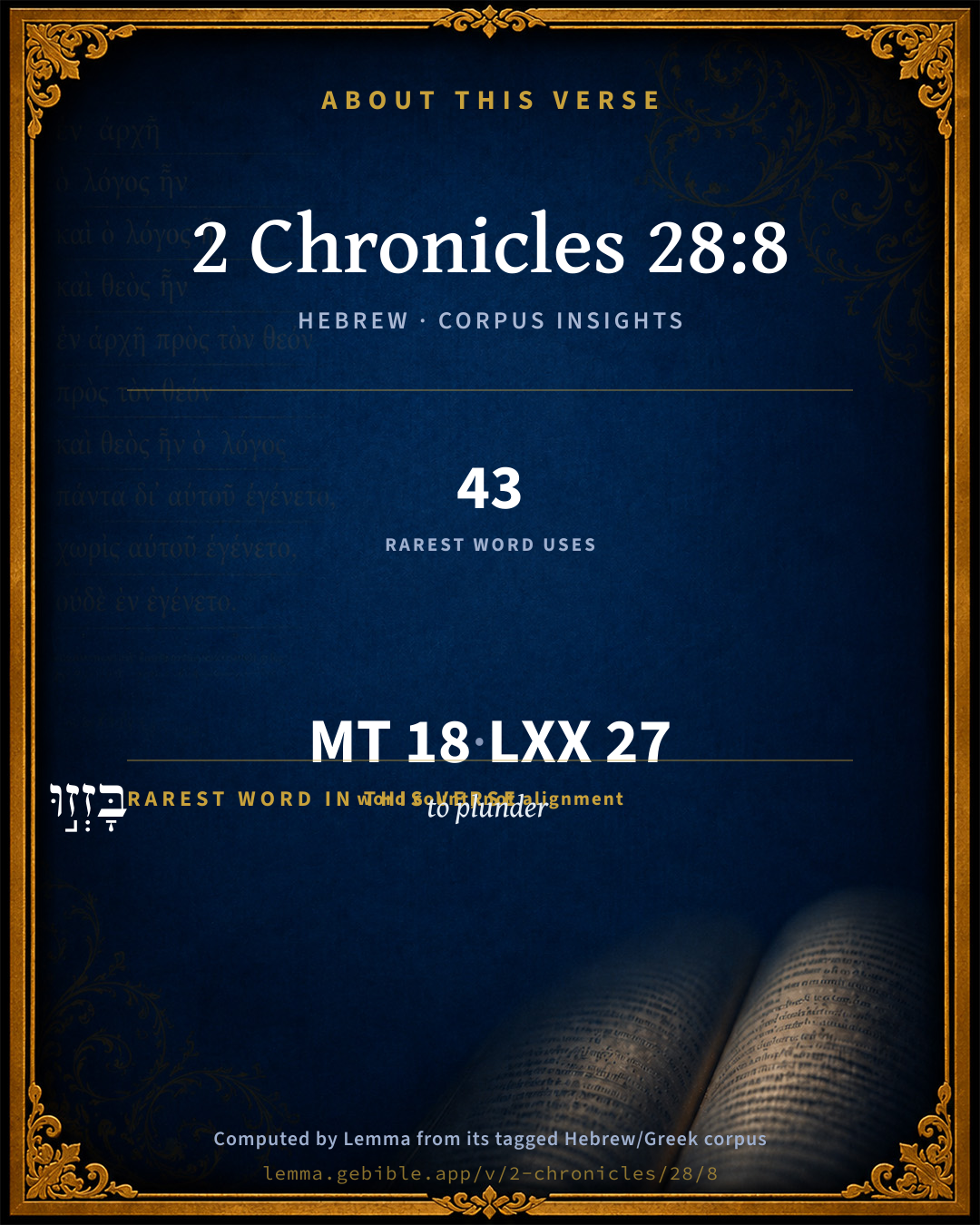
About this verse

These counts appear in no published source. They are computed here, from the morphology-tagged text and Lemma’s own curated glosses. What Lemma adds →

18
words
15
distinct lemmas
Historical
section

Shared distinctive vocabulary

בָּזְז֣וּ to plunder H962 occurs in 39 verses of the Hebrew Bible. Also found in:

Grammatical profile

  • 3 verbs
  • 9 nouns
  • 3 adjectives
  • 1 preposition
  • 2 particles

Verb forms

  • וַיִּשְׁבּוּ֩ Qal · Sequential Imperfect
  • בָּזְז֣וּ Qal · Perfect
  • וַיָּבִ֥יאוּ Hiphil · Sequential Imperfect

Repetition

Words recur within this verse — often emphatic in Hebrew:

  • בְנֵֽי son H1121 ×2
  • שָׁלָ֥ל plunder H7998 ×2

Hebrew & Septuagint length

In English translation the verse runs 31 words from the Hebrew and 31 from the Septuagint (LXX English) — the same length.

A rough comparison of the two English renderings, which tokenize alike — not a word-level alignment.

Word counts can differ between the Hebrew and the Greek without any difference in meaning — e.g. the Hebrew direct-object marker אֵת has no separate Greek word, and Greek often adds the article ὁ.

In the original languages it is 18 Hebrew tokens and 27 Greek tokens — but the two are counted differently (Hebrew bundles its prefixes and suffixes into one token; the Greek is in lemma form), so that isn’t a like-for-like length.

Cross-references

5

Topical passages linked to 2 Chronicles 28:8 in the Treasury of Scripture Knowledge — connected by theme and wording, ordered by reader-vote popularity; previews shown in the World English Bible.

  • 2 Chronicles 11:4 Thus says Yahweh, You shall not go up, nor fight against your brothers: return every man to his house; for this thing is of me. So they listened to the words of Yahweh, and returned from going against Jeroboam.
  • Deuteronomy 28:25 Yahweh will cause you to be struck before your enemies; you shall go out one way against them, and shall flee seven ways before them: and you shall be tossed back and forth among all the kingdoms of the earth.
  • Deuteronomy 28:41 You shall father sons and daughters, but they shall not be yours; for they shall go into captivity.
  • Acts 7:26 "The day following, he appeared to them as they fought, and urged them to be at peace again, saying, 'Sirs, you are brothers. Why do you wrong one another?'
  • Acts 13:26 Brothers, children of the stock of Abraham, and those among you who fear God, the word of this salvation is sent out to you.

Cross-references courtesy of OpenBible.info (CC BY 4.0).

Hebrew and Greek witnesses Masoretic Hebrew ↔ Greek Septuagint

The same verse in the two great witnesses to the Old Testament, shown verse-for-verse.

These are two independent witnesses, not word-aligned to each other, and the Septuagint is shown in lemma (dictionary) form.

Hebrew 2 Chronicles 28:8 Masoretic · Westminster Leningrad Codex

וַיִּשְׁבּוּ֩ בְנֵֽי יִשְׂרָאֵ֨ל מֵֽאֲחֵיהֶ֜ם מָאתַ֣יִם אֶ֗לֶף נָשִׁים֙ בָּנִ֣ים וּבָנ֔וֹת וְגַם שָׁלָ֥ל רָ֖ב בָּזְז֣וּ מֵהֶ֑ם וַיָּבִ֥יאוּ אֶת הַשָּׁלָ֖ל לְשֹׁמְרֽוֹן

The children of Israel carried away captive of their brothers two hundred thousand, women, sons, and daughters, and took also away much spoil from them, and brought the spoil to Samaria.

World English Bible · Public Domain

Greek LXX 2 Chronicles 28:8 Septuagint · lemma form

καί αἰχμαλωτίζω ὁ υἱός ἰσραήλ ἀπό ὁ ἀδελφός αὐτός τριακόσιοι χιλίας γυνή υἱός καί θυγάτηρ καί σκῦλον πολύς σκυλεύω ἐκ αὐτός καί φέρω ὁ σκῦλον εἰς σαμαρεία

And the children of Israel took captive of their brethren three hundred thousand, women, and sons, and daughters, and they spoiled them of much property, and brought the spoils to Samaria.

LXX2012 (modern English Septuagint) · Public Domain

Hebrew: Westminster Leningrad Codex (CC BY 4.0). Greek: Septuagint (public domain); English from LXX2012 (modern English Septuagint) (Public Domain). How the Septuagint differs from the Hebrew →

Commentary

Notes on 2 Chronicles 28:8 from classic Christian and Jewish commentators (each source and its license shown beneath its notes). The classic Christian expositions comment on the surrounding passage and are grouped to its opening verse, so a note may address several verses; the Jewish commentaries on the Tanakh (Rashi and others) are per-verse, so they appear only where the commentator wrote on this verse.

Lemma curates 59 commentaries, every one of them public domain or Creative Commons licensed, each selected and text-cleaned for this edition rather than reprinted as found. About our sources →

Trapp's Complete Commentary

John Trapp

2Ch 28:8 And the children of Israel carried away captive of their brethren two hundred thousand, women, sons, and daughters, and took also away much spoil from them, and brought the spoil to Samaria.

Ver. 8. Two hundred thousand women, sons and daughters.] These also were sinners against their own souls: for "the children gathered wood, and the fathers kindled the fire, and the women kneaded dough to make cakes to the queen of heaven, and to pour out drink offerings unto other gods, to provoke the Lord to anger." {Jer 7:18}

John Trapp, A Commentary or Exposition upon All the Books of the Old and New Testament (1647–1656) — public domain. Text from a community e-Sword module.

Joseph Benson's Commentary

2Ch 28:8. The children of Israel carried away captive two hundred thousand, women, &c. — When the army in the field was routed, the cities, and towns, and country villages were all easily stripped, the inhabitants taken for slaves, and their wealth for a prey.

Joseph Benson's Commentary on the Old and New Testaments (1811–1818) — public domain. Text from a community e-Sword module.

Geneva Bible (1599)

Geneva Bible translators

Thus by the just judgment of God, Israel destroyed Judah.

Geneva Bible (1599) marginal notes — public domain. Text via Bolls.life.

Jamieson, Fausset & Brown

Robert Jamieson, A. R. Fausset & David Brown

the children of Israel carried away captive of their brethren two hundred thousand--These captives included a great number of women, boys, and girls, a circumstance which creates a presumption that the Hebrews, like other Orientals, were accompanied in the war by multitudes of non-combatants (see on Jdg 4:8). The report of these "brethren," being brought as captives to Samaria, excited general indignation among the better-disposed inhabitants; and Oded, a prophet, accompanied by the princes (Ch2 28:12 compared with Ch2 28:14), went out, as the escort was approaching, to prevent the disgraceful outrage of introducing such prisoners into the city. The officers of the squadron were, of course, not to blame; they were simply doing their military duty in conducting those prisoners of war to their destination. But Oded clearly showed that the Israelitish army had gained the victory--not by the superiority of their arms, but in consequence of the divine judgment against Judah. He forcibly exposed the enormity of the offense of keeping "their brethren" as slaves got in war. He protested earnestly against adding this great offense of unnatural and sinful cruelty (Lev 25:43-44; Mic 2:8-9) to the already overwhelming amount of their own national sins. Such was the effect of his spirited remonstrance and the opposing tide of popular feeling, that "the armed men left the captives and the spoil before the princes and all the congregation."

Jamieson, Fausset & Brown — Commentary Critical and Explanatory on the Whole Bible (1871) — public domain (CC PDM 1.0). Text via the HelloAO Bible API.

Ellicott's Commentary for English Readers

(8) Of their brethren.—Heightening the barbarity of the deed. So 2Ch_28:11.

Two hundred thousand, women, sons, and daughters.—See Note on 2Ch_28:6. Sennacherib boasts that in the war against Hezekiah he took forty-six strong cities of Judah, and carried off 200,150 captives. The number of the text is thus corroborated from a foreign and wholly unrelated source. The thrilling narrative of Kings (2 Kings 18-19) says nothing of the carrying away of all these captives by the Assyrian invader, the interest of the writer being centred on Jerusalem. With this omission that of the facts related in the present section may be compared.

A Bible Commentary for English Readers, edited by Charles John Ellicott (1878–1897) — public domain. Text from a community e-Sword module.

The Cambridge Bible for Schools and Colleges

gen. ed. J. J. S. Perowne

8–15 (not in Kings; but cp. 2Ki_6:21-23, a similar incident). Israel sends back the Jewish Captives

8. of their brethren] Cp. 2Ch_11:4, “ye shall not … fight against your brethren.”

The Cambridge Bible for Schools and Colleges (gen. ed. J. J. S. Perowne; Cambridge University Press, 1878–1918) — public domain. Text from a community e-Sword module.

John Gill's Exposition

And the children of Israel carried captive of their brethren two hundred thousand women, sons and daughters,.... Which was a very large and unusual number to be carried captive; but having made such a slaughter of the men, and the rest being intimidated thereby, it was the more easily done:

and took away also much spoil from them; wealth and riches out of their cities, and even from Jerusalem; for by the preceding verse it seems as if they came thither:

and brought the spoils to Samaria; or rather "towards Samaria" (k), as some render the word; for they were not as yet come to it, nor did they bring it and their captives thither, see Ch2 9:15.

(k) "versus Samariam", Piscator, Rambachius.

John Gill's Exposition of the Whole Bible (1746–1763) — public domain (CC PDM 1.0). Text via the HelloAO Bible API.

The Pulpit Commentary

To Samaria. While the Syrian king carried his captives to Damascus (ver. 5), the Israel king carried his to Samaria. The numbers in this verse, with the added hundred and twenty thousand whom Pekah slew (ver. 6), may be compared with the military strength of the kingdom in Uzziah"s time, as given in 2Ch_26:13.

Vers. 8-15.

The sending back of the captives an incident of the Israelitish war.

I THE WARRIORS OF ISRAEL AND THE CAPTIVES OF JUDAH. (Ver. 8.)

1. The number of the captives. Two hundred thousand persons.

(1) This, following upon a slaughter of one hundred and twenty thousand soldiers, showed the crushing nature of the blow which had fallen upon Judah.

(2) It exemplified the horrors of war, especially amongst ancient peoples, with whom the deportation of vast hordes of a country"s population was a familiar phenomenon. Cf. among the Jews the twenty thousand footmen taken by David from Hadadezer of Zobah (2Sa_8:4; 1Ch_18:4) and the ten thousand Edomites captured by Amaziah; (2Ch_25:12) amongst the Assyrians the carrying away of the inhabitants of Samaria to Assyria by Tiglath-Pileser II (2Ki_15:29; cf. "Records," etc., 2Ki 5:52) population, the goods of its people (and the furniture)to the land of Assyria I sent," and the removal by Sargon II of 27, 280 of the leading inhabitants of Samaria to Gozan and Media ("Records," etc., 7:28); and amongst the Egyptians the number of foreign peoples transported to the Nile valley as the result of successful campaigns, a number so great as with their descendants to compose in the time of Rameses Sesostris "a third, aud probably still more, of all the families of Egypt" (Brugsch, " Egypt under the Pharaohs," 2:104).

(3) It illustrated the ease with which, when God willed it, a nation could be "minished and brought low" (Job_12:23; Psa_107:39)

(4) It attested the certainty and severity of God"s judgments on account of sin, whether upon nations or individuals (Lev_26:17; Deu_32:30; 2Ch_15:6)

2. The persons of the captives.

(1) The brethren of the Israelites, i.e. their kinsmen; hence the wickedness of their conduct in enslaving not merely human beings, which was bad, but their own flesh and blood, which was worse, yea, was unnatural; and

(2) of these, not the men who had fought against them, which might have been in some sort excusable, but, which was wholly indefensible, the women, with their sons and daughters, who were all alike innocent of offence in either causing or sustaining the war, and therefore should have been exempted from experiencing its miseries.

3. The destination of the captives. Samaria, in the Assyrian monuments Sa-mir-i-na (Schrader, "Die Keilinschriften," p. 191), the capital of the northern kingdom, built by Omri. (1Ki_16:24)

II THE WARRIORS OF ISRAEL AND THE PROPHET OF JEHOVAH. (Vers. 9-11.)

1. The prophets name. Oded, "Setting up." The name of the father of Azariah who went out to meet Asa. (2Ch_15:2)

2. The prophets designation. A prophet of Jehovah, not of the false Jehovah worshipped in Samaria under the image of a calf, (Hos_8:5, Hos_8:6) but of the true Jehovah, which shows that, apostate as the northern kingdom had become, it was not entirely destitute of true religion even there Jehovah having at least prophets who witnessed for him, like Hosea (Hos_1:1) and Oded, if not also adherents who worshipped him.

1. The prophets courage. He went out to meet the hosts of Israel as they returned from their successful campaign, and warned them of the wickedness of which they had been guilty; as Jehu, the son of Hanani, had met Jehoshaphat returning from Ramoth-Gilead, (2Ch_19:2) and a prophet of Jehovah had confronted Amaziah coming from the slaughter of the Edomites. (2Ch_25:15)

2. The prophets address.

(1) A reminder that the victory they had obtained had been due not so much (if at all) to their superior military skill or bravery, as to the fact that Jehovah had been angry with Judah, and had delivered her armies into their hands (ver. 9; of. (Neh_9:27)

(2) A rebuke for the want of pity they had shown towards their brethren upon whom the anger of God had fallen a circumstance which should have moved their hearts to clemency, (Job_19:21) but which had rather lent intensity to their rage.

(3) An accusation that they purposed to make bondmen and bondwomen of the sons and daughters of Judah and Jerusalem which, besides being an act of cruelty, was likewise an act of folly, since it could not be supposed Jehovah"s favour was finally withdrawn from Judah; and an act of presumption, inasmuch as they themselves had not been blameless in the matter of apostatizing from Jehovah, and, if the truth were told, were as much deserving to be punished as their southern brethren and sisters.

(4) An appeal to their conscience to say whether what he now affirmed was not correct: "Are there not with you, even with you, sins against the Lord your God?" Their idolatry was as great as that of Judah had been. Their pitiless butchery of their brethren was crying up against them to heaven. Their bringing away of these innocent women and children was an iniquity which filled up the measure of their guilt (ver. 10).

(5) An exhortation to desist from their criminal intention to enslave their brethren, and to send back the captives they had brought, with all convenient speed and with due expressions of reset (ver. 11).

(6) An argument to quicken their movements in the path of duty; if they did not, the fierce wrath of Jehovah, which was already on them, would engulf them. The speech, which was a model in respect of compact brevity, lofty eloquence, clear statement, pathetic appeal, resistless logic, and which must have been delivered with combined boldness and persuasiveness, made a deep impression.

III THE WARRIORS OF ISRAEL AND THE PRINCES OF EPHRAIM, (Vers. 12-14.)

1. The names of the princes. Azariah, (2Ch_15:2 2Ch_22:6) the son of Johanan, "Jehovah is gracious;" Berechiah, "Whom Jehovah hath blessed", (1Ch_6:39) son of Meshillemoth, "Retribution;" Jehizkiah, the same as Hezekiah, "The might of Jehovah," son of Shallum, "Retribution"; (2Ki_15:10) and Amasa, "Burden," the name of one of Absalom"s captains, (2Sa_17:25) the son of Hadlai, "Rest.

2. These princes were obviously at the head of the Israelitish congregation (ver. 14).

3. The action of the princes. They joined the Prophet Oded in resisting the introduction by the soldiers of the captives into the city. That people is fortunate whose leaders are courageous to oppose them in evil-doing, and to point out to them the path of duty.

4. The speech of the princes.

(1) A refusal to admit the captives into the city (ver. 13);

(2) a confession that already they, as a people, had transgressed against Jehovah, and incurred his wrath; and

(3) an intimation that the course the soldiers were pursuing was such as would increase their sin and trespass, and expose them to a heavier charge of guilt.

5. The success of the princes. "The armed men left the captives and the spoil before the princes and all the congregation" (ver. 14). Happy is that community in which the wise and good counsels of its leaders prevail.

IV THE PRINCES OF ISRAEL AND THE CAPTIVES OF JUDAH. (Ver. 15.)

1. The kindness of the princes. The above-named (ver. 12), with other famous and distinguished leaders, to whom a similar designation was customarily applied (1Ch_12:31 1Ch_16:41; 2Ch_31:19) rose up from their seats of honour in the midst of the assembly, stood forth as the representatives of the people and received at the hands of the soldiers the crowd of captives; out of the spoil, which, as usual, consisted in garments, flocks, and herds, with other articles of value, (2Ch_15:14, 15 20:25) clothed and shod all amongst them who were naked, giving them to eat and drink; (2Ki_6:22, 2Ki_6:23) anointed with oil such of them as had wounds; (Luk_10:34) set the feeble upon asses, of which animals there was a plentiful supply (1 Chronicles (Ezr_2:67) a lively picture of the pity and compassion which should ever be shown towards the unfortunate, suffering, and miserable, especially by the people of God (Isa_58:6, Isa_58:7; Job_30:25; Luk_10:37 Luk_14:12; 1Ti_5:10; 1Jn_3:17)

2. The return of the captives. Thus generously treated by the princes, they were sent back, those able to travel by themselves, those requiring to ride accompanied by conductors, who journeyed with them as far as Jericho, the city of palm trees, (Jud_1:3:13) distant from Jerusalem about five and a half hours walk, situated in the tribe of Benjamin, and belonging to the kingdom of Judah. Arrived thither, they were handed over to their brethren, after which their conductors returned to Samaria.

LESSONS.

1. The sin of slavery.

2. The function of prophecy.

3. The beauty of charity. W.

The Pulpit Commentary (1880–1919), ed. H.D.M. Spence-Jones & Joseph S. Exell — public domain. Text from a community e-Sword module.

Keil & Delitzsch

C. F. Keil & F. Delitzsch

The Israelites, moreover, carried away 200,000 - women, sons, and daughters-from their brethren, and a great quantity of spoil, and brought the booty (prisoners and goods; cf. for שׁלל of men, Jdg 5:30) to Samaria. אחיהם, the brethren of the Israelites, is the name given, with emphasis, to the inhabitants of Judah, here and in Ch2 28:11, in order to point out the cruelty of the Israelites in not scrupling to carry away captive the defenceless women and children of their brethren.

The modern critics have taken offence at the large numbers, 120,000 slain and 200,000 women and children taken prisoners, and have declared them to be exaggerations of the wonder-loving chronicler (Gesen. on Isa., De Wette, Winer, etc.). But in this they are mistaken; for if we consider the war more closely, we learn from Isa 7:6 that the allied kings purposed to annihilate the kingdom of Judah. And, moreover, the Ephraimites acted always with extreme cruelty in war (cf. Kg2 15:16); but more especially cherished the fiercest hatred against the men of Judah, because these regarded them as having fallen away from the service of the true God (Ch2 25:6-10; Ch2 13:4.). But in a war for the existence of the kingdom, Ahaz must certainly have called out the whole male population capable of bearing arms, which is estimated in the time of Amaziah at 300,000 men, and in that of Uzziah at 307,500 (Isa 25:5; Isa 26:13), - numbers which appear thoroughly credible, considering the size and populousness of Judah. If we suppose the army of Ahaz to have been as large, in a decisive battle fought with all possible energy nearly 120,000 men may have fallen, especially if the Ephraimites, in their exasperation, unsparingly butchered their enemies, as the narrative would seem to hint both by the word הרג in Ch2 28:6, which signifies to murder, massacre, butcher, and by the saying of the prophet, Ch2 28:9, "Ye massacred among them with a rage which reached to heaven." By the character of the war, which resembled a civil or even a religious war, and by the cruelty of the Israelites, the great number of those carried captive is accounted for; for after the great defeat of the men of Judah the whole land fell into the hands of the enemy, so that they could sate their hatred and anger to their heart's content by carrying off the defenceless women and children to make them slaves. And finally, we must also consider that the numbers of the slain and of the prisoners are not founded upon exact enumeration, but upon a mere general estimate. The immense loss which was sustained in the battle was estimated on the side of Judah at 120,000 men; and the number of captive women and children was so immense, that they were, or might be, estimated at 200,000 souls, it being impossible to give an exact statement of their number. These numbers were consequently recorded in the annals of the kingdom, whence the author of the Chronicle has taken them; cf. Caspari, S. 37ff.

Keil & Delitzsch — Biblical Commentary on the Old Testament (1861–1891) — public domain (CC PDM 1.0). Text via the HelloAO Bible API. (Old Testament only.)

Lesson kit

Teaching starters — assembled from the data on this page, not authored interpretation. Every prompt links to the verse data it draws on. Edit before teaching.

2 Chronicles, in the Historical, opens this verse with 18 words (15 distinct Hebrew lemmas). Its most distinctive word is bâzaz (“to plunder”). A historical commentator’s framing appears above. Read the whole chapter for the surrounding context.

Discussion questions

  1. What does “to plunder” (bâzaz) contribute to the verse as a whole?
  2. Genesis 34:27 shares the word «to plunder» with this verse. How do the two illuminate each other?
  3. “son” occurs 2× in this one verse. What is the effect of the repetition?
  4. These translations render this verse differently; the difference is in the English rendering, not the original. What questions does that raise?
  5. The verb «וַיִּשְׁבּוּ֩» is Qal Sequential Imperfect. How does its form color the action?
  6. Reading how Trapp's Complete Commentary and Joseph Benson's Commentary read this verse, where do the two commentators agree and where do they part?

Things to notice

Reading settings

Reading text

Shown beneath each verse's original-language words.

Old Testament
Old Testament edition

Read the OT as the Masoretic Hebrew (MT) or the Greek Septuagint (LXX).

English shown for the Greek Septuagint (in the Hebrew ↔ Greek comparison).

Comparing translations? Open the Compare panel on any verse page to stack up to four side by side.