
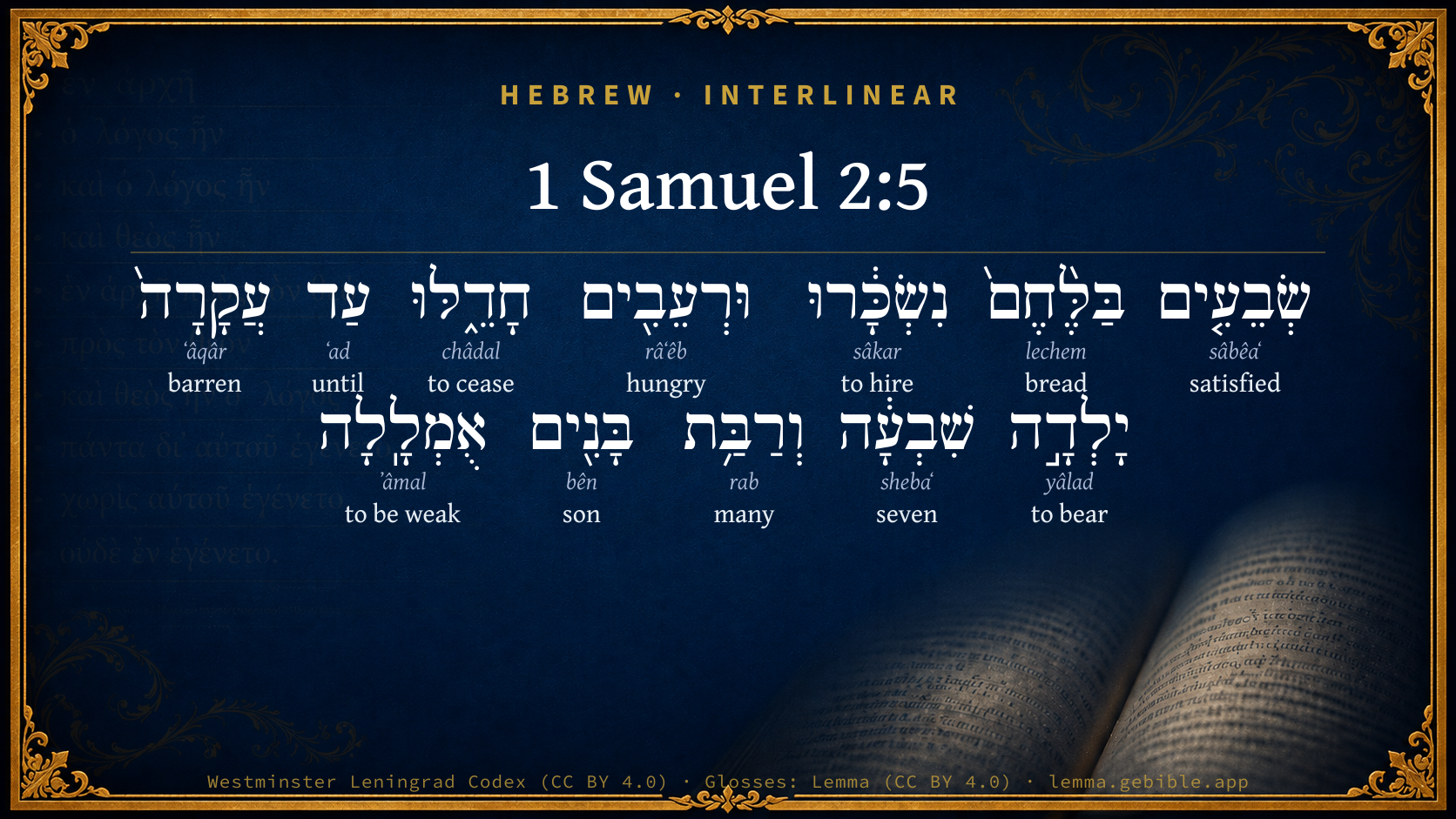
1 Samuel 2:5

Hebrew (Westminster Leningrad Codex) 1 Samuel 2:5 appears in the Hebrew Old Testament. The text above is from the Westminster Leningrad Codex. Each word links to its Strong’s number, a concise gloss, and parsing drawn from the Open Scriptures Hebrew Bible morphology. Click any word for its full Brown-Driver-Briggs (BDB) entry.
Download image
Cite this verse

1 Samuel 2:5 (World English Bible). Public Domain. Lemma interlinear Bible study tool, https://lemma.gebible.app/v/1-samuel/2/5.

Show BibTeX & RIS
BibTeX
RIS
English Translation
Those who were full have hired out themselves for bread; Those who were hungry have ceased [to hunger]: Yes, the barren has borne seven; She who has many children languishes.
World English Bible · Public Domain
Highlights
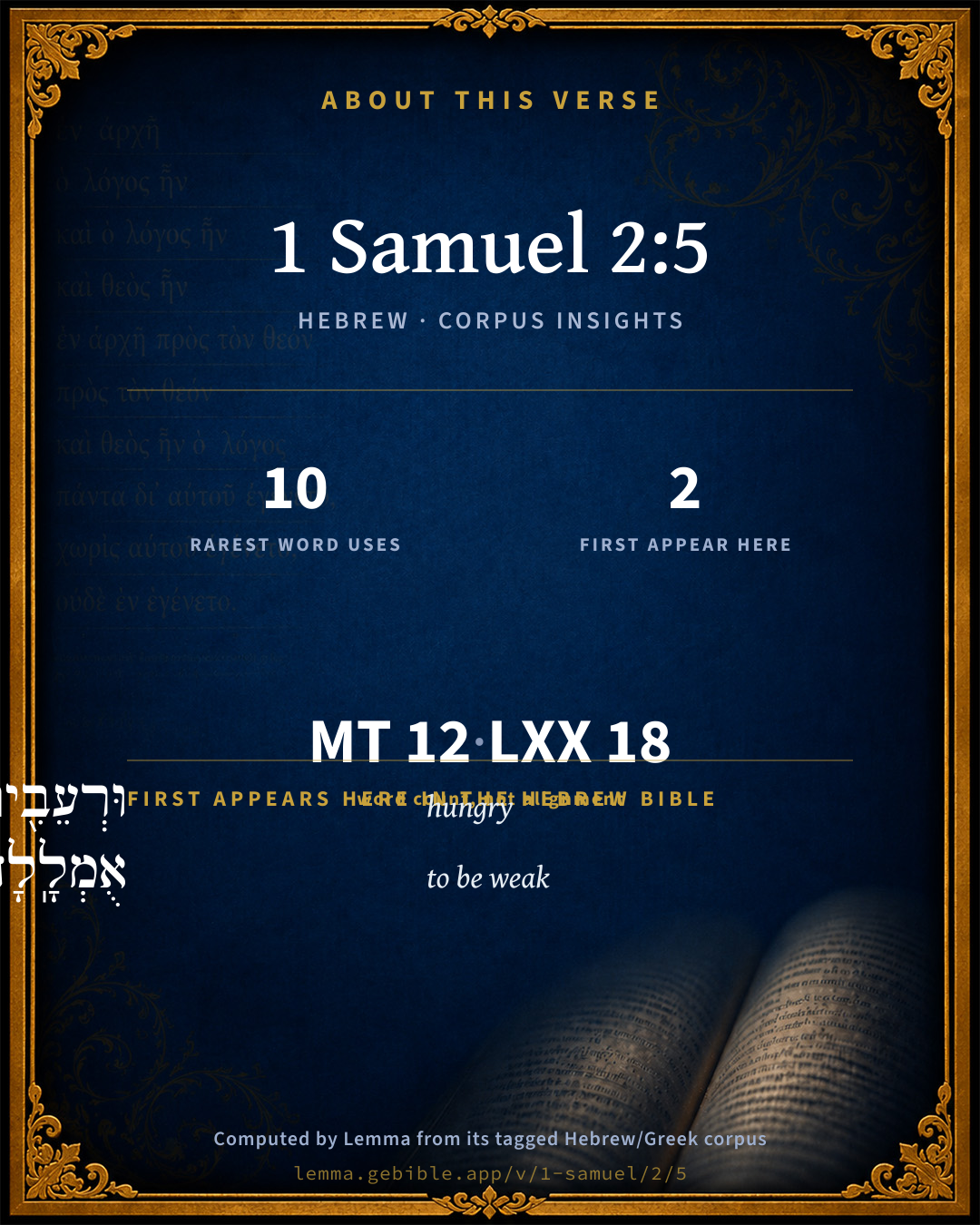
  • 2 first appearances in the Hebrew Bible
Full analysis ↓
Download a study sheet

One document with this verse’s original text, its word-by-word gloss line, the meaning frame, cross-references with their text, attributed commentary, and full source and license credits — printable, and it pastes into notes with its structure intact.

This verse Autodidact and up

Study sheet (.html) Plain text (.txt)

A passage Seminary Student

Up to 50 verses in one chapter. A passage sheet keeps up to 6 commentary sources and 12 cross-references per verse, in the order this page ranks them, and says so on the sheet whenever that leaves anything out. Ask for a single verse and you get the Autodidact verse sheet above.

Everything on this page stays free to read, with no account — the sheet is a download of what is already on screen, not access to it.

Want to remove ads? Support Godless Engineer
Compare translations 3

The same verse in 3 English versions, stacked beneath the original-language interlinear above. Click any original word for its lexicon entry.

Each is an independent rendering of the whole verse — the interlinear is not word-aligned to these translations.

Highlighted words mark where these versions differ — a whole-verse word diff, not a word-by-word alignment.

  • World English Bible Public Domain
    Those who were full have hired out themselves for bread; Those who were hungry have ceased [to hunger]: Yes, the barren has borne seven; She who has many children languishes.
  • King James Version Public Domain
    They that were full have hired out themselves for bread; and they that were hungry ceased: so that the barren hath born seven; and she that hath many children is waxed feeble.
  • unfoldingWord Literal Text CC BY-SA 4.0
    The satisfied hire themselves out for bread, but the hungry cease. Even the barren bears seven, but the plenteous of sons languishes.

unfoldingWord Literal Text — © unfoldingWord, licensed CC BY-SA 4.0. Word-aligned USFM3 via Door43 (git.door43.org/unfoldingWord/en_ult).

Versions to compare (up to 4)

3 of 4 selected

Show all 18 translations

Every available English version of this verse, each an independent rendering of the whole verse.

  • World English Bible Public Domain
    Those who were full have hired out themselves for bread; Those who were hungry have ceased [to hunger]: Yes, the barren has borne seven; She who has many children languishes.
  • Berean Standard Bible Public Domain
    The well-fed hire themselves out for food, but the starving hunger no more. The barren woman gives birth to seven, but she who has many sons pines away.
  • Majority Standard Bible Public Domain
    The well-fed hire themselves out for food, but the starving hunger no more. The barren woman gives birth to seven, but she who has many sons pines away.
  • King James Version Public Domain
    They that were full have hired out themselves for bread; and they that were hungry ceased: so that the barren hath born seven; and she that hath many children is waxed feeble.
  • American Standard Version (1901) Public Domain
    They that were full have hired out themselves for bread; And they that were hungry have ceased `to hunger': Yea, the barren hath borne seven; And she that hath many children languisheth.
  • Revised Version (1885) Public Domain
    They that were full have hired out themselves for bread; and they that were hungry have ceased: yea, the barren hath borne seven; and she that hath many children languisheth.
  • Geneva Bible (1599) Public Domain
    They that were full, are hired foorth for bread, and the hungrie are no more hired, so that the barren hath borne seuen: and shee that had many children, is feeble.
  • Douay-Rheims (1899) Public Domain
    They that were full before have hired out themselves for bread: and the hungry are filled, so that the barren hath borne many: and she that had many children is weakened.
  • Young's Literal Translation Public Domain
    The satiated for bread hired themselves, And the hungry have ceased. While the barren hath borne seven, And she abounding with sons hath languished.
  • Literal Standard Version CC BY-SA 4.0
    The satiated hired themselves for bread, || And the hungry have ceased. While the barren has borne seven, || And she abounding with sons has languished.
  • Unlocked Literal Bible CC BY-SA 4.0
    Those who were full have hired themselves out for bread; those who were hungry have stopped being hungry. Even the barren one gives birth to seven, but the woman who has many children languishes.
  • unfoldingWord Literal Text CC BY-SA 4.0
    The satisfied hire themselves out for bread, but the hungry cease. Even the barren bears seven, but the plenteous of sons languishes.
  • Darby Bible Public Domain
    They that were full have hired themselves out for bread; and the hungry are [so] no more: Even the barren beareth seven, and she that hath many children is waxed feeble.
  • World Messianic Bible Public Domain
    Those who were full have hired themselves out for bread. Those who were hungry are satisfied. Yes, the barren has borne seven. She who has many children languishes.
  • Webster's Bible Public Domain
    They that were full have hired out themselves for bread; and they that were hungry ceased: so that the barren hath borne seven; and she that hath many children is become feeble.
  • Free Bible Version CC BY-SA 4.0
    Those who used to have plenty of food now have to work to earn a crust, while those who used to be hungry now have become fat. The woman who was childless now has seven children, while the woman with many children fades away.
  • Bible in Basic English Public Domain
    Those who were full are offering themselves as servants for bread; those who were in need are at rest; truly, she who had no children has become the mother of seven; and she who had a family is wasted with sorrow.
  • JPS Tanakh (1917) Public Domain
    They that were full have hired out themselves for bread; and they that were hungry have ceased; while the barren hath borne seven, she that had many children hath languished.

Literal Standard Version (2020), Covenant Press — licensed CC BY-SA 4.0. Text via the HelloAO Bible API (eBible.org). Unlocked Literal Bible (unfoldingWord) — licensed CC BY-SA 4.0. Text via the HelloAO Bible API (eBible.org). unfoldingWord Literal Text — © unfoldingWord, licensed CC BY-SA 4.0. Word-aligned USFM3 via Door43 (git.door43.org/unfoldingWord/en_ult). Free Bible Version, Dr. Jonathan Gallagher — licensed CC BY-SA 4.0. Text via the HelloAO Bible API (eBible.org).

Word by word

More ways to search: Search by grammar → Find every occurrence → Compare this word →

Practice this passage: Drill this verse → Learn its vocabulary →

שְׂבֵעִ֤ים
sâbêaʻ
H7649
“satisfied”
Adjective, Adjective, Masculine, Plural, Absolute
Part of Speech
Adjective
Type
Adjective
Gender
Masculine
Number
Plural
State
Absolute
Full BDB Definition

Origin: from H7646

TWOT: 2231d

sated, satisfied, surfeited - sated, abounding, satisfied - surfeited (bad sense)
  1. בַּלֶּ֨חֶם֙ lechem H3899 “in/at the · bread” Preposition, Determined + Noun, Common, Both, Singular, Absolute
  2. נִשְׂכָּ֔רוּ sâkar H7936 “to hire” Verb, Niphal, Perfect, 3rd Person, Common, Plural
  3. וּרְעֵבִ֖ים râʻêb H7457 “and · hungry” Conjunction + Adjective, Adjective, Masculine, Plural, Absolute
  4. חָדֵ֑לּוּ châdal H2308 “to cease” Verb, Qal, Perfect, 3rd Person, Common, Plural
  5. עַד ʻad H5704 “until” Preposition
  6. עֲקָרָה֙ ʻâqâr H6135 “barren” Adjective, Adjective, Feminine, Singular, Absolute
  7. יָלְדָ֣ה yâlad H3205 “to bear” Verb, Qal, Perfect, 3rd Person, Feminine, Singular
  8. שִׁבְעָ֔ה shebaʻ H7651 “seven” Adjective, Cardinal number, Masculine, Singular, Absolute
  9. וְרַבַּ֥ת rab H7227 “and · many of” Conjunction + Adjective, Adjective, Feminine, Singular, Construct
  10. בָּנִ֖ים bên H1121 “sons” Noun, Common, Masculine, Plural, Absolute
  11. אֻמְלָֽלָה ʼâmal H535 “to be weak” Verb, Pulal, Perfect, 3rd Person, Feminine, Singular

About this verse

These counts appear in no published source. They are computed here, from the morphology-tagged text and Lemma’s own curated glosses. What Lemma adds →

12
words
12
distinct lemmas
Historical
section

Notable vocabulary

The rarest word here is שְׂבֵעִ֤ים satisfied H7649 — appearing just 10 times in the whole Hebrew Bible.

First appearance in Scripture

These words make their first canonical appearance in the Hebrew Bible here:

  • וּרְעֵבִ֖ים hungry H7457
  • אֻמְלָֽלָה to be weak H535

Shared distinctive vocabulary

שְׂבֵעִ֤ים satisfied H7649 occurs in 10 verses of the Hebrew Bible. Also found in:

Grammatical profile

  • 4 verbs
  • 2 nouns
  • 5 adjectives
  • 1 preposition

Verb forms

  • נִשְׂכָּ֔רוּ Niphal · Perfect
  • חָדֵ֑לּוּ Qal · Perfect
  • יָלְדָ֣ה Qal · Perfect
  • אֻמְלָֽלָה Pulal · Perfect

Hebrew & Septuagint length

In English translation the verse runs 30 words from the Hebrew and 31 from the Septuagint (LXX English) — closely comparable.

A rough comparison of the two English renderings, which tokenize alike — not a word-level alignment.

Word counts can differ between the Hebrew and the Greek without any difference in meaning — e.g. the Hebrew direct-object marker אֵת has no separate Greek word, and Greek often adds the article ὁ.

In the original languages it is 12 Hebrew tokens and 18 Greek tokens — but the two are counted differently (Hebrew bundles its prefixes and suffixes into one token; the Greek is in lemma form), so that isn’t a like-for-like length.

Cross-references

9

Topical passages linked to 1 Samuel 2:5 in the Treasury of Scripture Knowledge — connected by theme and wording, ordered by reader-vote popularity; previews shown in the World English Bible.

  • Psalms 113:9 He settles the barren woman in her home, As a joyful mother of children. Praise Yah!
  • Jeremiah 15:9 She who has borne seven languishes; she has given up the spirit; her sun is gone down while it was yet day; she has been disappointed and confounded: and the residue of them will I deliver to the sword before their enemies, says Yahweh.
  • Luke 1:53 He has filled the hungry with good things. He has sent the rich away empty.
  • Psalms 34:10 The young lions do lack, and suffer hunger, But those who seek Yahweh shall not lack any good thing.
  • 1 Samuel 1:6 Her rival provoked her sore, to make her fret, because Yahweh had shut up her womb.
  • Isaiah 54:1 Sing, barren, you who didn't bear; break forth into singing, and cry aloud, you who did not travail with child: for more are the children of the desolate than the children of the married wife, says Yahweh.
  • Luke 16:25 "But Abraham said, 'Son, remember that you, in your lifetime, received your good things, and Lazarus, in like manner, bad things. But now here he is comforted and you are in anguish.
  • 1 Samuel 1:20 It happened, when the time was come about, that Hannah conceived, and bore a son; and she named him Samuel, [saying], Because I have asked him of Yahweh.
  • Galatians 4:27 For it is written, "Rejoice, you barren who don't bear. Break forth and shout, you that don't travail. For more are the children of the desolate than of her who has a husband."

Cross-references courtesy of OpenBible.info (CC BY 4.0).

Hebrew and Greek witnesses Masoretic Hebrew ↔ Greek Septuagint

The same verse in the two great witnesses to the Old Testament, shown verse-for-verse.

These are two independent witnesses, not word-aligned to each other, and the Septuagint is shown in lemma (dictionary) form.

Hebrew 1 Samuel 2:5 Masoretic · Westminster Leningrad Codex

שְׂבֵעִ֤ים בַּלֶּ֨חֶם֙ נִשְׂכָּ֔רוּ וּרְעֵבִ֖ים חָדֵ֑לּוּ עַד עֲקָרָה֙ יָלְדָ֣ה שִׁבְעָ֔ה וְרַבַּ֥ת בָּנִ֖ים אֻמְלָֽלָה

Those who were full have hired out themselves for bread; Those who were hungry have ceased [to hunger]: Yes, the barren has borne seven; She who has many children languishes.

World English Bible · Public Domain

Greek LXX 1 Samuel 2:5 Septuagint · lemma form

πλήρης ἄρτος ἀλάσσω καί ὁ πεινάω παραἵημι γῆ ὅτι στεῖρα τίκτω ἑπτά καί ὁ πολύς ἐν τέκνον ἀσθενέω

They that were full of bread are brought low; and the hungry have forsaken the land; for the barren has born seven, and she that abounded in children has waxed feeble.

LXX2012 (modern English Septuagint) · Public Domain

Hebrew: Westminster Leningrad Codex (CC BY 4.0). Greek: Septuagint (public domain); English from LXX2012 (modern English Septuagint) (Public Domain). How the Septuagint differs from the Hebrew →

Targum (Aramaic paraphrase)

1

The Targum is the ancient Jewish Aramaic paraphrase of the Hebrew Scriptures — an interpretive translation, not the Hebrew text itself. Onkelos (literal) and Pseudo-Jonathan (expansive) render the Torah, and Jonathan the Prophets. Coverage is partial: where no permissively-licensed English translation exists for a verse, only the Aramaic is shown. This is verse-level text, not a word-by-word alignment to the Hebrew.

  1. Targum Jonathan Prophets (Joshua–Malachi)
    עַל בְּנוֹהִי דְהָמָן אִתְנַבִּיאַת וַאֲמַרַת דַהֲווֹ שָׂבְעִין בְּלַחְמָא וְגָאָן בְּעוּתְרָא וְסַגִיאִין בְמָמוֹנָא אִתְמַסְכְּנוּ תָּבוּ לְאִתַּגָרָא בִּלְחֵם וּמָזוֹן פּוּמְהוֹן מָרְדְכַי וְאֶסְתֵּר דַהֲווֹ חֲשִׁיכִין וּמִסְכְּנִין עֲתָרוּ וְאִיתְנְשִׁיאוּ יַת מִסְכְּנוּתְהוֹן תָּבוּ לְמֶהֱוֵי בְנֵי חוֹרִין כֵּן יְרוּשְׁלֵם דַהֲוַת כְּאִתְּתָא עֲקְרָא עֲתִידָא דְתִתְמְלֵי מֵעַם גַלְוָתָהָא וְרוֹמֵי דְמַלְיָא סַגִי עַמְמַיָא יְסוּפוּן מַשִׁרְיָתָהָא תְּצְדֵי וְתֵיחֲרוּב:

    (no public-domain English translation for this verse)

    Targum Jonathan — Aramaic: “Mikraot Gedolot” (public domain). English: “Sefaria Community Translation” (CC0 1.0 (public-domain dedication)); “London "Chaldee Paraphrase," 1871” (public domain). Text via Sefaria.

Commentary

Notes on 1 Samuel 2:5 from classic Christian and Jewish commentators (each source and its license shown beneath its notes). The classic Christian expositions comment on the surrounding passage and are grouped to its opening verse, so a note may address several verses; the Jewish commentaries on the Tanakh (Rashi and others) are per-verse, so they appear only where the commentator wrote on this verse.

Lemma curates 59 commentaries, every one of them public domain or Creative Commons licensed, each selected and text-cleaned for this edition rather than reprinted as found. About our sources →

Trapp's Complete Commentary

John Trapp

1Sa 2:5 [They that were] full have hired out themselves for bread; and [they that were] hungry ceased: so that the barren hath born seven; and she that hath many children is waxed feeble.

Ver. 5. And they that were hungry ceased.] Nimirum famelici esse, to be still hungry; they were "filled with good things," as Luk 1:53.

Is waxed feeble.] Weak for prolification; or having luctuosam faecunditatem, as Jerome saith of Laeta, who had born many children, but with this she had buried them.

John Trapp, A Commentary or Exposition upon All the Books of the Old and New Testament (1647–1656) — public domain. Text from a community e-Sword module.

Joseph Benson's Commentary

1Sa 2:5. Have hired themselves out for bread — They that formerly lived in affluence have been so reduced as to be obliged to labour hard for daily bread. They that were hungry ceased — That is, ceased to suffer hunger, or to complain of it. This vicissitude of human affairs, especially the sudden turns which often take place, from a great height of prosperity to a very low condition, and the contrary, are very wonderful, and ought seriously to be pondered; that no man may be self-confident and proud, nor any one be dejected and desponding. So that the barren hath born seven — That is, many children. She alludes to the great change God had made in her own condition. For though she had actually born but one, yet it is probable she had a confident persuasion that she should have more, grounded either upon some particular assurance from God, or, rather, upon the prayer or prediction of Eli. She that hath many children, &c. — Those that have been fruitful grow barren when God pleaseth.

Joseph Benson's Commentary on the Old and New Testaments (1811–1818) — public domain. Text from a community e-Sword module.

Tyndale Open Study Notes

Tyndale Open Resources

2:5 those who were starving are now full: Cp. 1:7, 18. • The phrase seven children poetically means that the childless woman would be blessed with a house full of children (cp. 2:21).

Tyndale Open Study Notes — © Tyndale Open Resources, licensed CC BY-SA 4.0. Text via the HelloAO Bible API.

Geneva Bible (1599)

Geneva Bible translators

Or, many.

They sell their labors for necessary food.

Geneva Bible (1599) marginal notes — public domain. Text via Bolls.life.

Jamieson, Fausset & Brown

Robert Jamieson, A. R. Fausset & David Brown

they that were hungry ceased--that is, to hunger.

the barren hath born seven--that is, many children.

Jamieson, Fausset & Brown — Commentary Critical and Explanatory on the Whole Bible (1871) — public domain (CC PDM 1.0). Text via the HelloAO Bible API.

Adam Clarke's Commentary

Verse 5. They that were full] All the things mentioned in these verses frequently happen in the course of the Divine providence; and indeed it is the particular providence of God that Hannah seems more especially to celebrate through the whole of this simple yet sublime ode.

Adam Clarke's Commentary on the Bible (1810–1826) — public domain. Text from a community e-Sword/MySword module.

Ellicott's Commentary for English Readers

(5) They that were full.—Another image to illustrate the vicissitudes of human affairs is sketched, one very familiar to the dwellers among the cornfields and vineyards of Canaan.

The barren hath born seven.—Here the thought of the inspired singer reverts to herself, and the imagery is drawn from the story of her own life. Seven children are mentioned as the full number of the Divine blessing in children (see Rth_4:15; Jer_15:9). There is a curious Jewish legend which relates how for each boy child that was born to Hannah, two of Peninnah’s died.

A Bible Commentary for English Readers, edited by Charles John Ellicott (1878–1897) — public domain. Text from a community e-Sword module.

The Cambridge Bible for Schools and Colleges

gen. ed. J. J. S. Perowne

5. ceased] i.e. are at rest: need toil no more: or, cease to be hungry.

seven] A perfect family. Cp. Rth_4:15.

is waxed feeble] By the loss of her children. Cp. Jer_15:9.

The Cambridge Bible for Schools and Colleges (gen. ed. J. J. S. Perowne; Cambridge University Press, 1878–1918) — public domain. Text from a community e-Sword module.

John Gill's Exposition

They that are full have hired out themselves for bread,.... Such as have been full of the good things of this life have been stripped of all, and reduced to such circumstances as to be obliged to hire themselves out to persons to labour under them for their bread. Hannah has either respect to some instances she had known, or prophesies of what would be hereafter, and was fulfilled in the Israelites, when in the hands of the Egyptians and Assyrians, Lam 4:6 and may be exemplified in the case of the prodigal son, Luk 15:13 and is true of such who have larger gifts, but not grace, and which they exercise for lucre sake, and are mere hirelings; and of self-righteous persons who are full of themselves, of their goodness and righteousness, purity, and power; are quite mercenary do all they do for gain, work for life, and labour for perishing meat, and for that which is not bread, and is unsatisfying:

and they that were hungry ceased; that is, from being hungry, being filled with good things, having a large and sufficient supply to satisfy their craving desires, Luk 1:53. Such are the changes sometimes in Providence, that those who have lived in great plenty and fulness are obliged to work for their bread; and, on the other hand, such as have been starving, and in furnishing circumstances, have been brought into very plentiful and affluent ones. The "hungry", in a spiritual sense, are such who hunger an thirst after Christ, and his righteousness, for justification before God; after him and his blood for the remission of their sins, and the cleansing of their souls; after him, and salvation by him, in whom alone it is to be had; after a view of interest in him, and a greater degree of knowledge of him; and after more communion with him in his word and ordinances; and after the enjoyment of them for that purpose: now when they enjoy what they are craving after, they cease to hire out themselves for bread, as others do; they do not cease from working, but from dependence on their works, on which they cannot feed and live, having found and got other and better bread to feed upon; they cease to be hungry, for they are filled and satisfied with the love of God, with the righteousness of Christ, with the blessings of grace, and salvation by him, with the goodness of his house, and with all the fulness of God and Christ; and so having what satisfies them, they desire no other food, shall have no more want, or be in a starving condition any more, especially this will be the case hereafter:

so that the barren hath born seven; meaning herself, who had born many, even five children besides Samuel, Sa1 2:20 which either was the case before this song was delivered; or rather what she believed would be the case after Eli had blessed her, and prayed for the children by her; seven being a number put for many, Pro 24:16.

and she that hath many children is waxed feeble; and incapable of bearing more; and stripped of what she had; this may be understood of Peninnah, concerning whom the Jews have this tradition (o), which Jarchi relates, that when Hannah bore one child, Peninnah buried two; and whereas Hannah had five, Peninnah lost all her ten children. This may be applied to the case of the Gentile and Jewish churches, under the Gospel dispensation, when more were the children of the desolate or barren, the Gentiles, than of the married wife, the Jews, Isa 54:1.

(o) Vid. Hieron, Trad. Heb. in. lib. Reg. fol. 34. K.

John Gill's Exposition of the Whole Bible (1746–1763) — public domain (CC PDM 1.0). Text via the HelloAO Bible API.

Albert Barnes' Notes on the Bible

See an instance in 1Sa 2:36. See, too, in Eze 13:19, another example of hire paid in bread.

Ceased - i. e. were at rest, did no work. The general sense is expressed by the translation of the Latin Version, “they were filled.”

Albert Barnes' Notes on the Bible (1834–1885) — public domain. Text from a community e-Sword/MySword module.

Haydock's Catholic Bible Commentary

Many. Hebrew, "seven," which is often used in the same sense. Anna had never more than six children; (Calmet) whereas Phenenna had perhaps ten, chap. i. 8., and iii. 21. (Haydock) --- The Rabbins pretend that she lost one every time that Anna brought forth. But the text says nothing of the kind. It only insinuates at most, that she had no more. This admirably represents the state of the Synagogue, compared to the Christian Church. (St. Augustine, sup.) (Calmet; Worthington) --- The blessed Virgin conveys the same idea in other words, Luke i. (Menochius)

George Leo Haydock (1774–1849), Haydock's Catholic Family Bible and Commentary, 1859 edition — public domain. Excludes Psalms (Douay-Rheims chapter numbering differs from Protestant) and Deuterocanonical books (Catholic canon only).

Matthew Poole's English Annotations

Have hired themselves out for bread, through extreme necessity, into which they are fallen from their greatest plenty. It is the same thing which is expressed both in divers metaphors in the foregoing and following verses, and properly in the latter branch of this verse.

Ceased, i.e. ceased to be such, to wit, hungry; the hungry failed; there was none of them hungry or indigent.

Seven, i.e. many, as seven is oft used. She speaks in the prophetic style, the past time for the future; for though she had actually born but one, yet she had a confident persuasion that she should have more, which was grounded either upon some particular assurance from God, or rather upon the prayer or prediction of Eli; which, though it be mentioned after this song, 1Sa 2:20, yet in all probability was spoken before it, even upon the parents’ presentation of the child to Eli, 1Sa 1:25, it not being likely that she would sing this song in Eli’s presence, or before he had given his answer to her speech delivered 1Sa 1:26-28, there being nothing more frequent than such transpositions in Scripture. And the experience she had of the strange and speedy accomplishment of his former prophecy made her confidently expect the same issue from the latter.

She that hath many children, i.e. Peninnah.

Is waxed feeble; either because she was now past child-bearing, and impotent for procreation; or because divers of her children, which were her strength and her glory, were dead, as the Hebrew doctors relate.

Matthew Poole's English Annotations on the Holy Bible (1683–1685) — public domain. Text from a community e-Sword/MySword module.

Whedon's Commentary on the Bible

Daniel D. Whedon

5. Full ones — Those who are usually sated with an abundance of food. With bread are hired, or, hire themselves out for bread. They are glad if, by toil even, they can get but their daily food.

Hungry ones cease — From their usual toils. They who were accustomed to labour hard for bread to satisfy their hunger now keep holiday; they cease to be what they were before. By this metaphorical language, as well as by the positive statements immediately following, does Hannah still further contrast the changed circumstances of herself and her rival.

Seven — That is, seven children. The number of fulness. Compare Rth_4:15. Up to this point the prophetess seems to have had her rival particularly in view; but throughout the rest of this sacred song she rises above things peculiar to herself alone, and celebrates the power and glory of God’s universal providence.

Daniel D. Whedon (gen. ed.), Commentary on the Old and New Testaments (1874–1909) — public domain. Text from a community e-Sword module.

John Wesley's Explanatory Notes

Hired themselves out for bread - It is the same thing which is expressed both in divers metaphors in the foregoing, and following verses. Ceased - That is, ceased to be hungry. Seven - That is, many, as seven is often used. She speaks in the prophetick style, the past time, for the future; for though she had actually born but one, yet she had a confident persuasion that she should have more, which was grounded either upon some particular assurance from God; or rather upon the prayer or prediction of Eli. She - That is, Peninnah. Feeble - Either because she was now past child-bearing: or, because divers of her children, which were her strength and her glory, were dead, as the Hebrew doctors relate.

John Wesley, Explanatory Notes Upon the Whole Bible (1754–1765) — public domain. Text via the GEBible commentary corpus.

unfoldingWord translationNotes

Door43 World Missions Community

Connecting Statement:

Hannah continues to recite a song to Yahweh. (See: Parallelism)

gives birth to seven

"gives birth to seven children"

languishes

becomes weak and sad and lonely

translationWords

bread

barren

unfoldingWord translationNotes — © Distant Shores Media and the Door43 World Missions Community, licensed CC BY-SA 4.0. Source: git.door43.org/Door43/en_tn.

Rashi

Rabbi Shlomo Yitzchaki (Rashi)

The sated have hired themselves out for bread. [The sated] who do not need to hire themselves out for any work, He starves them and they must hire themselves out for bread,

And the hungry Who would toil and weary themselves for food.

Have ceased. From their toil.

Until the barren has born seven and she with many children…. While the barren woman has born seven, she that had many children has been bereaved and buries her children. Chana bore seven as it is stated, "For Adonoy remembered Chana and she conceived and gave birth to three sons and two daughters." When Chana bore one, Penina buried two. Penina had ten children as it is stated, "Am I not better to you than [the] ten sons of Penina?" When Chana bore four, Penina buried eight. When she [Chana] conceived and bore a fifth child, Penina prostrated herself at her feet and begged for mercy and they lived and were therefore considered as hers. This is R. Nechemya's opinion. R. Yehudah however says that grandchildren are considered as children. Some are of the opinion that the numerical value of שִׁבְעָה(377) is equivalent to that of שְׁמוּאֵל(377).

Rashi on the Tanakh — English translations: “The Judaica Press complete Tanach with Rashi, translated by A. J. Rosenberg” (CC BY 4.0); “Pentateuch with Rashi's commentary by M. Rosenbaum and A.M. Silbermann, 1929-1934” (public domain); “The Metsudah Tanach series, Lakewood, N.J” (CC BY 4.0); and “The Book of Joshua, Metsudah Publications, 1997” (CC BY 4.0). Text via Sefaria.

Radak

Rabbi David Kimhi (Radak)

The sated must hire out for bread: Those who were sated at the beginning became hungry, to the point that they must hire themselves out to work for the sake of bread. And those who were hungry at the beginning and hired themselves out, stopped hiring themselves out and exerting themselves. For they became sated through the will of the Creator, may He be blessed, until the will of the Creator came to this. And the providence is to the point that someone who was barren like me gave birth to seven; and one who was the mother of many like my rival, Peninah, is now forlorn [and] cut off - meaning to say that her sons died. And that which she said, "seven," is not precise, but rather this is a [general] amount. As this is the way of Scripture - when it wants to say, many, it says, seven, as in (Jeremiah 15:9), "Forlorn is the one who gave birth to seven"; (Leviticus 26:21) "seven times like your sins"; (Proverbs 24:16) "seven times does a righteous one fall and arise." As the world is with seven - seven planets, seven days of the week. And Channah said this about herself, as she had sons and daughters - as it is written (I Samuel 2:22), "For the Lord remembered Channah, and she conceived and gave birth to three sons and two daughters."

And the mother of many: She said this about Peninah. They said that when Channah bore [a child], two of Peninah's children would die. And in the homiletical teachings: "While the barren woman bears seven" - Shmuel is the numerical equivalent (gematria) of the number seven (sheva, when it is spelled out). And it is likely to say that Channah said this about the Community of Israel, and all of the song is also about the Community of Israel. And that is why it began with the wording (I Samuel 2:1), "And Channah prayed." As the expression, prayer usually relates to future matters and [only] rarely to what has passed. And she said this with the spirit of prophecy and that is why it was placed in Scripture among the Prophets. For it is all a future prophecy about the troubles of Israel and their salvations, like the translator, Yonatan ben Uzziel, translated. And he said well, and it fits for those that have understanding. But our opinion about this verse and about this whole song is that Channah said that all the matters of the world and the needs of people are dependent on the hands of the Creator, may He blessed, and on His will; and that He supervises the generalities and the specifics and does with them according to His will. And even if it appears to people that He will do something that is not like their will and their desire, they should pray to Him with all their soul, like I did myself. And He will grant them their request and their desire in anything that is their desire and their need. For His providence is upon the earthly ones just like it is on the celestial ones, as she said at the end (II Samuel 2:8), "For the pillars of the earth are the Lord's; He has set the world upon them." And she said that if Israel will be in distress and in exile under the idolaters, who are compared to a woman that has given birth to many children and she lords it over them and is happy and glorifies herself over them at all times when the woman with many children is victorious to distress and cause evil to the barren woman - and that is the Community of Israel, who is compared to the barren woman, since she gives birth to few children, as it appears in Isaiah (54:1), "Rejoice, barren one who has not given birth," and there are many [examples] like this, even though she has a few children - there will still be a time that this barren one will also be the mother of many. [This will be] at the time that they return to God with all their hearts and pray to Him in their exile and their distress. And then the one that was the mother of many will be forlorn, the explantion of which is cut off and ceasing to give birth and to be successful. And those whom she bore will be cut off and lost. And this teaches about the coming of our Messiah, and the matter of the salvation of Israel when we return to our land, speedily in our days; and about the death of those who convene with Gog and Magog, since there will be a big ruckus with them. But the good among Israel will be saved. And about this did she say (II Samuel 2:9), "He guards the steps of His faithful." And all the content follows in this way; and from here, I have opened the way for you and [now] you can understand [it] on your own.

Radak on the Tanakh — English translations: “Sefaria Community Translation” (CC0 1.0 (public-domain dedication)); “Eliyahu Munk, HaChut Hameshulash” (CC BY 4.0); “Rabbi Mike Feuer, Jerusalem Anthology” (CC BY 4.0); and “R. David Kimhi on the first book of Psalms, Translated by R.G. Finch, London, 1919” (public domain). Text via Sefaria.

Lesson kit

Teaching starters — assembled from the data on this page, not authored interpretation. Every prompt links to the verse data it draws on. Edit before teaching.

1 Samuel, in the Historical, opens this verse with 12 words (12 distinct Hebrew lemmas). Its most distinctive word is sâbêaʻ (“satisfied”). A historical commentator’s framing appears above. Read the whole chapter for the surrounding context.

Discussion questions

  1. The word sâbêaʻ carries the sense “satisfied.” How does it shape the verse?
  2. 2 words make their first appearance in Scripture here. What does this debut establish?
  3. How does Genesis 25:8, which shares the word «satisfied», read alongside this verse?
  4. These translations render this verse differently. What is at stake in choosing one wording over another?
  5. «נִשְׂכָּ֔רוּ» is a Niphal Perfect verb. How does that grammatical form shape the action described?
  6. Compare how Trapp's Complete Commentary and Joseph Benson's Commentary read this verse. Where do they agree or differ?

Things to notice

Reading settings

Reading text

Shown beneath each verse's original-language words.

Old Testament
Old Testament edition

Read the OT as the Masoretic Hebrew (MT) or the Greek Septuagint (LXX).

English shown for the Greek Septuagint (in the Hebrew ↔ Greek comparison).

Comparing translations? Open the Compare panel on any verse page to stack up to four side by side.