Exodus 23:2

Hebrew (Westminster Leningrad Codex) Exodus 23:2 appears in the Hebrew Old Testament. The text above is from the Westminster Leningrad Codex. Each word links to its Strong’s number, a concise gloss, and parsing drawn from the Open Scriptures Hebrew Bible morphology. Click any word for its full Brown-Driver-Briggs (BDB) entry.
Download image
Cite this verse

Exodus 23:2 (World English Bible). Public Domain. Lemma interlinear Bible study tool, https://lemma.gebible.app/v/exodus/23/2.

Show BibTeX & RIS
BibTeX
RIS
English Translation
You shall not follow a crowd to do evil; neither shall you testify in court to side with a multitude to pervert justice;
World English Bible · Public Domain
Download a study sheet

One document with this verse’s original text, its word-by-word gloss line, the meaning frame, cross-references with their text, attributed commentary, and full source and license credits — printable, and it pastes into notes with its structure intact.

This verse Autodidact and up

Study sheet (.html) Plain text (.txt)

A passage Seminary Student

Up to 50 verses in one chapter. A passage sheet keeps up to 6 commentary sources and 12 cross-references per verse, in the order this page ranks them, and says so on the sheet whenever that leaves anything out. Ask for a single verse and you get the Autodidact verse sheet above.

Everything on this page stays free to read, with no account — the sheet is a download of what is already on screen, not access to it.

Want to remove ads? Support Godless Engineer
Compare translations 3

The same verse in 3 English versions, stacked beneath the original-language interlinear above. Click any original word for its lexicon entry.

Each is an independent rendering of the whole verse — the interlinear is not word-aligned to these translations.

Highlighted words mark where these versions differ — a whole-verse word diff, not a word-by-word alignment.

  • World English Bible Public Domain
    You shall not follow a crowd to do evil; neither shall you testify in court to side with a multitude to pervert justice;
  • King James Version Public Domain
    Thou shalt not follow a multitude to do evil; neither shalt thou speak in a cause to decline after many to wrest judgment:
  • unfoldingWord Literal Text CC BY-SA 4.0
    You shall not follow a crowd into evil, nor shall you testify on legal matters to turn aside behind the crowd that turns aside.

unfoldingWord Literal Text — © unfoldingWord, licensed CC BY-SA 4.0. Word-aligned USFM3 via Door43 (git.door43.org/unfoldingWord/en_ult).

Versions to compare (up to 4)

3 of 4 selected

Show all 18 translations

Every available English version of this verse, each an independent rendering of the whole verse.

  • World English Bible Public Domain
    You shall not follow a crowd to do evil; neither shall you testify in court to side with a multitude to pervert justice;
  • Berean Standard Bible Public Domain
    You shall not follow the crowd in wrongdoing. When you testify in a lawsuit, do not pervert justice by siding with the crowd.
  • Majority Standard Bible Public Domain
    You shall not follow the crowd in wrongdoing. When you testify in a lawsuit, do not pervert justice by siding with the crowd.
  • King James Version Public Domain
    Thou shalt not follow a multitude to do evil; neither shalt thou speak in a cause to decline after many to wrest judgment:
  • American Standard Version (1901) Public Domain
    Thou shalt not follow a multitude to do evil; neither shalt thou speak in a cause to turn aside after a multitude to wrest `justice':
  • Revised Version (1885) Public Domain
    Thou shalt not follow a multitude to do evil; neither shalt thou speak in a cause to turn aside after a multitude to wrest judgment:
  • Geneva Bible (1599) Public Domain
    Thou shalt not follow a multitude to do euil, neither agree in a controuersie to decline after many and ouerthrowe the trueth.
  • Douay-Rheims (1899) Public Domain
    Thou shalt not follow the multitude to do evil: neither shalt thou yield in judgment, to the opinion of the most part, to stray from the truth.
  • Young's Literal Translation Public Domain
    `Thou art not after many to evil, nor dost thou testify concerning a strife, to turn aside after many to cause `others' to turn aside;
  • Literal Standard Version CC BY-SA 4.0
    You are not after many to [do] evil, nor do you testify concerning a strife, to turn aside after many to cause [others] to turn aside;
  • Unlocked Literal Bible CC BY-SA 4.0
    You must not follow a crowd to do evil, nor may you bear witness while siding with the crowd in order to pervert justice.
  • unfoldingWord Literal Text CC BY-SA 4.0
    You shall not follow a crowd into evil, nor shall you testify on legal matters to turn aside behind the crowd that turns aside.
  • Darby Bible Public Domain
    Thou shalt not follow the multitude for evil; neither shalt thou answer in a cause, to go after the multitude to pervert [judgment].
  • World Messianic Bible Public Domain
    “You shall not follow a crowd to do evil. You shall not testify in court to side with a multitude to pervert justice.
  • Webster's Bible Public Domain
    Thou shalt not follow a multitude to do evil; neither shalt thou speak in a cause to decline after many to wrest judgment:
  • Free Bible Version CC BY-SA 4.0
    Don't follow the crowd in doing wrong. When you give evidence in a lawsuit, don't corrupt justice by siding with the majority.
  • Bible in Basic English Public Domain
    Do not be moved to do wrong by the general opinion, or give the support of your words to a wrong decision:
  • JPS Tanakh (1917) Public Domain
    Thou shalt not follow a multitude to do evil; neither shalt thou bear witness in a cause to turn aside after a multitude to pervert justice;

Literal Standard Version (2020), Covenant Press — licensed CC BY-SA 4.0. Text via the HelloAO Bible API (eBible.org). Unlocked Literal Bible (unfoldingWord) — licensed CC BY-SA 4.0. Text via the HelloAO Bible API (eBible.org). unfoldingWord Literal Text — © unfoldingWord, licensed CC BY-SA 4.0. Word-aligned USFM3 via Door43 (git.door43.org/unfoldingWord/en_ult). Free Bible Version, Dr. Jonathan Gallagher — licensed CC BY-SA 4.0. Text via the HelloAO Bible API (eBible.org).

Word by word

More ways to search: Search by grammar → Find every occurrence → Compare this word →

Practice this passage: Drill this verse → Learn its vocabulary →

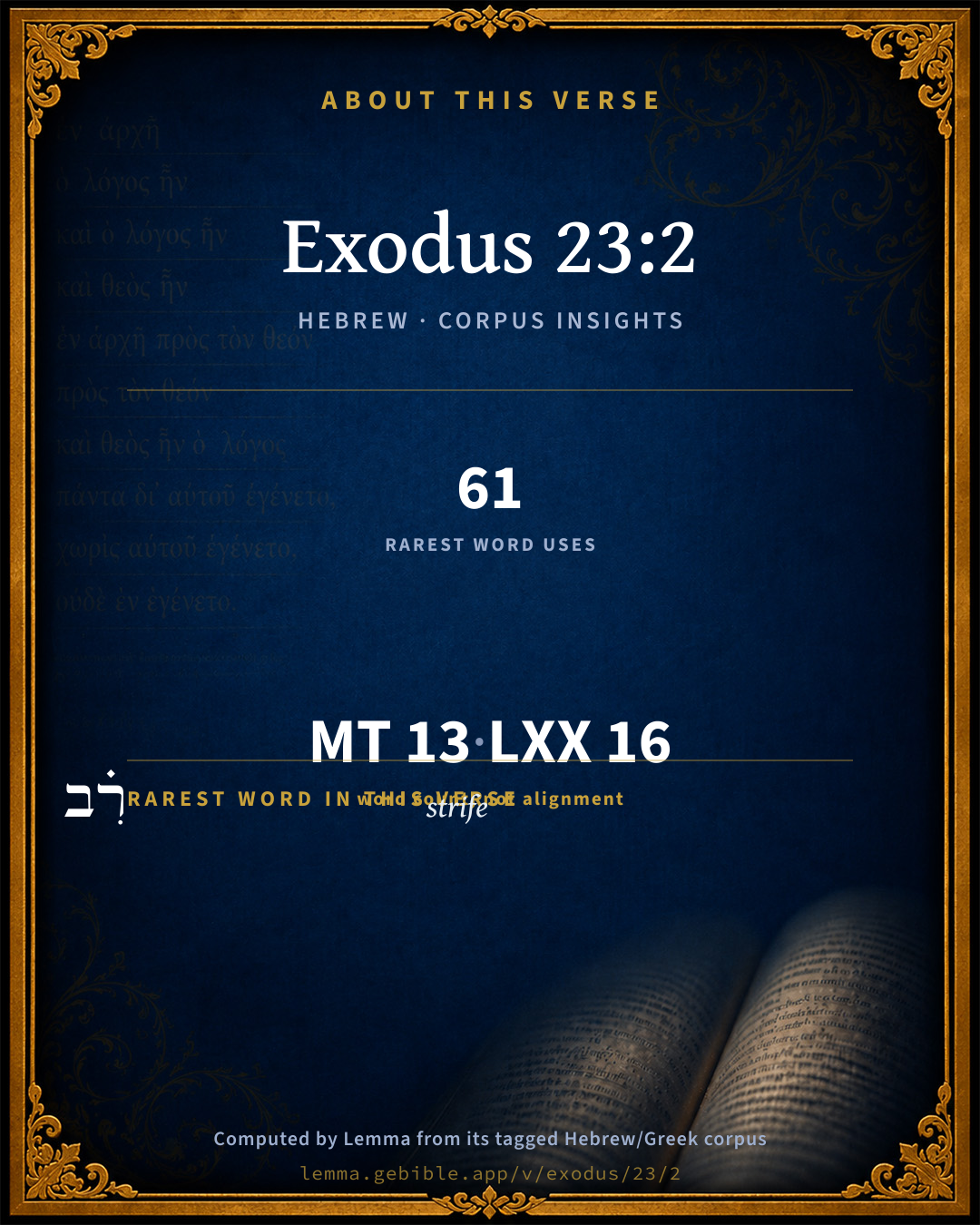
רִ֗ב
rîyb
H7379
“strife”
Noun, Common, Both, Singular, Absolute
Part of Speech
Noun
Type
Common
Gender
Both
Number
Singular
State
Absolute
Full BDB Definition

Origin: from H7378

TWOT: 2159a

strife, controversy, dispute - strife, quarrel - dispute, controversy, case at law
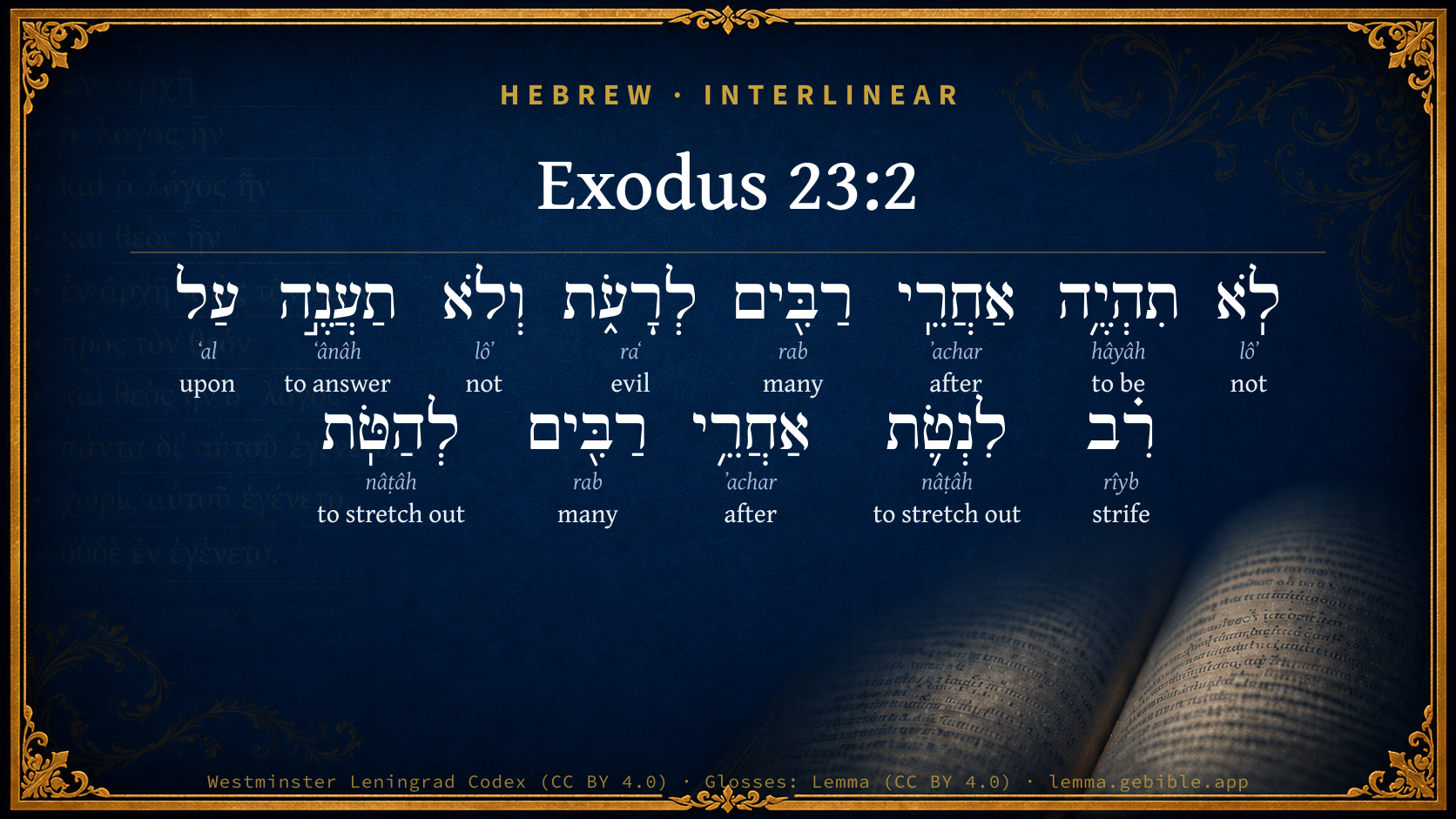
  1. לֹֽא lôʼ H3808 “not” Particle, Negative
  2. תִהְיֶ֥ה hâyâh H1961 “to be” Verb, Qal, Imperfect, 2nd Person, Masculine, Singular
  3. אַחֲרֵֽי ʼachar H310 “after” Preposition
  4. רַבִּ֖ים rab H7227 “many” Adjective, Adjective, Masculine, Plural, Absolute
  5. לְרָעֹ֑ת raʻ H7451 “to/for · evils” Preposition + Noun, Common, Feminine, Plural, Absolute
  6. וְלֹא lôʼ H3808 “and · not” Conjunction + Particle, Negative
  7. תַעֲנֶ֣ה ʻânâh H6030 “to answer” Verb, Qal, Imperfect, 2nd Person, Masculine, Singular
  8. עַל ʻal H5921 “upon” Preposition
  9. לִנְטֹ֛ת nâṭâh H5186 “to stretch out” Preposition + Verb, Qal, Infinitive Construct
  10. אַחֲרֵ֥י ʼachar H310 “after” Preposition
  11. רַבִּ֖ים rab H7227 “many” Adjective, Adjective, Masculine, Plural, Absolute
  12. לְהַטֹּֽת nâṭâh H5186 “to stretch out” Preposition + Verb, Hiphil, Infinitive Construct

About this verse

These counts appear in no published source. They are computed here, from the morphology-tagged text and Lemma’s own curated glosses. What Lemma adds →

13
words
9
distinct lemmas
Pentateuch
section

Grammatical profile

  • 4 verbs
  • 2 nouns
  • 2 adjectives
  • 3 prepositions
  • 2 particles

Verb forms

  • תִהְיֶ֥ה Qal · Imperfect
  • תַעֲנֶ֣ה Qal · Imperfect
  • לִנְטֹ֛ת Qal · Infinitive Construct
  • לְהַטֹּֽת Hiphil · Infinitive Construct

Repetition

Words recur within this verse — often emphatic in Hebrew:

  • אַחֲרֵֽי after H310 ×2
  • רַבִּ֖ים many H7227 ×2
  • לִנְטֹ֛ת to stretch out H5186 ×2
  • לֹֽא not H3808 ×2

Hebrew & Septuagint length

In English translation the verse runs 23 words from the Hebrew and 29 from the Septuagint (LXX English) — closely comparable.

A rough comparison of the two English renderings, which tokenize alike — not a word-level alignment.

Word counts can differ between the Hebrew and the Greek without any difference in meaning — e.g. the Hebrew direct-object marker אֵת has no separate Greek word, and Greek often adds the article ὁ.

In the original languages it is 13 Hebrew tokens and 16 Greek tokens — but the two are counted differently (Hebrew bundles its prefixes and suffixes into one token; the Greek is in lemma form), so that isn’t a like-for-like length.

Cross-references

34

Topical passages linked to Exodus 23:2 in the Treasury of Scripture Knowledge — connected by theme and wording, ordered by reader-vote popularity; previews shown in the World English Bible.

  • Proverbs 1:10–11 My son, if sinners entice you, don't consent.
  • Proverbs 1:15 My son, don't walk in the way with them. Keep your foot from their path,
  • Luke 23:23–24 But they were urgent with loud voices, asking that he might be crucified. Their voices and the voices of the chief priests prevailed.
  • Job 31:34 Because I feared the great multitude, And the contempt of families terrified me, So that I kept silence, and didn't go out of the door--
  • Matthew 27:24–26 So when Pilate saw that nothing was being gained, but rather that a disturbance was starting, he took water, and washed his hands before the multitude, saying, "I am innocent of the blood of this righteous person. You see to it."
  • Exodus 23:6–7 "You shall not deny justice to your poor people in their lawsuits.
  • Deuteronomy 1:17 You shall not show partiality in judgment; you shall hear the small and the great alike; you shall not be afraid of the face of man; for the judgment is God's: and the cause that is too hard for you, you shall bring to me, and I will hear it.
  • 1 Kings 19:10 He said, I have been very jealous for Yahweh, the God of hosts; for the children of Israel have forsaken your covenant, thrown down your altars, and slain your prophets with the sword: and I, even I only, am left; and they seek my life, to take it away.
  • Exodus 32:1–5 When the people saw that Moses delayed to come down from the mountain, the people gathered themselves together to Aaron, and said to him, "Come, make us gods, which shall go before us; for as for this Moses, the man who brought us up out of the land of Egypt, we don't know what has become of him."
  • Numbers 14:1–10 All the congregation lifted up their voice, and cried; and the people wept that night.
  • Joshua 24:15 If it seem evil to you to serve Yahweh, choose you this day whom you will serve; whether the gods which your fathers served that were beyond the River, or the gods of the Amorites, in whose land you dwell: but as for me and my house, we will serve Yahweh.
  • Proverbs 4:14 Don't enter into the path of the wicked. Don't walk in the way of evil men.
  • Mark 15:15 Pilate, wishing to please the multitude, released Barabbas to them, and handed over Jesus, when he had flogged him, to be crucified.
  • Luke 23:51 (he had not consented to their counsel and deed), from Arimathaea, a city of the Jews, who was also waiting for the Kingdom of God:
  • John 7:50–51 Nicodemus (he who came to him by night, being one of them) said to them,
  • Genesis 6:12 God saw the earth, and saw that it was corrupt, for all flesh had corrupted their way on the earth.
  • Genesis 19:4 But before they lay down, the men of the city, the men of Sodom, surrounded the house, both young and old, all the people from every quarter.
  • Genesis 19:7–9 He said, "Please, my brothers, don't act so wickedly.
  • Leviticus 19:15 "'You shall do no injustice in judgment: you shall not be partial to the poor, nor show favoritism to the great; but in righteousness shall you judge your neighbor.
  • Psalms 72:2 He will judge your people with righteousness, And your poor with justice.
  • Jeremiah 37:15 The princes were angry with Jeremiah, and struck him, and put him in prison in the house of Jonathan the scribe; for they had made that the prison.
  • Jeremiah 37:21 Then Zedekiah the king commanded, and they committed Jeremiah into the court of the guard; and they gave him daily a loaf of bread out of the bakers' street, until all the bread in the city was spent. Thus Jeremiah remained in the court of the guard.
  • Jeremiah 38:5–6 Zedekiah the king said, Behold, he is in your hand; for the king is not he who can do anything against you.
  • Jeremiah 38:9 My lord the king, these men have done evil in all that they have done to Jeremiah the prophet, whom they have cast into the dungeon; and he is likely to die in the place where he is, because of the famine; for there is no more bread in the city.
  • Acts 24:27 But when two years were fulfilled, Felix was succeeded by Porcius Festus, and desiring to gain favor with the Jews, Felix left Paul in bonds.
  • Acts 25:9 But Festus, desiring to gain favor with the Jews, answered Paul and said, "Are you willing to go up to Jerusalem, and be judged by me there concerning these things?"
  • Genesis 7:1 Yahweh said to Noah, "Come with all of your household into the ark, for I have seen your righteousness before me in this generation.
  • Deuteronomy 16:19 You shall not wrest justice: you shall not respect persons; neither shall you take a bribe; for a bribe does blind the eyes of the wise, and pervert the words of the righteous.
  • Deuteronomy 24:17 You shall not wrest the justice [due] to the foreigner, [or] to the fatherless, nor take the widow's clothing to pledge;
  • Ezekiel 9:9 Then said he to me, The iniquity of the house of Israel and Judah is exceeding great, and the land is full of blood, and the city full of wrestling [of judgment]: for they say, Yahweh has forsaken the land, and Yahweh doesn't see.
  • Romans 1:32 who, knowing the ordinance of God, that those who practice such things are worthy of death, not only do the same, but also approve of those who practice them.
  • Galatians 2:11–13 But when Peter came to Antioch, I resisted him to the face, because he stood condemned.
  • 1 Samuel 15:9 But Saul and the people spared Agag, and the best of the sheep, and of the oxen, and of the fatlings, and the lambs, and all that was good, and wouldn't utterly destroy them: but everything that was vile and refuse, that they destroyed utterly.
  • Haggai 1:4 "Is it a time for you yourselves to dwell in your paneled houses, while this house lies waste?

Cross-references courtesy of OpenBible.info (CC BY 4.0).

Hebrew and Greek witnesses Masoretic Hebrew ↔ Greek Septuagint

The same verse in the two great witnesses to the Old Testament, shown verse-for-verse.

These are two independent witnesses, not word-aligned to each other, and the Septuagint is shown in lemma (dictionary) form.

Hebrew Exodus 23:2 Masoretic · Westminster Leningrad Codex

לֹֽא תִהְיֶ֥ה אַחֲרֵֽי רַבִּ֖ים לְרָעֹ֑ת וְלֹא תַעֲנֶ֣ה עַל רִ֗ב לִנְטֹ֛ת אַחֲרֵ֥י רַבִּ֖ים לְהַטֹּֽת

You shall not follow a crowd to do evil; neither shall you testify in court to side with a multitude to pervert justice;

World English Bible · Public Domain

Greek LXX Exodus 23:2 Septuagint · lemma form

οὐ εἰμί μετά πολύς ἐπί κακία οὐ προςτίθημι μετά πλῆθος ἐκκλίνω μετά πολύς ὥστε ἐκκλίνω κρίσις

You shall not associate with the multitude for evil; you shall not join yourself with a multitude to turn aside with the majority so as to shut out judgment.

LXX2012 (modern English Septuagint) · Public Domain

Hebrew: Westminster Leningrad Codex (CC BY 4.0). Greek: Septuagint (public domain); English from LXX2012 (modern English Septuagint) (Public Domain). How the Septuagint differs from the Hebrew →

Targum (Aramaic paraphrase)

2

The Targum is the ancient Jewish Aramaic paraphrase of the Hebrew Scriptures — an interpretive translation, not the Hebrew text itself. Onkelos (literal) and Pseudo-Jonathan (expansive) render the Torah, and Jonathan the Prophets. Coverage is partial: where no permissively-licensed English translation exists for a verse, only the Aramaic is shown. This is verse-level text, not a word-by-word alignment to the Hebrew.

  1. Targum Onkelos Torah (Genesis–Deuteronomy)
    לָא תְהֵי בָּתַר סַגִיאִין לְאַבְאָשָׁא וְלָא תִתִּמְנַע מִלְאַלָפָא מָא דִבְעֵינָךְ עַל דִינָא בָּתַר סַגִיאֵי שְׁלַם דִינָא:

    (no public-domain English translation for this verse)

    Targum Onkelos — Aramaic: “Onkelos Genesis” (public domain); “Onkelos Exodus” (public domain); “Onkelos Leviticus” (public domain); “Onkelos Numbers” (public domain); “Onkelos Deuteronomy” (public domain). English: “Sefaria Community Translation” (CC0 1.0 (public-domain dedication)); “J.W. Etheridge. The Targums of Onkelos and Jonathan Ben Uzziel on the Pentateuch. London: Longmans, Green, 1862” (public domain). Text via Sefaria.

  2. Targum Pseudo-Jonathan Torah (Genesis–Deuteronomy)
    עַמִּי בְּנֵי יִשְרָאֵל לָא תֶהֱווֹן בָּתַר סַגִּיאִין לְמַבְאֲשָׁא אֱלָהֵן לִמְטַיְיבָא וְלָא יִתְמְנַע חַד מִנְכוֹן לְמַלְפָא זְכוּ עַל חַבְרֵיהּ בְּדִינָא לְמֵימַר הָא בָּתַר סַגִּיאֵי דִינָא סָטֵי

    Sons of Israel My people, you shall not go after the many to do evil, but to do good; and no one among you shall restrain himself from affirming justly concerning his neighbour in the judgment, by saying, Behold, the judgment sides with the many.

    Targum Pseudo-Jonathan — Aramaic: “Targum Jonathan on Genesis” (public domain); “Targum Jonathan on Exodus” (public domain); “Targum Jonathan on Leviticus” (public domain); “Targum Jonathan on Numbers” (public domain); “Targum Jonathan on Deuteronomy” (public domain). English: “The Targum of Jonathan ben Uzziel, trans. J. W. Etheridge, London, 1862” (public domain). Text via Sefaria.

Commentary

Notes on Exodus 23:2 from classic Christian and Jewish commentators (each source and its license shown beneath its notes). The classic Christian expositions comment on the surrounding passage and are grouped to its opening verse, so a note may address several verses; the Jewish commentaries on the Tanakh (Rashi and others) are per-verse, so they appear only where the commentator wrote on this verse.

Lemma curates 59 commentaries, every one of them public domain or Creative Commons licensed, each selected and text-cleaned for this edition rather than reprinted as found. About our sources →

Trapp's Complete Commentary

John Trapp

Exo 23:2 Thou shalt not follow a multitude to [do] evil; neither shalt thou speak in a cause to decline after many to wrest [judgment]:

Ver. 2. Thou shalt not follow a multitude.] The way to hell is broad and well beaten. Per viam publicam ne ingredere, was one of Pythagoras’s precepts. Do not as the most do, lest thou be undone for ever. Argumentum turpissimum est turba, saith Seneca. To live "according to the course of the world" is to be acted by the devil. {Eph 2:2}

John Trapp, A Commentary or Exposition upon All the Books of the Old and New Testament (1647–1656) — public domain. Text from a community e-Sword module.

The Biblical Illustrator

Joseph S. Exell

Exo_23:2

Thou shalt not fellow a multitude to do evil.

Following the multitude prohibited

I. Explain the nature of this precept.

1. It is here assumed that the multitude do evil. This may be inferred--

(1) From the review of past ages.

(2) From the cruel persecutions which have been raised against the righteous in various ages of the world.

(3) From the common conduct of mankind. Is not vice more general than virtue?

2. Secondly, the precept in the text supposes that we are in danger of copying the example of the multitude. We may infer this--

(1) From the innate tendencies we have to evil.

(2) From the prevalence of bad example.

3. From a variety of melancholy facts. The multitude who now do evil were not always such adepts in depravity; when they first entered into the broad way their feet were not swift to do evil; they proceeded with hesitating steps, but by practice became hardened in crime.

II. Urge reasons to induce us to observe it. The multitude doing evil should not be imitated, because they are--

1. Unlawful and unconstituted guides.

2. Bad guides.

3. Dishonourable guides.

4. Unprofitable guides.

5. Dangerous guides.

III. Impart advice for the direction of those who wish to escape the ensnaring wiles of the multitude.

1. Get your minds deeply and thoroughly impressed with the awfulness of your situation. Dangers unseen will be unavoided.

2. Seek the regenerating grace of God.

3. Be on your guard against the seductive wiles and insinuating influence of the multitude. Sinners will entice you; but come out from among them; have no communion with the unfruitful works of darkness (Psa_1:1).

4. Follow the happy few who strive to do good. Show that you are with Christ by being with His people. Oh, say, This people shall be my people, and their God my God. Inferences--

(1) That the measures of right and wrong are not to be determined by the majority. Good and evil are fixed immutable principles; and their natures are unchangeable, whether many or few follow them.

(2) What gratitude is due to God for the revelation of His will, which marks the boundaries of right and wrong; and for the gift of His Son to redeem us from this present evil world: to whom be glory for ever and ever. Amen. (Sketches of Sermons.)

Individual responsibility

There is, I suppose, no doctrine more clearly set forth in Scripture than the doctrine of personal responsibility. There is no doctrine more readily owned, no doctrine more insisted upon by men. Yet I think I can show you that, in its application to a great number of particular cases, you would not only act as though you disbelieved it, but you would unconsciously maintain in words doctrines directly opposed to it. The words which I have just read to you suggest one of the most universally employed modes of denying this universally received doctrine of individual responsibility. Thou shalt not follow a multitude to do evil, was said long ago by the Jewish law. I think you will find that the present condition of things, in whatever place or class we are thinking of, grew up from something very small, and that by degrees the sin acquired strength from the power and position, and then from the mere number of its perpetrators, until in time it acquired positive dignity and became correct, or according to the absurd modern phraseology, became good form, from the multitude of transgressors. I will begin with the sex which since the creation of the world has almost uniformly carried its point against the opposite sex, and which, nevertheless, is still facetiously called the weaker. They will, I believe, if you ask them, readily own themselves responsible for their use of time and of money. Well, they certainly spend an excessive amount of the latter, money, as I daresay their husbands know, in purchasing; and of the former, time, as everybody knows, in adjusting those ever-changing and most cumbrous absurdities which they pile upon themselves, and with which they surround themselves to the general inconvenience of everybody and everywhere. They do this until I should think they must feel uncomfortable, and I know that they look deformed. Why do they do it? Ask any one, and you will hear it all condemned at once, solemnly, perhaps piously condemned at once, the responsibility being shifted immediately from the individual to fashion, and that is to everybody. What does all that mean? Their conscience is relieved by the multitude whom they follow. Let us go a little further and take another view of the matter. Public bodies, I believe, parliaments, ministries, corporations, town commissioners, Poor Law guardians, boards of all kinds, and committees of all kinds, are known--every one of you knows it as well as I do--to be guilty of neglect of duties and violations of honour of which none of their members singly, in private transactions, would for one moment be capable. Take another set of instances. Look at the recognized dishonesties of different trades and businesses. The man who keeps light weights for selling, and heavy weights for buying, as I once knew a most pious man do; the man who adulterates food; the man who puts bad work or bad material where it is not to be detected; the servant who robs his master in the usual way; the workman who to no greater extent than others of his craft plunders his employer; none of these desire by any means, I fancy, to have their children taught at school that the Eighth Commandment has no meaning. They like to hear it every Sunday. Why? Because they have an unwritten tradition in the craft or trade, by which it is dispensed with. But I am going into more dangerous ground now. In the present day, the multitude has come to be considered something more than an excuser of deviations from strict principles in the ordinary affairs of life. It is beginning to assume the functions of the highest authority on religious matters. To call in question its decision, or refuse submission to its commands, no matter how uninstructed it may be, is coming to be viewed in the light of standing up against an inspired prophet. It does not occur to the thoughtless throng, who will rush anywhere to hear anybody, or to see anything, that when the multitude appears to have taken a pious turn it can be wrong to follow it whithersoever it leads. It does not seem to occur to them that when the multitude is longing to take Jesus by force and make Him a king, it may have just as little perception of His mission as when it clamorously demands His crucifixion. No, they are afraid to gainsay what the multitude asserts; they are afraid to do anything but echo its assertions, and thus each one among a multitude perpetuates the delusion of the others as to his real opinion, by being afraid to say it out, and act in conformity with it. This is the very spirit by which multitudes are created, by which they are enabled to assume formidable proportions, to become powerful for evil. The silence of cowardice is regarded as satisfactory consent, and everybodys echo of what everybody else says is vaunted as the concurrence of numerous independent testimonies. Persons of this kind are the genuine followers of the multitude who are condemned in the text. (J. C. Coghlan, D. D.)

The sin of following the multitude to do evil

I. It implies that the majority or great mass of mankind are uniformly and constantly engaged in doing evil.

II. The prohibition which we are considering implies that every person is naturally disposed to follow a multitude to do evil.

III. The prohibition in the text implies that those are altogether criminal who, follow the evil examples of evil-doers, though they are the great majority of mankind. For--

1. They are free and voluntary in following the examples of those who do evil.

2. Every person acts contrary to his reason and conscience in following a multitude to do evil, which renders him altogether criminal and inexcusable.

Conclusion:

1. If men are apt to follow bad examples, as has been said, then there is reason to think that bad examples are the great source of moral corruption in every part of the world.

2. If men are naturally disposed to follow the multitude to do evil, then the truly godly have much more concern in spreading moral corruption, and obstructing the cause of religion than they are apt to imagine.

3. Since men are naturally disposed to follow the bad examples of the multitude, it is easy to see why a people, declining in religion, are so apt to be insensible of their religious declensions. The minority are blended with the majority, and they are all imperceptibly declining together.

4. If all men are naturally disposed to follow the multitude to do evil, then the rising generation are always in a peculiarly dangerous situation.

5. If it be criminal to follow bad examples, it must be far more criminal to set bad examples.

6. If men are naturally disposed to follow the multitude to do evil, then every one in a state of nature has a great reason to fear that he shall live and die in his present unsanctified and impenitent state. Your belonging to the majority will not help you to turn about, but powerfully tend to hinder you. What will you say when He punishes you? (N. Emmons, D. D.)

Multirude no prevailing argument

The Lord that made us knoweth our mould and how easily we are persuaded to taste of the forbidden fruit, and how prone to be carried headlong to error, and therefore gives us a caveat, and sets a bar and stop in our way, that we run not to evil because we see others run or lead the way before us. And we shall do well by the way to take notice of our own corruption, as the Lord doth, that in the same we may see the necessity of this precept; for first, nature corrupt is as attractive of evil as the adamant naturally draws iron; just as a spark to tinder or gunpowder. Secondly, evil is diffusive of itself, and such an acquaintance there is between it and us, as the plague cannot so easily infect our bodies as sin doth poison and suddenly infect our souls. Thirdly, our nature is social, and not as the brutes; we readily thrust into company, and therefore being naturally enemies to solitariness, we are ready to follow if any one lead us the way; but if many or a multitude (as here) then we run, and for haste never stay to reason the case, neither in what way nor upon what errand. And, therefore, the Lord would have His people to fence themselves with a rule of prudence, that they be not misled by the crooked steps of others and their own perverse inclinations.

1. One reason is in the text: because a multitude may err and run to evil, and may decline to overthrow truth.

2. Multitudes cannot make that to be good which is evil in itself, neither in doctrine nor manners; well they may make an evil worse, but none better.

3. Multitudes cannot keep off the revenge of evil; one evil mate may help his fellow into sin, but cannot help him out of punishment,

4. Multitudes and most men are commonly the worst. The way to hell is broad and the gate wide that leads to destruction, and many go in thereat (Mat_7:13). Hell enlargeth itself (Isa_5:14). Tophet is large and wide (Exo_30:33). And therefore it cannot be the safest way which the most walk in. Contrarily, the fewest are commonly the best; pearls are rare; many hundred false prophets to one poor Micaiah; Gods part in the world was ever but a gleaning and a small remnant; and the apostle (1Jn_5:19) pronounceth in the name of believers, We know we are of God, and the whole world lieth in unrighteousness.

5. It is better to walk the right way alone than to wander out of the way with company; better go to heaven alone, or with a few, than with multitudes to hell.

Come we now to application of this point.

1. If it be so dangerous to follow a multitude to evil, what a fearful thing it is to lead a multitude to evil! as the magistrate that enacts and commands evil; like Jeroboam that made all Israel to sin. Or the minister that shall be weak as another man by whose example many are corrupted, through loose speeches, unseemly behaviours, libertine courses, fellowship with the abject, opposing the persons and strict courses of such as fear God.

2. See how desperately many men frame their courses while they live as if to do as the most do, were a good and warrantable plea. Because the most are irreligious, without the fear of God, and without conscience: so are they. The most scorn to attend Gods ordinance: so do they. Commit a felony, riot, robbery, or rebellion with a multitude, and try if in thy trial before the judge it will be a good plea to say, I was led, and followed the multitude. What then would you have us to do? In matters of faith build upon a surer foundation than upon numbers and multitudes, whom it was never safe to follow; nor was it ever a good argument either of the truth or true Church. In Christs time the multitude followed the Scribes and Pharisees, but not Christ nor His apostles; and all the multitude cried, Crucify Him. And how uncertain a rule this is the father tells us who observed, that in synods and councils the greater side doth oftentimes overcome the better; and another who saith, that in all Divine cases we must not number voices, but weigh them. What sure ground can be expected from the rude multitude, than which nothing is more fickle and uncertain? But we have a surer word, Being built upon the foundation of the apostles and prophets, Jesus Christ Himself being the chief corner-stone (Eph_2:20; 1Co_3:11). And we say as Hushai to Absolom (2Sa_16:18) Nay, but whom the Lord and this people, and all the men of Israel chose, his will I be, and with him will I abide. (T. Taylor, D. D.)

Thou shalt not follow a multitude to do evil

I. Imitation is one of the great characteristics of the human species. The same passion that impels us to society, impels us to take part with our companions in their interests and inclinations. Insensibly and without thought we fall into their customs and their manners; we adopt their sentiments, their passions, and even their foibles, and follow the same course as if we were actuated by the same spirit.

II. By what means we are to keep ourselves from following a multitude to do evil.

1. Let us be early and firmly established in the principles of an holy faith. It is education chiefly that forms the human character; and it is a virtuous and religious education that forms the character.

2. Let us beware with what company we associate.

3. Let us acquire firmness and fortitude of mind. (James Logan.)

The multitude an unsafe guide

It is said of the roes and hinds that they are most tender and fearful of all beasts, affrighted with any noise, checked with the least foil, turned out of course with the snapping of a stick, presently make head another way, and when they are once out of their wonted walk they run they know not whither, even to their own death. Such is the natural disposition of the multitude or common people, soon stirred up, quickly awry, sometimes running full head one way, on a sudden turned as much another, easily set agog, delighted with novelties. (J. Spencer.)

The multitude not to be followed

Said Horace Bushnell to his younger brother, who had been to a cheap show and came home crestfallen, The next time that you see the whole world doing something, be sure not to go with them unless you have some better reason. That was the germ of manly independence out of which the sturdy manhood of that remarkable thinker grew. The sooner a young man learns that there are in this world more silly people than wise, more weak than strong, the better his chances of being a man.

Custom not the standard of right

Know that the Lord has set apart him that is godly for Himself. Therefore it is no excuse for him to say, I do but as others do. He is to reckon his hours by the sun, not the town clock; to take Gods direction, not the vice of the multitudes, as one of their stamp and at liberty to comply with their fashions. (T. Mantan, D. D.)

The Biblical Illustrator, edited by Joseph S. Exell (c. 1880s–1900s) — public domain. Text from a community e-Sword module.

Joseph Benson's Commentary

Exo 23:2. Thou shalt not follow a multitude — Either their counsel or their example; to do evil — General usage will never excuse us in any ill practice; nor is the broad way ever the safer for its being crowded. We must inquire what we ought to do, not what the most do; because we must be judged by our Master, not our fellow-servants; and it is too great a compliment to be willing to go to hell for company. Neither shalt thou speak in a cause — Either to extenuate or excuse a great fault, aggravate a small one, vindicate an offender, charge guilt on an innocent person, put false glosses, or sinister interpretations upon things, or do any thing tending to procure an unjust sentence; to decline after many — Either the friends of the party, the judges, the witnesses, or the opinions of the vulgar. The word רבים, rabbim, in this verse rendered multitude and many, signifying also great men, some prefer the following translation of the verse, Thou shalt not follow great men to do evil — neither shalt thou speak (Hebrew, answer) in a cause to decline after great men. This is a very important sense of the words: because the example of great men, of men of power, wealth, and authority, has great influence.

Joseph Benson's Commentary on the Old and New Testaments (1811–1818) — public domain. Text from a community e-Sword module.

Geneva Bible (1599)

Geneva Bible translators

Hebrew, answer.

Do that which is godly, though few do favor it.

Geneva Bible (1599) marginal notes — public domain. Text via Bolls.life.

Jamieson, Fausset & Brown

Robert Jamieson, A. R. Fausset & David Brown

decline--depart, deviate from the straight path of rectitude.

Jamieson, Fausset & Brown — Commentary Critical and Explanatory on the Whole Bible (1871) — public domain (CC PDM 1.0). Text via the HelloAO Bible API.

Adam Clarke's Commentary

Verse 2. Thou shalt not follow a multitude to do evil] Be singular. Singularity, if in the right, can never be criminal. So completely disgraceful is the way of sin, that if there were not a multitude walking in that way, who help to keep each other in countenance, every solitary sinner would be obliged to hide his head. But רבים rabbim, which we translate multitude, sometimes signifies the great, chiefs, or mighty ones; and is so understood by some eminent critics in this place: "Thou shalt not follow the example of the great or rich, who may so far disgrace their own character as to live without God in the world, and trample under foot his laws." It is supposed that these directions refer principally to matters which come under the eye of the civil magistrate; as if he had said, "Do not join with great men in condemning an innocent or righteous person, against whom they have conceived a prejudice on the account of his religion," &c.

Adam Clarke's Commentary on the Bible (1810–1826) — public domain. Text from a community e-Sword/MySword module.

Ellicott's Commentary for English Readers

(2) Thou shalt not follow a multitude to do evil . . . —It is perhaps true that the offence especially condemned is joining with a majority in an unrighteous judgment; but the words of the precept extend much further than this, and forbid our being carried away by numbers or popularity in any case. Vox populi vox Dei is a favourite maxim with many, but Scripture nowhere sanctions it. Job boasts that he did not fear a great multitude (Job_31:34). David says that the “ten thousands of the people set themselves against him round about” (Psa_3:6). The prophets had always the multitude against them. “Strait is the gate, and narrow is the way,” said our blessed Lord, “which leadeth unto life, and few there be that find it.” But ‘wide is the gate, and broad is the way, that leadeth to destruction, and many there be which go in thereat” Mat_7:13-14). We must be prepared to face unpopularity if we would walk in accordance with the Law of God.

A Bible Commentary for English Readers, edited by Charles John Ellicott (1878–1897) — public domain. Text from a community e-Sword module.

The Cambridge Bible for Schools and Colleges

gen. ed. J. J. S. Perowne

2. Not to follow a majority blindly for evil purposes, or, in particular to pervert justice.

to do evil] lit. into evil things.

speak] answer (in a court of law), i.e. bear witness (RVm.), as Exo_20:16. The Heb. ‘ânâh never means simply to ‘speak.’

to turn aside after] Jdg_9:3 Heb., 1Sa_8:3, 1Ki_2:28 Heb.

to wrest] or, as the same word is rendered in v. 6 and elsewhere, to pervert (lit. to turn aside): see Deu_16:19; Deu_24:17; Deu_27:19, 1Sa_8:3, Lam_3:35. (To ‘turn aside’ a man from his right is also said (sometimes with ‘from his right’ omitted): Isa_10:2; Isa_29:21, Amo_5:12, Pro_18:5, Mal_3:5). The text of this verse is in parts suspicious: but no doubt the same general sense was always expressed by it.

The Cambridge Bible for Schools and Colleges (gen. ed. J. J. S. Perowne; Cambridge University Press, 1878–1918) — public domain. Text from a community e-Sword module.

John Gill's Exposition

Thou shalt not follow a multitude to do evil,.... The Targums of Jerusalem and Jonathan add, but to do good. As in private life, the examples of the many, who are generally the most wicked, are not to be followed, though they too often are; examples, and especially of the multitude, having great influence, and therefore to be guarded against; so in public courts of judicature, where there are many judges upon the bench, if one of them is sensible that the greater part go wrong in their judgment of a case, he ought not to follow them, or be influenced by them, but go according to the dictates of his own conscience, and the evidence of things as they appear to him, and neither agree to justify the wicked, nor condemn the righteous:

neither shall thou speak in a cause to decline after many to wrest judgment; or "thou shalt not answer" (r); either in pleading in a cause, and taking the side of it the majority is on, and for that reason, though it is a manifest perversion of justice; or by giving a vote on that side, and on that account, whereby a wrong judgment passes; and this vote given either according to the number of witnesses, which ought not always to be the rule of judgment; for it is not the number of witnesses, but the nature, evidence, and circumstances of their testimony, that are to be regarded: Jarchi says, in judgments of life and death, they go after the mouth of one witness to absolve, and after the mouth of two to condemn: or according to the number of judges on the bench, and their superiority in years and knowledge; and so some render the word, "after the great ones" (s); for a judge is not to be influenced by names or numbers in giving his vote, but to judge according to the truth of things, as they appear to him: hence the Jews say, that the younger or puisne judges used to be asked their judgment first, that they might not be influenced by others superior to them; and a like method is taken with us in the trial of a peer, the younger lords always giving their opinion first: as to the number of votes by which a cause was carried in court, it is said (t), not as the decline to good, is the decline to evil; the decline to good, i.e. to absolution, is by the sentence of one (a majority of one); the decline to evil, i.e. to condemnation, is by the mouth or sentence of two, a majority of two.

(r) "neque respondeas", Tigurine version; "non respondebis", Pagninus, Montanus, Vatablus, Drusius. (s) "post potentiores", Junius & Tremellius; "post magnos", Lyra, Cartwright. (t) Misn. Sanhedrin, c. 1. sect. 6.

John Gill's Exposition of the Whole Bible (1746–1763) — public domain (CC PDM 1.0). Text via the HelloAO Bible API.

Matthew Poole's English Annotations

Thou shalt not follow a multitude, either their counsel or example. But the Hebrew rabbin both here and in the following clause is by some rendered great men, men in power and authority, whom we are commanded not to follow. And as the word is thus used Job 32:9; Jer 41:1, so this sense may seem most probable,

1. Because in the last clause he speaks of causes or controversies, as the Hebrew rib signifies; and matters of judgment, which were not determined by the multitude, but by great men.

2. Because these are opposed to the poor in the next verse.

3. Because the examples of such men are most prevalent.

To do evil, either in general or particular, to work mischief, to oppress or crush another.

Neither shalt thou speak, Heb. answer, when thou art summoned as a witness in any cause.

To wrest judgment, or to turn aside right, or to pervert

thyself the verb being taken reciprocally, as hiphil is oft put for hithpahel; or, which is all one, to do perverserly, i.e. unrighteously.

Matthew Poole's English Annotations on the Holy Bible (1683–1685) — public domain. Text from a community e-Sword/MySword module.

Whedon's Commentary on the Bible

Daniel D. Whedon

2. Speak in a cause — Literally, answer in a controversy (suit at law) to turn away after many, to pervert. This law, like that of the preceding and the following verse is mainly directed against giving false testimony in judicial proceedings, and so perverting justice and truth.

Daniel D. Whedon (gen. ed.), Commentary on the Old and New Testaments (1874–1909) — public domain. Text from a community e-Sword module.

The Pulpit Commentary

Thou shalt not follow a multitude to do evil. Rather, "Thou shalt not follow a multitude to evil." A law alike for deed, for word, and for thought. The example of the many is to be shunned. "Wide is the gate and broad is the way that leadeth to destruction, and many there be which go in thereat." But "strait is the gate and narrow is the way, which leadeth unto life; and few there be that find it". (Mat_7:13, Mat_7:14) It is extraordinary that so many, even of professing Christians, are content to go with the many, notwithstanding the warnings against so doing, both of the law and of the Gospel. Neither shalt thou speak, etc. Rather, "Neither shalt thou bear witness in a cause to go aside after a multitude to put aside justice." The general precept is followed by a particular application of it. In judging a cause, if thou art one of the judges, thou shalt not simply go with the majority, if it he bent on injustice, but form thine own opinion and adhere to it.

The Pulpit Commentary (1880–1919), ed. H.D.M. Spence-Jones & Joseph S. Exell — public domain. Text from a community e-Sword module.

John Wesley's Explanatory Notes

Thou shalt not follow a multitude to do evil - General usage will never excuse us in any ill practice; nor is the broad way ever the safer for its being crowded. We must inquire what we ought to do, not what the most do; because we must be judged by our master, not our fellow servants; and it is too great a compliment, to be willing to go to hell for company.

John Wesley, Explanatory Notes Upon the Whole Bible (1754–1765) — public domain. Text via the GEBible commentary corpus.

Rashi

Rabbi Shlomo Yitzchaki (Rashi)

לא תהיה אחרי רבים לרעת THOU SHALT NOT FOLLOW THE MANY FOR EVIL — There are Halachic interpretations of this verse given by the Sages of Israel but the wording of the text does not fit in well with them. They derive from here that we must not decide a person’s guilt by a preponderance of one judge. And the end of the verse they explained thus: אחרי רבים להטות — but if the judges who declare the defendant guilty are two more than those who declare him innocent, then decide the matter as they declare — that he is guilty (Sanhedrin 2a). — The verse, they point out, speaks of capital cases. — The middle passage לא תענה על רב, they explained as though it were written על רַב, “thou shalt not speak against the chief of the judges, meaning that one should not give an opinion different from that given by the מופלא of the court (the most eminent among the judges, because this is disrespectful to the Presiding-judge). In consequence of this rule we begin to take the view of those in the side-benches first — we ask the youngest judges to express their opinion first (so that they may not be able to vote against the view expressed by the מופלא). Therefore the exegesis of the verse according to the words of our Rabbis is as follows: “thou shalt not follow a bare majority for evil” — to sentence a man to death on account of the one judge by whom those who condemn him are more in number than those who acquit him; “and thou shalt not speak against the chief inclining away” from his opinion. — They explained this latter phrase thus, because the word which is usually written רִיב is here written without and therefore may be read, אחרי רבים להטות —;רַב, there is, however, a majority to whose view thou must incline. When is this the case? When there are two who preponderate amongst those who vote for condemnation over and above those who vote for acquittal. For from what is implied in, “thou shalt not follow a bare majority for evil”, I may infer: but thou shall follow it for good. Hence they (the Rabbis) said (i. e. they established the general rule): In capital cases we may decide by a majority of one for acquittal, but only by a majority of at least two to condemn. Onkelos translates the second phrase by: Do not refrain from teaching when you are being asked your opinion in a legal matter. The Hebrew text is to be explained according to the Targum as follows: לא תענה על רב לנטת If you are being asked your opinion in a legal matter do not give your answer just to incline to one particular side and so to withdraw yourself from the dispute, but decide the matter as truth requires. Such are the expositions that have been offered of this verse.

But I think that if one wishes to explain the verse so that every thing should fit in properly, its exegesis must be as follows: לא תהיה אחרי רבים לרעת, If you see wicked men wresting judgment do not say: since they are many I will incline after them;

ולא תענה על רב לנטת וגו׳, and if the defendant asks you about that judgment do not give him as a reply concerning the dispute any statement which will incline after that majority, thereby wresting judgment from the truth, but pronounce the decision just as it should be and let the collar hang around the neck of the majority (i. e. if you be outvoted let them bear the responsibility).

Rashi on the Tanakh — English translations: “The Judaica Press complete Tanach with Rashi, translated by A. J. Rosenberg” (CC BY 4.0); “Pentateuch with Rashi's commentary by M. Rosenbaum and A.M. Silbermann, 1929-1934” (public domain); “The Metsudah Tanach series, Lakewood, N.J” (CC BY 4.0); and “The Book of Joshua, Metsudah Publications, 1997” (CC BY 4.0). Text via Sefaria.

Lesson kit

Teaching starters — assembled from the data on this page, not authored interpretation. Every prompt links to the verse data it draws on. Edit before teaching.

Exodus, in the Pentateuch, opens this verse with 13 words (9 distinct Hebrew lemmas). Its most distinctive word is rîyb (“strife”). A historical commentator’s framing appears above. Read the whole chapter for the surrounding context.

Discussion questions

  1. How does “strife” (rîyb) shape what this verse is saying?
  2. How does Proverbs 1:10–11, which shares this passage’s theme, read alongside this verse?
  3. What does the repetition of “after” (2× in this one verse) do in this verse?
  4. These translations render this verse differently. What is at stake in choosing one wording over another?
  5. «תִהְיֶ֥ה» is a Qal Imperfect verb. How does that grammatical form shape the action described?
  6. Compare how Trapp's Complete Commentary and The Biblical Illustrator read this verse. Where do they agree or differ?

Things to notice

Reading settings

Reading text

Shown beneath each verse's original-language words.

Old Testament
Old Testament edition

Read the OT as the Masoretic Hebrew (MT) or the Greek Septuagint (LXX).

English shown for the Greek Septuagint (in the Hebrew ↔ Greek comparison).

Comparing translations? Open the Compare panel on any verse page to stack up to four side by side.