
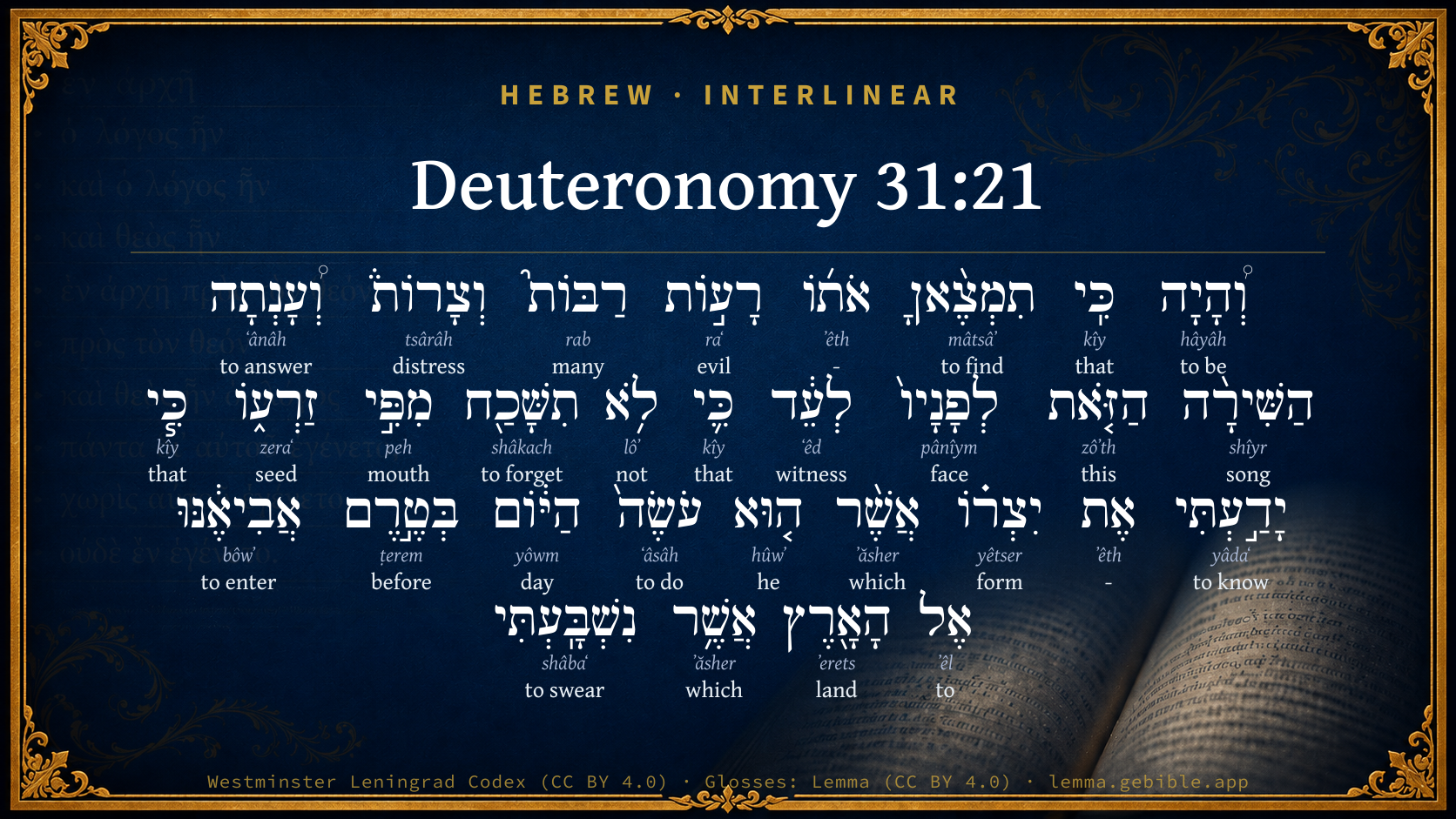
Deuteronomy 31:21

Hebrew (Westminster Leningrad Codex) Deuteronomy 31:21 appears in the Hebrew Old Testament. The text above is from the Westminster Leningrad Codex. Each word links to its Strong’s number, a concise gloss, and parsing drawn from the Open Scriptures Hebrew Bible morphology. Click any word for its full Brown-Driver-Briggs (BDB) entry.
Download image
Cite this verse

Deuteronomy 31:21 (World English Bible). Public Domain. Lemma interlinear Bible study tool, https://lemma.gebible.app/v/deuteronomy/31/21.

Show BibTeX & RIS
BibTeX
RIS
English Translation
It shall happen, when many evils and troubles are come on them, that this song shall testify before them as a witness; for it shall not be forgotten out of the mouths of their seed: for I know their imagination which they frame this day, before I have brought them into the land which I swore.
World English Bible · Public Domain
Download a study sheet

One document with this verse’s original text, its word-by-word gloss line, the meaning frame, cross-references with their text, attributed commentary, and full source and license credits — printable, and it pastes into notes with its structure intact.

This verse Autodidact and up

Study sheet (.html) Plain text (.txt)

A passage Seminary Student

Up to 50 verses in one chapter. A passage sheet keeps up to 6 commentary sources and 12 cross-references per verse, in the order this page ranks them, and says so on the sheet whenever that leaves anything out. Ask for a single verse and you get the Autodidact verse sheet above.

Everything on this page stays free to read, with no account — the sheet is a download of what is already on screen, not access to it.

Want to remove ads? Support Godless Engineer
Compare translations 3

The same verse in 3 English versions, stacked beneath the original-language interlinear above. Click any original word for its lexicon entry.

Each is an independent rendering of the whole verse — the interlinear is not word-aligned to these translations.

Highlighted words mark where these versions differ — a whole-verse word diff, not a word-by-word alignment.

  • World English Bible Public Domain
    It shall happen, when many evils and troubles are come on them, that this song shall testify before them as a witness; for it shall not be forgotten out of the mouths of their seed: for I know their imagination which they frame this day, before I have brought them into the land which I swore.
  • King James Version Public Domain
    And it shall come to pass, when many evils and troubles are befallen them, that this song shall testify against them as a witness; for it shall not be forgotten out of the mouths of their seed: for I know their imagination which they go about, even now, before I have brought them into the land which I sware.
  • unfoldingWord Literal Text CC BY-SA 4.0
    And it will be, when many evils and troubles find him, then this song will testify to his face as a witness (for it will not be forgotten from the mouths of his seed). For I know the intent that he is making today, before I have brought him into the land that I promised.”

unfoldingWord Literal Text — © unfoldingWord, licensed CC BY-SA 4.0. Word-aligned USFM3 via Door43 (git.door43.org/unfoldingWord/en_ult).

Versions to compare (up to 4)

3 of 4 selected

Show all 18 translations

Every available English version of this verse, each an independent rendering of the whole verse.

  • World English Bible Public Domain
    It shall happen, when many evils and troubles are come on them, that this song shall testify before them as a witness; for it shall not be forgotten out of the mouths of their seed: for I know their imagination which they frame this day, before I have brought them into the land which I swore.
  • Berean Standard Bible Public Domain
    And when many troubles and afflictions have come upon them, this song will testify against them, because it will not be forgotten from the lips of their descendants. For I know their inclination, even before I bring them into the land that I swore to give them.”
  • Majority Standard Bible Public Domain
    And when many troubles and afflictions have come upon them, this song will testify against them, because it will not be forgotten from the lips of their descendants. For I know their inclination, even before I bring them into the land that I swore to give them.”
  • King James Version Public Domain
    And it shall come to pass, when many evils and troubles are befallen them, that this song shall testify against them as a witness; for it shall not be forgotten out of the mouths of their seed: for I know their imagination which they go about, even now, before I have brought them into the land which I sware.
  • American Standard Version (1901) Public Domain
    And it shall come to pass, when many evils and troubles are come upon them, that this song shall testify before them as a witness; for it shall not be forgotten out of the mouths of their seed: for I know their imagination which they frame this day, before I have brought them into the land which I sware.
  • Revised Version (1885) Public Domain
    And it shall come to pass, when many evils and troubles are come upon them, that this song shall testify before them as a witness; for it shall not be forgotten out of the mouths of their seed: for I know their imagination which they go about, even now, before I have brought them into the land which I sware.
  • Geneva Bible (1599) Public Domain
    And then when many aduersities and tribulations shall come vpon them, this song shall answere them to their face as a witnesse: for it shall not be forgotte out of the mouthes of their posteritie: for I knowe their imagination, which they goe about euen now, before I haue brought them into the lande which I sware.
  • Douay-Rheims (1899) Public Domain
    And after many evils and afflictions shall have come upon them, this canticle shall answer them for a testimony, which no oblivion shall take away out of the mouth of their seed. For I know their thoughts, and what they are about to de this day, before that I bring them into the land which I have promised them.
  • Young's Literal Translation Public Domain
    `And it hath been, when many evils and distresses do meet it, that this song hath testified to its face for a witness; for it is not forgotten out of the mouth of its seed, for I have known its imagining which it is doing to-day, before I bring them in unto the land of which I have sworn.'
  • Literal Standard Version CC BY-SA 4.0
    then it has been, when many evils and distresses meet it, that this song has testified to its face for a witness; for it is not forgotten out of the mouth of its seed, for I have known its imagining which it is doing today, before I bring them into the land of which I have sworn.”
  • Unlocked Literal Bible CC BY-SA 4.0
    When many evils and troubles come upon this people, this song will testify before them as a witness (for it will not be forgotten from the mouths of their descendants). For I know the plans that they are forming today, even before I have brought them into the land that I promised them.”
  • unfoldingWord Literal Text CC BY-SA 4.0
    And it will be, when many evils and troubles find him, then this song will testify to his face as a witness (for it will not be forgotten from the mouths of his seed). For I know the intent that he is making today, before I have brought him into the land that I promised.”
  • Darby Bible Public Domain
    And it shall come to pass, when many evils and troubles have befallen them, that this song shall testify against them as a witness; for it shall not be forgotten out of the mouths of their seed; for I know their imagination which they are forming already this day, before I bring them into the land which I have sworn [unto them].
  • World Messianic Bible Public Domain
    It will happen, when many evils and troubles have come on them, that this song will testify before them as a witness; for it will not be forgotten out of the mouths of their descendants; for I know their ways and what they are doing today, before I have brought them into the land which I promised them.”
  • Webster's Bible Public Domain
    And it shall come to pass, when many evils and troubles have befallen them, that this song shall testify against them as a witness: for it shall not be forgotten out of the mouths of their seed: for I know their imagination which they form, even now, before I have brought them into the land which I swore.
  • Free Bible Version CC BY-SA 4.0
    Once they've experienced plenty of trouble and suffering, this song will testify against them, because their descendants won't forget the words. I know what they're like, even before I lead them into the country that I promised to give them.”
  • Bible in Basic English Public Domain
    Then when evils and troubles without number have overtaken them, this song will be a witness to them, for the words of it will be clear in the memories of their children: for I see the thoughts which are moving in their hearts even now, before I have taken them into the land of my oath.
  • JPS Tanakh (1917) Public Domain
    then it shall come to pass, when many evils and troubles are come upon them, that this song shall testify before them as a witness; for it shall not be forgotten out of the mouths of their seed; for I know their imagination how they do even now, before I have brought them into the land which I swore.'

Literal Standard Version (2020), Covenant Press — licensed CC BY-SA 4.0. Text via the HelloAO Bible API (eBible.org). Unlocked Literal Bible (unfoldingWord) — licensed CC BY-SA 4.0. Text via the HelloAO Bible API (eBible.org). unfoldingWord Literal Text — © unfoldingWord, licensed CC BY-SA 4.0. Word-aligned USFM3 via Door43 (git.door43.org/unfoldingWord/en_ult). Free Bible Version, Dr. Jonathan Gallagher — licensed CC BY-SA 4.0. Text via the HelloAO Bible API (eBible.org).

Word by word

More ways to search: Search by grammar → Find every occurrence → Compare this word →

Practice this passage: Drill this verse → Learn its vocabulary →

יִצְר֗וֹ
yêtser
H3336
“form · his”
Noun, Common, Masculine, Singular, Construct + Suffix, Personal, 3rd Person, Masculine, Singular
Part of Speech
Noun
Type
Common
Gender
Masculine
Number
Singular
State
Construct
Full BDB Definition

Origin: from H3335

TWOT: 898a

form, framing, purpose, framework - form - pottery - graven image - man (as formed from the dust) - purpose, imagination, device (intellectual framework)
  1. וְ֠הָיָה hâyâh H1961 “and · to be” Conjunction + Verb, Qal, Sequential Perfect, 3rd Person, Masculine, Singular
  2. כִּֽי kîy H3588 “that” Conjunction
  3. תִמְצֶ֨אןָ mâtsâʼ H4672 “to find” Verb, Qal, Imperfect, 3rd Person, Feminine, Plural
  4. אֹת֜וֹ ʼêth H853 “- · him” Particle, Direct Object + Suffix, Personal, 3rd Person, Masculine, Singular
  5. רָע֣וֹת raʻ H7451 “evils” Noun, Common, Feminine, Plural, Absolute
  6. רַבּוֹת֮ rab H7227 “many” Adjective, Adjective, Feminine, Plural, Absolute
  7. וְצָרוֹת֒ tsârâh H6869 “and · distresses” Conjunction + Noun, Common, Feminine, Plural, Absolute
  8. וְ֠עָנְתָה ʻânâh H6030 “and · to answer” Conjunction + Verb, Qal, Sequential Perfect, 3rd Person, Feminine, Singular
  9. הַשִּׁירָ֨ה shîyr H7892 “the · song” Particle, Definite Article + Noun, Common, Both, Singular, Absolute
  10. הַזֹּ֤את zôʼth H2063 “the · this” Particle, Definite Article + Pronoun, Demonstrative, Feminine, Singular
  11. לְפָנָיו֙ pânîym H6440 “to/for · face(s) · his” Preposition + Noun, Common, Both, Plural, Construct + Suffix, Personal, 3rd Person, Masculine, Singular
  12. לְעֵ֔ד ʻêd H5707 “to/for · witness” Preposition + Noun, Common, Masculine, Singular, Absolute
  13. כִּ֛י kîy H3588 “that” Conjunction
  14. לֹ֥א lôʼ H3808 “not” Particle, Negative
  15. תִשָּׁכַ֖ח shâkach H7911 “to forget” Verb, Niphal, Imperfect, 3rd Person, Feminine, Singular
  16. מִפִּ֣י peh H6310 “from · mouth of” Preposition + Noun, Common, Masculine, Singular, Construct
  17. זַרְע֑וֹ zeraʻ H2233 “seed · his” Noun, Common, Masculine, Singular, Construct + Suffix, Personal, 3rd Person, Masculine, Singular
  18. כִּ֧י kîy H3588 “that” Conjunction
  19. יָדַ֣עְתִּי yâdaʻ H3045 “to know” Verb, Qal, Perfect, 1st Person, Common, Singular
  20. אֶת ʼêth H853 “-” Particle, Direct Object
  21. אֲשֶׁ֨ר ʼăsher H834 “which” Particle, Relative
  22. ה֤וּא hûwʼ H1931 “he” Pronoun, Personal, 3rd Person, Masculine, Singular
  23. עֹשֶׂה֙ ʻâsâh H6213 “doing” Verb, Qal, Participle Active, Masculine, Singular, Absolute
  24. הַיּ֔וֹם yôwm H3117 “the · day” Particle, Definite Article + Noun, Common, Masculine, Singular, Absolute
  25. בְּטֶ֣רֶם ṭerem H2962 “in/at · before” Preposition + Adverb
  26. אֲבִיאֶ֔נּוּ bôwʼ H935 “to enter · him” Verb, Hiphil, Imperfect, 1st Person, Common, Singular + Suffix, Personal, 3rd Person, Masculine, Singular
  27. אֶל ʼêl H413 “to” Preposition
  28. הָאָ֖רֶץ ʼerets H776 “the · land” Particle, Definite Article + Noun, Common, Both, Singular, Absolute
  29. אֲשֶׁ֥ר ʼăsher H834 “which” Particle, Relative
  30. נִשְׁבָּֽעְתִּי shâbaʻ H7650 “to swear” Verb, Niphal, Perfect, 1st Person, Common, Singular

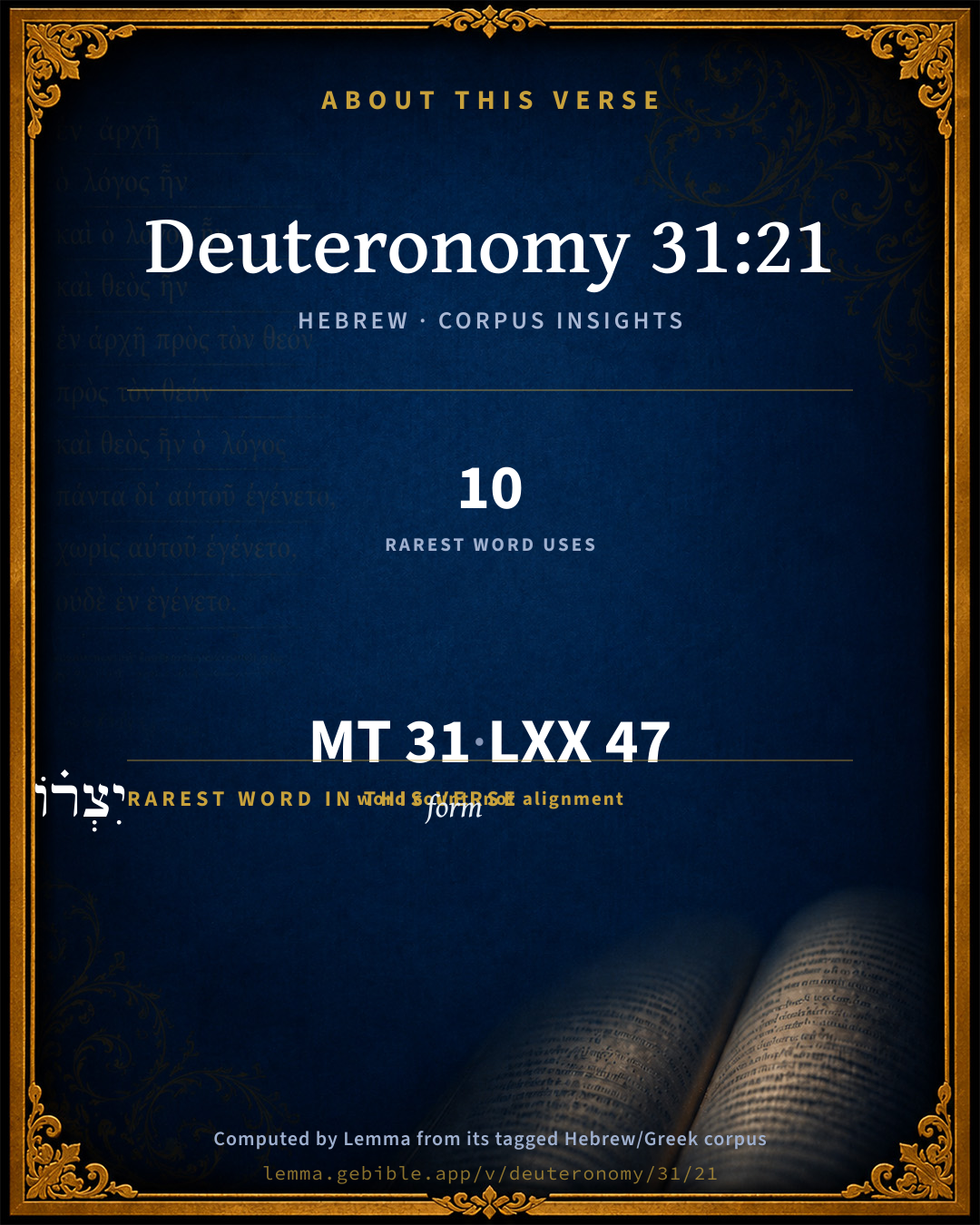
About this verse

These counts appear in no published source. They are computed here, from the morphology-tagged text and Lemma’s own curated glosses. What Lemma adds →

31
words
27
distinct lemmas
Pentateuch
section

Notable vocabulary

The rarest word here is יִצְר֗וֹ form H3336 — appearing just 10 times in the whole Hebrew Bible.

Shared distinctive vocabulary

יִצְר֗וֹ form H3336 occurs in 9 verses of the Hebrew Bible. Also found in:

Grammatical profile

  • 8 verbs
  • 10 nouns
  • 1 adjective
  • 2 pronouns
  • 1 preposition
  • 3 conjunctions
  • 1 adverb
  • 5 particles

Verb forms

  • וְ֠הָיָה Qal · Sequential Perfect
  • תִמְצֶ֨אןָ Qal · Imperfect
  • וְ֠עָנְתָה Qal · Sequential Perfect
  • תִשָּׁכַ֖ח Niphal · Imperfect
  • יָדַ֣עְתִּי Qal · Perfect
  • עֹשֶׂה֙ Qal · Participle Active
  • אֲבִיאֶ֔נּוּ Hiphil · Imperfect
  • נִשְׁבָּֽעְתִּי Niphal · Perfect

Repetition

Words recur within this verse — often emphatic in Hebrew:

  • כִּֽי that H3588 ×3
  • אֲשֶׁ֨ר which H834 ×2

Hebrew & Septuagint length

In English translation the verse runs 56 words from the Hebrew and 55 from the Septuagint (LXX English) — closely comparable.

A rough comparison of the two English renderings, which tokenize alike — not a word-level alignment.

Word counts can differ between the Hebrew and the Greek without any difference in meaning — e.g. the Hebrew direct-object marker אֵת has no separate Greek word, and Greek often adds the article ὁ.

In the original languages it is 31 Hebrew tokens and 47 Greek tokens — but the two are counted differently (Hebrew bundles its prefixes and suffixes into one token; the Greek is in lemma form), so that isn’t a like-for-like length.

Cross-references

11

Topical passages linked to Deuteronomy 31:21 in the Treasury of Scripture Knowledge — connected by theme and wording, ordered by reader-vote popularity; previews shown in the World English Bible.

  • Hosea 5:3 I know Ephraim, And Israel is not hidden from me; For now, Ephraim, you have played the prostitute. Israel is defiled.
  • Genesis 6:5 Yahweh saw that the wickedness of man was great in the earth, and that every imagination of the thoughts of his heart was only evil continually.
  • Psalms 139:2 You know my sitting down and my rising up. You perceive my thoughts from afar.
  • John 2:24–25 But Jesus didn't trust himself to them, because he knew everyone,
  • Genesis 8:21 Yahweh smelled the sweet savor. Yahweh said in his heart, "I will not again curse the ground any more for man's sake, because the imagination of man's heart is evil from his youth; neither will I ever again strike everything living, as I have done.
  • Isaiah 46:10 declaring the end from the beginning, and from ancient times things that are not [yet] done; saying, My counsel shall stand, and I will do all my pleasure;
  • Ezekiel 38:10–11 Thus says the Lord Yahweh: It shall happen in that day, that things shall come into your mind, and you shall devise an evil device:
  • Hosea 13:5–6 I knew you in the wilderness, In the land of great drought.
  • Amos 5:25–26 "Did you bring to me sacrifices and offerings in the wilderness forty years, house of Israel?
  • Acts 2:23 him, being delivered up by the determined counsel and foreknowledge of God, you have taken by the hand of lawless men, crucified and killed;
  • Acts 4:28 to do whatever your hand and your council foreordained to happen.

Cross-references courtesy of OpenBible.info (CC BY 4.0).

Hebrew and Greek witnesses Masoretic Hebrew ↔ Greek Septuagint

The same verse in the two great witnesses to the Old Testament, shown verse-for-verse.

These are two independent witnesses, not word-aligned to each other, and the Septuagint is shown in lemma (dictionary) form.

Hebrew Deuteronomy 31:21 Masoretic · Westminster Leningrad Codex

וְ֠הָיָה כִּֽי תִמְצֶ֨אןָ אֹת֜וֹ רָע֣וֹת רַבּוֹת֮ וְצָרוֹת֒ וְ֠עָנְתָה הַשִּׁירָ֨ה הַזֹּ֤את לְפָנָיו֙ לְעֵ֔ד כִּ֛י לֹ֥א תִשָּׁכַ֖ח מִפִּ֣י זַרְע֑וֹ כִּ֧י יָדַ֣עְתִּי אֶת יִצְר֗וֹ אֲשֶׁ֨ר ה֤וּא עֹשֶׂה֙ הַיּ֔וֹם בְּטֶ֣רֶם אֲבִיאֶ֔נּוּ אֶל הָאָ֖רֶץ אֲשֶׁ֥ר נִשְׁבָּֽעְתִּי

It shall happen, when many evils and troubles are come on them, that this song shall testify before them as a witness; for it shall not be forgotten out of the mouths of their seed: for I know their imagination which they frame this day, before I have brought them into the land which I swore.

World English Bible · Public Domain

Greek LXX Deuteronomy 31:21 Septuagint · lemma form

καί ἀντι καταἵστημι ὁ ᾠδή οὗτος κατά πρόσωπον μαρτυρέω οὐ γάρ μή ἐπιλανθάνω ἀπό στόμα αὐτός καί ἀπό στόμα ὁ σπέρμα αὐτός ἐγώ γάρ οἶδα ὁ πονηρία αὐτός ὅσος ποιέω ὧδε σήμερον πρό ὁ εἰςἄγω ἐγώ αὐτός εἰς ὁ γῆ ὁ ἀγαθός ὅς ὄμνυμι ὁ πατήρ αὐτός

And this song shall stand up to witness against them; for they shall not forget it out of their mouth, or out of the mouth of their seed; for I know their wickedness, what they are doing here this day, before I have brought them into the good land, which I swore to their fathers.

LXX2012 (modern English Septuagint) · Public Domain

On this verse, Haydock's Catholic Bible Commentary discusses the Septuagint’s reading. Read the note in Commentary ↓

Hebrew: Westminster Leningrad Codex (CC BY 4.0). Greek: Septuagint (public domain); English from LXX2012 (modern English Septuagint) (Public Domain). How the Septuagint differs from the Hebrew →

Targum (Aramaic paraphrase)

2

The Targum is the ancient Jewish Aramaic paraphrase of the Hebrew Scriptures — an interpretive translation, not the Hebrew text itself. Onkelos (literal) and Pseudo-Jonathan (expansive) render the Torah, and Jonathan the Prophets. Coverage is partial: where no permissively-licensed English translation exists for a verse, only the Aramaic is shown. This is verse-level text, not a word-by-word alignment to the Hebrew.

  1. Targum Onkelos Torah (Genesis–Deuteronomy)
    וִיהֵי אֲרֵי יְעָרְעָן יָתֵהּ בִּישָׁן סַגִיאָן וְעָקָן וְתָתֵב תֻּשְׁבַּחְתָּא הָדָא קֳדָמוֹהִי לְסָהִיד אֲרֵי לָא תִתְנְשֵׁי מִפּוּם בֵּנֵיהוֹן ארֵי גִלֵי קֳדָמַי יָת יִצְרְהוֹן דִי אִנוּן עָבְדִין יוֹמָא דֵין עַד לָא אָעֵלִנוּן לְאַרְעָא דִי קַיֵמִית

    (no public-domain English translation for this verse)

    Targum Onkelos — Aramaic: “Onkelos Genesis” (public domain); “Onkelos Exodus” (public domain); “Onkelos Leviticus” (public domain); “Onkelos Numbers” (public domain); “Onkelos Deuteronomy” (public domain). English: “Sefaria Community Translation” (CC0 1.0 (public-domain dedication)); “J.W. Etheridge. The Targums of Onkelos and Jonathan Ben Uzziel on the Pentateuch. London: Longmans, Green, 1862” (public domain). Text via Sefaria.

  2. Targum Pseudo-Jonathan Torah (Genesis–Deuteronomy)
    וִיהֵי אֲרוּם יְעַרְעָן יַתְהוֹן בִּישַׁן סַגִיאָן וְעָקָן וְתַסְהִיד תּוּשְׁבַּחְתָּא הֲדָא קֳדָמֵיהוֹן לְסַהֲדוּ אֲרוּם גְלֵי קֳדָמַי דְלָא תִתְנְשֵׁי מִפּוּם בְּנֵיהוֹן אֲרוּם גְלֵי קֳדָמַי יַת יִצְרֵהוֹן בִּישָׁא דְאִינוּן עַבְדִין יוֹמָנָא עַד לָא אַעֲלֵיכוֹן לְאַרְעָא דְקַיֵימִית

    And when these many evils and troubles shall come upon them, then will this hymn bear witness to them for a testimony; for it is revealed before Me that it will not be forgotten on the lips of their children: for their evil disposition to which they are yielding today, even before I bring you into the promised land, is known to Me.

    Targum Pseudo-Jonathan — Aramaic: “Targum Jonathan on Genesis” (public domain); “Targum Jonathan on Exodus” (public domain); “Targum Jonathan on Leviticus” (public domain); “Targum Jonathan on Numbers” (public domain); “Targum Jonathan on Deuteronomy” (public domain). English: “The Targum of Jonathan ben Uzziel, trans. J. W. Etheridge, London, 1862” (public domain). Text via Sefaria.

Commentary

Notes on Deuteronomy 31:21 from classic Christian and Jewish commentators (each source and its license shown beneath its notes). The classic Christian expositions comment on the surrounding passage and are grouped to its opening verse, so a note may address several verses; the Jewish commentaries on the Tanakh (Rashi and others) are per-verse, so they appear only where the commentator wrote on this verse.

Lemma curates 59 commentaries, every one of them public domain or Creative Commons licensed, each selected and text-cleaned for this edition rather than reprinted as found. About our sources →

Trapp's Complete Commentary

John Trapp

Deu 31:21 And it shall come to pass, when many evils and troubles are befallen them, that this song shall testify against them as a witness; for it shall not be forgotten out of the mouths of their seed: for I know their imagination which they go about, even now, before I have brought them into the land which I sware.

Ver. 21. For I know their imagination.] As a man that knows what roots he hath in his garden; though there be not a flower appears, yet he can say, when the spring comes, this and this will come up, because he knows the garden, and knows what roots are there: so the Lord knows our thoughts afar off, because he knows the principles that are within, and knows what they will do when occasion serves; he is privy to that root that beareth gall and wormwood. {Deu 29:18}

John Trapp, A Commentary or Exposition upon All the Books of the Old and New Testament (1647–1656) — public domain. Text from a community e-Sword module.

Joseph Benson's Commentary

Deu 31:21. This song shall testify against them as a witness — That they were sufficiently admonished of their duty, and forewarned what would be the consequence of their defection from me and my worship, (Deu 32:18-19,) and be a clear evidence that the calamities which befall them are judgments sent from me for the punishment of their transgressions. How ought this to be remarked with wonder! For, to this very day, above three thousand years after, this song is a strong proof and demonstration, both to Jews and Christians, that Moses did indeed speak by the commandment of God. I know their imagination — Inclination to idolatry, which they do not check as they ought: and some of them do not only cherish it in their hearts, but, as far as they can and dare, secretly practise it, as may be gathered from Amo 5:25; Act 7:43.

Joseph Benson's Commentary on the Old and New Testaments (1811–1818) — public domain. Text from a community e-Sword module.

Geneva Bible (1599)

Geneva Bible translators

That these evils are come upon them, because they forsook me.

Geneva Bible (1599) marginal notes — public domain. Text via Bolls.life.

Adam Clarke's Commentary

Verse 21. This song shall testify against them] Because in it their general defection is predicted, but in such a way as to show them how to avoid the evil; and if they did not avoid the evil, and the threatened punishment should come upon them, then the song should testify against them, by showing that they had been sufficiently warned, and might have lived to God, and so escaped those disasters.

Adam Clarke's Commentary on the Bible (1810–1826) — public domain. Text from a community e-Sword/MySword module.

Ellicott's Commentary for English Readers

(21) This song . . . shall not be forgotten out of the mouths of their seed.—And it is not forgotten now. St. Paul made special use of it in the last days of the second Temple. This song is a favourite piece of Hebrew poetry to this day. Rashi observes: “This is a promise to Israel that the law shall not be utterly forgotten by their seed.”

I know their imagination.—Heb., yêtzer, the same word employed in Gen_6:5; Gen_8:21. It is the word commonly used in Rabbinical literature for the evil nature or good nature in any man. The nature which they are forming, or making, this day, would be a literal rendering of the sentence in this verse. And yet with all this, He made Balaam say, “He hath not beheld iniquity in Jacob nor seen perverseness in Israel” (Num_23:21). Comp. 1Ch_28:9, “The Lord . . . understandeth all the imaginations of the thoughts,” and Psa_103:14, “He knoweth our frame (yêtzer); He remembereth that we are dust.”

A Bible Commentary for English Readers, edited by Charles John Ellicott (1878–1897) — public domain. Text from a community e-Sword module.

The Cambridge Bible for Schools and Colleges

gen. ed. J. J. S. Perowne

21. many evils … are come upon it] Cp. Deu_31:17; this song shall testify to its face, the same vb. as in Deu_19:18; as a witness, Deu_31:19; its seed; its imagination, yéṣer, lit. moulding. This term and its synonyms are applied in the O.T. to evil imaginations in rebellion against God (e.g. Gen_6:5; Gen_8:21, Psa_10:2; Psa_140:2, Pro_6:18, Lam_3:60 f.) except in two passages (1Ch_28:9; 1Ch_29:18), where they are used indifferently, and in Isa_26:3 where the yéṣer or imagination is described as stayed on God.

before I bring it into the land, etc.] See Deu_31:20.

The Cambridge Bible for Schools and Colleges (gen. ed. J. J. S. Perowne; Cambridge University Press, 1878–1918) — public domain. Text from a community e-Sword module.

John Gill's Exposition

Moses therefore wrote this song the same day,.... The same day it was dictated to him by divine inspiration; he wrote it, as Josephus says (d),"in hexameter verse, which he left in the holy Bible or book (the Pentateuch), containing (as he adds) a prophecy of things future, according to which all things have been done, and are done; and in nothing of it has he erred from the truth;''which is a very just account of it, and worthy of observation:

and taught it the children of Israel; instructed them in the meaning of it, directed them to repeat it frequently, to lay it up in their memories, and often meditate upon it; as being a divine composition, and of great importance, as the consideration of it will make appear.

(d) Antiqu. l. 4. c. 8. sect. 44.

John Gill's Exposition of the Whole Bible (1746–1763) — public domain (CC PDM 1.0). Text via the HelloAO Bible API.

Haydock's Catholic Bible Commentary

Thoughts. Hebrew, "imagination." Septuagint, "wickedness." --- Them. Hebrew, "concerning which I swore." Septuagint add, "to their fathers." (Haydock)

George Leo Haydock (1774–1849), Haydock's Catholic Family Bible and Commentary, 1859 edition — public domain. Excludes Psalms (Douay-Rheims chapter numbering differs from Protestant) and Deuterocanonical books (Catholic canon only).

Matthew Poole's English Annotations

It shall not be forgotten: this seems not to be a precept that they should remember it, but a prediction, that God would give them sad occasion to remember it, by bringing upon them the dreadful calamities mentioned in it.

Their imagination which they go about, even now; either their inward inclinations to idolatry, which they do not check, as they ought, but rather entertain with delight; and some of them do not only cherish it in their hearts, but as far as they can and dare secretly practise it, as may be gathered from Amo 5:26; Act 7:43; or their secret purposes to allow themselves therein, when they are settled in their land, which were clearly known to God, though it may be not fully evident to themselves.

Matthew Poole's English Annotations on the Holy Bible (1683–1685) — public domain. Text from a community e-Sword/MySword module.

Whedon's Commentary on the Bible

Daniel D. Whedon

21. This song shall testify against them as a witness — This ode, passing down from father to son, from generation to generation, would rebuke the apostasy of the nation. How in the midst of prevailing idolatry and gross corruption these divine words would be like the utterances of the prophets of the old and the apostles of the new dispensation! Every time the ode was repeated it would reprove and rebuke. In the days of apostate kings, if the song were repeated, how startling the words, “They sacrificed unto devils, not unto God!”

Daniel D. Whedon (gen. ed.), Commentary on the Old and New Testaments (1874–1909) — public domain. Text from a community e-Sword module.

John Wesley's Explanatory Notes

Their imaginations - Inclinations to Idolatry, which they do not check, as they ought; and some of them do not only cherish it in their hearts, but as far as they can and dare, secretly practice it, as may be gathered from Amos v, 25 Acts vii, 43.

John Wesley, Explanatory Notes Upon the Whole Bible (1754–1765) — public domain. Text via the GEBible commentary corpus.

unfoldingWord translationNotes

Door43 World Missions Community

When many evils and troubles come upon this people

Here evils and troubles are described as if they were human and could find people. AT: "When this people experiences many evils and troubles" (See: Personification)

this song will testify before them as a witness

This speaks of the song as if it were a human witness testifying in court against Israel. (See: Personification)

it will not be forgotten from the mouths of their descendants

This can be stated in active form. AT: "their descendants will not forget to keep it in their mouths" (See: Active or Passive)

it will not be forgotten from the mouths of their descendants

This can be stated positively. AT: "their descendants will remember to keep it in their mouths" (See: Active or Passive)

it will not be forgotten from the mouths of their descendants

The idiom "forget it from the mouth" means to stop speaking about it. AT: "their descendants will not stop speaking about it to each other" (See: Active or Passive)

the plans that they are forming

What people plan to do is spoken of as if it were a physical object. AT: "what they plan to do" (See: Metaphor)

the land that I promised

God's promise of the land was to give it to the people of Israel. This can be stated clearly. AT: "the land that I promised I would give to them" (See: Assumed Knowledge and Implicit Information)

translationWords

evil

trouble

people group

testimony

testimony

descend

oath

unfoldingWord translationNotes — © Distant Shores Media and the Door43 World Missions Community, licensed CC BY-SA 4.0. Source: git.door43.org/Door43/en_tn.

Rashi

Rabbi Shlomo Yitzchaki (Rashi)

וענתה השירה הזאת לפניו לעד [AND IT SHALL COME TO PASS …] THAT THIS SONG SHALL TESTIFY that in it I had warned them concerning all the things that had befallen them.

כי לא תשכח מפי זרעו FOR IT SHALL NOT BE FORGOTTEN OUT OF THE MOUTHS OF THEIR SEED — This is an assurance to Israel that the Torah in which this song is contained will never be entirely forgotten by their descendants (Shabbat 138b).

Rashi on the Tanakh — English translations: “The Judaica Press complete Tanach with Rashi, translated by A. J. Rosenberg” (CC BY 4.0); “Pentateuch with Rashi's commentary by M. Rosenbaum and A.M. Silbermann, 1929-1934” (public domain); “The Metsudah Tanach series, Lakewood, N.J” (CC BY 4.0); and “The Book of Joshua, Metsudah Publications, 1997” (CC BY 4.0). Text via Sefaria.

Ramban (Nachmanides)

Rabbi Moshe ben Nachman (Ramban / Nachmanides)

FOR I KNOW THEIR INCLINATION WHICH THEY HAVE SHOWN THIS DAY. The meaning thereof is like the expression, for now I know that thou art a G-d-fearing man, which is knowledge become actualized, for knowledge of the future is knowledge in potential., (Vol. I, p. 279). Now, if Israel had not sinned in the wilderness and the recognition of his temperament had not been actualized, it would have been inappropriate for him to testify against them in the Song, saying that it is known to Him that you will sin and therefore I call [heaven and earth] to witness that many evils and troubles like such and such will come upon you. Instead it would have been proper that He give them the Torah with unspecified foreknowledge: If ye be willing and obedient, ye shall eat the good of the Land; but if ye refuse and rebel, ye shall be devoured with the sword. But now, that their bad temperament and their straying heart had become known to them as well, He told them all that would occur to them. This is similar to what is said, Because I knew that thou art obstinate, and thy neck is an iron sinew etc., therefore I have declared to thee from of old; before it came to pass I announced it to thee.

Ramban (Nachmanides) on the Tanakh — English translation: “Commentary on the Torah by Ramban (Nachmanides). Translated and annotated by Charles B. Chavel. New York, Shilo Pub. House, 1971-1976” (CC BY 4.0). Text via Sefaria.

Sforno

Rabbi Ovadia Sforno

For I know their impulse. They do not wish to enter the Land of Israel in order to serve me, which is My intent, as the verse states, “That they may keep His statutes” (Tehillim 105:45). However, they want to enter to fulfil their desires, and this will lead to all the evil that will surely come, as the verse states, “Yeshurun grew fat and rebelled” (Devarim 32:15).

Sforno on the Tanakh — English translation: “Yalkut, Sifsei Chachomim Chumash, Metsudah Publications, 2009” (CC BY 4.0). Text via Sefaria.

Lesson kit

Teaching starters — assembled from the data on this page, not authored interpretation. Every prompt links to the verse data it draws on. Edit before teaching.

Deuteronomy, in the Pentateuch, opens this verse with 31 words (27 distinct Hebrew lemmas). Its most distinctive word is yêtser (“form”). A historical commentator’s framing appears above. Read the whole chapter for the surrounding context.

Discussion questions

  1. What does “form” (yêtser) contribute to the verse as a whole?
  2. Genesis 6:5 shares the word «form» with this verse. How do the two illuminate each other?
  3. “that” occurs 3× in this one verse. What is the effect of the repetition?
  4. These translations render this verse differently; the difference is in the English rendering, not the original. What questions does that raise?
  5. The verb «וְ֠הָיָה» is Qal Sequential Perfect. How does its form color the action?
  6. Reading how Trapp's Complete Commentary and Joseph Benson's Commentary read this verse, where do the two commentators agree and where do they part?

Things to notice

Reading settings

Reading text

Shown beneath each verse's original-language words.

Old Testament
Old Testament edition

Read the OT as the Masoretic Hebrew (MT) or the Greek Septuagint (LXX).

English shown for the Greek Septuagint (in the Hebrew ↔ Greek comparison).

Comparing translations? Open the Compare panel on any verse page to stack up to four side by side.