Numbers 22:3

Hebrew (Westminster Leningrad Codex) Numbers 22:3 appears in the Hebrew Old Testament. The text above is from the Westminster Leningrad Codex. Each word links to its Strong’s number, a concise gloss, and parsing drawn from the Open Scriptures Hebrew Bible morphology. Click any word for its full Brown-Driver-Briggs (BDB) entry.
Download image
Cite this verse

Numbers 22:3 (World English Bible). Public Domain. Lemma interlinear Bible study tool, https://lemma.gebible.app/v/numbers/22/3.

Show BibTeX & RIS
BibTeX
RIS
English Translation
Moab was sore afraid of the people, because they were many: and Moab was distressed because of the children of Israel.
World English Bible · Public Domain
Download a study sheet

One document with this verse’s original text, its word-by-word gloss line, the meaning frame, cross-references with their text, attributed commentary, and full source and license credits — printable, and it pastes into notes with its structure intact.

This verse Autodidact and up

Study sheet (.html) Plain text (.txt)

A passage Seminary Student

Up to 50 verses in one chapter. A passage sheet keeps up to 6 commentary sources and 12 cross-references per verse, in the order this page ranks them, and says so on the sheet whenever that leaves anything out. Ask for a single verse and you get the Autodidact verse sheet above.

Everything on this page stays free to read, with no account — the sheet is a download of what is already on screen, not access to it.

Want to remove ads? Support Godless Engineer
Compare translations 3

The same verse in 3 English versions, stacked beneath the original-language interlinear above. Click any original word for its lexicon entry.

Each is an independent rendering of the whole verse — the interlinear is not word-aligned to these translations.

Highlighted words mark where these versions differ — a whole-verse word diff, not a word-by-word alignment.

  • World English Bible Public Domain
    Moab was sore afraid of the people, because they were many: and Moab was distressed because of the children of Israel.
  • King James Version Public Domain
    And Moab was sore afraid of the people, because they were many: and Moab was distressed because of the children of Israel.
  • unfoldingWord Literal Text CC BY-SA 4.0
    And Moab was very terrified from the face of the people, because they numerous. And Moab felt a sickening dread from the face of the sons of Israel.

unfoldingWord Literal Text — © unfoldingWord, licensed CC BY-SA 4.0. Word-aligned USFM3 via Door43 (git.door43.org/unfoldingWord/en_ult).

Versions to compare (up to 4)

3 of 4 selected

Show all 18 translations

Every available English version of this verse, each an independent rendering of the whole verse.

  • World English Bible Public Domain
    Moab was sore afraid of the people, because they were many: and Moab was distressed because of the children of Israel.
  • Berean Standard Bible Public Domain
    and Moab was terrified of the people because they were numerous. Indeed, Moab dreaded the Israelites.
  • Majority Standard Bible Public Domain
    and Moab was terrified of the people because they were numerous. Indeed, Moab dreaded the Israelites.
  • King James Version Public Domain
    And Moab was sore afraid of the people, because they were many: and Moab was distressed because of the children of Israel.
  • American Standard Version (1901) Public Domain
    And Moab was sore afraid of the people, because they were many: and Moab was distressed because of the children of Israel.
  • Revised Version (1885) Public Domain
    And Moab was sore afraid of the people, because they were many: and Moab was distressed because of the children of Israel.
  • Geneva Bible (1599) Public Domain
    And the Moabites were sore afraide of the people, because they were many, and Moab fretted against the children of Israel.
  • Douay-Rheims (1899) Public Domain
    And that the Moabites were in great fear of him, and were not able to sustain his assault,
  • Young's Literal Translation Public Domain
    and Moab is exceedingly afraid of the presence of the people, for it `is' numerous; and Moab is vexed by the presence of the sons of Israel,
  • Literal Standard Version CC BY-SA 4.0
    and Moab is exceedingly afraid of the presence of the people, for it [is] numerous; and Moab is distressed by the presence of the sons of Israel,
  • Unlocked Literal Bible CC BY-SA 4.0
    Moab was very afraid of the people because they were many, and Moab was in terror of the people of Israel.
  • unfoldingWord Literal Text CC BY-SA 4.0
    And Moab was very terrified from the face of the people, because they numerous. And Moab felt a sickening dread from the face of the sons of Israel.
  • Darby Bible Public Domain
    And Moab was much afraid of the people, because they were many; and Moab was distressed because of the children of Israel.
  • World Messianic Bible Public Domain
    Moab was very afraid of the people, because they were many. Moab was distressed because of the children of Israel.
  • Webster's Bible Public Domain
    And Moab was greatly afraid of the people, because they were many: and Moab was distressed because of the children of Israel.
  • Free Bible Version CC BY-SA 4.0
    The Moabites were terrified of the Israelites because there were so many of them. The Moabites dreaded the arrival of the Israelites
  • Bible in Basic English Public Domain
    And in Moab there was great fear of the people, because their numbers were so great: and the feeling of Moab was bitter against the children of Israel.
  • JPS Tanakh (1917) Public Domain
    And Moab was sore afraid of the people, because they were many; and Moab was overcome with dread because of the children of Israel.

Literal Standard Version (2020), Covenant Press — licensed CC BY-SA 4.0. Text via the HelloAO Bible API (eBible.org). Unlocked Literal Bible (unfoldingWord) — licensed CC BY-SA 4.0. Text via the HelloAO Bible API (eBible.org). unfoldingWord Literal Text — © unfoldingWord, licensed CC BY-SA 4.0. Word-aligned USFM3 via Door43 (git.door43.org/unfoldingWord/en_ult). Free Bible Version, Dr. Jonathan Gallagher — licensed CC BY-SA 4.0. Text via the HelloAO Bible API (eBible.org).

Word by word

More ways to search: Search by grammar → Find every occurrence → Compare this word →

Practice this passage: Drill this verse → Learn its vocabulary →

וַיָּ֣קָץ
qûwts
H6973
“and · to abhor”
Conjunction + Verb, Qal, Sequential Imperfect, 3rd Person, Masculine, Singular
Part of Speech
Conjunction + Verb
Stem
Qal
Form
Sequential Imperfect
Person
3rd Person
Gender
Masculine
Number
Singular
Full BDB Definition

Origin: a primitive root [identical with H6972 through the idea of severing oneself from (compare H6962 )]

TWOT: 2002

to be grieved, loathe, abhor, feel a loathing or abhorrence or sickening dread - (Qal) - to feel a loathing at, abhor - to feel a sickening dread - (Hiphil) - to cause sickening dread - to cause loathing
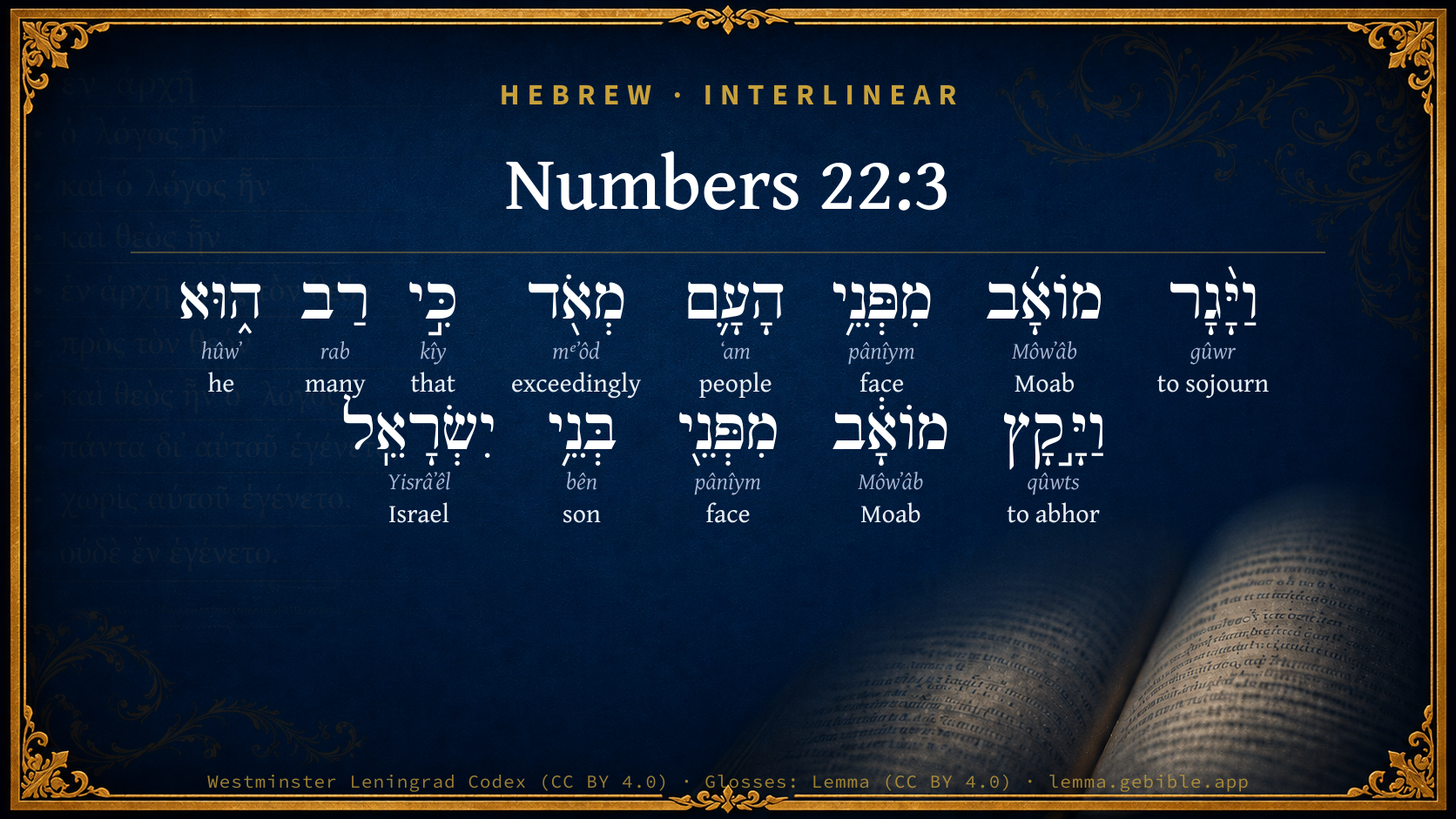
  1. וַיָּ֨גָר gûwr H1481 “and · to sojourn” Conjunction + Verb, Qal, Sequential Imperfect, 3rd Person, Masculine, Singular
  2. מוֹאָ֜ב Môwʼâb H4124 “Moab” Noun, Proper
  3. מִפְּנֵ֥י pânîym H6440 “from · face(s) of” Preposition + Noun, Common, Both, Plural, Construct
  4. הָעָ֛ם ʻam H5971 “the · people” Particle, Definite Article + Noun, Common, Masculine, Singular, Absolute
  5. מְאֹ֖ד mᵉʼôd H3966 “exceedingly” Adverb
  6. כִּ֣י kîy H3588 “that” Conjunction
  7. רַב rab H7227 “many” Adjective, Adjective, Masculine, Singular, Absolute
  8. ה֑וּא hûwʼ H1931 “he” Pronoun, Personal, 3rd Person, Masculine, Singular
  9. מוֹאָ֔ב Môwʼâb H4124 “Moab” Noun, Proper
  10. מִפְּנֵ֖י pânîym H6440 “from · face(s) of” Preposition + Noun, Common, Both, Plural, Construct
  11. בְּנֵ֥י bên H1121 “sons of” Noun, Common, Masculine, Plural, Construct
  12. יִשְׂרָאֵֽל Yisrâʼêl H3478 “Israel” Noun, Proper

About this verse

These counts appear in no published source. They are computed here, from the morphology-tagged text and Lemma’s own curated glosses. What Lemma adds →

13
words
11
distinct lemmas
Pentateuch
section

Notable vocabulary

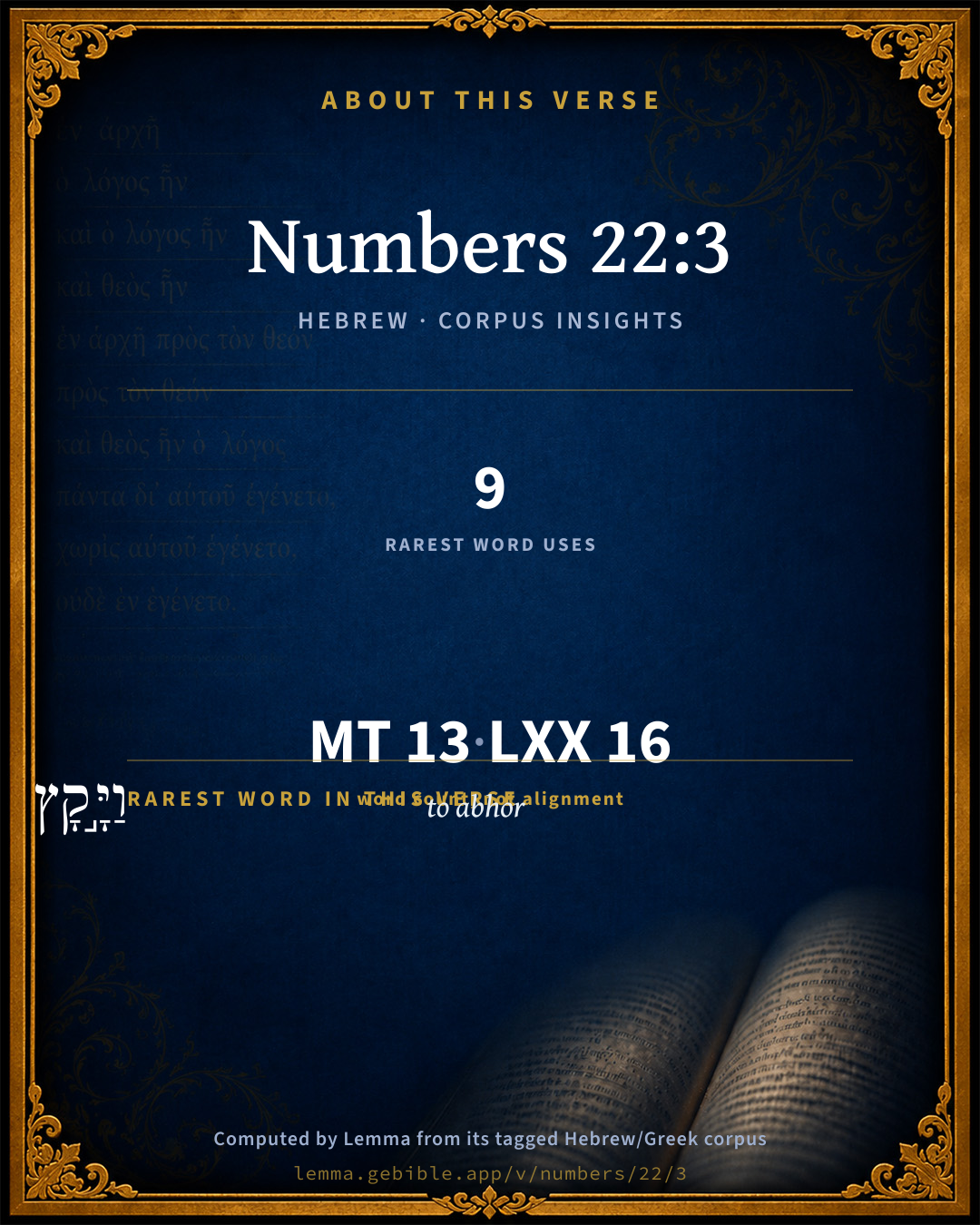
The rarest word here is וַיָּ֣קָץ to abhor H6973 — appearing just 9 times in the whole Hebrew Bible.

Shared distinctive vocabulary

וַיָּ֣קָץ to abhor H6973 occurs in 9 verses of the Hebrew Bible. Also found in:

Grammatical profile

  • 2 verbs
  • 7 nouns
  • 1 adjective
  • 1 pronoun
  • 1 conjunction
  • 1 adverb

Verb forms

  • וַיָּ֨גָר Qal · Sequential Imperfect
  • וַיָּ֣קָץ Qal · Sequential Imperfect

Repetition

Words recur within this verse — often emphatic in Hebrew:

  • מוֹאָ֜ב Moab H4124 ×2
  • מִפְּנֵ֥י face H6440 ×2

Hebrew & Septuagint length

In English translation the verse runs 21 words from the Hebrew and 22 from the Septuagint (LXX English) — closely comparable.

A rough comparison of the two English renderings, which tokenize alike — not a word-level alignment.

Word counts can differ between the Hebrew and the Greek without any difference in meaning — e.g. the Hebrew direct-object marker אֵת has no separate Greek word, and Greek often adds the article ὁ.

In the original languages it is 13 Hebrew tokens and 16 Greek tokens — but the two are counted differently (Hebrew bundles its prefixes and suffixes into one token; the Greek is in lemma form), so that isn’t a like-for-like length.

Cross-references

7

Topical passages linked to Numbers 22:3 in the Treasury of Scripture Knowledge — connected by theme and wording, ordered by reader-vote popularity; previews shown in the World English Bible.

  • Exodus 15:15 Then the chiefs of Edom were dismayed. Trembling takes hold of the mighty men of Moab. All the inhabitants of Canaan are melted away.
  • Isaiah 23:5 When the report comes to Egypt, they shall be sorely pained at the report of Tyre.
  • Deuteronomy 2:25 This day will I begin to put the dread of you and the fear of you on the peoples who are under the whole sky, who shall hear the report of you, and shall tremble, and be in anguish because of you.
  • Joshua 2:10–11 For we have heard how Yahweh dried up the water of the Red Sea before you, when you came out of Egypt; and what you did to the two kings of the Amorites, who were beyond the Jordan, to Sihon and to Og, whom you utterly destroyed.
  • Joshua 2:24 They said to Joshua, Truly Yahweh has delivered into our hands all the land; and moreover all the inhabitants of the land do melt away before us.
  • Joshua 9:24 They answered Joshua, and said, Because it was certainly told your servants, how that Yahweh your God commanded his servant Moses to give you all the land, and to destroy all the inhabitants of the land from before you; therefore we were sore afraid for our lives because of you, and have done this thing.
  • Psalms 53:5 There they were in great fear, where no fear was, For God has scattered the bones of him who encamps against you. You have put them to shame, Because God has rejected them.

Cross-references courtesy of OpenBible.info (CC BY 4.0).

Hebrew and Greek witnesses Masoretic Hebrew ↔ Greek Septuagint

The same verse in the two great witnesses to the Old Testament, shown verse-for-verse.

These are two independent witnesses, not word-aligned to each other, and the Septuagint is shown in lemma (dictionary) form.

Hebrew Numbers 22:3 Masoretic · Westminster Leningrad Codex

וַיָּ֨גָר מוֹאָ֜ב מִפְּנֵ֥י הָעָ֛ם מְאֹ֖ד כִּ֣י רַב ה֑וּא וַיָּ֣קָץ מוֹאָ֔ב מִפְּנֵ֖י בְּנֵ֥י יִשְׂרָאֵֽל

Moab was sore afraid of the people, because they were many: and Moab was distressed because of the children of Israel.

World English Bible · Public Domain

Greek LXX Numbers 22:3 Septuagint · lemma form

καί φοβέω μωαβ ὁ λαός σφόδρα ὅτι πολύς εἰμί καί προςὀχθίζω μωαβ ἀπό πρόσωπον υἱός ἰσραήλ

then Moab feared the people exceedingly because they were many; and Moab was grieved before the face of the children of Israel.

LXX2012 (modern English Septuagint) · Public Domain

Hebrew: Westminster Leningrad Codex (CC BY 4.0). Greek: Septuagint (public domain); English from LXX2012 (modern English Septuagint) (Public Domain). How the Septuagint differs from the Hebrew →

Targum (Aramaic paraphrase)

2

The Targum is the ancient Jewish Aramaic paraphrase of the Hebrew Scriptures — an interpretive translation, not the Hebrew text itself. Onkelos (literal) and Pseudo-Jonathan (expansive) render the Torah, and Jonathan the Prophets. Coverage is partial: where no permissively-licensed English translation exists for a verse, only the Aramaic is shown. This is verse-level text, not a word-by-word alignment to the Hebrew.

  1. Targum Onkelos Torah (Genesis–Deuteronomy)
    וּדְחִיל מוֹאֲבָאָה מִן קֳדָם עַמָא לַחֲדָא אֲרֵי סַגִי הוּא וַעֲקַת לְמוֹאֲבָאָה מִן קֳדָם בְּנֵי יִשְׂרָאֵל

    And Moav were afraid because of the nation also because they were numerous, and they were distressed because of the children of Israel.

    Targum Onkelos — Aramaic: “Onkelos Genesis” (public domain); “Onkelos Exodus” (public domain); “Onkelos Leviticus” (public domain); “Onkelos Numbers” (public domain); “Onkelos Deuteronomy” (public domain). English: “Sefaria Community Translation” (CC0 1.0 (public-domain dedication)); “J.W. Etheridge. The Targums of Onkelos and Jonathan Ben Uzziel on the Pentateuch. London: Longmans, Green, 1862” (public domain). Text via Sefaria.

  2. Targum Pseudo-Jonathan Torah (Genesis–Deuteronomy)
    וּדְחִילוּ מוֹאֲבָאֵי מִן קֳדָם עַמָא לַחֲדָא אֲרוּם סַגִי הוּא וְאִתְיַעֲקוּ מוֹאֲבָאֵי בְּחַיֵיהוֹן מִן קֳדָם בְּנֵי יִשְׂרָאֵל

    And the Moabaee feared before the people greatly because they were many, and they were distressed in their life before the sons of Israel.

    Targum Pseudo-Jonathan — Aramaic: “Targum Jonathan on Genesis” (public domain); “Targum Jonathan on Exodus” (public domain); “Targum Jonathan on Leviticus” (public domain); “Targum Jonathan on Numbers” (public domain); “Targum Jonathan on Deuteronomy” (public domain). English: “The Targum of Jonathan ben Uzziel, trans. J. W. Etheridge, London, 1862” (public domain). Text via Sefaria.

Commentary

Notes on Numbers 22:3 from classic Christian and Jewish commentators (each source and its license shown beneath its notes). The classic Christian expositions comment on the surrounding passage and are grouped to its opening verse, so a note may address several verses; the Jewish commentaries on the Tanakh (Rashi and others) are per-verse, so they appear only where the commentator wrote on this verse.

Lemma curates 59 commentaries, every one of them public domain or Creative Commons licensed, each selected and text-cleaned for this edition rather than reprinted as found. About our sources →

Trapp's Complete Commentary

John Trapp

Num 22:3 And Moab was sore afraid of the people, because they [were] many: and Moab was distressed because of the children of Israel.

Ver. 3. And Moab was distressed.] Or, Was irked, fretted, vexed. And yet Moab was allied to Israel, eased by them of a troublesome encroaching neighbour Sihon, and assured by them, that they would not meddle or molest them. But being of a different religion, they were carried with satanical malice against God’s people, and sought their ruin. This is the guise of graceless and absurd men, acted and agitated by the devil.

John Trapp, A Commentary or Exposition upon All the Books of the Old and New Testament (1647–1656) — public domain. Text from a community e-Sword module.

Joseph Benson's Commentary

Num 22:3. Moab was sore afraid — As Moses had foretold of Moab in particular, (Exo 15:15,) and as the Lord himself had promised concerning all nations in general, Deu 2:25. The Moabites were afraid lest the Israelites should destroy or expel them out of their country, as they had done the Amorites; for they knew nothing of God’s command, prohibiting them from disturbing the Moabites in their possessions.

Joseph Benson's Commentary on the Old and New Testaments (1811–1818) — public domain. Text from a community e-Sword module.

Geneva Bible (1599)

Geneva Bible translators

Or, was vexed.

Geneva Bible (1599) marginal notes — public domain. Text via Bolls.life.

Ellicott's Commentary for English Readers

(3) And Moab was sore afraid of the people.—There was no ground for this apprehension, inasmuch as the Divine command given to Moses was “Distress not the Moabites, neither contend with them in battle” (Deu_2:9). It does not appear, however, that Balak was aware of the prohibition; and the recent conquests of the Israelites naturally filled the Moabites with alarm, especially inasmuch as when the Israelites sent to the King of Moab to ask permission to pass through his land he did not consent (Jdg_11:17).

A Bible Commentary for English Readers, edited by Charles John Ellicott (1878–1897) — public domain. Text from a community e-Sword module.

The Cambridge Bible for Schools and Colleges

gen. ed. J. J. S. Perowne

3. The two halves of the verse appear to be doublets, from E and J respectively.

The Cambridge Bible for Schools and Colleges (gen. ed. J. J. S. Perowne; Cambridge University Press, 1878–1918) — public domain. Text from a community e-Sword module.

John Gill's Exposition

And Moab said unto the elders of Midian,.... Whom the king of Moab sent for to consult with what to do in the present case, for the good and safety of both people; for, according to the Targum of Jonathan, they were one people and one kingdom unto this time, at least had been confederates, by what is said Gen 36:35 though Jarchi thinks there was always a mutual hatred of each other, and that Midian now came against Moab to war, but for fear of Israel a peace was made between them, just as it was with Herod and Pontius Pilate in another case, Luk 23:12, however, they were friends as well as neighbours now; and by which it appears, that this Midian was not that where Jethro lived, which was on the Red sea, near Mount Sinai, in Arabia Felix; this was near the river Arnon, and the Moabites in Arabia Petraea; and though both the one and the other descended from Midian, the son of Abraham by Keturah, yet they had spread themselves, or the one was a colony from the other, and might be distinguished into southern and northern Midianites; the latter were those near Moab; and these elders of Midian, addressed by the king of Moab, being now at his court, whether sent for or not, are the same with the five kings or princes of Midian, as they are called, Num 31:8 as Aben Ezra observes:

now shall this company lick up all that are round about us; consume us, and all our people, and all adjoining to us, and depending on us:

as the ox licketh up the grass of the field; as easily, and as soon, and as completely and entirely; nor are we any more able to oppose them than the grass of the field is to resist and hinder the ox from devouring it:

and Balak the son of Zippor was king of the Moabites at that time; according to the Targum of Jonathan, Midianites and Moabites reigned by turns so long a time; and that Balak was a Midianite, and so says Jarchi, and unfit for the kingdom, and was set over them through necessity for a time: but it seems rather that he was king in succession after his father Zippor; and the design of the expression is only to show, that he who was before mentioned, Num 22:2 was the then reigning prince when this affair happened.

John Gill's Exposition of the Whole Bible (1746–1763) — public domain (CC PDM 1.0). Text via the HelloAO Bible API.

Haydock's Catholic Bible Commentary

Of him: Israel. (Menochius) --- They knew not that God had forbidden the Hebrews to attack the Moabites, unless they were first assailed. Joseph. --- Hebrew, "Moab was much afraid of the people, because of their numbers, and was distressed (and upon his guard) on account of the children of Israel." (Haydock)

George Leo Haydock (1774–1849), Haydock's Catholic Family Bible and Commentary, 1859 edition — public domain. Excludes Psalms (Douay-Rheims chapter numbering differs from Protestant) and Deuterocanonical books (Catholic canon only).

Matthew Poole's English Annotations

As it was foretold both in general of all nations, Deu 2:25, and particularly concerning Moab, Exo 15:15.

Matthew Poole's English Annotations on the Holy Bible (1683–1685) — public domain. Text from a community e-Sword/MySword module.

Whedon's Commentary on the Bible

Daniel D. Whedon

3. Moab was sore afraid — This fear was groundless, since Israel had circuitously passed by the Moabites and had now left them in the rear. They had broken the power of their foes, the Amorites, and had scrupulously obeyed the command, “Distress not the Moabites.” Deu_2:9.

Was distressed — Hebrew, loathed and felt disgust and abhorrence. See Num_21:5.

Daniel D. Whedon (gen. ed.), Commentary on the Old and New Testaments (1874–1909) — public domain. Text from a community e-Sword module.

The Pulpit Commentary

Moab was sore afraid of the people. While the Israelites had moved along their eastern and north-eastern border, the Moabites supplied them with provisions, (Deu_2:29) desiring, no doubt, to be rid of them, but not disdaining to make some profit by their presence. But after the sudden defeat and overthrow of their own Amorite conquerors, their terror and uneasiness forced them to take some action, although they dared not commence open hostilities.

The Pulpit Commentary (1880–1919), ed. H.D.M. Spence-Jones & Joseph S. Exell — public domain. Text from a community e-Sword module.

John Wesley's Explanatory Notes

Sore afraid - As it was foretold both in general of all nations, Deut. ii, 25, and particularly concerning Moab, Exod. xv, 15.

John Wesley, Explanatory Notes Upon the Whole Bible (1754–1765) — public domain. Text via the GEBible commentary corpus.

Rashi

Rabbi Shlomo Yitzchaki (Rashi)

ויגר is an expression signifying fear, as in (Job. 19:29): “Be ye afraid (גורו‎)".

ויקץ מואב means they (Moab) were sick of their lives (the expression is similar to קצתי בחיי in Genesis 27:46, being an abbreviated form of it).

Rashi on the Tanakh — English translations: “The Judaica Press complete Tanach with Rashi, translated by A. J. Rosenberg” (CC BY 4.0); “Pentateuch with Rashi's commentary by M. Rosenbaum and A.M. Silbermann, 1929-1934” (public domain); “The Metsudah Tanach series, Lakewood, N.J” (CC BY 4.0); and “The Book of Joshua, Metsudah Publications, 1997” (CC BY 4.0). Text via Sefaria.

Ramban (Nachmanides)

Rabbi Moshe ben Nachman (Ramban / Nachmanides)

AND MOAB WAS SORE AFRAID OF THE PEOPLE. The meaning of this is [that Moab stood in great fear] because they [the Israelites] were many,. This can be interpreted as “although they were many,” in which case the reference would be to the Moabites, [the word ki meaning “although”]. The meaning of the verse would thus be: “And Moab was sore afraid of the Israelites although they [the Moabites] were many, Ramban, wishing to exclude this interpretation, for the reason cited in the text, explains that the word ki here means “because”; hence the pronoun hu — “they” [they were many] refers to the Israelites. for Moab was small among the nations; and it was not an ancient people, like the Canaanites, the Amorites and other [nations of the] sons of Noah. Therefore they [the Moabites] were greatly afraid of the people who outnumbered them exceedingly, for they were fruitful, and increased abundantly, and waxed greater than the Moabites. And they were furthermore overcome with dread because of the children of Israel, for they had heard of the great wonders that had happened to them and their fathers. Now Moab knew that Israel would not take their land from them, since they had sent to them [offering peace] just as they had sent to Sihon, [asking permission only to pass through their land], saying, until I shall pass over the Jordan into the Land which the Eternal our G-d giveth us. Or it is also possible that they had heard of G-d’s prohibition, when He said to the Israelites, Be not at enmity with Moab., Verse 9. Therefore they said to the elders of Midian: “Even though the Israelites will not capture our land, they will lick up because of their great numbers all that is round about us, as the ox licketh up the grass of the field, and they will capture all [the lands] that surround us, just as they did to the two Amorite kings, and they will make us servants to do taskwork.”

Ramban (Nachmanides) on the Tanakh — English translation: “Commentary on the Torah by Ramban (Nachmanides). Translated and annotated by Charles B. Chavel. New York, Shilo Pub. House, 1971-1976” (CC BY 4.0). Text via Sefaria.

Lesson kit

Teaching starters — assembled from the data on this page, not authored interpretation. Every prompt links to the verse data it draws on. Edit before teaching.

Numbers, in the Pentateuch, opens this verse with 13 words (11 distinct Hebrew lemmas). Its most distinctive word is qûwts (“to abhor”). A historical commentator’s framing appears above. Read the whole chapter for the surrounding context.

Discussion questions

  1. What does “to abhor” (qûwts) contribute to the verse as a whole?
  2. How does Genesis 27:46, which shares the word «to abhor», read alongside this verse?
  3. What does the repetition of “Moab” (2× in this one verse) do in this verse?
  4. These translations render this verse differently; the difference is in the English rendering, not the original. What questions does that raise?
  5. «וַיָּ֨גָר» is a Qal Sequential Imperfect verb. How does that grammatical form shape the action described?
  6. Compare how Trapp's Complete Commentary and Joseph Benson's Commentary read this verse. Where do they agree or differ?

Things to notice

Reading settings

Reading text

Shown beneath each verse's original-language words.

Old Testament
Old Testament edition

Read the OT as the Masoretic Hebrew (MT) or the Greek Septuagint (LXX).

English shown for the Greek Septuagint (in the Hebrew ↔ Greek comparison).

Comparing translations? Open the Compare panel on any verse page to stack up to four side by side.