
Deuteronomy 33:7

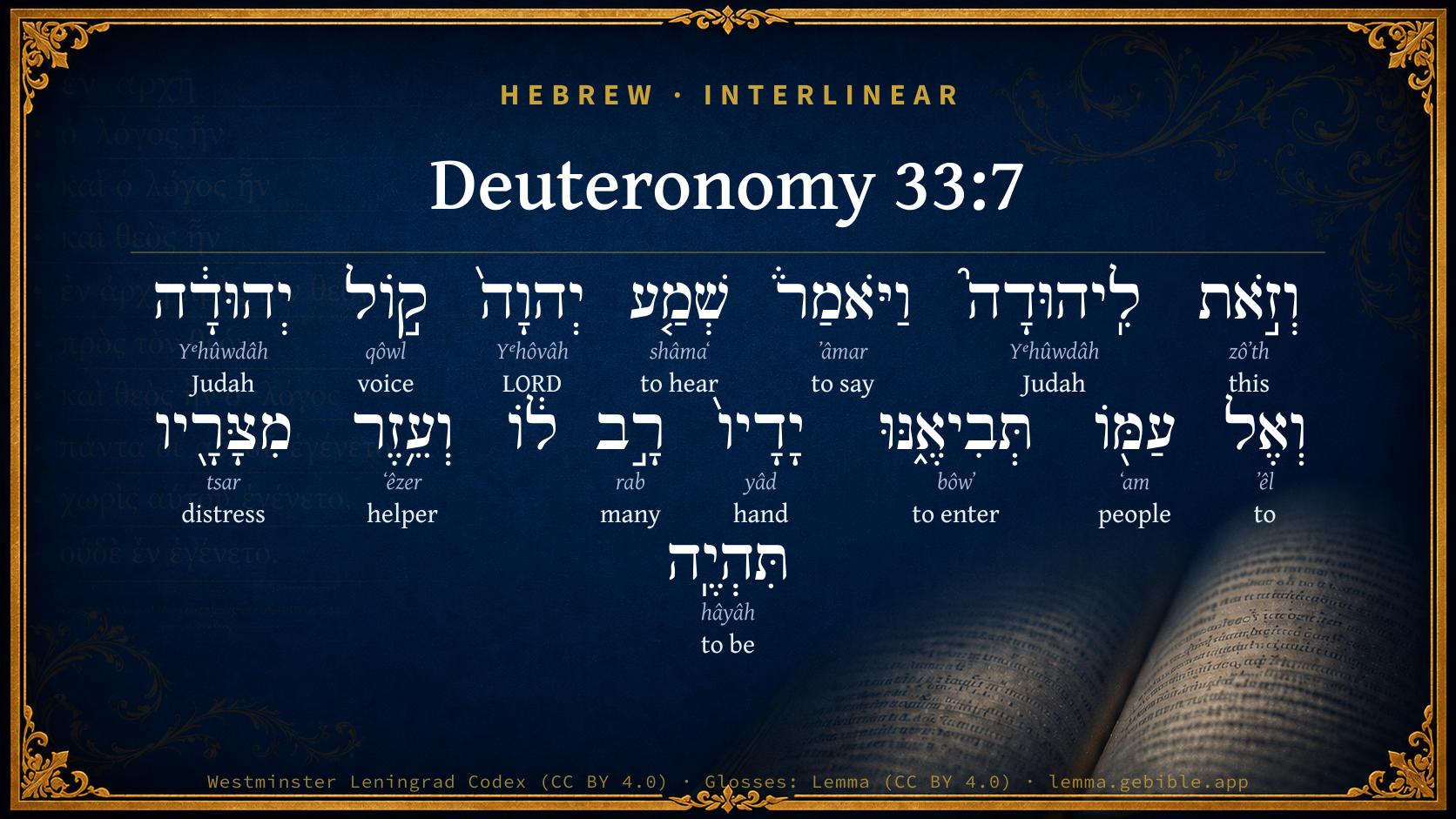
Hebrew (Westminster Leningrad Codex) Deuteronomy 33:7 appears in the Hebrew Old Testament. The text above is from the Westminster Leningrad Codex. Each word links to its Strong’s number, a concise gloss, and parsing drawn from the Open Scriptures Hebrew Bible morphology. Click any word for its full Brown-Driver-Briggs (BDB) entry.
Download image
Cite this verse

Deuteronomy 33:7 (World English Bible). Public Domain. Lemma interlinear Bible study tool, https://lemma.gebible.app/v/deuteronomy/33/7.

Show BibTeX & RIS
BibTeX
RIS
English Translation
This is [the blessing] of Judah: and he said, Hear, Yahweh, the voice of Judah, Bring him in to his people. With his hands he contended for himself; You shall be a help against his adversaries.
World English Bible · Public Domain
Download a study sheet

One document with this verse’s original text, its word-by-word gloss line, the meaning frame, cross-references with their text, attributed commentary, and full source and license credits — printable, and it pastes into notes with its structure intact.

This verse Autodidact and up

Study sheet (.html) Plain text (.txt)

A passage Seminary Student

Up to 50 verses in one chapter. A passage sheet keeps up to 6 commentary sources and 12 cross-references per verse, in the order this page ranks them, and says so on the sheet whenever that leaves anything out. Ask for a single verse and you get the Autodidact verse sheet above.

Everything on this page stays free to read, with no account — the sheet is a download of what is already on screen, not access to it.

Want to remove ads? Support Godless Engineer
Compare translations 3

The same verse in 3 English versions, stacked beneath the original-language interlinear above. Click any original word for its lexicon entry.

Each is an independent rendering of the whole verse — the interlinear is not word-aligned to these translations.

Highlighted words mark where these versions differ — a whole-verse word diff, not a word-by-word alignment.

  • World English Bible Public Domain
    This is [the blessing] of Judah: and he said, Hear, Yahweh, the voice of Judah, Bring him in to his people. With his hands he contended for himself; You shall be a help against his adversaries.
  • King James Version Public Domain
    And this is the blessing of Judah: and he said, Hear, LORD, the voice of Judah, and bring him unto his people: let his hands be sufficient for him; and be thou an help to him from his enemies.
  • unfoldingWord Literal Text CC BY-SA 4.0
    And this for Judah. And he said, “Listen, Yahweh, the voice of Judah, and to his people bring him. Let his hand strive for himself, and a help against his enemies you will be.”

unfoldingWord Literal Text — © unfoldingWord, licensed CC BY-SA 4.0. Word-aligned USFM3 via Door43 (git.door43.org/unfoldingWord/en_ult).

Versions to compare (up to 4)

3 of 4 selected

Show all 18 translations

Every available English version of this verse, each an independent rendering of the whole verse.

  • World English Bible Public Domain
    This is [the blessing] of Judah: and he said, Hear, Yahweh, the voice of Judah, Bring him in to his people. With his hands he contended for himself; You shall be a help against his adversaries.
  • Berean Standard Bible Public Domain
    And concerning Judah he said: “O LORD, hear the cry of Judah and bring him to his people. With his own hands he defends his cause, but may You be a help against his foes.”
  • Majority Standard Bible Public Domain
    And concerning Judah he said: “O LORD, hear the cry of Judah and bring him to his people. With his own hands he defends his cause, but may You be a help against his foes.”
  • King James Version Public Domain
    And this is the blessing of Judah: and he said, Hear, LORD, the voice of Judah, and bring him unto his people: let his hands be sufficient for him; and be thou an help to him from his enemies.
  • American Standard Version (1901) Public Domain
    And this is `the blessing' of Judah: and he said, Hear, Jehovah, the voice of Judah, And bring him in unto his people. With his hands he contended for himself; And thou shalt be a help against his adversaries.
  • Revised Version (1885) Public Domain
    And this is the blessing of Judah: and he said, Hear, LORD, the voice of Judah, And bring him in unto his people: With his hands he contended for himself; And thou shalt be an help against his adversaries.
  • Geneva Bible (1599) Public Domain
    And thus he blessed Iudah, and said, Heare, O Lord, the voyce of Iudah, and bring him vnto his people: his hands shalbe sufficient for him, if thou helpe him against his enemies.
  • Douay-Rheims (1899) Public Domain
    This is the blessing of Juda. Hear, O Lord, the voice of Juda, and bring him in unto his people: his hands shall fight for him, and he shall be his helper against his enemies.
  • Young's Literal Translation Public Domain
    And this `is' for Judah; and he saith: -- Hear, O Jehovah, the voice of Judah, And unto his people do Thou bring him in; His hand hath striven for him, And an help from his adversaries art Thou.
  • Literal Standard Version CC BY-SA 4.0
    And this [is] for Judah, and he says: Hear, O YHWH, the voice of Judah, || And You bring him in to his people; His hand has striven for him, || And You are a help from his adversaries.
  • Unlocked Literal Bible CC BY-SA 4.0
    This is the blessing for Judah. Moses said: Listen, Yahweh, to the voice of Judah, and bring him to his people again. Fight for him; be a help against his enemies.
  • unfoldingWord Literal Text CC BY-SA 4.0
    And this for Judah. And he said, “Listen, Yahweh, the voice of Judah, and to his people bring him. Let his hand strive for himself, and a help against his enemies you will be.”
  • Darby Bible Public Domain
    And this of Judah; and he said, Hear, Jehovah, the voice of Judah, And bring him unto his people; May his hands strive for them; And be thou a help to him against his oppressors.
  • World Messianic Bible Public Domain
    This is for Judah. He said, “Hear, LORD, the voice of Judah. Bring him in to his people. With his hands he contended for himself. You shall be a help against his adversaries.”
  • Webster's Bible Public Domain
    And this is the blessing of Judah: and he said, Hear, LORD, the voice of Judah, and bring him to his people: let his hands be sufficient for him, and be thou a help to him from his enemies.
  • Free Bible Version CC BY-SA 4.0
    To Judah he said: “Lord, please hear the cry of Judah and reunite him with his people. Even though he fights for himself, may you help him against his enemies.”
  • Bible in Basic English Public Domain
    And this is the blessing of Judah: he said, Give ear, O Lord, to the voice of Judah and make him one with his people: let your hands take up his cause, and be his help against his attackers.
  • JPS Tanakh (1917) Public Domain
    And this for Judah, and he said: Hear, LORD, the voice of Judah, and bring him in unto his people; his hands shall contend for him, and Thou shalt be a help against his adversaries.

Literal Standard Version (2020), Covenant Press — licensed CC BY-SA 4.0. Text via the HelloAO Bible API (eBible.org). Unlocked Literal Bible (unfoldingWord) — licensed CC BY-SA 4.0. Text via the HelloAO Bible API (eBible.org). unfoldingWord Literal Text — © unfoldingWord, licensed CC BY-SA 4.0. Word-aligned USFM3 via Door43 (git.door43.org/unfoldingWord/en_ult). Free Bible Version, Dr. Jonathan Gallagher — licensed CC BY-SA 4.0. Text via the HelloAO Bible API (eBible.org).

Word by word

More ways to search: Search by grammar → Find every occurrence → Compare this word →

Practice this passage: Drill this verse → Learn its vocabulary →

וְעֵ֥זֶר
ʻêzer
H5828
“and · helper”
Conjunction + Noun, Common, Masculine, Singular, Absolute
Part of Speech
Conjunction + Noun
Type
Common
Gender
Masculine
Number
Singular
State
Absolute
Full BDB Definition

Origin: from H5826

TWOT: 1598a

help, succour - help, succour - one who helps
  1. וְזֹ֣את zôʼth H2063 “and · this” Conjunction + Pronoun, Demonstrative, Feminine, Singular
  2. לִֽיהוּדָה֮ Yᵉhûwdâh H3063 “to/for · Judah” Preposition + Noun, Proper
  3. וַיֹּאמַר֒ ʼâmar H559 “and · to say” Conjunction + Verb, Qal, Sequential Imperfect, 3rd Person, Masculine, Singular
  4. שְׁמַ֤ע shâmaʻ H8085 “hear” Verb, Qal, Imperative, 2nd Person, Masculine, Singular
  5. יְהוָה֙ Yᵉhôvâh H3068 “LORD” Noun, Proper
  6. ק֣וֹל qôwl H6963 “voice of” Noun, Common, Masculine, Singular, Construct
  7. יְהוּדָ֔ה Yᵉhûwdâh H3063 “Judah” Noun, Proper
  8. וְאֶל ʼêl H413 “and · to” Conjunction + Preposition
  9. עַמּ֖וֹ ʻam H5971 “people · his” Noun, Common, Masculine, Singular, Construct + Suffix, Personal, 3rd Person, Masculine, Singular
  10. תְּבִיאֶ֑נּוּ bôwʼ H935 “to enter · him” Verb, Hiphil, Imperfect, 2nd Person, Masculine, Singular + Suffix, Personal, 3rd Person, Masculine, Singular
  11. יָדָיו֙ yâd H3027 “hands · his” Noun, Common, Both, Dual, Construct + Suffix, Personal, 3rd Person, Masculine, Singular
  12. רָ֣ב rab H7227 “many” Verb, Qal, Perfect, 3rd Person, Masculine, Singular
  13. מִצָּרָ֖יו tsar H6862 “from · distresses · his” Preposition + Noun, Common, Masculine, Plural, Construct + Suffix, Personal, 3rd Person, Masculine, Singular
  14. תִּהְיֶֽה hâyâh H1961 “to be” Verb, Qal, Imperfect, 2nd Person, Masculine, Singular

About this verse

These counts appear in no published source. They are computed here, from the morphology-tagged text and Lemma’s own curated glosses. What Lemma adds →

16
words
14
distinct lemmas
Pentateuch
section

Notable vocabulary

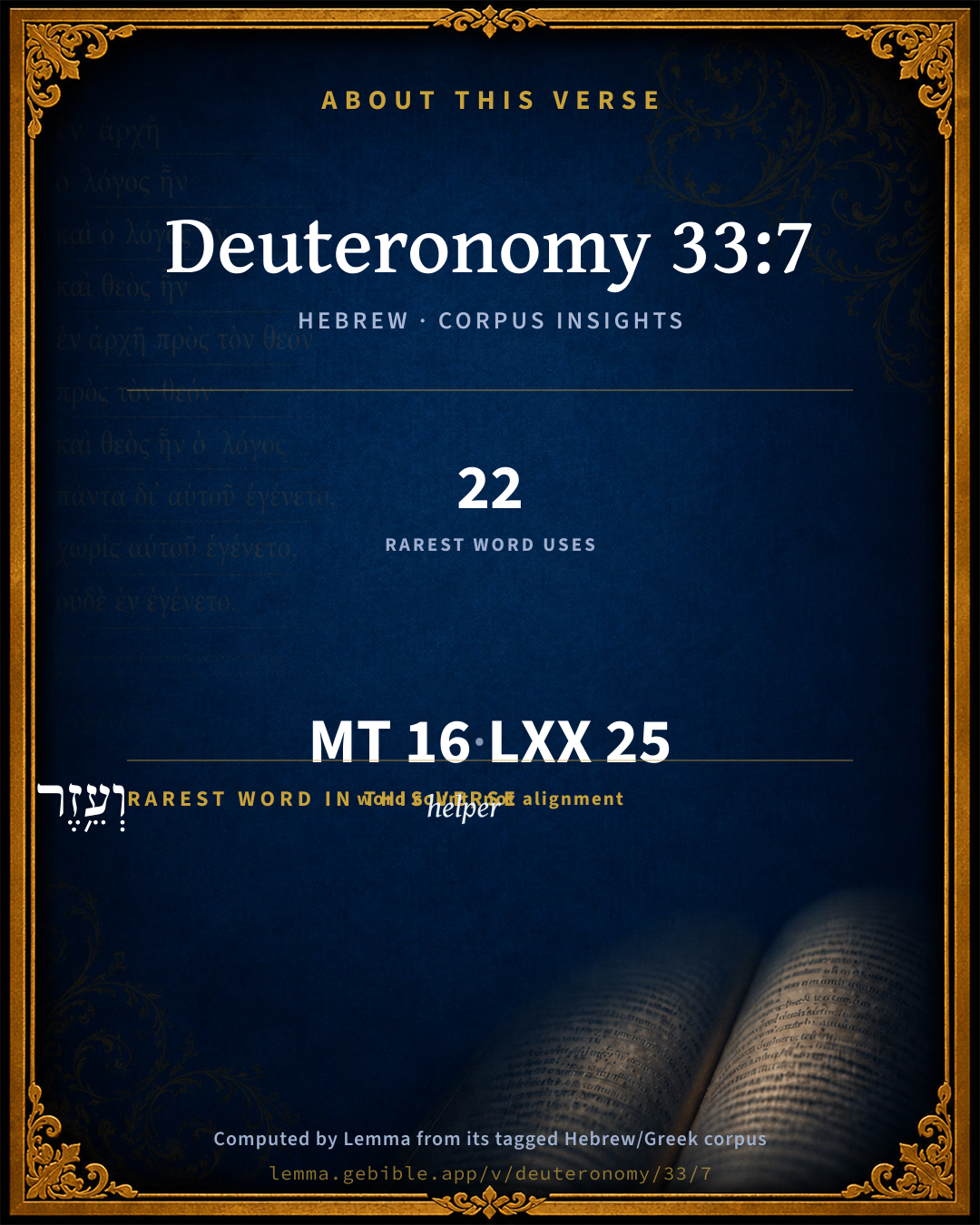
The rarest word here is וְעֵ֥זֶר helper H5828 — appearing just 22 times in the whole Hebrew Bible.

Shared distinctive vocabulary

וְעֵ֥זֶר helper H5828 occurs in 21 verses of the Hebrew Bible. Also found in:

Grammatical profile

  • 5 verbs
  • 8 nouns
  • 1 pronoun
  • 2 prepositions

Verb forms

  • וַיֹּאמַר֒ Qal · Sequential Imperfect
  • שְׁמַ֤ע Qal · Imperative
  • תְּבִיאֶ֑נּוּ Hiphil · Imperfect
  • רָ֣ב Qal · Perfect
  • תִּהְיֶֽה Qal · Imperfect

Repetition

A word recurs within this verse — often emphatic in Hebrew:

  • לִֽיהוּדָה֮ Judah H3063 ×2

Hebrew & Septuagint length

In English translation the verse runs 36 words from the Hebrew and 34 from the Septuagint (LXX English) — closely comparable.

A rough comparison of the two English renderings, which tokenize alike — not a word-level alignment.

Word counts can differ between the Hebrew and the Greek without any difference in meaning — e.g. the Hebrew direct-object marker אֵת has no separate Greek word, and Greek often adds the article ὁ.

In the original languages it is 16 Hebrew tokens and 25 Greek tokens — but the two are counted differently (Hebrew bundles its prefixes and suffixes into one token; the Greek is in lemma form), so that isn’t a like-for-like length.

Cross-references

25

Topical passages linked to Deuteronomy 33:7 in the Treasury of Scripture Knowledge — connected by theme and wording, ordered by reader-vote popularity; previews shown in the World English Bible.

  • Genesis 49:8–12 "Judah, your brothers will praise you: Your hand will be on the neck of your enemies; Your father's sons will bow down before you.
  • 2 Samuel 7:9–12 and I have been with you wherever you went, and have cut off all your enemies from before you; and I will make you a great name, like the name of the great ones who are in the earth.
  • Psalms 11:1–7 In Yahweh, I take refuge. How can you say to my soul, "Flee as a bird to your mountain!"
  • Psalms 20:2 Send you help from the sanctuary, Grant you support from Zion,
  • Psalms 21:8 Your hand will find out all of your enemies. Your right hand will find out those who hate you.
  • Psalms 146:5 Happy is he who has the God of Jacob for his help, Whose hope is in Yahweh, his God:
  • Isaiah 9:17 Therefore the Lord will not rejoice over their young men, neither will he have compassion on their fatherless and widows; for everyone is profane and an evil-doer, and every mouth speaks folly. For all this his anger is not turned away, but his hand is stretched out still.
  • Luke 19:27 But bring those enemies of mine who didn't want me to reign over them here, and kill them before me.'"
  • 1 Corinthians 15:25 For he must reign until he has put all his enemies under his feet.
  • Hebrews 7:14 For it is evident that our Lord has sprung out of Judah, about which tribe Moses spoke nothing concerning priesthood.
  • Revelation 19:13–16 He is clothed in a garment sprinkled with blood. His name is called "The Word of God."
  • Revelation 20:10–15 The devil who deceived them was thrown into the lake of fire and sulfur, where the beast and the false prophet are also. They will be tormented day and night forever and ever.
  • Judges 1:1–7 It happened after the death of Joshua, the children of Israel asked of Yahweh, saying, Who shall go up for us first against the Canaanites, to fight against them?
  • 2 Samuel 3:1 Now there was long war between the house of Saul and the house of David: and David grew stronger and stronger, but the house of Saul grew weaker and weaker.
  • 2 Samuel 5:1 Then came all the tribes of Israel to David to Hebron, and spoke, saying, Behold, we are your bone and your flesh.
  • 2 Samuel 5:19 David inquired of Yahweh, saying, Shall I go up against the Philistines? will you deliver them into my hand? Yahweh said to David, Go up; for I will certainly deliver the Philistines into your hand.
  • 2 Samuel 5:24 It shall be, when you hear the sound of marching in the tops of the mulberry trees, that then you shall bestir yourself; for then is Yahweh gone out before you to strike the host of the Philistines.
  • 1 Chronicles 12:22 For from day to day men came to David to help him, until there was a great host, like the host of God.
  • 2 Chronicles 17:12–19 Jehoshaphat grew great exceedingly; and he built in Judah castles and cities of store.
  • Psalms 21:1 The king rejoices in your strength, Yahweh! How greatly he rejoices in your salvation!
  • Psalms 78:68 But chose the tribe of Judah, Mount Zion which he loved.
  • Psalms 78:70 He also chose David his servant, And took him from the sheepfolds;
  • Psalms 110:1–2 Yahweh says to my Lord, "Sit at my right hand, Until I make your enemies your footstool for your feet."
  • Micah 5:2 But you, Bethlehem Ephrathah, Being small among the clans of Judah, Out of you one will come forth to me that is to be ruler in Israel; Whose goings forth are from of old, from everlasting.
  • Malachi 3:1 "Behold, I send my messenger, and he will prepare the way before me; and the Lord, whom you seek, will suddenly come to his temple; and the messenger of the covenant, whom you desire, behold, he comes!" says Yahweh of hosts.

Cross-references courtesy of OpenBible.info (CC BY 4.0).

Hebrew and Greek witnesses Masoretic Hebrew ↔ Greek Septuagint

The same verse in the two great witnesses to the Old Testament, shown verse-for-verse.

These are two independent witnesses, not word-aligned to each other, and the Septuagint is shown in lemma (dictionary) form.

Hebrew Deuteronomy 33:7 Masoretic · Westminster Leningrad Codex

וְזֹ֣את לִֽיהוּדָה֮ וַיֹּאמַר֒ שְׁמַ֤ע יְהוָה֙ ק֣וֹל יְהוּדָ֔ה וְאֶל עַמּ֖וֹ תְּבִיאֶ֑נּוּ יָדָיו֙ רָ֣ב ל֔וֹ וְעֵ֥זֶר מִצָּרָ֖יו תִּהְיֶֽה

This is [the blessing] of Judah: and he said, Hear, Yahweh, the voice of Judah, Bring him in to his people. With his hands he contended for himself; You shall be a help against his adversaries.

World English Bible · Public Domain

Greek LXX Deuteronomy 33:7 Septuagint · lemma form

καί οὗτος ιουδα εἰςἀκούω κύριος φωνή ιουδα καί εἰς ὁ λαός αὐτός εἰςἔρχομαι ὁ χείρ αὐτός διακρίνω αὐτός καί βοηθός ἐκ ὁ ἐχθρός αὐτός εἰμί

And this is the blessing of Juda; Hear, Lord, the voice of Juda, and do you visit his people: his hands shall contend for him, and you shall be a help from his enemies.

LXX2012 (modern English Septuagint) · Public Domain

On this verse, The Cambridge Bible for Schools and Colleges discusses the Septuagint’s reading. Read the note in Commentary ↓

Hebrew: Westminster Leningrad Codex (CC BY 4.0). Greek: Septuagint (public domain); English from LXX2012 (modern English Septuagint) (Public Domain). How the Septuagint differs from the Hebrew →

Targum (Aramaic paraphrase)

2

The Targum is the ancient Jewish Aramaic paraphrase of the Hebrew Scriptures — an interpretive translation, not the Hebrew text itself. Onkelos (literal) and Pseudo-Jonathan (expansive) render the Torah, and Jonathan the Prophets. Coverage is partial: where no permissively-licensed English translation exists for a verse, only the Aramaic is shown. This is verse-level text, not a word-by-word alignment to the Hebrew.

  1. Targum Onkelos Torah (Genesis–Deuteronomy)
    וְדָא לִיהוּדָה וַאֲמַר קַבֵּל יְיָ צְלוֹתֵהּ דִיהוּדָא בְּמִפְּקֵהּ לְאַגָחָא קְרָבָא וּלְעַמֵהּ תָּתֵיבִנֵהּ לִשְׁלָם יְדוֹהִי יַעְבְּדָן לֵהּ פֻּרְעֲנוּתָא מִסָנְאוֹהִי וְסָעִיד מִבַּעֲלֵי דְבָבוֹהִי הֲוֵי לֵהּ

    (no public-domain English translation for this verse)

    Targum Onkelos — Aramaic: “Onkelos Genesis” (public domain); “Onkelos Exodus” (public domain); “Onkelos Leviticus” (public domain); “Onkelos Numbers” (public domain); “Onkelos Deuteronomy” (public domain). English: “Sefaria Community Translation” (CC0 1.0 (public-domain dedication)); “J.W. Etheridge. The Targums of Onkelos and Jonathan Ben Uzziel on the Pentateuch. London: Longmans, Green, 1862” (public domain). Text via Sefaria.

  2. Targum Pseudo-Jonathan Torah (Genesis–Deuteronomy)
    וְדָא בִּירְכָתָא לְשִׁבְטָא דִיהוּדָה וְזַוֵג בְּחוּלְקֵיהּ וּבְבִירְכָתֵיהּ לְשִׁמְעוֹן אָחוֹי וְכֵן אָמַר קַבֵּל יְיָ צְלוֹתֵיהּ דִיהוּדָה בְּמִפְקֵיהּ לְסִדְרֵי קְרָבָא וּלְוַות עַמֵיהּ תַּעֲלִינֵיהּ מִסִדְרֵי קְרָבָא בִּשְׁלָם יְדוֹי יִתְפַּרְעַן לֵיהּ מִן בַּעֲלֵי דְבָבוֹי וּסְעִיד וּסְמִיךְ מִסַנְאוֹי תֶּהֱוֵי לֵיהּ

    And this is the benediction of the tribe of Jehudah, conjoined with the portion and benediction of his brother Shemeon; and thus he spake: Receive, O Lord, the prayer of Jehudah when he goeth forth unto war, and bring Thou him back from war unto his people in peace. Let his hand take vengeance on his enemies, and be Thou his help and support against his foes.

    Targum Pseudo-Jonathan — Aramaic: “Targum Jonathan on Genesis” (public domain); “Targum Jonathan on Exodus” (public domain); “Targum Jonathan on Leviticus” (public domain); “Targum Jonathan on Numbers” (public domain); “Targum Jonathan on Deuteronomy” (public domain). English: “The Targum of Jonathan ben Uzziel, trans. J. W. Etheridge, London, 1862” (public domain). Text via Sefaria.

Commentary

Notes on Deuteronomy 33:7 from classic Christian and Jewish commentators (each source and its license shown beneath its notes). The classic Christian expositions comment on the surrounding passage and are grouped to its opening verse, so a note may address several verses; the Jewish commentaries on the Tanakh (Rashi and others) are per-verse, so they appear only where the commentator wrote on this verse.

Lemma curates 59 commentaries, every one of them public domain or Creative Commons licensed, each selected and text-cleaned for this edition rather than reprinted as found. About our sources →

Trapp's Complete Commentary

John Trapp

Deu 33:7 And this [is the blessing] of Judah: and he said, Hear, LORD, the voice of Judah, and bring him unto his people: let his hands be sufficient for him; and be thou an help [to him] from his enemies.

Ver. 7. And this is the blessing.] Simeon is not mentioned, but implied in Judah’s blessing, in the midst of whose inheritance lay his portion. {Jos 19:1} Besides, that tribe was exceedingly defiled with fornication, spiritual and corporal, and by that means much decayed and diminished. {Num 26:14}

Hear, Lord, the voice of Judah.] Putting thy promises {Gen 8:9-11} into suit by his prayers, and pressing thee for a performance.

Let his hands be sufficient for him, and be thou a help to him, &c.] Moses first prays for Judah, that "his hands may be sufficient for him": and then addeth, as there was need, "And be thou a help to him": for all "our sufficiency is of God," and that man is sure to come down that standeth on his own legs. Ithiel and Ucal are twins.

John Trapp, A Commentary or Exposition upon All the Books of the Old and New Testament (1647–1656) — public domain. Text from a community e-Sword module.

The Biblical Illustrator

Joseph S. Exell

Deu_33:7

And thus is the blessing of Judah.

Judah

The name Judah was given to Jacobs fourth son in memory of his mothers grateful utterance of praise to God when this child was vouchsafed to her. It is the Hebrew word meaning praised, and had reference originally to Jehovah, upon whom Leah in her joy conferred that title, saying, Now will I praise the Lord (Gen_29:35). But, by a very natural change, the praise which this name implied came to be attributed to the individual who bore it; and Jacobs dying blessing embodies that new application of the idea: Judah, thou art he whom thy brethren shall praise. The blessing of Jacob goes on to disclose the great reasons for Judahs exaltation in the esteem of men. He was to be the royal tribe in Israel; from him was to spring the Prince of Peace, the promised Messiah, unto whom shall be the obedience of the peoples (Gen_49:8; Gen_49:10). A third part of his eldest brother Reubens birthright was conferred upon him,--and this, not by his fathers caprice, but by Gods deliberate appointment; so that the refusal of his brethren to acknowledge Judah as their leader would have been nothing less than rebellion against Jehovah. The sons of Jacob, however, seem to have acknowledged this leadership very willingly from the first. Reuben, Simeon, and Levi yielded the place of honour to Judah without a murmur, so far as the sacred record suffers us to judge, Only one tribe submitted with ill-concealed impatience and reluctance to the divinely appointed leadership of Judah. This was Ephraim, which had come to represent Joseph, the favourite of Jacob and the inheritor of another third part of Reubens forfeited birthright. The first settlement of Canaan after its conquest by Joshua shows us the secret rivalry between these two tribes, and also allows us to see how completely these two had cast all the others into the shade. For Judah and Joseph divided the whole conquered territory between themselves; so that the central mountain ridge of Palestine received a permanent name from the one tribe in its southern portion, and from the other tribe in its northern continuation. It was not until some few years had elapsed that the murmurs of seven other tribes, for which no landed possessions had been allotted, shamed Judah and Ephraim into a more equitable division of their spoils, and led to the well-known partition of Canaan into nine lots, instead of the original two (Jos_15:1-63; Jos_16:1-10; Jos_17:1-18; Jos_18:2-7). But about one hundred years later the old dual division reappeared in more pronounced and permanent form. The seceding kingdom of Israel was established through the union of eight tribes or fragments of tribes under Ephraim, who now for the second time ruled over the whole northern half of the Promised Land; whilst Judah retained dominion over the south, in which part of the country Benjamin, Simeon, and Dan had found settlements under the wing of their stronger brother. From that time forth the name of Jew (that is, man of Judah) was given to every subject of the kingdom of Davids house, whether he belonged to the tribe of Judah or not. The second clause of this blessing may seem at first sight a little obscure; but the traditional Jewish interpretation will probably commend itself to everyone who bears in mind that peculiar position of Judah among his brethren which has been already described. The royal tribe was also the champion tribe, bound to go before all the rest in the path of warfare and of danger. The third and fourth clauses of the blessing bring out, on the one hand, Judahs valiant and unselfish discharge of the honourable task assigned him; and, on the other hand, they contemplate the serious hindrances which would oppose his work. He would have many adversaries, not only from among the surrounding Gentile nations, but also from amongst his own brethren, some of whom would envy him, and set up a rival kingdom and championship to his. But if God would be his helper, these rivalries and oppositions would only serve to make his glorious destiny more manifest. The Lord would set His anointed One king upon His holy hill of Zion; there He should rule in the midst of His enemies. The opening words of Judahs blessing are, however, the most suggestive in regard to the actual history of the tribe and to the typical application of that history to our own circumstances. Judahs triumph and rest and help were to come from God in answer to the uplifting of Judahs voice. Distinct as was Gods purpose to bless him and to make him a blessing, He would yet be inquired of for this: prayer and supplication on the part of His chosen people were to be the condition of their effectual blessing. The Apostle Paul has taught us that in everything by prayer and supplication with thanksgiving our requests should be made known unto God (Php_4:6). This oft-forgotten but Important truth is forcibly suggested in the wording of Judahs blessing: Hear, Lord, the voice of Judah; for, as already explained, that name was given by Leah in token of the debt of praise which was owing on Judahs account to God. The history of the reign of Jehoshaphat furnishes a notable commentary upon the point which is thus suggested. Moab, and Ammon, and Edom had become confederate against that prince; and in his fear he set himself to seek the Lord; and all Judah gathered together to seek help from the Lord (2Ch_20:1-4). The answer which was given to this cry for help required from the king and from the people no ordinary display of faith, and no easy sacrifice of praise. But Judah was strengthened to stand the test (2Ch_20:21-28). Perhaps this hint from the meaning of Judahs name may be the most needed and the most profitable teaching of the blessing of Judah for someone who now reads it. It is no unfrequent experience when a Christians prayer fails to be answered from God, simply because it was conceived in a querulous, ungrateful, and complaining spirit. No element of praise mingled with its petitions. It was wholly occupied with requests for something that seemed lacking; whilst God was expecting a thankful acknowledgment of countless mercies which His selfish servant had received in silence, or even with discontented depreciation. Let not the offerer of such defective prayers expect any share in the blessings which Moses invoked on Judah. The voice of rejoicing and of thanksgiving was in his tabernacles; therefore the right hand of the Lord did valiantly for him. For thus saith the Hope of Israel, the Lion of the tribe of Judah (Psa_50:23). (T. G. Rooke, B. A.)

The Biblical Illustrator, edited by Joseph S. Exell (c. 1880s–1900s) — public domain. Text from a community e-Sword module.

Joseph Benson's Commentary

Deu 33:7. And this is the blessing of Judah — As these words are used of none of the rest, so they seem to denote that Judah’s blessing was more remarkable than the rest. Judah is here put before Levi, because it was to be the royal tribe. This benediction, as Bishop Sherlock argues, cannot relate to the time when it was given: for then Judah’s hands were very sufficient for him, this tribe being by much the greatest of the twelve tribes, as appears by two different accounts of the forces of Israel in the book of Numbers, Num 1:26: and there was more reason to put up this petition for several other tribes than for Judah. Besides, what is the meaning of bringing Judah to his people? How were he and his people at this time separate? What means, likewise, the other part of the petition, Be thou a help to him from his enemies? This petition supposes a state of distress; yet what distress was Judah in at this time, at least what greater distress than the other tribes? The ancient Targums, and some old versions, understand the first petition of bringing Judah back to his people, to be only a request in his behalf, for safe return from the day of battle; but was there not the same reason for the same petition in behalf of every tribe? Nay, how much better would it have suited Reuben, Gad, and the half tribe of Manasseh, who left their people and their settlements on the other side of Jordan, and passed over the river in the very front of the battle, to assist their brethren? Jos 4:12.

But if you refer this prophecy to the prophecy of Jacob, (Gen 49:10,) and to the continuance of the sceptre of Judah after the destruction of the other tribes, every expression is natural and proper, and suited to the occasion. Do but suppose Moses, in the spirit of prophecy, to have a sight of the state of affairs, when all the people were in captivity, and you will see how this prophetic prayer answers to that state. All the tribes were in captivity, the ten tribes in Assyria, and Judah in Babylon; but it was implied in Jacob’s prophecy, that Judah should retain the sceptre, and return again: for Judah only, therefore, does Moses pray that he may come to his people again. Let his hands be sufficient for him — Good reason was there for this petition, for scarcely were his hands sufficient at the return from Babylon. The tribe of Judah, (Num 26:22,) in Moses’s time, consisted of seventy-six thousand five hundred, reckoning only those of twenty years old and upward. But upon the return from Babylon, Judah, with Benjamin, the Levites, and the remnant of Israel, made only forty-two thousand three hundred and sixty, (Ezr 2:64,) and in so weak a state they were, that Sanballat, in great scorn, said, “What do these feeble Jews?” Neh 4:2. Be thou a help to him from his enemies — The books of Ezra and Nehemiah are convincing proofs of the great difficulties and oppositions which the Jews found in setting up their temple and city. Once their enemies had so prevailed, that orders came from the court of Persia, to stop all their proceedings: and, even at last, when Nehemiah came to their assistance, with a new commission from Artaxerxes, they were so beset with enemies, that the men employed in building the wall, every one, with one of his hands, wrought in the work, and with the other hand held a weapon, Neh 4:17.

Lay these two prophecies now together, and they will explain each other. Jacob foretels that Judah’s sceptre should continue till Shiloh came: which is, in effect, foretelling that the sceptres of the other tribes should not continue so long. Moses, in the spirit of prophecy, sees the desolation of all the tribes; he sees the tribes of the kingdom of Israel carried away by the Assyrians, the people of Judah by the Babylonians; he sees that Judah should again return weak, harassed, and scarcely able to maintain himself in his own country: for them, therefore, he conceives this prophetic prayer: Hear, Lord, the voice of Judah, &c.

Joseph Benson's Commentary on the Old and New Testaments (1811–1818) — public domain. Text from a community e-Sword module.

Tyndale Open Study Notes

Tyndale Open Resources

33:7 Judah was Jacob’s fourth son by Leah (Gen 29:35). The anticipated messianic ruler would come through this tribe. This promise was fulfilled first in David (Ruth 4:18-22; 1 Chr 2:3-15) and then in Jesus Christ (Matt 1:1-6a; see Gen 49:10).

Tyndale Open Study Notes — © Tyndale Open Resources, licensed CC BY-SA 4.0. Text via the HelloAO Bible API.

Geneva Bible (1599)

Geneva Bible translators

Signifying, that he should hardly obtain Jacob’s promises, Gen. 49:8.

Geneva Bible (1599) marginal notes — public domain. Text via Bolls.life.

Jamieson, Fausset & Brown

Robert Jamieson, A. R. Fausset & David Brown

this is the blessing of Judah--Its general purport points to the great power and independence of Judah, as well as its taking the lead in all military expeditions.

Jamieson, Fausset & Brown — Commentary Critical and Explanatory on the Whole Bible (1871) — public domain (CC PDM 1.0). Text via the HelloAO Bible API.

Adam Clarke's Commentary

Verse 7. And this is the blessing of Judah] Though the word blessing is not in the text, yet it may be implied from De 33:1; but probably the words, he spake, are those which should be supplied: And this he spake of Judah, Lord, hear the voice of Judah; that is, says the Targum, receive his prayer when he goes out to battle, and let him be brought back in safety to his own people. Let his hands be sufficient for him - let him have a sufficiency of warriors always to support the tribe, and vindicate its rights; and let his enemies never be able to prevail against him! Three things are expressed here:

1. That the tribe of Judah, conscious of its weakness, shall depend on the Most High, and make prayer and supplication to him;

2. That God will hear such prayer; and,

3. That his hands shall be increased, and that he shall prevail over his enemies. This blessing has a striking affinity with that which this tribe received from Jacob, Ge 49:9; and both may refer to our blessed Lord, who sprang from this tribe, as is noticed on the above passage, who has conquered our deadly foes by his death, and whose praying posterity ever prevail through his might.

Adam Clarke's Commentary on the Bible (1810–1826) — public domain. Text from a community e-Sword/MySword module.

Ellicott's Commentary for English Readers

(7) And this (he said) of Judah.—The words which follow are a kingly blessing: “Hear, Lord, the voice of Judah, and bring him to his people.” In other words, when we think of “the Lion of the tribe of Judah,” “Thy kingdom come.” Rashi reminds us of the many prayers in Old Testament history which were heard from Judah’s lips. The prayers of David and Solomon; of Asa and Jehoshaphat; of Hezekiah against Sennacherib;—and, we may add, of King Manasseh, and Daniel the prophet—were all “the voice of Judah.” The last line of Old Testament history is a prayer of Judah by the mouth of Nehemiah, “Remember me, O my God, for good.” The psalms of David, again, are all “the voice of Judah.” And, best of all, every prayer of our Lord’s is “the voice of Judah” also. The remainder of the blessing is easily understood. The “hands” of Judah embrace those Hands which were “sufficient” for the salvation of mankind. “His enemies” include all, even to Death, the “last enemy,” whom God shall subdue under His feet.

A Bible Commentary for English Readers, edited by Charles John Ellicott (1878–1897) — public domain. Text from a community e-Sword module.

The Cambridge Bible for Schools and Colleges

gen. ed. J. J. S. Perowne

7. Thou shalt not abhor] regard as an abomination, ritually alien or ‘unclean.’ see on Deu_7:26.

stranger] Guest, or client. Heb. gçr.

7. See introductory note above.

bring him in] Not back. Judah is isolated from the rest of the nation, but whether this refers to that early isolation, to which Deborah’s silence upon Judah testifies, or to the later one after the Disruption of the Kingdom it is impossible to say; see introd. to this ch.

With his hands, etc.] Text uncertain, Sam. his hand, LXX his hands, contend for him. Read therefore His own hands have striven for him, in antithesis to the next line, But thou, etc. This is better than Stade’s ‘with thy hands strive thou for him and thou,’ etc. R.V. marg., reading another vb with the same consonants, is possible but less likely; better than it is his own hands have sufficed for him. Calvin: let his hands suffice him; so too Geddes. Contrast the very different description of Judah in Gen_49:8-12.

The Cambridge Bible for Schools and Colleges (gen. ed. J. J. S. Perowne; Cambridge University Press, 1878–1918) — public domain. Text from a community e-Sword module.

John Gill's Exposition

And of Levi he said,.... That is, Moses said of the tribe of Levi, as both the Targums of Jonathan and Jerusalem:

let thy Thummim and thy Urim be with thy Holy One; with Aaron, as the same Targums interpret it, who was of the tribe of Levi, and was a holy good man, a saint of the Lord, as he is called, Psa 106:16; of the Urim and Thummim, which were with him and with every high priest; see Gill on Exo 28:30; and though they were not in use under the second temple, yet had their fulfilment in Christ the antitype of Aaron, who may be chiefly here intended; who is after called the Lord's Holy One, as he is, both as God and man, holy in both his natures, divine and human, and in his life and actions; and with him are the true Urim and Thummim, lights and perfections, the light of nature, grace and glory, and all perfections, both divine and human; See Gill on Exo 28:30 (i):

whom thou didst prove at Massah, and with whom thou didst strive at the waters of Meribah; which, as it may respect Aaron, may be understood either of the Lord's proving him and contending with him, by suffering the children of Israel to murmur against him and Moses, at the said places; when, according to the three Targums, he stood in the temptation, and was perfect and found faithful; or of Levi, who, with the rest of the tribes, tried him, and strove with him at the same places; though Jarchi says they did not murmur with the rest that murmured: as it may refer to Christ the antitype of Levi, the sense is, that the Urim and Thummim should be with the Holy One, the Messiah, whom thou, O Levi, with the rest of the tribes, tempted and strove with at the places mentioned; for it is expressly said, they tempted the Lord, Exo 17:7; and which is interpreted of Christ, Co1 10:9.

(i) See a Sermon of mine on this text, called "Levi's Urim and Thummim Found with Christ".

John Gill's Exposition of the Whole Bible (1746–1763) — public domain (CC PDM 1.0). Text via the HelloAO Bible API.

Albert Barnes' Notes on the Bible

Bring him unto his people - Moses, taking up the promise of Jacob, prays that Judah, marching forth at the head of the tribes, might ever be brought back in safety and victory; arm intimates that God would grant help to accomplish this.

Albert Barnes' Notes on the Bible (1834–1885) — public domain. Text from a community e-Sword/MySword module.

Haydock's Catholic Bible Commentary

Of Juda, "when he goes to war, and bring him back in peace to his people." (Onkelos) --- The general made a solemn prayer on such occasions; and the Psalm xix. was composed, and is still used, to draw down God’s blessing in times of war. Moses thus clearly insinuates that the tribe of Juda should obtain the sovereign authority, though it would not be without opposition, that Israel would submit to David. He begs that God would remove all obstacles. This tribe was always distinguished for its valour. It was directed by God to attack the Chanaanites, under Othoniel, Judges i. 2. But its chief glory appeared under the reigns of David and Solomon. The other tribes were scarcely a match for the single tribe of Juda. (Calmet) --- And he, God. (Menochius) --- If God be for us, who is against us? (Romans viii. 31.) (Haydock)

George Leo Haydock (1774–1849), Haydock's Catholic Family Bible and Commentary, 1859 edition — public domain. Excludes Psalms (Douay-Rheims chapter numbering differs from Protestant) and Deuterocanonical books (Catholic canon only).

Matthew Poole's English Annotations

Hear, Lord, the voice of Judah, i.e. God will hear his prayer for the accomplishment of those great things promised to that tribe, Gen 49:8-11. This implies the delays and difficulties Judah would meet with herein, which would drive him to his prayers, and that those prayers should be crowned with success.

Bring him unto his people; either,

1. When he shall go forth to battle against God’s and his enemies, and shall fall fiercely upon them, as was foretold Gen 49:8,9,

bring him back with honour, and victory, and safety to his people, i.e. either to the rest of his tribe, who were left at home when their brethren went to battle, or to his brethren the other tribes of Israel. Or,

2. When that tribe shall go into captivity, let them not always be kept in captivity, as the ten tribes are like to be, but do thou bring him again to his people. Or,

3. As thou hast promised the gathering of the people to him, even to the Shiloh, who was to come out of his loins, Gen 49:10; so do thou bring him, i.e. the Messias, who may be understood out of that parallel prophecy, and who may be here called

Judah, because he was to come from him, as he is for that reason called David in divers places, to his people, i. e. to that people which thou hast given to him. Or,

4. Bring him in, to wit, as a prince and governor, as thou hast promised, Ge 49, to his people, i.e. to thy people of Israel, now to be reckoned as his people, because of their subjection to him. Or rather,

5. Bring him in to his people, to that people which thou hast promised and given to him, i.e. to that portion of land which thou hast allotted to him, settle him in his possession; the people or inhabitants being here put for the land inhabited by them, as the Israelites are told they should possess the nations or people of Canaan, Deu 11:23; 12:2, i.e. their land, as it is explained, Deu 17:14; 30:18; for the people they were not to possess, but to dispossess, and to root out.

Let his hands be sufficient for him: this tribe shall be so numerous, and potent, and valiant, that it shall suffice to defend itself without any aid, either from foreign nations or from other tribes; as appeared when this tribe alone was able to grapple with nine or ten of the other tribes.

Be thou an help to him from his enemies; thou wilt preserve this tribe in a special manner, so as his enemies shall not be able to ruin it, as they will do other tribes, and that for the sake of Messias, who shall spring out of it.

Matthew Poole's English Annotations on the Holy Bible (1683–1685) — public domain. Text from a community e-Sword/MySword module.

Whedon's Commentary on the Bible

Daniel D. Whedon

7. And this is the blessing of Judah — Literally, this for Judah.

Bring him unto his people — Judah was the regal tribe, from whom for long centuries the sceptre was not to depart. The prayer that Jehovah may bring Judah to his people expresses the desire that, as he was to be the leader of the tribes in the wars with the neighbouring nations, he may return victorious.

Daniel D. Whedon (gen. ed.), Commentary on the Old and New Testaments (1874–1909) — public domain. Text from a community e-Sword module.

The Pulpit Commentary

The blessing on Judah is in the form of prayer to Jehovah. As Jacobhad promised to Judah supremacy over his brethren and success in war, so Moses here names him next after Reuben, whose pre-eminence he had assumed, and prays for him that, going forth at the head of the tribes, he might return in triumph, being helped of the Lord. Let his hands be sufficient for him; rather, with his hands he contendeth for it (to wit, his people). br here is not the adj. much, enough, but the part. of the verb byri, to contend, to strive; and wyd; y; is the aeons, of instrument. The rendering in the Authorized Version is grammatically possible; but the meaning thereby brought out is not in keeping with the sentiment of the passage; for if Judah"s hands, i.e. his own power and resources, were sufficient for him, what need had he of help from the Lord?

The blessing of Judah; or, help needed to fulfill destiny.

It cannot but suggest itself to the student to compare the blessing on Judah pronounced by Moses, with the renowned prophecy of Jacob concerning him and his tribe. That the patriarch"s words declared the future preeminence of that tribe is well known; consequently, it could not be surprising to the other tribes to find precedence given to Judah in the order of encamping and of marching. (cf. Num_2:1-4 Num_10:14) This thought of Judah"s firstness gives its hue to the words uttered respecting him. They take the form of a prayer, which is at once the holy benediction of the dying leader, the pious breathing of the saint, and the prophetic fore-glance of the seer. It could not be a matter of doubt, that being in the front would involve not only eminence in honor, but also precedence in weight of responsibility; and in order to sustain aright great responsibility, there is need for an unusual supply of Divine strength. This it is which forms the contents of the prayer. Jacob had said, To him shall the gathering of the people be;" Moses prays, "Lord, fulfill that prediction, and

(1) sustain him; so that he may be brought to his people;

(2) give him all the strength he requires to enable him to fulfill his high and holy destiny; "let his hands be sufficient for him;" and

(3) when the enemy would endeavor to overthrow him, let thine almighty aid be near; "be thou a Help to him from his enemies. That this prophetic blessing and prayer is, in the highest meaning thereof, Messianic, seems to admit of no question. Its complete fulfillment will be realized in the ultimate triumph of him who is at once "the Lion of the tribe of Judah," and yet "the Lamb that was slain." He will be brought "unto his people;" his hands have been and will be "sufficient for him;" and power no less than that of the eternal Father will ensure the defeat of the enemy and the enthronement of the Son, that "in all things he may become the preeminent One." For this believers have prayed implicitly ever since the days of Moses; for this they have prayed explicitly ever since the day of Pentecost.

But there is another bearing of this blessing of Judah, perhaps less obvious, though not less real than the one already named; while it equally suggests a topic for pulpit teaching of no small interest and value, viz. Divine help needed for man, that he may realize his true destiny. The following line of thought may serve to press home this truth:

I The life of man has a noble destiny before it.

II According to the greatness of destiny must be the measure of responsibility.

III According to responsibility, so is the need of Divine help to give unity and directness to life. We need

(1) strength: "let his hands be sufficient for him;

(2) protection: "be thou a help to him from his enemies.

IV That such Divine help may be granted may well be made matter of earnest prayer:

(1) of pastors for people;

(2) of parents for children;

(3) of friend for friend.

V It is a great stimulus to prayer, when the one prayed for is known to pray for himself. Moses was not praying for a prayerless tribe. "Hear, Lord, the voice of Judah.

VI When prayer has great promises to fall back upon, we may be absolutely sure of its success. The prayer, "Bring him unto his people," was based on the promise, "To him shall the gathering of the people be." It is equivalent to, "Lord, fulfill thine own promise." The great Messianic promise was made through Judah, and through him and in him was it fulfilled.

The royal house of Judah.

The name Judah signifies praise. Here Moses represents Judah as the praying tribe in this respect inheriting the spirit of its great father, Jacob. Prayer and praise usually wed; they make a happy pair in the habitation of the heart, and the offspring is royal nobleness.

I TRUE PRAYER PLEADS FOR AN APPOINTED DESTINY. What God has designed and destined for us this is a proper object of prayer. For although God has designed some good for us, our prayer is the last link in the succession of causes which brings us into actual possession.

all these things," saith God, "I will be inquired of... to do it for them." Prayer has respect to the will of God. The purpose and oath of God have prepared the blessing. The hand of faith is stretched forth to take it.

II TRUE PRAYER IS SUPPORTED BY OTHERS" INTERCESSIONS. The prayer of a good man on our behalf is an inestimable boon. Here Moses prayed that Judah"s petition might be heard. Example is contagious. When good men see us praying, they will pray with us, and for us too. If only combustible material be at hand, the fiery flame will spread. It is always an inspiration to us, if we remember that while we pray, Christ our Elder Brother is praying for us above.

III TRUE PRAYER IS ALWAYS SECONDED BY PERSONAL ENDEAVOR. "Let his hands be sufficient for him." What we can do to gain the blessing, God will not do for us. What we cannot do, God will, if we meekly ask him. Prayer without effort is hypocrisy. We are not sincere in our request. Labor without prayer is stark atheism. The boat of human progress must be rowed with two oars prayer and effort. Unless both wings are in motion, the eagle cannot rise.

IV TRUE PRAYER OBTAINS THE HELP OF GOD, It obtains help for every undertaking husbandry, commerce, art, and war. Prayer always has prevailed it always will. Prayer and painstaking can accomplish anything. Prayer secures for us the best help, the presence of God himself. "Be thou a Help to him." This is an Ally worth having an Ally who, by a breath, secures success. If the Lord be our Helper, we can wisely speak the challenge," What can man do unto me?" God with me, God in me, inspiring every thought, and purpose, and desire and deed, this makes a mean man royal indeed. Thus we may all obtain a place in the honored tribe of Judah, and be "kings unto God. D.

The Pulpit Commentary (1880–1919), ed. H.D.M. Spence-Jones & Joseph S. Exell — public domain. Text from a community e-Sword module.

John Wesley's Explanatory Notes

Hear, Lord - God will hear his prayer for the accomplishment of those great things promised to that tribe, Gen. xlix, 8-12. This implies the delays and difficulties Judah would meet with, that would drive him to his prayers, which would be with success. Unto his people - When he shall go forth to battle against his enemies and shall fall fiercely upon them, as was foretold, Gen. xlix, 8, 9. Bring him back with honour and victory, to his people, to the rest of his tribe who were left at home when their brethren went to battle: and to his brethren the other tribes of Israel. Let his hands be sufficient for him - This tribe shall be so numerous and potent that it shall suffice to defend itself without any aid, either from foreign nations or from other tribes; as appeared when this tribe alone was able to grapple with nine or ten of the other tribes. From his enemies - Thou wilt preserve this tribe in a special manner, so that his enemies shall not be able to ruin it, as they will do other tribes, and that for the sake of the Messiah who shall spring out of it.

John Wesley, Explanatory Notes Upon the Whole Bible (1754–1765) — public domain. Text via the GEBible commentary corpus.

Keil & Delitzsch

C. F. Keil & F. Delitzsch

The blessing upon Judah is introduced with the formula, "And this for Judah, and he said:" "Hear, Jehovah, the voice of Judah, and bring him to his people; with his hands he fights for him; and help against his adversaries wilt Thou be." Judah, from whom the sceptre was not to depart (Gen 49:10), is mentioned before Levi as the royal tribe. The prayer, May Jehovah bring Judah to his people, can hardly be understood in any other way than it is by Onkelos and Hengstenberg (Christol. i. 80), viz., as founded upon the blessing of Jacob, and expressing the desire, that as Judah was to lead the way as the champion of his brethren in the wars of Israel against the nations, he might have a prosperous return to his people; for the thought, "introduce him to the kingdom of Israel and Judah" (Luther), or "give up to him the people which belongs to him according to Thine appointment" (Schultz), is hardly implied in the words, "bring to his people." Other explanations are not worth mentioning. What follows points to strife and war: "With his hands (ידיו accusative of the instrument, vid., Ges. ֗138, 1, note 3; Ewald, ֗283, a.) is he fighting (רב participle of ריב) for it (the nation); Thou wilt grant him help, deliverance before his foes."

Keil & Delitzsch — Biblical Commentary on the Old Testament (1861–1891) — public domain (CC PDM 1.0). Text via the HelloAO Bible API. (Old Testament only.)

unfoldingWord translationNotes

Door43 World Missions Community

General Information:

Moses continues to bless the tribes of Israel, which he began to do in Deuteronomy 33:2. The blessings are short poems. (See: Parallelism)

to the voice of Judah

Here "voice of Judah" refers to the cries and prayers of the people of Judah. AT: "when the people of Judah pray to you" (See: Metonymy)

be a help

The abstract noun "help" can be translated as a verb. AT: "help him to fight" (See: Abstract Nouns)

translationWords

bless

Judah

voice

adversary

unfoldingWord translationNotes — © Distant Shores Media and the Door43 World Missions Community, licensed CC BY-SA 4.0. Source: git.door43.org/Door43/en_tn.

Rashi

Rabbi Shlomo Yitzchaki (Rashi)

וזאת ליהודה AND THIS IS FOR JUDAH — He mentioned Judah immediately after Reuben because both of them made confession of the wrong that was theirs, as it is said, (Job 15:18-15:19) “Because wise men have told their sins … unto them alone [the land was given] and no stranger passed amidst them”. Further our Rabbis explained that during the whole forty years that Israel was in the wilderness Judah's bones were moving about in his coffin because of the excommunication that he had invoked upon himself, as it is stated that he said "If I do not bring him unto thee … I shall be sinning against my father all days" (cf. Rashi thereon: “also in the world to come”). Moses said, “Who brought it about that Reuben confessed his sin?” Judah, etc. (Sotah 7b; Bava Kamma 92a).

שמע ה' קול יהודה HEAR, O LORD, THE VOICE OF JUDAH — Hear the prayer of Judah’s descendants, David and Solomon, and of Asa because of the Ethiopians, of Jehoshaphat because of the Ammonites and of Hezekiah because of Sannecherib (cf. Sifrei Devarim 348:8),

ואל עמו תביאנו AND BRING HIM TO HIS PEOPLE in peace from battle;

ידיו רב לו LET HIS HANDS רב FOR HIM — let them successfully strive for him (רב) and avenge his wrongs,

ועזר מצריו תהיה AND BE THOU A HELP TO HIM FROM HIS ADVERSARIES — He here prayed for Jehoshaphat with regard to the battle at Ramoth Gilead, as it states, (II Chronicles 18:31) “And Jehoshaphat cried and the Lord helped him”. — Another explanation of שמע ה' קול יהודה HEAR, O LORD, THE VOICE OF JUDAH — Here in Judah’s blessings he alluded to Simeon (שמע) (i.e., Simeon’s blessing was included in that of Judah). And indeed, when they divided the land of Israel amongst the tribes, Simeon took his portion from amongst Judah’s lot, as it is said, (Joshua 19:9) “Out of the allotment of the children of Judah was the inheritance of the children of Simeon” (cf. Sifrei Devarim 348:5). {And why did he not assign to him (to Simeon) a separate blessing? Because he had something in his heart against him on account of what he had done at Shittim (Numbers 25:14). thus is it written in the Agada on the Psalms}.

Rashi on the Tanakh — English translations: “The Judaica Press complete Tanach with Rashi, translated by A. J. Rosenberg” (CC BY 4.0); “Pentateuch with Rashi's commentary by M. Rosenbaum and A.M. Silbermann, 1929-1934” (public domain); “The Metsudah Tanach series, Lakewood, N.J” (CC BY 4.0); and “The Book of Joshua, Metsudah Publications, 1997” (CC BY 4.0). Text via Sefaria.

Ramban (Nachmanides)

Rabbi Moshe ben Nachman (Ramban / Nachmanides)

AND THIS FOR JUDAH. “And for Judah he said likewise that he live and not die, and further added for him, hear, Eternal, the voice of Judah.” This is the opinion of Rabbi Abraham ibn Ezra. But this is not correct in accordance with our interpretation [above on the blessing of Reuben], for Judah was not involved in this [punishment of] extinction [making it necessary for] Moses to pray for him, just as he did not mention this in the blessing of the remaining tribes. But the verse is to be understood in its plain meaning: “and this is the blessing for Judah.” And by way of the Truth, [the mystic teachings of the Cabala], he singled out the attribute of zoth (this) for Judah because his is the conduct of war and from him shall be royalty forever, this being the help against his adversaries. This is the secret of the verse stating, To teach the sons of Judah the bow. Behold, it is written in the Book of Jashar, for this is the bow which is seen in the cloud concerning which it is said, ‘Zoth’ (this) is the token of the covenant.

HEAR, ETERNAL, THE VOICE OF JUDAH. He prayed for him when he goes out to fight, for it was Judah who was first to go up to fight and of him came he that is the prince to fight the enemies of Israel. And so also did Jacob say, thy hand shall be on the neck of thine enemies., 49:8.

AND BRING HIM IN INTO HIS PEOPLE — that he should return [from the fighting] in peace. HIS HANDS SHALL ‘RAV’ FOR HIM. His hands shall “be sufficient” for him, so that he need no other help except for the help of G-d Who will answer him when he prays, all as written in the words of Onkelos. So also is the opinion of the commentators. In my opinion he [Moses] further alludes to Judah’s first war against the Canaanite concerning which G-d said, Judah shall go up first. And he states his hands shall ‘rav’ meaning that he will annex and conquer from his foes “many” lands, more than are due him as his inheritance. He intimates that Judah will give part of his inheritance to his brother Simeon, this being what is stated, Out of the allotment of the children of Judah was the inheritance of the children of Simeon, for the portion of Judah was too much for them; therefore the children of Simeon had inheritance in the midst of their inheritance. Thus Moses mentioned Simeon by allusion together with Judah.

Ramban (Nachmanides) on the Tanakh — English translation: “Commentary on the Torah by Ramban (Nachmanides). Translated and annotated by Charles B. Chavel. New York, Shilo Pub. House, 1971-1976” (CC BY 4.0). Text via Sefaria.

Lesson kit

Teaching starters — assembled from the data on this page, not authored interpretation. Every prompt links to the verse data it draws on. Edit before teaching.

Deuteronomy, in the Pentateuch, opens this verse with 16 words (14 distinct Hebrew lemmas). Its most distinctive word is ʻêzer (“helper”). A historical commentator’s framing appears above. Read the whole chapter for the surrounding context.

Discussion questions

  1. The word ʻêzer carries the sense “helper.” How does it shape the verse?
  2. Genesis 2:18 shares the word «helper» with this verse. How do the two illuminate each other?
  3. “Judah” occurs 2× in this one verse. What is the effect of the repetition?
  4. These translations render this verse differently. What is at stake in choosing one wording over another?
  5. The verb «וַיֹּאמַר֒» is Qal Sequential Imperfect. How does its form color the action?
  6. Reading how Trapp's Complete Commentary and The Biblical Illustrator read this verse, where do the two commentators agree and where do they part?

Things to notice

Reading settings

Reading text

Shown beneath each verse's original-language words.

Old Testament
Old Testament edition

Read the OT as the Masoretic Hebrew (MT) or the Greek Septuagint (LXX).

English shown for the Greek Septuagint (in the Hebrew ↔ Greek comparison).

Comparing translations? Open the Compare panel on any verse page to stack up to four side by side.