
Ezekiel 1:24

Hebrew (Westminster Leningrad Codex) Ezekiel 1:24 appears in the Hebrew Old Testament. The text above is from the Westminster Leningrad Codex. Each word links to its Strong’s number, a concise gloss, and parsing drawn from the Open Scriptures Hebrew Bible morphology. Click any word for its full Brown-Driver-Briggs (BDB) entry.
Download image
Cite this verse

Ezekiel 1:24 (World English Bible). Public Domain. Lemma interlinear Bible study tool, https://lemma.gebible.app/v/ezekiel/1/24.

Show BibTeX & RIS
BibTeX
RIS
English Translation
When they went, I heard the noise of their wings like the noise of great waters, like the voice of the Almighty, a noise of tumult like the noise of a host: when they stood, they let down their wings.
World English Bible · Public Domain
Download a study sheet

One document with this verse’s original text, its word-by-word gloss line, the meaning frame, cross-references with their text, attributed commentary, and full source and license credits — printable, and it pastes into notes with its structure intact.

This verse Autodidact and up

Study sheet (.html) Plain text (.txt)

A passage Seminary Student

Up to 50 verses in one chapter. A passage sheet keeps up to 6 commentary sources and 12 cross-references per verse, in the order this page ranks them, and says so on the sheet whenever that leaves anything out. Ask for a single verse and you get the Autodidact verse sheet above.

Everything on this page stays free to read, with no account — the sheet is a download of what is already on screen, not access to it.

Want to remove ads? Support Godless Engineer
Compare translations 3

The same verse in 3 English versions, stacked beneath the original-language interlinear above. Click any original word for its lexicon entry.

Each is an independent rendering of the whole verse — the interlinear is not word-aligned to these translations.

Highlighted words mark where these versions differ — a whole-verse word diff, not a word-by-word alignment.

  • World English Bible Public Domain
    When they went, I heard the noise of their wings like the noise of great waters, like the voice of the Almighty, a noise of tumult like the noise of a host: when they stood, they let down their wings.
  • King James Version Public Domain
    And when they went, I heard the noise of their wings, like the noise of great waters, as the voice of the Almighty, the voice of speech, as the noise of an host: when they stood, they let down their wings.
  • unfoldingWord Literal Text CC BY-SA 4.0
    Then I heard the sound of their wings. Like the noise of many waters. Like the voice of the Almighty whenever they moved. Like the sound of a rainstorm. Like the sound of an army. Whenever they stood still, they lowered their wings.

unfoldingWord Literal Text — © unfoldingWord, licensed CC BY-SA 4.0. Word-aligned USFM3 via Door43 (git.door43.org/unfoldingWord/en_ult).

Versions to compare (up to 4)

3 of 4 selected

Show all 18 translations

Every available English version of this verse, each an independent rendering of the whole verse.

  • World English Bible Public Domain
    When they went, I heard the noise of their wings like the noise of great waters, like the voice of the Almighty, a noise of tumult like the noise of a host: when they stood, they let down their wings.
  • Berean Standard Bible Public Domain
    When the creatures moved, I heard the sound of their wings like the roar of many waters, like the voice of the Almighty, like the tumult of an army. When they stood still, they lowered their wings.
  • Majority Standard Bible Public Domain
    When the creatures moved, I heard the sound of their wings like the roar of many waters, like the voice of the Almighty, like the tumult of an army. When they stood still, they lowered their wings.
  • King James Version Public Domain
    And when they went, I heard the noise of their wings, like the noise of great waters, as the voice of the Almighty, the voice of speech, as the noise of an host: when they stood, they let down their wings.
  • American Standard Version (1901) Public Domain
    And when they went, I heard the noise of their wings like the noise of great waters, like the voice of the Almighty, a noise of tumult like the noise of a host: when they stood, they let down their wings.
  • Revised Version (1885) Public Domain
    And when they went, I heard the noise of their wings, like the noise of great waters, like the voice of the Almighty, a noise of tumult like the noise of an host: when they stood, they let down their wings.
  • Geneva Bible (1599) Public Domain
    And when they went foorth, I heard the noyse of their wings, like the noyse of great waters, and as the voyce of the Almightie, euen the voyce of speach, as the noyse of an host: and when they stood, they let downe their wings.
  • Douay-Rheims (1899) Public Domain
    And I heard the noise of their wings, like the noise of many waters, as it were the voice of the most high God: when they walked, it was like the voice of a multitude, like the noise of an army, and when they stood, their wings were let down.
  • Young's Literal Translation Public Domain
    And I hear the noise of their wings, as the noise of many waters, as the noise of the Mighty One, in their going -- the noise of tumult, as the noise of a camp, in their standing they let fall their wings.
  • Literal Standard Version CC BY-SA 4.0
    And I hear the noise of their wings, as the noise of many waters, as the noise of the Mighty One, in their going—the noise of tumult, as the noise of a camp, in their standing they let their wings fall.
  • Unlocked Literal Bible CC BY-SA 4.0
    Then I heard the sound of their wings. Like the noise of many waters. Like the voice of the Almighty whenever they moved. Like the sound of a rainstorm. Like the sound of an army. Whenever they stood still, they lowered their wings.
  • unfoldingWord Literal Text CC BY-SA 4.0
    Then I heard the sound of their wings. Like the noise of many waters. Like the voice of the Almighty whenever they moved. Like the sound of a rainstorm. Like the sound of an army. Whenever they stood still, they lowered their wings.
  • Darby Bible Public Domain
    And when they went, I heard the noise of their wings, like the noise of great waters, as the voice of the Almighty, a tumultuous noise, as the noise of a host: when they stood, they let down their wings;
  • World Messianic Bible Public Domain
    When they went, I heard the noise of their wings like the noise of great waters, like the voice of the Almighty, a noise of tumult like the noise of an army. When they stood, they let down their wings.
  • Webster's Bible Public Domain
    And when they went, I heard the noise of their wings, like the noise of great waters, as the voice of the Almighty, the voice of speech, as the noise of a host: when they stood, they let down their wings.
  • Free Bible Version CC BY-SA 4.0
    When the beings moved, I heard the sound their wings made. It was like the roar of a thundering waterfall, like the voice of the Almighty, like the noise of an army on the march. Whenever they stopped, they folded their wings.
  • Bible in Basic English Public Domain
    And when they went, the sound of their wings was like the sound of great waters to my ears, like the voice of the Ruler of all, a sound like the rushing of an army: when they came to rest they let down their wings.
  • JPS Tanakh (1917) Public Domain
    And when they went, I heard the noise of their wings like the noise of great waters, like the voice of the Almighty, a noise of tumult like the noise of a host; when they stood, they let down their wings.

Literal Standard Version (2020), Covenant Press — licensed CC BY-SA 4.0. Text via the HelloAO Bible API (eBible.org). Unlocked Literal Bible (unfoldingWord) — licensed CC BY-SA 4.0. Text via the HelloAO Bible API (eBible.org). unfoldingWord Literal Text — © unfoldingWord, licensed CC BY-SA 4.0. Word-aligned USFM3 via Door43 (git.door43.org/unfoldingWord/en_ult). Free Bible Version, Dr. Jonathan Gallagher — licensed CC BY-SA 4.0. Text via the HelloAO Bible API (eBible.org).

Word by word

More ways to search: Search by grammar → Find every occurrence → Compare this word →

Practice this passage: Drill this verse → Learn its vocabulary →

הֲמֻלָּ֖ה
hămullâh
H1999
“roaring”
Noun, Common, Feminine, Singular, Absolute
Part of Speech
Noun
Type
Common
Gender
Feminine
Number
Singular
State
Absolute
Full BDB Definition

Origin: pass. participle of an unused root

TWOT: 506a

rushing, roaring, rainstorm, roaring sound, rushing sound
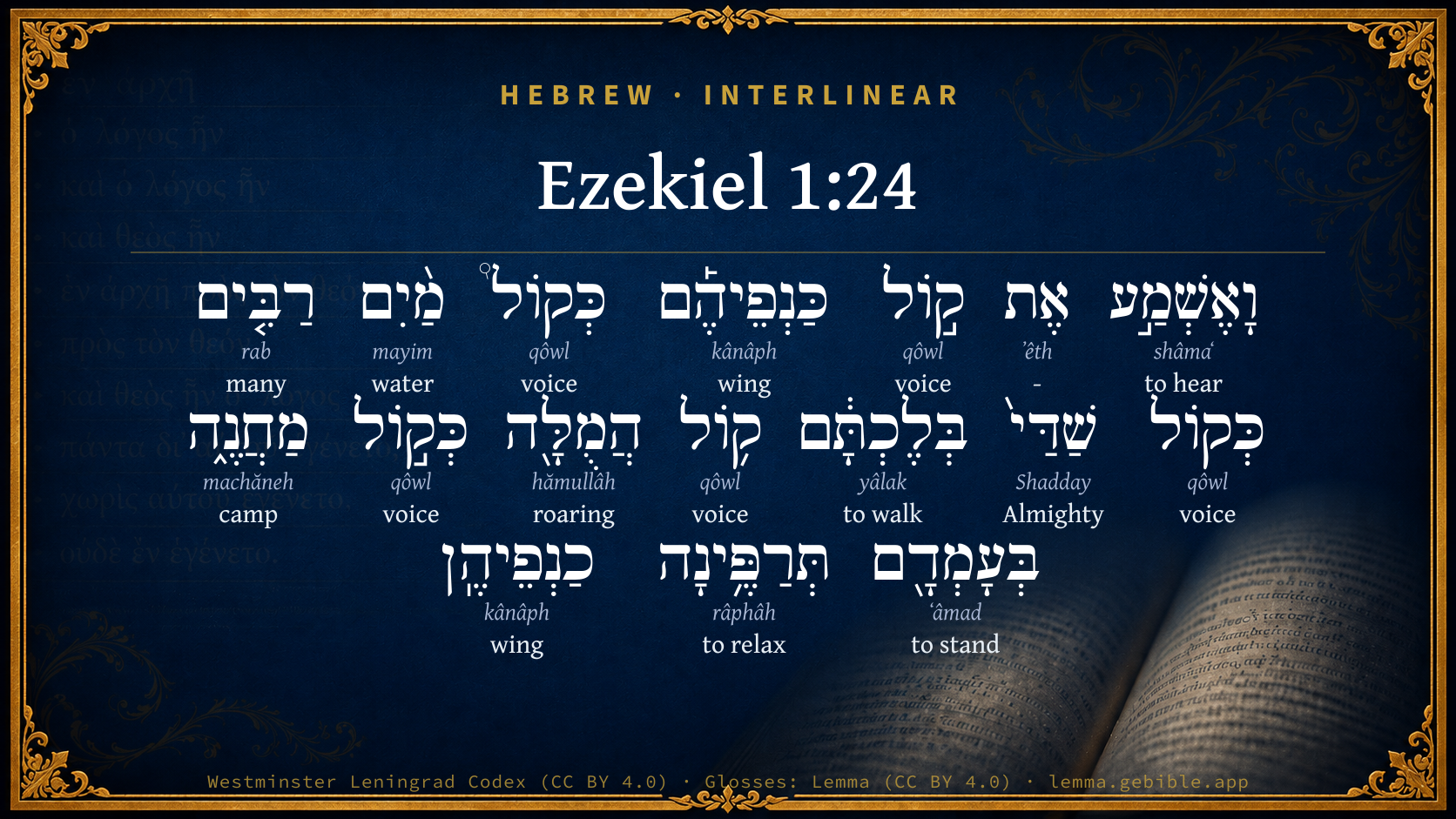
  1. וָאֶשְׁמַ֣ע shâmaʻ H8085 “and · to hear” Conjunction + Verb, Qal, Sequential Imperfect, 1st Person, Common, Singular
  2. אֶת ʼêth H853 “-” Particle, Direct Object
  3. ק֣וֹל qôwl H6963 “voice of” Noun, Common, Masculine, Singular, Construct
  4. כַּנְפֵיהֶ֡ם kânâph H3671 “wings · their” Noun, Common, Feminine, Dual, Construct + Suffix, Personal, 3rd Person, Masculine, Plural
  5. כְּקוֹל֩ qôwl H6963 “like/as · voice of” Preposition + Noun, Common, Masculine, Singular, Construct
  6. מַ֨יִם mayim H4325 “water(s)” Noun, Common, Masculine, Plural, Absolute
  7. רַבִּ֤ים rab H7227 “many” Adjective, Adjective, Masculine, Plural, Absolute
  8. כְּקוֹל qôwl H6963 “like/as · voice of” Preposition + Noun, Common, Masculine, Singular, Construct
  9. שַׁדַּי֙ Shadday H7706 “Almighty” Noun, Proper
  10. בְּלֶכְתָּ֔ם yâlak H3212 “in/at · to walk · them” Preposition + Verb, Qal, Infinitive Construct + Suffix, Personal, 3rd Person, Masculine, Plural
  11. ק֥וֹל qôwl H6963 “voice of” Noun, Common, Masculine, Singular, Construct
  12. כְּק֣וֹל qôwl H6963 “like/as · voice of” Preposition + Noun, Common, Masculine, Singular, Construct
  13. מַחֲנֶ֑ה machăneh H4264 “camp” Noun, Common, Both, Singular, Absolute
  14. בְּעָמְדָ֖ם ʻâmad H5975 “in/at · to stand · them” Preposition + Verb, Qal, Infinitive Construct + Suffix, Personal, 3rd Person, Masculine, Plural
  15. תְּרַפֶּ֥ינָה râphâh H7503 “to relax” Verb, Piel, Imperfect, 3rd Person, Feminine, Plural
  16. כַנְפֵיהֶֽן kânâph H3671 “wings · their” Noun, Common, Feminine, Dual, Construct + Suffix, Personal, 3rd Person, Feminine, Plural

About this verse

These counts appear in no published source. They are computed here, from the morphology-tagged text and Lemma’s own curated glosses. What Lemma adds →

17
words
12
distinct lemmas
Prophets
section

Notable vocabulary

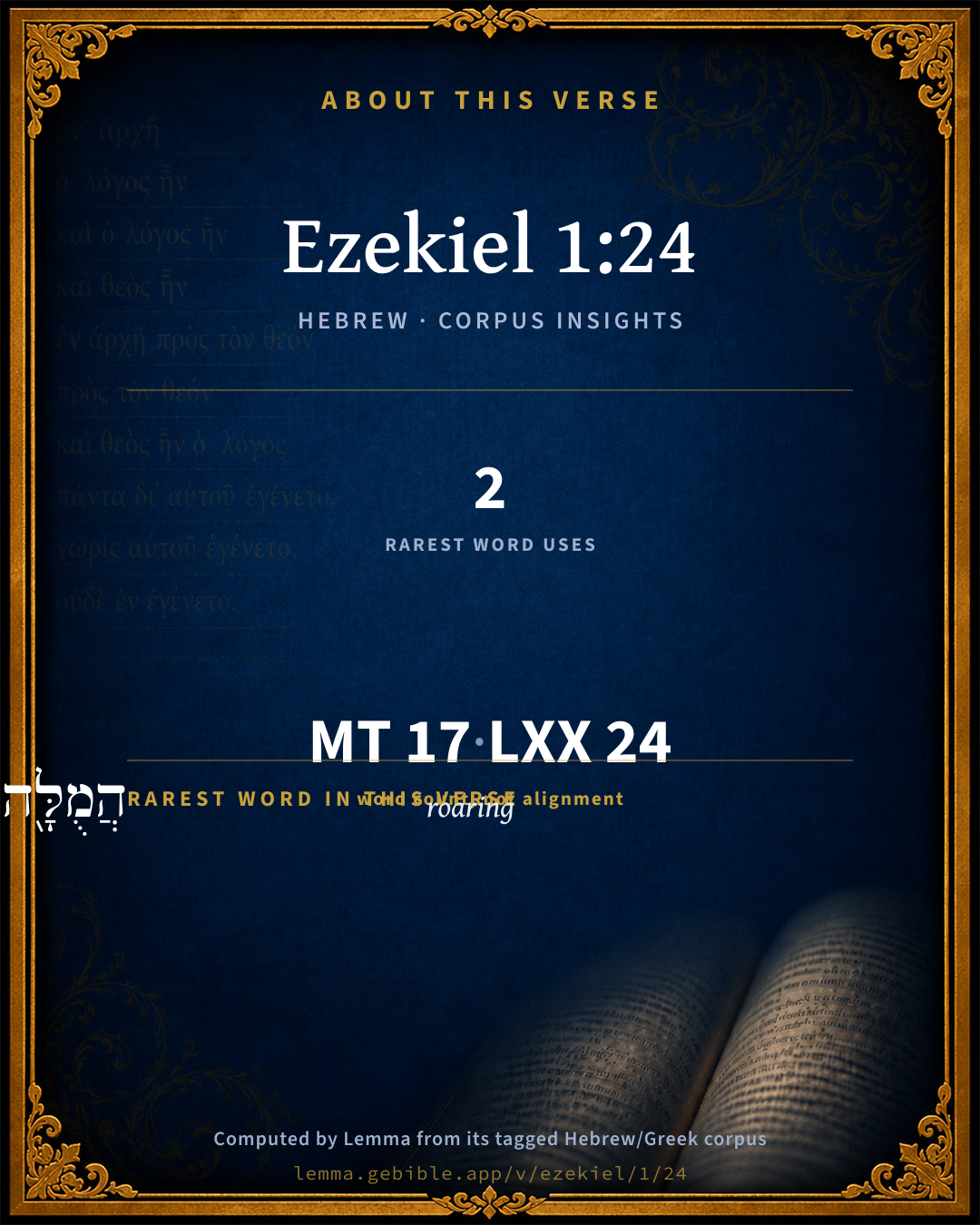
The rarest word here is הֲמֻלָּ֖ה roaring H1999 — appearing just 2 times in the whole Hebrew Bible.

Shared distinctive vocabulary

הֲמֻלָּ֖ה roaring H1999 occurs in 2 verses of the Hebrew Bible. Also found in:

Grammatical profile

  • 4 verbs
  • 11 nouns
  • 1 adjective
  • 1 particle

Verb forms

  • וָאֶשְׁמַ֣ע Qal · Sequential Imperfect
  • בְּלֶכְתָּ֔ם Qal · Infinitive Construct
  • בְּעָמְדָ֖ם Qal · Infinitive Construct
  • תְּרַפֶּ֥ינָה Piel · Imperfect

Repetition

Words recur within this verse — often emphatic in Hebrew:

  • ק֣וֹל voice H6963 ×5
  • כַּנְפֵיהֶ֡ם wing H3671 ×2

Hebrew & Septuagint length

In English translation the verse runs 40 words from the Hebrew and 26 from the Septuagint (LXX English) — the Septuagint runs noticeably shorter here. See the side-by-side →

A rough comparison of the two English renderings, which tokenize alike — not a word-level alignment.

Word counts can differ between the Hebrew and the Greek without any difference in meaning — e.g. the Hebrew direct-object marker אֵת has no separate Greek word, and Greek often adds the article ὁ.

In the original languages it is 17 Hebrew tokens and 24 Greek tokens — but the two are counted differently (Hebrew bundles its prefixes and suffixes into one token; the Greek is in lemma form), so that isn’t a like-for-like length.

Cross-references

11

Topical passages linked to Ezekiel 1:24 in the Treasury of Scripture Knowledge — connected by theme and wording, ordered by reader-vote popularity; previews shown in the World English Bible.

  • Ezekiel 43:2 Behold, the glory of the God of Israel came from the way of the east: and his voice was like the sound of many waters; and the earth shined with his glory.
  • Daniel 10:6 his body also was like the beryl, and his face as the appearance of lightning, and his eyes as flaming torches, and his arms and his feet like burnished brass, and the voice of his words like the voice of a multitude.
  • Psalms 29:3–9 Yahweh's voice is on the waters. The God of glory thunders, even Yahweh on many waters.
  • Revelation 1:15 His feet were like burnished brass, as if it had been refined in a furnace. His voice was like the voice of many waters.
  • Revelation 19:6 I heard something like the voice of a great multitude, and like the voice of many waters, and like the voice of mighty thunders, saying, "Hallelujah! For the Lord our God, the Almighty, reigns!
  • Psalms 68:33 To him who rides on the heaven of heavens, which are of old; Behold, he utters his voice, a mighty voice.
  • Psalms 18:13 Yahweh also thundered in the sky, The Most High uttered his voice: Hailstones and coals of fire.
  • Job 37:4–5 After it a voice roars. He thunders with the voice of his majesty; He doesn't hold back anything when his voice is heard.
  • Job 37:2 Hear, oh, hear the noise of his voice, The sound that goes out of his mouth.
  • 2 Kings 7:6 For the Lord had made the host of the Syrians to hear a noise of chariots, and a noise of horses, even the noise of a great host: and they said one to another, Behold, the king of Israel has hired against us the kings of the Hittites, and the kings of the Egyptians, to come on us.
  • Ezekiel 10:5 The sound of the wings of the cherubim was heard even to the outer court, as the voice of God Almighty when he speaks.

Cross-references courtesy of OpenBible.info (CC BY 4.0).

Hebrew and Greek witnesses Masoretic Hebrew ↔ Greek Septuagint

The same verse in the two great witnesses to the Old Testament, shown verse-for-verse.

Here the Septuagint runs noticeably shorter than the Hebrew — LXX2012 (modern English Septuagint) 26 words vs World English Bible 40. A rough length comparison of the two English translations, not a word-level alignment — read both below.

These are two independent witnesses, not word-aligned to each other, and the Septuagint is shown in lemma (dictionary) form.

Hebrew Ezekiel 1:24 Masoretic · Westminster Leningrad Codex

וָאֶשְׁמַ֣ע אֶת ק֣וֹל כַּנְפֵיהֶ֡ם כְּקוֹל֩ מַ֨יִם רַבִּ֤ים כְּקוֹל שַׁדַּי֙ בְּלֶכְתָּ֔ם ק֥וֹל הֲמֻלָּ֖ה כְּק֣וֹל מַחֲנֶ֑ה בְּעָמְדָ֖ם תְּרַפֶּ֥ינָה כַנְפֵיהֶֽן

When they went, I heard the noise of their wings like the noise of great waters, like the voice of the Almighty, a noise of tumult like the noise of a host: when they stood, they let down their wings.

World English Bible · Public Domain

Greek LXX Ezekiel 1:24 Septuagint · lemma form

καί ἀκούω ὁ φωνή ὁ πτέρυξ αὐτός ἐν ὁ πορεύομαι αὐτός ὡς φωνή ὕδωρ πολύς καί ἐν ὁ ἵστημι αὐτός καταπαύω ὁ πτέρυξ αὐτός

And I heard the sound of their wings when they went, as the sound of much water: and when they stood, their wings were let down.

LXX2012 (modern English Septuagint) · Public Domain

On this verse, The Cambridge Bible for Schools and Colleges discusses the Septuagint’s reading. Read the note in Commentary ↓

Hebrew: Westminster Leningrad Codex (CC BY 4.0). Greek: Septuagint (public domain); English from LXX2012 (modern English Septuagint) (Public Domain). How the Septuagint differs from the Hebrew →

Targum (Aramaic paraphrase)

1

The Targum is the ancient Jewish Aramaic paraphrase of the Hebrew Scriptures — an interpretive translation, not the Hebrew text itself. Onkelos (literal) and Pseudo-Jonathan (expansive) render the Torah, and Jonathan the Prophets. Coverage is partial: where no permissively-licensed English translation exists for a verse, only the Aramaic is shown. This is verse-level text, not a word-by-word alignment to the Hebrew.

  1. Targum Jonathan Prophets (Joshua–Malachi)
    וּשְׁמָעִית יַת קַל גַפֵּיהֶן כְּקַל מַיִין סַגִיאִין כְּקָלָא מִן קֳדָם שַׁדַי בִּמְהָכְהֵן קָל מִלוּלֵיהֶן כַּד מוֹדָן וּמְבָרְכִין יַת רִבּוֹנְהוֹן קַיָמָא מֶלֶךְ עָלְמַיָא כְּקָל מַשִׁרְיָת מַלְאֲכֵי מְרוֹמָא בִּמְקָמְהֶן מְשַׁתְקָן גַפֵּיהֶן מִן קֳדָם דִבּוּרָא:

    (no public-domain English translation for this verse)

    Targum Jonathan — Aramaic: “Mikraot Gedolot” (public domain). English: “Sefaria Community Translation” (CC0 1.0 (public-domain dedication)); “London "Chaldee Paraphrase," 1871” (public domain). Text via Sefaria.

Commentary

Notes on Ezekiel 1:24 from classic Christian and Jewish commentators (each source and its license shown beneath its notes). The classic Christian expositions comment on the surrounding passage and are grouped to its opening verse, so a note may address several verses; the Jewish commentaries on the Tanakh (Rashi and others) are per-verse, so they appear only where the commentator wrote on this verse.

Lemma curates 59 commentaries, every one of them public domain or Creative Commons licensed, each selected and text-cleaned for this edition rather than reprinted as found. About our sources →

The Cambridge Bible for Schools and Colleges

gen. ed. J. J. S. Perowne

24. The sound of the wings of the living creatures when in flight was as the noise of many waters, as the thunder, or, as the roar of a host.

voice of the Almighty] that is, the thunder, Psa_29:3; Job_37:4. The comparison to waters occurs again, ch. Eze_43:2, and that to the voice of the Almighty, ch. Eze_10:5 (God Almighty). The name Almighty (Heb. shaddai, of uncertain derivation) occurs alone chiefly in poetical pieces, e.g. about thirty times in Job, a few times in prophecy (Isa_13:6 = Joe_1:15; Eze_1:24) and in the idyl of Ruth (Eze_1:20-21); but in prose has the word “God” (El) prefixed to it (Gen_17:1).

the voice of speech] Rather: noise of tumult, as Jer_11:16, where the word appears to occur again. The rendering “speech,” though that of the ancient versions, assumes a different pronunciation. As to noise of a “host” cf. Isa_17:12, Joe_2:5. LXX. omits all the comparisons except the first, as in ch. Eze_43:2, unless Jerome is to be followed, who vindicates here for LXX. what is usually ascribed to Theodotion.

The Cambridge Bible for Schools and Colleges (gen. ed. J. J. S. Perowne; Cambridge University Press, 1878–1918) — public domain. Text from a community e-Sword module.

Trapp's Complete Commentary

John Trapp

Eze 1:24 And when they went, I heard the noise of their wings, like the noise of great waters, as the voice of the Almighty, the voice of speech, as the noise of an host: when they stood, they let down their wings.

Ver. 24. And when they went, I heard the noise of their wings.] A very great noise, as is here set forth by a threefold similitude - Congeries similium faciens ad amplificationem.

Like the noise of great waters.] Which fall with a horrible fragor, as with the catadupes, for instance. See Psa 46:3.

As the noise of the Almighty,] i.e., As thunder. {Psa 29:4; Psa 18:13}

The voice of speech.] When a man crieth aloud, lifteth up his voice like a trumpet, sic clamans ut stentora vincat.

As the noise of an host] Barritus ille milltarls, besides the roaring of cannons, rattling of wheels, beating of drums, &c. This none hear but the spiritual man, who "discerneth all things," {1Co 2:15} and hath his senses habitually exercised to discern good and evil. {Heb 5:14}

They let down their wings.] As expecting a new commission.

John Trapp, A Commentary or Exposition upon All the Books of the Old and New Testament (1647–1656) — public domain. Text from a community e-Sword module.

Geneva Bible (1599)

Geneva Bible translators

Which signified that they had no power of themselves, but only waited to execute God’s commandment.

Which declared the swiftness and the fearfulness of God’s judgments.

Geneva Bible (1599) marginal notes — public domain. Text via Bolls.life.

Jamieson, Fausset & Brown

Robert Jamieson, A. R. Fausset & David Brown

voice of . . . Almighty--the thunder (Psa 29:3-4).

voice of speech--rather, "the voice" or "sound of tumult," as in Jer 11:16. From an Arabic root, meaning the "impetuous rush of heavy rain."

noise of . . . host-- (Isa 13:4; Dan 10:6).

Jamieson, Fausset & Brown — Commentary Critical and Explanatory on the Whole Bible (1871) — public domain (CC PDM 1.0). Text via the HelloAO Bible API.

Adam Clarke's Commentary

Verse 24. The noise of their wings] When the whirlwind drove the wheels, the wind rustling among the wings was like the noise of many waters; like a waterfall, or waters dashing continually against the rocks, or rushing down precipices.

As the voice of the Almighty] Like distant thunder; for this is termed the voice of God, Ps 18:13; Ex 9:23; Ex 9:28-29; Ex 20:18.

Adam Clarke's Commentary on the Bible (1810–1826) — public domain. Text from a community e-Sword/MySword module.

John Calvin's Commentaries

When the Prophet says, he heard the voice of wings, it is an explanation of his former teaching, when he said that the wings followed the course of the living creatures, and stood, unless when they were drawn by the living creatures: this he now expresses more clearly by the word voice We know that, precepts are expressed by the voice, and this is the means of human intercourse, so that he who bears sway proclaims by the voice what he wishes to be done. Since therefore what we have previously said was obscure — that the wheels were moved by the living creatures — therefore the Prophet says there was a voice in the motion of the wings He had said this before, and he now repeats that the living creatures sometimes rested and let fall their wings. When the wings were thus let fall there was no motion in the wheels; but as the wheels obey the motions of the living creatures, he says the wings were vocal; not that the wheels were endued with ears or could hear any commands. But the Prophet could not otherwise express what I have just said: viz., that heaven and earth are full of angelic motion, unless he said that in such motion there was something like a voice, as he said that whatever happens obeys God’s will. But this obedience cannot be conceived unless a voice go before it. Now therefore we see the Prophet weaving his own discourse, and by a new form of speech expressing and confirming what we formerly saw — that the wheels were mowed by the living creatures, because in the wings themselves a voice was heard, he adds, it was as it were a voice many or mighty waters We know that a great noise arises from the overflow of art impetuous river. Nothing is more terrible than its sound, for it is something like a crash which seems to threaten the breaking up of the whole earth, and this vehemence the Prophet now expresses. He adds, a voice of God It will be harsh to explain this of God himself, to whom although the phrase is often attributed, yet we know that it is done metaphorically. But there ought to be some external likeness which may show the Prophet what was not visible of itself. But that cannot suit the phrase, “the voice of God,” unless we understand it as in Psalm 29:5, 6, 9, concerning thunder: the voice of God shakes the cedars and the mountains, and makes the animals miscarry in the woods. Here David calls thunder the voice of God, but I know not whether this metaphor is suitable to the present place. Nor yet if we could take the word of God in another sense, could it mean anything but thunder. Others translate שדי, shedi, brave or violent, which suits tolerably well, unless a general form of speech is not sufficiently fitted to this place. For those images of things ought to be set before the mind of the Prophet that tend to raise it upwards. Besides, if he had said simply the voice of a strong or violent man, it would imply but little, so I dare not reject the meaning — thunder; and if this exposition is unsatisfactory to any one, yet the meaning will still be a loud and terrific voice, because Scripture calls cedars and mountains, cedars and mountains of God, on account of their superior excellence. (Psalm 80:11; Psalm 36:6.)

He says, when they walked, because there was no other motion, for he said that the wings of the animals were let fall while they stood. Then it was not necessary for earthly things to be agitated, unless when the inspiration goes forward in the living creatures, that is the angels. He adds, the voice of speech Here Ezekiel proceeds further, asserting the voice to be articulate. True, inanimate things cannot hear a voice, but as I have said, he wished to represent the obedience in the wheels to be such as if they had been taught, and God had eloquently and articulately commanded what he wished to be done; or as if the wheels had spoken intelligibly, so that the wheels might not afterwards roll round rashly, but in accordance with a received command. He says, as it were the voice of armies And the simile is to be diligently noticed, because in an army, in consequence of the multitude, one can scarcely notice another with the view of promoting union, and yet military discipline requires this. Therefore, in camps there is great clamor and confusion, yet each accommodates himself to others, and so order is preserved. The Prophet therefore signifies, that although infinitely numerous events meet together, yet nothing is left without guidance, because God governs all earthly motions with much better skill than a general, though endued with singular foresight, rules his army. We see therefore what the Spirit intends by this part of the vision, when he compares the things that are carried on in the world to mighty forces; for he says that such reason was displayed among this multitude, that although their clamors are tumultuous, yet all things are mutually suited to each other. Again he says, when they stood they let down their wings This question may be asked, how can the living creatures rest when God is always at work: as also Christ says, My Father and I work even to this day? (John 5:17.) Since therefore the power of God is never at rest, what can the resting of the living creatures mean? for God works by angels as we have seen: if they rest, God has his periods of repose, which is absurd. But when the Prophet says they rested, he wishes to mark the variety of human events. For sometimes they are so tranquil, that we think God is taking some repose, and is completely at rest in heaven: not that he ever ceases, but because we do not perceive the agitations, which plainly show his virtue to consist in motion and in action. Therefore the Prophet here wishes only to denote variety; not that we ought to imagine God to rest at any time or his angels to repose, but because he does not always work in the same equable manner.

John Calvin's Commentaries (1540-1563) — public domain. Text from the Calvin Translation Society English edition (1840s-50s) via the Christian Classics Ethereal Library (ccel.org). Calvin's coverage is partial (roughly two-thirds of the Bible); uncommented books and verses are honest gaps, never fabricated. The 19th-century editor's footnotes and remarks are omitted so the notes are faithfully Calvin's own voice.

Ellicott's Commentary for English Readers

(24) The noise of their wings.—The same word translated “noise” three times in this verse is also translated “voice” twice here, and once in the next verse. It is better to keep voice throughout. “I heard the voice of their wings, like the voice of many waters.” The same comparison is used to describe the voice of God in Eze_43:2; Rev_1:15. Further attempts to convey an impression of the effect are :—“ As the voice of the Almighty,” by which thunder is often described in Scripture (Job_37:4-5; Psa_29:3-4); “the voice of speech,” by which is not to be understood articulate language. The word occurs elsewhere only in Jer_11:16, and is there translated a tumult. The idea conveyed by the word is probably that of the confused sound from a great multitude, and, finally, “as the voice of an host.” All these comparisons concur in representing a vast and terrible sound, but inarticulate.

A Bible Commentary for English Readers, edited by Charles John Ellicott (1878–1897) — public domain. Text from a community e-Sword module.

John Gill's Exposition

And when they went,.... In their ministrations, preaching the Gospel, and administering ordinances:

I heard the noise of their wings, like the noise of great waters: so the voice of Christ, which is no other than his Gospel preached by his ministers, is said to be as the sound of many waters, Rev 1:15; which is heard a great way off, as the Gospel ministry is, even to the ends of the earth; thither the sound of the apostles' words reached, Rom 10:18; and which, as they move with great force, yield a pleasant sound of and may denote both the energy of the word, and the delightfulness of it:

as the voice of the Almighty; the Gospel being the word of God, and not of man; which is quick and powerful, and full of majesty, and works effectually in them that believe:

the voice of speech; an articulate voice, a human one, pronounced by men, whom God employs to deliver out his mind and will:

as the noise of an host; the church being militant, to whom they minister; so that their voice, in their ministry, is sometimes reproving, convincing, confuting, contending, and disputing, as well as teaching and instructing. The Targum is,

"and the voice of their words, when they confess and bless the Lord, the living everlasting King, is as the voice of the host of angels on high:''

when they stood, they let down their wings; those two with which they flew, and with them covered their faces, or some part of their bodies, as ashamed of their own unworthiness and imperfections; or this may denote their having done their work, and finished their course.

John Gill's Exposition of the Whole Bible (1746–1763) — public domain (CC PDM 1.0). Text via the HelloAO Bible API.

Albert Barnes' Notes on the Bible

The voice of the Almighty - Thunder.

The voice of speech - Rendered in Jer 11:16 “a great tumult.” Some take it to describe the rushing of a storm.

Albert Barnes' Notes on the Bible (1834–1885) — public domain. Text from a community e-Sword/MySword module.

Haydock's Catholic Bible Commentary

Voice. The motion of the wings made a noise like a torrent, or thunder. --- God. Hebrew, "self-sufficient," as Septuagint, &c., render it, Greek ikanou. (Calmet) --- Protestants, "like the voice of the Almighty." (Haydock) --- Down; or rather ceased to make such a noise, ver. 25. (Calmet)

George Leo Haydock (1774–1849), Haydock's Catholic Family Bible and Commentary, 1859 edition — public domain. Excludes Psalms (Douay-Rheims chapter numbering differs from Protestant) and Deuterocanonical books (Catholic canon only).

Matthew Poole's English Annotations

And when they went; so soon and as often as they, i.e. the living creatures, moved, were on their work, executing God’s commands.

I heard, and attended to know what it was.

The noise of their wings: though some of God’s judgments are executed with silence, and are in the dark, yet here is an alarm, and they may be heard.

Like the noise of great waters: when the sea rageth and swells as though it would overwhelm the earth, so when the just and dreadful judgments of God are executed, they threaten the overflowing of all.

As the voice of the Almighty; thunder, called God’s voice, Psa 29:3. The voice of speech; the prophet heard the voice in an articulate manner declaring the will of God, as if the wings had tongues to speak as well as power to fly.

As the noise of an host: this voice was not of friends saluting each other, or comforting, but it was the voice and noise of a host, a tumultuous voice of men, a confused noise of warlike weapons and instruments; some suppose it is meant of the army of the Chaldeans, which those winged living creatures had now fetched in to spoil the Jews, which they did with terrible outcries, as enraged, merciless adversaries use to do.

When they stood, they let down their wings; having done their office, they present themselves before God, and let down their wings, not out of weariness, but out of a sense that they must never act but by commission. And now with wings let down and covering their bodies, they do humbly watch as servants for the commands of their lord.

Matthew Poole's English Annotations on the Holy Bible (1683–1685) — public domain. Text from a community e-Sword/MySword module.

Whedon's Commentary on the Bible

Daniel D. Whedon

24. The noise of their wings — If it had not been for the noise one could not have known the wings were being used for locomotion. They moved so swiftly and with such perfect regularity that they always appeared outstretched; as if the tips of each pair were joined together (Eze_1:11).

The sound seemed to the hearer like the roar of the surf on the rocky shore of the Mediterranean; like the voice of Jehovah when the “God of glory thundereth” (Psa_29:3); like a distant tumult (Jer_11:16).

A voice is in the wind I do not know;

A meaning on the face of the high hills

Whose utterance I cannot comprehend;

A something is behind them; this is God.

— Macdonald.

They let down their wings — This was their destination. This wondrous chariot of God stopped before the dazzled eyes of the prophet. Had it come to take him away from this heathen country? Was he to be translated like Elijah?

Daniel D. Whedon (gen. ed.), Commentary on the Old and New Testaments (1874–1909) — public domain. Text from a community e-Sword module.

The Pulpit Commentary

The noise of their wings, etc. The wings representing the soaring, ascending elements in nature, their motion answers to its aspirations, their sounds to its inarticulate groanings (Rom_8:26) or its chorus of praise. The noise of great waters may be that of the sea, or river, or torrents. Ezekiel"s use of the term in Eze_31:7, in connection with the cedars of Lebanon, seems in favour of the last. On the other hand, in Eze_27:26; Psa_29:3 Psa_107:23, the term is manifestly used for the seas. The thought appears again in Rev_1:15 Rev_19:6; in Psa_29:3, et al., the "voice of the Lord" is identified with thunder. For the voice of speech, which wrongly suggests articulate utterance, read, with the Revised Version, a noise of tumult.

The Pulpit Commentary (1880–1919), ed. H.D.M. Spence-Jones & Joseph S. Exell — public domain. Text from a community e-Sword module.

John Wesley's Explanatory Notes

The voice - Thunder. Speech - The prophet heard the voice in an articulate manner. An host - A tumultuous voice of men. Stood - Having done their office they present themselves before God, waiting for the commands of their Lord.

John Wesley, Explanatory Notes Upon the Whole Bible (1754–1765) — public domain. Text via the GEBible commentary corpus.

unfoldingWord translationNotes

Door43 World Missions Community

General Information:

Ezekiel continues to tell about his vision of the living creatures.

Then I heard the sound of their wings. Like the noise of many waters. Like the voice of the Almighty whenever they moved. Like

Other possible meanings are that the words "whenever they moved" refer to 1) all the words before them in this verse, "Whenever they moved, I heard the sound of their wings. Like the noise of rushing water. Like the voice of the Almighty. Like" or 2) to the words that follow, "wings. Like the noise of rushing water. Like the voice of the Almighty. Whenever they moved, it sounded like."

Like ... waters. Like ... moved. Like ... rainstorm. Like ... army.

These sentences are not complete because Ezekiel was showing that he was excited about what he saw. They can be translated as complete sentences: "The wings sounded like ... water. They sounded like ... moved. They sounded like ... rainstorm. They sounded like ... army." (See: Simile)

many waters

This simply means "a lot of water." It could refer to a loud river or a large waterfall or the waves crashing at the ocean. All of these are very loud.

Like the voice of the Almighty

The Bible sometimes refers to thunder as "the voice of the Almighty." AT: "It sounded like the voice of the Almighty God" or "It sounded like the thunder of the Almighty" (See: Metonymy)

Like the sound of a rainstorm

Possible meanings are: 1) "Like the sound of very big storm" or 2) "Like the sound of a very large crowd of people" AT: "There was a sound that was loud like a big storm" or "There was a sound that was loud like a very large crowd of people" (See: Simile)

Whenever they stood still

"Whenever the creatures stopped moving"

they lowered their wings

"the creatures let their wings hang down by their sides." They did this when they were not using their wings to fly.

A voice came from above the dome

"Someone who was above the dome spoke." If you need to tell whose voice this is, you should probably identify it as the voice of Yahweh (Ezekiel 1:3).

the dome over their heads

"the dome that was over the heads of the creatures"

the dome

See how you translated this in Ezekiel 1:23.

translationWords

voice

Almighty

unfoldingWord translationNotes — © Distant Shores Media and the Door43 World Missions Community, licensed CC BY-SA 4.0. Source: git.door43.org/Door43/en_tn.

Rashi

Rabbi Shlomo Yitzchaki (Rashi)

like the sound of many waters I would think that the voice was low. Therefore, Scripture adds: like the sound of the Almighty, like the voice delineated in the Holy Writings (Ps. 29:4f.): “The voice of the Lord is in strength, etc. The voice of the Lord breaks the cedars.”

the sound of stirring, like the sound of a camp Like the sound of their speech when they thank and bless their Master; it was like the sound of the camp of the angels on high.

when they would stand, they would let down their wings [and cease] from making a sound be heard, and Jonathan rendered: when they would stand, they would silence their wings because of the speech, [i.e., because of] the speech of the Omnipresent emanating from above their heads, to let the prophets hear His mission, as he [Ezekiel] concludes (verse 25): “And there was a voice, etc.” The Midrash Aggadah (Gen. Rabbah 65:11) states: “When they would stop praising [God] so that Israel would praise first.”

Rashi on the Tanakh — English translations: “The Judaica Press complete Tanach with Rashi, translated by A. J. Rosenberg” (CC BY 4.0); “Pentateuch with Rashi's commentary by M. Rosenbaum and A.M. Silbermann, 1929-1934” (public domain); “The Metsudah Tanach series, Lakewood, N.J” (CC BY 4.0); and “The Book of Joshua, Metsudah Publications, 1997” (CC BY 4.0). Text via Sefaria.

Lesson kit

Teaching starters — assembled from the data on this page, not authored interpretation. Every prompt links to the verse data it draws on. Edit before teaching.

Ezekiel, in the Prophets, opens this verse with 17 words (12 distinct Hebrew lemmas). Its most distinctive word is hămullâh (“roaring”). The Greek Septuagint runs shorter here. A historical commentator’s framing appears above. Read the whole chapter for the surrounding context.

Discussion questions

  1. The word hămullâh carries the sense “roaring.” How does it shape the verse?
  2. Jeremiah 11:16 shares the word «roaring» with this verse. How do the two illuminate each other?
  3. “voice” occurs 5× in this one verse. What is the effect of the repetition?
  4. Compared with the Hebrew, the Septuagint runs shorter here. What questions does that raise?
  5. These translations render this verse differently. What is at stake in choosing one wording over another?
  6. The verb «וָאֶשְׁמַ֣ע» is Qal Sequential Imperfect. How does its form color the action?
  7. Reading how The Cambridge Bible for Schools and Colleges and Trapp's Complete Commentary read this verse, where do the two commentators agree and where do they part?

Things to notice

Reading settings

Reading text

Shown beneath each verse's original-language words.

Old Testament
Old Testament edition

Read the OT as the Masoretic Hebrew (MT) or the Greek Septuagint (LXX).

English shown for the Greek Septuagint (in the Hebrew ↔ Greek comparison).

Comparing translations? Open the Compare panel on any verse page to stack up to four side by side.