Psalms 71:20

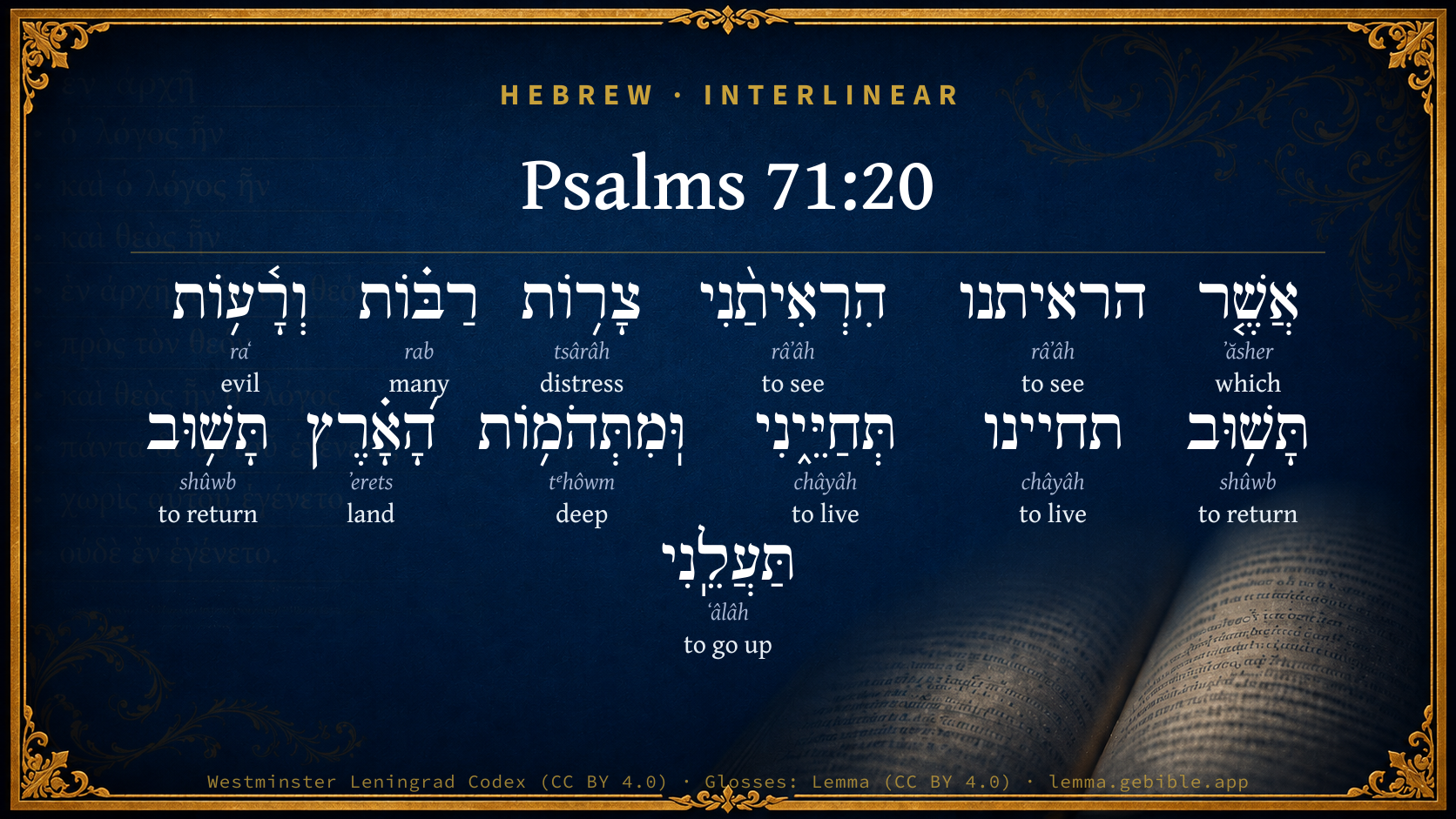
Hebrew (Westminster Leningrad Codex) Psalms 71:20 appears in the Hebrew Old Testament. The text above is from the Westminster Leningrad Codex. Each word links to its Strong’s number, a concise gloss, and parsing drawn from the Open Scriptures Hebrew Bible morphology. Click any word for its full Brown-Driver-Briggs (BDB) entry.
Download image
Cite this verse

Psalms 71:20 (World English Bible). Public Domain. Lemma interlinear Bible study tool, https://lemma.gebible.app/v/psalms/71/20.

Show BibTeX & RIS
BibTeX
RIS
English Translation
You, who have shown us many and bitter troubles, You will let me live. You will bring us up again from the depths of the earth.
World English Bible · Public Domain
Download a study sheet

One document with this verse’s original text, its word-by-word gloss line, the meaning frame, cross-references with their text, attributed commentary, and full source and license credits — printable, and it pastes into notes with its structure intact.

This verse Autodidact and up

Study sheet (.html) Plain text (.txt)

A passage Seminary Student

Up to 50 verses in one chapter. A passage sheet keeps up to 6 commentary sources and 12 cross-references per verse, in the order this page ranks them, and says so on the sheet whenever that leaves anything out. Ask for a single verse and you get the Autodidact verse sheet above.

Everything on this page stays free to read, with no account — the sheet is a download of what is already on screen, not access to it.

Want to remove ads? Support Godless Engineer
Compare translations 3

The same verse in 3 English versions, stacked beneath the original-language interlinear above. Click any original word for its lexicon entry.

Each is an independent rendering of the whole verse — the interlinear is not word-aligned to these translations.

Highlighted words mark where these versions differ — a whole-verse word diff, not a word-by-word alignment.

  • World English Bible Public Domain
    You, who have shown us many and bitter troubles, You will let me live. You will bring us up again from the depths of the earth.
  • King James Version Public Domain
    Thou, which hast shewed me great and sore troubles, shalt quicken me again, and shalt bring me up again from the depths of the earth.
  • unfoldingWord Literal Text CC BY-SA 4.0
    who have made me see many and evil troubles, may you return, may you revive me, and may you return, may you bring me up from the depths of the earth.

unfoldingWord Literal Text — © unfoldingWord, licensed CC BY-SA 4.0. Word-aligned USFM3 via Door43 (git.door43.org/unfoldingWord/en_ult).

Versions to compare (up to 4)

3 of 4 selected

Show all 18 translations

Every available English version of this verse, each an independent rendering of the whole verse.

  • World English Bible Public Domain
    You, who have shown us many and bitter troubles, You will let me live. You will bring us up again from the depths of the earth.
  • Berean Standard Bible Public Domain
    Though You have shown me many troubles and misfortunes, You will revive me once again. Even from the depths of the earth You will bring me back up.
  • Majority Standard Bible Public Domain
    Though You have shown me many troubles and misfortunes, You will revive me once again. Even from the depths of the earth You will bring me back up.
  • King James Version Public Domain
    Thou, which hast shewed me great and sore troubles, shalt quicken me again, and shalt bring me up again from the depths of the earth.
  • American Standard Version (1901) Public Domain
    Thou, who hast showed us many and sore troubles, Wilt quicken us again, And wilt bring us up again from the depths of the earth.
  • Revised Version (1885) Public Domain
    Thou, which hast shewed us many and sore troubles, shalt quicken us again, and shalt bring us up again from the depths of the earth.
  • Geneva Bible (1599) Public Domain
    Which hast shewed me great troubles and aduersities, but thou wilt returne, and reuiue me, and wilt come againe, and take mee vp from the depth of the earth.
  • Douay-Rheims (1899) Public Domain
    How great troubles hast thou shewn me, many and grievous: and turning thou hast brought me to life, and hast brought me back again from the depths of the earth:
  • Young's Literal Translation Public Domain
    Because Thou hast showed me many and sad distresses, Thou turnest back -- Thou revivest me, And from the depths of the earth, Thou turnest back -- Thou bringest me up.
  • Literal Standard Version CC BY-SA 4.0
    Because You have showed me many and sad distresses, || You turn back—You revive me, || And from the depths of the earth, || You turn back—You bring me up.
  • Unlocked Literal Bible CC BY-SA 4.0
    You who made me see many troubles will revive us again and will bring us up again from the depths of the earth.
  • unfoldingWord Literal Text CC BY-SA 4.0
    who have made me see many and evil troubles, may you return, may you revive me, and may you return, may you bring me up from the depths of the earth.
  • Darby Bible Public Domain
    Thou, who hast shewn us many and sore troubles, wilt revive us again, and wilt bring us up again from the depths of the earth;
  • World Messianic Bible Public Domain
    You, who have shown us many and bitter troubles, you will let me live. You will bring us up again from the depths of the earth.
  • Webster's Bible Public Domain
    Thou, who hast shown me great and severe troubles, wilt revive me again, and wilt bring me again from the depths of the earth.
  • Free Bible Version CC BY-SA 4.0
    You had me face many troubles and plenty of misery, but you will bring me back to life; you will rise me up from the depths of the earth.
  • Bible in Basic English Public Domain
    You, who have sent great and bitter troubles on me, will give me life again, lifting me up from the deep waters of the underworld.
  • JPS Tanakh (1917) Public Domain
    Thou, who hast made me to see many and sore troubles, wilt quicken me again, and bring me up again from the depths of the earth.

Literal Standard Version (2020), Covenant Press — licensed CC BY-SA 4.0. Text via the HelloAO Bible API (eBible.org). Unlocked Literal Bible (unfoldingWord) — licensed CC BY-SA 4.0. Text via the HelloAO Bible API (eBible.org). unfoldingWord Literal Text — © unfoldingWord, licensed CC BY-SA 4.0. Word-aligned USFM3 via Door43 (git.door43.org/unfoldingWord/en_ult). Free Bible Version, Dr. Jonathan Gallagher — licensed CC BY-SA 4.0. Text via the HelloAO Bible API (eBible.org).

Word by word

More ways to search: Search by grammar → Find every occurrence → Compare this word →

Practice this passage: Drill this verse → Learn its vocabulary →

וּֽמִתְּהֹמ֥וֹת
tᵉhôwm
H8415
“and · from · depths of”
Conjunction + Preposition + Noun, Common, Both, Plural, Construct
Part of Speech
Conjunction + Preposition + Noun
Type
Common
Gender
Both
Number
Plural
State
Construct
Full BDB Definition

Origin: from H1949

TWOT: 2495a

deep, depths, deep places, abyss, the deep, sea - deep (of subterranean waters) - deep, sea, abysses (of sea) - primeval ocean, deep - deep, depth (of river) - abyss, the grave
  1. אֲשֶׁ֤ר ʼăsher H834 “which” Particle, Relative
  2. הראיתנו râʼâh H7200 “to see · us” Verb, Hiphil, Perfect, 2nd Person, Masculine, Singular + Suffix, Personal, 1st Person, Common, Plural
  3. הִרְאִיתַ֨נִי râʼâh H7200 “to see · me” Verb, Hiphil, Perfect, 2nd Person, Masculine, Singular + Suffix, Personal, 1st Person, Common, Singular
  4. צָר֥וֹת tsârâh H6869 “distresses” Noun, Common, Feminine, Plural, Absolute
  5. רַבּ֗וֹת rab H7227 “many” Adjective, Adjective, Feminine, Plural, Absolute
  6. וְרָ֫ע֥וֹת raʻ H7451 “and · evil” Conjunction + Adjective, Adjective, Feminine, Plural, Absolute
  7. תָּשׁ֥וּב shûwb H7725 “to return” Verb, Qal, Imperfect, 2nd Person, Masculine, Singular
  8. תחיינו châyâh H2421 “to live · us” Verb, Piel, Imperfect, 2nd Person, Masculine, Singular + Suffix, Personal, 1st Person, Common, Plural
  9. תְּחַיֵּ֑ינִי châyâh H2421 “to live · me” Verb, Piel, Imperfect, 2nd Person, Masculine, Singular + Suffix, Personal, 1st Person, Common, Singular
  10. הָ֝אָ֗רֶץ ʼerets H776 “the · land” Particle, Definite Article + Noun, Common, Both, Singular, Absolute
  11. תָּשׁ֥וּב shûwb H7725 “to return” Verb, Qal, Imperfect, 2nd Person, Masculine, Singular
  12. תַּעֲלֵֽנִי ʻâlâh H5927 “to go up · me” Verb, Hiphil, Imperfect, 2nd Person, Masculine, Singular + Suffix, Personal, 1st Person, Common, Singular

About this verse

These counts appear in no published source. They are computed here, from the morphology-tagged text and Lemma’s own curated glosses. What Lemma adds →

13
words
10
distinct lemmas
Wisdom
section

Shared distinctive vocabulary

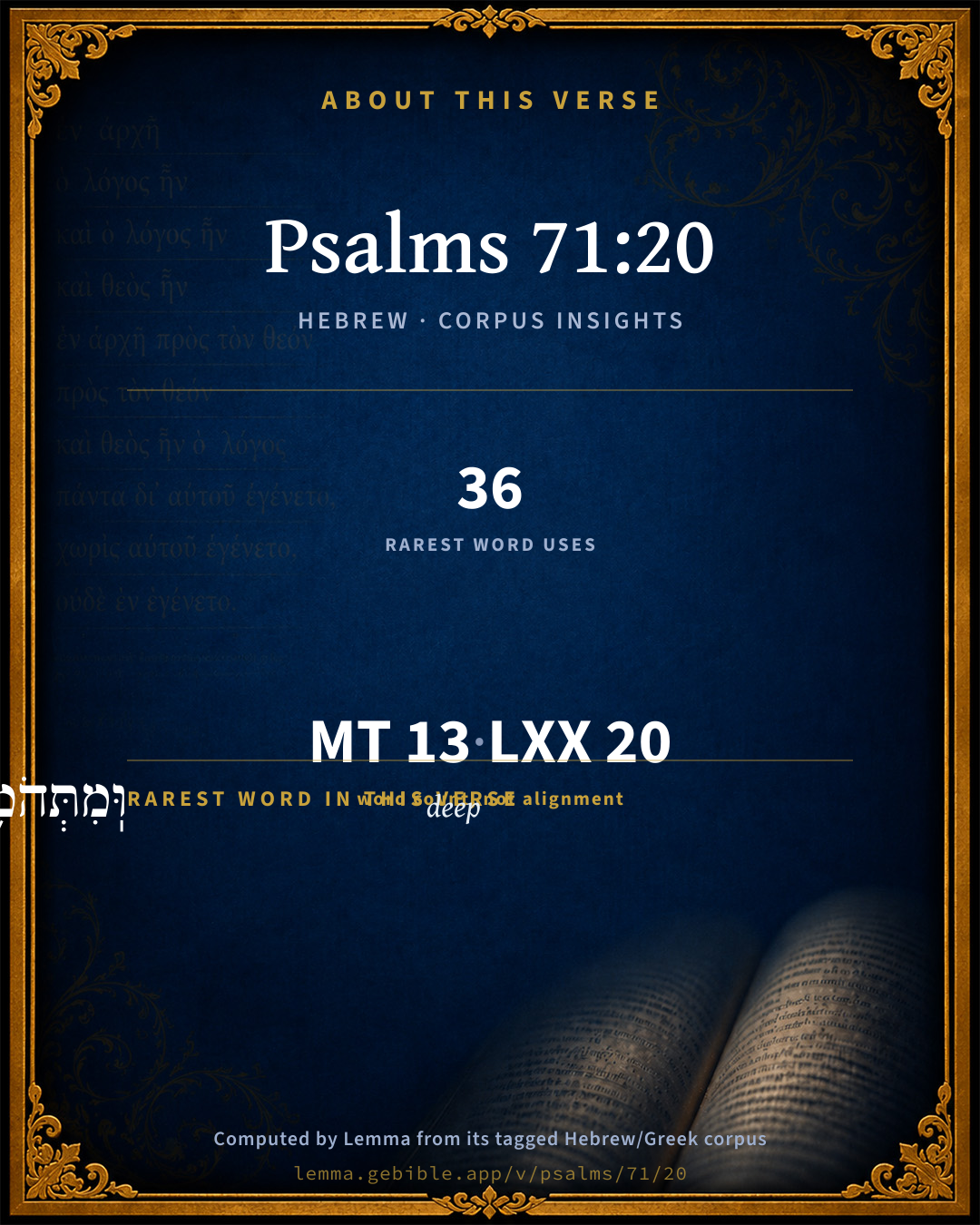
וּֽמִתְּהֹמ֥וֹת deep H8415 occurs in 35 verses of the Hebrew Bible. Also found in:

Grammatical profile

  • 7 verbs
  • 3 nouns
  • 2 adjectives
  • 1 particle

Verb forms

  • הראיתנו Hiphil · Perfect
  • הִרְאִיתַ֨נִי Hiphil · Perfect
  • תָּשׁ֥וּב Qal · Imperfect
  • תחיינו Piel · Imperfect
  • תְּחַיֵּ֑ינִי Piel · Imperfect
  • תָּשׁ֥וּב Qal · Imperfect
  • תַּעֲלֵֽנִי Hiphil · Imperfect

Repetition

Words recur within this verse — often emphatic in Hebrew:

  • הראיתנו to see H7200 ×2
  • תָּשׁ֥וּב to return H7725 ×2
  • תחיינו to live H2421 ×2

Hebrew & Septuagint length

In English translation the verse runs 26 words from the Hebrew and 26 from the Septuagint (LXX English) — the same length.

A rough comparison of the two English renderings, which tokenize alike — not a word-level alignment.

Word counts can differ between the Hebrew and the Greek without any difference in meaning — e.g. the Hebrew direct-object marker אֵת has no separate Greek word, and Greek often adds the article ὁ.

In the original languages it is 13 Hebrew tokens and 20 Greek tokens — but the two are counted differently (Hebrew bundles its prefixes and suffixes into one token; the Greek is in lemma form), so that isn’t a like-for-like length.

Cross-references

23

Topical passages linked to Psalms 71:20 in the Treasury of Scripture Knowledge — connected by theme and wording, ordered by reader-vote popularity; previews shown in the World English Bible.

  • Psalms 138:7 Though I walk in the midst of trouble, you will revive me. You will stretch forth your hand against the wrath of my enemies. Your right hand will save me.
  • Hosea 6:1–2 "Come, and let us return to Yahweh; For he has torn us to pieces, And he will heal us; He has injured us, And he will bind up our wounds.
  • Psalms 60:3 You have shown your people hard things. You have made us drink the wine that makes us stagger.
  • Psalms 86:13 For your loving kindness is great toward me. You have delivered my soul from the lowest Sheol.
  • Ezekiel 37:12–13 Therefore prophesy, and tell them, Thus says the Lord Yahweh: Behold, I will open your graves, and cause you to come up out of your graves, my people; and I will bring you into the land of Israel.
  • Psalms 40:1–3 I waited patiently for Yahweh. He turned to me, and heard my cry.
  • Psalms 80:18 So we will not turn away from you. Revive us, and we will call on your name.
  • Psalms 119:25 My soul is laid low in the dust. Revive me according to your word!
  • Jonah 2:6 I went down to the bottoms of the mountains. The earth barred me in forever: Yet have you brought up my life from the pit, Yahweh my God.
  • Psalms 16:10 For you will not leave my soul in Sheol, Neither will you allow your holy one to see corruption.
  • Psalms 88:6–18 You have laid me in the lowest pit, In the darkest depths.
  • Isaiah 26:19 Your dead shall live; my dead bodies shall arise. Awake and sing, you who dwell in the dust; for your dew is [as] the dew of herbs, and the earth shall cast forth the dead.
  • 2 Samuel 12:11 This is what Yahweh says: 'Behold, I will raise up evil against you out of your own house; and I will take your wives before your eyes, and give them to your neighbor, and he will lie with your wives in the sight of this sun.
  • Psalms 66:10–12 For you, God, have tested us. You have refined us, as silver is refined.
  • Psalms 85:6 Won't you revive us again, That your people may rejoice in you?
  • Isaiah 38:17 Behold, [it was] for [my] peace [that] I had great bitterness: But you have in love to my soul delivered it from the pit of corruption; For you have cast all my sins behind your back.
  • Mark 14:33–34 He took with him Peter, James, and John, and began to be greatly troubled and distressed.
  • Mark 15:34 At the ninth hour Jesus cried with a loud voice, saying, "Eloi, Eloi, lama sabachthani?" which is, being interpreted, "My God, my God, why have you forsaken me?"
  • Acts 2:24 whom God raised up, having freed him from the agony of death, because it was not possible that he should be held by it.
  • Ephesians 4:9 Now this, "He ascended," what is it but that he also first descended into the lower parts of the earth?
  • Revelation 7:14 I told him, "My lord, you know." He said to me, "These are those who came out of the great tribulation. They washed their robes, and made them white in the Lamb's blood.
  • Acts 2:32–34 This Jesus God raised up, to which we all are witnesses.
  • 2 Corinthians 11:23–31 Are they servants of Christ? (I speak as one beside himself) I am more so; in labors more abundantly, in prisons more abundantly, in stripes above measure, in deaths often.

Cross-references courtesy of OpenBible.info (CC BY 4.0).

Hebrew and Greek witnesses Masoretic Hebrew ↔ Greek Septuagint

The same verse in the two great witnesses to the Old Testament, shown verse-for-verse.

You’re reading Greek Psalm 70 (Hebrew Psalm 71). The Septuagint counts the superscription, so verse numbers can differ from the Hebrew — chapter-level alignment, not verse-by-verse. Numbering follows Rahlfs.

These are two independent witnesses, not word-aligned to each other, and the Septuagint is shown in lemma (dictionary) form.

Hebrew Psalms 71:20 Masoretic · Westminster Leningrad Codex

אֲשֶׁ֤ר הראיתנו הִרְאִיתַ֨נִי צָר֥וֹת רַבּ֗וֹת וְרָ֫ע֥וֹת תָּשׁ֥וּב תחיינו תְּחַיֵּ֑ינִי וּֽמִתְּהֹמ֥וֹת הָ֝אָ֗רֶץ תָּשׁ֥וּב תַּעֲלֵֽנִי

You, who have shown us many and bitter troubles, You will let me live. You will bring us up again from the depths of the earth.

World English Bible · Public Domain

Greek LXX Greek Psalm 70:20 Septuagint · lemma form

ὅσος δεικνύω ἐγώ θλῖψις πολύς καί κακός καί ἐπιστρέφω ζωοποιέω ἐγώ καί ἐκ ὁ ἄβυσσος ὁ γῆ πάλιν ἀναἄγω ἐγώ

What afflictions many and sore have you showed me! yet you did turn and quicken me, and brought me again from the depths of the earth.

LXX2012 (modern English Septuagint) · Public Domain

On this verse, The Cambridge Bible for Schools and Colleges discusses the Septuagint’s reading. Read the note in Commentary ↓

Hebrew: Westminster Leningrad Codex (CC BY 4.0). Greek: Septuagint (public domain); English from LXX2012 (modern English Septuagint) (Public Domain). How the Septuagint differs from the Hebrew →

Commentary

Notes on Psalms 71:20 from classic Christian and Jewish commentators (each source and its license shown beneath its notes). The classic Christian expositions comment on the surrounding passage and are grouped to its opening verse, so a note may address several verses; the Jewish commentaries on the Tanakh (Rashi and others) are per-verse, so they appear only where the commentator wrote on this verse.

Lemma curates 59 commentaries, every one of them public domain or Creative Commons licensed, each selected and text-cleaned for this edition rather than reprinted as found. About our sources →

Trapp's Complete Commentary

John Trapp

Psa 71:20 [Thou], which hast shewed me great and sore troubles, shalt quicken me again, and shalt bring me up again from the depths of the earth.

Ver. 20. Thou which hast showed me great and sore troubles] Angustias magnas et malas, and hast thereby taught me, Psa 71:17, Quae nocent, docent.

Shall quicken me again] And this is one singular height of thy righteousness, that thou carriest tby people through so many deaths, and causest them to ascend from the lowest ebb of affliction to the highest pitch of comfort. Stoics ascribe such occurrences to fate, epicures to fortune, but David to God alone.

John Trapp, A Commentary or Exposition upon All the Books of the Old and New Testament (1647–1656) — public domain. Text from a community e-Sword module.

The Biblical Illustrator

Joseph S. Exell

Psa_71:20

Thou who hast showed me great and sore troubles shalt quicken me again, and shalt bring me up again from the depths of the earth.

Divine help in times of trouble

This is a psalm of experience: it begins with trusting and ends with praise, which is the usual ending for such beginning.

I. The fact recognized, that troubles are often sent by God. If David were the author, then he might have remembered the troubles which arose--

1. From Sauls jealousy. See the history, and learn, that advancement in social life is no security against trouble; and that the more we may do for anothers good, the greater, oftentimes, shall be the ingratitude we shall receive.

2. From the accusings of conscience. The conscience of a man who is not an habitual sinner! a great source of trouble.

3. From the rebellion of his son.

4. The being forsaken by his friend.

5. The jeers of the ungodly (Psa_71:10-11).

6. But the greatest trouble of all was when he thought God had left him.

7. We, today, may know some of all those things.

II. These troubles are always sent for a good purpose. To admonish, to purify, etc.

III. Rightly received they shall issue in joy. (A. F. Barfield.)

From winter to spring

What a lamentable change has taken place in my condition, said the frozen brook. Only a short time ago I ran along, a lively stream, glistening in the sunshine, dancing in the shade, and doing my work with joyous pleasure; but now, alas! I am cold and motionless--what a melancholy change has come over me, and oh, what if I should never recover from this torpor--never flow again. A sturdy oak that had outlived a hundred winters, and now also stood bare and comparatively leafless, overhearing, tried to comfort it. Dont despair, said the oak; these changes are common, and affect you now so powerfully because you are so shallow. As long as streams have been exposed to climates of this nature, they have endured what you now suffer. But the glorious sun retains his power in the heavens; and depend upon it that by and by we shall both again feel his quickening influence--myself to put on a new dress of foliage, and you to flow with freedom and freshness. The old oak was not mistaken. In due time the sun poured forth bright beams from the sky, the air became soft and balmy, and the little rivulet burst its icy bonds and coursed again through the meadows. The Christian has his wintry season, when cold and lifeless, as it were, and lamenting the absence of former spiritual enjoyments, he cries, Quicken me in Thy way. Thou who hast showed me great and sore troubles shalt quicken me again. (W. Bowden.)

The Biblical Illustrator, edited by Joseph S. Exell (c. 1880s–1900s) — public domain. Text from a community e-Sword module.

Joseph Benson's Commentary

Psa 71:20-21. Thou, who hast showed me great and sore troubles, shalt quicken me again — I never was in such straits and distresses, (and yet I have been in such as were very great and sore,) but I found relief in thee; and therefore I doubt not but thou wilt now revive and restore me, though all men give me up for lost. And shalt bring me up again from the depths of the earth — That is, from the grave; for I am like one dead and buried, and past all hope of deliverance, without thy almighty help. Or, rather, it is an allusion to men who are fallen into a deep pit of water; and the meaning is, Thou shalt draw me out of the extreme danger in which I am plunged, and wherein I should perish without thy aid. Thou shalt increase my greatness — Nay, thou wilt not only restore me to my former greatness, but much augment the splendour of it; and comfort me on every side — And though I now seem forsaken by thee, thou wilt return again, and so surround me by thy favour, that my future comforts shall far exceed my present troubles.

Joseph Benson's Commentary on the Old and New Testaments (1811–1818) — public domain. Text from a community e-Sword module.

J. A. Alexander on Psalms

Joseph Addison Alexander

Psa 71:20. (Thou) who hast shewed us, made us see, i.e. caused us to experience, distresses many and severe (or many distresses and evils) wilt return (and) make us live, revive or quicken us, and from the depths of the earth wilt return (and) bring us up, make or cause us to ascend. The sudden change from the singular to the plural form, in reference to the same subject, led he authors of the masoretic punctuation to restore the singular in this verse also; but the reading in the text is no doubt the original and true one. As the word translated depths is elsewhere invariably applied to water, some suppose an allusion to the deluge, as in Psa 29:10; Psa 32:6; Psa 36:6. Compare Isa 8:7-8. The verb return, twice used here, may, agreeably to Hebrew usage, merely qualify the verbs to which it is prefixed, thou wilt quicken us again, thou wilt bring us again. But the similar expression in the next verse makes it probable that the verb was meant to have an independent meaning, and to point out the dependence of the quickening and the restoration here expected on Jehovah's return to his forsaken people. See above, on Psa 14:7.

Joseph Addison Alexander, The Psalms Translated and Explained (1850) — public domain. Text from a community e-Sword module.

Tyndale Open Study Notes

Tyndale Open Resources

71:20 lift me up from the depths: The psalmist hopes for the renewal of an abundant earthly life. This later became grounds for belief in the resurrection of the dead.

Tyndale Open Study Notes — © Tyndale Open Resources, licensed CC BY-SA 4.0. Text via the HelloAO Bible API.

Geneva Bible (1599)

Geneva Bible translators

As he confesseth that God is the only author of his deliverance: so he acknowledgeth that these evils were sent unto him by God’s providence.

Geneva Bible (1599) marginal notes — public domain. Text via Bolls.life.

Adam Clarke's Commentary

Verse 20. Thou, which hast showed me great and sore troubles] Multiplied straits and difficulties. And thou hast only showed them. Hadst thou permitted them to have fallen upon me with all their own energy and natural consequences, they would have destroyed me. As it was, I was nearly buried under them.

Shalt quicken me again] Shalt revive me - put new life in me. This has been applied to the passion of our Lord, and his resurrection; for it is added, Thou

Shalt bring me up again from the depths of the earth.] Death shall not prey upon my body; thy Holy One can see no corruption. As applicable to David, it might mean his being almost overwhelmed with afflictions; and his deliverance was like a life from the dead.

Adam Clarke's Commentary on the Bible (1810–1826) — public domain. Text from a community e-Sword/MySword module.

John Calvin's Commentaries

20. Thou hast made me to see great and sore troubles. The verb to see among the Hebrews, as is well known, is applied to the other senses also. Accordingly, when David complains that calamities had been shown to him, he means that he had suffered them. And as he attributes to God the praise of the deliverances which he had obtained, so he, on the other hand, acknowledges that whatever adversities he had endured were inflicted on him according to the counsel and will of God. But we must first consider the object which David has in view, which is to render by comparison the grace of God the more illustrious, in the way of recounting how hardly he had been dealt with. Had he always enjoyed a uniform course of prosperity, he would no doubt have had good reason to rejoice; but in that case he would not have experienced what it is to be delivered from destruction by the stupendous power of God. We must be brought down even to the gates of death before God can be seen to be our deliverer. As we are born without thought and understanding, our minds, during the earlier part of our life, are not sufficiently impressed with a sense of the Author of our existence; but when God comes to our help, as we are lying in a state of despair, this resurrection is to us a bright mirror from which is seen reflected his grace. In this way David amplifies the goodness of God, declaring, that though plunged in a bottomless abyss, he was nevertheless drawn out by the divine hand, and restored to the light. And he boasts not only of having been preserved perfectly safe by the grace of God, but of having also been advanced to higher honor — a change which was, as it were, the crowning of his restoration, and was as if he had been lifted out of hell, even up to heaven. What he repeats the third time, with respect to God’s turning, goes to the commendation of Divine Providence; the idea which he intends to be conveyed being, that no adversity happened to him by chance, as was evident from the fact that his condition was reversed as soon as the favor of God shone upon him.

John Calvin's Commentaries (1540-1563) — public domain. Text from the Calvin Translation Society English edition (1840s-50s) via the Christian Classics Ethereal Library (ccel.org). Calvin's coverage is partial (roughly two-thirds of the Bible); uncommented books and verses are honest gaps, never fabricated. The 19th-century editor's footnotes and remarks are omitted so the notes are faithfully Calvin's own voice.

Ellicott's Commentary for English Readers

(20) Quicken me.—According to the written text, quicken us, an indication that the psalm is a hymn for congregational use. As for the change from singular to plural, that is common enough.

Depths . . .—Abysses, properly of water. (See Psa_33:7.) Perhaps here with thought of the waters on which the earth was supposed to rest. If so, the image is the common one of a “sea of trouble.”

A Bible Commentary for English Readers, edited by Charles John Ellicott (1878–1897) — public domain. Text from a community e-Sword module.

The Cambridge Bible for Schools and Colleges

gen. ed. J. J. S. Perowne

20. Thou which haat shewed us many and sore troubles,

Shalt quicken us again,

And shalt bring us up again from the depths of the earth.

So R.V., with marg. note, ‘Another reading is, me.’ The Kthîbh or written text (p. lxvii) has us; but the Qrç, or accepted reading of the Jewish textual tradition, is me. The latter reading is supported in the first line by all the Versions except Aquila: in the second and third lines the LXX and Syr. read me, Targ. and Jer. us. The plural, whether it is the original reading or not, points to the correct interpretation. The Psalmist’s hopes are not merely personal; he speaks on behalf of the nation whose representative he is; he looks for its restoration from its present state of humiliation. It is as it were dead and sunk in the depths of Sheol, but God can and will recall it to life. Cp. Hos_6:1-2; Eze_37:12 ff.; Psa_80:18 : Psa_85:6. Again hardly expresses the full meaning: lit. thou wilt turn, or, return (and) quicken us. Cp. Psa_6:4; Psa_80:14; Psa_85:4; Isa_63:17.

the depths of the earth] The ‘depths’ denote (1) the vast masses of water stored away in the earth (Psa_33:7), and hence (2) the subterranean abysses where Sheol was supposed to be situated. Cp. “the lower parts of the earth” (Psa_63:9), and Job_26:5-6.

The Cambridge Bible for Schools and Colleges (gen. ed. J. J. S. Perowne; Cambridge University Press, 1878–1918) — public domain. Text from a community e-Sword module.

John Gill's Exposition

Thou, which hast showed me great and sore troubles,.... Or, "made him to see" (g); that is, to experience. David had his troubles, and these were great, both as to quantity and quality; and very grievous and hard to be borne, and were very trying and afflictive: some outward, such as he endured when persecuted by Saul; and afterwards in his own family, though the incest of Ammon, the murder of him by Absalom, and Absalom's rebellion against him; the curses of Shimei, and the bickerings of the sons of Zeruiah; with many others: and some inward, arising from the corruptions of his heart, the hidings of God's face, and the temptations of Satan. His experience of all which he ascribes, not to instruments or second causes, but to God himself; who had either laid them upon him, or suffered them to befall him, for wise ends of his glory, and his servant's good. There is in this clause and the following, a "Keri" and a "Cetib"; according to the "Cetib", or writing in the text, it is, "who hast showed us"; and so the Targum renders it: but according to the "Keri" in the margin, and the points, it is as we read; so it is in the Septuagint and Oriental versions, and both may be retained; for David's troubles, and those of other saints, are much the same;

shalt quicken me again; either raise him from so great a death of afflictions, in which he seemed to be as a dead man, both by himself and others, to a more comfortable and happy state and condition, in which he might live more free from vexation and trouble: or, in a spiritual sense, quicken him, being dead and lifeless, in the exercise of grace, and discharge of duty; which is usually done by the word and ordinances, and to purpose, by the discoveries of the love of God, which excite grace, and animate to duty. And this is God's work, and may be called a quickening again in distinction from the first quickening, when dead in trespasses and sins;

and shalt bring me up again from the depths of the earth; expressive of a very low estate, either of body or mind, into which he had been brought; see Psa 130:1. Could the psalm be understood of Christ, this and the preceding clause might be applied to his resurrection from the dead; see Eph 4:9; and to the resurrection of the saints; on which the faith of Christ and his people is exercised,

(g) "fecisti me videre", Vatablus, Cocceius, Gejerus; "videre et experiri fecisti nos", Michaelis.

John Gill's Exposition of the Whole Bible (1746–1763) — public domain (CC PDM 1.0). Text via the HelloAO Bible API.

Albert Barnes' Notes on the Bible

Thou, which hast showed me great and sore troubles - Or rather, who hast caused us to see or experience great trials. The psalmist here, by a change from the singular to the plural, connects himself with his friends and followers, meaning that he had suffered with them and through them. It was not merely a personal affliction, but others connected with him had been identified with him, and his personal sorrows had been increased by the trials which had come upon them also. Our severest trials often are those which affect our friends.

Shalt quicken me again - literally, “Shalt return and make us live.” The word “quicken” in the Scriptures has always this sense of “making to live again.” See the notes at Joh 5:21; compare Rom 4:17; 1Co 15:36; Eph 2:1. The plural form should have been retained here as in the former member of the sentence. The authors of the Masoretic punctuation have pointed this as if it were to be read in the singular, but the plural is undoubtedly the true reading. Alike in his affliction, and in his hope of the returning mercy of God, he connects himself here with those who had suffered with him. The language expresses firm confidence in the goodness of God - an assurance that these troubles would pass away, and that he would see a brighter day.

And shalt bring me up again from the depths of the earth - As if he had been sunk in the waters, or in the mire. See Psa 130:1. The word here used means commonly “wave, billow, surge;” then, a mass of waters, “a flood,” the deep; then, a gulf, an abyss. The idea here is, that, instead of being on the mountain top, in a place of security, he had sunk down to the lowest point; he had, as it were, sunk “into” the very earth. Yet from that low estate he felt assured that God would raise him up, and place him in a condition of happiness and safety. This is one of the many instances which we have in the Psalms, where the psalmist in great trouble expresses the most entire confidence that God would interpose in his behalf.

Albert Barnes' Notes on the Bible (1834–1885) — public domain. Text from a community e-Sword/MySword module.

Matthew Poole's English Annotations

i.e. From the grave; for I was like one dead and buried, and past all hope of deliverance, without thy almighty assistance.

Matthew Poole's English Annotations on the Holy Bible (1683–1685) — public domain. Text from a community e-Sword/MySword module.

The Treasury of David

Charles H. Spurgeon

Ver. 20. Thou, which hast shewed me great and sore troubles, shalt quicken me again. Here is faith's inference from the infinite greatness of the Lord. He has been strong to smite; he will be also strong to save. He has shown me many heavy and severe trials, and he will also show me many and precious mercies. He has almost killed me, he will speedily revive me; and though I have been almost dead and buried, he will give me a resurrection, and

bring me up again from the depths of the earth. However low the Lord may permit us to sink, he will fix a limit to the descent, and in due time will bring us up again. Even when we are laid low in the tomb, the mercy is that we can go no lower, but shall retrace our steps and mount to better lands; and all this, because the Lord is ever mighty to save. A little God would fail us, but not Jehovah the Omnipotent. It is safe to lean on him, since he bears up the pillars both of heaven and earth.

Ver. 20. Thou shalt quicken me again, etc. Here Jerome triumphs over the Jews, challenging them when this was ever verified in David, for he was never dead and quickened again; and, therefore, this must needs be expounded of him as that in Psalm 16: "Thou wilt not leave my soul in the grave; "and to "the depths of the earth, "here, answer those words, Eph 4:9, "Now that he ascended, what is it but that he also descended first into the lower parts of the earth?" Yet, this may also be applied to David, being figuratively understood, as a like speech of Hannah, 1 Samuel 2. John Mayer.

Ver. 20. And thou shalt bring me up, etc. This is an allusion to men who are unhappily fallen into a deep pit of water. The meaning is, Thou shalt draw me out of the extreme danger into which I am plunged, and wherein I shall perish without thy help. Thomas Fenton.

Ver. 20.

I. The future benefit of present trials: "Hereafter, "

said Aneas to his shipwrecked companions. "It will

delight us to think of these things."

II. The present benefit of future mercies: "Glory to thee

for all the grace we have not tasted yet."

Psalms 71:21*

Charles H. Spurgeon's The Treasury of David (1869–1885) — public domain. Psalms only. Text from a community e-Sword/MySword module.

Whedon's Commentary on the Bible

Daniel D. Whedon

20. Thou… hast showed me—Literally, Caused me to see; that is, to experience. He stumbles not at secondary causes, but refers his sufferings, no less than his deliverances, to the will of God. The Keri (Hebrew marginal reading) gives a plural suffix to this pronoun, and to the verb rendered quicken. It would then read, Thou who hast caused us to see distresses… shalt quicken us again. This shows that David’s troubles are identical with those of his people, in whose name, and as whose representative, he speaks. But this also is implied in the use of the singular pronoun, and is to be commonly understood in the interpretation of the psalms.

Great and sore troubles—The descriptions following show that his distresses were such as to put deliverance completely beyond human power.

Depths of the earth—Hebrew, abysses of the earth, equal to the lowest grave. The word abyss, or depth, here, is the same as is translated deep, Gen_1:2, where, as in other places, it means the unfathomed waters of the ocean. Similar are the figures “deep waters,” “lower parts of the earth,” (but on this see an exception, Psa_63:9,) “gates of death,” etc., terms equivalent to the grave. Psa_69:2; Psa_69:14; Psa_63:9; Psa_9:13; also Eph_4:9. In all such imagery the difficulty of saving is supposed to be equal to a resurrection from the dead, the idea of which is implied and was familiar to the Hebrews. Comp. Gen_22:9-12; Heb_11:19; Rom_4:17

Daniel D. Whedon (gen. ed.), Commentary on the Old and New Testaments (1874–1909) — public domain. Text from a community e-Sword module.

The Pulpit Commentary

Thou, which hast showed me great and sore troubles, shalt quicken me again; or, according to another reading, which hast showed us shalt deliver us. The change of number may be ascribed to the desire of the psalmist to unite his people with himself in the hopes of deliverance which he is expressing. And shalt bring me up again (rather, shalt bring us up again) from the depths of the earth. "The "depths of the earth" is a metaphor for the extreme of misery and depression. (comp. Psa_88:6 Psa_130:1)

The Pulpit Commentary (1880–1919), ed. H.D.M. Spence-Jones & Joseph S. Exell — public domain. Text from a community e-Sword module.

John Wesley's Explanatory Notes

Bring me - From the grave.

John Wesley, Explanatory Notes Upon the Whole Bible (1754–1765) — public domain. Text via the GEBible commentary corpus.

Lesson kit

Teaching starters — assembled from the data on this page, not authored interpretation. Every prompt links to the verse data it draws on. Edit before teaching.

Psalms, in the Wisdom, opens this verse with 13 words (10 distinct Hebrew lemmas). Its most distinctive word is tᵉhôwm (“deep”). A historical commentator’s framing appears above. Read the whole chapter for the surrounding context.

Discussion questions

  1. How does “deep” (tᵉhôwm) shape what this verse is saying?
  2. Genesis 1:2 shares the word «deep» with this verse. How do the two illuminate each other?
  3. “to see” occurs 2× in this one verse. What is the effect of the repetition?
  4. The translations on this page render this verse differently — a whole-verse word diff, not a word-by-word alignment. What might account for the different wordings?
  5. The verb «הראיתנו» is Hiphil Perfect. How does its form color the action?
  6. Reading how Trapp's Complete Commentary and The Biblical Illustrator read this verse, where do the two commentators agree and where do they part?

Things to notice

Reading settings

Reading text

Shown beneath each verse's original-language words.

Old Testament
Old Testament edition

Read the OT as the Masoretic Hebrew (MT) or the Greek Septuagint (LXX).

English shown for the Greek Septuagint (in the Hebrew ↔ Greek comparison).

Comparing translations? Open the Compare panel on any verse page to stack up to four side by side.