
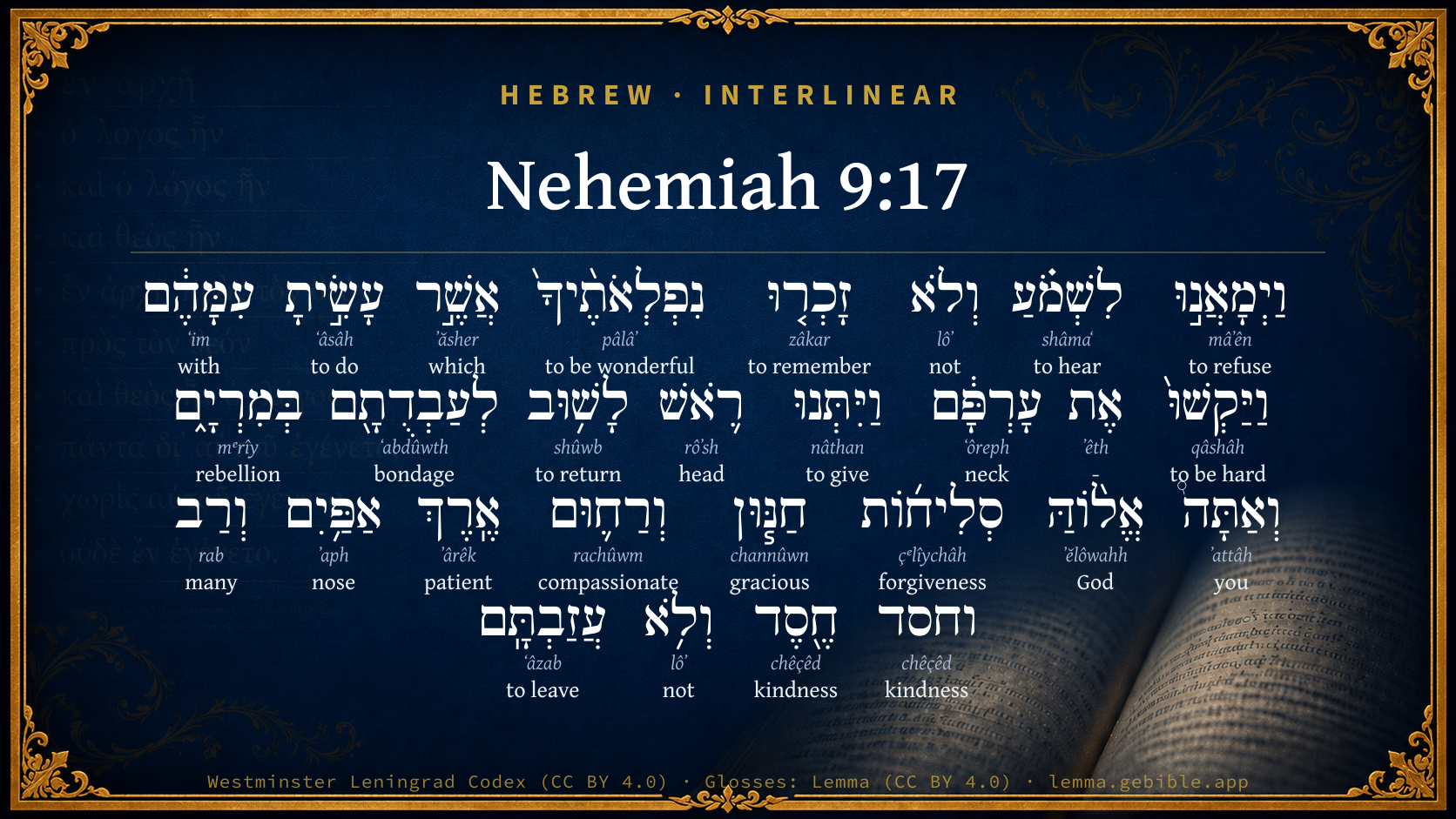
Nehemiah 9:17

Hebrew (Westminster Leningrad Codex) Nehemiah 9:17 appears in the Hebrew Old Testament. The text above is from the Westminster Leningrad Codex. Each word links to its Strong’s number, a concise gloss, and parsing drawn from the Open Scriptures Hebrew Bible morphology. Click any word for its full Brown-Driver-Briggs (BDB) entry.
Download image
Cite this verse

Nehemiah 9:17 (World English Bible). Public Domain. Lemma interlinear Bible study tool, https://lemma.gebible.app/v/nehemiah/9/17.

Show BibTeX & RIS
BibTeX
RIS
English Translation
and refused to obey, neither were mindful of your wonders that you did among them, but hardened their neck, and in their rebellion appointed a captain to return to their bondage. But you are a God ready to pardon, gracious and merciful, slow to anger, and abundant in loving kindness, and didn't forsake them.
World English Bible · Public Domain
Highlights
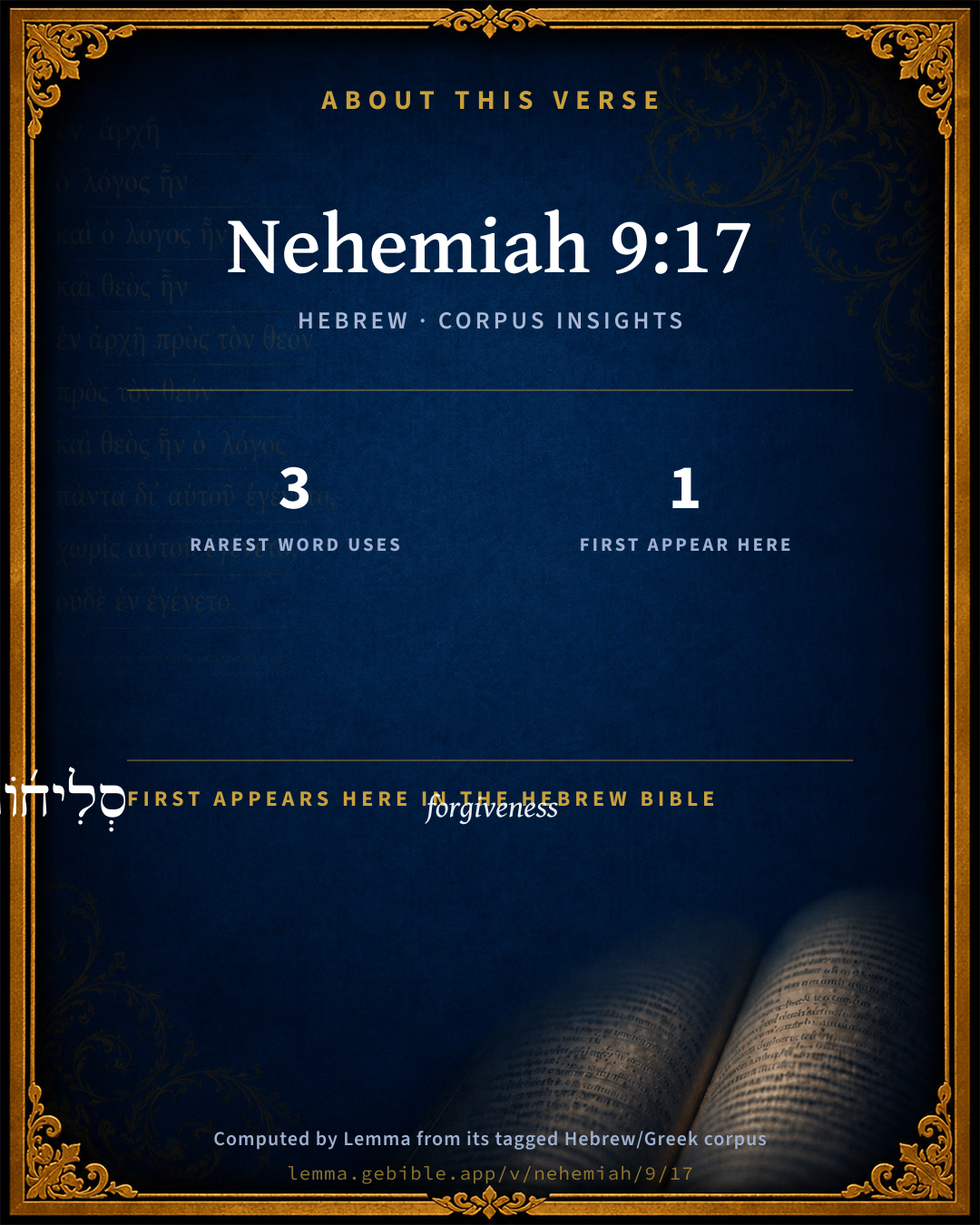
  • 1 first appearance in the Hebrew Bible
Full analysis ↓
Download a study sheet

One document with this verse’s original text, its word-by-word gloss line, the meaning frame, cross-references with their text, attributed commentary, and full source and license credits — printable, and it pastes into notes with its structure intact.

This verse Autodidact and up

Study sheet (.html) Plain text (.txt)

A passage Seminary Student

Up to 50 verses in one chapter. A passage sheet keeps up to 6 commentary sources and 12 cross-references per verse, in the order this page ranks them, and says so on the sheet whenever that leaves anything out. Ask for a single verse and you get the Autodidact verse sheet above.

Everything on this page stays free to read, with no account — the sheet is a download of what is already on screen, not access to it.

Want to remove ads? Support Godless Engineer
Compare translations 3

The same verse in 3 English versions, stacked beneath the original-language interlinear above. Click any original word for its lexicon entry.

Each is an independent rendering of the whole verse — the interlinear is not word-aligned to these translations.

Highlighted words mark where these versions differ — a whole-verse word diff, not a word-by-word alignment.

  • World English Bible Public Domain
    and refused to obey, neither were mindful of your wonders that you did among them, but hardened their neck, and in their rebellion appointed a captain to return to their bondage. But you are a God ready to pardon, gracious and merciful, slow to anger, and abundant in loving kindness, and didn't forsake them.
  • King James Version Public Domain
    And refused to obey, neither were mindful of thy wonders that thou didst among them; but hardened their necks, and in their rebellion appointed a captain to return to their bondage: but thou art a God ready to pardon, gracious and merciful, slow to anger, and of great kindness, and forsookest them not.
  • unfoldingWord Literal Text CC BY-SA 4.0
    And they refused to hear, and they did not remember your wonderful deeds that you performed with them. And they stiffened their neck and in their rebellion chose a head in order to return to their servitude. But you are a God of forgiveness, gracious and compassionate, long of nostrils and abounding in covenant faithfulness, and you did not forsake them.

unfoldingWord Literal Text — © unfoldingWord, licensed CC BY-SA 4.0. Word-aligned USFM3 via Door43 (git.door43.org/unfoldingWord/en_ult).

Versions to compare (up to 4)

3 of 4 selected

Show all 18 translations

Every available English version of this verse, each an independent rendering of the whole verse.

  • World English Bible Public Domain
    and refused to obey, neither were mindful of your wonders that you did among them, but hardened their neck, and in their rebellion appointed a captain to return to their bondage. But you are a God ready to pardon, gracious and merciful, slow to anger, and abundant in loving kindness, and didn't forsake them.
  • Berean Standard Bible Public Domain
    They refused to listen and failed to remember the wonders You performed among them. They stiffened their necks and appointed a leader to return them to their bondage in Egypt. But You are a forgiving God, gracious and compassionate, slow to anger and rich in loving devotion, and You did not forsake them.
  • Majority Standard Bible Public Domain
    They refused to listen and failed to remember the wonders You performed among them. They stiffened their necks and appointed a leader to return them to their bondage in Egypt. But You are a forgiving God, gracious and compassionate, slow to anger and rich in loving devotion, and You did not forsake them.
  • King James Version Public Domain
    And refused to obey, neither were mindful of thy wonders that thou didst among them; but hardened their necks, and in their rebellion appointed a captain to return to their bondage: but thou art a God ready to pardon, gracious and merciful, slow to anger, and of great kindness, and forsookest them not.
  • American Standard Version (1901) Public Domain
    and refused to obey, neither were mindful of thy wonders that thou didst among them, but hardened their neck, and in their rebellion appointed a captain to return to their bondage. But thou art a God ready to pardon, gracious and merciful, slow to anger, and abundant in lovingkindness, and forsookest them not.
  • Revised Version (1885) Public Domain
    and refused to obey, neither were mindful of thy wonders that thou didst among them; but hardened their neck, and in their rebellion appointed a captain to return to their bondage: but thou art a God ready to pardon, gracious and full of compassion, slow to anger, and plenteous in mercy, and forsookest them not.
  • Geneva Bible (1599) Public Domain
    But refused to obey, and would not remember thy marueilous works that thou haddest done for them, but hardened their neckes, and had in their heads to returne to their bondage by their rebellion: but thou, O God of mercies, gratious and full of compassion, of long suffring and of great mercie, yet forsookest them not.
  • Douay-Rheims (1899) Public Domain
    And they would not hear, and they remembered not thy wonders which thou hadst done for them. And they hardened their necks, and gave the head to return to their bondage, as it were by contention. But thou, a forgiving God, gracious, and merciful, longsuffering, and full of compassion, didst not forsake them.
  • Young's Literal Translation Public Domain
    yea, they refuse to hearken, and have not remembered Thy wonders that Thou hast done with them, and harden their neck and appoint a head, to turn back to their service, in their rebellion; and Thou `art' a God of pardons, gracious, and merciful, long-suffering, and abundant in kindness, and hast not forsaken them.
  • Literal Standard Version CC BY-SA 4.0
    Indeed, they refuse to listen, || And have not remembered Your wonders that You have done with them, || And harden their neck and appoint a head, || To turn back to their service, in their rebellion; And You [are] a God of pardons, || Gracious, and merciful, long-suffering, and abundant in kindness, || And have not forsaken them.
  • Unlocked Literal Bible CC BY-SA 4.0
    They refused to listen, and they did not think about the wonders that you had done among them, but became stubborn, and in their rebellion they appointed a leader to return to their slavery. But you are a God who is full of forgiveness, gracious and compassionate, slow to anger, and abounding in steadfast love. You did not abandon them.
  • unfoldingWord Literal Text CC BY-SA 4.0
    And they refused to hear, and they did not remember your wonderful deeds that you performed with them. And they stiffened their neck and in their rebellion chose a head in order to return to their servitude. But you are a God of forgiveness, gracious and compassionate, long of nostrils and abounding in covenant faithfulness, and you did not forsake them.
  • Darby Bible Public Domain
    and refused to obey, neither were they mindful of thy wonders which thou hadst done among them; but hardened their neck, and in their rebellion made a captain to return to their bondage. But thou art a +God ready to forgive, gracious and merciful, slow to anger and of great loving-kindness, and thou forsookest them not.
  • World Messianic Bible Public Domain
    and refused to obey. They weren’t mindful of your wonders that you did among them, but hardened their neck, and in their rebellion appointed a captain to return to their bondage. But you are a God ready to pardon, gracious and merciful, slow to anger, and abundant in loving kindness, and didn’t forsake them.
  • Webster's Bible Public Domain
    And refused to obey, neither were mindful of thy wonders that thou didst perform among them; but hardened their necks, and in their rebellion appointed a captain to return to their bondage: but thou art a God ready to pardon, gracious and merciful, slow to anger, and of great kindness, and forsookest them not.
  • Free Bible Version CC BY-SA 4.0
    They refused to listen to you, and forgot about all the miracles you did for them. They became obstinate and decided to choose themselves a leader to take them back to slavery in Egypt. But you are a forgiving God, gracious and merciful, slow to get angry, and full of trustworthy love. You did not give up on them,
  • Bible in Basic English Public Domain
    And would not do them, and gave no thought to the wonders you had done among them; but made their necks stiff, and turning away from you, made a captain over themselves to take them back to their prison in Egypt: but you are a God of forgiveness, full of grace and pity, slow to wrath and great in mercy, and you did not give them up.
  • JPS Tanakh (1917) Public Domain
    and refused to hearken, neither were mindful of Thy wonders that Thou didst among them; but hardened their neck, and in their rebellion appointed a captain to return to their bondage; but Thou art a God ready to pardon, gracious and full of compassion, slow to anger, and plenteous in mercy, and forsookest them not.

Literal Standard Version (2020), Covenant Press — licensed CC BY-SA 4.0. Text via the HelloAO Bible API (eBible.org). Unlocked Literal Bible (unfoldingWord) — licensed CC BY-SA 4.0. Text via the HelloAO Bible API (eBible.org). unfoldingWord Literal Text — © unfoldingWord, licensed CC BY-SA 4.0. Word-aligned USFM3 via Door43 (git.door43.org/unfoldingWord/en_ult). Free Bible Version, Dr. Jonathan Gallagher — licensed CC BY-SA 4.0. Text via the HelloAO Bible API (eBible.org).

Word by word

More ways to search: Search by grammar → Find every occurrence → Compare this word →

Practice this passage: Drill this verse → Learn its vocabulary →

לְעַבְדֻתָ֖ם
ʻabdûwth
H5659
“to/for · bondage · their”
Preposition + Noun, Common, Feminine, Singular, Construct + Suffix, Personal, 3rd Person, Masculine, Plural
Part of Speech
Preposition + Noun
Type
Common
Gender
Feminine
Number
Singular
State
Construct
Full BDB Definition

Origin: from H5647

TWOT: 1553e

servitude, bondage
  1. וַיְמָאֲנ֣וּ mâʼên H3985 “and · to refuse” Conjunction + Verb, Piel, Sequential Imperfect, 3rd Person, Masculine, Plural
  2. לִשְׁמֹ֗עַ shâmaʻ H8085 “to hear” Preposition + Verb, Qal, Infinitive Construct
  3. וְלֹא lôʼ H3808 “and · not” Conjunction + Particle, Negative
  4. זָכְר֤וּ zâkar H2142 “to remember” Verb, Qal, Perfect, 3rd Person, Common, Plural
  5. נִפְלְאֹתֶ֨יךָ֙ pâlâʼ H6381 “being wonderful · you” Verb, Niphal, Participle Active, Feminine, Plural, Construct + Suffix, Personal, 2nd Person, Masculine, Singular
  6. אֲשֶׁ֣ר ʼăsher H834 “which” Particle, Relative
  7. עָשִׂ֣יתָ ʻâsâh H6213 “to do” Verb, Qal, Perfect, 2nd Person, Masculine, Singular
  8. עִמָּהֶ֔ם ʻim H5973 “with · them” Preposition + Suffix, Personal, 3rd Person, Masculine, Plural
  9. וַיַּקְשׁוּ֙ qâshâh H7185 “and · to be hard” Conjunction + Verb, Hiphil, Sequential Imperfect, 3rd Person, Masculine, Plural
  10. אֶת ʼêth H853 “-” Particle, Direct Object
  11. עָרְפָּ֔ם ʻôreph H6203 “neck · their” Noun, Common, Masculine, Singular, Construct + Suffix, Personal, 3rd Person, Masculine, Plural
  12. וַיִּתְּנוּ nâthan H5414 “and · to give” Conjunction + Verb, Qal, Sequential Imperfect, 3rd Person, Masculine, Plural
  13. רֹ֛אשׁ rôʼsh H7218 “head” Noun, Common, Masculine, Singular, Absolute
  14. לָשׁ֥וּב shûwb H7725 “to return” Preposition + Verb, Qal, Infinitive Construct
  15. בְּמִרְיָ֑ם mᵉrîy H4805 “in/at · rebellion · their” Preposition + Noun, Common, Masculine, Singular, Construct + Suffix, Personal, 3rd Person, Masculine, Plural
  16. וְאַתָּה֩ ʼattâh H859 “and · you” Conjunction + Pronoun, Personal, 2nd Person, Masculine, Singular
  17. אֱל֨וֹהַּ ʼĕlôwahh H433 “God of” Noun, Common, Masculine, Singular, Construct
  18. סְלִיח֜וֹת çᵉlîychâh H5547 “forgiveness” Noun, Common, Feminine, Plural, Absolute
  19. חַנּ֧וּן channûwn H2587 “gracious” Adjective, Adjective, Masculine, Singular, Absolute
  20. וְרַח֛וּם rachûwm H7349 “and · compassionate” Conjunction + Adjective, Adjective, Masculine, Singular, Absolute
  21. אֶֽרֶךְ ʼârêk H750 “patient of” Adjective, Adjective, Masculine, Singular, Construct
  22. אַפַּ֥יִם ʼaph H639 “nostrils” Noun, Common, Masculine, Dual, Absolute
  23. וְרַב rab H7227 “and · many of” Conjunction + Adjective, Adjective, Masculine, Singular, Construct
  24. וחסד chêçêd H2617 “and · kindness” Conjunction + Noun, Common, Masculine, Singular, Absolute
  25. חֶ֖סֶד chêçêd H2617 “kindness” Noun, Common, Masculine, Singular, Absolute
  26. וְלֹ֥א lôʼ H3808 “and · not” Conjunction + Particle, Negative
  27. עֲזַבְתָּֽם ʻâzab H5800 “to leave · them” Verb, Qal, Perfect, 2nd Person, Masculine, Singular + Suffix, Personal, 3rd Person, Masculine, Plural

About this verse

These counts appear in no published source. They are computed here, from the morphology-tagged text and Lemma’s own curated glosses. What Lemma adds →

28
words
26
distinct lemmas
Historical
section

Notable vocabulary

The rarest word here is לְעַבְדֻתָ֖ם bondage H5659 — appearing just 3 times in the whole Hebrew Bible.

First appearance in Scripture

This word makes its first canonical appearance in the Hebrew Bible here:

  • סְלִיח֜וֹת forgiveness H5547

Shared distinctive vocabulary

לְעַבְדֻתָ֖ם bondage H5659 occurs in 3 verses of the Hebrew Bible. Also found in:

Grammatical profile

  • 9 verbs
  • 9 nouns
  • 4 adjectives
  • 1 pronoun
  • 1 preposition
  • 4 particles

Verb forms

  • וַיְמָאֲנ֣וּ Piel · Sequential Imperfect
  • לִשְׁמֹ֗עַ Qal · Infinitive Construct
  • זָכְר֤וּ Qal · Perfect
  • נִפְלְאֹתֶ֨יךָ֙ Niphal · Participle Active
  • עָשִׂ֣יתָ Qal · Perfect
  • וַיַּקְשׁוּ֙ Hiphil · Sequential Imperfect
  • וַיִּתְּנוּ Qal · Sequential Imperfect
  • לָשׁ֥וּב Qal · Infinitive Construct
  • עֲזַבְתָּֽם Qal · Perfect

Repetition

Words recur within this verse — often emphatic in Hebrew:

  • וחסד kindness H2617 ×2
  • וְלֹא not H3808 ×2

Cross-references

29

Topical passages linked to Nehemiah 9:17 in the Treasury of Scripture Knowledge — connected by theme and wording, ordered by reader-vote popularity; previews shown in the World English Bible.

  • Psalms 86:5 For you, Lord, are good, and ready to forgive; Abundant in loving kindness to all those who call on you.
  • Joel 2:13 Tear your heart, and not your garments, And turn to Yahweh, your God; For he is gracious and merciful, Slow to anger, and abundant in loving kindness, And relents from sending calamity.
  • Psalms 86:15 But you, Lord, are a merciful and gracious God, Slow to anger, and abundant in loving kindness and truth.
  • Psalms 145:8–9 Yahweh is gracious, merciful, Slow to anger, and of great loving kindness.
  • Micah 7:18–19 Who is a God like you, who pardons iniquity, And passes over the disobedience of the remnant of his heritage? He doesn't retain his anger forever, Because he delights in loving kindness.
  • Exodus 34:6–7 Yahweh passed by before him, and proclaimed, "Yahweh! Yahweh, a merciful and gracious God, slow to anger, and abundant in loving kindness and truth,
  • Numbers 14:18–19 Yahweh is slow to anger, and abundant in loving kindness, forgiving iniquity and disobedience; and that will by no means clear [the guilty], visiting the iniquity of the fathers on the children, on the third and on the fourth generation.
  • 1 Kings 6:13 I will dwell among the children of Israel, and will not forsake my people Israel.
  • Psalms 78:38 But he, being merciful, forgave iniquity, and didn't destroy them. Yes, many times he turned his anger away, And didn't stir up all his wrath.
  • Psalms 103:8–18 Yahweh is merciful and gracious, Slow to anger, and abundant in loving kindness.
  • Isaiah 55:7–9 let the wicked forsake his way, and the unrighteous man his thoughts; and let him return to Yahweh, and he will have mercy on him; and to our God, for he will abundantly pardon.
  • Matthew 16:9–11 Don't you yet perceive, neither remember the five loaves for the five thousand, and how many baskets you took up?
  • Romans 9:15 For he said to Moses, "I will have mercy on whom I have mercy, and I will have compassion on whom I have compassion."
  • 1 Kings 8:57 Yahweh our God be with us, as he was with our fathers: let him not leave us, nor forsake us;
  • Psalms 78:11 They forgot his doings, His wondrous works that he had shown them.
  • Psalms 78:42–43 They didn't remember his hand, Nor the day when he redeemed them from the adversary;
  • Psalms 106:7 Our fathers didn't understand your wonders in Egypt. They didn't remember the multitude of your loving kindnesses, But were rebellious at the sea, even at the Red Sea.
  • Psalms 106:43–46 Many times he delivered them, But they were rebellious in their counsel, And were brought low in their iniquity.
  • Psalms 106:13 They soon forgot his works. They didn't wait for his counsel,
  • Ephesians 1:6–7 to the praise of the glory of his grace, by which he freely bestowed favor on us in the Beloved,
  • Numbers 14:3–4 Why does Yahweh bring us to this land, to fall by the sword? Our wives and our little ones will be a prey: wouldn't it be better for us to return into Egypt?
  • Psalms 106:24–25 Yes, they despised the pleasant land. They didn't believe his word,
  • Psalms 130:4 But there is forgiveness with you, Therefore you are feared.
  • Numbers 14:11 Yahweh said to Moses, How long will this people despise me? and how long will they not believe in me, for all the signs which I have worked among them?
  • Numbers 14:41 Moses said, Why now do you disobey the commandment of Yahweh, seeing it shall not prosper?
  • Numbers 16:14 Moreover you haven't brought us into a land flowing with milk and honey, nor given us inheritance of fields and vineyards: will you put out the eyes of these men? we won't come up.
  • Proverbs 1:24 Because I have called, and you have refused; I have stretched out my hand, and no one has paid attention;
  • Acts 7:39 to whom our fathers wouldn't be obedient, but rejected him, and turned back in their hearts to Egypt,
  • Hebrews 12:25 See that you don't refuse him who speaks. For if they didn't escape when they refused him who warned on the Earth, how much more will we not escape who turn away from him who warns from heaven,

Cross-references courtesy of OpenBible.info (CC BY 4.0).

Hebrew and Greek witnesses Masoretic Hebrew ↔ Greek Septuagint

The same verse in the two great witnesses to the Old Testament, shown verse-for-verse.

These are two independent witnesses, not word-aligned to each other, and the Septuagint is shown in lemma (dictionary) form.

Hebrew Nehemiah 9:17 Masoretic · Westminster Leningrad Codex

וַיְמָאֲנ֣וּ לִשְׁמֹ֗עַ וְלֹא זָכְר֤וּ נִפְלְאֹתֶ֨יךָ֙ אֲשֶׁ֣ר עָשִׂ֣יתָ עִמָּהֶ֔ם וַיַּקְשׁוּ֙ אֶת עָרְפָּ֔ם וַיִּתְּנוּ רֹ֛אשׁ לָשׁ֥וּב לְעַבְדֻתָ֖ם בְּמִרְיָ֑ם וְאַתָּה֩ אֱל֨וֹהַּ סְלִיח֜וֹת חַנּ֧וּן וְרַח֛וּם אֶֽרֶךְ אַפַּ֥יִם וְרַב וחסד חֶ֖סֶד וְלֹ֥א עֲזַבְתָּֽם

and refused to obey, neither were mindful of your wonders that you did among them, but hardened their neck, and in their rebellion appointed a captain to return to their bondage. But you are a God ready to pardon, gracious and merciful, slow to anger, and abundant in loving kindness, and didn't forsake them.

World English Bible · Public Domain

Greek LXX Structure differs

The Septuagint has no separate book of Nehemiah. Its Greek text is the second half of Esdras B (2 Esdras), chapters 11–23; Ezra is the first half (1–10).

A verse-for-verse comparison isn’t shown here because the chapters and verses don’t line up. Switch to the LXX edition with the MT / LXX toggle above to read the Greek directly.

On this verse, Adam Clarke's Commentary discusses the Septuagint’s reading. Read the note in Commentary ↓

Hebrew: Westminster Leningrad Codex (CC BY 4.0). Greek: Septuagint (public domain); English from a public-domain English Septuagint. How the Septuagint differs from the Hebrew →

Commentary

Notes on Nehemiah 9:17 from classic Christian and Jewish commentators (each source and its license shown beneath its notes). The classic Christian expositions comment on the surrounding passage and are grouped to its opening verse, so a note may address several verses; the Jewish commentaries on the Tanakh (Rashi and others) are per-verse, so they appear only where the commentator wrote on this verse.

Lemma curates 59 commentaries, every one of them public domain or Creative Commons licensed, each selected and text-cleaned for this edition rather than reprinted as found. About our sources →

Trapp's Complete Commentary

John Trapp

Neh 9:17 And refused to obey, neither were mindful of thy wonders that thou didst among them; but hardened their necks, and in their rebellion appointed a captain to return to their bondage: but thou [art] a God ready to pardon, gracious and merciful, slow to anger, and of great kindness, and forsookest them not.

Ver. 17. And refused to obey] Heb. To hearken. They not only not hearkened, but refused to hear reasons why they should; as having made their conclusion, and being as good as ever they meant to be. This is to add rebellion to sin; this is that stubbornness that Ahaz is taxed of and branded for, 2Ch 28:25.

Neither were mindful of thy wonders] These soon grew stale to them, as the Psalmist proves by their wicked practices, Psa 106:13. And truly who that looketh upon our lives would ever think that God had done any wonders for us of this nation, either by sea or land, either against fireworks or water works formerly; or against a viperous brood among ourselves, here of late?

And in their rebellion appointed a captain] They once talked (in their mad mood) of doing such a thing, and therefore they are here said to have done it, Num 14:4; like as Jos 24:9, it is said that Balak arose and fought with Israel; and yet the story saith no such matter. But if he did not, yet because he thought and talked of such a matter, it was a done thing before the Lord!

But thou art a God ready to pardon] Heb. A God of pardons. One that hast set up a pardon office; where pardons for penitents lie ready sealed, that the sinner may not be to seek, that he may not perish in his sins while the plaster is in providing. It is our comfort that we have to do with a forgiving, sin-pardoning God, that doth it naturally, Exo 34:6, plentifully, Isa 55:7, constantly, Psa 130:4. This should be as a perpetual picture in our hearts.

Gracious] Doing all for us gratis, et ex mero motu, out of his free and unexcited love.

And merciful] All-heart; whereby he is inclined to succour them that are in misery, notwithstanding their sins. See his non obstante , Psa 106:8.

Longsuffering] Heb. Long of anger, that is, long ere he will be angry; not hasty of spirit, as Pro 14:17; Pro 14:29, but wondrous patient, amidst a world of provocations.

And of great kindness] Of exceeding propensity to communicate good. The Hebrew word signifies a large quantity either continued (that is, magnitude or greatness), Psa 48:2, or discrete (that is, multitude), Psa 2:1-2.

And forsookest them not] That is, not utterly, as David prayeth, Psa 119:8, and after him Solomon, 1Ki 8:57. When God forsaketh a people or person, woe be to them, Hos 9:12. What a terrible text is that, Eze 22:20, "I will gather you in mine anger, and my fury, and I will leave you there!" and that other, Jer 16:13, "I will cast you out of this land into a land that ye know not … where I will not show you favour!" This last was worse than all the rest. This the prophet well knew, and therefore cried out, Lord, leave us not, Jer 17:17.

Extingui lucem ne patiare tuam.

Or if thou desert us for a time, yet do not disinherit us for ever. If thy dereliction of us be penal, yet let it not be perpetual (Mos. Gerundin).

John Trapp, A Commentary or Exposition upon All the Books of the Old and New Testament (1647–1656) — public domain. Text from a community e-Sword module.

The Biblical Illustrator

Joseph S. Exell

Neh_9:17

But Thou art a God ready to pardon, gracious and merciful.

Divine forgiveness

I. What is necessary to render the subject interesting.

1. A conviction of guilt.

2. An apprehension of our danger as transgressors.

3. A discovery of the privileges of a pardoned state.

II. The proofs which establish the truth of the doctrine.

1. The provision He has made for the exercise of pardon.

2. The promptitude with which He pardons on our return,

3. His earnestness to excite us to seek after the blessing.

4. The character of those who have received pardon.

5. The number of those who obtain forgiveness.

III. The way in which this subject may be abused.

1. When it leads us to deny any disposition in God to punish.

2. When it encourages us to hope for pardon in ways not warranted by the Word of God.

(1) Without a reference to the work of Christ.

(2) Without repentance.

(3) By delaying an application for it to the close of life.

(4) By expecting to find this pardon in another world if we fail to obtain it in this.

IV. Improvment.

1. It should yield encouragement to the brokenhearted.

2. It should afford consolation to those who have believed through grace.

3. The subject demands our admiration and praise.

4. It also calls upon us not only to admire, but to imitate (Eph_4:31-32; Eph_5:1). (W. Jay.)

Pardon of sin

I. The certainty of this readiness to pardon. This may be discerned--

1. In the plans which He devised for its bestowment consistent with His honour as a sovereign, and compatible with His character as a just and moral Ruler.

2. In the repeated assurances and urgent entreaties with regard to the facts which are furnished in His Word.

3. In the efforts He makes to effect it, and so frequently recorded in the pages of history.

II. The conditions of this readiness to pardon.

1. A vivid apprehension of personal guilt.

2. A full consciousness of personal danger.

3. Repentance and faith. (W. S. Edwards.)

The pardon of sin

No attribute of the Deity is so calculated to afford encouragement and relief to the distressed and penitent sinner as that of His mercy. His justice and holiness make him tremble. The Divine mercy is the only fountain from which all our hope is derived. If God were unmerciful--if He were unable and unwilling to forgive, how awful and desperate would be our condition!

I. Some of the distinguishing characteristics of divine pardon. Respecting this blessing, we observe that it is--

1. Gratuitous in its bestowment. Had it not been perfectly free, it would be for ever beyond our reach. As fallen man is altogether destitute of all inherent and acquired righteousness, he can never obtain it on the ground of his own merit. Conscious of his utter unworthiness, and that he was destitute of all merit, the psalmist cried, For Thy names sake, pardon mine iniquity, for it is great. In the forgiveness of sin, God acts like the creditor towards his two debtors; one owes him five hundred pence, and the other fifty; and when they had nothing to pay, he frankly (freely) forgave them both. It is true that there are certain duties which must be discharged by the sinner; he must repent and believe; but these acts can never merit forgiveness. The pardon of the penitent flows from the free and sovereign grace of God, and is conveyed through the channel of the Redeemers atoning blood.

2. Unlimited in its extent. The pardoning mercy of God is not confined to any degrees of guilt or amount of transgression. Bless the Lord, O my soul, and forget not all His benefits; who forgiveth all thine iniquities, who healeth all thy diseases. The pardoning mercy of God extends to the most flagrant transgressions, and transcends all human conception. There is no sin so heinous which God cannot forgive, and no guilt of so deep a hue which He cannot remove.

3. Permanent in its enjoyment.

II. Prove the truth of the declaration. Gods readiness to pardon is manifest--

1. From the provisions made for this purpose. Before sinners could be pardoned and saved, there were certain barriers that must be removed. As God was the supreme Lawgiver and Judge of the world--the Protector of righteousness and goodness--it became Him not to pardon the guilty without the punishing of sin, and that in such a manner as would satisfy His injured justice, and vindicate the honour of His despised law, and at the same time declare His greatest hatred to sin. Had there been no Mediator, the justice and holiness of God would have stood as everlasting obstructions to the exercise of pardoning mercy.

2. The express declarations of Scripture. Listen to the exulting and triumphant language of the prophet Micah: Who is a God like unto our God, that pardoneth iniquity, and passeth by the transgression of the remnant of His heritage? He retaineth not His anger for ever, because He delighteth in mercy. See how earnestly does God exhort the careless and impenitent, saying, Turn ye, turn ye from your evil way, for why will ye die, O house of Israel? How shall I give thee up, O Ephraim? How shall I deliver thee, O Israel? How shall I make thee as Admah? How shall I set thee as Zeboim? Observe the grand commission of the apostles, that repentance and remission of sins should be preached in His name, among all nations, beginning at Jerusalem.

3. Recorded facts. This glorious truth is not only declared by the voice of inspiration, but also by the loud and impressive testimony of experience. What multitudes have already obtained forgiveness! The Scriptures abound with the most astonishing and striking instances of this delightful truth. But if we look into the New Testament, we shall see this truth shining forth with greater lustre still. The first instance that strikes us here is Peter. How great and dreadful were his sins! He denied his Divine Lord and Master, and that with oaths and curses; and yet repenting, he was forgiven. In the same list we behold Mary Magdalene, out of whom seven unclean spirits were cast. (Essex Congregational Remembrancer.)

Pardoning mercy

These words--

I. Prefer an important charge. And refused to obey, etc. Though this charge was primarily brought against the Jews, it is substantially applicable to all impenitent sinners. Here is--

1. A charge of obstinate disobedience. We are guilty of the same charge. We are under infinite obligations to the Divine Being. He is the Creator, Sovereign, Benefactor, Redeemer, Saviour, and Judge of mankind.

2. A charge of criminal forgetfulness. Neither were mindful of Thy wonders, (Psa_78:10-17; Psa_106:21-26). God has crowned each of us with loving-kindness and tender mercies, and wrought wonders in our creation, preservation, redemption, and salvation. We have too often unfaithfully forgotten His innumerable benefits, and ungratefully murmured against His kind dispensations (Isa_1:2-3).

3. A charge of hardened impenitence. But hardened their necks,. etc. This is an awful state (Pro_29:1; Rom_2:5-6; Heb_3:15).

II. Contain a gracious declaration. Thou art a God ready to pardon. This is manifest from--

1. The perfections of the Divine character.

2. The glorious scheme of human redemption (Isa_53:5-6; Rom_3:25-26; 2Co_5:18; 2Co_5:21).

3. The testimonies and promises of Scripture.

III. Suggest appropriate instruction. (Sketches of Four Hundred Sermons.)

A God ready to pardon

I. The history of israel singularly illustrates the readiness of God to pardon.

II. It is equally true that the lord at all times is a God ready to pardon.

1. It is true of Him by nature. Mercy is an essential attribute of God.

2. He Himself removed the impediment which lay in the way of forgiveness.

3. He sends His message of love to sinners while they are yet in their sins.

4. He makes no hard conditions with sinners.

5. What He demands of man by the gospel He also works in Him by His Spirit.

6. He accepts even the very lowest grade of the necessary graces. Repentance, etc. (C. H. Spurgeon.)

A pardoning God

I. The nature of this pardon. It is--

1. Free. Pardon must be so. It is no objection to say that Christ has purchased it. True, He has purchased, but it is free in its bestowment on us, because we could not merit it, nor claim it as a right.

2. Complete. Do not mean that it refers to the future. Some say when once pardoned all done. Not so Scriptures. Complete because it refers to all; complete because it is full.

3. Present. Some say not until death. Not so Scriptures.

4. Righteous. Be it known unto you, therefore, men and brethren, etc. Righteous because bestowed on righteous principles; because of Christs atonement.

5. Discriminating. If Christ died for all, how is it that all are not pardoned? Remedy only available for those who apply for it. Hence--

II. The conditions. Scriptures teach us duty of forgiveness if offender repents and asks. So with God our confession must be--

1. Frank. He that covereth his sins shall not prosper, but whoso confesseth and forsaketh them shall have mercy.

2. Penitent. The sacrifice, etc. Many frankly confess, but not penitently. True penitence seen in the publican.

3. Believing.

III. Evidence that God is ready to pardon.

1. From scheme of redemption. Love in scheme, end of scheme; and if pardon not dispensed, end defeated.

2. From His relation to the Saviour. As Father He could not furnish a greater guarantee.

3. From means He employs to bring to Him. Sends Spirit--Providence--Word. Characterised by love.

4. From receptions others have met with. Manasseh--dying thief--Saul. Shown in Prodigal.

Lessons:

1. Subject does not imply God will not punish.

2. Subject shows only way of deliverance, and that way to be taken now. (E. R. Derry.)

The joy of pardon

A man named John Welsh lay in prison in Chicago under sentence of death. His friends tried to get his sentence commuted to imprisonment for life. The day before that fixed for the execution arrived without any favourable reply being received. The prisoner sat in his cell listening and longing earnestly for a respite. Presently he heard the rumbling of the wheels of a car. It brought the materials for his scaffold, and soon he heard the strokes of the hammers, and pictured himself hanging on the scaffold which he could hear them raising. The sound almost drove him frantic, and he sent for the governor, and begged that he might be taken away anywhere from that dreadful noise. He was taken to a distant cell, and there he sat on the edge of his bed, haunted with gloomy thoughts, all hope gone. He was startled from his rom, erie by a hurried step along the corridor. The key was thrust into the lock, and one of the officers of the prison stood before him. He held a paper in his hand signed by the Governor of the State of Illinois. It was a commutation of his sentence . . . How the truth burst on his mind! When the paper was handed to him he could not read it for tears; but it was a paper bringing him his life, and he hugged it, and clasped it, and kissed it. (H. W. Taylor.)

The Biblical Illustrator, edited by Joseph S. Exell (c. 1880s–1900s) — public domain. Text from a community e-Sword module.

Adam Clarke's Commentary

Verse 17. And in their rebellion appointed a captain] This clause, read according to its order in the Hebrew text, is thus: And appointed a captain to return to their bondage in their rebellion. But it is probable that במרים bemiryam, in their rebellion, is a mistake for במצרים bemitsrayim, in Egypt. This is the reading of seven of Kennicott's and De Rossi's MSS., the Neapolitan edition of the Hagiographa, and the Septuagint. It is also the reading in Nu 14:4. The clause should undoubtedly be read, They appointed a captain to return to their bondage in EGYPT.

Adam Clarke's Commentary on the Bible (1810–1826) — public domain. Text from a community e-Sword/MySword module.

Ellicott's Commentary for English Readers

(17) In their rebellion.—Rather, appointed a captain to return to their bondage in Egypt. This is the reading of some MSS., followed by the Septuagint, and is in harmony with Num_14:4, though there the appointment is only proposed.

A God ready to pardon.—A God of pardons; only in Dan_9:9 and Psa_130:4.

A Bible Commentary for English Readers, edited by Charles John Ellicott (1878–1897) — public domain. Text from a community e-Sword module.

The Cambridge Bible for Schools and Colleges

gen. ed. J. J. S. Perowne

17. in their rebellion appointed a captain, &c.] Based on Num_14:4, and perhaps representing a tradition that the words ‘And they said one to another, Let us make a captain, and let us return into Egypt’ were partially carried into effect.

The R.V. marg. runs, ‘The Sept. has, And appointed a captain to return to their bondage in Egypt.’ See Num_14:4. The Sept. (ἐν Αἰγύπτῳ) read b’mizraim for b’miryam. Another proposed rendering instead of ‘appointed a captain’ is ‘turned their attention,’ or ‘directed their thoughts,’ literally ‘set their head.’

a God ready to pardon] R.V. marg. ‘Heb. a God of forgivenesses’. The word for ‘forgivenesses’ is found only in Dan_9:9; Psa_130:4.

merciful] R.V. full of compassion.

and of great kindness] R.V. plenteous in mercy.

For these descriptive epithets of Divine mercy cf. Neh_9:31; Exo_33:19; Exo_34:6-7; Psa_86:15; Psa_103:8; Psa_111:4; Psa_145:8; 2Ch_30:9; Joe_2:13; Jon_4:2; Nah_1:3.

forsookest them not] Cf. Neh_9:31; Ezr_9:9.

The Cambridge Bible for Schools and Colleges (gen. ed. J. J. S. Perowne; Cambridge University Press, 1878–1918) — public domain. Text from a community e-Sword module.

John Gill's Exposition

And refused to obey,.... Though exhorted, admonished, and threatened, such was their obstinacy:

neither were mindful of thy wonders that thou didst among them; in delivering them at the Red sea, in raining manna about them, and giving them water out of the rock:

but hardened their necks; see the preceding verse:

and in their rebellion appointed a captain to return to their bondage; they not only proposed it, but determined upon it, which is reckoned the same as if they had done it, see Num 14:4,

but thou art a God ready to pardon, gracious and merciful, slow to anger, and of great kindness; as he had proclaimed his name before Moses, and as the whole of his conduct towards the people of Israel abundantly shewed, see Exo 34:6

and forsookest them not; when in the wilderness, where otherwise they must have perished, but still fed and protected them, notwithstanding their provocations.

John Gill's Exposition of the Whole Bible (1746–1763) — public domain (CC PDM 1.0). Text via the HelloAO Bible API.

Albert Barnes' Notes on the Bible

In their rebellion - The Septuagint and several maunscripts have “in Egypt” (the words in the original differing by one letter only), and translate - “And appointed a captain to return to their bondage in Egypt.” Compare the margin reference. The appointment of a leader is regarded here as made, whereas we are only told in the Book of Numbers that it was proposed.

Albert Barnes' Notes on the Bible (1834–1885) — public domain. Text from a community e-Sword/MySword module.

Haydock's Catholic Bible Commentary

Their head. Or appointed a leader instead of Moses, (Numbers xiv. 4.; Menochius) or an idol, Exodus xxxii. 1. Septuagint, "they gave a beginning, or a chief to return." Syriac, "their heart returned to their crimes." (Calmet) --- Protestants, "and tin their rebellion appointed a captain to," &c. They turned their back upon the promised land, and set their faces to return into Egypt. (Haydock) --- Sinners are not deprived of free-will. (Worthington)

George Leo Haydock (1774–1849), Haydock's Catholic Family Bible and Commentary, 1859 edition — public domain. Excludes Psalms (Douay-Rheims chapter numbering differs from Protestant) and Deuterocanonical books (Catholic canon only).

Matthew Poole's English Annotations

Refused to obey; persisted in their disobedience after many admonitions, and invitations to repentance.

Appointed a captain, i.e. designed, purposed, and resolved to do so, Num 14:4, and therefore they are said to do so, as Abraham is said to have offered up Isaac, Heb 11:17, because he intended and attempted to do it.

Matthew Poole's English Annotations on the Holy Bible (1683–1685) — public domain. Text from a community e-Sword/MySword module.

Whedon's Commentary on the Bible

Daniel D. Whedon

17. Appointed a captain — According to Num_14:4 the Israelites only proposed among themselves to appoint a captain, but it is quite probable that they also carried their rebellion so far as actually to nominate a new leader.

Daniel D. Whedon (gen. ed.), Commentary on the Old and New Testaments (1874–1909) — public domain. Text from a community e-Sword module.

The Pulpit Commentary

In their rebellion. Several MSS. have bMitzraim for bMiryam, which would give the sense "appointed a captain to return to their bondage in Egypt." So the Septuagint. Appointed a captain. The reference is to Num_14:4, where we are told that the Israelites "said one to another, Let us make a captain, and let us return into Egypt." The Levites speak as if the appointment had been made, perhaps regarding the intention as morally equivalent to the act. A God ready to pardon. Literally, "a God of pardons." The word used is a rare one, occurring only in Dan_9:9 and Psa_130:4, besides the present passage. Gracious and merciful, slow to anger, and of great kindness . This is quoted from Joe_2:13, which is perhaps a conscious reproduction of Jon_4:2.

The Pulpit Commentary (1880–1919), ed. H.D.M. Spence-Jones & Joseph S. Exell — public domain. Text from a community e-Sword module.

John Wesley's Explanatory Notes

Made - Designed, and resolved to do so, Num. xiv, 4, and therefore they are said to do so, as Abraham is said to have offered up Isaac, Heb. xi, 17, because he intended to do it.

John Wesley, Explanatory Notes Upon the Whole Bible (1754–1765) — public domain. Text via the GEBible commentary corpus.

Rashi

Rabbi Shlomo Yitzchaki (Rashi)

because of their rebelliousness Heb. בְּמִרְיָם.

Rashi on the Tanakh — English translations: “The Judaica Press complete Tanach with Rashi, translated by A. J. Rosenberg” (CC BY 4.0); “Pentateuch with Rashi's commentary by M. Rosenbaum and A.M. Silbermann, 1929-1934” (public domain); “The Metsudah Tanach series, Lakewood, N.J” (CC BY 4.0); and “The Book of Joshua, Metsudah Publications, 1997” (CC BY 4.0). Text via Sefaria.

Lesson kit

Teaching starters — assembled from the data on this page, not authored interpretation. Every prompt links to the verse data it draws on. Edit before teaching.

Nehemiah, in the Historical, opens this verse with 28 words (26 distinct Hebrew lemmas). Its most distinctive word is ʻabdûwth (“bondage”). A historical commentator’s framing appears above. Read the whole chapter for the surrounding context.

Discussion questions

  1. What does “bondage” (ʻabdûwth) contribute to the verse as a whole?
  2. The word “forgiveness” first appears here in Scripture. What is being introduced at this debut?
  3. Ezra 9:8 shares the word «bondage» with this verse. How do the two illuminate each other?
  4. “kindness” occurs 2× in this one verse. What is the effect of the repetition?
  5. These translations render this verse differently. What is at stake in choosing one wording over another?
  6. The verb «וַיְמָאֲנ֣וּ» is Piel Sequential Imperfect. How does its form color the action?
  7. Reading how Trapp's Complete Commentary and The Biblical Illustrator read this verse, where do the two commentators agree and where do they part?

Things to notice

  • 1 word makes its first canonical appearance in Scripture here.
  • These translations choose different wording for 43 words in this verse.
  • “kindness” occurs 2× in this single verse.
  • 26 distinct Hebrew lemmas span 28 words in this verse.

Reading settings

Reading text

Shown beneath each verse's original-language words.

Old Testament
Old Testament edition

Read the OT as the Masoretic Hebrew (MT) or the Greek Septuagint (LXX).

English shown for the Greek Septuagint (in the Hebrew ↔ Greek comparison).

Comparing translations? Open the Compare panel on any verse page to stack up to four side by side.