
Job 5:25

Hebrew (Westminster Leningrad Codex) Job 5:25 appears in the Hebrew Old Testament. The text above is from the Westminster Leningrad Codex. Each word links to its Strong’s number, a concise gloss, and parsing drawn from the Open Scriptures Hebrew Bible morphology. Click any word for its full Brown-Driver-Briggs (BDB) entry.
Download image
Cite this verse

Job 5:25 (World English Bible). Public Domain. Lemma interlinear Bible study tool, https://lemma.gebible.app/v/job/5/25.

Show BibTeX & RIS
BibTeX
RIS
English Translation
You shall know also that your seed shall be great, Your offspring as the grass of the earth.
World English Bible · Public Domain
Highlights
  • 1 first appearance in the Hebrew Bible
Full analysis ↓
Download a study sheet

One document with this verse’s original text, its word-by-word gloss line, the meaning frame, cross-references with their text, attributed commentary, and full source and license credits — printable, and it pastes into notes with its structure intact.

This verse Autodidact and up

Study sheet (.html) Plain text (.txt)

A passage Seminary Student

Up to 50 verses in one chapter. A passage sheet keeps up to 6 commentary sources and 12 cross-references per verse, in the order this page ranks them, and says so on the sheet whenever that leaves anything out. Ask for a single verse and you get the Autodidact verse sheet above.

Everything on this page stays free to read, with no account — the sheet is a download of what is already on screen, not access to it.

Want to remove ads? Support Godless Engineer
Compare translations 3

The same verse in 3 English versions, stacked beneath the original-language interlinear above. Click any original word for its lexicon entry.

Each is an independent rendering of the whole verse — the interlinear is not word-aligned to these translations.

Highlighted words mark where these versions differ — a whole-verse word diff, not a word-by-word alignment.

  • World English Bible Public Domain
    You shall know also that your seed shall be great, Your offspring as the grass of the earth.
  • King James Version Public Domain
    Thou shalt know also that thy seed shall be great, and thine offspring as the grass of the earth.
  • unfoldingWord Literal Text CC BY-SA 4.0
    And you will know that your seed great and your offspring, like the grass of the earth.

unfoldingWord Literal Text — © unfoldingWord, licensed CC BY-SA 4.0. Word-aligned USFM3 via Door43 (git.door43.org/unfoldingWord/en_ult).

Versions to compare (up to 4)

3 of 4 selected

Show all 18 translations

Every available English version of this verse, each an independent rendering of the whole verse.

  • World English Bible Public Domain
    You shall know also that your seed shall be great, Your offspring as the grass of the earth.
  • Berean Standard Bible Public Domain
    You will know that your offspring will be many, your descendants like the grass of the earth.
  • Majority Standard Bible Public Domain
    You will know that your offspring will be many, your descendants like the grass of the earth.
  • King James Version Public Domain
    Thou shalt know also that thy seed shall be great, and thine offspring as the grass of the earth.
  • American Standard Version (1901) Public Domain
    Thou shalt know also that thy seed shall be great, And thine offspring as the grass of the earth.
  • Revised Version (1885) Public Domain
    Thou shalt know also that thy seed shall be great, and thine offspring as the grass of the earth.
  • Geneva Bible (1599) Public Domain
    Thou shalt perceiue also, that thy seede shalbe great, and thy posteritie as the grasse of the earth.
  • Douay-Rheims (1899) Public Domain
    Thou shalt know also that thy seed shall be multiplied, and thy offspring like the grass of the earth.
  • Young's Literal Translation Public Domain
    And hast known that numerous `is' Thy seed, And thine offspring as the herb of the earth;
  • Literal Standard Version CC BY-SA 4.0
    And have known that your seed [is] numerous, || And your offspring as the herb of the earth;
  • Unlocked Literal Bible CC BY-SA 4.0
    You will also know that your seed will be great, that your offspring will be like the grass on the ground.
  • unfoldingWord Literal Text CC BY-SA 4.0
    And you will know that your seed great and your offspring, like the grass of the earth.
  • Darby Bible Public Domain
    And thou shalt know that thy seed is numerous, and thine offspring as the herb of the earth.
  • World Messianic Bible Public Domain
    You will know also that your offspring will be great, your offspring as the grass of the earth.
  • Webster's Bible Public Domain
    Thou shalt know also that thy seed will be great, and thy offspring as the grass of the earth.
  • Free Bible Version CC BY-SA 4.0
    You will also be sure that you will have many children; your descendants will be like the grass of the earth.
  • Bible in Basic English Public Domain
    You will be certain that your seed will be great, and your offspring like the plants of the earth.
  • JPS Tanakh (1917) Public Domain
    Thou shalt know also that thy seed shall be great, and thine offspring as the grass of the earth.

Literal Standard Version (2020), Covenant Press — licensed CC BY-SA 4.0. Text via the HelloAO Bible API (eBible.org). Unlocked Literal Bible (unfoldingWord) — licensed CC BY-SA 4.0. Text via the HelloAO Bible API (eBible.org). unfoldingWord Literal Text — © unfoldingWord, licensed CC BY-SA 4.0. Word-aligned USFM3 via Door43 (git.door43.org/unfoldingWord/en_ult). Free Bible Version, Dr. Jonathan Gallagher — licensed CC BY-SA 4.0. Text via the HelloAO Bible API (eBible.org).

Word by word

More ways to search: Search by grammar → Find every occurrence → Compare this word →

Practice this passage: Drill this verse → Learn its vocabulary →

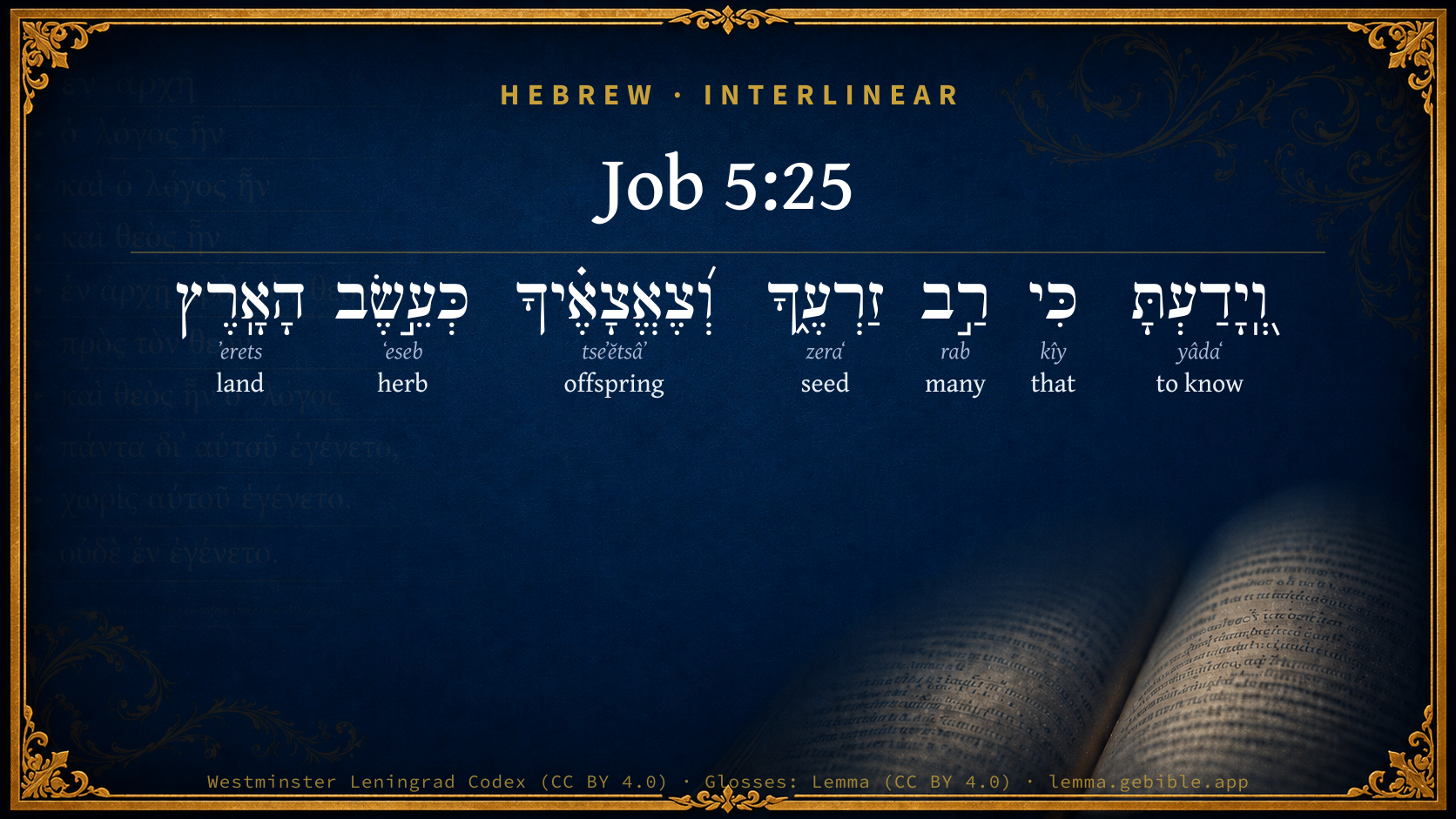
וְ֝צֶאֱצָאֶ֗יךָ
tseʼĕtsâʼ
H6631
“and · offspring · your”
Conjunction + Noun, Common, Masculine, Plural, Construct + Suffix, Personal, 2nd Person, Masculine, Singular
Part of Speech
Conjunction + Noun
Type
Common
Gender
Masculine
Number
Plural
State
Construct
Full BDB Definition

Origin: from H3318

TWOT: 893b

offspring, produce, issue - offspring (of men) - produce (of earth) - descendants (metaphorical)
  1. וְֽ֭יָדַעְתָּ yâdaʻ H3045 “and · to know” Conjunction + Verb, Qal, Sequential Perfect, 2nd Person, Masculine, Singular
  2. כִּי kîy H3588 “that” Conjunction
  3. רַ֣ב rab H7227 “many” Adjective, Adjective, Masculine, Singular, Absolute
  4. זַרְעֶ֑ךָ zeraʻ H2233 “seed · your” Noun, Common, Masculine, Singular, Construct + Suffix, Personal, 2nd Person, Masculine, Singular
  5. כְּעֵ֣שֶׂב ʻeseb H6212 “like/as · herb of” Preposition + Noun, Common, Masculine, Singular, Construct
  6. הָאָֽרֶץ ʼerets H776 “the · land” Particle, Definite Article + Noun, Common, Both, Singular, Absolute

About this verse

These counts appear in no published source. They are computed here, from the morphology-tagged text and Lemma’s own curated glosses. What Lemma adds →

7
words
7
distinct lemmas
Wisdom
section

Notable vocabulary

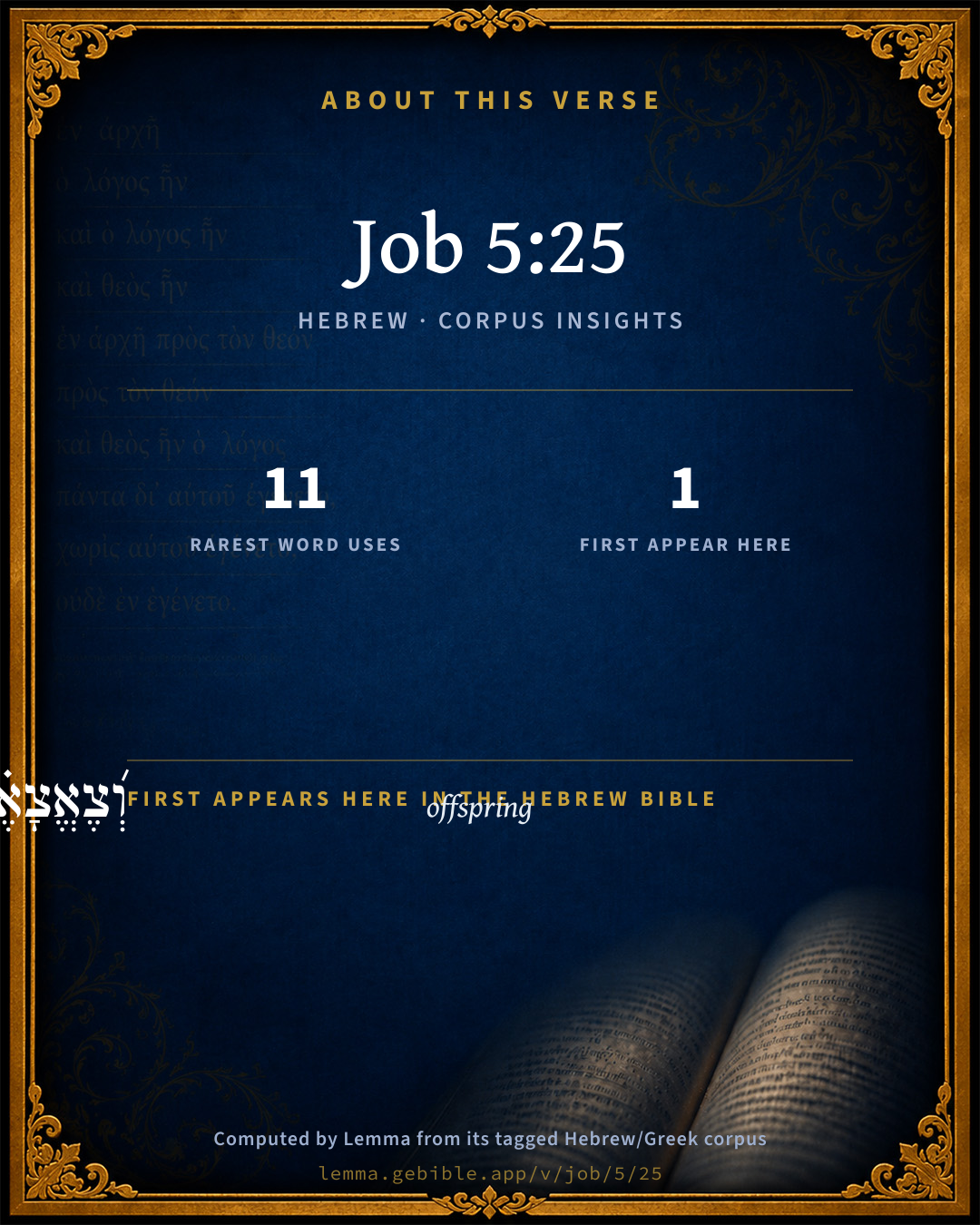
The rarest word here is וְ֝צֶאֱצָאֶ֗יךָ offspring H6631 — appearing just 11 times in the whole Hebrew Bible.

First appearance in Scripture

This word makes its first canonical appearance in the Hebrew Bible here:

  • וְ֝צֶאֱצָאֶ֗יךָ offspring H6631

Shared distinctive vocabulary

וְ֝צֶאֱצָאֶ֗יךָ offspring H6631 occurs in 11 verses of the Hebrew Bible. Also found in:

Grammatical profile

  • 1 verb
  • 4 nouns
  • 1 adjective
  • 1 conjunction

Verb forms

  • וְֽ֭יָדַעְתָּ Qal · Sequential Perfect

Hebrew & Septuagint length

In English translation the verse runs 18 words from the Hebrew and 21 from the Septuagint (LXX English) — closely comparable.

A rough comparison of the two English renderings, which tokenize alike — not a word-level alignment.

Word counts can differ between the Hebrew and the Greek without any difference in meaning — e.g. the Hebrew direct-object marker אֵת has no separate Greek word, and Greek often adds the article ὁ.

Cross-references

9

Topical passages linked to Job 5:25 in the Treasury of Scripture Knowledge — connected by theme and wording, ordered by reader-vote popularity; previews shown in the World English Bible.

  • Psalms 112:2 His seed will be mighty in the land. The generation of the upright will be blessed.
  • Psalms 72:16 There shall be abundance of grain throughout the land. Its fruit sways like Lebanon. Let it flourish, thriving like the grass of the field.
  • Deuteronomy 28:4 Blessed shall be the fruit of your body, and the fruit of your ground, and the fruit of your animals, the increase of your cattle, and the young of your flock.
  • Genesis 15:5 Yahweh brought him outside, and said, "Look now toward the sky, and count the stars, if you are able to count them." He said to Abram, "So shall your seed be."
  • Job 42:13–16 He had also seven sons and three daughters.
  • Leviticus 26:9 "'I will have respect for you, and make you fruitful, and multiply you, and will establish my covenant with you.
  • Psalms 127:3–5 Behold, children are a heritage of Yahweh. The fruit of the womb is his reward.
  • Psalms 128:3–6 Your wife will be as a fruitful vine, In the innermost parts of your house; Your children like olive plants, Around your table.
  • Isaiah 44:3–4 For I will pour water on him who is thirsty, and streams on the dry ground; I will pour my Spirit on your seed, and my blessing on your offspring:

Cross-references courtesy of OpenBible.info (CC BY 4.0).

Hebrew and Greek witnesses Masoretic Hebrew ↔ Greek Septuagint

The same verse in the two great witnesses to the Old Testament, shown verse-for-verse.

These are two independent witnesses, not word-aligned to each other, and the Septuagint is shown in lemma (dictionary) form.

Hebrew Job 5:25 Masoretic · Westminster Leningrad Codex

וְֽ֭יָדַעְתָּ כִּי רַ֣ב זַרְעֶ֑ךָ וְ֝צֶאֱצָאֶ֗יךָ כְּעֵ֣שֶׂב הָאָֽרֶץ

You shall know also that your seed shall be great, Your offspring as the grass of the earth.

World English Bible · Public Domain

Greek LXX Job 5:25 Septuagint · lemma form

γιγνώσκω δέ ὅτι πολύς ὁ σπέρμα σύ ὁ δέ τέκνον σύ εἰμί ὥσπερ ὁ παμβότανον ὁ ἀγρός

And you shall know that your seed shall be abundant; and your children shall be like the herbage of the field.

LXX2012 (modern English Septuagint) · Public Domain

Hebrew: Westminster Leningrad Codex (CC BY 4.0). Greek: Septuagint (public domain); English from LXX2012 (modern English Septuagint) (Public Domain). How the Septuagint differs from the Hebrew →

Commentary

Notes on Job 5:25 from classic Christian and Jewish commentators (each source and its license shown beneath its notes). The classic Christian expositions comment on the surrounding passage and are grouped to its opening verse, so a note may address several verses; the Jewish commentaries on the Tanakh (Rashi and others) are per-verse, so they appear only where the commentator wrote on this verse.

Lemma curates 59 commentaries, every one of them public domain or Creative Commons licensed, each selected and text-cleaned for this edition rather than reprinted as found. About our sources →

Trapp's Complete Commentary

John Trapp

Job 5:25 Thou shalt know also that thy seed [shall be] great, and thine offspring as the grass of the earth.

Ver. 25. Thou shalt know also that thy seed shall be great] Thou shalt live to see thy children (whereof thou art now bereft) not only restored, but increased. Children are the seed, parents are but the husk, as it were: to have these multiplied is no small mercy, Psa 128:3, especially when the wife is as the vine, and the children like olive plants, two of the best fruits, the one for sweetness, the other for fatness, Jdg 9:13; when they prove to be as arrows of a strong man, such as whose natural knottiness is reformed and smoothed by grace, such as for the workmanship of grace and holiness in their hearts and lives are become like the graving of a king’s palace, Psa 144:12. What can better preserve Jacob (Job) from confusion, or his face from waxing pale, than if he might see his children, the work of God’s hands, framed and fitted by the word in regeneration, and the duties of new obedience? this would make religious parents to sanctify God’s name, even to sanctify the Holy One, and with singular encouragement from the God of Israel, Isa 29:22-23.

And thine offspring as the grass of the earth] Thy nephews shall be not only numerous, but innumerable, they shall also flourish, as grass in its prime.

John Trapp, A Commentary or Exposition upon All the Books of the Old and New Testament (1647–1656) — public domain. Text from a community e-Sword module.

Joseph Benson's Commentary

Job 5:25. Thou shalt know — By assurance from God’s promises, the impressions of his Spirit, and by experience, in due time, that thy seed shall be great — Thy posterity, which God shall give thee, instead of those whom thou hast lost, shall be high, and honourable, and powerful: or, shall be many, as רב, rab, often signifies. And thine offspring — The fruit of thy body; (for he speaks of his natural, not of his spiritual seed, as Abraham’s seed is in part to be understood;) as the grass of the earth —

Both for its plentiful increase, and for its flourishing greenness.

Joseph Benson's Commentary on the Old and New Testaments (1811–1818) — public domain. Text from a community e-Sword module.

Tyndale Open Study Notes

Tyndale Open Resources

5:25 descendants . . . as plentiful as grass: See Gen 22:17; Lev 26:9; Deut 28:4, 11-12.

Tyndale Open Study Notes — © Tyndale Open Resources, licensed CC BY-SA 4.0. Text via the HelloAO Bible API.

Jamieson, Fausset & Brown

Robert Jamieson, A. R. Fausset & David Brown

as the grass-- (Psa 72:16). Properly, "herb-bearing seed" (Gen 1:11-12).

Jamieson, Fausset & Brown — Commentary Critical and Explanatory on the Whole Bible (1871) — public domain (CC PDM 1.0). Text via the HelloAO Bible API.

Adam Clarke's Commentary

Verse 25. Thine offspring as the grass] Thou shalt have a numerous and permanent issue.

Adam Clarke's Commentary on the Bible (1810–1826) — public domain. Text from a community e-Sword/MySword module.

Ellicott's Commentary for English Readers

(25) Great.—The word means also numerous, which seems to suit the parallelism better here. The whole description is a very beautiful and poetical one of the perfect security of faith, though it is to a certain extent vitiated by its want of strict correspondence with facts, of which the very case of Job was a crucial instance. This was the special problem with which his friends had to deal, and which proved too hard for them. May we not learn that the problem is one that can only be solved in practice and not in theory?

A Bible Commentary for English Readers, edited by Charles John Ellicott (1878–1897) — public domain. Text from a community e-Sword module.

The Cambridge Bible for Schools and Colleges

gen. ed. J. J. S. Perowne

25. Another much-desired joy he shall feel that God has given him, a numerous offspring.

The Cambridge Bible for Schools and Colleges (gen. ed. J. J. S. Perowne; Cambridge University Press, 1878–1918) — public domain. Text from a community e-Sword module.

John Gill's Exposition

Thou shalt know also that thy seed shall be great,.... Not his seed sown in the earth, and the increase of that, but his children, as the next clause explains it, as Bar Tzemach well observes; and designs either their greatness in worldly things, in wealth and riches, in honour and dignity, in power and authority, or else their numbers; for the word may be rendered "much" or "many" (n), a multitude of children being reckoned a great temporal blessing; but this seems rather intended in the following words:

and thine offspring as the grass of the earth; as numerous as the spires of grass, which can no more be told than the stars of the heavens, or the sand of the sea, by which the same thing, a numerous progeny, is sometimes illustrated: this is to be understood not of his immediate offspring, but his descendants in successive ages and generations, and which should be as beautiful as the grass of the earth when in its verdure; pointing at the comeliness of their persons, their honour and dignity raised unto, the largeness of their substance, the greatness of their prosperity, and flourishing circumstances they should be in; though it may also denote the original of them, amidst all, being of the earth and earthy, and their frailty and fading condition; for which reason all flesh is said to be as grass, and men are frequently compared unto it, see Psa 90:5.

(n) "multum", Pagninus, Montanus, Vatablus, Mercerus, Piscator, Schmidt, Michaelis.

John Gill's Exposition of the Whole Bible (1746–1763) — public domain (CC PDM 1.0). Text via the HelloAO Bible API.

Albert Barnes' Notes on the Bible

Thou shalt know also that thy seed shall be great - Margin, “much.” That is, thy posterity shall be numerous. This was one of the blessings supposed to be connected with the favor of God; see the notes at Isa 53:10.

And thine offspring as the grass of the earth - On the meaning of the word here rendered offspring, see the notes at Isa 48:19. Nothing is more common in the Scriptures, than to compare a prosperous and a happy man to a green and flourishing tree; see Psa 1:3; Psa 92:12-14. The idea here is, that the righteous would have a numerous and a happy posterity, and that the divine favor to them would bc shown by the blessing of God on their children; compare Psa 128:1, Psa 128:3.

Blessed is every one that feareth the Lord,

That walketh in his ways.

Thy wife shall be a fruitful vine by the side of thine house;

Thy children like olive-plants round about thy table.

Albert Barnes' Notes on the Bible (1834–1885) — public domain. Text from a community e-Sword/MySword module.

Matthew Poole's English Annotations

Thou shalt know; partly by assurance from God’s promises, and the impressions of his Spirit; and partly by experience in due time.

Thy seed shall be great; thy posterity, which God will give thee instead of those which thou hast lost, shall be high, and honourable, and powerful. Or, shall be many.

Thine offspring; which shall come out of thy own loins as branches out of a tree, as the word signifies. And this word seems added to the former to restrain and explain it, by showing that he did not speak of his spiritual seed, as Abraham’s seed is in part understood, but of the fruit of his own body. As the grass of the earth; both for its plentiful increase, and for its flourishing greenness.

Matthew Poole's English Annotations on the Holy Bible (1683–1685) — public domain. Text from a community e-Sword/MySword module.

The Pulpit Commentary

Thou shalt know also that thy seed shall be great. Little by little Eliphaz passes from a general description of the blessedness of those faithful ones who "despise not the chastening of the Almighty" (ver. 17) to a series of allusions which seem specially to touch Job"s case. Without claiming prophetical inspiration, he ventures to promise him in the future "the exact reverse of all that he had experienced" in the past safe home, flocks untouched, a happy and prosperous family, a peaceful old age" (Cook). The promises may have sounded in Job"s ears as "a mockery" (ibid.); but it is creditable to the sagacity of Eliphaz that he ventured to make them. And thine offspring as the grass of the earth. The ordinary symbols for multitudinousness the sand of the sea, and the stars of heaven are here superseded by an entirely new one, "the grass of the earth." Undoubtedly it is equally appropriate, and perhaps more natural in a pastoral community.

The Pulpit Commentary (1880–1919), ed. H.D.M. Spence-Jones & Joseph S. Exell — public domain. Text from a community e-Sword module.

John Wesley's Explanatory Notes

Know - By assurance from God's promises, and the impressions of his Spirit; and by experience in due time.

John Wesley, Explanatory Notes Upon the Whole Bible (1754–1765) — public domain. Text via the GEBible commentary corpus.

Lesson kit

Teaching starters — assembled from the data on this page, not authored interpretation. Every prompt links to the verse data it draws on. Edit before teaching.

Job, in the Wisdom, opens this verse with 7 words (7 distinct Hebrew lemmas). Its most distinctive word is tseʼĕtsâʼ (“offspring”). A historical commentator’s framing appears above. Read the whole chapter for the surrounding context.

Discussion questions

  1. What does “offspring” (tseʼĕtsâʼ) contribute to the verse as a whole?
  2. This is the first place “offspring” appears in Scripture (first appears here). What does its debut here establish?
  3. How does Job 21:8, which shares the word «offspring», read alongside this verse?
  4. The translations on this page render this verse differently — a whole-verse word diff, not a word-by-word alignment. What might account for the different wordings?
  5. «וְֽ֭יָדַעְתָּ» is a Qal Sequential Perfect verb. How does that grammatical form shape the action described?
  6. Compare how Trapp's Complete Commentary and Joseph Benson's Commentary read this verse. Where do they agree or differ?

Things to notice

  • 1 word makes its first canonical appearance in Scripture here.
  • These translations choose different wording for 5 words in this verse.
  • 7 distinct Hebrew lemmas span 7 words in this verse.

Reading settings

Reading text

Shown beneath each verse's original-language words.

Old Testament
Old Testament edition

Read the OT as the Masoretic Hebrew (MT) or the Greek Septuagint (LXX).

English shown for the Greek Septuagint (in the Hebrew ↔ Greek comparison).

Comparing translations? Open the Compare panel on any verse page to stack up to four side by side.