Exodus 9:28

Hebrew (Westminster Leningrad Codex) Exodus 9:28 appears in the Hebrew Old Testament. The text above is from the Westminster Leningrad Codex. Each word links to its Strong’s number, a concise gloss, and parsing drawn from the Open Scriptures Hebrew Bible morphology. Click any word for its full Brown-Driver-Briggs (BDB) entry.
Download image
Cite this verse

Exodus 9:28 (World English Bible). Public Domain. Lemma interlinear Bible study tool, https://lemma.gebible.app/v/exodus/9/28.

Show BibTeX & RIS
BibTeX
RIS
English Translation
Pray to Yahweh; for there has been enough of mighty thunderings and hail. I will let you go, and you shall stay no longer."
World English Bible · Public Domain
Download a study sheet

One document with this verse’s original text, its word-by-word gloss line, the meaning frame, cross-references with their text, attributed commentary, and full source and license credits — printable, and it pastes into notes with its structure intact.

This verse Autodidact and up

Study sheet (.html) Plain text (.txt)

A passage Seminary Student

Up to 50 verses in one chapter. A passage sheet keeps up to 6 commentary sources and 12 cross-references per verse, in the order this page ranks them, and says so on the sheet whenever that leaves anything out. Ask for a single verse and you get the Autodidact verse sheet above.

Everything on this page stays free to read, with no account — the sheet is a download of what is already on screen, not access to it.

Want to remove ads? Support Godless Engineer
Compare translations 3

The same verse in 3 English versions, stacked beneath the original-language interlinear above. Click any original word for its lexicon entry.

Each is an independent rendering of the whole verse — the interlinear is not word-aligned to these translations.

Highlighted words mark where these versions differ — a whole-verse word diff, not a word-by-word alignment.

  • World English Bible Public Domain
    Pray to Yahweh; for there has been enough of mighty thunderings and hail. I will let you go, and you shall stay no longer."
  • King James Version Public Domain
    Entreat the LORD (for it is enough) that there be no more mighty thunderings and hail; and I will let you go, and ye shall stay no longer.
  • unfoldingWord Literal Text CC BY-SA 4.0
    Pray to Yahweh, for the thunder of God and hail are too much. And I will let you go, and you will not continue to stay.”

unfoldingWord Literal Text — © unfoldingWord, licensed CC BY-SA 4.0. Word-aligned USFM3 via Door43 (git.door43.org/unfoldingWord/en_ult).

Versions to compare (up to 4)

3 of 4 selected

Show all 18 translations

Every available English version of this verse, each an independent rendering of the whole verse.

  • World English Bible Public Domain
    Pray to Yahweh; for there has been enough of mighty thunderings and hail. I will let you go, and you shall stay no longer."
  • Berean Standard Bible Public Domain
    Pray to the LORD, for there has been enough of God’s thunder and hail. I will let you go; you do not need to stay any longer.”
  • Majority Standard Bible Public Domain
    Pray to the LORD, for there has been enough of God’s thunder and hail. I will let you go; you do not need to stay any longer.”
  • King James Version Public Domain
    Entreat the LORD (for it is enough) that there be no more mighty thunderings and hail; and I will let you go, and ye shall stay no longer.
  • American Standard Version (1901) Public Domain
    Entreat Jehovah; for there hath been enough of `these' mighty thunderings and hail; and I will let you go, and ye shall stay no longer.
  • Revised Version (1885) Public Domain
    Entreat the LORD; for there hath been enough of these mighty thunderings and hail; and I will let you go, and ye shall stay no longer.
  • Geneva Bible (1599) Public Domain
    Pray ye vnto the Lord (for it is ynough) that there be no more mightie thunders and haile, and I will let you goe, and yee shall tarie no longer.
  • Douay-Rheims (1899) Public Domain
    Pray ye to the Lord, that the thunderings of God and the hail may cease: that I may let you go, and that you may stay here no longer.
  • Young's Literal Translation Public Domain
    make ye supplication unto Jehovah, and plead that there be no voices of God and hail, and I send you away, and ye add not to remain.'
  • Literal Standard Version CC BY-SA 4.0
    make supplication to YHWH, and plead that there be no voices of God and hail, and I send you away, and you do not add to remain.”
  • Unlocked Literal Bible CC BY-SA 4.0
    Pray to Yahweh, because the mighty thunderbolts and hail are too much. I will let you go, and you will stay here no longer.”
  • unfoldingWord Literal Text CC BY-SA 4.0
    Pray to Yahweh, for the thunder of God and hail are too much. And I will let you go, and you will not continue to stay.”
  • Darby Bible Public Domain
    Intreat Jehovah that it may be enough, that there be no more thunder of God and hail; and I will let you go, and ye shall stay no longer!
  • World Messianic Bible Public Domain
    Pray to the LORD; for there has been enough of mighty thunderings and hail. I will let you go, and you shall stay no longer.”
  • Webster's Bible Public Domain
    Entreat the LORD (for it is enough) that there be no more mighty thunderings and hail; and I will let you go, and ye shall stay no longer.
  • Free Bible Version CC BY-SA 4.0
    Pray to the Lord for us, because there's been more than enough of God's thunder and hail. I will let you leave. You don't need to stay here any longer.”
  • Bible in Basic English Public Domain
    Make prayer to the Lord; for there has been enough of these thunderings of God and this ice-storm; and I will let you go and will keep you no longer.
  • JPS Tanakh (1917) Public Domain
    Entreat the LORD, and let there be enough of these mighty thunderings and hail; and I will let you go, and ye shall stay no longer.'

Literal Standard Version (2020), Covenant Press — licensed CC BY-SA 4.0. Text via the HelloAO Bible API (eBible.org). Unlocked Literal Bible (unfoldingWord) — licensed CC BY-SA 4.0. Text via the HelloAO Bible API (eBible.org). unfoldingWord Literal Text — © unfoldingWord, licensed CC BY-SA 4.0. Word-aligned USFM3 via Door43 (git.door43.org/unfoldingWord/en_ult). Free Bible Version, Dr. Jonathan Gallagher — licensed CC BY-SA 4.0. Text via the HelloAO Bible API (eBible.org).

Word by word

More ways to search: Search by grammar → Find every occurrence → Compare this word →

Practice this passage: Drill this verse → Learn its vocabulary →

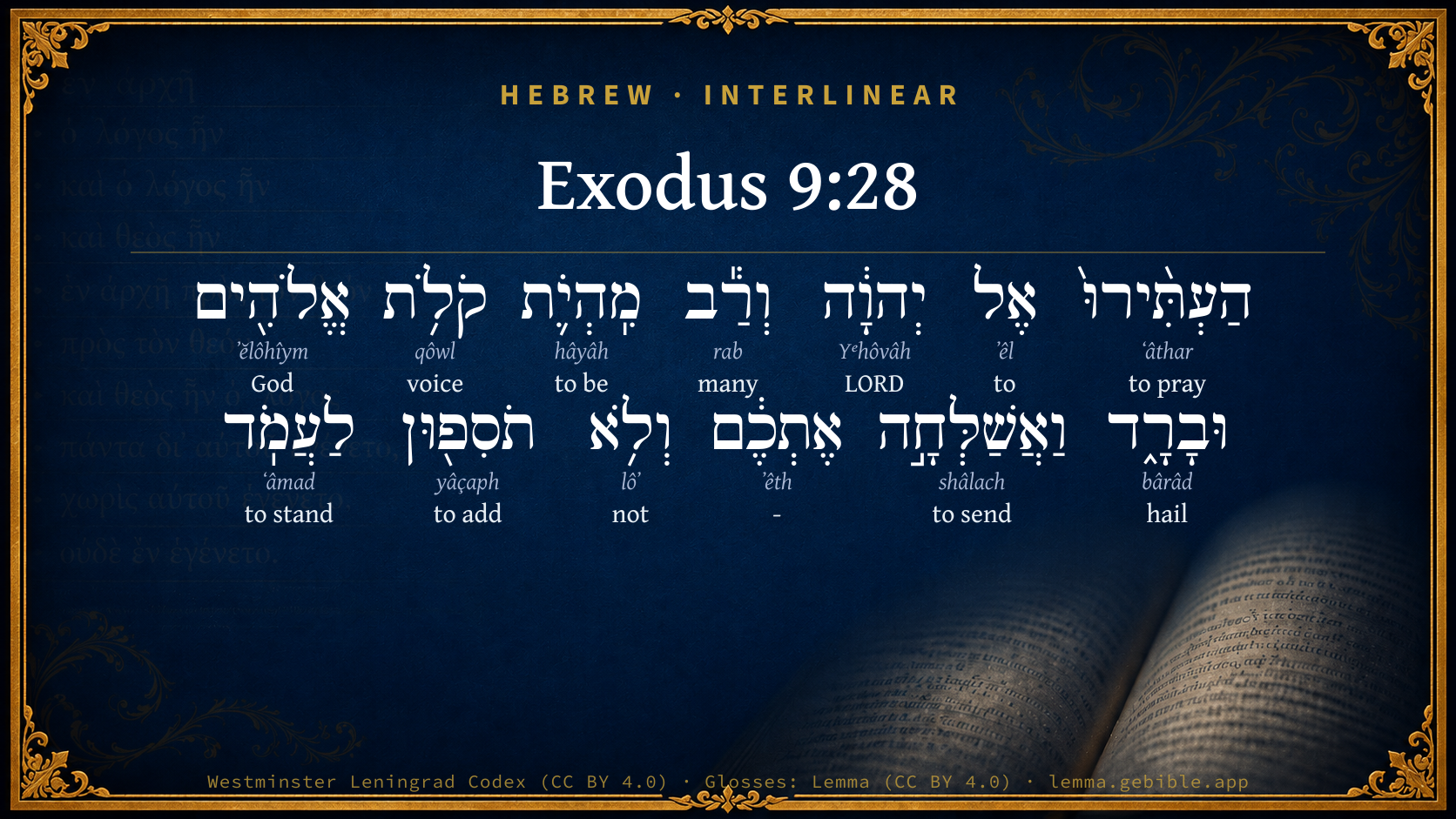
הַעְתִּ֨ירוּ֙
ʻâthar
H6279
“pray”
Verb, Hiphil, Imperative, 2nd Person, Masculine, Plural
Part of Speech
Verb
Stem
Hiphil
Form
Imperative
Person
2nd Person
Gender
Masculine
Number
Plural
Full BDB Definition

Origin: a primitive root [rather denominative from H6281 ]

TWOT: 1722

to pray, entreat, supplicate - (Qal) to pray, entreat - (Niphal) to be supplicated, be entreated - (Hiphil) to make supplication, plead
  1. אֶל ʼêl H413 “to” Preposition
  2. יְהוָ֔ה Yᵉhôvâh H3068 “LORD” Noun, Proper
  3. וְרַ֕ב rab H7227 “and · many” Conjunction + Adjective, Adjective, Masculine, Singular, Absolute
  4. מִֽהְיֹ֛ת hâyâh H1961 “from · to be” Preposition + Verb, Qal, Infinitive Construct
  5. קֹלֹ֥ת qôwl H6963 “voices of” Noun, Common, Masculine, Plural, Construct
  6. אֱלֹהִ֖ים ʼĕlôhîym H430 “God(s)” Noun, Common, Masculine, Plural, Absolute
  7. וּבָרָ֑ד bârâd H1259 “and · hail” Conjunction + Noun, Common, Masculine, Singular, Absolute
  8. וַאֲשַׁלְּחָ֣ה shâlach H7971 “and · to send” Conjunction + Verb, Piel, Cohortative, 1st Person, Common, Singular
  9. אֶתְכֶ֔ם ʼêth H853 “- · you” Particle, Direct Object + Suffix, Personal, 2nd Person, Masculine, Plural
  10. וְלֹ֥א lôʼ H3808 “and · not” Conjunction + Particle, Negative
  11. תֹסִפ֖וּן yâçaph H3254 “to add” Verb, Hiphil, Imperfect, 2nd Person, Masculine, Plural + Suffix, n
  12. לַעֲמֹֽד ʻâmad H5975 “to stand” Preposition + Verb, Qal, Infinitive Construct

About this verse

These counts appear in no published source. They are computed here, from the morphology-tagged text and Lemma’s own curated glosses. What Lemma adds →

13
words
13
distinct lemmas
Pentateuch
section

Notable vocabulary

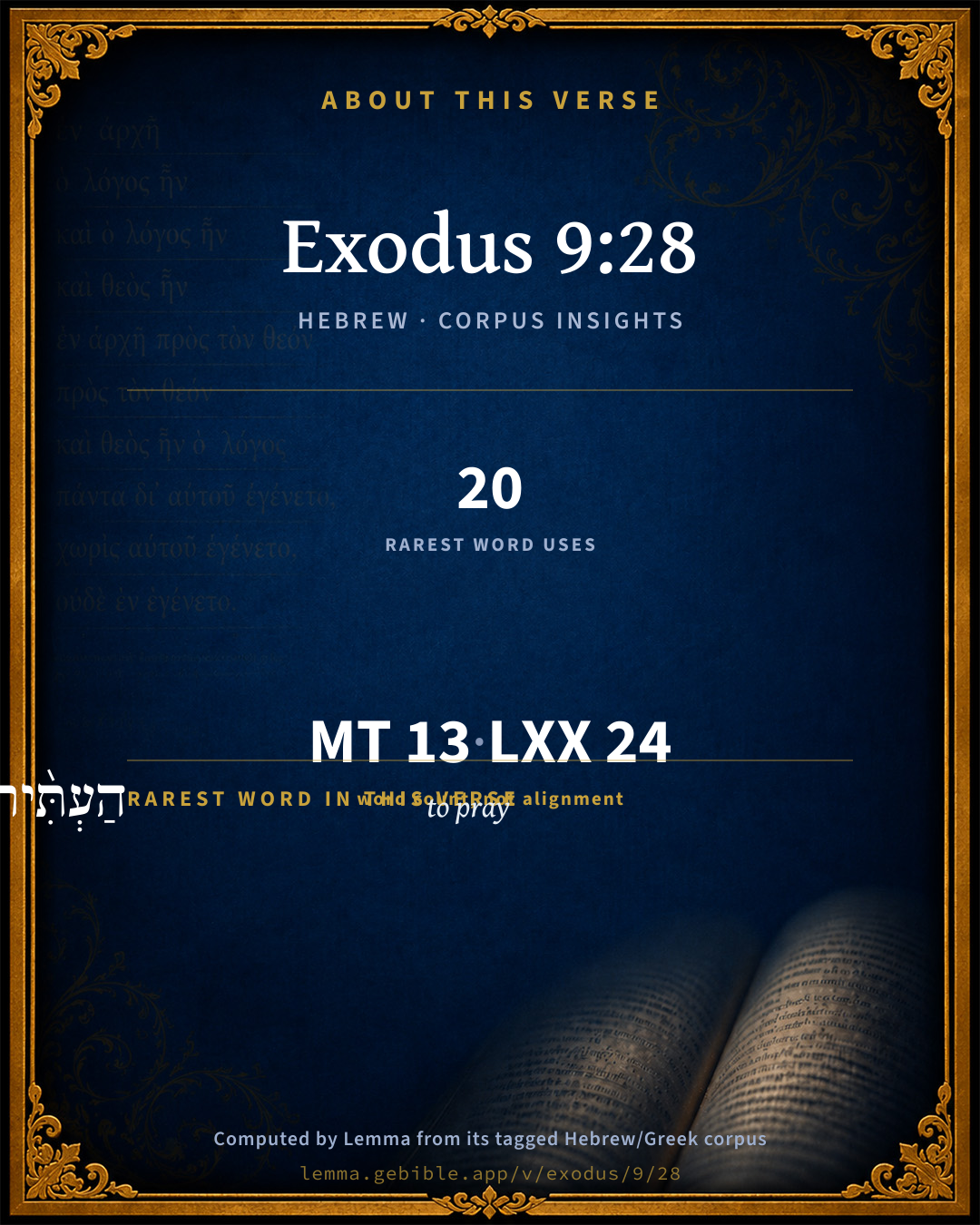
The rarest word here is הַעְתִּ֨ירוּ֙ to pray H6279 — appearing just 20 times in the whole Hebrew Bible.

Shared distinctive vocabulary

הַעְתִּ֨ירוּ֙ to pray H6279 occurs in 19 verses of the Hebrew Bible. Also found in:

Grammatical profile

  • 5 verbs
  • 4 nouns
  • 1 adjective
  • 1 preposition
  • 2 particles

Verb forms

  • הַעְתִּ֨ירוּ֙ Hiphil · Imperative
  • מִֽהְיֹ֛ת Qal · Infinitive Construct
  • וַאֲשַׁלְּחָ֣ה Piel · Cohortative
  • תֹסִפ֖וּן Hiphil · Imperfect
  • לַעֲמֹֽד Qal · Infinitive Construct

Hebrew & Septuagint length

In English translation the verse runs 24 words from the Hebrew and 35 from the Septuagint (LXX English) — the Septuagint runs noticeably longer here. See the side-by-side →

A rough comparison of the two English renderings, which tokenize alike — not a word-level alignment.

Word counts can differ between the Hebrew and the Greek without any difference in meaning — e.g. the Hebrew direct-object marker אֵת has no separate Greek word, and Greek often adds the article ὁ.

In the original languages it is 13 Hebrew tokens and 24 Greek tokens — but the two are counted differently (Hebrew bundles its prefixes and suffixes into one token; the Greek is in lemma form), so that isn’t a like-for-like length.

Cross-references

6

Topical passages linked to Exodus 9:28 in the Treasury of Scripture Knowledge — connected by theme and wording, ordered by reader-vote popularity; previews shown in the World English Bible.

  • Exodus 8:8 Then Pharaoh called for Moses and Aaron, and said, "Entreat Yahweh, that he take away the frogs from me, and from my people; and I will let the people go, that they may sacrifice to Yahweh."
  • Exodus 10:17 Now therefore please forgive my sin again, and pray to Yahweh your God, that he may also take away from me this death."
  • Exodus 8:28 Pharaoh said, "I will let you go, that you may sacrifice to Yahweh your God in the wilderness, only you shall not go very far away. Pray for me."
  • Exodus 11:1 Yahweh said to Moses, "Yet one plague more will I bring on Pharaoh, and on Egypt; afterwards he will let you go. When he lets you go, he will surely thrust you out altogether.
  • Psalms 29:3–4 Yahweh's voice is on the waters. The God of glory thunders, even Yahweh on many waters.
  • Acts 8:24 Simon answered, "Pray for me to the Lord, that none of the things which you have spoken happen to me."

Cross-references courtesy of OpenBible.info (CC BY 4.0).

Hebrew and Greek witnesses Masoretic Hebrew ↔ Greek Septuagint

The same verse in the two great witnesses to the Old Testament, shown verse-for-verse.

Here the Septuagint runs noticeably longer than the Hebrew — LXX2012 (modern English Septuagint) 35 words vs World English Bible 24. A rough length comparison of the two English translations, not a word-level alignment — read both below.

These are two independent witnesses, not word-aligned to each other, and the Septuagint is shown in lemma (dictionary) form.

Hebrew Exodus 9:28 Masoretic · Westminster Leningrad Codex

הַעְתִּ֨ירוּ֙ אֶל יְהוָ֔ה וְרַ֕ב מִֽהְיֹ֛ת קֹלֹ֥ת אֱלֹהִ֖ים וּבָרָ֑ד וַאֲשַׁלְּחָ֣ה אֶתְכֶ֔ם וְלֹ֥א תֹסִפ֖וּן לַעֲמֹֽד

Pray to Yahweh; for there has been enough of mighty thunderings and hail. I will let you go, and you shall stay no longer."

World English Bible · Public Domain

Greek LXX Exodus 9:28 Septuagint · lemma form

εὔχομαι οὖν περί ἐγώ πρός κύριος καί παύω ὁ γίγνομαι φωνή θεός καί χάλαζα καί πῦρ καί ἐκ ἀποστέλλω σύ καί οὐκέτι προςτίθημι μένω

Pray then for me to the Lord, and let him cause the thunderings of God to cease, and the hail and the fire, and I will send you forth and you⌃ shall remain no longer.

LXX2012 (modern English Septuagint) · Public Domain

Hebrew: Westminster Leningrad Codex (CC BY 4.0). Greek: Septuagint (public domain); English from LXX2012 (modern English Septuagint) (Public Domain). How the Septuagint differs from the Hebrew →

Targum (Aramaic paraphrase)

2

The Targum is the ancient Jewish Aramaic paraphrase of the Hebrew Scriptures — an interpretive translation, not the Hebrew text itself. Onkelos (literal) and Pseudo-Jonathan (expansive) render the Torah, and Jonathan the Prophets. Coverage is partial: where no permissively-licensed English translation exists for a verse, only the Aramaic is shown. This is verse-level text, not a word-by-word alignment to the Hebrew.

  1. Targum Onkelos Torah (Genesis–Deuteronomy)
    צַלוֹ קֳדָם יְיָ וְסַגִי קֳדָמוֹהִי רְוַח דְלָא יְהוֹן עֲלָנָא קָלִין דִלְוַט כְּאִלֵין מִן קֳדָם יְיָ וּבַרְדָא וְאֶשְׁלַח יָתְכוֹן וְלָא תוֹסְפוּן לְאִתְעַכָּבָא:

    (no public-domain English translation for this verse)

    Targum Onkelos — Aramaic: “Onkelos Genesis” (public domain); “Onkelos Exodus” (public domain); “Onkelos Leviticus” (public domain); “Onkelos Numbers” (public domain); “Onkelos Deuteronomy” (public domain). English: “Sefaria Community Translation” (CC0 1.0 (public-domain dedication)); “J.W. Etheridge. The Targums of Onkelos and Jonathan Ben Uzziel on the Pentateuch. London: Longmans, Green, 1862” (public domain). Text via Sefaria.

  2. Targum Pseudo-Jonathan Torah (Genesis–Deuteronomy)
    צְלוֹי קֳדָם יְיָ וִיהִי סַגִי קָדָמוֹי מִלְמֶהֱוֵי קָלִין דִלְוָוט מִן קֳדָם יְיָ וּבַרְדָן וְאֶפְטוֹר יַתְכוֹן וְלָא תוֹסְפוּן לְאִתְעַכָּבָא

    Intercede before the Lord, that with Him it may be enough, and there may be no more maledictory thunders nor hail from the presence of the Lord; and I will release you, and no longer hinder.

    Targum Pseudo-Jonathan — Aramaic: “Targum Jonathan on Genesis” (public domain); “Targum Jonathan on Exodus” (public domain); “Targum Jonathan on Leviticus” (public domain); “Targum Jonathan on Numbers” (public domain); “Targum Jonathan on Deuteronomy” (public domain). English: “The Targum of Jonathan ben Uzziel, trans. J. W. Etheridge, London, 1862” (public domain). Text via Sefaria.

Commentary

Notes on Exodus 9:28 from classic Christian and Jewish commentators (each source and its license shown beneath its notes). The classic Christian expositions comment on the surrounding passage and are grouped to its opening verse, so a note may address several verses; the Jewish commentaries on the Tanakh (Rashi and others) are per-verse, so they appear only where the commentator wrote on this verse.

Lemma curates 59 commentaries, every one of them public domain or Creative Commons licensed, each selected and text-cleaned for this edition rather than reprinted as found. About our sources →

Trapp's Complete Commentary

John Trapp

Exo 9:28 Intreat the LORD (for [it is] enough) that there be no [more] mighty thunderings and hail; and I will let you go, and ye shall stay no longer.

Ver. 28. I will let you go.] But though he speak thus fair, believe him not: "for there are seven abominations in his heart." {Pro 26:25} No sooner was Pharaoh off the rack, but he bites in his confession, and retracts his promise.

John Trapp, A Commentary or Exposition upon All the Books of the Old and New Testament (1647–1656) — public domain. Text from a community e-Sword module.

Geneva Bible (1599)

Geneva Bible translators

Hebrew, voice of God.

Geneva Bible (1599) marginal notes — public domain. Text via Bolls.life.

Adam Clarke's Commentary

Verse 28. It is enough] There is no need of any farther plague; I submit to the authority of Jehovah and will rebel no more.

Mighty thunderings] כלת אלהים koloth Elohim, voices of God; - that is, superlatively loud thunder. So mountains of God (Ps 36:6) means exceeding high mountains. So a prince of God (Ge 23:6) means a mighty prince. See a description of thunder, Ps 29:3-8: "The VOICE OF THE LORD is upon the waters: the God of glory thundereth; the Lord is upon many waters. The voice of the Lord is powerful; the voice of the Lord is full of majesty. The voice of the Lord breaketh the cedars. The voice of the Lord divideth the flames of fire. The voice of the Lord shaketh the wilderness," &c. The production of rain by the electric spark is alluded to in a very beautiful manner, Jer 10:13: When he uttereth his voice, there is a multitude of waters in the heavens. See Clarke on Ge 7:11, and See Clarke on Ge 8:1.

Adam Clarke's Commentary on the Bible (1810–1826) — public domain. Text from a community e-Sword/MySword module.

The Cambridge Bible for Schools and Colleges

gen. ed. J. J. S. Perowne

28. Intreat] Exo_8:8; Exo_8:28, Exo_10:17.

mighty thunderings] Heb. voices (v. 23) of God. The addition, ‘of God,’ does sometimes imply worthy to belong to God, i.e. mighty or noble (Gen_23:6, Num_24:6, Psa_36:6; Psa_68:15 RV., Psa_80:10; Psa_104:16); but, in view of the idiom explained on v. 23a, it is doubtful whether that is the case here.

The Cambridge Bible for Schools and Colleges (gen. ed. J. J. S. Perowne; Cambridge University Press, 1878–1918) — public domain. Text from a community e-Sword module.

John Gill's Exposition

And Moses said unto him, as soon as I am gone out of the city,.... Zoan or Tanis, for it was in the field of Zoan where these wonders were wrought, Psa 78:12, the reason why he went out of the city to pray, Jarchi says, was because it was full of idols; but the truer reason was, that he might be private and alone while he was praying to God; and perhaps he went out also to show that he was not frightened at the storm, or afraid of being destroyed by it, and was confident of preservation in the midst of it, in the open field, by the power of God, whom he served:

I will spread abroad my hands unto the Lord; which was a prayer gesture directed to by the light of nature, and was used very anciently, and by the Heathens, as well as others; of which the learned Rivet has given many instances in his comment on this text:

and the thunder shall cease, neither shall there be any more hail; this he had faith in, and full assurance of before he prayed for it; he knew the mind and will of God, and not only he knew what he could do, but what he would do, and which he tells Pharaoh of before hand; which was a full proof that he was a god to Pharaoh, as the Lord said he had made him, Exo 7:1.

that thou mayest know how that the earth is the Lord's; that the whole earth is his, and therefore he can do, and does in it whatever he pleases; as the heavens also are his, and therefore can cause thunder, lightning, hail, and rain, and stop them when he thinks fit; or that the land of Egypt particularly was his, and not Pharaoh's, and therefore could destroy, or save it at his pleasure; and particularly it being his, Pharaoh had no right to detain his people in it against his will, who was Lord of it.

John Gill's Exposition of the Whole Bible (1746–1763) — public domain (CC PDM 1.0). Text via the HelloAO Bible API.

Matthew Poole's English Annotations

Or, and let it be enough, (let God content himself that he hath punished me so long, and that I have confessed my sin, and promised amendment,)

that there may be hereafter

no more.

Matthew Poole's English Annotations on the Holy Bible (1683–1685) — public domain. Text from a community e-Sword/MySword module.

The Pulpit Commentary

Mighty thunderings. Literally, as in the margin, "voices of God." Thunder was regarded by many nations of antiquity as the actual voice of a god. In the Vedic theology, Indra spoke in thunder. The Egyptian view on the subject has not been ascertained.

The Pulpit Commentary (1880–1919), ed. H.D.M. Spence-Jones & Joseph S. Exell — public domain. Text from a community e-Sword module.

Rashi

Rabbi Shlomo Yitzchaki (Rashi)

ורב AND IT IS ENOUGH — let it suffice Him with what He has brought down already.

Rashi on the Tanakh — English translations: “The Judaica Press complete Tanach with Rashi, translated by A. J. Rosenberg” (CC BY 4.0); “Pentateuch with Rashi's commentary by M. Rosenbaum and A.M. Silbermann, 1929-1934” (public domain); “The Metsudah Tanach series, Lakewood, N.J” (CC BY 4.0); and “The Book of Joshua, Metsudah Publications, 1997” (CC BY 4.0). Text via Sefaria.

Lesson kit

Teaching starters — assembled from the data on this page, not authored interpretation. Every prompt links to the verse data it draws on. Edit before teaching.

Exodus, in the Pentateuch, opens this verse with 13 words (13 distinct Hebrew lemmas). Its most distinctive word is ʻâthar (“to pray”). The Greek Septuagint runs longer here. A historical commentator’s framing appears above. Read the whole chapter for the surrounding context.

Discussion questions

  1. What does “to pray” (ʻâthar) contribute to the verse as a whole?
  2. How does Genesis 25:21, which shares the word «to pray», read alongside this verse?
  3. The Septuagint runs longer here than the Hebrew. What might account for the difference?
  4. The translations on this page render this verse differently — a whole-verse word diff, not a word-by-word alignment. What might account for the different wordings?
  5. «הַעְתִּ֨ירוּ֙» is a Hiphil Imperative verb. How does that grammatical form shape the action described?
  6. Compare how Trapp's Complete Commentary and Geneva Bible (1599) read this verse. Where do they agree or differ?

Things to notice

Reading settings

Reading text

Shown beneath each verse's original-language words.

Old Testament
Old Testament edition

Read the OT as the Masoretic Hebrew (MT) or the Greek Septuagint (LXX).

English shown for the Greek Septuagint (in the Hebrew ↔ Greek comparison).

Comparing translations? Open the Compare panel on any verse page to stack up to four side by side.