
2 Chronicles 32:7

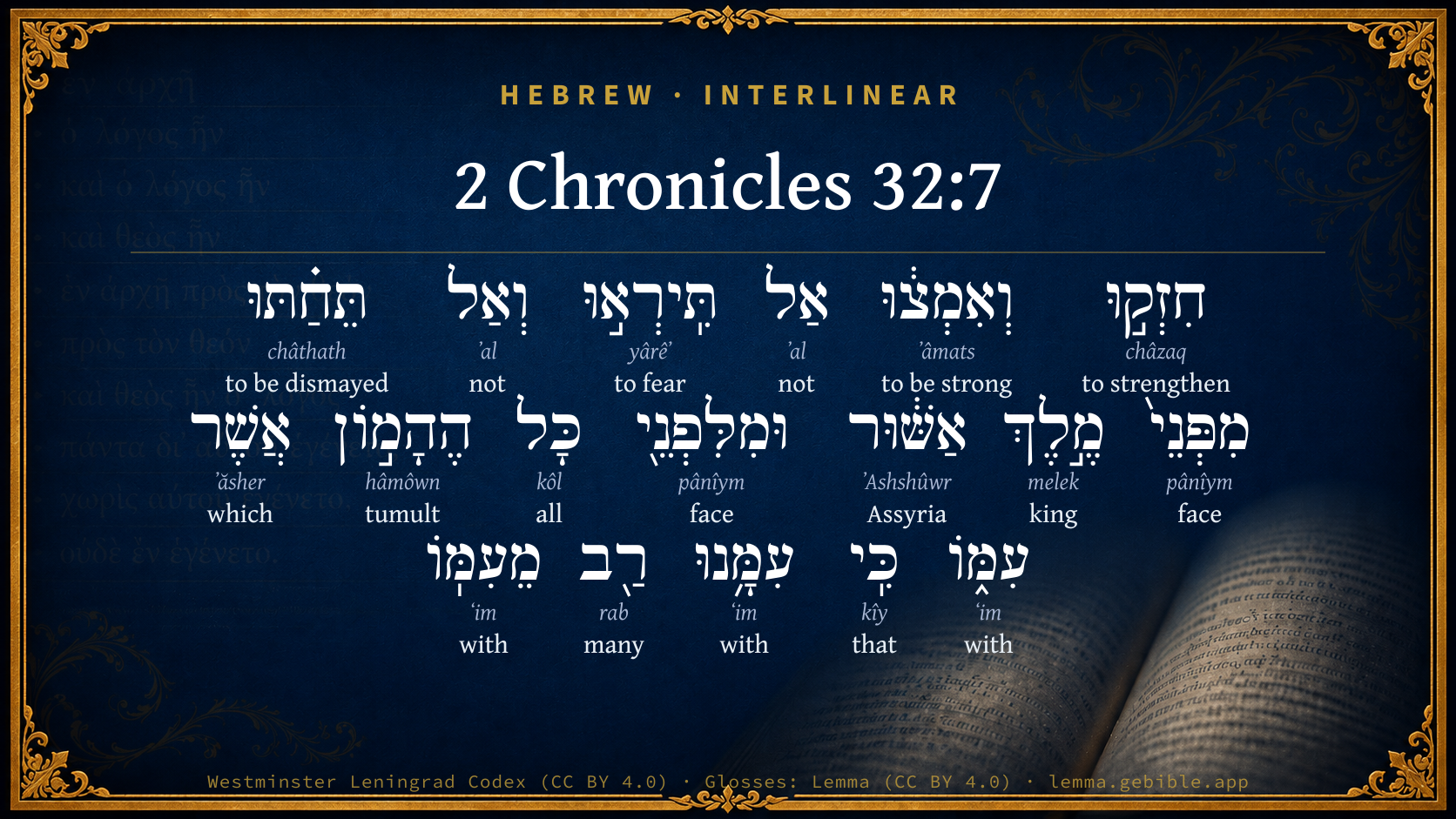
Hebrew (Westminster Leningrad Codex) 2 Chronicles 32:7 appears in the Hebrew Old Testament. The text above is from the Westminster Leningrad Codex. Each word links to its Strong’s number, a concise gloss, and parsing drawn from the Open Scriptures Hebrew Bible morphology. Click any word for its full Brown-Driver-Briggs (BDB) entry.
Download image
Cite this verse

2 Chronicles 32:7 (World English Bible). Public Domain. Lemma interlinear Bible study tool, https://lemma.gebible.app/v/2-chronicles/32/7.

Show BibTeX & RIS
BibTeX
RIS
English Translation
Be strong and of good courage, don't be afraid nor dismayed for the king of Assyria, nor for all the multitude who is with him; for there is a greater with us than with him:
World English Bible · Public Domain
Download a study sheet

One document with this verse’s original text, its word-by-word gloss line, the meaning frame, cross-references with their text, attributed commentary, and full source and license credits — printable, and it pastes into notes with its structure intact.

This verse Autodidact and up

Study sheet (.html) Plain text (.txt)

A passage Seminary Student

Up to 50 verses in one chapter. A passage sheet keeps up to 6 commentary sources and 12 cross-references per verse, in the order this page ranks them, and says so on the sheet whenever that leaves anything out. Ask for a single verse and you get the Autodidact verse sheet above.

Everything on this page stays free to read, with no account — the sheet is a download of what is already on screen, not access to it.

Want to remove ads? Support Godless Engineer
Compare translations 3

The same verse in 3 English versions, stacked beneath the original-language interlinear above. Click any original word for its lexicon entry.

Each is an independent rendering of the whole verse — the interlinear is not word-aligned to these translations.

Highlighted words mark where these versions differ — a whole-verse word diff, not a word-by-word alignment.

  • World English Bible Public Domain
    Be strong and of good courage, don't be afraid nor dismayed for the king of Assyria, nor for all the multitude who is with him; for there is a greater with us than with him:
  • King James Version Public Domain
    Be strong and courageous, be not afraid nor dismayed for the king of Assyria, nor for all the multitude that is with him: for there be more with us than with him:
  • unfoldingWord Literal Text CC BY-SA 4.0
    “Be strong and be courageous. Do not be afraid, and do not be dismayed from before the king of Assyria and from before all the multitude that is with him, for with us is one greater than with him.

unfoldingWord Literal Text — © unfoldingWord, licensed CC BY-SA 4.0. Word-aligned USFM3 via Door43 (git.door43.org/unfoldingWord/en_ult).

Versions to compare (up to 4)

3 of 4 selected

Show all 18 translations

Every available English version of this verse, each an independent rendering of the whole verse.

  • World English Bible Public Domain
    Be strong and of good courage, don't be afraid nor dismayed for the king of Assyria, nor for all the multitude who is with him; for there is a greater with us than with him:
  • Berean Standard Bible Public Domain
    “Be strong and courageous! Do not be afraid or discouraged before the king of Assyria and the vast army with him, for there is a greater One with us than with him.
  • Majority Standard Bible Public Domain
    “Be strong and courageous! Do not be afraid or discouraged before the king of Assyria and the vast army with him, for there is a greater One with us than with him.
  • King James Version Public Domain
    Be strong and courageous, be not afraid nor dismayed for the king of Assyria, nor for all the multitude that is with him: for there be more with us than with him:
  • American Standard Version (1901) Public Domain
    Be strong and of good courage, be not afraid nor dismayed for the king of Assyria, nor for all the multitude that is with him; for there is a greater with us than with him:
  • Revised Version (1885) Public Domain
    Be strong and of a good courage, be not afraid nor dismayed for the king of Assyria, nor for all the multitude that is with him: for there is a greater with us than with him:
  • Geneva Bible (1599) Public Domain
    Be strong and couragious: feare not, neither be afraide for the King of Asshur, neither for all the multitude that is with him: for there be more with vs, then is with him.
  • Douay-Rheims (1899) Public Domain
    Behave like men, and take courage: be not afraid nor dismayed for the king of the Assyrians, nor for all the multitude that is with him: for there are many more with us than with him.
  • Young's Literal Translation Public Domain
    `Be strong and courageous, be not afraid, nor be cast down from the face of the king of Asshur, and from the face of all the multitude that `is' with him, for with us `are' more than with him.
  • Literal Standard Version CC BY-SA 4.0
    “Be strong and courageous, do not be afraid, nor be cast down from the face of the king of Asshur, and from the face of all the multitude that [is] with him, for with us [are] more than with him.
  • Unlocked Literal Bible CC BY-SA 4.0
    “Be strong and of good courage. Do not be afraid or discouraged because of the king of Assyria and all the army that is with him, for someone is with us who is greater than those with him.
  • unfoldingWord Literal Text CC BY-SA 4.0
    “Be strong and be courageous. Do not be afraid, and do not be dismayed from before the king of Assyria and from before all the multitude that is with him, for with us is one greater than with him.
  • Darby Bible Public Domain
    Be strong and courageous, be not afraid nor dismayed for the king of Assyria, nor for all the multitude that is with him; for there are more with us than with him:
  • World Messianic Bible Public Domain
    “Be strong and courageous. Don’t be afraid or dismayed because of the king of Assyria, nor for all the multitude who is with him; for there is a greater one with us than with him.
  • Webster's Bible Public Domain
    Be strong and courageous, be not afraid nor dismayed for the king of Assyria, nor for all the multitude that is with him: for there are more with us than with him:
  • Free Bible Version CC BY-SA 4.0
    “Be strong and be brave! Don't be afraid or discouraged because of the king of Assyria with his large army, for there are more with us than with him.
  • Bible in Basic English Public Domain
    Be strong and take heart; have no fear, and do not be troubled on account of the king of Assyria and all the great army with him: for there is a greater with us.
  • JPS Tanakh (1917) Public Domain
    'Be strong and of good courage, be not afraid nor dismayed for the king of Assyria, nor for all the multitude that is with him; for there is a Greater with us than with him:

Literal Standard Version (2020), Covenant Press — licensed CC BY-SA 4.0. Text via the HelloAO Bible API (eBible.org). Unlocked Literal Bible (unfoldingWord) — licensed CC BY-SA 4.0. Text via the HelloAO Bible API (eBible.org). unfoldingWord Literal Text — © unfoldingWord, licensed CC BY-SA 4.0. Word-aligned USFM3 via Door43 (git.door43.org/unfoldingWord/en_ult). Free Bible Version, Dr. Jonathan Gallagher — licensed CC BY-SA 4.0. Text via the HelloAO Bible API (eBible.org).

Word by word

More ways to search: Search by grammar → Find every occurrence → Compare this word →

Practice this passage: Drill this verse → Learn its vocabulary →

וְאִמְצ֔וּ
ʼâmats
H553
“and · be strong”
Conjunction + Verb, Qal, Imperative, 2nd Person, Masculine, Plural
Part of Speech
Conjunction + Verb
Stem
Qal
Form
Imperative
Person
2nd Person
Gender
Masculine
Number
Plural
Full BDB Definition

Origin: a primitive root

TWOT: 117

to be strong, alert, courageous, brave, stout, bold, solid, hard - (Qal) to be strong, brave, bold - (Piel) to strengthen, secure (for oneself), harden (heart), make firm, make obstinate, assure - (Hithpael) to be determined, to make oneself alert, strengthen oneself, confirm oneself, persist in, prove superior to - (Hiphil) to exhibit strength, be strong, feel strong
  1. חִזְק֣וּ châzaq H2388 “strengthen” Verb, Qal, Imperative, 2nd Person, Masculine, Plural
  2. אַל ʼal H408 “not” Particle, Negative
  3. תִּֽירְא֣וּ yârêʼ H3372 “to fear” Verb, Qal, Jussive, 2nd Person, Masculine, Plural
  4. וְאַל ʼal H408 “and · not” Conjunction + Particle, Negative
  5. תֵּחַ֗תּוּ châthath H2865 “to be dismayed” Verb, Niphal, Jussive, 2nd Person, Masculine, Plural
  6. מִפְּנֵי֙ pânîym H6440 “from · face(s) of” Preposition + Noun, Common, Both, Plural, Construct
  7. מֶ֣לֶךְ melek H4428 “king of” Noun, Common, Masculine, Singular, Construct
  8. אַשּׁ֔וּר ʼAshshûwr H804 “Assyria” Noun, Proper
  9. וּמִלִּפְנֵ֖י pânîym H6440 “and · from · to/for · face(s) of” Conjunction + Preposition + Preposition + Noun, Common, Both, Plural, Construct
  10. כָּל kôl H3605 “all of” Noun, Common, Masculine, Singular, Construct
  11. הֶהָמ֣וֹן hâmôwn H1995 “the · tumult” Particle, Definite Article + Noun, Common, Masculine, Singular, Absolute
  12. אֲשֶׁר ʼăsher H834 “which” Particle, Relative
  13. עִמּ֑וֹ ʻim H5973 “with · him” Preposition + Suffix, Personal, 3rd Person, Masculine, Singular
  14. כִּֽי kîy H3588 “that” Conjunction
  15. עִמָּ֥נוּ ʻim H5973 “with · us” Preposition + Suffix, Personal, 1st Person, Common, Plural
  16. רַ֖ב rab H7227 “many” Adjective, Adjective, Masculine, Singular, Absolute
  17. מֵעִמּֽוֹ ʻim H5973 “from · with · him” Preposition + Preposition + Suffix, Personal, 3rd Person, Masculine, Singular

About this verse

These counts appear in no published source. They are computed here, from the morphology-tagged text and Lemma’s own curated glosses. What Lemma adds →

18
words
14
distinct lemmas
Historical
section

Shared distinctive vocabulary

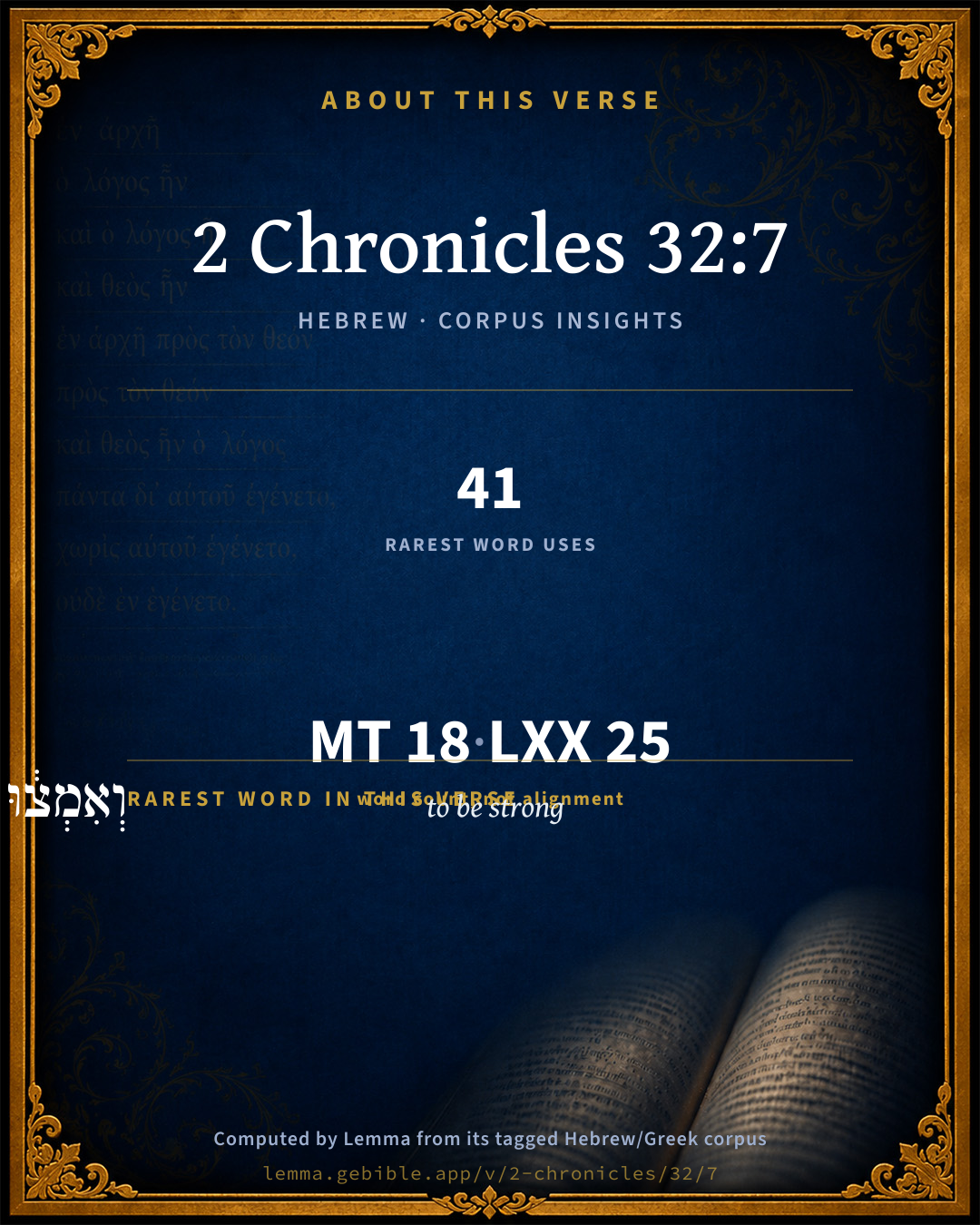
וְאִמְצ֔וּ to be strong H553 occurs in 41 verses of the Hebrew Bible. Also found in:

Grammatical profile

  • 4 verbs
  • 6 nouns
  • 1 adjective
  • 3 prepositions
  • 1 conjunction
  • 3 particles

Verb forms

  • חִזְק֣וּ Qal · Imperative
  • וְאִמְצ֔וּ Qal · Imperative
  • תִּֽירְא֣וּ Qal · Jussive
  • תֵּחַ֗תּוּ Niphal · Jussive

Repetition

Words recur within this verse — often emphatic in Hebrew:

  • מִפְּנֵי֙ face H6440 ×2
  • עִמּ֑וֹ with H5973 ×3
  • אַל not H408 ×2

Hebrew & Septuagint length

In English translation the verse runs 35 words from the Hebrew and 33 from the Septuagint (LXX English) — closely comparable.

A rough comparison of the two English renderings, which tokenize alike — not a word-level alignment.

Word counts can differ between the Hebrew and the Greek without any difference in meaning — e.g. the Hebrew direct-object marker אֵת has no separate Greek word, and Greek often adds the article ὁ.

In the original languages it is 18 Hebrew tokens and 25 Greek tokens — but the two are counted differently (Hebrew bundles its prefixes and suffixes into one token; the Greek is in lemma form), so that isn’t a like-for-like length.

Cross-references

18

Topical passages linked to 2 Chronicles 32:7 in the Treasury of Scripture Knowledge — connected by theme and wording, ordered by reader-vote popularity; previews shown in the World English Bible.

  • 2 Kings 6:16 He answered, Don't be afraid; for those who are with us are more than those who are with them.
  • Romans 8:31 What then shall we say about these things? If God is for us, who can be against us?
  • Ephesians 6:10 Finally, be strong in the Lord, and in the strength of his might.
  • 2 Kings 18:30 neither let Hezekiah make you trust in Yahweh, saying, Yahweh will surely deliver us, and this city shall not be given into the hand of the king of Assyria.
  • 2 Chronicles 20:15 and he said, Listen you, all Judah, and you inhabitants of Jerusalem, and you king Jehoshaphat: Thus says Yahweh to you, Don't be afraid you, neither be dismayed by reason of this great multitude; for the battle is not yours, but God's.
  • 1 John 4:4 You are of God, little children, and have overcome them; because greater is he who is in you than he who is in the world.
  • 1 Chronicles 28:20 David said to Solomon his son, Be strong and of good courage, and do it: don't be afraid, nor be dismayed; for Yahweh God, even my God, is with you; he will not fail you, nor forsake you, until all the work for the service of the house of Yahweh is finished.
  • Isaiah 35:4 Tell those who are of a fearful heart, Be strong, don't be afraid: behold, your God will come [with] vengeance, [with] the recompense of God; he will come and save you.
  • Daniel 10:19 He said, "Greatly beloved man, don't be afraid: peace be to you, be strong, yes, be strong." When he spoke to me, I was strengthened, and said, "Let my lord speak; for you have strengthened me."
  • Zechariah 8:9 Thus says Yahweh of Hosts: "Let your hands be strong, you who hear in these days these words from the mouth of the prophets who were in the day that the foundation of the house of Yahweh of Hosts was laid, even the temple, that it might be built.
  • Deuteronomy 31:6–7 Be strong and of good courage, don't be afraid, nor be scared of them: for Yahweh your God, he it is who does go with you; he will not fail you, nor forsake you.
  • Deuteronomy 31:23 He gave Joshua the son of Nun a charge, and said, Be strong and of good courage; for you shall bring the children of Israel into the land which I swore to them: and I will be with you.
  • Joshua 1:6–9 Be strong and of good courage; for you shall cause this people to inherit the land which I swore to their fathers to give them.
  • 2 Kings 19:6–7 Isaiah said to them, Thus shall you tell your master, Thus says Yahweh, Don't be afraid of the words that you have heard, with which the servants of the king of Assyria have blasphemed me.
  • Zechariah 8:23 Thus says Yahweh of Hosts: "In those days, ten men will take hold, out of all the languages of the nations, they will take hold of the skirt of him who is a Jew, saying, 'We will go with you, for we have heard that God is with you.'"
  • 1 Chronicles 22:13 Then shall you prosper, if you observe to do the statutes and the ordinances which Yahweh gave Moses concerning Israel. Be strong, and of good courage. Don't be afraid, neither be dismayed.
  • 1 Chronicles 28:10 Take heed now; for Yahweh has chosen you to build a house for the sanctuary: be strong, and do it.
  • 2 Timothy 2:1 You therefore, my child, be strengthened in the grace that is in Christ Jesus.

Cross-references courtesy of OpenBible.info (CC BY 4.0).

Hebrew and Greek witnesses Masoretic Hebrew ↔ Greek Septuagint

The same verse in the two great witnesses to the Old Testament, shown verse-for-verse.

These are two independent witnesses, not word-aligned to each other, and the Septuagint is shown in lemma (dictionary) form.

Hebrew 2 Chronicles 32:7 Masoretic · Westminster Leningrad Codex

חִזְק֣וּ וְאִמְצ֔וּ אַל תִּֽירְא֣וּ וְאַל תֵּחַ֗תּוּ מִפְּנֵי֙ מֶ֣לֶךְ אַשּׁ֔וּר וּמִלִּפְנֵ֖י כָּל הֶהָמ֣וֹן אֲשֶׁר עִמּ֑וֹ כִּֽי עִמָּ֥נוּ רַ֖ב מֵעִמּֽוֹ

Be strong and of good courage, don't be afraid nor dismayed for the king of Assyria, nor for all the multitude who is with him; for there is a greater with us than with him:

World English Bible · Public Domain

Greek LXX 2 Chronicles 32:7 Septuagint · lemma form

ἰσχύω καί ἀνδρίζομαι μή πτοέω ἀπό πρόσωπον βασιλεύς ασσουρ καί ἀπό πρόσωπον πᾶς ὁ ἔθνος ὁ μετά αὐτός ὅτι μετά ἐγώ πολύς ἤ μετά αὐτός

Be strong and courageous, and fear not, neither be dismayed before the King of Assyria, and before all the nation that is with him: for there are more with us than with him.

LXX2012 (modern English Septuagint) · Public Domain

Hebrew: Westminster Leningrad Codex (CC BY 4.0). Greek: Septuagint (public domain); English from LXX2012 (modern English Septuagint) (Public Domain). How the Septuagint differs from the Hebrew →

Commentary

Notes on 2 Chronicles 32:7 from classic Christian and Jewish commentators (each source and its license shown beneath its notes). The classic Christian expositions comment on the surrounding passage and are grouped to its opening verse, so a note may address several verses; the Jewish commentaries on the Tanakh (Rashi and others) are per-verse, so they appear only where the commentator wrote on this verse.

Lemma curates 59 commentaries, every one of them public domain or Creative Commons licensed, each selected and text-cleaned for this edition rather than reprinted as found. About our sources →

Trapp's Complete Commentary

John Trapp

2Ch 32:7 Be strong and courageous, be not afraid nor dismayed for the king of Assyria, nor for all the multitude that [is] with him: for [there be] more with us than with him:

Ver. 7. Be strong and courageous.] His speech is short but pithy: very cordial and comfortable.

Now for all the multitude that is with him.] Only go to Christ and say, as Isa 8:8, "The stretching out of his wings hath filled the breadth of thy land, O Immanuel."

John Trapp, A Commentary or Exposition upon All the Books of the Old and New Testament (1647–1656) — public domain. Text from a community e-Sword module.

The Biblical Illustrator

Joseph S. Exell

2Ch_32:7-8

With him is an arm of flesh; but with us is the Lord our God.

Hezekiah and the Assyrians

The story of Hezekiah and his preservation is one of the most vivid and thrilling. Rightly interpreted, it echoes the words of our text to all time. The king of Assyria is a representative character. The powers of this world are joined against the children of God, and they are variously commanded. Some Sennacherib rises from hour to hour and threatens, often with formidable front and fell purpose. But Gods people may always say, There be more with us than with him, etc. (Monday Club Sermons.)

We look too much to men

Oliver Cromwell was but a gentleman farmer, but the exigency of his time was such that he took up arms on behalf of his country. He was a man of prayer, and went to the battlefield from the prayer meeting. After one great victory, he writes to Parliament, God brought them into our hands God is not enough owned. We look too much to men and to visible helps. This hinders our success.

The arm of flesh

I. The character of our enemies described by an arm of flesh.

II. The source, of our support, and cause of victory. But with us is the Lord our God, to help us, and to fight our battles. This denotes--

1. Possession.

2. Presence.

3. Support.

4. Victory.

5. The Father is with us.

6. The Son is with us.

7. And the Holy Ghost is with us.

III. The result of Gods manifested presence. And the people rested themselves upon the words of Hezekiah, king of Judah. (T. B. Baker.)

Conditions of victory

I. At the negative side.

1. Numbers are no surety. Gideons army had to be reduced before it could conquer the Amalekites.

2. Worldly wisdom, policy, shrewdness, enterprise, will not ensure success.

3. Unlimited creature resources of every kind are insufficient.

4. The most seemingly favourable outward circumstances, as to time, place, auspices, expectations, combinations, oftentimes but deceive into carnal security and insure the worst kind of defeat.

II. At the positive side--the assured, unfailing conditions of victory in the sense of Righteousness and Godliness.

1. We must have God on our side. There must be no doubt on this point.

2. We must be careful to be on Gods side.

3. This brings out the point which the Apostle John emphasises so strongly (1Jn_5:4-5). (J. M. Sherwood.)

And the people rested themselves upon the words of Hezekiah, king of Judah.--

Words to rest on

I. The kind of man whose words are likely to be rested on. He must be--

1. A great man.

2. A good man.

3. A courageous man.

4. A hearty man.

5. In such a case God will add His sanction by granting success and he will be a prosperous man.

6. A man who has respect for Gods word.

II. In the second place let us turn the other way and look at the kind of people who rest on such a mans word.

1. Children do so with their parents.

2. Illiterate people who cannot read.

3. Unconverted persons who have no spiritual discernment.

4. Persons who naturally run in a groove. Having attended at such a place of worship, and having been brought up in the midst of a certain set of godly people, they scarcely deviate one jot from the teaching that they have received. Almost by the necessity of their nature they rest on what they hear.

5. Persons who profess always to do their own thinking. If you will trace them home, they are in nine cases out of ten the veriest slaves that ever lived. They are the bondservants of some heretic or other who has put it into their heads that in following him they become free men.

III. The kind of words you may rest on. You may safely rest on--

1. Words which urge you to faith in God.

2. Words which are the words of God Himself.

3. Words which are sealed by the Lord Jesus.

4. Words which have been blessed to other men.

5. Words which breathe a sense of rest into the soul. (C. H. Spurgeon.)

The Biblical Illustrator, edited by Joseph S. Exell (c. 1880s–1900s) — public domain. Text from a community e-Sword module.

Adam Clarke's Commentary

Verse 7. There be more with us than with him] We have more power than they have. (These words he quotes from the prophet Elisha, 2Kg 6:16.) This was soon proved to be true by the slaughter made by the angel of the Lord in the Assyrian camp.

Adam Clarke's Commentary on the Bible (1810–1826) — public domain. Text from a community e-Sword/MySword module.

Ellicott's Commentary for English Readers

(7) Be not afraid . . . the multitude.—Comp. 2Ch_20:15, “Be not afraid nor dismayed for this great multitude.” “Be strong and courageous, be not afraid” occurs in Deu_31:6 (Heb.).

For there be more with us than with him.—A reminiscence of 2Ki_6:16, “Be not thou afraid; for more are they that are with us than they that are with them.” It is not necessary to suppose that the chronicler professes to give the exact words of Hezekiah’s exhortation, but only the substance and spirit of it.

A Bible Commentary for English Readers, edited by Charles John Ellicott (1878–1897) — public domain. Text from a community e-Sword module.

The Cambridge Bible for Schools and Colleges

gen. ed. J. J. S. Perowne

7. and courageous] R.V. and of a good courage.

there be moe] R.V. there is a greater.

The Cambridge Bible for Schools and Colleges (gen. ed. J. J. S. Perowne; Cambridge University Press, 1878–1918) — public domain. Text from a community e-Sword module.

John Gill's Exposition

With him is an arm of flesh,.... Only weak, frail, mortal men, not at all to be feared; nothing in comparison of the Lord:

but with us is the Lord our God, to help us, and to fight our battles; who is the Lord God Almighty, who has the host of heaven at his command, and with whom all the inhabitants of the earth are as nothing; the Targum is,"the Word of the Lord our God is for us to help us, and fight our battles:"

and the people rested themselves upon the words of Hezekiah king of Judah; not upon his bare words, but on what was contained in them, on the strength and power of the Lord God he assured them was on their side; they believed what he said to be true, and trusted in the Lord that he would save them.

John Gill's Exposition of the Whole Bible (1746–1763) — public domain (CC PDM 1.0). Text via the HelloAO Bible API.

Albert Barnes' Notes on the Bible

On the language, compare the marginal references, for details, see Isa 22:5-13; Isa 29:3.

Albert Barnes' Notes on the Bible (1834–1885) — public domain. Text from a community e-Sword/MySword module.

Haydock's Catholic Bible Commentary

More: God and his angels, from whom he expected relief, and was not disappointed, 4 K. vi. 16., and xix. 35. C.

George Leo Haydock (1774–1849), Haydock's Catholic Family Bible and Commentary, 1859 edition — public domain. Excludes Psalms (Douay-Rheims chapter numbering differs from Protestant) and Deuterocanonical books (Catholic canon only).

The Pulpit Commentary

Several of the descriptive dramatic touches of Isa_22:4-14 are forcible and apt commentary to this verse.

The Pulpit Commentary (1880–1919), ed. H.D.M. Spence-Jones & Joseph S. Exell — public domain. Text from a community e-Sword module.

Lesson kit

Teaching starters — assembled from the data on this page, not authored interpretation. Every prompt links to the verse data it draws on. Edit before teaching.

2 Chronicles, in the Historical, opens this verse with 18 words (14 distinct Hebrew lemmas). Its most distinctive word is ʼâmats (“to be strong”). A historical commentator’s framing appears above. Read the whole chapter for the surrounding context.

Discussion questions

  1. What does “to be strong” (ʼâmats) contribute to the verse as a whole?
  2. Genesis 25:23 shares the word «to be strong» with this verse. How do the two illuminate each other?
  3. “face” occurs 2× in this one verse. What is the effect of the repetition?
  4. These translations render this verse differently; the difference is in the English rendering, not the original. What questions does that raise?
  5. The verb «חִזְק֣וּ» is Qal Imperative. How does its form color the action?
  6. Reading how Trapp's Complete Commentary and The Biblical Illustrator read this verse, where do the two commentators agree and where do they part?

Things to notice

Reading settings

Reading text

Shown beneath each verse's original-language words.

Old Testament
Old Testament edition

Read the OT as the Masoretic Hebrew (MT) or the Greek Septuagint (LXX).

English shown for the Greek Septuagint (in the Hebrew ↔ Greek comparison).

Comparing translations? Open the Compare panel on any verse page to stack up to four side by side.