
Joshua 17:15

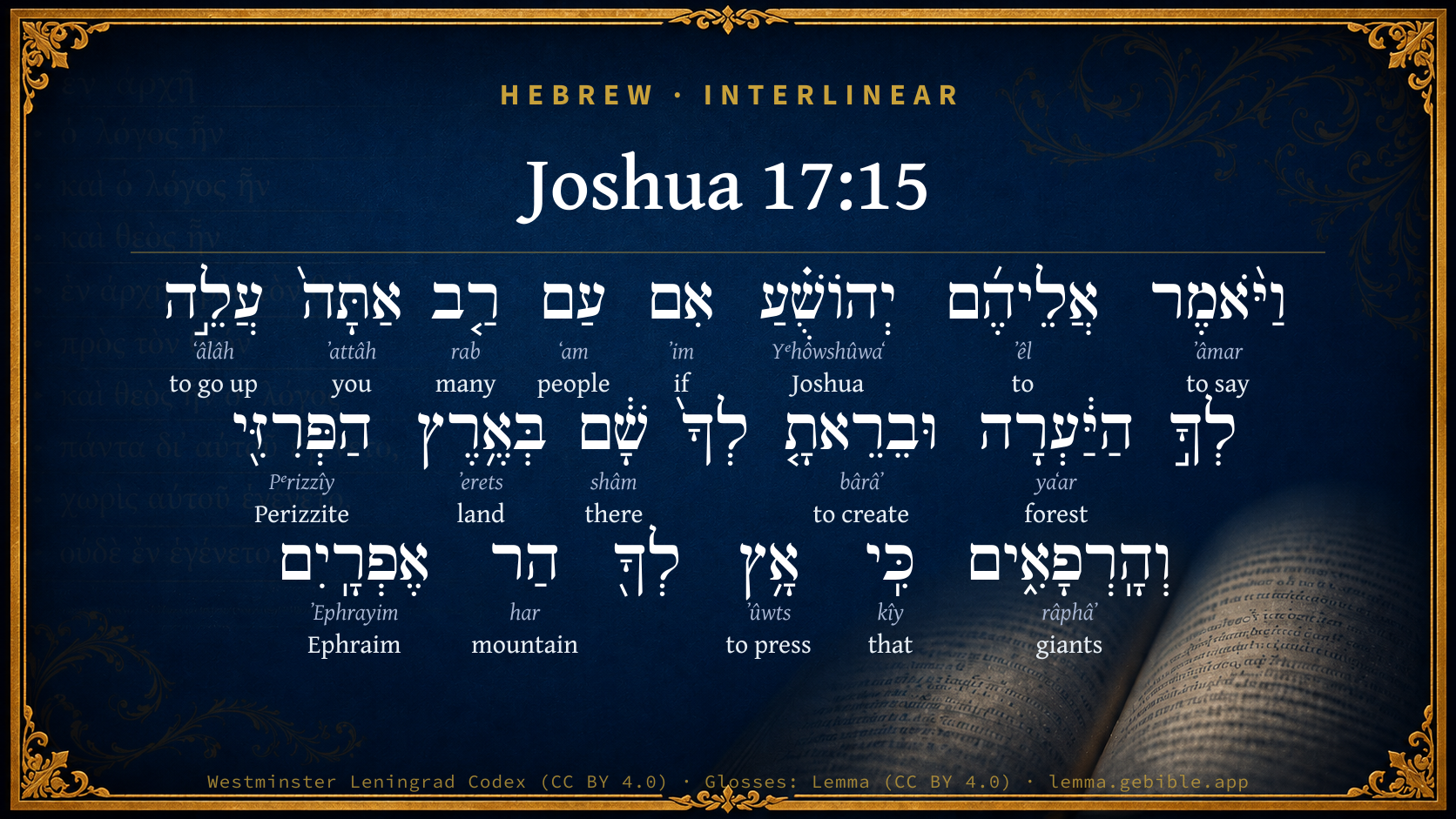
Hebrew (Westminster Leningrad Codex) Joshua 17:15 appears in the Hebrew Old Testament. The text above is from the Westminster Leningrad Codex. Each word links to its Strong’s number, a concise gloss, and parsing drawn from the Open Scriptures Hebrew Bible morphology. Click any word for its full Brown-Driver-Briggs (BDB) entry.
Download image
Cite this verse

Joshua 17:15 (World English Bible). Public Domain. Lemma interlinear Bible study tool, https://lemma.gebible.app/v/joshua/17/15.

Show BibTeX & RIS
BibTeX
RIS
English Translation
Joshua said to them, If you are a great people, go up to the forest, and cut down for yourself there in the land of the Perizzites and of the Rephaim; since the hill-country of Ephraim is too narrow for you.
World English Bible · Public Domain
Download a study sheet

One document with this verse’s original text, its word-by-word gloss line, the meaning frame, cross-references with their text, attributed commentary, and full source and license credits — printable, and it pastes into notes with its structure intact.

This verse Autodidact and up

Study sheet (.html) Plain text (.txt)

A passage Seminary Student

Up to 50 verses in one chapter. A passage sheet keeps up to 6 commentary sources and 12 cross-references per verse, in the order this page ranks them, and says so on the sheet whenever that leaves anything out. Ask for a single verse and you get the Autodidact verse sheet above.

Everything on this page stays free to read, with no account — the sheet is a download of what is already on screen, not access to it.

Want to remove ads? Support Godless Engineer
Compare translations 3

The same verse in 3 English versions, stacked beneath the original-language interlinear above. Click any original word for its lexicon entry.

Each is an independent rendering of the whole verse — the interlinear is not word-aligned to these translations.

Highlighted words mark where these versions differ — a whole-verse word diff, not a word-by-word alignment.

  • World English Bible Public Domain
    Joshua said to them, If you are a great people, go up to the forest, and cut down for yourself there in the land of the Perizzites and of the Rephaim; since the hill-country of Ephraim is too narrow for you.
  • King James Version Public Domain
    And Joshua answered them, If thou be a great people, then get thee up to the wood country, and cut down for thyself there in the land of the Perizzites and of the giants, if mount Ephraim be too narrow for thee.
  • unfoldingWord Literal Text CC BY-SA 4.0
    And Joshua said to them, “If you a numerous people, go up for yourself to the forest, and you shall clear for yourself there in the land of the Perizzite and the Raphaites, for the hill country of Ephraim is narrow to you.”

unfoldingWord Literal Text — © unfoldingWord, licensed CC BY-SA 4.0. Word-aligned USFM3 via Door43 (git.door43.org/unfoldingWord/en_ult).

Versions to compare (up to 4)

3 of 4 selected

Show all 18 translations

Every available English version of this verse, each an independent rendering of the whole verse.

  • World English Bible Public Domain
    Joshua said to them, If you are a great people, go up to the forest, and cut down for yourself there in the land of the Perizzites and of the Rephaim; since the hill-country of Ephraim is too narrow for you.
  • Berean Standard Bible Public Domain
    Joshua answered them, “If you have so many people that the hill country of Ephraim is too small for you, go to the forest and clear for yourself an area in the land of the Perizzites and the Rephaim.”
  • Majority Standard Bible Public Domain
    Joshua answered them, “If you have so many people that the hill country of Ephraim is too small for you, go to the forest and clear for yourself an area in the land of the Perizzites and the Rephaim.”
  • King James Version Public Domain
    And Joshua answered them, If thou be a great people, then get thee up to the wood country, and cut down for thyself there in the land of the Perizzites and of the giants, if mount Ephraim be too narrow for thee.
  • American Standard Version (1901) Public Domain
    And Joshua said unto them, If thou be a great people, get thee up to the forest, and cut down for thyself there in the land of the Perizzites and of the Rephaim; since the hill-country of Ephraim is too narrow for thee.
  • Revised Version (1885) Public Domain
    And Joshua said unto them, If thou be a great people, get thee up to the forest, and cut down for thyself there in the land of the Perizzites and of the Rephaim; since the hill country of Ephraim is too narrow for thee.
  • Geneva Bible (1599) Public Domain
    Ioshua then answered them, If thou be much people, get thee vp to the wood, and cut trees for thy selfe there in the lande of the Perizzites, and of the gyants, if mount Ephraim be too narowe for thee.
  • Douay-Rheims (1899) Public Domain
    And Josue said to them: If thou be a great people, go up into the woodland, and cut down room for thyself in the land of the Pherezite and the Raphaims: because the possession of mount Ephraim is too narrow for thee.
  • Young's Literal Translation Public Domain
    And Joshua saith unto them, `If thou `art' a numerous people, go up for thee to the forest, then thou hast prepared for thee there, in the land of the Perizzite, and of the Rephaim, when mount Ephraim hath been narrow for thee.'
  • Literal Standard Version CC BY-SA 4.0
    And Joshua says to them, “If you [are] a numerous people, go up to the forest for yourself, then you have created [a place] for yourself there in the land of the Perizzite and of the Rephaim, when Mount Ephraim has been narrow for you.”
  • Unlocked Literal Bible CC BY-SA 4.0
    Joshua said to them, “If you are a people great in number, go up by yourselves to the forest and there clear the ground for yourselves in the land of the Perizzites and of the Rephaim. Do this, since the hill country of Ephraim is too small for you.”
  • unfoldingWord Literal Text CC BY-SA 4.0
    And Joshua said to them, “If you a numerous people, go up for yourself to the forest, and you shall clear for yourself there in the land of the Perizzite and the Raphaites, for the hill country of Ephraim is narrow to you.”
  • Darby Bible Public Domain
    And Joshua said unto them, If thou art a great people, then get thee up to the wood, and cut down for thyself there in the land of the Perizzites and of the giants, if the hill-country of Ephraim is too narrow for thee.
  • World Messianic Bible Public Domain
    Joshua said to them, “If you are a numerous people, go up to the forest, and clear land for yourself there in the land of the Perizzites and of the Rephaim, since the hill country of Ephraim is too narrow for you.”
  • Webster's Bible Public Domain
    And Joshua answered them, If thou art a great people, then go up to the wood, and cut down for thyself there in the land of the Perizzites and of the giants, if mount Ephraim is too narrow for thee.
  • Free Bible Version CC BY-SA 4.0
    Joshua told them, “If there's so many of you, if the hill country of Ephraim is too small for you, then go and clear ground for yourselves from the forest in the land of the Perizzites and the Rephaim.”
  • Bible in Basic English Public Domain
    Then Joshua said to them, If you are such a great people, go up into the woodlands, clearing a place there for yourselves in the land of the Perizzites and the Rephaim, if the hill-country of Ephraim is not wide enough for you.
  • JPS Tanakh (1917) Public Domain
    And Joshua said unto them: 'If thou be a great people, get thee up to the forest, and cut down for thyself there in the land of the Perizzites and of the Rephaim; since the hill-country of Ephraim is too narrow for thee.'

Literal Standard Version (2020), Covenant Press — licensed CC BY-SA 4.0. Text via the HelloAO Bible API (eBible.org). Unlocked Literal Bible (unfoldingWord) — licensed CC BY-SA 4.0. Text via the HelloAO Bible API (eBible.org). unfoldingWord Literal Text — © unfoldingWord, licensed CC BY-SA 4.0. Word-aligned USFM3 via Door43 (git.door43.org/unfoldingWord/en_ult). Free Bible Version, Dr. Jonathan Gallagher — licensed CC BY-SA 4.0. Text via the HelloAO Bible API (eBible.org).

Word by word

More ways to search: Search by grammar → Find every occurrence → Compare this word →

Practice this passage: Drill this verse → Learn its vocabulary →

אָ֥ץ
ʼûwts
H213
“to press”
Verb, Qal, Perfect, 3rd Person, Masculine, Singular
Part of Speech
Verb
Stem
Qal
Form
Perfect
Person
3rd Person
Gender
Masculine
Number
Singular
Full BDB Definition

Origin: a primitive root

TWOT: 51

to press, be pressed, make haste, urge, be narrow - (Qal) - to press, hasten - to be pressed, confined, narrow - to hasten, make haste - be narrow - (Hiphil) - to urge, insist - to hasten
  1. וַיֹּ֨אמֶר ʼâmar H559 “and · to say” Conjunction + Verb, Qal, Sequential Imperfect, 3rd Person, Masculine, Singular
  2. אֲלֵיהֶ֜ם ʼêl H413 “to · them” Preposition + Suffix, Personal, 3rd Person, Masculine, Plural
  3. יְהוֹשֻׁ֗עַ Yᵉhôwshûwaʻ H3091 “Joshua” Noun, Proper
  4. אִם ʼim H518 “if” Conjunction
  5. עַם ʻam H5971 “people” Noun, Common, Masculine, Singular, Absolute
  6. רַ֤ב rab H7227 “many” Adjective, Adjective, Masculine, Singular, Absolute
  7. אַתָּה֙ ʼattâh H859 “you” Pronoun, Personal, 2nd Person, Masculine, Singular
  8. עֲלֵ֣ה ʻâlâh H5927 “go up” Verb, Qal, Imperative, 2nd Person, Masculine, Singular
  9. הַיַּ֔עְרָה yaʻar H3293 “the · forest · toward” Particle, Definite Article + Noun, Common, Masculine, Singular, Absolute + Suffix, Demonstrative
  10. וּבֵרֵאתָ֤ bârâʼ H1254 “and · to create” Conjunction + Verb, Piel, Sequential Perfect, 2nd Person, Masculine, Singular
  11. שָׁ֔ם shâm H8033 “there” Adverb
  12. בְּאֶ֥רֶץ ʼerets H776 “in/at · land of” Preposition + Noun, Common, Both, Singular, Construct
  13. הַפְּרִזִּ֖י Pᵉrizzîy H6522 “the · Perizzite” Particle, Definite Article + Noun, Gentilic, Masculine, Singular, Absolute
  14. וְהָֽרְפָאִ֑ים râphâʼ H7497 “and · the · giants” Conjunction + Particle, Definite Article + Noun, Proper
  15. כִּֽי kîy H3588 “that” Conjunction
  16. הַר har H2022 “mountain of” Noun, Common, Masculine, Singular, Construct
  17. אֶפְרָֽיִם ʼEphrayim H669 “Ephraim” Noun, Proper

About this verse

These counts appear in no published source. They are computed here, from the morphology-tagged text and Lemma’s own curated glosses. What Lemma adds →

21
words
18
distinct lemmas
Historical
section

Notable vocabulary

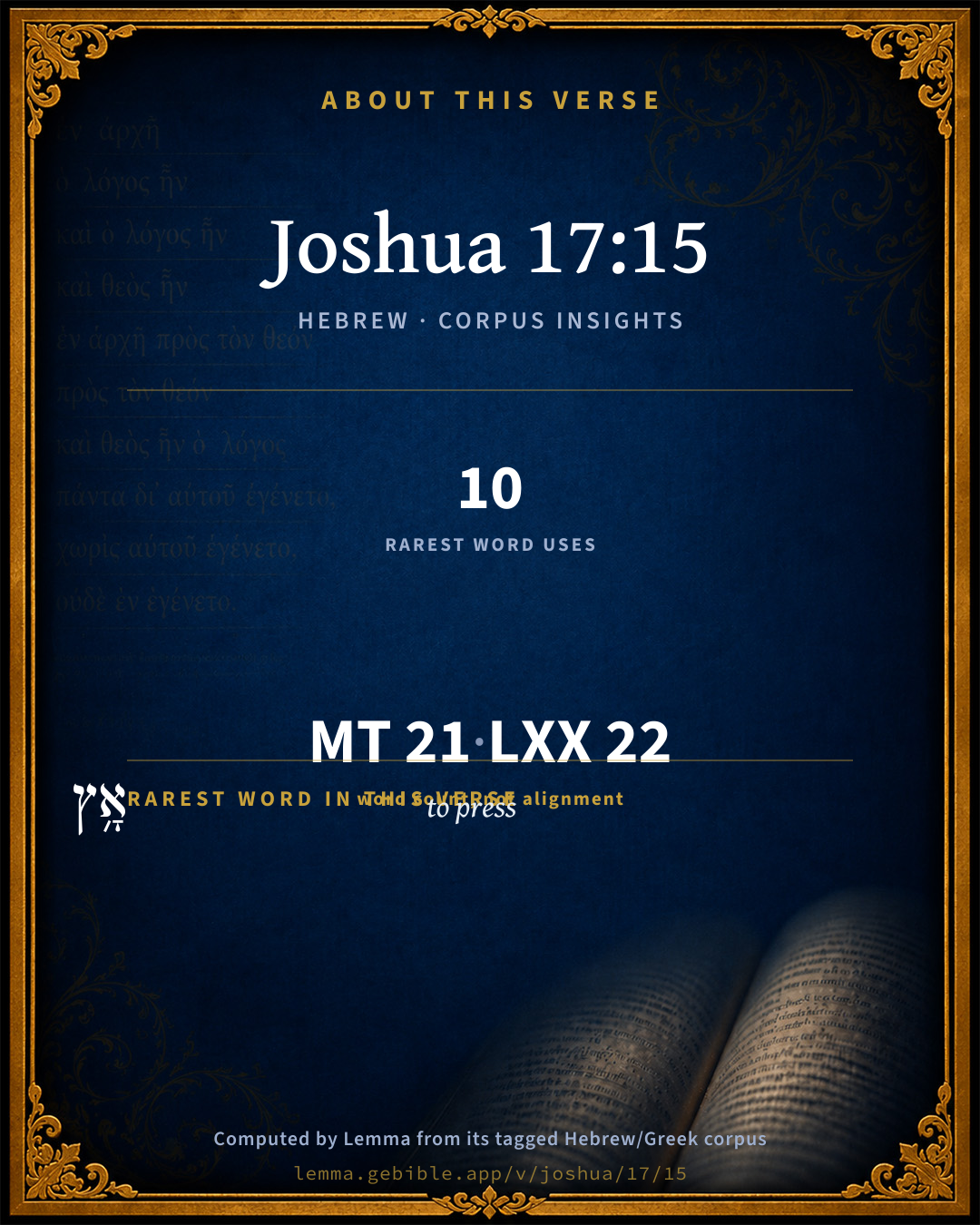
The rarest word here is אָ֥ץ to press H213 — appearing just 10 times in the whole Hebrew Bible.

Shared distinctive vocabulary

אָ֥ץ to press H213 occurs in 10 verses of the Hebrew Bible. Also found in:

Grammatical profile

  • 4 verbs
  • 8 nouns
  • 1 adjective
  • 1 pronoun
  • 4 prepositions
  • 2 conjunctions
  • 1 adverb

Verb forms

  • וַיֹּ֨אמֶר Qal · Sequential Imperfect
  • עֲלֵ֣ה Qal · Imperative
  • וּבֵרֵאתָ֤ Piel · Sequential Perfect
  • אָ֥ץ Qal · Perfect

Hebrew & Septuagint length

In English translation the verse runs 41 words from the Hebrew and 30 from the Septuagint (LXX English) — closely comparable.

A rough comparison of the two English renderings, which tokenize alike — not a word-level alignment.

Word counts can differ between the Hebrew and the Greek without any difference in meaning — e.g. the Hebrew direct-object marker אֵת has no separate Greek word, and Greek often adds the article ὁ.

In the original languages it is 21 Hebrew tokens and 22 Greek tokens — but the two are counted differently (Hebrew bundles its prefixes and suffixes into one token; the Greek is in lemma form), so that isn’t a like-for-like length.

Cross-references

8

Topical passages linked to Joshua 17:15 in the Treasury of Scripture Knowledge — connected by theme and wording, ordered by reader-vote popularity; previews shown in the World English Bible.

  • Genesis 13:7 There was a strife between the herdsmen of Abram's cattle and the herdsmen of Lot's cattle: and the Canaanite and the Perizzite lived then in the land.
  • Genesis 14:5 In the fourteenth year Chedorlaomer came, and the kings who were with him, and struck the Rephaim in Ashteroth Karnaim, and the Zuzim in Ham, and the Emim in Shaveh-kiriathaim,
  • Genesis 15:20 the Hittites, the Perizzites, the Rephaim,
  • Exodus 33:2 I will send an angel before you; and I will drive out the Canaanite, the Amorite, and the Hittite, and the Perizzite, the Hivite, and the Jebusite:
  • 2 Samuel 5:18 Now the Philistines had come and spread themselves in the valley of Rephaim.
  • 2 Samuel 5:22 The Philistines came up yet again, and spread themselves in the valley of Rephaim.
  • Ezra 9:1 Now when these things were done, the princes drew near to me, saying, The people of Israel, and the priests and the Levites, have not separated themselves from the peoples of the lands, [doing] according to their abominations, even of the Canaanites, the Hittites, the Perizzites, the Jebusites, the Ammonites, the Moabites, the Egyptians, and the Amorites.
  • Luke 12:48 but he who didn't know, and did things worthy of stripes, will be beaten with few stripes. To whoever much is given, of him will much be required; and to whom much was entrusted, of him more will be asked.

Cross-references courtesy of OpenBible.info (CC BY 4.0).

Hebrew and Greek witnesses Masoretic Hebrew ↔ Greek Septuagint

The same verse in the two great witnesses to the Old Testament, shown verse-for-verse.

These are two independent witnesses, not word-aligned to each other, and the Septuagint is shown in lemma (dictionary) form.

Hebrew Joshua 17:15 Masoretic · Westminster Leningrad Codex

וַיֹּ֨אמֶר אֲלֵיהֶ֜ם יְהוֹשֻׁ֗עַ אִם עַם רַ֤ב אַתָּה֙ עֲלֵ֣ה לְךָ֣ הַיַּ֔עְרָה וּבֵרֵאתָ֤ לְךָ֙ שָׁ֔ם בְּאֶ֥רֶץ הַפְּרִזִּ֖י וְהָֽרְפָאִ֑ים כִּֽי אָ֥ץ לְךָ֖ הַר אֶפְרָֽיִם

Joshua said to them, If you are a great people, go up to the forest, and cut down for yourself there in the land of the Perizzites and of the Rephaim; since the hill-country of Ephraim is too narrow for you.

World English Bible · Public Domain

Greek LXX Joshua 17:15 Septuagint · lemma form

καί εἶπον αὐτός ἰησοῦς εἰ λαός πολύς εἰμί ἀναβαίνω εἰς ὁ δρυμός καί ἐκκαθαρίζω σεαυτοῦ εἰ στενοχωρέω σύ ὁ ὄρος ὁ ἐφράιμ

And Joshua said to them, If you be a great people, go up to the forest, and clear the land for yourself, If mount Ephraim be too little for you.

LXX2012 (modern English Septuagint) · Public Domain

Hebrew: Westminster Leningrad Codex (CC BY 4.0). Greek: Septuagint (public domain); English from LXX2012 (modern English Septuagint) (Public Domain). How the Septuagint differs from the Hebrew →

Targum (Aramaic paraphrase)

1

The Targum is the ancient Jewish Aramaic paraphrase of the Hebrew Scriptures — an interpretive translation, not the Hebrew text itself. Onkelos (literal) and Pseudo-Jonathan (expansive) render the Torah, and Jonathan the Prophets. Coverage is partial: where no permissively-licensed English translation exists for a verse, only the Aramaic is shown. This is verse-level text, not a word-by-word alignment to the Hebrew.

  1. Targum Jonathan Prophets (Joshua–Malachi)
    וַאֲמַר לְהוֹן יְהוֹשֻׁעַ אִם עַם סַגִי אַתּוּן סַקוּ לְכוֹן לְחוּרְשָׁא וּתְתַקֵן לָךְ תַמָן אֲתַר בְּאַרַע פְּרִזָאֵי וְגִבָּרַיָא אֲרֵי עָק לְכוֹן טוּרָא דְהַר אֶפְרָיִם:

    (no public-domain English translation for this verse)

    Targum Jonathan — Aramaic: “Mikraot Gedolot” (public domain). English: “Sefaria Community Translation” (CC0 1.0 (public-domain dedication)); “London "Chaldee Paraphrase," 1871” (public domain). Text via Sefaria.

Commentary

Notes on Joshua 17:15 from classic Christian and Jewish commentators (each source and its license shown beneath its notes). The classic Christian expositions comment on the surrounding passage and are grouped to its opening verse, so a note may address several verses; the Jewish commentaries on the Tanakh (Rashi and others) are per-verse, so they appear only where the commentator wrote on this verse.

Lemma curates 59 commentaries, every one of them public domain or Creative Commons licensed, each selected and text-cleaned for this edition rather than reprinted as found. About our sources →

Trapp's Complete Commentary

John Trapp

Jos 17:15 And Joshua answered them, If thou [be] a great people, [then] get thee up to the wood [country], and cut down for thyself there in the land of the Perizzites and of the giants, if mount Ephraim be too narrow for thee.

Ver. 15. If thou be a great people.] Thus he retorteth their arguments upon themselves, that if they were so numerous, they were the better able to enlarge their borders by their own endeavours, though it might be to their pains and peril.

Get thee up to the wood.] Where many hands may make light work, and soon lay all level, fit for thy use.

If mount Ephraim be too narrow for thee.] And so thou want room, as bees do, that for like cause, do hang out of the hive’s mouth on heaps.

John Trapp, A Commentary or Exposition upon All the Books of the Old and New Testament (1647–1656) — public domain. Text from a community e-Sword module.

Joseph Benson's Commentary

Jos 17:15. If thou be a great people — Though Joshua was of their tribe he would not humour them, or abuse his authority to gratify their inclinations; but retorts their own argument: seeing thou art a great and numerous people, turn thy complaints into action, and enlarge thy borders by thy own hand, for which thou mayest confidently expect God’s assistance. The wood country — To the mountain, as it is called, (Jos 17:17,) where among some towns there is much wood-land, which thou mayest without much difficulty possess, and so get the more room. And cut down — The wood, for thy own advantage, in building more cities and towns, and preparing the land for pasture and tillage. The Perizzites — Supposed to be a savage and brutish kind of people, that lived in woods and mountains. Giants — Who lived in caves and mountains, now especially when they were driven out of their cities. If mount Ephraim — Or, seeing mount Ephraim is too narrow for thee, as thou complainest; take to thyself the rest of that hilly and wood country. Mount Ephraim was a particular portion of the land, belonging to the tribe of Ephraim. And this seems to be here mentioned, for all the portion allotted to Ephraim and Manasseh, as appears from their complaint, which was not, that this part, but that their whole portion was too strait for them.

Joseph Benson's Commentary on the Old and New Testaments (1811–1818) — public domain. Text from a community e-Sword module.

Tyndale Open Study Notes

Tyndale Open Resources

17:15 The Perizzites lived in Canaan when Israel’s conquest began. • Rephaites: See study note on 12:4; see also Deut 2:10-11, 20-21; 3:11.

Tyndale Open Study Notes — © Tyndale Open Resources, licensed CC BY-SA 4.0. Text via the HelloAO Bible API.

Geneva Bible (1599)

Geneva Bible translators

If this mount be not large enough, why dost not thou get more by destroying God’s enemies, as he hath commanded?

Geneva Bible (1599) marginal notes — public domain. Text via Bolls.life.

Jamieson, Fausset & Brown

Robert Jamieson, A. R. Fausset & David Brown

mount Ephraim--called so here by anticipation. The Gilboa range between Beth-shean and the plain of Jezreel is meant, anciently covered with an extensive forest.

Jamieson, Fausset & Brown — Commentary Critical and Explanatory on the Whole Bible (1871) — public domain (CC PDM 1.0). Text via the HelloAO Bible API.

Adam Clarke's Commentary

Verse 15. If thou be a great people] Joshua takes them at their own word; they said, Jos 17:14, that they were a great people; then said he, If thou be a great people or seeing thou art a great people, go to the wood country, and clear away for thyself. Joshua would not reverse the decision of the lot; but as there was much woodland country, he gave them permission to clear away as much of it as they found necessary to extend themselves as far as they pleased.

Adam Clarke's Commentary on the Bible (1810–1826) — public domain. Text from a community e-Sword/MySword module.

The Cambridge Bible for Schools and Colleges

gen. ed. J. J. S. Perowne

15. And Joshua answered them] They expected of their fellow-tribesman a better guardianship of their interests.

If thou be a great people] There is a kind of delicate irony in Joshua’s reply. “Yes, it is true that thou art a numerous people, and hast great strength, and oughtest to have more than one share. But if thou wouldest have it, procure it for thyself! Rely on thine own power and resources!”

get thee up to the wood country] i.e. the forest of the “mountain of Ephraim.” This was a district, which extended as far south as Ramah and Bethel (1Sa_1:1; 1Sa_7:17; 2Ch_13:19). It is an elevated district of limestone, consisting of rounded hills separated by valleys of denudation, but much less regular and monotonous than that part more to the south, about and below Jerusalem; with wide plains in the heart of the mountains, streams of running water, and continuous tracts of vegetation. That the “mount” was then covered with woods is clear from 1Sa_14:25; 2Sa_18:6, and even now travellers have found wooded heights, and forests of oak trees, between Carmel and the mountains of Samaria. To these mountain heights even the members of other tribes resorted for shelter and for power. “Ehud the Benjamite, when he armed his countrymen against Moab, ‘blew his trumpet in the mountain of Ephraim’ (Jdg_3:27-28); Deborah, though, as it would seem, herself of the northern tribes, ‘dwelt between Ramah and Bethel in Mount Ephraim’ (Jdg_4:5). Tola, of Issachar, judged Israel in Shamir, in Mount Ephraim (Jdg_10:1). Samuel, too, was of Ramathaim-zophim of Mount Ephraim.” Stanley, S. and P., p. 231. The name, “Mount Ephraim,” is applied here, in anticipation, to the mountain which afterward received it as a standing name, from the tribe of Ephraim, to which it was first assigned.

cut down for thyself] “Cut down for thyself there,” says the great Captain, “in the land of the Perizzites (see above, Jos_3:10) and of the giants” or Rephaim (see above, ch. Jos_12:4), “if Mount Ephraim is too narrow.”

The Cambridge Bible for Schools and Colleges (gen. ed. J. J. S. Perowne; Cambridge University Press, 1878–1918) — public domain. Text from a community e-Sword module.

John Gill's Exposition

And Joshua answered them,.... By retorting their own argument upon them:

if thou be a great people; which he does not deny, as they were for numbers and power:

then get thee up to the wood country; which was near them, and within their borders, and lay on hills and mountains, perhaps the mountains of Gilboa, and therefore are bid to go up:

and cut down for thyself there; cut down the trees of the wood, clear the ground of them, and so make it habitable, and by that means enlarge the places of their habitation:

in the land of the Perizzites, and of the giants; or Rephaim; the former of these were one of the seven nations of the Canaanites, who from their name seem to have dwelt not in the cities, and walled towns, but in villages, and scattered houses, in desert places, and among the woods, where also the giants had retired and dwelt after Joshua had driven them out of the cities; and by driving these out of their present habitations, they would gain more room to dwell in, and would find their lot sufficient for them:

if Mount Ephraim be too narrow for thee; either meaning all Ephraim, and even the whole lot of the sons of Joseph, or rattler the mount particularly so called; for the words may be rendered, "for Mount Ephraim hastens for thee" (q); was clear or open for thee; ready to be delivered to thee, and thou mayest possess it at once.

(q) Vid Gusset. Ebr. Comment, p. 21.

John Gill's Exposition of the Whole Bible (1746–1763) — public domain (CC PDM 1.0). Text via the HelloAO Bible API.

Albert Barnes' Notes on the Bible

Joshua was himself of the tribe of Ephraim, but far from supporting the demands of his kinsmen he reproves them, and calls upon them to make good their great words by corresponding deeds of valor. He bids them clear the country of its woods and thus make room for settling their people. The “wood country” means probably the range which runs along the northern border of Manasseh, and which connects the mountains of Gilboa with Carmel. Mount Ephraim, (a name perhaps used by anticipation) called “the hill” Jos 17:16, and “the mountain of Israel” Jos 11:16, is the eastern portion of the territory of Ephraim and Manasseh extending toward the Jordan. This was a hilly, though by no means barren, district.

Albert Barnes' Notes on the Bible (1834–1885) — public domain. Text from a community e-Sword/MySword module.

Matthew Poole's English Annotations

He retorts their own argument: Seeing thou art a great and numerous people, turn thy complaints into actions and valiant exploits, and enlarge thy borders by thy own hand, to which thou mayst confidently expect God’s assistance.

To the wood country; to the mountain, as it, is called, Jos 17:18, where among some towns there is much wood land, which thou mayst without much difficulty possess, and so get the more room.

Cut down, i.e. the wood, Jos 17:18, for thy own advantage and use; partly in building more cities and towns; and partly for preparing the land for the use of pasture and tillage.

The Perizzites; supposed to be a savage and brutish kind of people, that lived in woods and mountains.

Of the giants, who lived in caves and mountains, now especially when they were driven out of their cities.

If Mount Ephraim be too narrow for thee, or, seeing Mount Ephraim is too narrow for thee, as thou complainest, take to thyself the rest of that hilly and wood country. Mount Ephraim was a particular and eminent portion of the land, belonging to the tribe of Ephraim, as appears from Jos 19:50; 20:7; 21:21; Jdg 4:5. And this seems to be here mentioned synecdochically, for all the portion allotted to Ephraim and Manasseh, as appears from their complaint, which was not that this part, but that their whole portion, was too strait for them.

Matthew Poole's English Annotations on the Holy Bible (1683–1685) — public domain. Text from a community e-Sword/MySword module.

Whedon's Commentary on the Bible

Daniel D. Whedon

15. If thou be a great people — Here is notable irony, but no “mockery,” as Ewald assumes. The great captain could wield cutting sarcasm as well as deadly weapons. It is the best medicine for conceit and self-adulation. Joshua, in his management of this matter, shows great breadth of view and freedom from partisan bias. His own tribe shall receive no more than even-handed justice had allotted. The wood is either the region of Mount Gilboa, west of Beth-shean, or that between Shechem and Carmel. [The ancient forests, which thickly covered these mountains and hills, are referred to in 1Sa_14:25; 2Sa_18:6. Ewald understands the wood metaphorically of the multitude of tall Perizzites and giants, whom these brave Josephites are counselled to cut down.]

And cut down — Either the forests, or the gigantic foemen who have possession of them, or both. Enlarge your territories for yourselves by your bravery, and thus show that ye are really a great people.

Giants — Rephaim. See on Jos_12:4.

Mount Ephraim — This complaint of the Josephites was probably not made immediately after the allotment, but some time later, when the mountainous tract of Ephraim had become commonly designated by the name of this tribe.

Daniel D. Whedon (gen. ed.), Commentary on the Old and New Testaments (1874–1909) — public domain. Text from a community e-Sword module.

The Pulpit Commentary

If thou be a great people. As though Joshua would say, "You are ready enough to boast, but unwilling to act. If your tribe be as large as you say it is, it is capable of taking care of itself. There is the vast forest of Central Palestine before you. Do not complain to me, but go and take possession of it." Get thee up into the wood country. The word "country" is not in the original, which is, strictly speaking, in the direction of the wood. Whether this be the "wood of Ephraim" mentioned in 2Sa_18:6 has been much disputed. For not only David is related to have crossed the Jordan, but Absalom also, in hot pursuit of his father. (see 2Sa_17:22, 2Sa_17:24) Neither army is mentioned as having recrossed the river; and it is a question whether it is more probable that there happened to be a "wood of Ephraim" on the other side of Jordan, or that Joab and Absalom, with their respective armies, recrossed Jordan without a word being said of the fact by the historian; the more especially as David (see 2Sa_19:15-17, 2Sa_19:31) remained on the other side Jordan, while yet it was possible for the Ethiopian attendant, as well as Jonathan, to run to him with tidings of the defeat and death of Absalom. For the wood country in this neighbourhood cf. Psa_132:6. Ewald would regard the language here as figurative, and the wood as referring to the powerful Phoenician tribes in the neighbourhood. He regards this answer as a sign of Joshua"s "wit." But the interpretation seems far fetched and improbable. Cut down. Or, make a clearing, just as emigrants do now in the primeval forest. This wood, or forest, has now disappeared, though sufficient wood still remains to testify to the correctness of, the history. Perizzites and of the giants. The Rephaim. (see notes on Jos_3:10 Jos_12:4) If Mount Ephraim be too narrow for thee . This fastness in the heart of the land, the refuge of Ehud, the dwelling place of Deborah, the early home of Samuel, was well adapted to purposes of secrecy and defence, but not so well suited for a place of habitation.

The Pulpit Commentary (1880–1919), ed. H.D.M. Spence-Jones & Joseph S. Exell — public domain. Text from a community e-Sword module.

John Wesley's Explanatory Notes

A great people - He retorts their own argument; seeing thou art a great and numerous people, turn thy complaints into action, and enlarge thy borders by thy own hand, to which thou mayest confidently expect God's assistance. The wood-country - To the mountain, as it is called, ver. 18, where among some towns there is much wood-land, which thou mayest without much difficulty possess, and so get the more room. And cut down - The wood, for thy own advantage; in building more cities and towns; and preparing the land for pasture and tillage. The Perizzites - Supposed to be a savage and brutish kind of people, that lived in woods and mountains. Giants - Who lived in caves and mountains, now especially when they were driven out of their cities. If mount Ephraim - Or, seeing mount Ephraim is too narrow for thee, as thou complainest; take to thyself the rest of that hilly and wood country. Mount Ephraim was a particular portion of the land, belonging to the tribe of Ephraim. And this seems to be here mentioned, for all the portion allotted to Ephraim and Manasseh, as appears from their complaint, which was not, that this part, but that their whole portion was too strait for them.

John Wesley, Explanatory Notes Upon the Whole Bible (1754–1765) — public domain. Text via the GEBible commentary corpus.

Scofield Reference Notes

C. I. Scofield

giants

Or, Rephaims.

The Scofield Reference Bible (1917 edition), notes by C. I. Scofield — public domain. Text from a community e-Sword module.

Rashi

Rabbi Shlomo Yitzchaki (Rashi)

If you are indeed such a multitude of people— then you have the strength to cut down forests and to clear them, as expressed in old French, essarter, and there you will be able to build cities.

And cut out— This is an expression of cutting, as stated, “And they will cut them down with their swords,” essarteras-in Old French,

Crowded—dense [or stress].

Rashi on the Tanakh — English translations: “The Judaica Press complete Tanach with Rashi, translated by A. J. Rosenberg” (CC BY 4.0); “Pentateuch with Rashi's commentary by M. Rosenbaum and A.M. Silbermann, 1929-1934” (public domain); “The Metsudah Tanach series, Lakewood, N.J” (CC BY 4.0); and “The Book of Joshua, Metsudah Publications, 1997” (CC BY 4.0). Text via Sefaria.

Lesson kit

Teaching starters — assembled from the data on this page, not authored interpretation. Every prompt links to the verse data it draws on. Edit before teaching.

Joshua, in the Historical, opens this verse with 21 words (18 distinct Hebrew lemmas). Its most distinctive word is ʼûwts (“to press”). A historical commentator’s framing appears above. Read the whole chapter for the surrounding context.

Discussion questions

  1. The word ʼûwts carries the sense “to press.” How does it shape the verse?
  2. Genesis 19:15 shares the word «to press» with this verse. How do the two illuminate each other?
  3. The translations on this page render this verse differently — a whole-verse word diff, not a word-by-word alignment. What might account for the different wordings?
  4. The verb «וַיֹּ֨אמֶר» is Qal Sequential Imperfect. How does its form color the action?
  5. Reading how Trapp's Complete Commentary and Joseph Benson's Commentary read this verse, where do the two commentators agree and where do they part?

Things to notice

Reading settings

Reading text

Shown beneath each verse's original-language words.

Old Testament
Old Testament edition

Read the OT as the Masoretic Hebrew (MT) or the Greek Septuagint (LXX).

English shown for the Greek Septuagint (in the Hebrew ↔ Greek comparison).

Comparing translations? Open the Compare panel on any verse page to stack up to four side by side.