
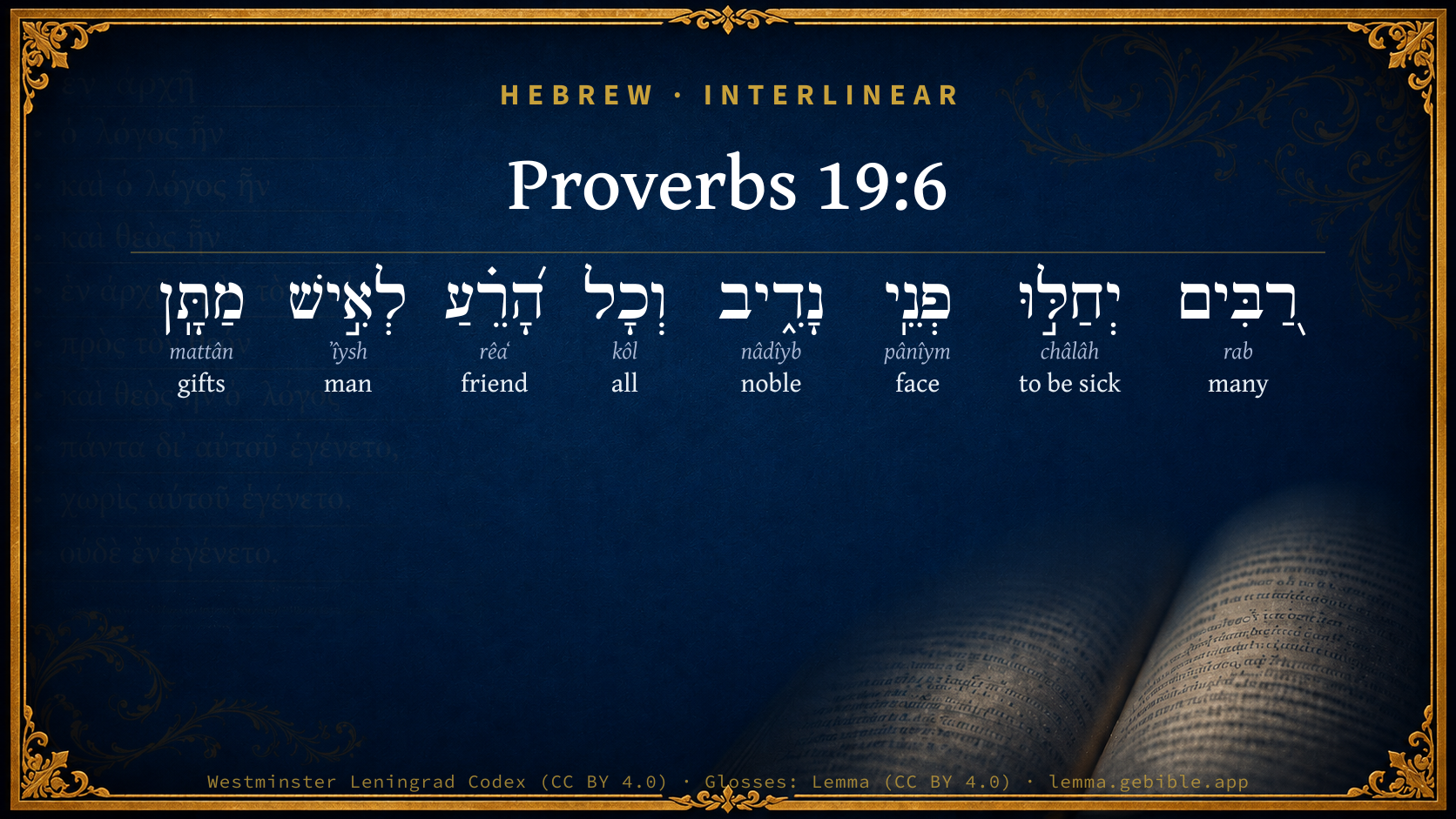
Proverbs 19:6

Hebrew (Westminster Leningrad Codex) Proverbs 19:6 appears in the Hebrew Old Testament. The text above is from the Westminster Leningrad Codex. Each word links to its Strong’s number, a concise gloss, and parsing drawn from the Open Scriptures Hebrew Bible morphology. Click any word for its full Brown-Driver-Briggs (BDB) entry.
Download image
Cite this verse

Proverbs 19:6 (World English Bible). Public Domain. Lemma interlinear Bible study tool, https://lemma.gebible.app/v/proverbs/19/6.

Show BibTeX & RIS
BibTeX
RIS
English Translation
Many will entreat the favor of a ruler, And everyone is a friend to a man who gives gifts.
World English Bible · Public Domain
Download a study sheet

One document with this verse’s original text, its word-by-word gloss line, the meaning frame, cross-references with their text, attributed commentary, and full source and license credits — printable, and it pastes into notes with its structure intact.

This verse Autodidact and up

Study sheet (.html) Plain text (.txt)

A passage Seminary Student

Up to 50 verses in one chapter. A passage sheet keeps up to 6 commentary sources and 12 cross-references per verse, in the order this page ranks them, and says so on the sheet whenever that leaves anything out. Ask for a single verse and you get the Autodidact verse sheet above.

Everything on this page stays free to read, with no account — the sheet is a download of what is already on screen, not access to it.

Want to remove ads? Support Godless Engineer
Compare translations 3

The same verse in 3 English versions, stacked beneath the original-language interlinear above. Click any original word for its lexicon entry.

Each is an independent rendering of the whole verse — the interlinear is not word-aligned to these translations.

Highlighted words mark where these versions differ — a whole-verse word diff, not a word-by-word alignment.

  • World English Bible Public Domain
    Many will entreat the favor of a ruler, And everyone is a friend to a man who gives gifts.
  • King James Version Public Domain
    Many will intreat the favour of the prince: and every man is a friend to him that giveth gifts.
  • unfoldingWord Literal Text CC BY-SA 4.0
    Many will entreat the face of a noble, and everyone the friend of a man of gift.

unfoldingWord Literal Text — © unfoldingWord, licensed CC BY-SA 4.0. Word-aligned USFM3 via Door43 (git.door43.org/unfoldingWord/en_ult).

Versions to compare (up to 4)

3 of 4 selected

Show all 18 translations

Every available English version of this verse, each an independent rendering of the whole verse.

  • World English Bible Public Domain
    Many will entreat the favor of a ruler, And everyone is a friend to a man who gives gifts.
  • Berean Standard Bible Public Domain
    Many seek the favor of the prince, and everyone is a friend of the gift giver.
  • Majority Standard Bible Public Domain
    Many seek the favor of the prince, and everyone is a friend of the gift giver.
  • King James Version Public Domain
    Many will intreat the favour of the prince: and every man is a friend to him that giveth gifts.
  • American Standard Version (1901) Public Domain
    Many will entreat the favor of the liberal man; And every man is a friend to him that giveth gifts.
  • Revised Version (1885) Public Domain
    Many will entreat the favour of the liberal man: and every man is a friend to him that giveth gifts.
  • Geneva Bible (1599) Public Domain
    Many reuerence the face of the prince, and euery man is friend to him that giueth giftes.
  • Douay-Rheims (1899) Public Domain
    Many honour the person of him that is mighty, and are friends of him that giveth gifts.
  • Young's Literal Translation Public Domain
    Many entreat the face of the noble, And all have made friendship to a man of gifts.
  • Literal Standard Version CC BY-SA 4.0
    Many beg the face of the noble, || And all have made friendship to a man of gifts.
  • Unlocked Literal Bible CC BY-SA 4.0
    Many will ask for a favor from a generous person and everyone is a friend of the one who gives gifts.
  • unfoldingWord Literal Text CC BY-SA 4.0
    Many will entreat the face of a noble, and everyone the friend of a man of gift.
  • Darby Bible Public Domain
    Many court the favour of a noble; and every one is friend to a man that giveth.
  • World Messianic Bible Public Domain
    Many will entreat the favor of a ruler, and everyone is a friend to a man who gives gifts.
  • Webster's Bible Public Domain
    Many will entreat the favor of the prince: and every man is a friend to him that giveth gifts.
  • Free Bible Version CC BY-SA 4.0
    Many ask favors from important people, and everyone's a friend of the generous.
  • Bible in Basic English Public Domain
    Great numbers will make attempts to get the approval of a ruler: and every man is the special friend of him who has something to give.
  • JPS Tanakh (1917) Public Domain
    Many will entreat the favour of the liberal man; and every man is a friend to him that giveth gifts.

Literal Standard Version (2020), Covenant Press — licensed CC BY-SA 4.0. Text via the HelloAO Bible API (eBible.org). Unlocked Literal Bible (unfoldingWord) — licensed CC BY-SA 4.0. Text via the HelloAO Bible API (eBible.org). unfoldingWord Literal Text — © unfoldingWord, licensed CC BY-SA 4.0. Word-aligned USFM3 via Door43 (git.door43.org/unfoldingWord/en_ult). Free Bible Version, Dr. Jonathan Gallagher — licensed CC BY-SA 4.0. Text via the HelloAO Bible API (eBible.org).

Word by word

More ways to search: Search by grammar → Find every occurrence → Compare this word →

Practice this passage: Drill this verse → Learn its vocabulary →

About this verse

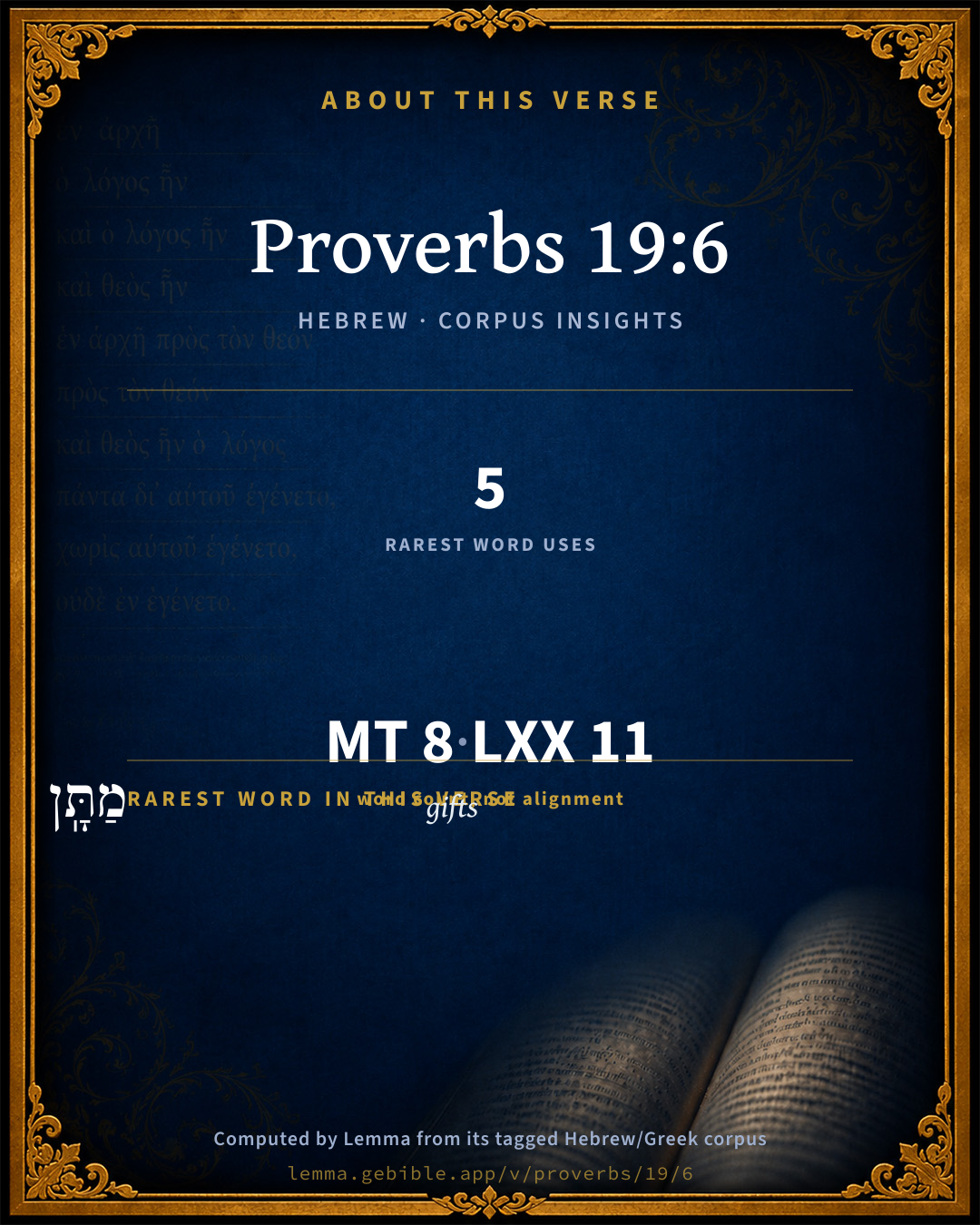
These counts appear in no published source. They are computed here, from the morphology-tagged text and Lemma’s own curated glosses. What Lemma adds →

8
words
8
distinct lemmas
Wisdom
section

Notable vocabulary

The rarest word here is מַתָּֽן gifts H4976 — appearing just 5 times in the whole Hebrew Bible.

Shared distinctive vocabulary

מַתָּֽן gifts H4976 occurs in 5 verses of the Hebrew Bible. Also found in:

Grammatical profile

  • 1 verb
  • 5 nouns
  • 2 adjectives

Verb forms

  • יְחַלּ֣וּ Piel · Imperfect

Hebrew & Septuagint length

In English translation the verse runs 19 words from the Hebrew and 16 from the Septuagint (LXX English) — closely comparable.

A rough comparison of the two English renderings, which tokenize alike — not a word-level alignment.

Word counts can differ between the Hebrew and the Greek without any difference in meaning — e.g. the Hebrew direct-object marker אֵת has no separate Greek word, and Greek often adds the article ὁ.

In the original languages it is 8 Hebrew tokens and 11 Greek tokens — but the two are counted differently (Hebrew bundles its prefixes and suffixes into one token; the Greek is in lemma form), so that isn’t a like-for-like length.

Cross-references

14

Topical passages linked to Proverbs 19:6 in the Treasury of Scripture Knowledge — connected by theme and wording, ordered by reader-vote popularity; previews shown in the World English Bible.

  • Proverbs 18:16 A man's gift makes room for him, And brings him before great men.
  • Proverbs 29:26 Many seek the ruler's favor, But a man's justice comes from Yahweh.
  • Proverbs 17:8 A bribe is a precious stone in the eyes of him who gives it; Wherever he turns, he prospers.
  • Genesis 42:6 Joseph was the governor over the land. It was he who sold to all the people of the land. Joseph's brothers came, and bowed themselves down to him with their faces to the earth.
  • Romans 6:23 For the wages of sin is death, but the free gift of God is eternal life in Christ Jesus our Lord.
  • Proverbs 19:12 The king's wrath is like the roaring of a lion, But his favor is like dew on the grass.
  • Proverbs 21:14 A gift in secret pacifies anger; And a bribe in the cloak, strong wrath.
  • 2 Samuel 19:19–39 He said to the king, Don't let my lord impute iniquity to me, neither do you remember that which your servant did perversely the day that my lord the king went out of Jerusalem, that the king should take it to his heart.
  • Job 29:24–25 I smiled on them when they had no confidence. They didn't reject the light of my face.
  • Genesis 43:15 The men took that present, and they took double money in their hand, and Benjamin; and rose up, went down to Egypt, and stood before Joseph.
  • Psalms 45:12 The daughter of Tyre comes with a gift. The rich among the people entreat your favor.
  • Genesis 32:20 You shall say, 'Not only that, but behold, your servant, Jacob, is behind us.'" For, he said, "I will appease him with the present that goes before me, and afterward I will see his face. Perhaps he will accept me."
  • Proverbs 16:15 In the light of the king's face is life. His favor is like a cloud of the spring rain.
  • Matthew 2:11 They came into the house and saw the young child with Mary, his mother, and they fell down and worshiped him. Opening their treasures, they offered to him gifts: gold, frankincense, and myrrh.

Cross-references courtesy of OpenBible.info (CC BY 4.0).

Hebrew and Greek witnesses Masoretic Hebrew ↔ Greek Septuagint

The same verse in the two great witnesses to the Old Testament, shown verse-for-verse.

These are two independent witnesses, not word-aligned to each other, and the Septuagint is shown in lemma (dictionary) form.

Hebrew Proverbs 19:6 Masoretic · Westminster Leningrad Codex

רַ֭בִּים יְחַלּ֣וּ פְנֵֽי נָדִ֑יב וְכָל הָ֝רֵ֗עַ לְאִ֣ישׁ מַתָּֽן

Many will entreat the favor of a ruler, And everyone is a friend to a man who gives gifts.

World English Bible · Public Domain

Greek LXX Proverbs 19:6 Septuagint · lemma form

πολύς θεραπεύω πρόσωπον βασιλεύς πᾶς δέ ὁ κακός γίγνομαι ὄνειδος ἀνήρ

Many court the favor of kings; but every bad man becomes a reproach to another man.

LXX2012 (modern English Septuagint) · Public Domain

On this verse, The Pulpit Commentary discusses the Septuagint’s reading. Read the note in Commentary ↓

Hebrew: Westminster Leningrad Codex (CC BY 4.0). Greek: Septuagint (public domain); English from LXX2012 (modern English Septuagint) (Public Domain). How the Septuagint differs from the Hebrew →

Commentary

Notes on Proverbs 19:6 from classic Christian and Jewish commentators (each source and its license shown beneath its notes). The classic Christian expositions comment on the surrounding passage and are grouped to its opening verse, so a note may address several verses; the Jewish commentaries on the Tanakh (Rashi and others) are per-verse, so they appear only where the commentator wrote on this verse.

Lemma curates 59 commentaries, every one of them public domain or Creative Commons licensed, each selected and text-cleaned for this edition rather than reprinted as found. About our sources →

Trapp's Complete Commentary

John Trapp

Pro 19:6 Many will intreat the favour of the prince: and every man [is] a friend to him that giveth gifts.

Ver. 6. Many will entreat the favour of the prince.] Yea, lie at his feet, and lick up his spittle, not being loyal in love for conscience, but submissive in show for commodity. Every man will be thrusting in where anything is to be gotten. The poets make Litae, or Petitions, to be the daughters of Jupiter, and ever about him; to signify, saith the mythologist, that princes and great ones are seldom without suppliants and suitors. {a}

And every man is a friend, &c.] {See Trapp on "Pro 17:8"}

{a} ου γαρ ατιμοι Iκεσιου Zηνος κουραι λιται. - Orph. in Arg.

John Trapp, A Commentary or Exposition upon All the Books of the Old and New Testament (1647–1656) — public domain. Text from a community e-Sword module.

Joseph Benson's Commentary

Pro 19:6-7. Many will entreat the favour of the prince — Or, of the liberal, or bountiful man, as נדיבmay be properly rendered. Kings and princes were anciently called benefactors, Luk 22:25. And every man is a friend to him that giveth gifts — Not sincerely, however, as daily experience shows, but only in show, or profession, or in the outward expressions of friendship and kindness. All the brethren of the poor — His nearest and dearest relations, who are often called brethren in the Scriptures; do hate him — Despise and shun him, as men do a thing that they hate, and as the following words explain it; How much more do his friends go far from him — His other friends, who are no way related to him, but in his prosperity professed love and friendship to him. He pursueth them with words — Earnestly imploring their pity and help. Or, He urgeth their words, as מרדŠ אמריםmay be rendered; that is, he allegeth their former promises and professions of friendship: or, He seeketh words, (as the preacher sought to find out acceptable words, Ecc 12:10,) wherewith he might prevail and move them to pity; yet they are wanting to him — Hebrew, לא המה, not they, or, they not. The meaning is, they are not what they pretended to be, namely, friends to him: or, their words are vain, and without effect; there is no reality in them. Houbigant renders the verse, “All his own brethren hate a poor man; how much more his neighbours! They have departed far from him; he followeth after them, but they are not found.”

Joseph Benson's Commentary on the Old and New Testaments (1811–1818) — public domain. Text from a community e-Sword module.

Matthew Henry's Commentary

These two verses are a comment upon Pro 19:4, and show, 1. How those that are rich and great are courted and caressed, and have suitors and servants in abundance. The prince that has power in his hand, and preferments at his disposal, has his gate and his ante-chamber thronged with petitioners, that are ready to adore him for what they can get. Many will entreat his favour, and think themselves happy in it. Even great men are humble suppliants to the prince. How earnest then should we be for the favour of God, which is far beyond that of any earthly prince. But, it should seem, liberality will go further than majesty itself to gain respect, for there are many that court the prince, but every man is a friend to him that gives gifts; not only those that have received, or do expect, gifts from him, will, as friends, be ready to serve him, but others also will, as friends, give him their good word. Prodigals, who are foolishly free of what they have, will have many hangers-on who will cry them up as long as it lasts, but will leave them when it is done. Those that are prudently generous make an interest by it which may stand them in good stead; those that are accounted benefactors exercise an authority which may give them an opportunity of doing good, Luk 22:25. 2. How those that are poor and low are slighted and despised. Men may, if they please, court the prince, and the princely, but they may not trample upon the poor and look at them with disdain. Yet so it often is: All the brethren of the poor do hate him; even his own relations are shy of him, because he is needy and craving, and expects something from them, and because they look upon him as a blemish to their family; and then no marvel if others of his friends, that were nothing akin to him, go far from him, to get out of his way. He pursues them with words, hoping to prevail with them by his importunity to be kind to him, but all in vain; they have nothing for him. They pursue him with words (so some understand it), to excuse themselves from giving him any thing; they tell him that he is idle and impertinent, that he has brought himself into poverty, and therefore ought not to be relieved; as Nabal said to David's messengers: "There are many servants now a days that run away from their masters; and how do I know but that David may be one of them?" Let poor people therefore make God their friend, pursue him with their prayers, and he will not be wanting to them.

Matthew Henry's Commentary on the Whole Bible (1708–1710) — public domain (CC PDM 1.0). Text via the HelloAO Bible API.

The Cambridge Bible for Schools and Colleges

gen. ed. J. J. S. Perowne

6. prince] It is better to preserve the parallelism, and to render the Heb. word in its primary sense of princely disposition, the liberal man, R.V. text, than with A.V. and R.V. marg., of princely rank. The same word is rendered liberal, Isa_32:5; Isa_32:8. Comp. Keble’s version of it in Psa_51:12 (Sixth Sun. after Trinity):

“The princely heart of innocence.”

The Cambridge Bible for Schools and Colleges (gen. ed. J. J. S. Perowne; Cambridge University Press, 1878–1918) — public domain. Text from a community e-Sword module.

John Gill's Exposition

Many will entreat the favour of the prince,.... Or of the liberal and bountiful man; as kings and princes generally are, Luk 22:25; such have many to wait upon them, and are humble petitioners to them. Aben Ezra and Gersom interpret the many of great and honourable men, who are courtiers to kings and princes; who wait upon them, ask favours of them, and seek for places under them. The Targum is,

"there are many that minister before a prince;''

he has many servants, and some of them nobles;

and every man is a friend to him that giveth gifts; or "to a man of gift" (k): who has it in his power to give, and has a heart to it; who is both a rich man and a liberal man; who is both able and willing to communicate to the necessities of others: such a man not only has the poor his friends, but others will speak well of him, and will make application to him on account of the poor; and, for the sake of doing good to them, will court his friendship and acquaintance. Bayne interprets this "man of gift" of Christ, who ascended on high, and received gifts for men, and gives them to men.

(k) "viro doni", Montanus, Vatablus, Michaelis.

John Gill's Exposition of the Whole Bible (1746–1763) — public domain (CC PDM 1.0). Text via the HelloAO Bible API.

Albert Barnes' Notes on the Bible

Intreat the favor ... - literally, “stroke the face” of the man of princely nature, who gives munificently.

Albert Barnes' Notes on the Bible (1834–1885) — public domain. Text from a community e-Sword/MySword module.

Matthew Poole's English Annotations

Of the prince; or, as others, of the liberal or bountiful man; which comes to the same thing, for kings were anciently called benefactors, Luk 22:25.

A friend; not sincerely, as daily experience shows, but in show or profession, or in the outward expressions of it, whereby they may oblige him.

Matthew Poole's English Annotations on the Holy Bible (1683–1685) — public domain. Text from a community e-Sword/MySword module.

Whedon's Commentary on the Bible

Daniel D. Whedon

6. Many will entreat the favour — Literally, will stroke the face; will flatter, caress, or make court to, the prince.

A friend to him that giveth gifts — A liberal, generous man. Many will esteem acquaintance with him an honour. The “gifts” herein spoken of are not to be understood as bribes, and therefore, condemnatory, but such as proceed from the generous impulses of a noble spirit.

Daniel D. Whedon (gen. ed.), Commentary on the Old and New Testaments (1874–1909) — public domain. Text from a community e-Sword module.

The Pulpit Commentary

Many will intreat the favour of the prince; Literally, will stroke the face of the prince, of the liberal and powerful man, in expectation of receiving some benefit from him. (Pro_29:26 Job_11:19) Every man is a friend to him that giveth gifts. (see on Pro_17:8) The LXX, reading rehAlk for reHAlb, renders, "Every bad man is a reproach to a man," which may mean that a sordid, evil man brings only disgrace on himself; or that, while many truckle to and try to win the interest of a prince, bad courtiers bring on him not glory, but infamy and shame.

The Pulpit Commentary (1880–1919), ed. H.D.M. Spence-Jones & Joseph S. Exell — public domain. Text from a community e-Sword module.

John Wesley's Explanatory Notes

A friend - in profession.

John Wesley, Explanatory Notes Upon the Whole Bible (1754–1765) — public domain. Text via the GEBible commentary corpus.

Keil & Delitzsch

C. F. Keil & F. Delitzsch

6 Many stroke the cheeks of the noble;

And the mass of friends belongeth to him who gives.

The phrase 'חלּות פּני פל signifies to stroke the face of any one, from the fundamental meaning of the verb חלה, to rub, to stroke, Arab. khala, with which the Heb., meaning to be sick, weak (viribus attritum esse), and the Arabic: to be sweet (properly laevem et politum, glabrum esse, or palatum demulcere, leniter stringere, contrast asperum esse ad gustum), are connected (Fl.). The object of such insinuating, humble suing for favour is the נדיב (from נדב, instigare), the noble, he who is easily incited to noble actions, particularly to noble-mindedness in bestowing gifts and in doing good, or who feels himself naturally impelled thereto, and spontaneously practises those things; cf. the Arab. krym, nobilis and liberalis (Fl.), and at Job 21:28; parall. אישׁ מתּן, a man who gives willingly, as אישׁ חמה, Pro 15:18, one who is easily kindled into anger. Many (רבּים, as Job 11:19) stroke the face of the liberal (Lat. caput mulcent or demulcent); and to him who gives willingly and richly belongs כל־הרע, the mass (the totality) of good friends, cf. Pro 15:17; there the art. of הרע, according to the manner of expression of the Arab. grammarians, stood for "the exhaustion of the characteristic properties of the genus": the friend who corresponds to the nature (the idea) of such an one; here it stands for "the comprehension of the individuals of the genus;" all that is only always friend. It lies near with Ewald and Hitzig to read וכלּה רע (and every one is friend...) (כלּה = כלּו, as Jer 8:10, etc.); but why could not כל־הרע be used as well as כל־האדם, perhaps with the sarcastic appearance which the above translation seeks to express? The lxx also had וכל הרע in view, which it incorrectly translates πᾶς δὲ ὁ κακός, whereby the Syr. and the Targ. are led into error; but מתּן is not one and the same with שׂחד, vid., Pro 18:6. On the contrary, there certainly lies before us in Pro 19:7 a mutilated text. The tristich is, as we have shown, vol. i, p. 15, open to suspicion; and the violence which its interpretation needs in order to comprehend it, as a formal part of 7ab, places it beyond a doubt, and the lxx confirms it that 7c is the remainder of a distich, the half of which is lost.

Keil & Delitzsch — Biblical Commentary on the Old Testament (1861–1891) — public domain (CC PDM 1.0). Text via the HelloAO Bible API. (Old Testament only.)

Bridges on Proverbs

Charles Bridges

The fourth verse is here further opened with too accurate a description of man’s native selfishness. ’A prince never wants suitors for his favour.’†1 Every one loves, or professes to love those from whom they expect a benefit, "having men’s persons in admiration, because of advantage" (Jud 1:16 ), valuing them for their possessions, not for their virtues. Yet if "riches make to themselves wings, and flee away" (Pro 23:5 ), will not they take their flight with them? If the same person, now fawned on for his gifts, were by Providence brought to poverty, the same friends would hate or neglect him. ’Which of them’ — asks Bishop Hall — ’would dare acknowledge him, when he is going to prison?’†2 As the winter brooks, filled from the opening springs and the torrents from heaven, are dried up and vanish before the summer heat; so these friends of the poor go far from him, cold, distant, and vanishing in the day of his calamity. If he pursueth them with words, yet they are deaf to his entreaties for help and sympathy. Job found these "summer" friends a great aggravation to his affliction.†3 Jerusalem in its days of prosperity was "the joy of the whole earth." In the time of after-destitution "they called thee" — said the mournful prophet — "an outcast, saying — This is Zion, whom no man seeketh after." (Psa 48:2 . Jer 30:17 .)

But how ought we to entreat the favour of our Prince? What gifts does he give to his beloved people? And shall not those who are enriched with them exhibit his rule of mercy to their poorer brethren (Gal 6:10 . Heb 6:10 ), specially to his poor, the princes and heirs of his kingdom? (Jas 2:5 .) ’Lord! in my greatest plenty help me to mind and feel others’ poverty; and in my most prosperous condition keep me from forgetting the afflictions of thy Joseph.’†4

Footnotes:

†1 Bishop Patrick.

†2 Works, xiii. p. 77.

†3 Job 6:15-22; Job 19:13-19 . Job 29:1-25 . Job 30:1-31. Compare Sir 37:1-4 .

Donec eris felix, multos numerabis amicos;

Tempora si fuerint nubila, solus eris.

Ovid, Trist. Lib. i. viii. 9, 10.

†4 Swinnock’s Christian Man’s Calling, Part ii. 338.

Charles Bridges, An Exposition of the Book of Proverbs (1846) — public domain. Text from a community e-Sword module.

Kretzmann's Popular Commentary

Paul E. Kretzmann

v. 6. Many will intreat the favor of the prince, literally, "stroke his face," flatter him; and every man is a friend to him that giveth gifts, with the expectation of sharing in his generosity. These facts are stated as in agreement with men’s conduct everywhere and do not imply the approval of the Lord.

Paul E. Kretzmann, Popular Commentary of the Bible (1921–1924) — public domain. Text from a community e-Sword module.

Rashi

Rabbi Shlomo Yitzchaki (Rashi)

The great will beg the favor of a generous man, and everyone is a friend All become friends to a man who gives gifts. This may be interpreted as referring to those who give charity, and it may also be interpreted as referring to those who disseminate the Torah.

Rashi on the Tanakh — English translations: “The Judaica Press complete Tanach with Rashi, translated by A. J. Rosenberg” (CC BY 4.0); “Pentateuch with Rashi's commentary by M. Rosenbaum and A.M. Silbermann, 1929-1934” (public domain); “The Metsudah Tanach series, Lakewood, N.J” (CC BY 4.0); and “The Book of Joshua, Metsudah Publications, 1997” (CC BY 4.0). Text via Sefaria.

Lesson kit

Teaching starters — assembled from the data on this page, not authored interpretation. Every prompt links to the verse data it draws on. Edit before teaching.

Proverbs, in the Wisdom, opens this verse with 8 words (8 distinct Hebrew lemmas). Its most distinctive word is mattân (“gifts”). A historical commentator’s framing appears above. Read the whole chapter for the surrounding context.

Discussion questions

  1. How does “gifts” (mattân) shape what this verse is saying?
  2. How does Genesis 34:12, which shares the word «gifts», read alongside this verse?
  3. These translations render this verse differently; the difference is in the English rendering, not the original. What questions does that raise?
  4. «יְחַלּ֣וּ» is a Piel Imperfect verb. How does that grammatical form shape the action described?
  5. Compare how Trapp's Complete Commentary and Joseph Benson's Commentary read this verse. Where do they agree or differ?

Things to notice

Reading settings

Reading text

Shown beneath each verse's original-language words.

Old Testament
Old Testament edition

Read the OT as the Masoretic Hebrew (MT) or the Greek Septuagint (LXX).

English shown for the Greek Septuagint (in the Hebrew ↔ Greek comparison).

Comparing translations? Open the Compare panel on any verse page to stack up to four side by side.