Ezekiel 22:5

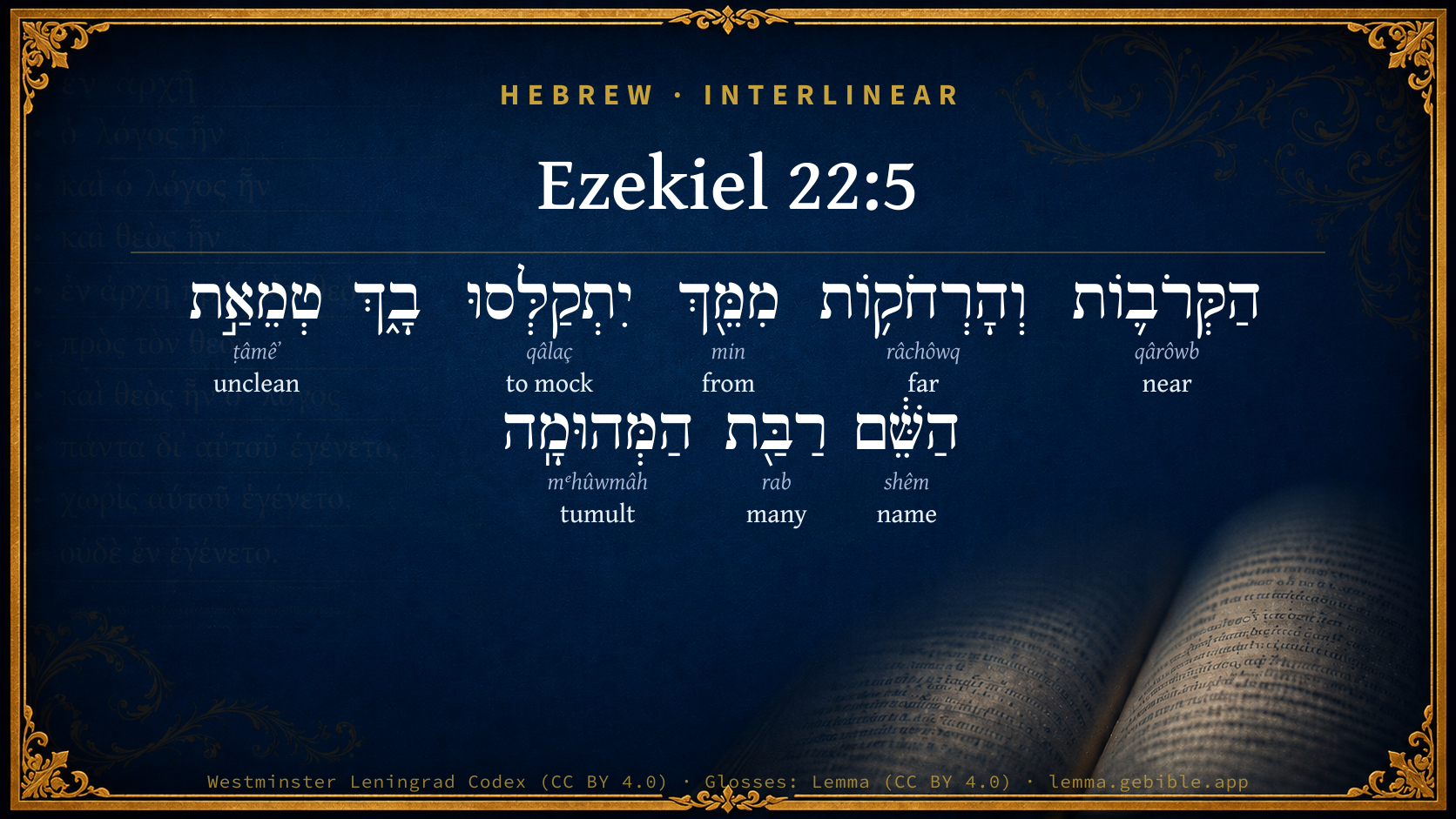
Hebrew (Westminster Leningrad Codex) Ezekiel 22:5 appears in the Hebrew Old Testament. The text above is from the Westminster Leningrad Codex. Each word links to its Strong’s number, a concise gloss, and parsing drawn from the Open Scriptures Hebrew Bible morphology. Click any word for its full Brown-Driver-Briggs (BDB) entry.
Download image
Cite this verse

Ezekiel 22:5 (World English Bible). Public Domain. Lemma interlinear Bible study tool, https://lemma.gebible.app/v/ezekiel/22/5.

Show BibTeX & RIS
BibTeX
RIS
English Translation
Those who are near, and those who are far from you, shall mock you, you infamous one [and] full of tumult.
World English Bible · Public Domain
Download a study sheet

One document with this verse’s original text, its word-by-word gloss line, the meaning frame, cross-references with their text, attributed commentary, and full source and license credits — printable, and it pastes into notes with its structure intact.

This verse Autodidact and up

Study sheet (.html) Plain text (.txt)

A passage Seminary Student

Up to 50 verses in one chapter. A passage sheet keeps up to 6 commentary sources and 12 cross-references per verse, in the order this page ranks them, and says so on the sheet whenever that leaves anything out. Ask for a single verse and you get the Autodidact verse sheet above.

Everything on this page stays free to read, with no account — the sheet is a download of what is already on screen, not access to it.

Want to remove ads? Support Godless Engineer
Compare translations 3

The same verse in 3 English versions, stacked beneath the original-language interlinear above. Click any original word for its lexicon entry.

Each is an independent rendering of the whole verse — the interlinear is not word-aligned to these translations.

Highlighted words mark where these versions differ — a whole-verse word diff, not a word-by-word alignment.

  • World English Bible Public Domain
    Those who are near, and those who are far from you, shall mock you, you infamous one [and] full of tumult.
  • King James Version Public Domain
    Those that be near, and those that be far from thee, shall mock thee, which art infamous and much vexed.
  • unfoldingWord Literal Text CC BY-SA 4.0
    Both those who are near and those who are far away from you will mock you—you unclean city—with the reputation known everywhere as being full of confusion.

unfoldingWord Literal Text — © unfoldingWord, licensed CC BY-SA 4.0. Word-aligned USFM3 via Door43 (git.door43.org/unfoldingWord/en_ult).

Versions to compare (up to 4)

3 of 4 selected

Show all 18 translations

Every available English version of this verse, each an independent rendering of the whole verse.

  • World English Bible Public Domain
    Those who are near, and those who are far from you, shall mock you, you infamous one [and] full of tumult.
  • Berean Standard Bible Public Domain
    Those near and far will mock you, O infamous city, full of turmoil.
  • Majority Standard Bible Public Domain
    Those near and far will mock you, O infamous city, full of turmoil.
  • King James Version Public Domain
    Those that be near, and those that be far from thee, shall mock thee, which art infamous and much vexed.
  • American Standard Version (1901) Public Domain
    Those that are near, and those that are far from thee, shall mock thee, thou infamous one `and' full of tumult.
  • Revised Version (1885) Public Domain
    Those that be near, and those that be far from thee, shall mock thee, thou infamous one and full of tumult.
  • Geneva Bible (1599) Public Domain
    Those that be neere, and those that be farre from thee, shall mocke thee, which art vile in name and sore in affliction.
  • Douay-Rheims (1899) Public Domain
    Those that are near, and those that are far from thee, shall triumph over thee: thou filthy one, infamous, great in destruction.
  • Young's Literal Translation Public Domain
    The near and the far-off from thee scoff at thee, O defiled of name -- abounding in trouble.
  • Literal Standard Version CC BY-SA 4.0
    The near and the far-off from you scoff at you, || O defiled of name—abounding in trouble.
  • Unlocked Literal Bible CC BY-SA 4.0
    Both those who are near and those who are far away from you will mock you—you unclean city—with the reputation known everywhere as being full of confusion.
  • unfoldingWord Literal Text CC BY-SA 4.0
    Both those who are near and those who are far away from you will mock you—you unclean city—with the reputation known everywhere as being full of confusion.
  • Darby Bible Public Domain
    Those that are near, and those that are far from thee, shall mock thee, who art infamous [and] full of tumult.
  • World Messianic Bible Public Domain
    Those who are near and those who are far from you will mock you, you infamous one, full of tumult.
  • Webster's Bible Public Domain
    Those that are near, and those that are far from thee, shall mock thee, who art infamous and much troubled.
  • Free Bible Version CC BY-SA 4.0
    People far and near will laugh at you, you corrupt city full of confusion!
  • Bible in Basic English Public Domain
    Those who are near and those who are far from you will make sport of you; your name is unclean, you are full of sounds of fear.
  • JPS Tanakh (1917) Public Domain
    Those that are near, and those that are far from thee, shall mock thee, thou defiled of name and full of tumult.

Literal Standard Version (2020), Covenant Press — licensed CC BY-SA 4.0. Text via the HelloAO Bible API (eBible.org). Unlocked Literal Bible (unfoldingWord) — licensed CC BY-SA 4.0. Text via the HelloAO Bible API (eBible.org). unfoldingWord Literal Text — © unfoldingWord, licensed CC BY-SA 4.0. Word-aligned USFM3 via Door43 (git.door43.org/unfoldingWord/en_ult). Free Bible Version, Dr. Jonathan Gallagher — licensed CC BY-SA 4.0. Text via the HelloAO Bible API (eBible.org).

Word by word

More ways to search: Search by grammar → Find every occurrence → Compare this word →

Practice this passage: Drill this verse → Learn its vocabulary →

יִתְקַלְּסוּ
qâlaç
H7046
“to mock”
Verb, Hithpael, Imperfect, 3rd Person, Masculine, Plural
Part of Speech
Verb
Stem
Hithpael
Form
Imperfect
Person
3rd Person
Gender
Masculine
Number
Plural
Full BDB Definition

Origin: a primitive root

TWOT: 2029

to mock, scoff - (Piel) to scoff at - (Hithpael) to mock, deride, make fun of
  1. הַקְּרֹב֛וֹת qârôwb H7138 “the · near” Particle, Definite Article + Adjective, Adjective, Feminine, Plural, Absolute
  2. וְהָרְחֹק֥וֹת râchôwq H7350 “and · the · far” Conjunction + Particle, Definite Article + Adjective, Adjective, Feminine, Plural, Absolute
  3. מִמֵּ֖ךְ min H4480 “from · you” Preposition + Suffix, Personal, 2nd Person, Feminine, Singular
  4. טְמֵאַ֣ת ṭâmêʼ H2931 “unclean of” Adjective, Adjective, Feminine, Singular, Construct
  5. הַשֵּׁ֔ם shêm H8034 “the · name” Particle, Definite Article + Noun, Common, Masculine, Singular, Absolute
  6. רַבַּ֖ת rab H7227 “many of” Adjective, Adjective, Feminine, Singular, Construct
  7. הַמְּהוּמָֽה mᵉhûwmâh H4103 “the · tumult” Particle, Definite Article + Noun, Common, Feminine, Singular, Absolute

About this verse

These counts appear in no published source. They are computed here, from the morphology-tagged text and Lemma’s own curated glosses. What Lemma adds →

9
words
8
distinct lemmas
Prophets
section

Notable vocabulary

The rarest word here is יִתְקַלְּסוּ to mock H7046 — appearing just 4 times in the whole Hebrew Bible.

Shared distinctive vocabulary

יִתְקַלְּסוּ to mock H7046 occurs in 4 verses of the Hebrew Bible. Also found in:

Grammatical profile

  • 1 verb
  • 2 nouns
  • 4 adjectives
  • 2 prepositions

Verb forms

  • יִתְקַלְּסוּ Hithpael · Imperfect

Hebrew & Septuagint length

In English translation the verse runs 21 words from the Hebrew and 25 from the Septuagint (LXX English) — closely comparable.

A rough comparison of the two English renderings, which tokenize alike — not a word-level alignment.

Word counts can differ between the Hebrew and the Greek without any difference in meaning — e.g. the Hebrew direct-object marker אֵת has no separate Greek word, and Greek often adds the article ὁ.

Cross-references

2

Topical passages linked to Ezekiel 22:5 in the Treasury of Scripture Knowledge — connected by theme and wording, ordered by reader-vote popularity; previews shown in the World English Bible.

  • Isaiah 22:2 You that are full of shouting, a tumultuous city, a joyous town; your slain are not slain with the sword, neither are they dead in battle.
  • Jeremiah 15:2–3 It shall happen, when they tell you, Where shall we go forth? then you shall tell them, Thus says Yahweh: Such as are for death, to death; and such as are for the sword, to the sword; and such as are for the famine, to the famine; and such as are for captivity, to captivity.

Cross-references courtesy of OpenBible.info (CC BY 4.0).

Hebrew and Greek witnesses Masoretic Hebrew ↔ Greek Septuagint

The same verse in the two great witnesses to the Old Testament, shown verse-for-verse.

These are two independent witnesses, not word-aligned to each other, and the Septuagint is shown in lemma (dictionary) form.

Hebrew Ezekiel 22:5 Masoretic · Westminster Leningrad Codex

הַקְּרֹב֛וֹת וְהָרְחֹק֥וֹת מִמֵּ֖ךְ יִתְקַלְּסוּ בָ֑ךְ טְמֵאַ֣ת הַשֵּׁ֔ם רַבַּ֖ת הַמְּהוּמָֽה

Those who are near, and those who are far from you, shall mock you, you infamous one [and] full of tumult.

World English Bible · Public Domain

Greek LXX Ezekiel 22:5 Septuagint · lemma form

ὁ ἐγγίζω πρός σύ καί ὁ μακράν ἀποἔχω ἀπό σύ καί ἐνπαίζω ἐν σύ ἀκάθαρτος ὁ ὀνομαστός καί πολύς ἐν ὁ ἀνομία

to those near you, and to those far distant from you; and they shall mock you, you that are notoriously unclean, and abundant in iniquities.

LXX2012 (modern English Septuagint) · Public Domain

Hebrew: Westminster Leningrad Codex (CC BY 4.0). Greek: Septuagint (public domain); English from LXX2012 (modern English Septuagint) (Public Domain). How the Septuagint differs from the Hebrew →

Targum (Aramaic paraphrase)

1

The Targum is the ancient Jewish Aramaic paraphrase of the Hebrew Scriptures — an interpretive translation, not the Hebrew text itself. Onkelos (literal) and Pseudo-Jonathan (expansive) render the Torah, and Jonathan the Prophets. Coverage is partial: where no permissively-licensed English translation exists for a verse, only the Aramaic is shown. This is verse-level text, not a word-by-word alignment to the Hebrew.

  1. Targum Jonathan Prophets (Joshua–Malachi)
    דְקָרִיבִין וְדִרְחִיקִין מִנִיךְ יִתְלַעֲבוּן בִּיךְ סוֹאֲבַת שְׁמָא דְסַגִיאִין אִתְרְגוּשְׁתָּהָא:

    (no public-domain English translation for this verse)

    Targum Jonathan — Aramaic: “Mikraot Gedolot” (public domain). English: “Sefaria Community Translation” (CC0 1.0 (public-domain dedication)); “London "Chaldee Paraphrase," 1871” (public domain). Text via Sefaria.

Commentary

Notes on Ezekiel 22:5 from classic Christian and Jewish commentators (each source and its license shown beneath its notes). The classic Christian expositions comment on the surrounding passage and are grouped to its opening verse, so a note may address several verses; the Jewish commentaries on the Tanakh (Rashi and others) are per-verse, so they appear only where the commentator wrote on this verse.

Lemma curates 59 commentaries, every one of them public domain or Creative Commons licensed, each selected and text-cleaned for this edition rather than reprinted as found. About our sources →

Trapp's Complete Commentary

John Trapp

Eze 22:5 [Those that be] near, and [those that be] far from thee, shall mock thee, [which art] infamous [and] much vexed.

Ver. 5. Shall mock thee, which are infamous.] This was forethreatened. {Deu 28:37} Our natures are most impatient of reproach; for there is none so mean but thinks himself worthy of some regard. Gens haec, saith Giraldus Cambrensis of the wild Irish, sicut et natio quaevis barbara, &c.; No nation is so barbarous, but that although they know not what belongeth to honour, yet do they exceedingly affect to be honoured, and will not abide to be reproached.

John Trapp, A Commentary or Exposition upon All the Books of the Old and New Testament (1647–1656) — public domain. Text from a community e-Sword module.

Geneva Bible (1599)

Geneva Bible translators

Whose very name all men hate.

Geneva Bible (1599) marginal notes — public domain. Text via Bolls.life.

Jamieson, Fausset & Brown

Robert Jamieson, A. R. Fausset & David Brown

infamous--They mockingly call thee, "Thou polluted one in name (Margin), and full of confusion" [FAIRBAIRN], (referring to the tumultuous violence prevalent in it). Thus the nations "far and near" mocked her as at once sullied in character and in actual fact lawless. What a sad contrast to the Jerusalem once designated "'the holy city!"

Jamieson, Fausset & Brown — Commentary Critical and Explanatory on the Whole Bible (1871) — public domain (CC PDM 1.0). Text via the HelloAO Bible API.

Adam Clarke's Commentary

Verse 5. Those that be near] Both distant as well as neighbouring provinces consider thee the most abandoned of characters; and through thee many have been involved in distress and ruin.

Adam Clarke's Commentary on the Bible (1810–1826) — public domain. Text from a community e-Sword/MySword module.

Ellicott's Commentary for English Readers

(5) Infamous and much vexed.—It is better to omit the words in italics, which art. The literal meaning of “infamous” is given in the margin; but the “much vexed” refers to the internal confusion, commotions, and social disorders which characterised the decaying state of the kingdom.

A Bible Commentary for English Readers, edited by Charles John Ellicott (1878–1897) — public domain. Text from a community e-Sword module.

The Cambridge Bible for Schools and Colleges

gen. ed. J. J. S. Perowne

5. much vexed] full of tumults, Amo_3:9, and on ch. Eze_5:7.

The Cambridge Bible for Schools and Colleges (gen. ed. J. J. S. Perowne; Cambridge University Press, 1878–1918) — public domain. Text from a community e-Sword module.

John Gill's Exposition

Those that be near, and those that be far from thee, shall mock thee,.... The neighbouring nations, as the Edomites, Philistines, Moabites, and Ammonites; and distant ones, as the Babylonians, Medes, and Persians; all that either hear of, or see their misery, shall rejoice at it, and triumph over them:

which art infamous and much vexed; or they shall say, O thou of an infamous name and character; who hast defiled thy name, got a blot upon it, and lost thy credit by thy conduct and behaviour; and now fretting and vexing under the afflictions and calamities that lie upon thee: or whose tumults are many, as the Targum; who hast been full of noise, and factions, and tumults; thou art now come to a righteous end.

John Gill's Exposition of the Whole Bible (1746–1763) — public domain (CC PDM 1.0). Text via the HelloAO Bible API.

Albert Barnes' Notes on the Bible

i. e., Countries near and afar oft shall mock thee, saying, “Ah! defiled in name; Ah! full of turbulence!”

Albert Barnes' Notes on the Bible (1834–1885) — public domain. Text from a community e-Sword/MySword module.

Matthew Poole's English Annotations

Those that be near; as the Idumeans or Edomites, who insulted over Jerusalem when it was taken, Ammonites, and Moabites, and Philistines.

Those that be far from thee; the barbarous Medes, Iberians, Hyrcanians, &c., to whom thou shalt be carried captive, whose land is far off.

Infamous; of a most infamous name.

Much vexed; afflicted, impoverished, and ruinated above what was ever done to any city.

Matthew Poole's English Annotations on the Holy Bible (1683–1685) — public domain. Text from a community e-Sword/MySword module.

Whedon's Commentary on the Bible

Daniel D. Whedon

5. Infamous and much vexed — Literally, defiled in name and full of turmoil. The city which was to have been the joy of the whole earth has now become the scorn of the heathen.

Daniel D. Whedon (gen. ed.), Commentary on the Old and New Testaments (1874–1909) — public domain. Text from a community e-Sword module.

The Pulpit Commentary

Those that be near, etc. The Hebrew words are both feminine, and refer to the neighboring and distant cities which took up their proverbs of reproach against the city, once holy and faithful, now infamous (Hebrew, defiled in name) and much vexed. The last words point to another form of punishment. Jerusalem is described as in a state of moral tumult and disorder as the consequence of its guilt (comp. Amo_3:9; Deu_7:23; Zec_14:13, where the same word is rendered by "tumults" and "destruction

The Pulpit Commentary (1880–1919), ed. H.D.M. Spence-Jones & Joseph S. Exell — public domain. Text from a community e-Sword module.

John Wesley's Explanatory Notes

Much vexed - Afflicted, impoverished, and ruined.

John Wesley, Explanatory Notes Upon the Whole Bible (1754–1765) — public domain. Text via the GEBible commentary corpus.

Rashi

Rabbi Shlomo Yitzchaki (Rashi)

will gossip about you And what is the gossip?...whose name is so befouled This is she who befouled her name, for they were called a holy people, sons of their Creator, and they caused themselves to be called (Isa. 6:5) “a people of unclean lips.”

Rashi on the Tanakh — English translations: “The Judaica Press complete Tanach with Rashi, translated by A. J. Rosenberg” (CC BY 4.0); “Pentateuch with Rashi's commentary by M. Rosenbaum and A.M. Silbermann, 1929-1934” (public domain); “The Metsudah Tanach series, Lakewood, N.J” (CC BY 4.0); and “The Book of Joshua, Metsudah Publications, 1997” (CC BY 4.0). Text via Sefaria.

Lesson kit

Teaching starters — assembled from the data on this page, not authored interpretation. Every prompt links to the verse data it draws on. Edit before teaching.

Ezekiel, in the Prophets, opens this verse with 9 words (8 distinct Hebrew lemmas). Its most distinctive word is qâlaç (“to mock”). A historical commentator’s framing appears above. Read the whole chapter for the surrounding context.

Discussion questions

  1. The word qâlaç carries the sense “to mock.” How does it shape the verse?
  2. 2 Kings 2:23 shares the word «to mock» with this verse. How do the two illuminate each other?
  3. These translations render this verse differently. What is at stake in choosing one wording over another?
  4. The verb «יִתְקַלְּסוּ» is Hithpael Imperfect. How does its form color the action?
  5. Reading how Trapp's Complete Commentary and Geneva Bible (1599) read this verse, where do the two commentators agree and where do they part?

Things to notice

Reading settings

Reading text

Shown beneath each verse's original-language words.

Old Testament
Old Testament edition

Read the OT as the Masoretic Hebrew (MT) or the Greek Septuagint (LXX).

English shown for the Greek Septuagint (in the Hebrew ↔ Greek comparison).

Comparing translations? Open the Compare panel on any verse page to stack up to four side by side.