
2 Chronicles 1:9

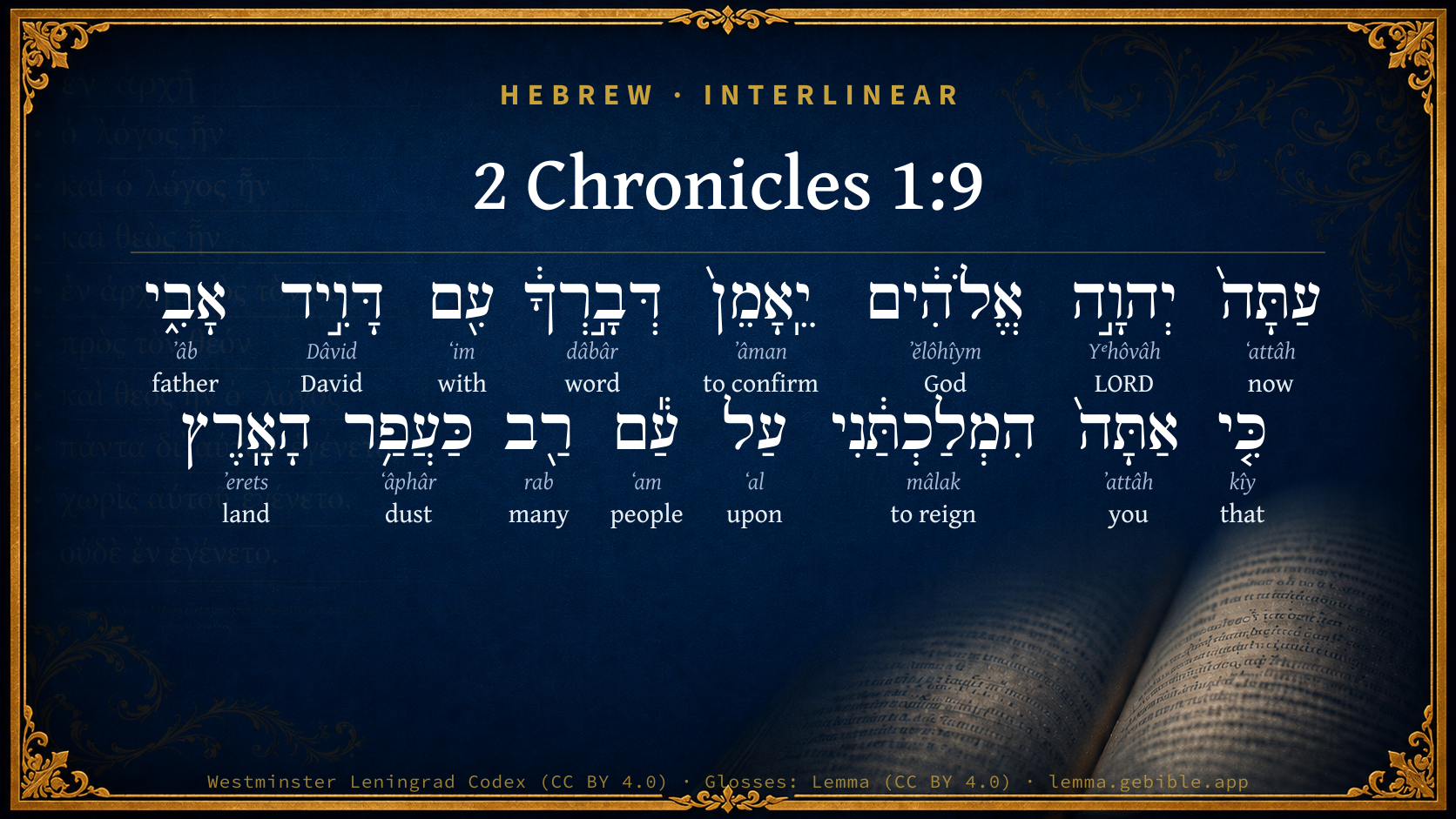
Hebrew (Westminster Leningrad Codex) 2 Chronicles 1:9 appears in the Hebrew Old Testament. The text above is from the Westminster Leningrad Codex. Each word links to its Strong’s number, a concise gloss, and parsing drawn from the Open Scriptures Hebrew Bible morphology. Click any word for its full Brown-Driver-Briggs (BDB) entry.
Download image
Cite this verse

2 Chronicles 1:9 (World English Bible). Public Domain. Lemma interlinear Bible study tool, https://lemma.gebible.app/v/2-chronicles/1/9.

Show BibTeX & RIS
BibTeX
RIS
English Translation
Now, Yahweh God, let your promise to David my father be established; for you have made me king over a people like the dust of the earth in multitude.
World English Bible · Public Domain
Download a study sheet

One document with this verse’s original text, its word-by-word gloss line, the meaning frame, cross-references with their text, attributed commentary, and full source and license credits — printable, and it pastes into notes with its structure intact.

This verse Autodidact and up

Study sheet (.html) Plain text (.txt)

A passage Seminary Student

Up to 50 verses in one chapter. A passage sheet keeps up to 6 commentary sources and 12 cross-references per verse, in the order this page ranks them, and says so on the sheet whenever that leaves anything out. Ask for a single verse and you get the Autodidact verse sheet above.

Everything on this page stays free to read, with no account — the sheet is a download of what is already on screen, not access to it.

Want to remove ads? Support Godless Engineer
Compare translations 3

The same verse in 3 English versions, stacked beneath the original-language interlinear above. Click any original word for its lexicon entry.

Each is an independent rendering of the whole verse — the interlinear is not word-aligned to these translations.

Highlighted words mark where these versions differ — a whole-verse word diff, not a word-by-word alignment.

  • World English Bible Public Domain
    Now, Yahweh God, let your promise to David my father be established; for you have made me king over a people like the dust of the earth in multitude.
  • King James Version Public Domain
    Now, O LORD God, let thy promise unto David my father be established: for thou hast made me king over a people like the dust of the earth in multitude.
  • unfoldingWord Literal Text CC BY-SA 4.0
    Now, Yahweh God, may your word with David my father be confirmed, for you yourself have made me king over a people numerous as the dust of the earth.

unfoldingWord Literal Text — © unfoldingWord, licensed CC BY-SA 4.0. Word-aligned USFM3 via Door43 (git.door43.org/unfoldingWord/en_ult).

Versions to compare (up to 4)

3 of 4 selected

Show all 18 translations

Every available English version of this verse, each an independent rendering of the whole verse.

  • World English Bible Public Domain
    Now, Yahweh God, let your promise to David my father be established; for you have made me king over a people like the dust of the earth in multitude.
  • Berean Standard Bible Public Domain
    Now, O LORD God, let Your promise to my father David be fulfilled. For You have made me king over a people as numerous as the dust of the earth.
  • Majority Standard Bible Public Domain
    Now, O LORD God, let Your promise to my father David be fulfilled. For You have made me king over a people as numerous as the dust of the earth.
  • King James Version Public Domain
    Now, O LORD God, let thy promise unto David my father be established: for thou hast made me king over a people like the dust of the earth in multitude.
  • American Standard Version (1901) Public Domain
    Now, O Jehovah God, let thy promise unto David my father be established; for thou hast made me king over a people like the dust of the earth in multitude.
  • Revised Version (1885) Public Domain
    Now, O LORD God, let thy promise unto David my father be established: for thou hast made me king over a people like the dust of the earth in multitude.
  • Geneva Bible (1599) Public Domain
    Nowe therefore, O Lord God, let thy promise vnto Dauid my father be true: for thou hast made mee King ouer a great people, like to the dust of the earth.
  • Douay-Rheims (1899) Public Domain
    Now therefore, O Lord God, let thy word be fulfilled, which thou hast promised to David my father: for thou hast made me king over thy great people, which is as innumerable as the dust of the earth.
  • Young's Literal Translation Public Domain
    Now, O Jehovah God, is Thy word with David my father stedfast, for Thou hast caused me to reign over a people numerous as the dust of the earth;
  • Literal Standard Version CC BY-SA 4.0
    Now, O YHWH God, Your word with my father David is steadfast, for You have caused me to reign over a people [as] numerous as the dust of the earth;
  • Unlocked Literal Bible CC BY-SA 4.0
    Now, Yahweh God, let your promise to David my father be carried out, for you have made me king over a people as numerous as the dust of the earth.
  • unfoldingWord Literal Text CC BY-SA 4.0
    Now, Yahweh God, may your word with David my father be confirmed, for you yourself have made me king over a people numerous as the dust of the earth.
  • Darby Bible Public Domain
    Now, Jehovah Elohim, let thy word unto David my father be firm; for thou hast made me king over a people numerous as the dust of the earth.
  • World Messianic Bible Public Domain
    Now, LORD God, let your promise to David my father be established; for you have made me king over a people like the dust of the earth in multitude.
  • Webster's Bible Public Domain
    Now, O LORD God, let thy promise to David my father be established: for thou hast made me king over a people like the dust of the earth in multitude.
  • Free Bible Version CC BY-SA 4.0
    Lord God, please keep the promise you made to my father David. You have made me king over a nation that has as many people as the dust of the earth.
  • Bible in Basic English Public Domain
    Now, O Lord God, let your word to David my father come true; for you have made me king over a people like the dust of the earth in number.
  • JPS Tanakh (1917) Public Domain
    Now, O LORD God, let Thy promise unto David my father be established; for Thou hast made me king over a people like the dust of the earth in multitude.

Literal Standard Version (2020), Covenant Press — licensed CC BY-SA 4.0. Text via the HelloAO Bible API (eBible.org). Unlocked Literal Bible (unfoldingWord) — licensed CC BY-SA 4.0. Text via the HelloAO Bible API (eBible.org). unfoldingWord Literal Text — © unfoldingWord, licensed CC BY-SA 4.0. Word-aligned USFM3 via Door43 (git.door43.org/unfoldingWord/en_ult). Free Bible Version, Dr. Jonathan Gallagher — licensed CC BY-SA 4.0. Text via the HelloAO Bible API (eBible.org).

Word by word

More ways to search: Search by grammar → Find every occurrence → Compare this word →

Practice this passage: Drill this verse → Learn its vocabulary →

יֵֽאָמֵן֙
ʼâman
H539
“to confirm”
Verb, Niphal, Jussive, 3rd Person, Masculine, Singular
Part of Speech
Verb
Stem
Niphal
Form
Jussive
Person
3rd Person
Gender
Masculine
Number
Singular
Full BDB Definition

Origin: a primitive root

TWOT: 116

to support, confirm, be faithful - (Qal) - to support, confirm, be faithful, uphold, nourish - foster-father (substantive) - foster-mother, nurse - pillars, supporters of the door - (Niphal) - to be established, be faithful, be carried, make firm - to be carried by a nurse - made firm, sure, lasting - confirmed, established, sure - verified, confirmed - reliable, faithful, trusty - (Hiphil) - to stand firm, to trust, to be certain, to believe in - stand firm - trust, believe
  1. עַתָּה֙ ʻattâh H6258 “now” Adverb
  2. יְהוָ֣ה Yᵉhôvâh H3068 “LORD” Noun, Proper
  3. אֱלֹהִ֔ים ʼĕlôhîym H430 “God(s)” Noun, Common, Masculine, Plural, Absolute
  4. דְּבָ֣רְךָ֔ dâbâr H1697 “word · your” Noun, Common, Masculine, Singular, Construct + Suffix, Personal, 2nd Person, Masculine, Singular
  5. עִ֖ם ʻim H5973 “with” Preposition
  6. דָּוִ֣יד Dâvid H1732 “David” Noun, Proper
  7. אָבִ֑י ʼâb H1 “father · my” Noun, Common, Masculine, Singular, Construct + Suffix, Personal, 1st Person, Common, Singular
  8. כִּ֤י kîy H3588 “that” Conjunction
  9. אַתָּה֙ ʼattâh H859 “you” Pronoun, Personal, 2nd Person, Masculine, Singular
  10. הִמְלַכְתַּ֔נִי mâlak H4427 “to reign · me” Verb, Hiphil, Perfect, 2nd Person, Masculine, Singular + Suffix, Personal, 1st Person, Common, Singular
  11. עַל ʻal H5921 “upon” Preposition
  12. עַ֕ם ʻam H5971 “people” Noun, Common, Masculine, Singular, Absolute
  13. רַ֖ב rab H7227 “many” Adjective, Adjective, Masculine, Singular, Absolute
  14. כַּעֲפַ֥ר ʻâphâr H6083 “like/as · dust of” Preposition + Noun, Common, Masculine, Singular, Construct
  15. הָאָֽרֶץ ʼerets H776 “the · land” Particle, Definite Article + Noun, Common, Both, Singular, Absolute

About this verse

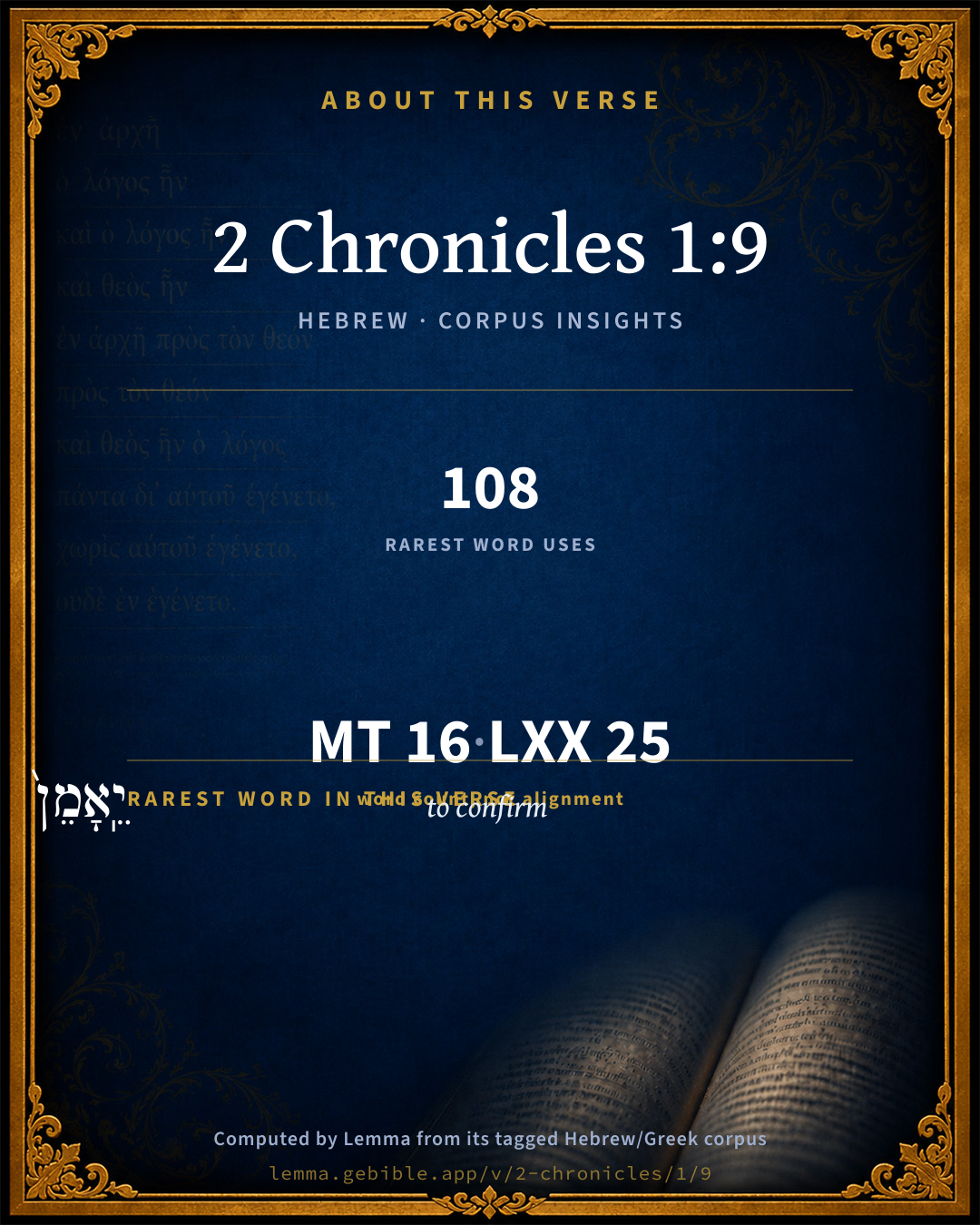
These counts appear in no published source. They are computed here, from the morphology-tagged text and Lemma’s own curated glosses. What Lemma adds →

16
words
16
distinct lemmas
Historical
section

Grammatical profile

  • 2 verbs
  • 8 nouns
  • 1 adjective
  • 1 pronoun
  • 2 prepositions
  • 1 conjunction
  • 1 adverb

Verb forms

  • יֵֽאָמֵן֙ Niphal · Jussive
  • הִמְלַכְתַּ֔נִי Hiphil · Perfect

Hebrew & Septuagint length

In English translation the verse runs 29 words from the Hebrew and 33 from the Septuagint (LXX English) — closely comparable.

A rough comparison of the two English renderings, which tokenize alike — not a word-level alignment.

Word counts can differ between the Hebrew and the Greek without any difference in meaning — e.g. the Hebrew direct-object marker אֵת has no separate Greek word, and Greek often adds the article ὁ.

In the original languages it is 16 Hebrew tokens and 25 Greek tokens — but the two are counted differently (Hebrew bundles its prefixes and suffixes into one token; the Greek is in lemma form), so that isn’t a like-for-like length.

Cross-references

11

Topical passages linked to 2 Chronicles 1:9 in the Treasury of Scripture Knowledge — connected by theme and wording, ordered by reader-vote popularity; previews shown in the World English Bible.

  • Genesis 13:16 I will make your offspring as the dust of the earth, so that if a man can number the dust of the earth, then your seed may also be numbered.
  • 2 Samuel 7:12–16 When your days are fulfilled, and you shall sleep with your fathers, I will set up your seed after you, who shall proceed out of your bowels, and I will establish his kingdom.
  • Genesis 22:17 that in blessing I will bless you, and in multiplying I will multiply your seed as the stars of the heavens, and as the sand which is on the seashore. Your seed will possess the gate of his enemies.
  • Psalms 89:35–37 Once have I sworn by my holiness, I will not lie to David.
  • Psalms 132:11–12 Yahweh has sworn to David in truth. He will not turn from it: "I will set the fruit of your body on your throne.
  • Numbers 23:10 Who can count the dust of Jacob, Or number the fourth part of Israel? Let me die the death of the righteous, Let my last end be like his!
  • 2 Samuel 7:25–29 Now, Yahweh God, the word that you have spoken concerning your servant, and concerning his house, confirm you it forever, and do as you have spoken.
  • 1 Kings 3:7–8 Now, Yahweh my God, you have made your servant king instead of David my father: and I am but a little child; I don't know how to go out or come in.
  • 1 Chronicles 17:11–14 It shall happen, when your days are fulfilled that you must go to be with your fathers, that I will set up your seed after you, who shall be of your sons; and I will establish his kingdom.
  • 1 Chronicles 17:23–27 Now, Yahweh, let the word that you have spoken concerning your servant, and concerning his house, be established forever, and do as you have spoken.
  • 1 Chronicles 28:6–7 He said to me, Solomon your son, he shall build my house and my courts; for I have chosen him to be my son, and I will be his father.

Cross-references courtesy of OpenBible.info (CC BY 4.0).

Hebrew and Greek witnesses Masoretic Hebrew ↔ Greek Septuagint

The same verse in the two great witnesses to the Old Testament, shown verse-for-verse.

These are two independent witnesses, not word-aligned to each other, and the Septuagint is shown in lemma (dictionary) form.

Hebrew 2 Chronicles 1:9 Masoretic · Westminster Leningrad Codex

עַתָּה֙ יְהוָ֣ה אֱלֹהִ֔ים יֵֽאָמֵן֙ דְּבָ֣רְךָ֔ עִ֖ם דָּוִ֣יד אָבִ֑י כִּ֤י אַתָּה֙ הִמְלַכְתַּ֔נִי עַל עַ֕ם רַ֖ב כַּעֲפַ֥ר הָאָֽרֶץ

Now, Yahweh God, let your promise to David my father be established; for you have made me king over a people like the dust of the earth in multitude.

World English Bible · Public Domain

Greek LXX 2 Chronicles 1:9 Septuagint · lemma form

καί νῦν κύριος ὁ θεός πιστόω ὁ ὄνομα σύ ἐπί δαυίδ πατήρ ἐγώ ὅτι σύ βασιλεύω ἐγώ ἐπί λαός πολύς ὡς ὁ χοῦς ὁ γῆ

And now, O Lord God, let, I pray you, your name be established upon David my father; for you have made me king over a people numerous as the dust of the earth.

LXX2012 (modern English Septuagint) · Public Domain

Hebrew: Westminster Leningrad Codex (CC BY 4.0). Greek: Septuagint (public domain); English from LXX2012 (modern English Septuagint) (Public Domain). How the Septuagint differs from the Hebrew →

Commentary

Notes on 2 Chronicles 1:9 from classic Christian and Jewish commentators (each source and its license shown beneath its notes). The classic Christian expositions comment on the surrounding passage and are grouped to its opening verse, so a note may address several verses; the Jewish commentaries on the Tanakh (Rashi and others) are per-verse, so they appear only where the commentator wrote on this verse.

Lemma curates 59 commentaries, every one of them public domain or Creative Commons licensed, each selected and text-cleaned for this edition rather than reprinted as found. About our sources →

Trapp's Complete Commentary

John Trapp

2Ch 1:9 Now, O LORD God, let thy promise unto David my father be established: for thou hast made me king over a people like the dust of the earth in multitude.

Ver. 9. Let thy promise,] viz., To the utmost extent of it.

John Trapp, A Commentary or Exposition upon All the Books of the Old and New Testament (1647–1656) — public domain. Text from a community e-Sword module.

Geneva Bible (1599)

Geneva Bible translators

Perform thy promise made to my father concerning me.

Geneva Bible (1599) marginal notes — public domain. Text via Bolls.life.

Adam Clarke's Commentary

Verse 9. Let thy promise] דברך debarcha, thy word; פתגמך pithgamach, Targum. It is very remarkable that when either God or man is represented as having spoken a word then the noun פתגם pithgam is used by the Targumist; but when word is used personally, then he employs the noun מימרא meymera, which appears to answer to the Λογος of St. John, Joh 1:1, &c.

Adam Clarke's Commentary on the Bible (1810–1826) — public domain. Text from a community e-Sword/MySword module.

Ellicott's Commentary for English Readers

(9) Now, O Lord God, let thy promise unto David my father be established.—A reminiscence of 1Ch_17:23.

Over a people like the dust of the earth in multitude.—Over a people numerous as the dust of the earth. This last clause freely corresponds with 1Ki_3:8. (Comp. the common title of Assyrian monarchs, “king of multitudes,” sar kissâti.)

A Bible Commentary for English Readers, edited by Charles John Ellicott (1878–1897) — public domain. Text from a community e-Sword module.

The Cambridge Bible for Schools and Colleges

gen. ed. J. J. S. Perowne

9. thy promise] Cp. 1Ch_22:9 ff. Perhaps the particular reference is to the first words of 1Ch_22:12, which may be translated as a promise, Surely the Lord will give thee wisdom and understanding.

The Cambridge Bible for Schools and Colleges (gen. ed. J. J. S. Perowne; Cambridge University Press, 1878–1918) — public domain. Text from a community e-Sword module.

The Pulpit Commentary

Now, O Lord God, let thy promise unto David my father be established. This challenge on the part of Solomon, intended, without doubt, most reverently, is not given in the parallel place, and forms not only a distinctive but an interesting additional feature of the present account. It is thought by some that the "promise "here challenged is not very distinctly recorded anywhere, but surely passages like 1Ch_17:12-14 1Ch_22:10 1Ch_28:6, 7 amply meet the case. See also 2Sa_7:12, 2Sa_7:15. King over a people like the dust. It is noteworthy that, though the equivalent of this phrase is found in the parallel, the distinctiveness of this simile is not found there. (For the use of the simile to express a vast number, (see Gen_28:14 Num_23:10; Zep_1:17; Zec_9:3) It is not at all of frequent use in Scripture.

The Pulpit Commentary (1880–1919), ed. H.D.M. Spence-Jones & Joseph S. Exell — public domain. Text from a community e-Sword module.

Rashi

Rabbi Shlomo Yitzchaki (Rashi)

Now, O Lord God, may...come true - Heb. יֵאָמֵן, (provarsi in Italian), to prove (true).

for You have enthroned me Since You have enthroned me over a numerous people like this, I require wisdom and strength to go forth before them and to wage their wars, as it is stated (I Samuel 8:20): “and our king will judge us and wage our wars.” Now since I must ask what is in my heart, I shall ask what I require and that is that You grant me wisdom.

Rashi on the Tanakh — English translations: “The Judaica Press complete Tanach with Rashi, translated by A. J. Rosenberg” (CC BY 4.0); “Pentateuch with Rashi's commentary by M. Rosenbaum and A.M. Silbermann, 1929-1934” (public domain); “The Metsudah Tanach series, Lakewood, N.J” (CC BY 4.0); and “The Book of Joshua, Metsudah Publications, 1997” (CC BY 4.0). Text via Sefaria.

Lesson kit

Teaching starters — assembled from the data on this page, not authored interpretation. Every prompt links to the verse data it draws on. Edit before teaching.

2 Chronicles, in the Historical, opens this verse with 16 words (16 distinct Hebrew lemmas). Its most distinctive word is ʼâman (“to confirm”). A historical commentator’s framing appears above. Read the whole chapter for the surrounding context.

Discussion questions

  1. The word ʼâman carries the sense “to confirm.” How does it shape the verse?
  2. Genesis 13:16 shares this passage’s theme. How do the two illuminate each other?
  3. These translations render this verse differently. What is at stake in choosing one wording over another?
  4. The verb «יֵֽאָמֵן֙» is Niphal Jussive. How does its form color the action?
  5. Reading how Trapp's Complete Commentary and Geneva Bible (1599) read this verse, where do the two commentators agree and where do they part?

Things to notice

Reading settings

Reading text

Shown beneath each verse's original-language words.

Old Testament
Old Testament edition

Read the OT as the Masoretic Hebrew (MT) or the Greek Septuagint (LXX).

English shown for the Greek Septuagint (in the Hebrew ↔ Greek comparison).

Comparing translations? Open the Compare panel on any verse page to stack up to four side by side.