1 Kings 3:8

Hebrew (Westminster Leningrad Codex) 1 Kings 3:8 appears in the Hebrew Old Testament. The text above is from the Westminster Leningrad Codex. Each word links to its Strong’s number, a concise gloss, and parsing drawn from the Open Scriptures Hebrew Bible morphology. Click any word for its full Brown-Driver-Briggs (BDB) entry.
Download image
Cite this verse

1 Kings 3:8 (World English Bible). Public Domain. Lemma interlinear Bible study tool, https://lemma.gebible.app/v/1-kings/3/8.

Show BibTeX & RIS
BibTeX
RIS
English Translation
Your servant is in the midst of your people which you have chosen, a great people, that can't be numbered nor counted for multitude.
World English Bible · Public Domain
Download a study sheet

One document with this verse’s original text, its word-by-word gloss line, the meaning frame, cross-references with their text, attributed commentary, and full source and license credits — printable, and it pastes into notes with its structure intact.

This verse Autodidact and up

Study sheet (.html) Plain text (.txt)

A passage Seminary Student

Up to 50 verses in one chapter. A passage sheet keeps up to 6 commentary sources and 12 cross-references per verse, in the order this page ranks them, and says so on the sheet whenever that leaves anything out. Ask for a single verse and you get the Autodidact verse sheet above.

Everything on this page stays free to read, with no account — the sheet is a download of what is already on screen, not access to it.

Want to remove ads? Support Godless Engineer
Compare translations 3

The same verse in 3 English versions, stacked beneath the original-language interlinear above. Click any original word for its lexicon entry.

Each is an independent rendering of the whole verse — the interlinear is not word-aligned to these translations.

Highlighted words mark where these versions differ — a whole-verse word diff, not a word-by-word alignment.

  • World English Bible Public Domain
    Your servant is in the midst of your people which you have chosen, a great people, that can't be numbered nor counted for multitude.
  • King James Version Public Domain
    And thy servant is in the midst of thy people which thou hast chosen, a great people, that cannot be numbered nor counted for multitude.
  • unfoldingWord Literal Text CC BY-SA 4.0
    And your servant in the midst of your people whom you have chosen, an abundant people who can not be numbered and can not be counted from abundance.

unfoldingWord Literal Text — © unfoldingWord, licensed CC BY-SA 4.0. Word-aligned USFM3 via Door43 (git.door43.org/unfoldingWord/en_ult).

Versions to compare (up to 4)

3 of 4 selected

Show all 18 translations

Every available English version of this verse, each an independent rendering of the whole verse.

  • World English Bible Public Domain
    Your servant is in the midst of your people which you have chosen, a great people, that can't be numbered nor counted for multitude.
  • Berean Standard Bible Public Domain
    Your servant is here among the people You have chosen, a people too numerous to count or number.
  • Majority Standard Bible Public Domain
    Your servant is here among the people You have chosen, a people too numerous to count or number.
  • King James Version Public Domain
    And thy servant is in the midst of thy people which thou hast chosen, a great people, that cannot be numbered nor counted for multitude.
  • American Standard Version (1901) Public Domain
    And thy servant is in the midst of thy people which thou hast chosen, a great people, that cannot be numbered nor counted for multitude.
  • Revised Version (1885) Public Domain
    And thy servant is in the midst of thy people which thou hast chosen, a great people, that cannot be numbered nor counted for multitude.
  • Geneva Bible (1599) Public Domain
    And thy seruant is in the mids of thy people, which thou hast chosen, euen a great people which cannot be told nor nobred for multitude.
  • Douay-Rheims (1899) Public Domain
    And thy servant is in the midst of the people which thou hast chosen, an immense people, which cannot be numbered nor counted for multitude.
  • Young's Literal Translation Public Domain
    and Thy servant `is' in the midst of thy people, whom Thou hast chosen, a people numerous, that is not numbered nor counted for multitude,
  • Literal Standard Version CC BY-SA 4.0
    and Your servant [is] in the midst of your people, whom You have chosen, a people numerous, that is not numbered nor counted for multitude,
  • Unlocked Literal Bible CC BY-SA 4.0
    Your servant is in the midst of the people whom you have chosen, a great people, too numerous to be numbered or counted.
  • unfoldingWord Literal Text CC BY-SA 4.0
    And your servant in the midst of your people whom you have chosen, an abundant people who can not be numbered and can not be counted from abundance.
  • Darby Bible Public Domain
    And thy servant is in the midst of thy people which thou hast chosen, a great people, that cannot be numbered nor counted for multitude.
  • World Messianic Bible Public Domain
    Your servant is among your people which you have chosen, a great people, that can’t be numbered or counted for multitude.
  • Webster's Bible Public Domain
    And thy servant is in the midst of thy people which thou hast chosen, a great people, that cannot be numbered nor counted for multitude.
  • Free Bible Version CC BY-SA 4.0
    I, your servant, am here among your chosen people, a great people that are so many they cannot be counted.
  • Bible in Basic English Public Domain
    And your servant has round him the people of your selection, a people so great that they may not be numbered, and no account of them may be given.
  • JPS Tanakh (1917) Public Domain
    And Thy servant is in the midst of Thy people which Thou hast chosen, a great people, that cannot be numbered nor counted for multitude.

Literal Standard Version (2020), Covenant Press — licensed CC BY-SA 4.0. Text via the HelloAO Bible API (eBible.org). Unlocked Literal Bible (unfoldingWord) — licensed CC BY-SA 4.0. Text via the HelloAO Bible API (eBible.org). unfoldingWord Literal Text — © unfoldingWord, licensed CC BY-SA 4.0. Word-aligned USFM3 via Door43 (git.door43.org/unfoldingWord/en_ult). Free Bible Version, Dr. Jonathan Gallagher — licensed CC BY-SA 4.0. Text via the HelloAO Bible API (eBible.org).

Word by word

More ways to search: Search by grammar → Find every occurrence → Compare this word →

Practice this passage: Drill this verse → Learn its vocabulary →

יִמָּנֶ֛ה
mânâh
H4487
“to count”
Verb, Niphal, Imperfect, 3rd Person, Masculine, Singular
Part of Speech
Verb
Stem
Niphal
Form
Imperfect
Person
3rd Person
Gender
Masculine
Number
Singular
Full BDB Definition

Origin: a primitive root

TWOT: 1213

to count, reckon, number, assign, tell, appoint, prepare - (Qal) - to count, number - reckon, assign, appoint - (Niphal) - to be counted, be numbered - to be reckoned, be assigned - (Piel) to appoint, ordain - (Pual) appointed (participle)
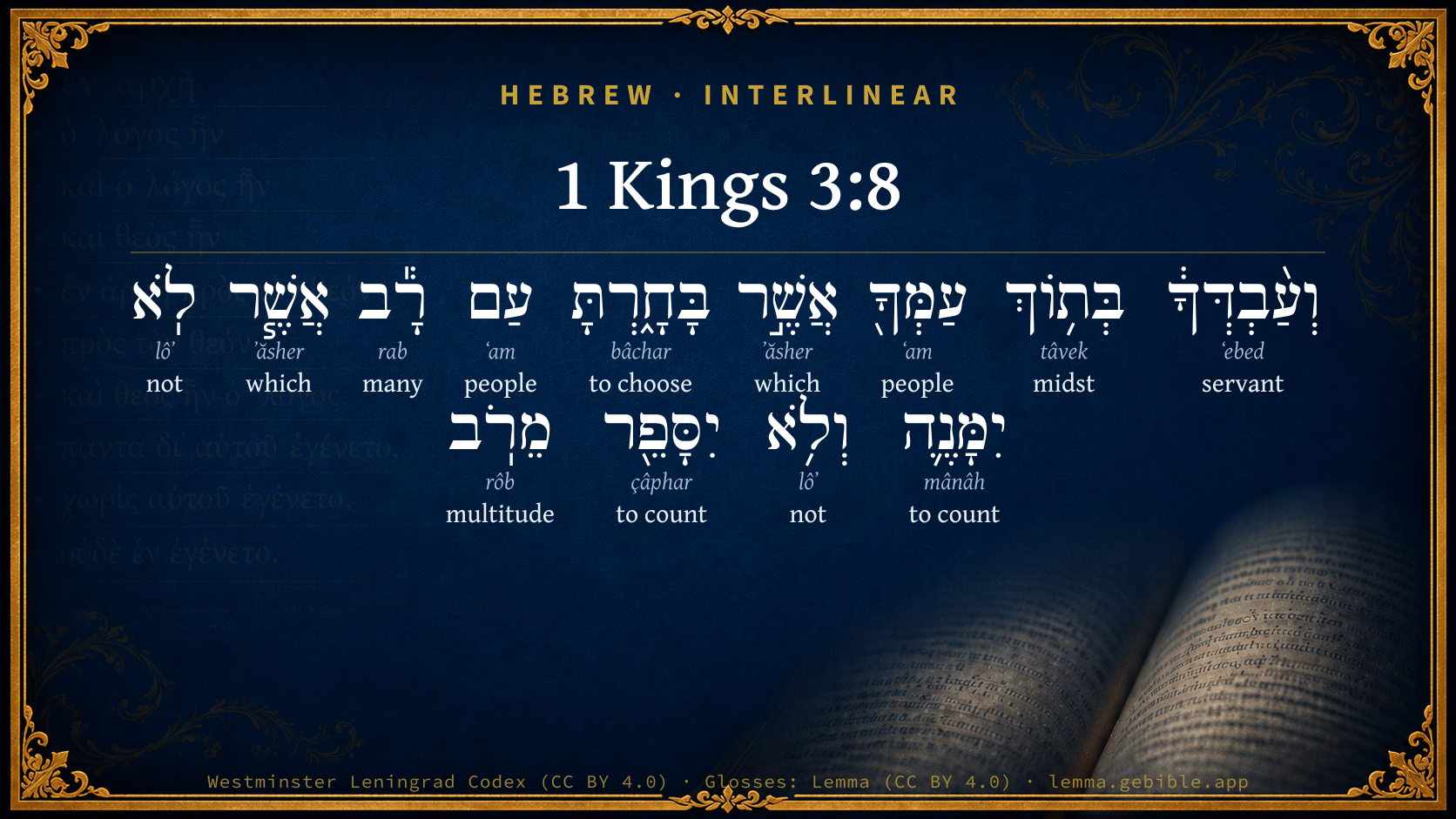
  1. וְעַ֨בְדְּךָ֔ ʻebed H5650 “and · servant · your” Conjunction + Noun, Common, Masculine, Singular, Construct + Suffix, Personal, 2nd Person, Masculine, Singular
  2. בְּת֥וֹךְ tâvek H8432 “in/at · midst of” Preposition + Noun, Common, Masculine, Singular, Construct
  3. עַמְּךָ֖ ʻam H5971 “people · your” Noun, Common, Masculine, Singular, Construct + Suffix, Personal, 2nd Person, Masculine, Singular
  4. אֲשֶׁ֣ר ʼăsher H834 “which” Particle, Relative
  5. בָּחָ֑רְתָּ bâchar H977 “to choose” Verb, Qal, Perfect, 2nd Person, Masculine, Singular
  6. עַם ʻam H5971 “people” Noun, Common, Masculine, Singular, Absolute
  7. רָ֕ב rab H7227 “many” Adjective, Adjective, Masculine, Singular, Absolute
  8. אֲשֶׁ֧ר ʼăsher H834 “which” Particle, Relative
  9. לֹֽא lôʼ H3808 “not” Particle, Negative
  10. וְלֹ֥א lôʼ H3808 “and · not” Conjunction + Particle, Negative
  11. יִסָּפֵ֖ר çâphar H5608 “to count” Verb, Niphal, Imperfect, 3rd Person, Masculine, Singular
  12. מֵרֹֽב rôb H7230 “from · multitude” Preposition + Noun, Common, Both, Singular, Absolute

About this verse

These counts appear in no published source. They are computed here, from the morphology-tagged text and Lemma’s own curated glosses. What Lemma adds →

13
words
10
distinct lemmas
Historical
section

Shared distinctive vocabulary

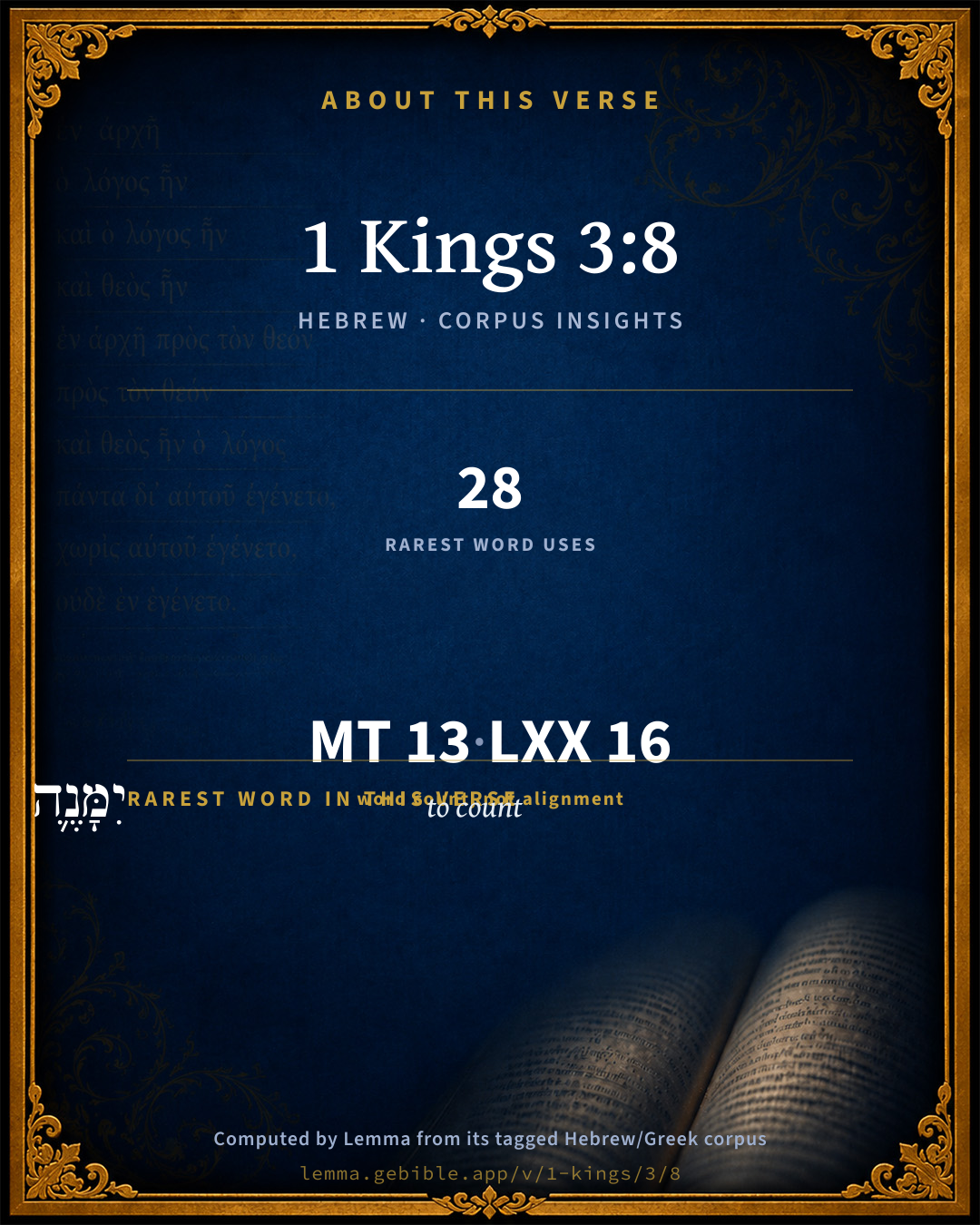
יִמָּנֶ֛ה to count H4487 occurs in 27 verses of the Hebrew Bible. Also found in:

Grammatical profile

  • 3 verbs
  • 5 nouns
  • 1 adjective
  • 4 particles

Verb forms

  • בָּחָ֑רְתָּ Qal · Perfect
  • יִמָּנֶ֛ה Niphal · Imperfect
  • יִסָּפֵ֖ר Niphal · Imperfect

Repetition

Words recur within this verse — often emphatic in Hebrew:

  • עַמְּךָ֖ people H5971 ×2
  • אֲשֶׁ֣ר which H834 ×2
  • לֹֽא not H3808 ×2

Hebrew & Septuagint length

In English translation the verse runs 24 words from the Hebrew and 24 from the Septuagint (LXX English) — the same length.

A rough comparison of the two English renderings, which tokenize alike — not a word-level alignment.

Word counts can differ between the Hebrew and the Greek without any difference in meaning — e.g. the Hebrew direct-object marker אֵת has no separate Greek word, and Greek often adds the article ὁ.

In the original languages it is 13 Hebrew tokens and 16 Greek tokens — but the two are counted differently (Hebrew bundles its prefixes and suffixes into one token; the Greek is in lemma form), so that isn’t a like-for-like length.

Cross-references

10

Topical passages linked to 1 Kings 3:8 in the Treasury of Scripture Knowledge — connected by theme and wording, ordered by reader-vote popularity; previews shown in the World English Bible.

  • Genesis 15:5 Yahweh brought him outside, and said, "Look now toward the sky, and count the stars, if you are able to count them." He said to Abram, "So shall your seed be."
  • Genesis 13:16 I will make your offspring as the dust of the earth, so that if a man can number the dust of the earth, then your seed may also be numbered.
  • Genesis 22:17 that in blessing I will bless you, and in multiplying I will multiply your seed as the stars of the heavens, and as the sand which is on the seashore. Your seed will possess the gate of his enemies.
  • 1 Chronicles 21:2 David said to Joab and to the princes of the people, Go, number Israel from Beersheba even to Dan; and bring me word, that I may know the sum of them.
  • Exodus 19:5–6 Now therefore, if you will indeed obey my voice, and keep my covenant, then you shall be my own possession from among all peoples; for all the earth is mine;
  • Deuteronomy 7:6–8 For you are a holy people to Yahweh your God: Yahweh your God has chosen you to be a people for his own possession, above all peoples who are on the face of the earth.
  • 1 Samuel 12:22 For Yahweh will not forsake his people for his great name's sake, because it has pleased Yahweh to make you a people to himself.
  • 1 Chronicles 21:5–6 Joab gave up the sum of the numbering of the people to David. All those of Israel were one million one hundred thousand men who drew sword: and in Judah were four hundred seventy thousand men who drew sword.
  • 1 Chronicles 27:23–24 But David didn't take the number of them from twenty years old and under, because Yahweh had said he would increase Israel like the stars of the sky.
  • Psalms 78:71 From following the ewes that have their young, He brought him to be the shepherd of Jacob, his people, And Israel, his inheritance.

Cross-references courtesy of OpenBible.info (CC BY 4.0).

Hebrew and Greek witnesses Masoretic Hebrew ↔ Greek Septuagint

The same verse in the two great witnesses to the Old Testament, shown verse-for-verse.

These are two independent witnesses, not word-aligned to each other, and the Septuagint is shown in lemma (dictionary) form.

Hebrew 1 Kings 3:8 Masoretic · Westminster Leningrad Codex

וְעַ֨בְדְּךָ֔ בְּת֥וֹךְ עַמְּךָ֖ אֲשֶׁ֣ר בָּחָ֑רְתָּ עַם רָ֕ב אֲשֶׁ֧ר לֹֽא יִמָּנֶ֛ה וְלֹ֥א יִסָּפֵ֖ר מֵרֹֽב

Your servant is in the midst of your people which you have chosen, a great people, that can't be numbered nor counted for multitude.

World English Bible · Public Domain

Greek LXX 1 Kings 3:8 Septuagint · lemma form

ὁ δέ δοῦλος σύ ἐν μέσος ὁ λαός σύ ὅς ἐκλέγω λαός πολύς ὅς οὐ ἀριθμέω

But your servant is in the midst of your people, whom you have chosen, a great people, which as this day can’t be numbered.

LXX2012 (modern English Septuagint) · Public Domain

Hebrew: Westminster Leningrad Codex (CC BY 4.0). Greek: Septuagint (public domain); English from LXX2012 (modern English Septuagint) (Public Domain). How the Septuagint differs from the Hebrew →

Targum (Aramaic paraphrase)

1

The Targum is the ancient Jewish Aramaic paraphrase of the Hebrew Scriptures — an interpretive translation, not the Hebrew text itself. Onkelos (literal) and Pseudo-Jonathan (expansive) render the Torah, and Jonathan the Prophets. Coverage is partial: where no permissively-licensed English translation exists for a verse, only the Aramaic is shown. This is verse-level text, not a word-by-word alignment to the Hebrew.

  1. Targum Jonathan Prophets (Joshua–Malachi)
    וְעַבְדָךְ בְּגוֹ עַמָךְ דְאִתְרְעִיתָא עַם סַגִי דְלָא יִתְחַשְׁבוּן וְלָא יִתְמְנוּן מִסְגֵי:

    (no public-domain English translation for this verse)

    Targum Jonathan — Aramaic: “Mikraot Gedolot” (public domain). English: “Sefaria Community Translation” (CC0 1.0 (public-domain dedication)); “London "Chaldee Paraphrase," 1871” (public domain). Text via Sefaria.

Commentary

Notes on 1 Kings 3:8 from classic Christian and Jewish commentators (each source and its license shown beneath its notes). The classic Christian expositions comment on the surrounding passage and are grouped to its opening verse, so a note may address several verses; the Jewish commentaries on the Tanakh (Rashi and others) are per-verse, so they appear only where the commentator wrote on this verse.

Lemma curates 59 commentaries, every one of them public domain or Creative Commons licensed, each selected and text-cleaned for this edition rather than reprinted as found. About our sources →

Trapp's Complete Commentary

John Trapp

1Ki 3:8 And thy servant [is] in the midst of thy people which thou hast chosen, a great people, that cannot be numbered nor counted for multitude.

Ver. 8. Is in the midst of thy people.] As lordkeeper of both tables of the law; as an antesignanus, a supreme governor. Royalty without wisdom is but eminent dishonour.

A great people.] The greater is my charge, and must be my care, who am yet unexperienced, unqualified.

John Trapp, A Commentary or Exposition upon All the Books of the Old and New Testament (1647–1656) — public domain. Text from a community e-Sword module.

The Cambridge Bible for Schools and Colleges

gen. ed. J. J. S. Perowne

8. a great people, &c.] The language is that of inexperience, which exaggerates the extent of duties and cares which it has not yet encountered, and which come upon it all at once.

The Cambridge Bible for Schools and Colleges (gen. ed. J. J. S. Perowne; Cambridge University Press, 1878–1918) — public domain. Text from a community e-Sword module.

John Gill's Exposition

And thy servant is in the midst of thy people which thou hast chosen,.... To be his special and peculiar people above all people on the earth; this is not to be understood locally, though Jerusalem, where his palace was, was in the middle of the land; but of the exercise of his office, he being placed over the people, and among them, and having the care and inspection of them:

a great people, that cannot be numbered and counted for multitude; being for number as the stars in the sky, and as the sand upon the seashore, as had been promised.

John Gill's Exposition of the Whole Bible (1746–1763) — public domain (CC PDM 1.0). Text via the HelloAO Bible API.

Albert Barnes' Notes on the Bible

Compare the marginal references. Solomon regards the promises as fulfilled in the existing greatness and glory of the Jewish nation.

Albert Barnes' Notes on the Bible (1834–1885) — public domain. Text from a community e-Sword/MySword module.

Matthew Poole's English Annotations

Is in the midst of thy people, i.e. is set over them to rule and guide them; a metaphor from the overseer of divers workmen, who usually is in the midst of them, that he may the better observe how each of them dischargeth his office.

Which thou hast chosen; thy peculiar people, whom thou takest special care of, and therefore wilt expect a more punctual account of my government of them.

Matthew Poole's English Annotations on the Holy Bible (1683–1685) — public domain. Text from a community e-Sword/MySword module.

Whedon's Commentary on the Bible

Daniel D. Whedon

8. That cannot be numbered — An acknowledged fulfilment of God’s promise to Abraham. Gen_13:16. Solomon feels that he has been made king of the covenant people.

Daniel D. Whedon (gen. ed.), Commentary on the Old and New Testaments (1874–1909) — public domain. Text from a community e-Sword module.

The Pulpit Commentary

And thy servant is in the midst of thy people which thou hast chosen, (see Deu_7:6) a great people, that cannot be numbered nor counted for multitude. The promises of Gen_13:16 Gen_15:5, lived in the thoughts and language of the Jews, and were doubtless the original of this expression. (Cf. also Num_23:10)

The Pulpit Commentary (1880–1919), ed. H.D.M. Spence-Jones & Joseph S. Exell — public domain. Text from a community e-Sword module.

John Wesley's Explanatory Notes

In the midst - Is set over them to rule and guide them. A metaphor from the overseer of divers workmen, who usually is in the midst of them, that he may the better observe how each of them discharges his office. Chosen - Thy peculiar people, whom thou takest special care of, and therefore wilt expect a more punctual account of my government of them.

John Wesley, Explanatory Notes Upon the Whole Bible (1754–1765) — public domain. Text via the GEBible commentary corpus.

Lesson kit

Teaching starters — assembled from the data on this page, not authored interpretation. Every prompt links to the verse data it draws on. Edit before teaching.

1 Kings, in the Historical, opens this verse with 13 words (10 distinct Hebrew lemmas). Its most distinctive word is mânâh (“to count”). A historical commentator’s framing appears above. Read the whole chapter for the surrounding context.

Discussion questions

  1. The word mânâh carries the sense “to count.” How does it shape the verse?
  2. Genesis 13:16 shares the word «to count» with this verse. How do the two illuminate each other?
  3. “people” occurs 2× in this one verse. What is the effect of the repetition?
  4. The translations on this page render this verse differently — a whole-verse word diff, not a word-by-word alignment. What might account for the different wordings?
  5. The verb «בָּחָ֑רְתָּ» is Qal Perfect. How does its form color the action?
  6. Reading how Trapp's Complete Commentary and The Cambridge Bible for Schools and Colleges read this verse, where do the two commentators agree and where do they part?

Things to notice

Reading settings

Reading text

Shown beneath each verse's original-language words.

Old Testament
Old Testament edition

Read the OT as the Masoretic Hebrew (MT) or the Greek Septuagint (LXX).

English shown for the Greek Septuagint (in the Hebrew ↔ Greek comparison).

Comparing translations? Open the Compare panel on any verse page to stack up to four side by side.