Ezekiel 37:2

Hebrew (Westminster Leningrad Codex) Ezekiel 37:2 appears in the Hebrew Old Testament. The text above is from the Westminster Leningrad Codex. Each word links to its Strong’s number, a concise gloss, and parsing drawn from the Open Scriptures Hebrew Bible morphology. Click any word for its full Brown-Driver-Briggs (BDB) entry.
Download image
Cite this verse

Ezekiel 37:2 (World English Bible). Public Domain. Lemma interlinear Bible study tool, https://lemma.gebible.app/v/ezekiel/37/2.

Show BibTeX & RIS
BibTeX
RIS
English Translation
He caused me to pass by them round about: and, behold, there were very many in the open valley; and, behold, they were very dry.
World English Bible · Public Domain
Download a study sheet

One document with this verse’s original text, its word-by-word gloss line, the meaning frame, cross-references with their text, attributed commentary, and full source and license credits — printable, and it pastes into notes with its structure intact.

This verse Autodidact and up

Study sheet (.html) Plain text (.txt)

A passage Seminary Student

Up to 50 verses in one chapter. A passage sheet keeps up to 6 commentary sources and 12 cross-references per verse, in the order this page ranks them, and says so on the sheet whenever that leaves anything out. Ask for a single verse and you get the Autodidact verse sheet above.

Everything on this page stays free to read, with no account — the sheet is a download of what is already on screen, not access to it.

Want to remove ads? Support Godless Engineer
Compare translations 3

The same verse in 3 English versions, stacked beneath the original-language interlinear above. Click any original word for its lexicon entry.

Each is an independent rendering of the whole verse — the interlinear is not word-aligned to these translations.

Highlighted words mark where these versions differ — a whole-verse word diff, not a word-by-word alignment.

  • World English Bible Public Domain
    He caused me to pass by them round about: and, behold, there were very many in the open valley; and, behold, they were very dry.
  • King James Version Public Domain
    And caused me to pass by them round about: and, behold, there were very many in the open valley; and, lo, they were very dry.
  • unfoldingWord Literal Text CC BY-SA 4.0
    Then he made me pass through them round and round. Behold! A great many of them were in the valley. Behold! They were very dry.

unfoldingWord Literal Text — © unfoldingWord, licensed CC BY-SA 4.0. Word-aligned USFM3 via Door43 (git.door43.org/unfoldingWord/en_ult).

Versions to compare (up to 4)

3 of 4 selected

Show all 18 translations

Every available English version of this verse, each an independent rendering of the whole verse.

  • World English Bible Public Domain
    He caused me to pass by them round about: and, behold, there were very many in the open valley; and, behold, they were very dry.
  • Berean Standard Bible Public Domain
    He led me all around among them, and I saw a great many bones on the floor of the valley, and indeed, they were very dry.
  • Majority Standard Bible Public Domain
    He led me all around among them, and I saw a great many bones on the floor of the valley, and indeed, they were very dry.
  • King James Version Public Domain
    And caused me to pass by them round about: and, behold, there were very many in the open valley; and, lo, they were very dry.
  • American Standard Version (1901) Public Domain
    And he caused me to pass by them round about: and, behold, there were very many in the open valley; and, lo, they were very dry.
  • Revised Version (1885) Public Domain
    And he caused me to pass by them round about: and behold, there were very many in the open valley; and lo, they were very dry.
  • Geneva Bible (1599) Public Domain
    And he led me round about by them, and beholde, they were very many in the open fielde, and lo, they were very drie.
  • Douay-Rheims (1899) Public Domain
    And he led me about through them on every side: now they were very many upon the face of the plain, and they were exceeding dry.
  • Young's Literal Translation Public Domain
    and He causeth me to pass over by them, all round about, and lo, very many `are' on the face of the valley, and lo, very dry.
  • Literal Standard Version CC BY-SA 4.0
    and He causes me to pass over by them, all around, and behold, very many [are] on the face of the valley, and behold—very dry.
  • Unlocked Literal Bible CC BY-SA 4.0
    Then he made me pass through them round and round. Behold! A great many of them were in the valley. Behold! They were very dry.
  • unfoldingWord Literal Text CC BY-SA 4.0
    Then he made me pass through them round and round. Behold! A great many of them were in the valley. Behold! They were very dry.
  • Darby Bible Public Domain
    And he caused me to pass by them round about; and behold, there were very many in the open valley; and behold, they were very dry.
  • World Messianic Bible Public Domain
    He caused me to pass by them all around; and behold, there were very many in the open valley, and behold, they were very dry.
  • Webster's Bible Public Domain
    And caused me to pass by them around: and behold, there were very many in the open valley; and lo, they were very dry.
  • Free Bible Version CC BY-SA 4.0
    He led me around them, and in all directions I saw many, many bones on the valley floor. They were really dry.
  • Bible in Basic English Public Domain
    And he made me go past them round about: and I saw that there was a very great number of them on the face of the wide valley, and they were very dry.
  • JPS Tanakh (1917) Public Domain
    and He caused me to pass by them round about, and, behold, there were very many in the open valley; and, lo, they were very dry.

Literal Standard Version (2020), Covenant Press — licensed CC BY-SA 4.0. Text via the HelloAO Bible API (eBible.org). Unlocked Literal Bible (unfoldingWord) — licensed CC BY-SA 4.0. Text via the HelloAO Bible API (eBible.org). unfoldingWord Literal Text — © unfoldingWord, licensed CC BY-SA 4.0. Word-aligned USFM3 via Door43 (git.door43.org/unfoldingWord/en_ult). Free Bible Version, Dr. Jonathan Gallagher — licensed CC BY-SA 4.0. Text via the HelloAO Bible API (eBible.org).

Word by word

More ways to search: Search by grammar → Find every occurrence → Compare this word →

Practice this passage: Drill this verse → Learn its vocabulary →

יְבֵשׁ֥וֹת
yâbêsh
H3002
“dry”
Adjective, Adjective, Feminine, Plural, Absolute
Part of Speech
Adjective
Type
Adjective
Gender
Feminine
Number
Plural
State
Absolute
Full BDB Definition

Origin: from H3001

TWOT: 837a

dry - dried
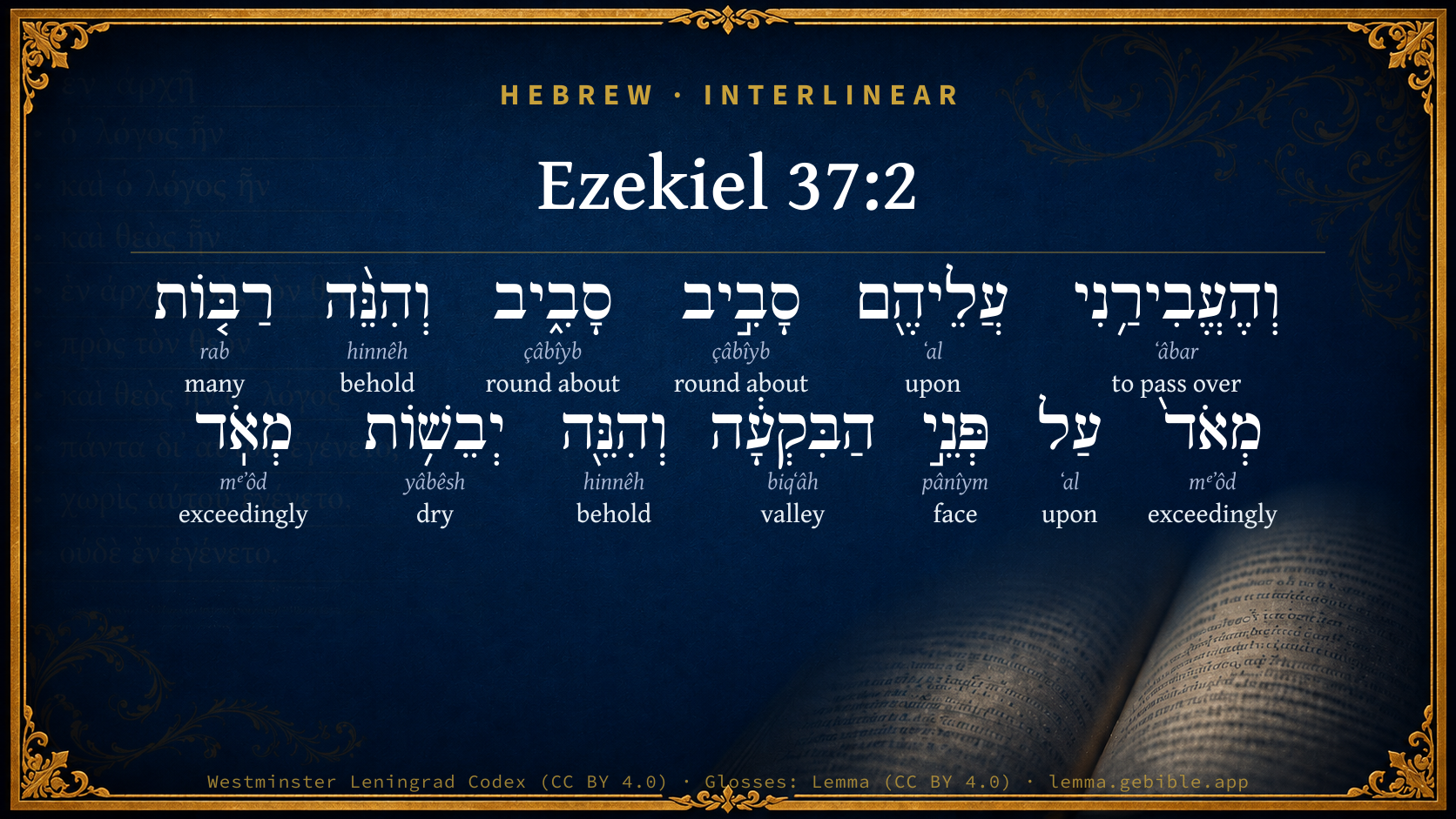
  1. וְהֶעֱבִירַ֥נִי ʻâbar H5674 “and · to pass over · me” Conjunction + Verb, Hiphil, Perfect, 3rd Person, Masculine, Singular + Suffix, Personal, 1st Person, Common, Singular
  2. עֲלֵיהֶ֖ם ʻal H5921 “upon · them” Preposition + Suffix, Personal, 3rd Person, Masculine, Plural
  3. סָבִ֣יב çâbîyb H5439 “round about” Noun, Common, Both, Singular, Absolute
  4. סָבִ֑יב çâbîyb H5439 “round about” Noun, Common, Both, Singular, Absolute
  5. וְהִנֵּ֨ה hinnêh H2009 “and · behold” Conjunction + Particle, Demonstrative
  6. רַבּ֤וֹת rab H7227 “many” Adjective, Adjective, Feminine, Plural, Absolute
  7. מְאֹד֙ mᵉʼôd H3966 “exceedingly” Adverb
  8. עַל ʻal H5921 “upon” Preposition
  9. פְּנֵ֣י pânîym H6440 “face(s) of” Noun, Common, Both, Plural, Construct
  10. הַבִּקְעָ֔ה biqʻâh H1237 “the · valley” Particle, Definite Article + Noun, Common, Feminine, Singular, Absolute
  11. וְהִנֵּ֖ה hinnêh H2009 “and · behold” Conjunction + Particle, Demonstrative
  12. מְאֹֽד mᵉʼôd H3966 “exceedingly” Adverb

About this verse

These counts appear in no published source. They are computed here, from the morphology-tagged text and Lemma’s own curated glosses. What Lemma adds →

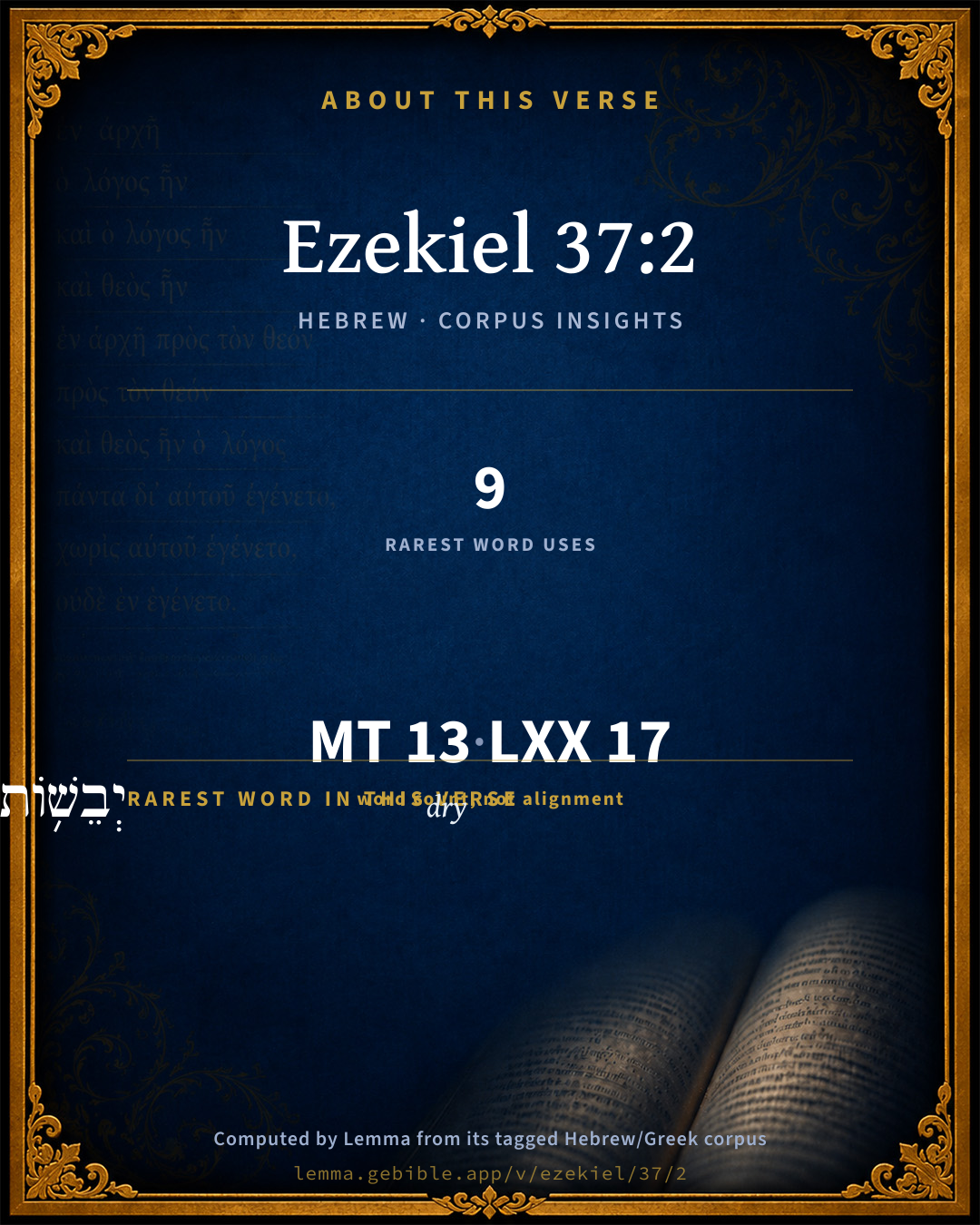
13
words
9
distinct lemmas
Prophets
section

Notable vocabulary

The rarest word here is יְבֵשׁ֥וֹת dry H3002 — appearing just 9 times in the whole Hebrew Bible.

Shared distinctive vocabulary

יְבֵשׁ֥וֹת dry H3002 occurs in 9 verses of the Hebrew Bible. Also found in:

Grammatical profile

  • 1 verb
  • 4 nouns
  • 2 adjectives
  • 2 prepositions
  • 2 adverbs
  • 2 particles

Verb forms

  • וְהֶעֱבִירַ֥נִי Hiphil · Perfect

Repetition

Words recur within this verse — often emphatic in Hebrew:

  • עֲלֵיהֶ֖ם upon H5921 ×2
  • סָבִ֣יב round about H5439 ×2
  • וְהִנֵּ֨ה behold H2009 ×2
  • מְאֹד֙ exceedingly H3966 ×2

Hebrew & Septuagint length

In English translation the verse runs 25 words from the Hebrew and 23 from the Septuagint (LXX English) — closely comparable.

A rough comparison of the two English renderings, which tokenize alike — not a word-level alignment.

Word counts can differ between the Hebrew and the Greek without any difference in meaning — e.g. the Hebrew direct-object marker אֵת has no separate Greek word, and Greek often adds the article ὁ.

In the original languages it is 13 Hebrew tokens and 17 Greek tokens — but the two are counted differently (Hebrew bundles its prefixes and suffixes into one token; the Greek is in lemma form), so that isn’t a like-for-like length.

Cross-references

2

Topical passages linked to Ezekiel 37:2 in the Treasury of Scripture Knowledge — connected by theme and wording, ordered by reader-vote popularity; previews shown in the World English Bible.

  • Psalms 141:7 "As when one plows and breaks up the earth, Our bones are scattered at the mouth of Sheol."
  • Ezekiel 37:11 Then he said to me, Son of man, these bones are the whole house of Israel: behold, they say, Our bones are dried up, and our hope is lost; we are clean cut off.

Cross-references courtesy of OpenBible.info (CC BY 4.0).

Hebrew and Greek witnesses Masoretic Hebrew ↔ Greek Septuagint

The same verse in the two great witnesses to the Old Testament, shown verse-for-verse.

These are two independent witnesses, not word-aligned to each other, and the Septuagint is shown in lemma (dictionary) form.

Hebrew Ezekiel 37:2 Masoretic · Westminster Leningrad Codex

וְהֶעֱבִירַ֥נִי עֲלֵיהֶ֖ם סָבִ֣יב סָבִ֑יב וְהִנֵּ֨ה רַבּ֤וֹת מְאֹד֙ עַל פְּנֵ֣י הַבִּקְעָ֔ה וְהִנֵּ֖ה יְבֵשׁ֥וֹת מְאֹֽד

He caused me to pass by them round about: and, behold, there were very many in the open valley; and, behold, they were very dry.

World English Bible · Public Domain

Greek LXX Ezekiel 37:2 Septuagint · lemma form

καί περιἄγω ἐγώ ἐπί αὐτός κυκλόθεν κύκλος καί ἰδού πολύς σφόδρα ἐπί πρόσωπον ὁ πεδίον ξηρός σφόδρα

And he led me round about them every way: and, behold, there were very many on the face of the plain, very dry.

LXX2012 (modern English Septuagint) · Public Domain

Hebrew: Westminster Leningrad Codex (CC BY 4.0). Greek: Septuagint (public domain); English from LXX2012 (modern English Septuagint) (Public Domain). How the Septuagint differs from the Hebrew →

Targum (Aramaic paraphrase)

1

The Targum is the ancient Jewish Aramaic paraphrase of the Hebrew Scriptures — an interpretive translation, not the Hebrew text itself. Onkelos (literal) and Pseudo-Jonathan (expansive) render the Torah, and Jonathan the Prophets. Coverage is partial: where no permissively-licensed English translation exists for a verse, only the Aramaic is shown. This is verse-level text, not a word-by-word alignment to the Hebrew.

  1. Targum Jonathan Prophets (Joshua–Malachi)
    וְאַעְבְּרַנִי עֲלֵיהוֹן סְחוֹר סְחוֹר וְהָא סַגִיאָן לַחֲדָא עַל אַפֵּי בִקְעֲתָא וְהָא יְבֵישִׁין לַחֲדָא:

    (no public-domain English translation for this verse)

    Targum Jonathan — Aramaic: “Mikraot Gedolot” (public domain). English: “Sefaria Community Translation” (CC0 1.0 (public-domain dedication)); “London "Chaldee Paraphrase," 1871” (public domain). Text via Sefaria.

Commentary

Notes on Ezekiel 37:2 from classic Christian and Jewish commentators (each source and its license shown beneath its notes). The classic Christian expositions comment on the surrounding passage and are grouped to its opening verse, so a note may address several verses; the Jewish commentaries on the Tanakh (Rashi and others) are per-verse, so they appear only where the commentator wrote on this verse.

Lemma curates 59 commentaries, every one of them public domain or Creative Commons licensed, each selected and text-cleaned for this edition rather than reprinted as found. About our sources →

Trapp's Complete Commentary

John Trapp

Eze 37:2 And caused me to pass by them round about: and, behold, [there were] very many in the open valley; and, lo, [they were] very dry.

Ver. 2. And, lo, they were very dry.] Ex vetustare et carie. This added to the miracle.

John Trapp, A Commentary or Exposition upon All the Books of the Old and New Testament (1647–1656) — public domain. Text from a community e-Sword module.

Joseph Benson's Commentary

Eze 37:2-3. He caused me to pass by them round about — To take an exact view of them; and behold, there were very many in the open valley — As if it had been a place where a great battle had been fought, and a vast multitude slain, who had been left unburied till the flesh was all consumed, and the bones were divided and scattered about. And lo, they were very dry — Having been long exposed to the sun and wind in the open valley, and the marrow within, as well as the flesh without, being utterly wasted. This circumstance was intended to show how unlikely it was, humanly speaking, that the Jews should ever be delivered from their dispersions and restored; should ever be brought together again, and formed into a body politic, or even into the skeleton of one. Still more unlikely it is that the dead in sin should be quickened, and raised up into living Christians; and most unlikely of all, that the dead bodies of men, after they have been turned into dust, and scattered to the four winds of heaven, should live again, and become bodies of light and glory. And he said, Son of man, can these bones live? — Namely, immediately, and in your sight? Or, as Houbigant renders it, Shall these bones live? The question, as he justly observes, is not concerning the possibility of the fact, for the prophet well knew that God could do all things; but the Lord, introductory to what follows, asks him whether these bones should now revive or not. And though this be the right interpretation of the place, yet a resurrection from the dead is very justly collected from it: for “a simile of the resurrection,” says St. Jerome, “would never have been used to signify the restoration of the people of Israel, unless such a future resurrection had been believed and known; because nobody ever confirms uncertain things by things which have no existence.” And I answered, O Lord, thou knowest — Raising the dead can only be an act of thy power and good pleasure. The prophet replies in a doubting manner, because he knew not the scope of the vision.

Joseph Benson's Commentary on the Old and New Testaments (1811–1818) — public domain. Text from a community e-Sword module.

Tyndale Open Study Notes

Tyndale Open Resources

37:2 This death scene seemed hopeless; these were not recently expired corpses but miscellaneous bones, scattered everywhere across the ground and . . . completely dried out. This scene symbolized the attitude of the people. Their hopes for themselves were not merely dead; they were dismembered and desiccated.

Tyndale Open Study Notes — © Tyndale Open Resources, licensed CC BY-SA 4.0. Text via the HelloAO Bible API.

Jamieson, Fausset & Brown

Robert Jamieson, A. R. Fausset & David Brown

dry--bleached by long exposure to the atmosphere.

Jamieson, Fausset & Brown — Commentary Critical and Explanatory on the Whole Bible (1871) — public domain (CC PDM 1.0). Text via the HelloAO Bible API.

Ellicott's Commentary for English Readers

(2) Very dry—as showing that it was a long time since life had left them, and that the possibility of their living again was far removed.

A Bible Commentary for English Readers, edited by Charles John Ellicott (1878–1897) — public domain. Text from a community e-Sword module.

The Cambridge Bible for Schools and Colleges

gen. ed. J. J. S. Perowne

2. the often valley] lit. on the face of the valley. The bones were strewed over the valley in vast numbers, and they appeared bleached and dry. Their great number no doubt was suggested by the actual fact that vast multitudes of the people had been slain with the sword or had otherwise perished; and their “dryness” expresses at least the utter deadness of the nation and the apparent hopelessness of its revival, if not that it had been long dead (Eze_37:11).

The Cambridge Bible for Schools and Colleges (gen. ed. J. J. S. Perowne; Cambridge University Press, 1878–1918) — public domain. Text from a community e-Sword module.

John Gill's Exposition

And caused me to pass by them round about,....

Round, round (s); several times round, that he might take exact notice of them, of their number, situation, and condition:

and, behold, there were very many in the open valley; as the Jews were in captivity; and as they will be when they shall be converted; and as the number of Christians will be in the spiritual reign of Christ; and as the dead will be at the time of their resurrection, both of the just and unjust:

and, lo, they were very dry; through length of time they had lain there, exposed to wind and weather; the flesh being wholly consumed from off of them, and the marrow within quite dried up; so that there was no probability or hope, humanly speaking, of their being quickened: these are a fit emblem of men in a state of nature and unregeneracy, who have no spiritual life, but are dead in trespasses and sins; have no sense of sin or danger; no strength to redeem and regenerate themselves, or do anything that is spiritually good; have no spiritual motion; no inward desires after God, or affection to him; no lifting up of the heart to him, or going out of the soul in faith and love to Christ; but in themselves entirely lifeless, helpless, and hopeless.

(s) "circum circa", Pagninus; "undique undique", Montanus.

John Gill's Exposition of the Whole Bible (1746–1763) — public domain (CC PDM 1.0). Text via the HelloAO Bible API.

Matthew Poole's English Annotations

Caused me; I was made to go round about them, in the same manner in which I was carried to see them.

Round about; round, round, perhaps twice or oftener, to view them well. Behold: he reports what he observed remarkable.

Very many; first for number, they were not only many, but very many, as Eze 37:10, they made an exceeding great army.

In the open valley; next the place, the face or surface of the plain, exposed to wind, weather, and to violence.

Very dry; the quality of them, dry, very dry, in which could be nothing that might promise life.

Matthew Poole's English Annotations on the Holy Bible (1683–1685) — public domain. Text from a community e-Sword/MySword module.

The Pulpit Commentary

And he caused me to pass by them round about. Not over, as Keil, Klie-foth, and Plumptre translate, but round about them, so as to view them from every side. The result of the prophet"s inspection of the bones was to excite within him a feeling of surprise which expressed itself in a twofold behold; the first occasioned by a contemplation of their number, very many, and their situation, in the open valley, literally, upon the face of the valley; i.e. not underground, where they could not have been seen, but upon the surface of the soil, and not piled up in heaps, but scattered over the ground; and the second by a discernment of their condition as very dry, so bleached and withered as to foreclose, not the possibility alone, but also the thought of their resuscitation.

The Pulpit Commentary (1880–1919), ed. H.D.M. Spence-Jones & Joseph S. Exell — public domain. Text from a community e-Sword module.

Rashi

Rabbi Shlomo Yitzchaki (Rashi)

And He made me pass by them round about the valley. But He did not bring him into its midst because he was a priest.

Rashi on the Tanakh — English translations: “The Judaica Press complete Tanach with Rashi, translated by A. J. Rosenberg” (CC BY 4.0); “Pentateuch with Rashi's commentary by M. Rosenbaum and A.M. Silbermann, 1929-1934” (public domain); “The Metsudah Tanach series, Lakewood, N.J” (CC BY 4.0); and “The Book of Joshua, Metsudah Publications, 1997” (CC BY 4.0). Text via Sefaria.

Lesson kit

Teaching starters — assembled from the data on this page, not authored interpretation. Every prompt links to the verse data it draws on. Edit before teaching.

Ezekiel, in the Prophets, opens this verse with 13 words (9 distinct Hebrew lemmas). Its most distinctive word is yâbêsh (“dry”). A historical commentator’s framing appears above. Read the whole chapter for the surrounding context.

Discussion questions

  1. The word yâbêsh carries the sense “dry.” How does it shape the verse?
  2. How does Numbers 6:3, which shares the word «dry», read alongside this verse?
  3. What does the repetition of “upon” (2× in this one verse) do in this verse?
  4. These translations render this verse differently; the difference is in the English rendering, not the original. What questions does that raise?
  5. «וְהֶעֱבִירַ֥נִי» is a Hiphil Perfect verb. How does that grammatical form shape the action described?
  6. Compare how Trapp's Complete Commentary and Joseph Benson's Commentary read this verse. Where do they agree or differ?

Things to notice

Reading settings

Reading text

Shown beneath each verse's original-language words.

Old Testament
Old Testament edition

Read the OT as the Masoretic Hebrew (MT) or the Greek Septuagint (LXX).

English shown for the Greek Septuagint (in the Hebrew ↔ Greek comparison).

Comparing translations? Open the Compare panel on any verse page to stack up to four side by side.