
Lamentations 1:22

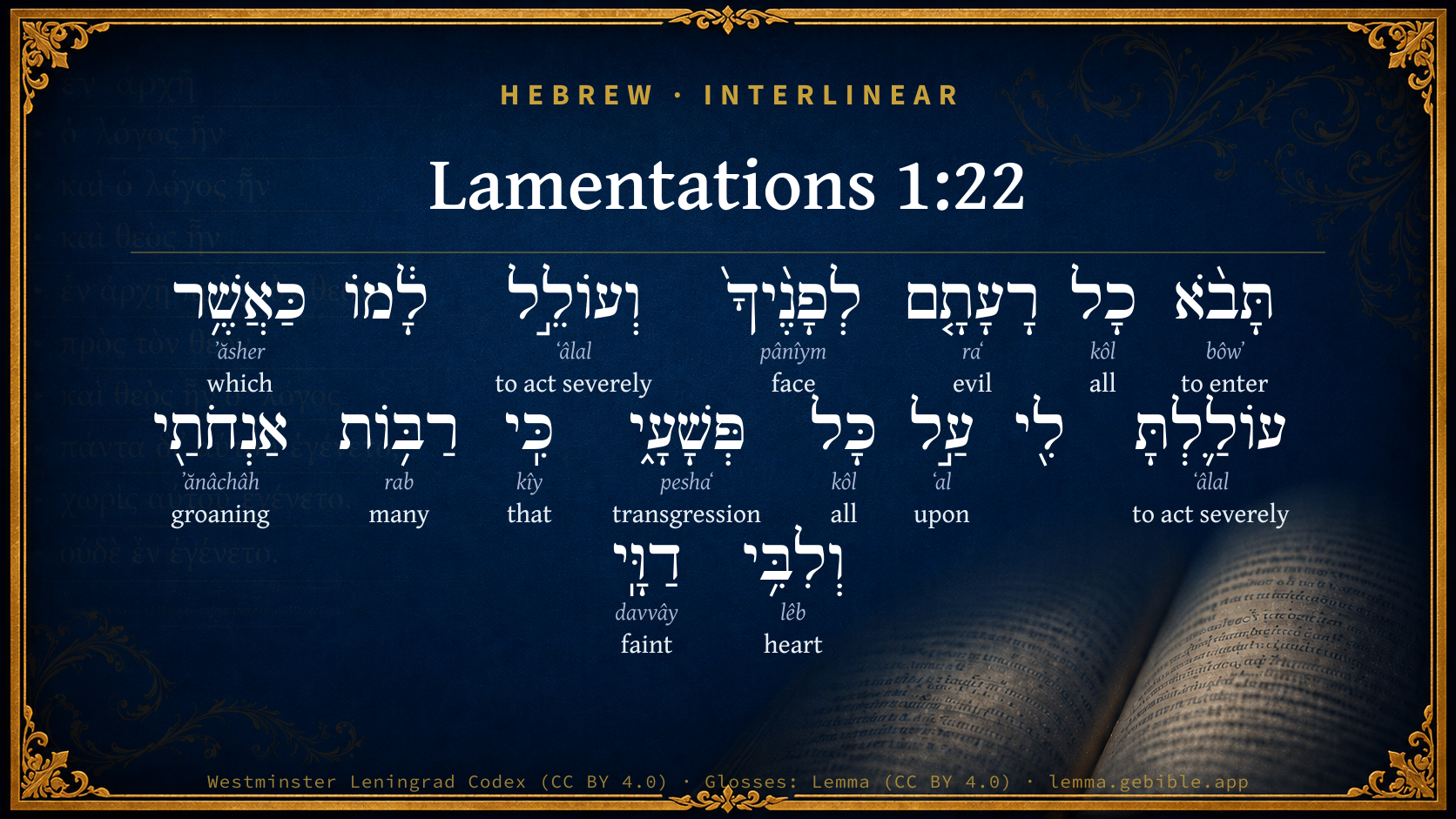
Hebrew (Westminster Leningrad Codex) Lamentations 1:22 appears in the Hebrew Old Testament. The text above is from the Westminster Leningrad Codex. Each word links to its Strong’s number, a concise gloss, and parsing drawn from the Open Scriptures Hebrew Bible morphology. Click any word for its full Brown-Driver-Briggs (BDB) entry.
Download image
Cite this verse

Lamentations 1:22 (World English Bible). Public Domain. Lemma interlinear Bible study tool, https://lemma.gebible.app/v/lamentations/1/22.

Show BibTeX & RIS
BibTeX
RIS
English Translation
Let all their wickedness come before you; Do to them, as you have done to me for all my transgressions: For my sighs are many, and my heart is faint.
World English Bible · Public Domain
Download a study sheet

One document with this verse’s original text, its word-by-word gloss line, the meaning frame, cross-references with their text, attributed commentary, and full source and license credits — printable, and it pastes into notes with its structure intact.

This verse Autodidact and up

Study sheet (.html) Plain text (.txt)

A passage Seminary Student

Up to 50 verses in one chapter. A passage sheet keeps up to 6 commentary sources and 12 cross-references per verse, in the order this page ranks them, and says so on the sheet whenever that leaves anything out. Ask for a single verse and you get the Autodidact verse sheet above.

Everything on this page stays free to read, with no account — the sheet is a download of what is already on screen, not access to it.

Want to remove ads? Support Godless Engineer
Compare translations 3

The same verse in 3 English versions, stacked beneath the original-language interlinear above. Click any original word for its lexicon entry.

Each is an independent rendering of the whole verse — the interlinear is not word-aligned to these translations.

Highlighted words mark where these versions differ — a whole-verse word diff, not a word-by-word alignment.

  • World English Bible Public Domain
    Let all their wickedness come before you; Do to them, as you have done to me for all my transgressions: For my sighs are many, and my heart is faint.
  • King James Version Public Domain
    Let all their wickedness come before thee; and do unto them, as thou hast done unto me for all my transgressions: for my sighs are many, and my heart is faint.
  • unfoldingWord Literal Text CC BY-SA 4.0
    Let all their evil come before you, and deal with them as you have dealt with me over all my transgressions, for my groaning many and my heart faint.”

unfoldingWord Literal Text — © unfoldingWord, licensed CC BY-SA 4.0. Word-aligned USFM3 via Door43 (git.door43.org/unfoldingWord/en_ult).

Versions to compare (up to 4)

3 of 4 selected

Show all 18 translations

Every available English version of this verse, each an independent rendering of the whole verse.

  • World English Bible Public Domain
    Let all their wickedness come before you; Do to them, as you have done to me for all my transgressions: For my sighs are many, and my heart is faint.
  • Berean Standard Bible Public Domain
    Let all their wickedness come before You, and deal with them as You have dealt with me because of all my transgressions. For my groans are many, and my heart is faint.
  • Majority Standard Bible Public Domain
    Let all their wickedness come before You, and deal with them as You have dealt with me because of all my transgressions. For my groans are many, and my heart is faint.
  • King James Version Public Domain
    Let all their wickedness come before thee; and do unto them, as thou hast done unto me for all my transgressions: for my sighs are many, and my heart is faint.
  • American Standard Version (1901) Public Domain
    Let all their wickedness come before thee; And do unto them, as thou hast done unto me for all my transgressions: For my sighs are many, and my heart is faint.
  • Revised Version (1885) Public Domain
    Let all their wickedness come before thee; and do unto them, as thou hast done unto me for all my transgressions: for my sighs are many, and my heart is faint.
  • Geneva Bible (1599) Public Domain
    Let all their wickednes come before thee: do vnto them, as thou hast done vnto me, for all my transgressions: for my sighes are many, and mine heart is heauy.
  • Douay-Rheims (1899) Public Domain
    Thau. Let all their evil be present before thee: and make vintage of them, as thou hast made vintage of me for all my iniquities: for my sighs are many, and my heart is sorrowful.
  • Young's Literal Translation Public Domain
    Come in doth all their evil before Thee, And one is doing to them as Thou hast done to me, For all my transgressions, For many `are' my sighs, and my heart `is' sick!
  • Literal Standard Version CC BY-SA 4.0
    All their evil comes in before You, || And one is doing to them as You have done to me, || For all my transgressions, || For many [are] my sighs, and my heart [is] sick!
  • Unlocked Literal Bible CC BY-SA 4.0
    Let all their wickedness come before you. deal with them as you have dealt with me because of all my transgressions. My groans are many and my heart is faint.
  • unfoldingWord Literal Text CC BY-SA 4.0
    Let all their evil come before you, and deal with them as you have dealt with me over all my transgressions, for my groaning many and my heart faint.”
  • Darby Bible Public Domain
    Let all their wickedness come before thee; and do unto them, as thou hast done unto me for all my transgressions: for my sighs are many, and my heart is faint.
  • World Messianic Bible Public Domain
    “Let all their wickedness come before you. Do to them as you have done to me for all my transgressions. For my sighs are many, and my heart is faint.
  • Webster's Bible Public Domain
    Let all their wickedness come before thee; and do to them, as thou hast done to me for all my transgressions: for my sighs are many, and my heart is faint.
  • Free Bible Version CC BY-SA 4.0
    May you see all the evil things they've done! Treat them the same way as you've treated me as a result of all my rebellious sins, for I'm groaning all the time, and I'm sick at heart.”
  • Bible in Basic English Public Domain
    Let all their evil-doing come before you; do to them as you have done to me for all my sins: for loud is the sound of my grief, and the strength of my heart is gone.
  • JPS Tanakh (1917) Public Domain
    Let all their wickedness come before Thee; and do unto them, as Thou hast done unto me for all my transgressions; for my sighs are many and my heart is faint.'

Literal Standard Version (2020), Covenant Press — licensed CC BY-SA 4.0. Text via the HelloAO Bible API (eBible.org). Unlocked Literal Bible (unfoldingWord) — licensed CC BY-SA 4.0. Text via the HelloAO Bible API (eBible.org). unfoldingWord Literal Text — © unfoldingWord, licensed CC BY-SA 4.0. Word-aligned USFM3 via Door43 (git.door43.org/unfoldingWord/en_ult). Free Bible Version, Dr. Jonathan Gallagher — licensed CC BY-SA 4.0. Text via the HelloAO Bible API (eBible.org).

Word by word

More ways to search: Search by grammar → Find every occurrence → Compare this word →

Practice this passage: Drill this verse → Learn its vocabulary →

דַוָּֽי
davvây
H1742
“faint”
Adjective, Adjective, Masculine, Singular, Absolute
Part of Speech
Adjective
Type
Adjective
Gender
Masculine
Number
Singular
State
Absolute
Full BDB Definition

Origin: from H1739

TWOT: 411d

faint (of heart)
  1. תָּבֹ֨א bôwʼ H935 “to enter” Verb, Qal, Imperfect, 3rd Person, Feminine, Singular
  2. כָל kôl H3605 “all of” Noun, Common, Masculine, Singular, Construct
  3. רָעָתָ֤ם raʻ H7451 “evil · their” Noun, Common, Feminine, Singular, Construct + Suffix, Personal, 3rd Person, Masculine, Plural
  4. לְפָנֶ֨יךָ֙ pânîym H6440 “to/for · face(s) · your” Preposition + Noun, Common, Both, Plural, Construct + Suffix, Personal, 2nd Person, Masculine, Singular
  5. וְעוֹלֵ֣ל ʻâlal H5953 “and · act severely” Conjunction + Verb, Poel, Imperative, 2nd Person, Masculine, Singular
  6. כַּאֲשֶׁ֥ר ʼăsher H834 “like/as · which” Preposition + Particle, Relative
  7. עוֹלַ֛לְתָּ ʻâlal H5953 “to act severely” Verb, Poel, Perfect, 2nd Person, Masculine, Singular
  8. עַ֣ל ʻal H5921 “upon” Preposition
  9. כָּל kôl H3605 “all of” Noun, Common, Masculine, Singular, Construct
  10. פְּשָׁעָ֑י peshaʻ H6588 “transgressions · my” Noun, Common, Masculine, Plural, Construct + Suffix, Personal, 1st Person, Common, Singular
  11. כִּֽי kîy H3588 “that” Conjunction
  12. רַבּ֥וֹת rab H7227 “many” Adjective, Adjective, Feminine, Plural, Absolute
  13. אַנְחֹתַ֖י ʼănâchâh H585 “groanings · my” Noun, Common, Feminine, Plural, Construct + Suffix, Personal, 1st Person, Common, Singular
  14. וְלִבִּ֥י lêb H3820 “and · heart · my” Conjunction + Noun, Common, Masculine, Singular, Construct + Suffix, Personal, 1st Person, Common, Singular

About this verse

These counts appear in no published source. They are computed here, from the morphology-tagged text and Lemma’s own curated glosses. What Lemma adds →

17
words
13
distinct lemmas
Prophets
section

Notable vocabulary

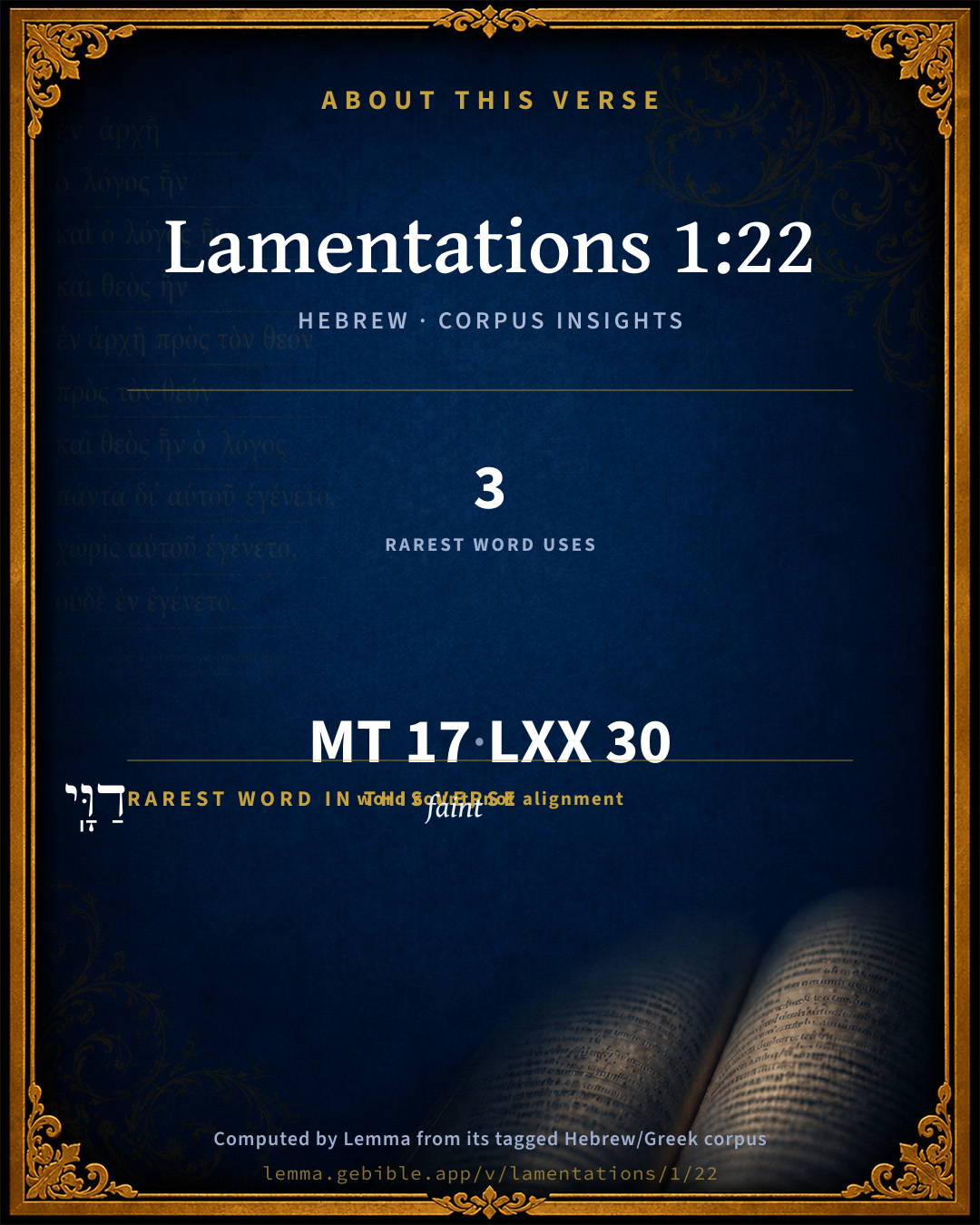
The rarest word here is דַוָּֽי faint H1742 — appearing just 3 times in the whole Hebrew Bible.

Shared distinctive vocabulary

דַוָּֽי faint H1742 occurs in 3 verses of the Hebrew Bible. Also found in:

Grammatical profile

  • 3 verbs
  • 7 nouns
  • 2 adjectives
  • 3 prepositions
  • 1 conjunction
  • 1 particle

Verb forms

  • תָּבֹ֨א Qal · Imperfect
  • וְעוֹלֵ֣ל Poel · Imperative
  • עוֹלַ֛לְתָּ Poel · Perfect

Repetition

Words recur within this verse — often emphatic in Hebrew:

  • כָל all H3605 ×2
  • וְעוֹלֵ֣ל to act severely H5953 ×2

Hebrew & Septuagint length

In English translation the verse runs 30 words from the Hebrew and 32 from the Septuagint (LXX English) — closely comparable.

A rough comparison of the two English renderings, which tokenize alike — not a word-level alignment.

Word counts can differ between the Hebrew and the Greek without any difference in meaning — e.g. the Hebrew direct-object marker אֵת has no separate Greek word, and Greek often adds the article ὁ.

In the original languages it is 17 Hebrew tokens and 30 Greek tokens — but the two are counted differently (Hebrew bundles its prefixes and suffixes into one token; the Greek is in lemma form), so that isn’t a like-for-like length.

Cross-references

13

Topical passages linked to Lamentations 1:22 in the Treasury of Scripture Knowledge — connected by theme and wording, ordered by reader-vote popularity; previews shown in the World English Bible.

  • Jeremiah 8:18 Oh that I could comfort myself against sorrow! my heart is faint within me.
  • Revelation 6:10 They cried with a loud voice, saying, "How long, Master, the holy and true, until you judge and avenge our blood on those who dwell on the earth?"
  • Psalms 109:14–15 Let the iniquity of his fathers be remembered by Yahweh. Don't let the sin of his mother be blotted out.
  • Nehemiah 4:4–5 Hear, our God; for we are despised: and turn back their reproach on their own head, and give them up for a spoil in a land of captivity;
  • Psalms 137:7–9 Remember, Yahweh, against the children of Edom, The day of Jerusalem; Who said, "Raze it! Raze it even to its foundation!"
  • Isaiah 13:7 Therefore shall all hands be feeble, and every heart of man shall melt:
  • Jeremiah 10:25 Pour out your wrath on the nations that don't know you, and on the families that don't call on your name: for they have devoured Jacob, yes, they have devoured him and consumed him, and have laid waste his habitation.
  • Jeremiah 18:23 Yet, Yahweh, you know all their counsel against me to kill me; don't forgive their iniquity, neither blot out their sin from your sight; but let them be overthrown before you; deal you with them in the time of your anger.
  • Jeremiah 51:35 The violence done to me and to my flesh be on Babylon, shall the inhabitant of Zion say; and, My blood be on the inhabitants of Chaldea, shall Jerusalem say.
  • Lamentations 1:13 From on high has he sent fire into my bones, and it prevails against them; He has spread a net for my feet, he has turned me back: He has made me desolate and faint all the day.
  • Lamentations 5:17 For this our heart is faint; For these things our eyes are dim;
  • Luke 23:31 For if they do these things in the green tree, what will be done in the dry?"
  • Ephesians 3:13 Therefore I ask that you may not lose heart at my troubles for you, which are your glory.

Cross-references courtesy of OpenBible.info (CC BY 4.0).

Hebrew and Greek witnesses Masoretic Hebrew ↔ Greek Septuagint

The same verse in the two great witnesses to the Old Testament, shown verse-for-verse.

These are two independent witnesses, not word-aligned to each other, and the Septuagint is shown in lemma (dictionary) form.

Hebrew Lamentations 1:22 Masoretic · Westminster Leningrad Codex

תָּבֹ֨א כָל רָעָתָ֤ם לְפָנֶ֨יךָ֙ וְעוֹלֵ֣ל לָ֔מוֹ כַּאֲשֶׁ֥ר עוֹלַ֛לְתָּ לִ֖י עַ֣ל כָּל פְּשָׁעָ֑י כִּֽי רַבּ֥וֹת אַנְחֹתַ֖י וְלִבִּ֥י דַוָּֽי

Let all their wickedness come before you; Do to them, as you have done to me for all my transgressions: For my sighs are many, and my heart is faint.

World English Bible · Public Domain

Greek LXX Lamentations 1:22 Septuagint · lemma form

εἰςἔρχομαι πᾶς ὁ κακία αὐτός κατά πρόσωπον σύ καί ἐπιφυλλίζω αὐτός ὅς τρόπος ποιέω ἐπιφυλλίς περί πᾶς ὁ ἁμάρτημα ἐγώ ὅτι πολύς ὁ στεναγμός ἐγώ καί ὁ καρδία ἐγώ λυπέω

THAU. Let all their wickedness come before your face; and strip them, as they have made a gleaning for all my sins: for my groans are many, and my heart is grieved.

LXX2012 (modern English Septuagint) · Public Domain

Hebrew: Westminster Leningrad Codex (CC BY 4.0). Greek: Septuagint (public domain); English from LXX2012 (modern English Septuagint) (Public Domain). How the Septuagint differs from the Hebrew →

Commentary

Notes on Lamentations 1:22 from classic Christian and Jewish commentators (each source and its license shown beneath its notes). The classic Christian expositions comment on the surrounding passage and are grouped to its opening verse, so a note may address several verses; the Jewish commentaries on the Tanakh (Rashi and others) are per-verse, so they appear only where the commentator wrote on this verse.

Lemma curates 59 commentaries, every one of them public domain or Creative Commons licensed, each selected and text-cleaned for this edition rather than reprinted as found. About our sources →

Trapp's Complete Commentary

John Trapp

Lam 1:22 Let all their wickedness come before thee; and do unto them, as thou hast done unto me for all my transgressions: for my sighs [are] many, and my heart [is] faint.

Ver. 22. Let their wickedness come before thee.] God had pronounced Babylon’s destruction, and therefore the Church might safely pray it: think the like of spiritual Babylon. God seemeth to forget the insolencies of his enemies, and deliverance of his people; we must mind him, and then it will be done. Only let us see to it, that our fire of zeal for God’s glory burn clear, without the smoke of self-ends and of private revenge.

As thou hast done unto me for my transgressions.] This was it that put a sting into all her sufferings; but then she had this to support her, that her sighs for her sins were many, and that her heart was faint or heavy through fear of wrath; yet not without hope of mercy, which made her thus to repair unto him by prayer. Qui nihil sperat, nihil orat.

John Trapp, A Commentary or Exposition upon All the Books of the Old and New Testament (1647–1656) — public domain. Text from a community e-Sword module.

Geneva Bible (1599)

Geneva Bible translators

Of desiring vengeance against the enemy, read Jer. 11:20 and 18:21.

Or, gather them like grapes.

Geneva Bible (1599) marginal notes — public domain. Text via Bolls.life.

Jamieson, Fausset & Brown

Robert Jamieson, A. R. Fausset & David Brown

Such prayers against foes are lawful, if the foe be an enemy of God, and if our concern be not for our own personal feeling, but for the glory of God and the welfare of His people.

come before thee--so Rev 16:19, "Babylon came in remembrance before God" (compare Psa 109:15).

Next: Lamentations Chapter 2

Jamieson, Fausset & Brown — Commentary Critical and Explanatory on the Whole Bible (1871) — public domain (CC PDM 1.0). Text via the HelloAO Bible API.

Adam Clarke's Commentary

Verse 22. Let all their wickedness come before thee] That is, Thou wilt call their crimes also into remembrance; and thou wilt do unto them by siege, sword, famine, and captivity, what thou hast done to me. Though thy judgments, because of thy long-suffering, are slow; yet, because of thy righteousness, they are sure.

For my sighs are many] My desolations continue; and my heart is faint - my political and physical strength almost totally destroyed.

Imprecations in the sacred writings are generally to be understood as declarative of the evils they indicate; or, that such evils will take place. No prophet of God ever wished desolation on those against whom he was directed to prophesy.

Adam Clarke's Commentary on the Bible (1810–1826) — public domain. Text from a community e-Sword/MySword module.

John Calvin's Commentaries

Here, no doubt, the faithful regarded as a part of their comfort the judgment which God would at length execute on the ungodly; and there is no doubt but that this kind of imprecation had been suggested to God’s children by the Holy Spirit, in order to sustain them when pressed down by heavy troubles; not that God gave them thus loose reins to desire vengeance on their enemies, but that while those perished who indulged their malice, the faithful might derive from their ruin a hope of deliverance; for the vengeance of God on the reprobate brings with it a token of paternal favor towards the elect.

And that we may better understand what this imprecation means, we must first bear in mind that we cannot complain of enemies, except they are also enemies to God. For should I hurt any one, and should he, impelled by wrath, vex me, there could be no access for my complaint to God, and in vain could I seek a covering from this example; why? because whenever we go before God, it is necessary, as I have said, that our enemies should be also his enemies. But, secondly, it would not be sufficient, except our zeal were also pure; for when we defend our own private cause, something excessive will necessarily be in our prayers. Let us, then, know that we are not to pronounce an imprecation on our enemies, except, first, they are God’s enemies; and, secondly, except we disregard ourselves, and plead not our own cause, but, on the contrary, undertake the cause of public safety, having laid aside all turbulent feelings; and especially, except our fervor arises from a desire to glorify God. With these qualifications, then, we may adopt the form of prayer given us here by the Prophet. But as this subject has been explained elsewhere, and often and very fully, I touch on it here but briefly.

He then says, Let all their wickedness come before thee; do to them as thou hast done to me. Here, again, the faithful take upon themselves the blame for all the evils they were suffering; for they do not expostulate with God, but pray only that he would become the judge of the whole world, in order that the ungodly might also at length have their turn, when God would be pacified towards his children. But they afterwards more clearly express that they had deserved all that they had suffered — for all my sins. Then they add, because my sighs are many and my heart is weak. We, in short, see that the faithful lay humbly their prayers before God, and at the same time confess that what they had deserved was rendered to them, only they set before God their extreme sorrow, straits, grieves, tears, and sighs. Then the way of pacifying God is, sincerely to confess that we are justly visited by his judgment, and also to lie down as it. were confounded, and at the same time to venture to look up to him, and to rely on his mercy with confidence. Now follows the second elegy, —

John Calvin's Commentaries (1540-1563) — public domain. Text from the Calvin Translation Society English edition (1840s-50s) via the Christian Classics Ethereal Library (ccel.org). Calvin's coverage is partial (roughly two-thirds of the Bible); uncommented books and verses are honest gaps, never fabricated. The 19th-century editor's footnotes and remarks are omitted so the notes are faithfully Calvin's own voice.

Ellicott's Commentary for English Readers

(22) Let all their wickedness . . .—The prayer for a righteous retribution, the first natural prayer of the outraged, reminds us of Psalms 69, 109, 137, yet more strongly of the language of the prophet himself in Jer_18:21-23. It is something more than a prayer for revenge, and rests on the underlying thought that righteousness requires the punishment. By some critics, it may be noted, Psalms 69, 109 have, on the strength of this parallelism, been ascribed to Jeremiah

A Bible Commentary for English Readers, edited by Charles John Ellicott (1878–1897) — public domain. Text from a community e-Sword module.

The Cambridge Bible for Schools and Colleges

gen. ed. J. J. S. Perowne

22. For my sighs are many] The connexion is, I have had my punishment. Do thou then proceed to inflict upon them their share. For the sentiment, as contrasted with N.T. teaching, cp. Jer_18:20 ff.

The Cambridge Bible for Schools and Colleges (gen. ed. J. J. S. Perowne; Cambridge University Press, 1878–1918) — public domain. Text from a community e-Sword module.

John Gill's Exposition

Let all their wickedness come before thee,.... The Targum adds,

"in the day of the great judgment;''

but it seems to refer to present time, at least to the time fixed by the Lord for their ruin; and which the church imprecates, not from a spirit of revenge, but from a holy zeal for the glory of God; desiring that the wickedness of her enemies might be remembered by the Lord, so as to punish them in righteous judgment for the same:

and do unto them as thou hast done unto me for all my transgressions; she owns that what was done to her was for her sins, and therefore could not charge God with injustice; only she desires the same might be done to her enemies, who were equally guilty: some render it, "glean them" (q); or rather, "gather them as a vintage"; or as grapes are gathered: "as thou hast gathered me"; as thou hast took me, and cast me into the winepress of thy wrath, and there hast trodden and squeezed me; see Lam 1:15; so do unto them:

for my sighs are many, and my heart is faint; her sighs were many because of her afflictions, and her heart faint because of her sighing.

(q) , Sept. "vindemia", V. L. Vatablus.

Next: Lamentations Chapter 2

John Gill's Exposition of the Whole Bible (1746–1763) — public domain (CC PDM 1.0). Text via the HelloAO Bible API.

Haydock's Catholic Bible Commentary

Let. He prays not for their ruin, but predicts it; and wishes rather that they would be converted. (Calmet)

George Leo Haydock (1774–1849), Haydock's Catholic Family Bible and Commentary, 1859 edition — public domain. Excludes Psalms (Douay-Rheims chapter numbering differs from Protestant) and Deuterocanonical books (Catholic canon only).

Matthew Poole's English Annotations

This verse is another prophetical curse or imprecation, several of which we meet with in holy writ, Psa 109:6-9; 137:8; Jer 11:20; 18:23, and in many other texts; which would incline us to think that our Saviour’s precept, Mat 5:44, to pray for those that persecute us, backed by his own example, Luk 23:34, and Stephen’s; Act 7:60, is either to be interpreted of praying for the forgiveness of their sins, (we ought to desire the eternal condemnation of none,) or to be restrained to such as are our personal enemies, not the common enemies of the church of God. Our Saviour’s precept most certainly is not to be so interpreted, but that we may lawfully pray for such evils to the implacable enemies of the church and people of God, as may restrain and weaken their hands, and put them out of a capacity of wasting the Lord’s heritage: we are only obliged by it to wish well to their souls, and to desire no evil against them out of private revenge or malice, but only out of love to God, and zeal for his glory; but for their outward prosperity in their courses of enmity we ought no more to pray than against their eternal salvation; for this were to beg of God to encourage his enemies in their enmity against him. And though Jeremiah were a greater prophet than any of us can pretend to be, and had revelations of particular future contingencies which we have not; yet every one may prophesy a ruin to the enemies of God’s church and people, and such as rejoice in their ruin; God never using a rod against his people which he doth not at last burn, nor ever countenacing inhumanity in any, but much less when it is rooted in a malice against himself, and his interest in the world.

Matthew Poole's English Annotations on the Holy Bible (1683–1685) — public domain. Text from a community e-Sword/MySword module.

The Pulpit Commentary

For my sighs are many. This is not mentioned as the reason why God should punish Jerusalem"s enemies; we ought rather to understand, either from ver. 20, "Behold, my distress;" or simply, "Deliver me."

The Pulpit Commentary (1880–1919), ed. H.D.M. Spence-Jones & Joseph S. Exell — public domain. Text from a community e-Sword module.

Rashi

Rabbi Shlomo Yitzchaki (Rashi)

May all their wickedness come before You May all their iniquities be remembered and counted before You.

and deal with them Heb. וְעוֹלֵל, and do, like (Prov. 20:11): “Also a child can disguise himself with his deeds (בְּמַעֲלָלָיו)”; (Jer. 32:19): “and in accordance with the fruit of his deeds (מַעֲלָלָיו).”

Rashi on the Tanakh — English translations: “The Judaica Press complete Tanach with Rashi, translated by A. J. Rosenberg” (CC BY 4.0); “Pentateuch with Rashi's commentary by M. Rosenbaum and A.M. Silbermann, 1929-1934” (public domain); “The Metsudah Tanach series, Lakewood, N.J” (CC BY 4.0); and “The Book of Joshua, Metsudah Publications, 1997” (CC BY 4.0). Text via Sefaria.

Lesson kit

Teaching starters — assembled from the data on this page, not authored interpretation. Every prompt links to the verse data it draws on. Edit before teaching.

Lamentations, in the Prophets, opens this verse with 17 words (13 distinct Hebrew lemmas). Its most distinctive word is davvây (“faint”). A historical commentator’s framing appears above. Read the whole chapter for the surrounding context.

Discussion questions

  1. The word davvây carries the sense “faint.” How does it shape the verse?
  2. Isaiah 1:5 shares the word «faint» with this verse. How do the two illuminate each other?
  3. “all” occurs 2× in this one verse. What is the effect of the repetition?
  4. These translations render this verse differently; the difference is in the English rendering, not the original. What questions does that raise?
  5. The verb «תָּבֹ֨א» is Qal Imperfect. How does its form color the action?
  6. Reading how Trapp's Complete Commentary and Geneva Bible (1599) read this verse, where do the two commentators agree and where do they part?

Things to notice

Reading settings

Reading text

Shown beneath each verse's original-language words.

Old Testament
Old Testament edition

Read the OT as the Masoretic Hebrew (MT) or the Greek Septuagint (LXX).

English shown for the Greek Septuagint (in the Hebrew ↔ Greek comparison).

Comparing translations? Open the Compare panel on any verse page to stack up to four side by side.