
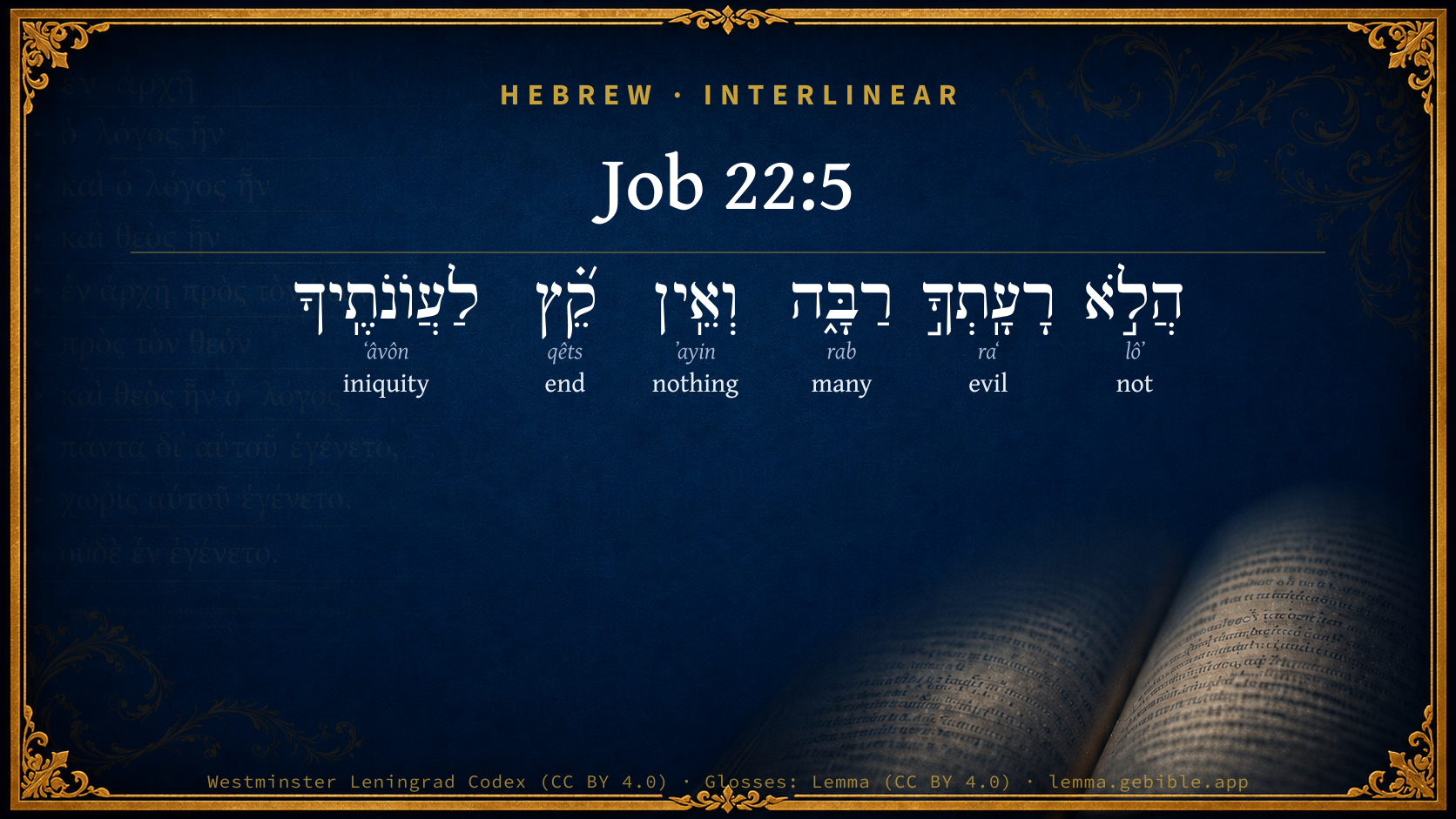
Job 22:5

Hebrew (Westminster Leningrad Codex) Job 22:5 appears in the Hebrew Old Testament. The text above is from the Westminster Leningrad Codex. Each word links to its Strong’s number, a concise gloss, and parsing drawn from the Open Scriptures Hebrew Bible morphology. Click any word for its full Brown-Driver-Briggs (BDB) entry.
Download image
Cite this verse

Job 22:5 (World English Bible). Public Domain. Lemma interlinear Bible study tool, https://lemma.gebible.app/v/job/22/5.

Show BibTeX & RIS
BibTeX
RIS
English Translation
Isn't your wickedness great? Neither is there any end to your iniquities.
World English Bible · Public Domain
Download a study sheet

One document with this verse’s original text, its word-by-word gloss line, the meaning frame, cross-references with their text, attributed commentary, and full source and license credits — printable, and it pastes into notes with its structure intact.

This verse Autodidact and up

Study sheet (.html) Plain text (.txt)

A passage Seminary Student

Up to 50 verses in one chapter. A passage sheet keeps up to 6 commentary sources and 12 cross-references per verse, in the order this page ranks them, and says so on the sheet whenever that leaves anything out. Ask for a single verse and you get the Autodidact verse sheet above.

Everything on this page stays free to read, with no account — the sheet is a download of what is already on screen, not access to it.

Want to remove ads? Support Godless Engineer
Compare translations 3

The same verse in 3 English versions, stacked beneath the original-language interlinear above. Click any original word for its lexicon entry.

Each is an independent rendering of the whole verse — the interlinear is not word-aligned to these translations.

Highlighted words mark where these versions differ — a whole-verse word diff, not a word-by-word alignment.

  • World English Bible Public Domain
    Isn't your wickedness great? Neither is there any end to your iniquities.
  • King James Version Public Domain
    Is not thy wickedness great? and thine iniquities infinite?
  • unfoldingWord Literal Text CC BY-SA 4.0
    Is not your wickedness great? And there is no end to your iniquities!

unfoldingWord Literal Text — © unfoldingWord, licensed CC BY-SA 4.0. Word-aligned USFM3 via Door43 (git.door43.org/unfoldingWord/en_ult).

Versions to compare (up to 4)

3 of 4 selected

Show all 18 translations

Every available English version of this verse, each an independent rendering of the whole verse.

  • World English Bible Public Domain
    Isn't your wickedness great? Neither is there any end to your iniquities.
  • Berean Standard Bible Public Domain
    Is not your wickedness great? Are not your iniquities endless?
  • Majority Standard Bible Public Domain
    Is not your wickedness great? Are not your iniquities endless?
  • King James Version Public Domain
    Is not thy wickedness great? and thine iniquities infinite?
  • American Standard Version (1901) Public Domain
    Is not thy wickedness great? Neither is there any end to thine iniquities.
  • Revised Version (1885) Public Domain
    Is not thy wickedness great? neither is there any end to thine iniquities.
  • Geneva Bible (1599) Public Domain
    Is not thy wickednes great, and thine iniquities innumerable?
  • Douay-Rheims (1899) Public Domain
    And not for thy manifold wickedness, and thy infinite iniquities?
  • Young's Literal Translation Public Domain
    Is not thy wickedness abundant? And there is no end to thine iniquities.
  • Literal Standard Version CC BY-SA 4.0
    Is your wickedness not abundant? And there is no end to your iniquities.
  • Unlocked Literal Bible CC BY-SA 4.0
    Is not your wickedness great? Is there no end to your iniquities?
  • unfoldingWord Literal Text CC BY-SA 4.0
    Is not your wickedness great? And there is no end to your iniquities!
  • Darby Bible Public Domain
    Is not thy wickedness great? and thine iniquities without end?
  • World Messianic Bible Public Domain
    Isn’t your wickedness great? Neither is there any end to your iniquities.
  • Webster's Bible Public Domain
    Is not thy wickedness great? and thy iniquities infinite?
  • Free Bible Version CC BY-SA 4.0
    No: it's because you're so wicked! Your sins are never-ending!
  • Bible in Basic English Public Domain
    Is not your evil-doing great? and there is no end to your sins.
  • JPS Tanakh (1917) Public Domain
    Is not thy wickedness great? And are not thine iniquities without end?

Literal Standard Version (2020), Covenant Press — licensed CC BY-SA 4.0. Text via the HelloAO Bible API (eBible.org). Unlocked Literal Bible (unfoldingWord) — licensed CC BY-SA 4.0. Text via the HelloAO Bible API (eBible.org). unfoldingWord Literal Text — © unfoldingWord, licensed CC BY-SA 4.0. Word-aligned USFM3 via Door43 (git.door43.org/unfoldingWord/en_ult). Free Bible Version, Dr. Jonathan Gallagher — licensed CC BY-SA 4.0. Text via the HelloAO Bible API (eBible.org).

Word by word

More ways to search: Search by grammar → Find every occurrence → Compare this word →

Practice this passage: Drill this verse → Learn its vocabulary →

About this verse

These counts appear in no published source. They are computed here, from the morphology-tagged text and Lemma’s own curated glosses. What Lemma adds →

6
words
6
distinct lemmas
Wisdom
section

Grammatical profile

  • 3 nouns
  • 1 adjective
  • 2 particles

Hebrew & Septuagint length

In English translation the verse runs 12 words from the Hebrew and 9 from the Septuagint (LXX English) — closely comparable.

A rough comparison of the two English renderings, which tokenize alike — not a word-level alignment.

Word counts can differ between the Hebrew and the Greek without any difference in meaning — e.g. the Hebrew direct-object marker אֵת has no separate Greek word, and Greek often adds the article ὁ.

Cross-references

9

Topical passages linked to Job 22:5 in the Treasury of Scripture Knowledge — connected by theme and wording, ordered by reader-vote popularity; previews shown in the World English Bible.

  • Job 15:5–6 For your iniquity teaches your mouth, And you choose the language of the crafty.
  • Psalms 40:12 For innumerable evils have surrounded me. My iniquities have overtaken me, so that I am not able to look up. They are more than the hairs of my head. My heart has failed me.
  • Job 4:7–11 "Remember, now, whoever perished, being innocent? Or where were the upright cut off?
  • Job 11:6 That he would show you the secrets of wisdom! For true wisdom has two sides. Know therefore that God exacts of you less than your iniquity deserves.
  • Job 11:14 If iniquity is in your hand, put it far away, Don't let unrighteousness dwell in your tents.
  • Job 15:31–34 Let him not trust in emptiness, deceiving himself; For emptiness shall be his reward.
  • Job 21:27 "Behold, I know your thoughts, The devices with which you would wrong me.
  • Job 32:3 Also his wrath was kindled against his three friends, because they had found no answer, and yet had condemned Job.
  • Psalms 19:12 Who can discern his errors? Forgive me from hidden errors.

Cross-references courtesy of OpenBible.info (CC BY 4.0).

Hebrew and Greek witnesses Masoretic Hebrew ↔ Greek Septuagint

The same verse in the two great witnesses to the Old Testament, shown verse-for-verse.

These are two independent witnesses, not word-aligned to each other, and the Septuagint is shown in lemma (dictionary) form.

Hebrew Job 22:5 Masoretic · Westminster Leningrad Codex

הֲלֹ֣א רָעָֽתְךָ֣ רַבָּ֑ה וְאֵֽין קֵ֝֗ץ לַעֲוֺנֹתֶֽיךָ

Isn't your wickedness great? Neither is there any end to your iniquities.

World English Bible · Public Domain

Greek LXX Job 22:5 Septuagint · lemma form

πότερον οὐ ὁ κακία σύ εἰμί πολύς ἀναρίθμητος δέ σύ εἰμί ὁ ἁμαρτία

Is not your wickedness abundant, and your sins innumerable?

LXX2012 (modern English Septuagint) · Public Domain

On this verse, Matthew Henry's Commentary discusses the Septuagint’s reading. Read the note in Commentary ↓

Hebrew: Westminster Leningrad Codex (CC BY 4.0). Greek: Septuagint (public domain); English from LXX2012 (modern English Septuagint) (Public Domain). How the Septuagint differs from the Hebrew →

Commentary

Notes on Job 22:5 from classic Christian and Jewish commentators (each source and its license shown beneath its notes). The classic Christian expositions comment on the surrounding passage and are grouped to its opening verse, so a note may address several verses; the Jewish commentaries on the Tanakh (Rashi and others) are per-verse, so they appear only where the commentator wrote on this verse.

Lemma curates 59 commentaries, every one of them public domain or Creative Commons licensed, each selected and text-cleaned for this edition rather than reprinted as found. About our sources →

Trapp's Complete Commentary

John Trapp

Job 22:5 [Is] not thy wickedness great? and thine iniquities infinite?

Ver. 5. Is not thy wickedness great?] Why, no; God of his grace had kept Job innocent of the great transgression, Psa 19:13, and that wicked one had not touched him, 1Jn 5:18, sc. with a deadly touch, Tactu qualitativo (Cajetan); had not thrust his sting into him, or transformed him into sin’s image. Had Eliphaz ever found Job to be such a one as here he maketh him? Or doth he not, by these interrogatories, cunningly come over him (in kindness, as we say), to make him confess it? Had all been true that is alleged, Job’s wickedness must needs have been great, and his iniquity infinite. But to be accused is not enough to render a man guilty; for then who should be innocent? Novit sapiens se ad hoc scamma productum, ut depugnet cum iis qui maledictis aluntur, ut venems capreae. Cato was thirty-two times accused, and as often absolved.

And thine iniquities infinite?] Heb. There is no end of thine iniquities; and hence it is that thy miseries are so many and so long lasting; commeruisti tanta tuis sceleribus. The wicked indeed are eternally tormented: 1. Because, being worthless, they cannot satisfy God’s justice in any time; 2. Because they have an infinite desire for sinning against God. But neither of these could be truly affirmed in Job. That so grave a man as Eliphaz (whom the Jewish doctors account a prophet) should fall so foul upon his innocent friend, and taking occasion by his great afflictions only, conjecture and conclude him so heinous an offender, cannot possibly be excused, Coniectura duntaxat, non rei veritate nititur.

John Trapp, A Commentary or Exposition upon All the Books of the Old and New Testament (1647–1656) — public domain. Text from a community e-Sword module.

The Biblical Illustrator

Joseph S. Exell

Job_22:5-14

Is not thy wickedness great?

The charge against Job

I. Wrong in relation to man. In regard to the charge which he here brings against Job, it is worthy of note that whilst most expositors regard Eliphaz as speaking in his own name, others, amongst whom Dr. Bernard, regard him as indicating merely the charges which the Almighty might bring against him. What is the charge that he brings? It is Jobs flagrant inhumanity.

1. He was rapacious.

2. He was inhospitable.

3. He was tyrannical.

II. Wrong in relation to God. Is not God in the height of heaven? And behold the height of the stars, how high they are! And thou sayest, How doth God know? Can He judge through the thick cloud? Thick clouds are a covering to Him, that He seeth not; and He walketh in the circuit of heaven. His charge here against Job in relation to God, is a denial of the Divine inspection and superintendence of individual man. This error, which he falsely charges on Job, was the leading error of the old Epicureans, and the leading error of deists in all ages. If all men felt God to be in conscious contact with them, idolatry, immorality, dormancy of soul, could not exist. Many causes have been assigned for mans tendency to regard God as remote, such as--

(1) The mediatory method of Divine operation. He does not deal directly with man.

(2) Mans power of spontaneous action. He is left free, he does not feel the hand of God on the springs of his being.

(3) The unbroken regularity of natural laws. Nature shows no changes, indicates no interruption.

(4) The disorders of the moral world. But the grand cause is dread of God. Men have sinned, and their guilty consciences invest the Almighty with such attributes of vengeance that they turn away in horror from Him. The language of each man is, Depart from me, for I desire not a knowledge of Thee. Learn--

1. That in natural religion the ill-treatment of our fellow men is regarded as a great crime. There is no reason to believe that Eliphaz had any revelation from God but that which nature supplies; and yet in his language to Job he expresses in a strong and unmistakable manner his conviction, that to be, not only cruel, but even inhospitable to our fellow men is wicked. The obligation to be socially sympathetic, loving, and kind, the God of love has written on the human soul.

2. That men often denounce evils in others of which they themselves are guilty. Strong as was the implied denunciation of Eliphaz against unkindness in Job, was he not himself unkind in tantalising him now when he was overwhelmed with suffering, by charges that were utterly false? (Homilist.)

Our sins infinite in number and enormity

Eliphaz was led to ask this question by a suspicion that Job was a hypocrite. He was sure that Job was a wicked man, so he endeavoured to convince him that this was his character. The text is a proper question to be proposed to all who are ignorant of themselves. We must show the meanings which attach to the terms sin and wickedness in the Word of God. By wicked men the Scriptures mean all who are not righteous; and by sin a violation of the Divine law, which requires us to love God with all our hearts, and our neighbour as ourselves. This law branches out into various and numerous precepts, prescribing, with great minuteness, our duties towards all the beings with whom we are connected, and the dispositions which are to be exercised in every situation and relation of life; and the violation and disregard of any of these precepts is a sin. When we do not perfectly obey all Gods commands, in feeling, thought, word, or action, we sin.

1. The sin of our hearts, or of our disposition and feelings. The sins of this class alone are innumerable. Yet most men think nothing of them, if they do not gain expression in overt acts. But what the law of God and the Gospel of Christ principally require is right feelings and dispositions. What they chiefly forbid and condemn is feelings and dispositions that are wrong. If, then, we wish to know the number of our sins, we must look first and chiefly at the feelings and dispositions of our hearts. Then we shall soon be convinced that our sins are numberless.

2. The sinfulness of our thoughts. These are the offspring of the mind, as feelings are the offspring of the heart. Mens characters are determined by their thoughts and purposes. If vain, foolish thoughts are sinful, who can enumerate his sins?

3. The sins of the tongue. Out of the abundance of the heart the mouth speaketh. If sin prevails in the heart, it will flow out through the lips. Of every idle word man shall give account. Every idle word then is a sin. Idle words are all that are unnecessary, and which do not tend to produce good effects. How innumerable then are the sins of the tongue.

4. Our sinful actions. Sins of omission and commission. If mens thoughts, words, and feelings are numberless, so are their sins.

5. Our sins are infinite not only in number, but also in criminality. Every sin is, in fact, infinitely evil, and deserving of infinite punishment.

(1) Because it is committed against an Infinite Being, against God, a Being infinitely powerful, wise, holy, just, and good.

(2) Because it is a violation of an infinitely perfect law.

(3) Because it tends to produce infinite mischief.

(4) Because committed in defiance of motives and obligations infinitely strong.

Inferences--

1. If our sins are thus infinite in number and criminality, then, of course, they deserve an infinite or everlasting punishment.

2. God is perfectly right in inflicting an infinite punishment upon stoners.

3. If it is just to inflict infinite punishment upon impenitent sinners, God is bound by the strongest obligations to inflict it.

4. Hence we see why the atonement made by Christ was necessary. (E. Payson, D. D.)

The Biblical Illustrator, edited by Joseph S. Exell (c. 1880s–1900s) — public domain. Text from a community e-Sword module.

Joseph Benson's Commentary

Job 22:5. Is not thy wickedness great? — Thy great sins are the true and only cause of thy misery. Or, the verse may be translated, Is not thy evil (thy affliction or punishment) great, because, אין קצ, ein ketz, there is no end to thy iniquities? Are not thy calamities procured by, and in proportion to thy sins? Thy conscience tells thee they are so. And therefore thou hast no reason to accuse God, or any person but thyself.

Joseph Benson's Commentary on the Old and New Testaments (1811–1818) — public domain. Text from a community e-Sword module.

Matthew Henry's Commentary

Eliphaz and his companions had condemned Job, in general, as a wicked man and a hypocrite; but none of them had descended to particulars, nor drawn up any articles of impeachment against him, until Eliphaz did so here, where he positively and expressly charges him with many high crimes and misdemeanours, which, if he had really been guilty of them, might well have justified them in their harsh censures of him. "Come," says Eliphaz, "we have been too long beating about the bush, too tender of Job and afraid of grieving him, which has but confirmed him in his self-justification. It is high time to deal plainly with him. We have condemned him by parables, but that does not answer the end; he is not prevailed with to condemn himself. We must therefore plainly tell him, Thou art the man, the tyrant, the oppressor, the atheist, we have been speaking of all this while. Is not thy wickedness great? Certainly it is, or else thy troubles would not be so great. I appeal to thyself, and thy own conscience; are not thy iniquities infinite, both in number and heinousness?" Strictly taken, nothing is infinite but God; but he means this, that his sins were more than could be counted and more heinous than could be conceived. Sin, being committed against Infinite Majesty, has in it a kind of infinite malignity. But when Eliphaz charges Job thus highly, and ventures to descend to particulars too, laying to his charge that which he knew not, we may take occasion hence, 1. To be angry at those who unjustly censure and condemn their brethren. For aught I know, Eliphaz, in accusing Job falsely, as he does here, was guilty of as great a sin and as great a wrong to Job as the Sabeans and Chaldeans that robbed him; for a man's good name is more precious and valuable than his wealth. It is against all the laws of justice, charity, and friendship, either to raise or receive calumnies, jealousies, and evil surmises, concerning others; and it is the more base and disingenuous if we thus vex those that are in distress and add to their affliction. Eliphaz could produce no instances of Job's guilt in any of the particulars that follow here, but seems resolved to calumniate boldly, and throw all the reproach he could on Job, not doubting but that some would cleave to him. 2. To pity those who are thus censured and condemned. Innocency itself will be no security against a false and foul tongue. Job, whom God himself praised as the best man in the world, is here represented by one of his friends, and he a wise and good man too, as one of the greatest villains in nature. Let us not think it strange if at any time we be thus blackened, but learn how to pass by evil report as well as good, and commit our cause, as Job did his, to him that judgeth righteously.

Let us see the particular articles of this charge.

I. He charged him with oppression and injustice, that, when he was in prosperity, he not only did no good with his wealth and power, but did a great deal of hurt with them. This was utterly false, as appears by the account Job gives of himself (Job 29:12, etc.) and the character God gave of him, ch. 1. And yet,

1. Eliphaz branches out this charge into divers particulars, with as much assurance as if he could call witnesses to prove upon oath every article of it. He tells him, (1.) That he had been cruel and unmerciful to the poor. As a magistrate he ought to have protected them and seen them provided for; but Eliphaz suspects that he never did them any kindness, but all the mischief his power enabled him to do, - that, for an inconsiderable debt, he demanded, and carried away by violence, a pawn of great value, even from his brother, whose honesty and sufficiency he could not but know (Job 22:6), Thou hast taken a pledge from thy brother for nought, or, as the Septuagint reads it, Thou hast taken thy brethren for pledges, and that for nought, imprisoned them, enslaved them, because they had nothing to pay, - that he had taken the very clothes of his insolvent tenants and debtors, so that he had stripped them naked, and left them so (the law of Moses forbade this, Exo 22:26, Deu 24:13), - he had not been charitable to the poor, no, not to poor travellers, and poor widows: "Thou hast not given so much as a cup of cold water (which would have cost thee nothing) to the weary to drink, when he begged for it (Job 22:7) and was ready to perish for want of it, nay, thou hast withholden bread from the hungry in their extremity, hast not only not given it, but hast forbidden the giving of it, which is withholding good from those to whom it is really due, Pro 3:27. Poor widows, who while their husbands were living troubled nobody, but now were forced to seek relief, thou hast sent away empty from thy doors with a sad heart, Job 22:9. Those who came to thee for justice, thou didst send away unheard, unhelped; nay, though they came to thee full, thou didst squeeze them, and send them away empty; and, worst of all, the arms of the fatherless have been broken; those that could help themselves but little thou hast quite disabled to help themselves." This which is the blackest part of the charge, is but insinuated: The arms of the fatherless have been broken. He does not say, "Thou has broken them," but he would have it understood so, and if they be broken, and those who have power do not relieve them, they are chargeable with it. "They have been broken by those under thee, and thou hast connived at it, which brings thee under the guilt." (2.) That he had been partial to the rich and great (Job 22:8): "As for the mighty man, if he was guilty of any crime, he was never questioned for it: he had the earth; he dwelt in it. If he brought an action ever so unjustly, or if an action were ever so justly brought against him, yet he was sure to carry his cause in thy courts. The poor were not fed at thy door, while the rich were feasted at thy table." Contrary to this is Christ's rule for hospitality (Luk 14:12-14); and Solomon says, He that gives to the rich shall come to poverty.

2. He attributes all his present troubles to these supposed sins (Job 22:10, Job 22:11): "Those that are guilty of such practices as these commonly bring themselves into just such a condition as thou art now in; and therefore we conclude thou hast been thus guilty." (1.) "The providence of God usually crosses and embarrasses such; and snares are, accordingly, round about thee, so that, which way soever thou steppest or lookest, thou findest thyself in distress; and others are as hard upon thee as thou hast been upon the poor." (2.) "Their consciences may be expected to terrify and accuse them. No sin makes a louder cry there than unmercifulness; and, accordingly, sudden fear troubles thee; and, though thou wilt not own it, it is guilt of this kind that creates thee all this terror." Zophar had insinuated this, Job 20:19, Job 20:20. (3.) "They are brought to their wits' end, so amazed and bewildered that they know not what to do, and that also is thy case; for thou art in darkness that thou canst not see wherefore God contends with thee nor what is the best course for thee to take, for abundance of waters cover thee," that is, "thou art in a mist, in the midst of dark waters, in the thick clouds of the sky." Note, Those that have not shown mercy may justly be denied the comfortable hope that they shall find mercy; and then what can they expect but snares, and darkness, and continual fear?

II. He charged him with atheism, infidelity, and gross impiety, and thought this was at the bottom of his injustice and oppressiveness: he that did not fear God did not regard man. He would have it thought that Job was an Epicurean, who did indeed own the being of God, but denied his providence, and fancied that he confined himself to the entertainments of the upper world and never concerned himself in the inhabitants and affairs of this.

1. Eliphaz referred to an important truth, which he thought, if Job had duly considered it, would have prevented him from being so passionate in his complaints and bold in justifying himself (Job 22:12): Is not God in the height of heaven? Yes, no doubt he is. No heaven so high but God is there; and in the highest heavens, the heavens of the blessed, the residence of his glory, he is present in a special manner. There he is pleased to manifest himself in a way peculiar to the upper world, and thence he is pleased to manifest himself in a way suited to this lower world. There is his throne; there is his court: he is called the Heavens, Dan 4:26. Thus Eliphaz proves that a man cannot be profitable to God (Job 22:2), that he ought not to contend with God (it is his folly if he does), and that we ought always to address ourselves to God with very great reverence; for when we behold the height of the stars, how high they are, we should, at the same time, also consider the transcendent majesty of God, who is above the stars, and how high he is.

2. He charged it upon Job that he made a bad use of this doctrine, which he might have made so good a use of, Job 22:13. "This is holding the truth in unrighteousness, fighting against religion with its own weapons, and turning its own artillery upon itself: thou art willing to own that God is in the height of heaven but thence thou inferrest, How doth God know?" Bad men expel the fear of God out of their hearts by banishing the eye of God out of the world (Eze 8:12), and care not what they do if they can but persuade themselves that God does not know. Eliphaz suspected that Job had such a notion of God as this, that, because he is in the height of heaven, (1.) It is therefore impossible for him to see and hear what is done at so great a distance as this earth, especially since there is a dark cloud (Job 22:13), many thick clouds (Job 22:14), that come between him and us, and are a covering to him, so that he cannot see, much less can he judge of, the affairs of this lower world; as if God had eyes of flesh, Job 10:4. The interposing firmament is to him as transparent crystal, Eze 1:22. Distance of place creates no difficulty to him who fills immensity, any more than distance of time to him who is eternal. Or, (2.) That it is therefore below him, and a diminution to his glory, to take cognizance of this inferior part of the creation: He walks in the circuit of heaven, and has enough to do to enjoy himself and his own perfections and glory in that bright and quiet world; why should he trouble himself about us? This is gross absurdity, as well as gross impiety, which Eliphaz here fathers upon Job; for it supposes that the administration of government is a burden and disparagement to the supreme governor and that the acts of justice and mercy are a toil to a mind infinitely wise, holy, and good. If the sun, a creature, and inanimate, can with his light and influence reach this earth, and every part of it (Psa 19:6), even from that vast height of the visible heavens in which he is, and in the circuit of which he walks, and that through many a thick and dark cloud, shall we question it concerning the Creator?

Matthew Henry's Commentary on the Whole Bible (1708–1710) — public domain (CC PDM 1.0). Text via the HelloAO Bible API.

Jamieson, Fausset & Brown

Robert Jamieson, A. R. Fausset & David Brown

Heretofore Eliphaz had only insinuated, now he plainly asserts Job's guilt, merely on the ground of his sufferings.

Jamieson, Fausset & Brown — Commentary Critical and Explanatory on the Whole Bible (1871) — public domain (CC PDM 1.0). Text via the HelloAO Bible API.

Adam Clarke's Commentary

Verse 5. Is not thy wickedness great?] Thy sins are not only many, but they are great; and of thy continuance in them there is no end, אין קץ ein kets.

Adam Clarke's Commentary on the Bible (1810–1826) — public domain. Text from a community e-Sword/MySword module.

Ellicott's Commentary for English Readers

(5) Is not thy wickedness great?—This was mere conjecture and surmise, arising simply from a false assumption: namely, that a just God can only punish the wicked, and that therefore those must be wicked whom He punishes.

A Bible Commentary for English Readers, edited by Charles John Ellicott (1878–1897) — public domain. Text from a community e-Sword module.

The Cambridge Bible for Schools and Colleges

gen. ed. J. J. S. Perowne

5–9. Job’s afflictions are because of his sins—sins which Eliphaz now suggests and enumerates. They are such sins as a powerful Oriental ruler naturally falls into, inhumanity, avarice, and abuse of power.

The Cambridge Bible for Schools and Colleges (gen. ed. J. J. S. Perowne; Cambridge University Press, 1878–1918) — public domain. Text from a community e-Sword module.

John Gill's Exposition

For thou hast taken a pledge from thy brother for nought,.... It can hardly be thought that it was for nothing at all, on no consideration whatever, or that nothing was lent, for which the pledge was taken; but that it was a small trifling sum, and comparatively nothing, not to be spoken of; or it was borrowed for so short a time, that there needed not any pledge it; and it was unkind to take it, especially of a brother, whether in nature, or in religion, whether a near kinsman, or friend, or neighbour. Some render the words, "thou hast taken thy brother", or "brothers, for a pledge" (p); them themselves, their persons, as a security for what was lent, in order to sell them, and pay off the debt with the money, or detain them as bondmen till it was paid, Kg2 4:1. If Eliphaz said this, and what follows, only as conjectures, as some think, or upon supposition, concluding from his afflictions that those things, or something like them, had been done by him; it is contrary to that charity that thinks no ill, and hopes the best; and if they are positive assertions of matters of fact, as they rather seem to be, delivered upon hearsay, and slender proof, it shows a readiness to receive calumnies and false accusations against his friend, and can scarcely be excused from the charge of bearing false testimony against him, since Job does in the most solemn manner deny those things in Job 31:1;

and stripped the naked of their clothing; not such as were stark naked, because they have no clothes to be stripped of; but such that were poorly clothed, scarce sufficient to cover their nakedness, and preserve them from the inclemencies of weather; these were stripped of their clothing, and being stripped, were quite naked and exposed, which to do was very cruel and hardhearted; perhaps it may respect the same persons from whom the pledge was taken, and that pledge was their clothing, which was no uncommon thing, see Exo 22:26.

(p) , Sept. "capies in pignus fratres tuos", Montanus.

John Gill's Exposition of the Whole Bible (1746–1763) — public domain (CC PDM 1.0). Text via the HelloAO Bible API.

Albert Barnes' Notes on the Bible

Is not thy wickedness great? - That is, “Is it not utter presumption and folly for a man, whose wickedness is undoubtedly so great, to presume to enter into a litigation with God?” Eliphaz here “assumes” it as an undeniable proposition, that Job was a great sinner. This charge had not been directly made before. He and his friends had argued evidently on that supposition, and had maintained that one who was a great sinner would be punished in this life for it, and they had left it to be implied, in no doubtful manner, that they so regarded Job. But the charge had not been before so openly made. Here Eliphaz argues as if that were a point that could not be disputed. The only “proof” that he had, so far as appears, was, that Job had been afflicted as they maintained great sinners “would be,” and they, therefore, concluded that he must be such. No facts are referred to, except that he was a great sufferer, and yet, on the ground of this, he proceeds to take for granted that he “must have been” a man who had taken a pledge for no cause; had refused to give water to the thirsty; had been an oppressor, etc.

And thine iniquities infinite? - Hebrew “And there is no end to thine iniquities,” that is, they are without number. This does not mean that sin is an “infinite evil,” or that his sins were infinite in degree; but that if one should attempt to reckon up the number of his transgressions, there would be no end to them. This, I believe, is the only place in the Bible where sin is spoken of, in any respect, as “infinite;” and this cannot be used as a proof text, to show that sin is an infinite evil, for:

(1) that is not the meaning of the passage even with respect to Job;

(2) it makes no affirmation respecting sin in general; and

(3) it was untrue, even in regard to Job, and in the sense in which Zophar meant to use the phrase.

There is no intelligible sense in which it can be said that sin is “an infinite evil;” and no argument should be based on such a declaration, to prove that sin demanded an infinite atonement, or that it deserves eternal sufferings. Those doctrines can be defended on solid grounds - they should not be made to rest on a false assumption, or on a false interpretation of the Scriptures.

Albert Barnes' Notes on the Bible (1834–1885) — public domain. Text from a community e-Sword/MySword module.

Haydock's Catholic Bible Commentary

Iniquities. He adduces no fresh arguments, but boldly taxes Job with many crimes, which a person in his station might have committed. He rashly concludes that he must have fallen into some of them at least. (Calmet)

George Leo Haydock (1774–1849), Haydock's Catholic Family Bible and Commentary, 1859 edition — public domain. Excludes Psalms (Douay-Rheims chapter numbering differs from Protestant) and Deuterocanonical books (Catholic canon only).

Matthew Poole's English Annotations

Thy great sins are the true and only causes of thy misery. The words may very well be rendered thus, Is not thy evil (i.e. thy punishment or affliction, which is frequently expressed by this very word) great, because (the particle and being oft used causally, as it is Gen 18:13; 22:12; 24:56; Isa 34:1; 64:5)

thine iniquities are infinite? Are not thy calamities procured by and proportionable to thy sins? Thy own conscience tells thee they are so. And therefore thou hast no reason to accuse God, nor any person but thyself.

Matthew Poole's English Annotations on the Holy Bible (1683–1685) — public domain. Text from a community e-Sword/MySword module.

Whedon's Commentary on the Bible

Daniel D. Whedon

5. Iniquities infinite — Literally, and no end of thy iniquities? As God has no motive of self-interest for chastising, the cause must be in Job himself. Eliphaz reasons from the severity of Job’s punishment that his sins must have been infinite in number.

Daniel D. Whedon (gen. ed.), Commentary on the Old and New Testaments (1874–1909) — public domain. Text from a community e-Sword module.

The Pulpit Commentary

Is not thy wickedness great? Judging from the greatness of Job"s punishment, Eliphaz concludes, logically from his premisses, that his wickedness must be commensurate. He must have been guilty of almost every form of ill-doing. And thine iniquities infinite? literally, and is there not no end to thine iniquities? These general conclusions seem to Eliphaz to justify him in proceeding to the enumeration of details.

Vers. 5-20. Eliphaz to Job: 2. A false accusation.

I A CHARGE OF FLAGRANT IMMORALITY.

1. Generally preferred. (Ver. 5) All sin may be justly characterized as great, being committed against a great God, a great Law, great light, great love, great obligations, and great penalties; and every man"s iniquities may be styled "without an end," i.e. numberless, since David says of his, "They are more than the hairs of mine head"; (Psa_40:12) but Eliphaz designs to represent Job"s wickedness as exception ally flagrant in comparison with that of ordinary sinners, and a fortiori of such good people as Bildad, Zophar, and himself, (cf. Luk_18:11) and Job"s crimes as not only already beyond computation, but, probably, as even then not terminated (Carey).

2. Specifically detailed. More abominable wickedness can scarcely be imagined.

(1) Merciless extortion (ver. 6). Job had exacted in pledge from his unhappy creditor the large upper garment of Orientals, and had not restored it at sundown, as was afterwards commanded by Moses (Exo_22:26, Exo_22:27) a sin in Job"s case aggravated by several considerations, as e.g. that his creditor was his" brother," i.e. either a relative or, at any rate, a fellow-countryman, and not a stranger; that he was poor, and would be rendered comparatively destitute without his upper raiment; and that the pledge had been taken from him "for nought," or without cause, i.e. either had been exacted though the debt was small, such as rich Job might have overlooked, or the pledge had in value greatly exceeded the debt, or it had been retained after the debt was paid.

(2) Heart less inhospitality (ver. 7). It was regarded in Oriental countries, especially in early times, as both a dictate of nature and a mark of piety, to provide kindly entertainment and comfortable shelter for famished and hungry travellers. (Gen_18:4, 5 19:2 21:14, 15 29:13 Exo_2:20) Nevertheless, according to Elihu, Job had "not given water to the weary to drink," and "bad withholden bread from the hungry a charge which, though unjustly preferred against Job, (Job_31:17, Job_31:32) will yet be righteously advanced against not a few professing Christians, (Mat_25:44) who are enjoined by the gospel to "use hospitality without grudging".

(3) Barefaced robbery (ver. 8). Conceiving that the land was made for the rich and the mighty and the noble a delusion which has survived in the minds of the earth"s "mighties" and "honourables" from Job"s day to this (Psa_115:16) Job, "the man of the arm," had by force or by fraud dispossessed the poor of their possessions and acquired them for himself. The wickedness is the same whether a man robs his neighbour with the help of the law or in defiance of it; and legislation tending to drive the poor from the soil is legalized robbery.

(4) Pitiless oppression (ver. 9). Instead of proving a shield and defender of helpless widows and orphans, a duty prompted by humanity and prescribed by religion, (Exo_22:22 Jam_1:27) in imitation of God himself, (Psa_68:5) Job, Elihu says, not only turned a deaf ear to their cries of distress and solicitations for aid, like the unjust judge in the parable, (Luk_18:2-5) but, like the Pharisees who devoured widows" houses, (Mat_23:14 Mar_12:40 Luk_20:47) took advantage of their friendless and helpless condition to defraud them of the last fragment of their possessions, thus "breaking the arms of the fatherless," i.e. taking away everything on which they relied. The crime of robbing the poor because he is poor is one that God will avenge. (Pro_22:22, Pro_22:23) Orphans and widows are God"s peculiar care.

1. Plausibly constructed. The charge preferred by Eliphaz had this mark of truthfulness, that the crimes specified were such as a rich and powerful prince might naturally have been supposed to commit. Men"s vices as well as their virtues usually adjust themselves to external surroundings as well as to internal dispositions. All men have their characteristic and besetting sins, while there are other forms of wickedness which they cannot commit. A person may shun burglary and yet perpetrate forgery. He who cannot steal a purse may yet appropriate an inheritance. A man may avoid the vulgar sin of drunkenness and yet fall into the greater wickedness of whoredom.

2. Ostensibly proved. Eliphaz could point to Job"s calamities as evidence that what he had alleged was true. That calamity had been

(1) sudden in its coming, it had caught him like a snare; it was

(2) terrifying in its effects, filling the mind of Job with inward fears;

(3) unavoidable in its endurance out of the darkness that encompassed him no way of escape could be detected;

(4) overwhelming in its measure, being likened to a multitude of waters; and it would be

(5) fatal in its end, there being no hope of other issue, so far as Eliphaz could see, but that Job should be submerged in the sea of trouble that surged around him. It was useless, then, to say that proof was wanting. Yet was the charge of Eliphaz:

3. Wholly imagined. It was purely a creation of the Arabian seer"s fancy. Not only did Job declare it untrue, but Eliphaz himself must have known it to be baseless. (cf. Job_4:3, Job_4:4) Either Eliphaz had allowed his excited and wrathful imagination to beguile his judgment, which was not like a seer, or he had taken up a slanderous report against Job, in spite of his better knowledge, which was not like a saint. But passion can disperse piety and confound reason, while malice will constrain even good people to believe lies. Envying and strife are the parents of confusion and every evil work. (Jam_3:16)

II A CHARGE OF PRACTICAL ATHEISM.

1. The import of this form of infidelity. It denies not the existence, but the overruling providence of God in this respect differing from theoretical atheism. It places the Supreme at an infinite distance from the universe which he has called into being, setting him "in the height of heaven," banishing him, as it were, beyond the stars, where "he walketh in the circuit of the heavens," wrapped about by "clouds" which "veil him that he seeth not," alike ignorant of, and unconcerned about, anything that transpires in this lower sphere, and, of course, never interfering in any way with "the work of his hands," which, like a perfect piece of mechanism, goes without inspection or repair in all this contradistinguished from pantheism, which believes in a God at hand, but at the same time confounds the Creator with his works. Practical atheism says, "The Almighty was once here present, but he has withdrawn ages ago; nature reigns, and all physical phenomena are the necessary result of mechanical laws" (Pearson on "Infidelity," ch. 3).

2. The antiquity of this form of infidelity. This was the creed of the men of the antediluvian world, "the old way of the wicked, who were cut down out of time" (i.e. before their time), "whose foundation was overflown by a flood" (literally, "a river poured out was their firm foundation") strong but suitable expression, referring probably to Noah"s flood" (Umbreit). Though not the faith of Job, it was that of some of Job"s contemporaries, (Job_21:14) as afterwards of some of David"s (Psa_10:11) and Asaph"s, (Psa_73:11) and at a later time of many Hebrews before and during the exile. (Isa_29:15 Eze_8:12) Among Greek philosophers it was the teaching of Epicurus and the atomists. The French encyclopaedists, the English deists of the last, and the Comtists of the present century, all concur in this opinion. It is the latest finding of modern materialistic science.

3. The origin of this form of infidelity.

(1) Intellectual pride. The belief that man can, or ought to be able to, explain everything has as its correlative the astounding assumption that nothing can exist which man does not understand. Practically this is the fundamental article in the modern scientific religion of agnosticism, which consigns to the limbo of the unknowable everything outside the domain of the senses and the reason, among other things such a doctrine as that of an overruling providence. The human mind discerns an insuperable difficulty in harmonizing the theory of a continual Divine interposition with the scientific dogma of the reign of law doth God know? can he judge through the dark? with the insignificance of this earth, which, in comparison with the boundless universe, is but as a drop to the ocean, and in particular with the majesty of God, whose Divine perfections and glory are thought not to admit of such a condescension to details as is implied in an overruling providence.

(2) Heart-depravity. Even more than in intellectual obliquity does practical atheism take its rise in moral perversion. It is the doctrine of "the wicked," of the moral fool, of those whose hearts are alienated from God by wicked works, who are so destitute of spiritual life that they have nothing the Almighty can do for them, and who desire nothing more earnestly than to have no further thought of God, to be left alone to their own infidelity and sin.

1. The wickedness of this form of infidelity. Were there no indications of God"s overruling providence discernible, such amazing incredulity might in part at least be excusable. But proof in abundance existed which these atheists might have studied had they been willing, for "he had filled their houses with good things." So Paul told the men of Lystra that God had never left himself without a witness, (Act_14:17) and the Athenians that he was not far to seek, or find, from any one who looked upon the world with open eye and honest mind. (Act_17:26-28) Hence such infidelity is criminal, and to be held in abhorrence by all good men, as well as by Eliphaz and Job. (Job_21:16)

2. The find doom of this form of infidelity. In opposition to Job, who maintained that men of atheistical principles flourished and were happy all their lives, Eliphaz contends that their common fate is rather that of the sinners who were engulfed by the Deluge (ver. 16); which fate, though often

(1) invisible to them, coming on them at the moment when they are saying, "Depart from us," as it did on the infidels of Noah"s day, (Luk_17:26, Luk_17:27) is

(2) progressing towards them, the righteous being able to discern its approach, though they, the wicked, cannot, "the secret of the Lord being with them that fear him," and "the Lord showing them what he is about to do " as he did to Abraham (Gen_47:17) and Pharaoh, (Gen_41:28) and will ultimately prove

(3) unavoidable by them, the fire of retribution being as certain to devour their abundance as it did that of the Sodomites, (Luk_17:29) as well as

(4) ignominious for them, the innocent mocking at them and exulting in their destruction, just as the worshippers of the beast shall yet be tormented with fire and brimstone in the presence of the holy angels and of the Lamb. (Rev_14:11)

Learn:

1. That good men may tell lies.

2. That saints should be chary in preferring charges against one another.

3. That no cause can be permanently advanced by an untruth.

4. That atheism is an old sin, and is commonly associated with immorality.

5. That neither distance nor darkness can hide from God.

6. That the Almighty can do more for, or against men, than unbelievers imagine.

7. That God"s goodness does not always lead the ungodly to repentance.

8. That they who now scorn the righteous will eventually be scorned by the righteous.

9. That God must reign until all his adversaries are overthrown.

The Pulpit Commentary (1880–1919), ed. H.D.M. Spence-Jones & Joseph S. Exell — public domain. Text from a community e-Sword module.

John Wesley's Explanatory Notes

Evil - Is not thy evil, thy affliction, are not thy calamities procured by, and proportionable to thy sins.

John Wesley, Explanatory Notes Upon the Whole Bible (1754–1765) — public domain. Text via the GEBible commentary corpus.

Rashi

Rabbi Shlomo Yitzchaki (Rashi)

Is not [Is it not so] that He knows that your evil is great?

Rashi on the Tanakh — English translations: “The Judaica Press complete Tanach with Rashi, translated by A. J. Rosenberg” (CC BY 4.0); “Pentateuch with Rashi's commentary by M. Rosenbaum and A.M. Silbermann, 1929-1934” (public domain); “The Metsudah Tanach series, Lakewood, N.J” (CC BY 4.0); and “The Book of Joshua, Metsudah Publications, 1997” (CC BY 4.0). Text via Sefaria.

Lesson kit

Teaching starters — assembled from the data on this page, not authored interpretation. Every prompt links to the verse data it draws on. Edit before teaching.

Job, in the Wisdom, opens this verse with 6 words (6 distinct Hebrew lemmas). Its most distinctive word is qêts (“end”). A historical commentator’s framing appears above. Read the whole chapter for the surrounding context.

Discussion questions

  1. What does “end” (qêts) contribute to the verse as a whole?
  2. Job 15:5–6 shares this passage’s theme. How do the two illuminate each other?
  3. These translations render this verse differently. What is at stake in choosing one wording over another?
  4. Reading how Trapp's Complete Commentary and The Biblical Illustrator read this verse, where do the two commentators agree and where do they part?

Things to notice

Reading settings

Reading text

Shown beneath each verse's original-language words.

Old Testament
Old Testament edition

Read the OT as the Masoretic Hebrew (MT) or the Greek Septuagint (LXX).

English shown for the Greek Septuagint (in the Hebrew ↔ Greek comparison).

Comparing translations? Open the Compare panel on any verse page to stack up to four side by side.