Malachi 2:8

Hebrew (Westminster Leningrad Codex) Malachi 2:8 appears in the Hebrew Old Testament. The text above is from the Westminster Leningrad Codex. Each word links to its Strong’s number, a concise gloss, and parsing drawn from the Open Scriptures Hebrew Bible morphology. Click any word for its full Brown-Driver-Briggs (BDB) entry.
Download image
Cite this verse

Malachi 2:8 (World English Bible). Public Domain. Lemma interlinear Bible study tool, https://lemma.gebible.app/v/malachi/2/8.

Show BibTeX & RIS
BibTeX
RIS
English Translation
But you have turned aside out of the way. You have caused many to stumble in the law. You have corrupted the covenant of Levi," says Yahweh of Hosts.
World English Bible · Public Domain
Download a study sheet

One document with this verse’s original text, its word-by-word gloss line, the meaning frame, cross-references with their text, attributed commentary, and full source and license credits — printable, and it pastes into notes with its structure intact.

This verse Autodidact and up

Study sheet (.html) Plain text (.txt)

A passage Seminary Student

Up to 50 verses in one chapter. A passage sheet keeps up to 6 commentary sources and 12 cross-references per verse, in the order this page ranks them, and says so on the sheet whenever that leaves anything out. Ask for a single verse and you get the Autodidact verse sheet above.

Everything on this page stays free to read, with no account — the sheet is a download of what is already on screen, not access to it.

Want to remove ads? Support Godless Engineer
Compare translations 3

The same verse in 3 English versions, stacked beneath the original-language interlinear above. Click any original word for its lexicon entry.

Each is an independent rendering of the whole verse — the interlinear is not word-aligned to these translations.

Highlighted words mark where these versions differ — a whole-verse word diff, not a word-by-word alignment.

  • World English Bible Public Domain
    But you have turned aside out of the way. You have caused many to stumble in the law. You have corrupted the covenant of Levi," says Yahweh of Hosts.
  • King James Version Public Domain
    But ye are departed out of the way; ye have caused many to stumble at the law; ye have corrupted the covenant of Levi, saith the LORD of hosts.
  • unfoldingWord Literal Text CC BY-SA 4.0
    But you yourselves have turned from the way. You have caused many to stumble by instruction. You have corrupted the covenant of Levi,” says Yahweh of Armies.

unfoldingWord Literal Text — © unfoldingWord, licensed CC BY-SA 4.0. Word-aligned USFM3 via Door43 (git.door43.org/unfoldingWord/en_ult).

Versions to compare (up to 4)

3 of 4 selected

Show all 18 translations

Every available English version of this verse, each an independent rendering of the whole verse.

  • World English Bible Public Domain
    But you have turned aside out of the way. You have caused many to stumble in the law. You have corrupted the covenant of Levi," says Yahweh of Hosts.
  • Berean Standard Bible Public Domain
    But you have departed from the way, and your instruction has caused many to stumble. You have violated the covenant of Levi,” says the LORD of Hosts.
  • Majority Standard Bible Public Domain
    But you have departed from the way, and your instruction has caused many to stumble. You have violated the covenant of Levi,” says the LORD of Hosts.
  • King James Version Public Domain
    But ye are departed out of the way; ye have caused many to stumble at the law; ye have corrupted the covenant of Levi, saith the LORD of hosts.
  • American Standard Version (1901) Public Domain
    But ye are turned aside out of the way; ye have caused many to stumble in the law; ye have corrupted the covenant of Levi, saith Jehovah of hosts.
  • Revised Version (1885) Public Domain
    But ye are turned aside out of the way; ye have caused many to stumble in the law; ye have corrupted the covenant of Levi, saith the LORD of hosts.
  • Geneva Bible (1599) Public Domain
    But yee are gone out of the way: yee haue caused many to fall by the Lawe: yee haue broken the couenant of Leui, sayeth the Lord of hostes.
  • Douay-Rheims (1899) Public Domain
    But you have departed out of the way, and have caused many to stumble at the law: you have made void the covenant of Levi, saith the Lord of hosts.
  • Young's Literal Translation Public Domain
    And ye, ye have turned from the way, Ye have caused many to stumble in the law, Ye have corrupted the covenant of Levi, Said Jehovah of Hosts.
  • Literal Standard Version CC BY-SA 4.0
    And you, you have turned from the way, || You have caused many to stumble in the Law, || You have corrupted the covenant of Levi,” said YHWH of Hosts.
  • Unlocked Literal Bible CC BY-SA 4.0
    But you have turned away from the true path. You have caused many to stumble with respect to the law. You have broken the covenant of Levi,” says Yahweh of hosts.
  • unfoldingWord Literal Text CC BY-SA 4.0
    But you yourselves have turned from the way. You have caused many to stumble by instruction. You have corrupted the covenant of Levi,” says Yahweh of Armies.
  • Darby Bible Public Domain
    But ye are departed out of the way; ye have caused many to stumble at the law; ye have corrupted the covenant of Levi, saith Jehovah of hosts.
  • World Messianic Bible Public Domain
    But you have turned away from the path. You have caused many to stumble in the law. You have corrupted the covenant of Levi,” says the LORD of Hosts.
  • Webster's Bible Public Domain
    But ye have departed out of the way; ye have caused many to stumble at the law; ye have corrupted the covenant of Levi, saith the LORD of hosts.
  • Free Bible Version CC BY-SA 4.0
    But you have turned from my way. You have made many people to fall into sin. By your teaching you have broken the agreement with Levi, says the Lord Almighty.
  • Bible in Basic English Public Domain
    But you are turned out of the way; you have made the law hard for numbers of people; you have made the agreement of Levi of no value, says the Lord of armies.
  • JPS Tanakh (1917) Public Domain
    But ye are turned aside out of the way; ye have caused many to stumble in the law; ye have corrupted the covenant of Levi, saith the LORD of hosts.

Literal Standard Version (2020), Covenant Press — licensed CC BY-SA 4.0. Text via the HelloAO Bible API (eBible.org). Unlocked Literal Bible (unfoldingWord) — licensed CC BY-SA 4.0. Text via the HelloAO Bible API (eBible.org). unfoldingWord Literal Text — © unfoldingWord, licensed CC BY-SA 4.0. Word-aligned USFM3 via Door43 (git.door43.org/unfoldingWord/en_ult). Free Bible Version, Dr. Jonathan Gallagher — licensed CC BY-SA 4.0. Text via the HelloAO Bible API (eBible.org).

Word by word

More ways to search: Search by grammar → Find every occurrence → Compare this word →

Practice this passage: Drill this verse → Learn its vocabulary →

הַלֵּוִ֔י
Lêvîy
H3878
“the · Levi”
Particle, Definite Article + Noun, Proper
Part of Speech
Particle + Noun
Type
Proper
Full BDB Definition

Origin: from H3867

TWOT: 1093

Levi = "joined to" - the 3rd son of Jacob by Leah and progenitor of tribe of Levites
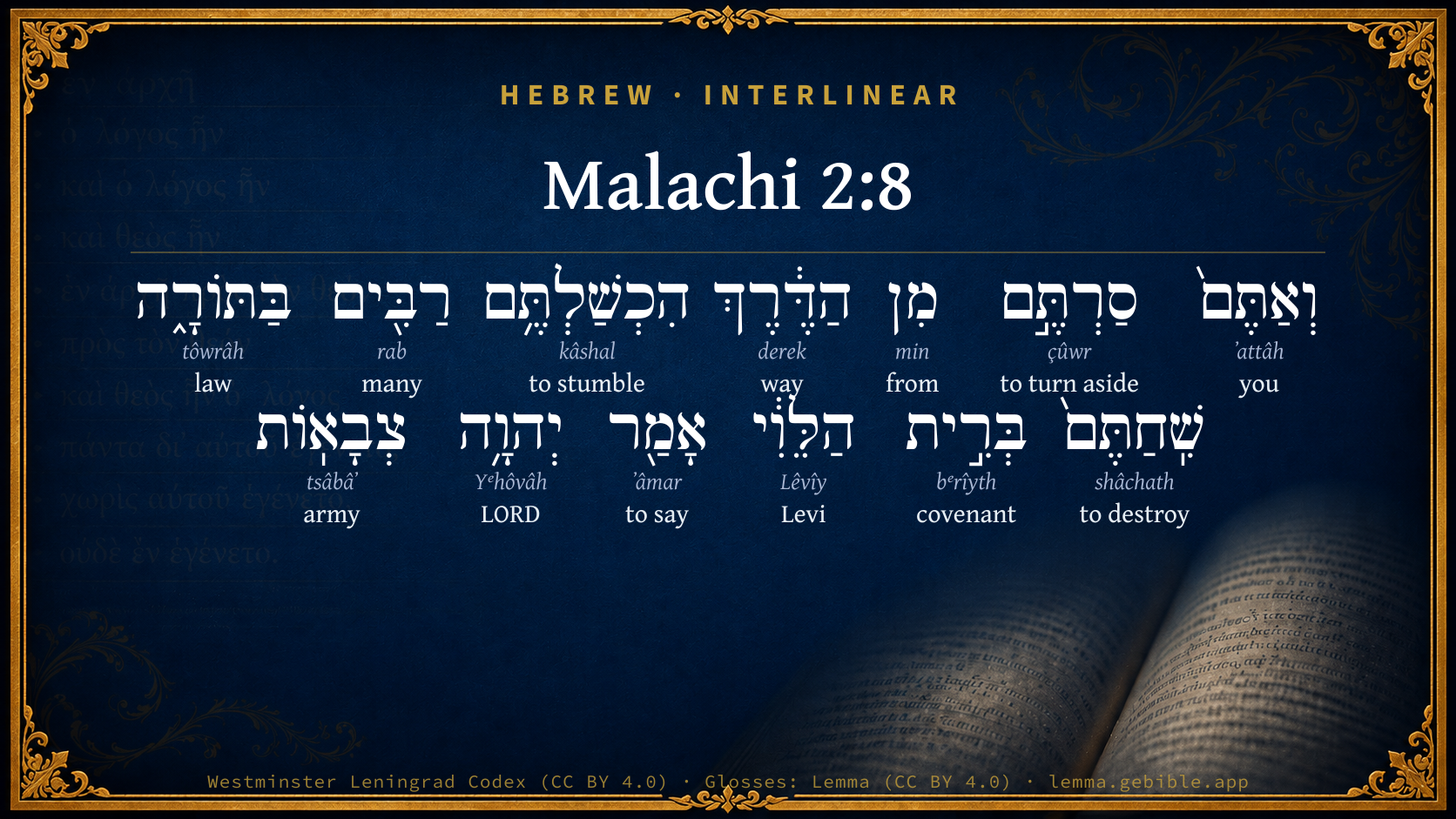
  1. וְאַתֶּם֙ ʼattâh H859 “and · you” Conjunction + Pronoun, Personal, 2nd Person, Masculine, Plural
  2. סַרְתֶּ֣ם çûwr H5493 “to turn aside” Verb, Qal, Perfect, 2nd Person, Masculine, Plural
  3. מִן min H4480 “from” Preposition
  4. הַדֶּ֔רֶךְ derek H1870 “the · way” Particle, Definite Article + Noun, Common, Both, Singular, Absolute
  5. הִכְשַׁלְתֶּ֥ם kâshal H3782 “to stumble” Verb, Hiphil, Perfect, 2nd Person, Masculine, Plural
  6. רַבִּ֖ים rab H7227 “many” Adjective, Adjective, Masculine, Plural, Absolute
  7. בַּתּוֹרָ֑ה tôwrâh H8451 “in/at the · law” Preposition, Determined + Noun, Common, Feminine, Singular, Absolute
  8. שִֽׁחַתֶּם֙ shâchath H7843 “to destroy” Verb, Piel, Perfect, 2nd Person, Masculine, Plural
  9. בְּרִ֣ית bᵉrîyth H1285 “covenant of” Noun, Common, Feminine, Singular, Construct
  10. אָמַ֖ר ʼâmar H559 “to say” Verb, Qal, Perfect, 3rd Person, Masculine, Singular
  11. יְהוָ֥ה Yᵉhôvâh H3068 “LORD” Noun, Proper
  12. צְבָאֽוֹת tsâbâʼ H6635 “armies” Noun, Common, Both, Plural, Absolute

About this verse

These counts appear in no published source. They are computed here, from the morphology-tagged text and Lemma’s own curated glosses. What Lemma adds →

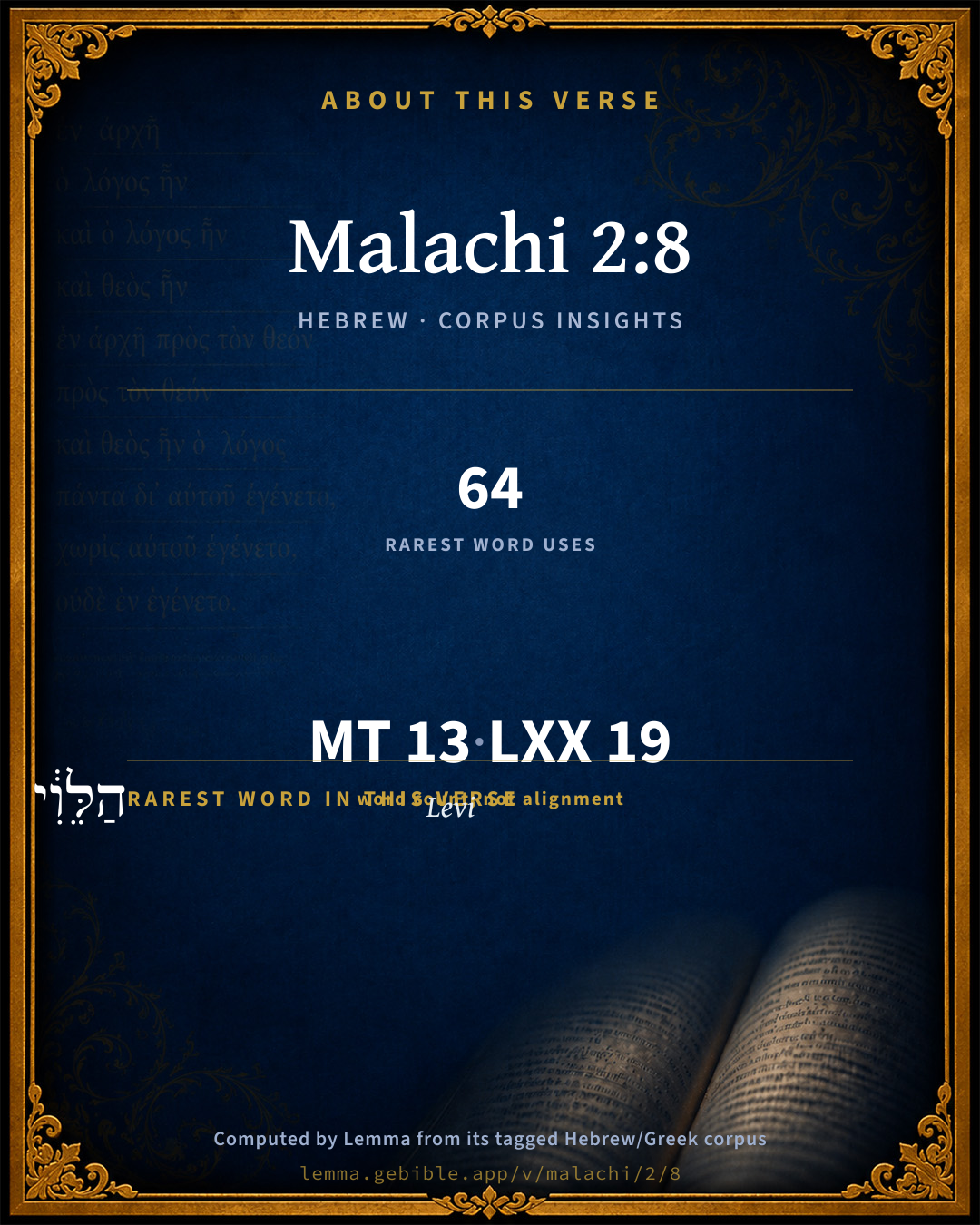
13
words
13
distinct lemmas
Prophets
section

Grammatical profile

  • 4 verbs
  • 6 nouns
  • 1 adjective
  • 1 pronoun
  • 1 preposition

Verb forms

  • סַרְתֶּ֣ם Qal · Perfect
  • הִכְשַׁלְתֶּ֥ם Hiphil · Perfect
  • שִֽׁחַתֶּם֙ Piel · Perfect
  • אָמַ֖ר Qal · Perfect

Hebrew & Septuagint length

In English translation the verse runs 29 words from the Hebrew and 28 from the Septuagint (LXX English) — closely comparable.

A rough comparison of the two English renderings, which tokenize alike — not a word-level alignment.

Word counts can differ between the Hebrew and the Greek without any difference in meaning — e.g. the Hebrew direct-object marker אֵת has no separate Greek word, and Greek often adds the article ὁ.

In the original languages it is 13 Hebrew tokens and 19 Greek tokens — but the two are counted differently (Hebrew bundles its prefixes and suffixes into one token; the Greek is in lemma form), so that isn’t a like-for-like length.

Cross-references

23

Topical passages linked to Malachi 2:8 in the Treasury of Scripture Knowledge — connected by theme and wording, ordered by reader-vote popularity; previews shown in the World English Bible.

  • Nehemiah 13:29 Remember them, my God, because they have defiled the priesthood, and the covenant of the priesthood, and of the Levites.
  • Jeremiah 17:5 Thus says Yahweh: Cursed is the man who trusts in man, and makes flesh his arm, and whose heart departs from Yahweh.
  • Jeremiah 18:15 For my people have forgotten me, they have burned incense to false [gods]; and they have been made to stumble in their ways, in the ancient paths, to walk in byways, in a way not built up;
  • 1 Samuel 2:17 The sin of the young men was very great before Yahweh; for the men despised the offering of Yahweh.
  • Isaiah 30:11 get out of the way, turn aside out of the path, cause the Holy One of Israel to cease from before us."
  • Ezekiel 44:10 But the Levites who went far from me, when Israel went astray, who went astray from me after their idols, they shall bear their iniquity.
  • Malachi 2:5 "My covenant was with him of life and peace; and I gave them to him who he might be reverent toward me; and he was reverent toward me, and stood in awe of my name.
  • Leviticus 21:15 He shall not profane his seed among his people: for I am Yahweh who sanctifies him.'"
  • 1 Samuel 2:24 No, my sons; for it is no good report that I hear: you make Yahweh's people to disobey.
  • 1 Samuel 2:30 Therefore Yahweh, the God of Israel, says, I said indeed that your house, and the house of your father, should walk before me forever: but now Yahweh says, Be it far from me; for those who honor me I will honor, and those who despise me shall be lightly esteemed.
  • Psalms 18:21 For I have kept the ways of Yahweh, And have not wickedly departed from my God.
  • Psalms 119:102 I have not turned aside from your ordinances, For you have taught me.
  • Isaiah 9:16 For those who lead this people cause them to err; and those who are led of them are destroyed.
  • Isaiah 59:13 transgressing and denying Yahweh, and turning away from following our God, speaking oppression and revolt, conceiving and uttering from the heart words of falsehood.
  • Jeremiah 23:11–15 for both prophet and priest are profane; yes, in my house have I found their wickedness, says Yahweh.
  • Daniel 9:5–6 we have sinned, and have dealt perversely, and have done wickedly, and have rebelled, even turning aside from your precepts and from your ordinances;
  • Malachi 2:9–10 "Therefore I have also made you contemptible and base before all the people, according to the way you have not kept my ways, but have had respect for persons in the law.
  • Matthew 15:2–5 "Why do your disciples disobey the tradition of the elders? For they don't wash their hands when they eat bread."
  • Luke 11:45–46 One of the lawyers answered him, "Teacher, in saying this you insult us also."
  • Romans 2:19–24 and are confident that you yourself are a guide of the blind, a light to those who are in darkness,
  • Romans 14:21 It is good to not eat meat, drink wine, nor do anything by which your brother stumbles, is offended, or is made weak.
  • Hebrews 3:12 Beware, brothers, lest perhaps there be in any one of you an evil heart of unbelief, in falling away from the living God;
  • Jeremiah 17:13 Yahweh, the hope of Israel, all who forsake you shall be disappointed. Those who depart from me shall be written in the earth, because they have forsaken Yahweh, the spring of living waters.

Cross-references courtesy of OpenBible.info (CC BY 4.0).

Hebrew and Greek witnesses Masoretic Hebrew ↔ Greek Septuagint

The same verse in the two great witnesses to the Old Testament, shown verse-for-verse.

These are two independent witnesses, not word-aligned to each other, and the Septuagint is shown in lemma (dictionary) form.

Hebrew Malachi 2:8 Masoretic · Westminster Leningrad Codex

וְאַתֶּם֙ סַרְתֶּ֣ם מִן הַדֶּ֔רֶךְ הִכְשַׁלְתֶּ֥ם רַבִּ֖ים בַּתּוֹרָ֑ה שִֽׁחַתֶּם֙ בְּרִ֣ית הַלֵּוִ֔י אָמַ֖ר יְהוָ֥ה צְבָאֽוֹת

But you have turned aside out of the way. You have caused many to stumble in the law. You have corrupted the covenant of Levi," says Yahweh of Hosts.

World English Bible · Public Domain

Greek LXX Malachi 2:8 Septuagint · lemma form

σύ δέ ἐκκλίνω ἐκ ὁ ὁδός καί πολύς ἀσθενέω ἐν νόμος διαφθείρω ὁ διαθήκη ὁ λευί λέγω κύριος παντοκράτωρ

But you⌃ have turned aside from the way, and caused many to fail in following the law: you⌃ have corrupted the covenant of Levi, says the Lord Almighty.

LXX2012 (modern English Septuagint) · Public Domain

On this verse, The Pulpit Commentary discusses the Septuagint’s reading. Read the note in Commentary ↓

Hebrew: Westminster Leningrad Codex (CC BY 4.0). Greek: Septuagint (public domain); English from LXX2012 (modern English Septuagint) (Public Domain). How the Septuagint differs from the Hebrew →

Targum (Aramaic paraphrase)

1

The Targum is the ancient Jewish Aramaic paraphrase of the Hebrew Scriptures — an interpretive translation, not the Hebrew text itself. Onkelos (literal) and Pseudo-Jonathan (expansive) render the Torah, and Jonathan the Prophets. Coverage is partial: where no permissively-licensed English translation exists for a verse, only the Aramaic is shown. This is verse-level text, not a word-by-word alignment to the Hebrew.

  1. Targum Jonathan Prophets (Joshua–Malachi)
    וְאַתּוּן סְטִיתוּן מִן אוֹרְחָא אַתְקַלְתּוּן סַגִיאִין בְּאוֹרַיְתָא חַבַּלְתּוּן קְיָמָא דְעִם לֵוִי אֲמַר יְיָ צְבָאוֹת:

    (no public-domain English translation for this verse)

    Targum Jonathan — Aramaic: “Mikraot Gedolot” (public domain). English: “Sefaria Community Translation” (CC0 1.0 (public-domain dedication)); “London "Chaldee Paraphrase," 1871” (public domain). Text via Sefaria.

Commentary

Notes on Malachi 2:8 from classic Christian and Jewish commentators (each source and its license shown beneath its notes). The classic Christian expositions comment on the surrounding passage and are grouped to its opening verse, so a note may address several verses; the Jewish commentaries on the Tanakh (Rashi and others) are per-verse, so they appear only where the commentator wrote on this verse.

Lemma curates 59 commentaries, every one of them public domain or Creative Commons licensed, each selected and text-cleaned for this edition rather than reprinted as found. About our sources →

Trapp's Complete Commentary

John Trapp

Mal 2:8 But ye are departed out of the way; ye have caused many to stumble at the law; ye have corrupted the covenant of Levi, saith the LORD of hosts.

Ver. 8. But ye are departed out of the way] Heb. From that way, viz. that good old way of your progenitors: you are nothing like Levi, but are woefully degenerated from the practice of your predecessors, and have swerved from your fathers’ footsteps, though ye have the same place, and enjoy the same privileges. This is a foul fault, and condemned even by the heathen sages. Seneca tells us, with indignation, that Socrates’ sons were more like their mother, a froward woman, than their father, the wisest of men; according to that saying, Partus sequitur ventrem, the birth follows the belly. Young Cicero was, for his intemperance and excess in drinking, surnamed Tricongius. Caligula, that monster, was the son of noble Germanicus ( Heroum filii noxae). But we have Scriptural instances not a few. Not to speak of Eli’s sons, and of Samuel’s, Solomon degenerates from his father David, who had carefully taught him better, Pro 4:4, and so had his mother, Pro 31:1 (which one calls Bathsheba’s catechism; another Lemuel’s lesson). Jehoram is taxed for his not walking in the ways of his father Jehoshaphat and his grandfather Asa, as if there had been no intervention of a Hezekiah. "Jonathan, the son of Gershom, the son of Manasseh," that idolatrous priest, mentioned Jdg 18:30, is thought to have been the grandson of Moses; so the Hebrews tell us; and that therefore the Nun in Manasseh is suspended above the rest of the letters. {Hebrew Text Note} Certain it is that Nabal, the fool, was of the line of faithful Caleb, 1Sa 25:3, to teach us that virtue is not, as lands, inheritable. All that is traduced with the seed is either evil, or not good. Grace is by gift, and not by descent. Hence that prayer of David’s courtiers, 1Ki 1:47, God make the name of Solomon better than thy name. Agreeable whereunto is Hector’s prayer in Homer, for his son - πατρος δ ογε πολλον αμεινων, I wish he may be a better man than his father. And that of Juvenal,

“ Male pater tibi sit Thersites, dummodo tu sis

Aeacidae similis, Vulcaniaque arma capessas,

Quam te Thersitae similem producat Achilles. ”

Ye have caused many to stumble at the law] Which is a very dangerous thing; like as it is to stumble on a bridge. A bridge is made to give us a safe passage over a dangerous river; but he who stumbles on the bridge is in no small danger to fall into the river. The word is given as a means to carry us over hell unto heaven; but he who stumbles at this means (as by snuffing at it, Mal 1:13, chatting against it and contesting with it, as often in this prophecy, casting reproaches upon it, Jer 20:8-9, gathering odious consequences from it, Rom 3:8-18) shall fall in thither, from whence otherwise he had been delivered by it. This mischief many fell into, in Malachi’s days, by the means of those ungodly priests, who either taught them not better, or otherwise drew them into sinful courses by their corrupt losses or lewd practices. Evil examples of ministers have a strong influence upon their people; and the sins of teachers are the teachers of sins: The leaders of this people have made them to err, Isa 9:16. Corruption commonly (as in a fish) begins at the head; neque solum obsunt principes, quod illi ipsi corrumpuntur, sed etiam quod corrumpunt: plusquam exemplo quam peccato nocent, saith Cicero: they that are in office do a great deal of mischief by encouraging others in evil, through their evil example. Jupiter’s adulteries drew the people to like wantonness. Magis intuentur quid fecerit Iupiter quam quid docuit Plato, saith Austin; They look more what Jupiter did than what Plato taught. I have read of a woman who, living in professed doubt of the Godhead, after better illumination and repentance, did ofton protest that the vicious life of a great scholar in that town did conjure up those damnable doubts in her soul. In the time of Pope Clement V the Church was so ill-governed, and things so corruptly carried at the court of Rome, that Frederick, King of Sicily, doubted much of the truth of the Christian religion; but was confirmed, and his mind better settled, by Arnoldus de Villa Nova, who showed him that "Offences must come, but woe be to them by whom they come." A scandalous priest is a singular mischief; for he falls not alone, but (as when a main stone in a building or a tall cedar falls) he draws many with him into fellowship of errors and enormities; as did Hymenaeus and Philetus, 2Ti 2:17-18; and as the dragon, with his long and strong tail, drew the third part of the stars of heaven, and threw them to the earth, Rev 13:4. When the pastors become brutish all the flocks are scattered, Jer 10:21.

Ye have corrupted the covenant of Levi] The covenant on God’s part with Levi was a covenant of salt, and could not be corrupted, Num 18:19, non computrescit vetustate, saith Flaccius, it putrefieth not with age or long standing; as that pillar of salt into which Lot’s wife was turned, and of which Josephus saith, that something of it was to be seen till his time. But these degenerate priests had abandoned God’s holy fear, they did not humble themselves and tremble before his name, as Levi their father had done, Mal 2:5; they had falsified with God, and so forfeited his favour. It was with them, as Cajetan complains and confesses of the Popish priests; that whereas by their places they should have been the salt of the earth, they had lost their savour, and were good for little else but looking after the rights and revenues of the Church; therefore God held himself disobliged, and resolved that they should bear the iniquity of their priesthood; Lev 19:8. that is, the punishment of their iniquity notwithstanding the priesthood. That should be no protection to them, but an aggravation; because they fell, as if they had not been anointed: and were, therefore, the worse, because they should have been better, Ideo deteriores sumus quia meliores esse debemus (Salvian.). God holds himself not bound to perform covenant with those who break with him; for why should he give the children’s bread to dogs? why should he cast away his favours upon those that value them not? We have the covenant, the seals, the ministry (and this is a singular happiness: Isa 19:25, Assyria is the work of God’s hands, but Israel his inheritance). But, alas, are not these blessings among us as the ark was among the Philistines, rather as prisoners than as privileges? rather in testimonium et ruinam quam in salutem for a testimony against us, and for our further ruin, than for our safety here and salvation here after? Oh consider how God hath cast off the Israelites, notwithstanding his covenant with their fathers; and when in their necessity they would have forced acquaintance with him, he would not look upon them, Jdg 10:14. The sword hath broken in pieces those seven golden candlesticks in Asia, merely for their covenantbreaking. {See Trapp on "Mal 2:5"}

John Trapp, A Commentary or Exposition upon All the Books of the Old and New Testament (1647–1656) — public domain. Text from a community e-Sword module.

Keil & Delitzsch

C. F. Keil & F. Delitzsch

Mal 2:8. "But ye have departed from the way, have made many to stumble at the law, have corrupted the covenant of Levi, saith Jehovah of hosts. Mal 2:9. Thus I also make you despised and base with all the people, inasmuch as ye do not keep my ways, and respect person in the law." הדּרך is the way depicted in Mal 2:6 and Mal 2:7, in which the priests ought to have walked. הכשׁלתּם בּתּורה does not mean "ye have caused to fall by instruction" (Koehler); for, in the first place, hattōrâh (with the article) is not the instruction or teaching of the priests, but the law of God; and secondly, ב with כּשׁל denotes the object against which a man stumbles and which causes him to fall. Hitzig has given the correct explanation: ye have made the law to many a מכשׁול, instead of the light of their way, through your example and through false teaching, as though the law allowed or commanded things which in reality are sin. In this way they have corrupted or overthrown the covenant with Levi. הלּוי, with the article, is not the patriarch Levi, but his posterity, really the priesthood, as the kernel of the Levites. Hence Jehovah also is no longer bound by the covenant, but withdraws from the priests what He granted to the Levi who was faithful to the covenant, viz., life and salvation (Mal 2:5), and makes them contemptible and base with all the people. This is simply a just retribution for the fact, that the priests depart from His ways and have respect to men. Battōrâh, in the law, i.e., in the administration of the law, they act with partiality. For the fact itself compare Mic 3:11.

Keil & Delitzsch — Biblical Commentary on the Old Testament (1861–1891) — public domain (CC PDM 1.0). Text via the HelloAO Bible API. (Old Testament only.)

Jamieson, Fausset & Brown

Robert Jamieson, A. R. Fausset & David Brown

out of the way--that is, from the covenant.

caused many to stumble--By scandalous example, the worse inasmuch as the people look up to you as ministers of religion (Sa1 2:17; Jer 18:15; Mat 18:6; Luk 17:1).

at the law--that is, in respect to the observances of the law.

corrupted . . . covenant--made it of none effect, by not fulfilling its conditions, and so forfeiting its promises (Zac 11:10; Neh 13:29).

Jamieson, Fausset & Brown — Commentary Critical and Explanatory on the Whole Bible (1871) — public domain (CC PDM 1.0). Text via the HelloAO Bible API.

Adam Clarke's Commentary

Verse 8. But ye are departed out of the way] Ye are become impure yourselves, and ye have led others into iniquity.

Adam Clarke's Commentary on the Bible (1810–1826) — public domain. Text from a community e-Sword/MySword module.

John Calvin's Commentaries

He shows here how far were the priests of his time from fulfilling that compact which he had mentioned. He hence concludes that they were unworthy of the honor of which they were so confidently proud, and under the shadow of which they sought to cover their vices, as though they were not bound to God, and were at liberty to tread the Church under foot with impunity. He then shows that it was an extremely foolish arrogance in them to seek to be exempt from all law, and yet to regard God and the whole Church bound to them.

He says first, that they deviated from the way, that is, they exhibited nothing suitable to their office, on account of which they were counted priests. He then amplifies their guilt — that they made many to stumble in the law He had before said that Levi walked in peace and uprightness; what he now says is very different — that the priests, forgetting religion, had first shaken off the yoke. He had said that Levi restored many from iniquity; but he now says that the priests made many to stumble.

He adds in the last place — Ye have therefore corrupted the covenant. An illative is to be put here, for so ought the sentence to be explained — “As ye have deviated from the way, and perverted the whole worship of God, ye have thus violated the compact which had been sanctioned with Levi; ye have then no reason to boast of your title of honor, for succession failed when ye fell away from the faithfulness of your father Levi.” At length it follows —

John Calvin's Commentaries (1540-1563) — public domain. Text from the Calvin Translation Society English edition (1840s-50s) via the Christian Classics Ethereal Library (ccel.org). Calvin's coverage is partial (roughly two-thirds of the Bible); uncommented books and verses are honest gaps, never fabricated. The 19th-century editor's footnotes and remarks are omitted so the notes are faithfully Calvin's own voice.

Ellicott's Commentary for English Readers

(8) But ye.—Priests of the present day have done in every respect the reverse.

Caused many to stumble at the law.—Or rather, in the Law; and ye have given them false instruction in the Law, and allowed those things which were forbidden, and so ye have corrupted the covenant of the (tribe of) Levi: ye have turned the Law, which ought to have been a light to their feet and a lamp to their path, into a stumbling-block.

A Bible Commentary for English Readers, edited by Charles John Ellicott (1878–1897) — public domain. Text from a community e-Sword module.

The Cambridge Bible for Schools and Colleges

gen. ed. J. J. S. Perowne

8. at the law] This rendering is quite defensible (Lev_26:37; Nah_3:3); and the idea of the Law itself being made the stumbling-block of the people, by the tortuous interpretations put upon it by the priests and by their inconsistent conduct, is forcible, and is in keeping with the representation of Christ Himself as a “stumbling-stone” (Isa_8:14; Rom_9:32-33). As however the figure of the Law as a road or path in which men should walk smoothly and safely is of very constant occurrence in the Old Testament, it is possible to render “in the law”, with R.V. and A.V. margin.

corrupted the covenant of Levi] Compare Nehemiah’s complaint, and the example he gives, Neh_13:28-29.

The Cambridge Bible for Schools and Colleges (gen. ed. J. J. S. Perowne; Cambridge University Press, 1878–1918) — public domain. Text from a community e-Sword module.

John Gill's Exposition

But ye are departed out of the way,.... Of truth and righteousness, of life and peace, of eternal salvation and happiness, pointed to by Christ and his forerunner, and by his apostles and ministers that followed him, and which was clearly showed in the preaching of the Gospel: this was the character of the chief priests, Scribes, and Pharisees, in Christ's time, to which the prophet seems to have respect; who not only failed in their observance of legal sacrifices, complained of in the former chapter Mal 1:1, but left that way of atonement and salvation they directed to, and led others out of the way with them:

ye have caused many to stumble at the law; at the doctrine of justification by the righteousness of Christ; which was the stumbling stone they fell at, seeking for righteousness, and directing others to seek for it, not by faith, but as it were by the works of the law, Rom 9:32,

ye have corrupted the covenant of Levi, saith the Lord of hosts: that which was foreshadowed by the Levitical priesthood and covenant, namely, the covenant of grace, dispensed under the Gospel dispensation by the ministry of the word and ordinances; which they rejected, despised, and set at nought, and as much as in them lay endeavoured to make void, by not attending to these things, nor suffering others, but doing all they could to bring them into disuse, contempt, and disgrace.

John Gill's Exposition of the Whole Bible (1746–1763) — public domain (CC PDM 1.0). Text via the HelloAO Bible API.

Albert Barnes' Notes on the Bible

But ye - o are departed out of the way “of knowledge, truth, equity, fear of God, which I appointed to Aaron and the Levites.” “Ye have caused many to stumble at the law.” He does not simply say, “in the law,” but “at” it. The law was what they stumbled at. They did not only misunderstand the law, through the false teaching of the priests, as though it allowed things which in truth were sins (although this too); itself was their source of stumbling. As Jesus Himself was “a rock of offence” whereon they stumbled, because through His divine holiness He was not what they expected Him to be, so contrariwise the law became an offence to them through the unholiness and inconsistency of the lives and ways of those who taught it; much as we now hear Christianity spoken against, because of the inconsistency of Christians. So Paul saith to the Jews Rom 2:24, “The name of God is blasphemed among the Gentiles through you, as it is written;” and, for the sins of Eli’s sons (1Sa 2:17, Pococke) “men abhorred the offering of the Lord.”

And have corrupted the covenant of Levi - as it is said in Nehemiah, Neh 13:29, “They have defiled the priesthood, and the covenant of the priesthood and of Levi, that covenant which was life and peace” Mal 2:5, and, therefore, forfeited them.

Albert Barnes' Notes on the Bible (1834–1885) — public domain. Text from a community e-Sword/MySword module.

Matthew Poole's English Annotations

But ye, priests that now are in office, now live, when I, Malachi, am sent to preach, are departed, have shamefully degenerated and turned away from your duty, are apostates,

out of the way of God’s law, and of those holy priests your predecessors; out of the way of truth, holiness, peace, and equity.

Ye have caused many to stumble at the law; your expositions of the law, your manner of worshipping God, and your manner of living, all together were great scandals to very many; and too many of these, that were offended by these things, these faults of yours, fell to sinning with you.

Ye have corrupted the covenant of Levi, the covenant of priesthood, Neh 13:29, chargeth them with this sin, and therefore they have no reason to expect the blessings of this covenant, viz. life and peace, since their making the covenant void on their part had cut off all claim and right to the blessings promised in that covenant, and had exposed them to the curses God threatened them with.

Matthew Poole's English Annotations on the Holy Bible (1683–1685) — public domain. Text from a community e-Sword/MySword module.

The Pulpit Commentary

But ye are departed out of the way. The priests of this time had far declined from the high ideal set forth in vers. 6, 7, the "way" in which God would have had them to walk. Ye have caused many to stumble at (in ) the law. By their example and teaching they had made the Law a stumbling block, causing many to err, while they fancied they were not infringing God"s commandments. Septuagint, Hsyenhsate polloumw , "Ye made many weak equivalent to hsyenwsate in the Law." Ye have corrupted the covenant of Levi (see ver. 5). They broke their part of the covenant, therefore Jehovah held himself no longer bound by it. They did not pay him due reverence and obedience; he withdrew the blessings promised to Levi, as threatened (ver. 2).

The Pulpit Commentary (1880–1919), ed. H.D.M. Spence-Jones & Joseph S. Exell — public domain. Text from a community e-Sword module.

John Wesley's Explanatory Notes

But ye - Priests. Stumble at the law - By your false expositions of it. Have corrupted - You have violated it, have contradicted the great intentions of it, and done what in you lay, to defeat them.

John Wesley, Explanatory Notes Upon the Whole Bible (1754–1765) — public domain. Text via the GEBible commentary corpus.

unfoldingWord translationNotes

Door43 World Missions Community

you have turned away from the true path

The right way to behave is spoken of as if it were the right path to follow, and abandoning right conduct is spoken of as if it were turning away from that path. (See: Metaphor)

You have caused many to stumble

Disobeying God is spoken of as if it were stumbling. (See: Metaphor)

You have caused many to stumble with respect to the law

The expression "with respect to the law" gives the context for the "stumbling." AT: "You have caused many to disobey the law"

before all the people

This spatial idea stands for the people's awareness of the priests' evil behavior. (See: Metaphor)

kept my ways

Here "ways" stands for "desires" and "behavior." These ways are spoken of as if they were things that could be kept by people. AT: "followed my desires in how you should live" (See: Metaphor)

shown partiality with regard to the instruction

"set easy standards of behavior for people you like and difficult standards of behavior for people you do not like"

shown partiality

Here the habit of favoring some people more than others is spoken of as if it were a thing that could be shown to others. AT: "made people aware that you favor some people more than others (See: Metaphor)

translationWords

stumble

corrupt

law

covenant

Yahweh of hosts

partial

unfoldingWord translationNotes — © Distant Shores Media and the Door43 World Missions Community, licensed CC BY-SA 4.0. Source: git.door43.org/Door43/en_tn.

Lesson kit

Teaching starters — assembled from the data on this page, not authored interpretation. Every prompt links to the verse data it draws on. Edit before teaching.

Malachi, in the Prophets, opens this verse with 13 words (13 distinct Hebrew lemmas). Its most distinctive word is Lêvîy (“Levi”). A historical commentator’s framing appears above. Read the whole chapter for the surrounding context.

Discussion questions

  1. How does “Levi” (Lêvîy) shape what this verse is saying?
  2. How does Nehemiah 13:29, which shares this passage’s theme, read alongside this verse?
  3. The translations on this page render this verse differently — a whole-verse word diff, not a word-by-word alignment. What might account for the different wordings?
  4. «סַרְתֶּ֣ם» is a Qal Perfect verb. How does that grammatical form shape the action described?
  5. Compare how Trapp's Complete Commentary and Keil & Delitzsch read this verse. Where do they agree or differ?

Things to notice

Reading settings

Reading text

Shown beneath each verse's original-language words.

Old Testament
Old Testament edition

Read the OT as the Masoretic Hebrew (MT) or the Greek Septuagint (LXX).

English shown for the Greek Septuagint (in the Hebrew ↔ Greek comparison).

Comparing translations? Open the Compare panel on any verse page to stack up to four side by side.