
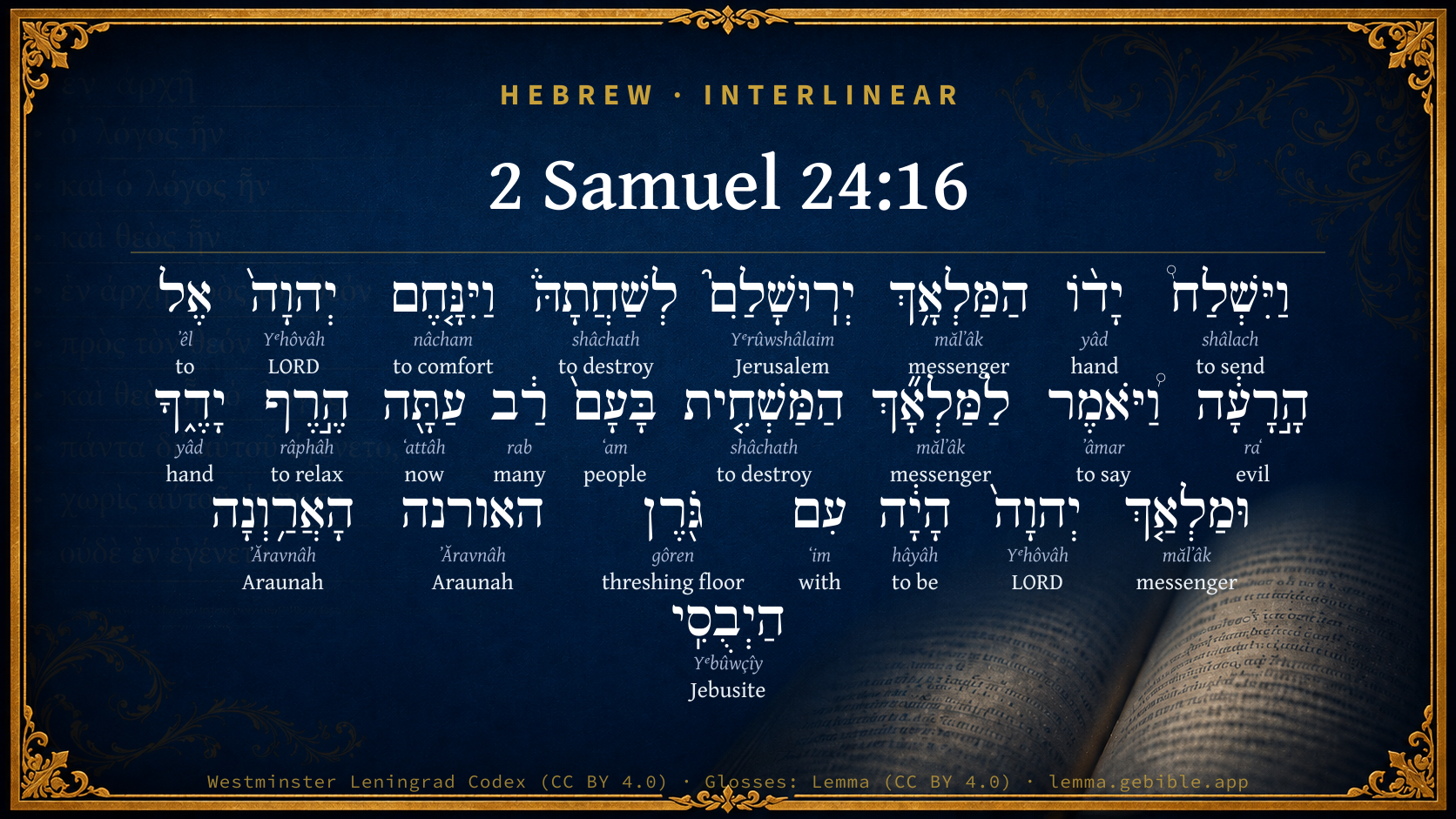
2 Samuel 24:16

Hebrew (Westminster Leningrad Codex) 2 Samuel 24:16 appears in the Hebrew Old Testament. The text above is from the Westminster Leningrad Codex. Each word links to its Strong’s number, a concise gloss, and parsing drawn from the Open Scriptures Hebrew Bible morphology. Click any word for its full Brown-Driver-Briggs (BDB) entry.
Download image
Cite this verse

2 Samuel 24:16 (World English Bible). Public Domain. Lemma interlinear Bible study tool, https://lemma.gebible.app/v/2-samuel/24/16.

Show BibTeX & RIS
BibTeX
RIS
English Translation
When the angel stretched out his hand toward Jerusalem to destroy it, Yahweh repented him of the evil, and said to the angel who destroyed the people, It is enough; now stay your hand. The angel of Yahweh was by the threshing floor of Araunah the Jebusite.
World English Bible · Public Domain
Highlights
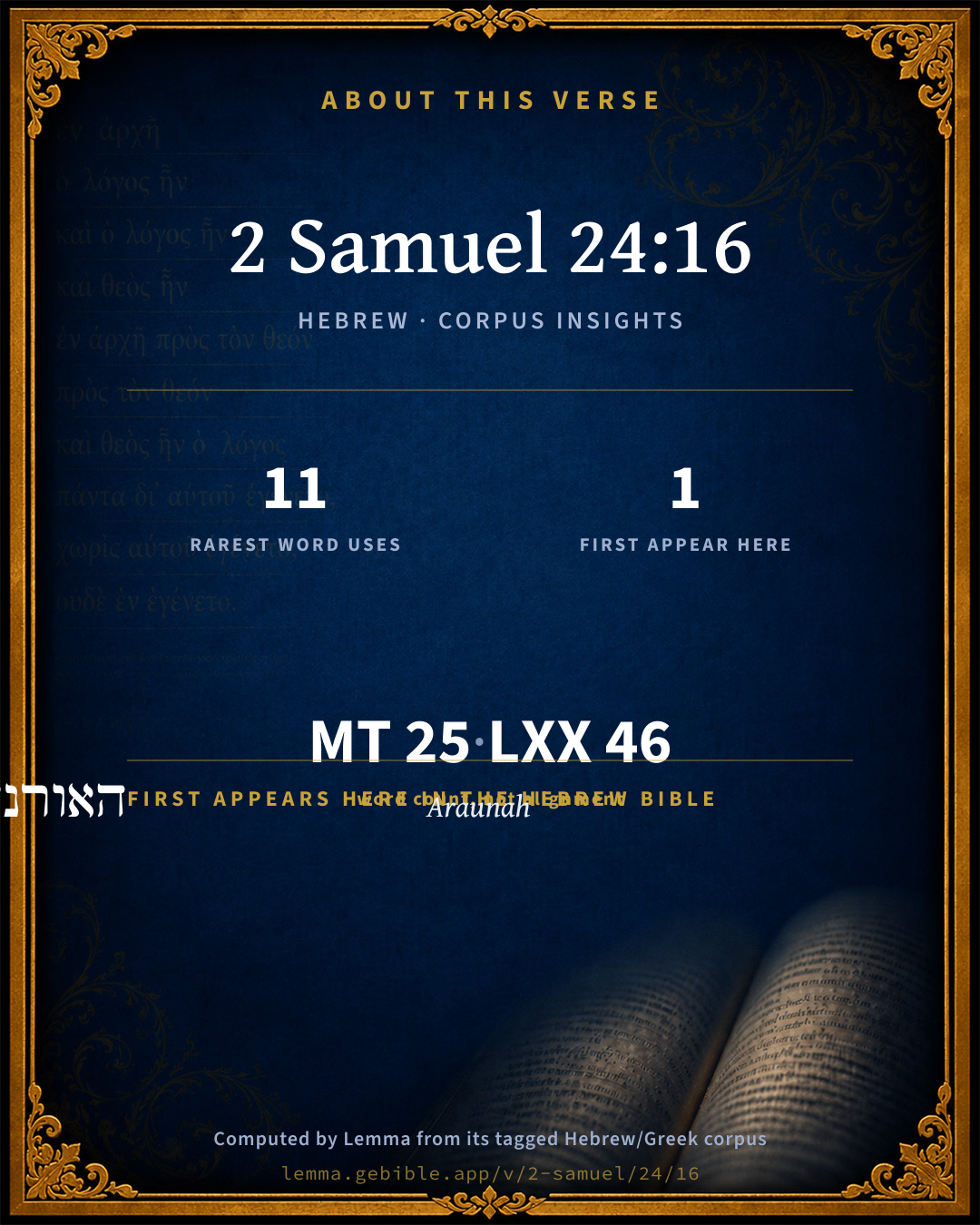
  • 1 first appearance in the Hebrew Bible
Full analysis ↓
Download a study sheet

One document with this verse’s original text, its word-by-word gloss line, the meaning frame, cross-references with their text, attributed commentary, and full source and license credits — printable, and it pastes into notes with its structure intact.

This verse Autodidact and up

Study sheet (.html) Plain text (.txt)

A passage Seminary Student

Up to 50 verses in one chapter. A passage sheet keeps up to 6 commentary sources and 12 cross-references per verse, in the order this page ranks them, and says so on the sheet whenever that leaves anything out. Ask for a single verse and you get the Autodidact verse sheet above.

Everything on this page stays free to read, with no account — the sheet is a download of what is already on screen, not access to it.

Want to remove ads? Support Godless Engineer
Compare translations 3

The same verse in 3 English versions, stacked beneath the original-language interlinear above. Click any original word for its lexicon entry.

Each is an independent rendering of the whole verse — the interlinear is not word-aligned to these translations.

Highlighted words mark where these versions differ — a whole-verse word diff, not a word-by-word alignment.

  • World English Bible Public Domain
    When the angel stretched out his hand toward Jerusalem to destroy it, Yahweh repented him of the evil, and said to the angel who destroyed the people, It is enough; now stay your hand. The angel of Yahweh was by the threshing floor of Araunah the Jebusite.
  • King James Version Public Domain
    And when the angel stretched out his hand upon Jerusalem to destroy it, the LORD repented him of the evil, and said to the angel that destroyed the people, It is enough: stay now thine hand. And the angel of the LORD was by the threshingplace of Araunah the Jebusite.
  • unfoldingWord Literal Text CC BY-SA 4.0
    And the angel stretched out his hand Jerusalem to destroy it, but Yahweh relented concerning the harm. And he said to the angel, the destroyer among the many people, “Now lower your hand.” And the angel of Yahweh was near the threshing floor of Araunah the Jebusite.

unfoldingWord Literal Text — © unfoldingWord, licensed CC BY-SA 4.0. Word-aligned USFM3 via Door43 (git.door43.org/unfoldingWord/en_ult).

Versions to compare (up to 4)

3 of 4 selected

Show all 18 translations

Every available English version of this verse, each an independent rendering of the whole verse.

  • World English Bible Public Domain
    When the angel stretched out his hand toward Jerusalem to destroy it, Yahweh repented him of the evil, and said to the angel who destroyed the people, It is enough; now stay your hand. The angel of Yahweh was by the threshing floor of Araunah the Jebusite.
  • Berean Standard Bible Public Domain
    But when the angel stretched out his hand to destroy Jerusalem, the LORD relented from the calamity and said to the angel who was destroying the people, “Enough! Withdraw your hand now!” At that time the angel of the LORD was by the threshing floor of Araunah the Jebusite.
  • Majority Standard Bible Public Domain
    But when the angel stretched out his hand to destroy Jerusalem, the LORD relented from the calamity and said to the angel who was destroying the people, “Enough! Withdraw your hand now!” At that time the angel of the LORD was by the threshing floor of Araunah the Jebusite.
  • King James Version Public Domain
    And when the angel stretched out his hand upon Jerusalem to destroy it, the LORD repented him of the evil, and said to the angel that destroyed the people, It is enough: stay now thine hand. And the angel of the LORD was by the threshingplace of Araunah the Jebusite.
  • American Standard Version (1901) Public Domain
    And when the angel stretched out his hand toward Jerusalem to destroy it, Jehovah repented him of the evil, and said to the angel that destroyed the people, It is enough; now stay thy hand. And the angel of Jehovah was by the threshing-floor of Araunah the Jebusite.
  • Revised Version (1885) Public Domain
    And when the angel stretched out his hand toward Jerusalem to destroy it, the LORD repented him of the evil, and said to the angel that destroyed the people, It is enough; now stay thine hand. And the angel of the LORD was by the threshing-floor of Araunah the Jebusite.
  • Geneva Bible (1599) Public Domain
    And when the Angel stretched out his hande vpon Ierusalem to destroy it, the Lord repented of the euil, and said to the Angel that destroyed the people, It is sufficient, holde nowe thine hand. And the Angel of the Lord was by the threshing place of Araunah the Iebusite.
  • Douay-Rheims (1899) Public Domain
    And when the angel of the Lord had stretched out his hand over Jerusalem to destroy it, the Lord had pity on the affliction, and said to the angel that slew the people: It is enough: now hold thy hand. And the angel of the Lord was by the thrashingfloor of Areuna the Jebusite.
  • Young's Literal Translation Public Domain
    and the messenger putteth forth his hand to Jerusalem to destroy it, and Jehovah repenteth concerning the evil, and saith to the messenger who is destroying among the people, `Enough, now, cease thy hand;' and the messenger of Jehovah was near the threshing-floor of Araunah the Jebusite.
  • Literal Standard Version CC BY-SA 4.0
    and the messenger puts forth his hand to Jerusalem to destroy it, and YHWH sighs concerning the calamity, and says to the messenger who is destroying among the people, “Enough, now, cease your hand”; and the messenger of YHWH was near the threshing-floor of Araunah the Jebusite.
  • Unlocked Literal Bible CC BY-SA 4.0
    When the angel reached out with his hand toward Jerusalem to destroy it, Yahweh changed his mind because of the harm it would cause, and he said to the angel who was destroying people, “Enough! Now draw back your hand.” At that time the angel of Yahweh was standing at the threshing floor of Araunah the Jebusite.
  • unfoldingWord Literal Text CC BY-SA 4.0
    And the angel stretched out his hand Jerusalem to destroy it, but Yahweh relented concerning the harm. And he said to the angel, the destroyer among the many people, “Now lower your hand.” And the angel of Yahweh was near the threshing floor of Araunah the Jebusite.
  • Darby Bible Public Domain
    And the angel stretched out his hand upon Jerusalem to destroy it; but Jehovah repented him of the evil, and said to the angel that destroyed among the people, It is enough: withdraw now thine hand. And the angel of Jehovah was by the threshing-floor of Araunah the Jebusite.
  • World Messianic Bible Public Domain
    When the angel stretched out his hand toward Jerusalem to destroy it, the LORD relented of the disaster, and said to the angel who destroyed the people, “It is enough. Now withdraw your hand.” The LORD’s angel was by the threshing floor of Araunah the Jebusite.
  • Webster's Bible Public Domain
    And when the angel stretched out his hand upon Jerusalem to destroy it, the LORD repented of the evil, and said to the angel that destroyed the people, It is enough: stay now thy hand. And the angel of the LORD was by the threshing-place of Araunah the Jebusite.
  • Free Bible Version CC BY-SA 4.0
    But just as the angel was getting ready to destroy Jerusalem, the Lord relented from causing such a disaster and told the destroying angel, “That's enough. You can stop now.” Right then the angel of the Lord was standing beside the threshing floor of Araunah the Jebusite.
  • Bible in Basic English Public Domain
    And when the hand of the angel was stretched out in the direction of Jerusalem, for its destruction, the Lord had regret for the evil, and said to the angel who was sending destruction on the people, It is enough; do no more. And the angel of the Lord was by the grain-floor of Araunah the Jebusite.
  • JPS Tanakh (1917) Public Domain
    And when the angel stretched out his hand toward Jerusalem to destroy it, the LORD repented Him of the evil, and said to the angel that destroyed the people: 'It is enough; now stay thy hand.' And the angel of the LORD was by the threshing-floor of Araunah the Jebusite.

Literal Standard Version (2020), Covenant Press — licensed CC BY-SA 4.0. Text via the HelloAO Bible API (eBible.org). Unlocked Literal Bible (unfoldingWord) — licensed CC BY-SA 4.0. Text via the HelloAO Bible API (eBible.org). unfoldingWord Literal Text — © unfoldingWord, licensed CC BY-SA 4.0. Word-aligned USFM3 via Door43 (git.door43.org/unfoldingWord/en_ult). Free Bible Version, Dr. Jonathan Gallagher — licensed CC BY-SA 4.0. Text via the HelloAO Bible API (eBible.org).

Word by word

More ways to search: Search by grammar → Find every occurrence → Compare this word →

Practice this passage: Drill this verse → Learn its vocabulary →

האורנה
ʼĂravnâh
H728
“the · Araunah”
Particle, Definite Article + Noun, Proper
Part of Speech
Particle + Noun
Type
Proper
Full BDB Definition

Origin: all by orthographical variation for H771

TWOT: None

= "joyful shouting of Jah ( 2Sa 24:18 )" = "make ye to shine ( 2Sa 24:16 )" = "joyful shouting of Jah ( 2Sa 24:18 )" - a Jebusite who sold David the site for an altar
  1. וַיִּשְׁלַח֩ shâlach H7971 “and · to send” Conjunction + Verb, Qal, Sequential Imperfect, 3rd Person, Masculine, Singular
  2. יָד֨וֹ yâd H3027 “hand · his” Noun, Common, Both, Singular, Construct + Suffix, Personal, 3rd Person, Masculine, Singular
  3. הַמַּלְאָ֥ךְ mălʼâk H4397 “the · messenger” Particle, Definite Article + Noun, Common, Masculine, Singular, Absolute
  4. יְרֽוּשָׁלִַם֮ Yᵉrûwshâlaim H3389 “Jerusalem” Noun, Proper
  5. לְשַׁחֲתָהּ֒ shâchath H7843 “to destroy · her” Preposition + Verb, Piel, Infinitive Construct + Suffix, Personal, 3rd Person, Feminine, Singular
  6. וַיִּנָּ֤חֶם nâcham H5162 “and · to comfort” Conjunction + Verb, Niphal, Sequential Imperfect, 3rd Person, Masculine, Singular
  7. יְהוָה֙ Yᵉhôvâh H3068 “LORD” Noun, Proper
  8. אֶל ʼêl H413 “to” Preposition
  9. הָ֣רָעָ֔ה raʻ H7451 “the · evil” Particle, Definite Article + Noun, Common, Feminine, Singular, Absolute
  10. וַ֠יֹּאמֶר ʼâmar H559 “and · to say” Conjunction + Verb, Qal, Sequential Imperfect, 3rd Person, Masculine, Singular
  11. לַמַּלְאָ֞ךְ mălʼâk H4397 “to/for the · messenger” Preposition, Determined + Noun, Common, Masculine, Singular, Absolute
  12. הַמַּשְׁחִ֤ית shâchath H7843 “the · destroying” Particle, Definite Article + Verb, Hiphil, Participle Active, Masculine, Singular, Absolute
  13. בָּעָם֙ ʻam H5971 “in/at the · people” Preposition, Determined + Noun, Common, Masculine, Singular, Absolute
  14. רַ֔ב rab H7227 “many” Adjective, Adjective, Masculine, Singular, Absolute
  15. עַתָּ֖ה ʻattâh H6258 “now” Adverb
  16. הֶ֣רֶף râphâh H7503 “relax” Verb, Hiphil, Imperative, 2nd Person, Masculine, Singular
  17. יָדֶ֑ךָ yâd H3027 “hand · your” Noun, Common, Both, Singular, Construct + Suffix, Personal, 2nd Person, Masculine, Singular
  18. וּמַלְאַ֤ךְ mălʼâk H4397 “and · messenger of” Conjunction + Noun, Common, Masculine, Singular, Construct
  19. יְהוָה֙ Yᵉhôvâh H3068 “LORD” Noun, Proper
  20. הָיָ֔ה hâyâh H1961 “to be” Verb, Qal, Perfect, 3rd Person, Masculine, Singular
  21. עִם ʻim H5973 “with” Preposition
  22. גֹּ֖רֶן gôren H1637 “threshing floor of” Noun, Common, Both, Singular, Construct
  23. הָאֲרַ֥וְנָה ʼĂravnâh H728 “the · Araunah” Particle, Definite Article + Noun, Proper
  24. הַיְבֻסִֽי Yᵉbûwçîy H2983 “the · Jebusite” Particle, Definite Article + Noun, Gentilic, Masculine, Singular, Absolute

About this verse

These counts appear in no published source. They are computed here, from the morphology-tagged text and Lemma’s own curated glosses. What Lemma adds →

25
words
19
distinct lemmas
Historical
section

Notable vocabulary

The rarest word here is האורנה Araunah H728 — appearing just 11 times in the whole Hebrew Bible.

First appearance in Scripture

This word makes its first canonical appearance in the Hebrew Bible here:

  • האורנה Araunah H728

Shared distinctive vocabulary

האורנה Araunah H728 occurs in 7 verses of the Hebrew Bible. Also found in:

Grammatical profile

  • 7 verbs
  • 14 nouns
  • 1 adjective
  • 2 prepositions
  • 1 adverb

Verb forms

  • וַיִּשְׁלַח֩ Qal · Sequential Imperfect
  • לְשַׁחֲתָהּ֒ Piel · Infinitive Construct
  • וַיִּנָּ֤חֶם Niphal · Sequential Imperfect
  • וַ֠יֹּאמֶר Qal · Sequential Imperfect
  • הַמַּשְׁחִ֤ית Hiphil · Participle Active
  • הֶ֣רֶף Hiphil · Imperative
  • הָיָ֔ה Qal · Perfect

Repetition

Words recur within this verse — often emphatic in Hebrew:

  • הַמַּלְאָ֥ךְ messenger H4397 ×3
  • יָד֨וֹ hand H3027 ×2
  • לְשַׁחֲתָהּ֒ to destroy H7843 ×2
  • יְהוָה֙ LORD H3068 ×2
  • האורנה Araunah H728 ×2

Hebrew & Septuagint length

In English translation the verse runs 47 words from the Hebrew and 53 from the Septuagint (LXX English) — closely comparable.

A rough comparison of the two English renderings, which tokenize alike — not a word-level alignment.

Word counts can differ between the Hebrew and the Greek without any difference in meaning — e.g. the Hebrew direct-object marker אֵת has no separate Greek word, and Greek often adds the article ὁ.

In the original languages it is 25 Hebrew tokens and 46 Greek tokens — but the two are counted differently (Hebrew bundles its prefixes and suffixes into one token; the Greek is in lemma form), so that isn’t a like-for-like length.

Cross-references

33

Topical passages linked to 2 Samuel 24:16 in the Treasury of Scripture Knowledge — connected by theme and wording, ordered by reader-vote popularity; previews shown in the World English Bible.

  • Exodus 12:23 For Yahweh will pass through to strike the Egyptians; and when he sees the blood on the lintel, and on the two side-posts, Yahweh will pass over the door, and will not allow the destroyer to come in to your houses to strike you.
  • Joel 2:13–14 Tear your heart, and not your garments, And turn to Yahweh, your God; For he is gracious and merciful, Slow to anger, and abundant in loving kindness, And relents from sending calamity.
  • Genesis 6:6 Yahweh was sorry that he had made man on the earth, and it grieved him in his heart.
  • 2 Kings 19:35 It happened that night, that the angel of Yahweh went forth, and struck in the camp of the Assyrians one hundred eighty-five thousand: and when men arose early in the morning, behold, these were all dead bodies.
  • 2 Chronicles 3:1 Then Solomon began to build the house of Yahweh at Jerusalem on Mount Moriah, where [Yahweh] appeared to David his father, which he made ready in the place that David had appointed, in the threshing floor of Ornan the Jebusite.
  • 1 Samuel 15:11 It repents me that I have set up Saul to be king; for he is turned back from following me, and has not performed my commandments. Samuel was angry; and he cried to Yahweh all night.
  • Acts 12:23 Immediately an angel of the Lord struck him, because he didn't give God the glory, and he was eaten by worms and died.
  • Genesis 10:16 the Jebusite, the Amorite, the Girgashite,
  • Exodus 9:28 Pray to Yahweh; for there has been enough of mighty thunderings and hail. I will let you go, and you shall stay no longer."
  • Exodus 12:13 The blood shall be to you for a token on the houses where you are: and when I see the blood, I will pass over you, and there shall no plague be on you to destroy you, when I strike the land of Egypt.
  • Joshua 15:63 As for the Jebusites, the inhabitants of Jerusalem, the children of Judah couldn't drive them out: but the Jebusites dwell with the children of Judah at Jerusalem to this day.
  • Judges 1:21 The children of Benjamin did not drive out the Jebusites who inhabited Jerusalem; but the Jebusites dwell with the children of Benjamin in Jerusalem to this day.
  • Judges 19:11 When they were by Jebus, the day was far spent; and the servant said to his master, Please come and let us turn aside into this city of the Jebusites, and lodge in it.
  • 2 Samuel 5:8 David said on that day, Whoever strikes the Jebusites, let him get up to the watercourse, and [strike] the lame and the blind, who are hated of David's soul. Therefore they say, There are the blind and the lame; he can't come into the house.
  • 2 Samuel 24:18 Gad came that day to David, and said to him, Go up, rear an altar to Yahweh in the threshing floor of Araunah the Jebusite.
  • 1 Kings 19:4 But he himself went a day's journey into the wilderness, and came and sat down under a juniper tree: and he requested for himself that he might die, and said, It is enough; now, O Yahweh, take away my life; for I am not better than my fathers.
  • 1 Chronicles 21:15–16 God sent an angel to Jerusalem to destroy it: and as he was about to destroy, Yahweh saw, and he repented him of the evil, and said to the destroying angel, It is enough; now stay your hand. The angel of Yahweh was standing by the threshing floor of Ornan the Jebusite.
  • 2 Chronicles 32:21 Yahweh sent an angel, who cut off all the mighty men of valor, and the leaders and captains, in the camp of the king of Assyria. So he returned with shame of face to his own land. When he was come into the house of his god, those who came forth from his own bowels killed him there with the sword.
  • Psalms 35:6 Let their way be dark and slippery, Yahweh's angel pursuing them.
  • Psalms 78:38 But he, being merciful, forgave iniquity, and didn't destroy them. Yes, many times he turned his anger away, And didn't stir up all his wrath.
  • Psalms 90:13 Relent, Yahweh! How long? Have compassion on your servants!
  • Psalms 135:14 For Yahweh will judge his people, And have compassion on his servants.
  • Isaiah 27:8 In measure, when you send them away, you do contend with them; he has removed [them] with his rough blast in the day of the east wind.
  • Isaiah 40:1–2 Comfort you, comfort you my people, says your God.
  • Isaiah 57:16 For I will not contend forever, neither will I be always angry; for the spirit would faint before me, and the souls who I have made.
  • Jeremiah 18:7–10 At what instant I shall speak concerning a nation, and concerning a kingdom, to pluck up and to break down and to destroy it;
  • Amos 7:3 Yahweh relented concerning this. "It shall not be," says Yahweh.
  • Amos 7:6 Yahweh relented concerning this. "This also shall not be," says the Lord Yahweh.
  • Habakkuk 3:2 Yahweh, I have heard of your fame. I stand in awe of your deeds, Yahweh. Renew your work in the midst of the years. In the midst of the years make it known. In wrath, you remember mercy.
  • Zechariah 9:7 I will take away his blood out of his mouth, And his abominations from between his teeth; And he also will be a remnant for our God; And he will be as a chieftain in Judah, And Ekron as a Jebusite.
  • Mark 14:41 He came the third time, and said to them, "Sleep on now, and take your rest. It is enough. The hour has come. Behold, the Son of Man is betrayed into the hands of sinners.
  • Exodus 32:14 Yahweh repented of the evil which he said he would do to his people.
  • 2 Corinthians 2:6 Sufficient to such a one is this punishment which was inflicted by the many;

Cross-references courtesy of OpenBible.info (CC BY 4.0).

Hebrew and Greek witnesses Masoretic Hebrew ↔ Greek Septuagint

The same verse in the two great witnesses to the Old Testament, shown verse-for-verse.

These are two independent witnesses, not word-aligned to each other, and the Septuagint is shown in lemma (dictionary) form.

Hebrew 2 Samuel 24:16 Masoretic · Westminster Leningrad Codex

וַיִּשְׁלַח֩ יָד֨וֹ הַמַּלְאָ֥ךְ יְרֽוּשָׁלִַם֮ לְשַׁחֲתָהּ֒ וַיִּנָּ֤חֶם יְהוָה֙ אֶל הָ֣רָעָ֔ה וַ֠יֹּאמֶר לַמַּלְאָ֞ךְ הַמַּשְׁחִ֤ית בָּעָם֙ רַ֔ב עַתָּ֖ה הֶ֣רֶף יָדֶ֑ךָ וּמַלְאַ֤ךְ יְהוָה֙ הָיָ֔ה עִם גֹּ֖רֶן האורנה הָאֲרַ֥וְנָה הַיְבֻסִֽי

When the angel stretched out his hand toward Jerusalem to destroy it, Yahweh repented him of the evil, and said to the angel who destroyed the people, It is enough; now stay your hand. The angel of Yahweh was by the threshing floor of Araunah the Jebusite.

World English Bible · Public Domain

Greek LXX 2 Samuel 24:16 Septuagint · lemma form

καί ἐκτείνω ὁ ἄγγελος ὁ θεός ὁ χείρ αὐτός εἰς ἰερουσαλήμ ὁ διαφθείρω αὐτός καί παρακαλέω κύριος ἐπί ὁ κακία καί εἶπον ὁ ἄγγελος ὁ διαφθείρω ἐν ὁ λαός πολύς νῦν ἀναἵημι ὁ χείρ σύ καί ὁ ἄγγελος κύριος εἰμί παρά ὁ ἅλων ορνα ὁ ιεβουσαῖος

And the angel of the Lord stretched out his hand against Jerusalem to destroy it, and the Lord repented of the evil, and said to the angel that destroyed the people, It is enough now, withhold your hand. And the angel of the Lord was by the threshing floor of Orna the Jebusite.

LXX2012 (modern English Septuagint) · Public Domain

On this verse, The Pulpit Commentary discusses the Septuagint’s reading. Read the note in Commentary ↓

Hebrew: Westminster Leningrad Codex (CC BY 4.0). Greek: Septuagint (public domain); English from LXX2012 (modern English Septuagint) (Public Domain). How the Septuagint differs from the Hebrew →

Targum (Aramaic paraphrase)

1

The Targum is the ancient Jewish Aramaic paraphrase of the Hebrew Scriptures — an interpretive translation, not the Hebrew text itself. Onkelos (literal) and Pseudo-Jonathan (expansive) render the Torah, and Jonathan the Prophets. Coverage is partial: where no permissively-licensed English translation exists for a verse, only the Aramaic is shown. This is verse-level text, not a word-by-word alignment to the Hebrew.

  1. Targum Jonathan Prophets (Joshua–Malachi)
    וְאוֹשִׁיט יְדֵיהּ מַלְאָכָא לִירוּשְׁלֵם לְחַבָּלוּתָהּ וְתַב יְיָ מִן בִּישְׁתָא וַאֲמַר לְמַלְאָכָא דִמְחַבֵּל בְּעַמָא מִסַת כְּעַן אַגַח יְדָךְ וּמַלְאָכָא דַייָ הֲוָה שָׁרֵי בְּבֵית אִידְרֵי דְאַרְנוֹן יְבוּסָאָה:

    (no public-domain English translation for this verse)

    Targum Jonathan — Aramaic: “Mikraot Gedolot” (public domain). English: “Sefaria Community Translation” (CC0 1.0 (public-domain dedication)); “London "Chaldee Paraphrase," 1871” (public domain). Text via Sefaria.

Commentary

Notes on 2 Samuel 24:16 from classic Christian and Jewish commentators (each source and its license shown beneath its notes). The classic Christian expositions comment on the surrounding passage and are grouped to its opening verse, so a note may address several verses; the Jewish commentaries on the Tanakh (Rashi and others) are per-verse, so they appear only where the commentator wrote on this verse.

Lemma curates 59 commentaries, every one of them public domain or Creative Commons licensed, each selected and text-cleaned for this edition rather than reprinted as found. About our sources →

Adam Clarke's Commentary

Verse 16. The angel stretched out his hand upon Jerusalem] By what means this destruction took place, we know not: it appears that an angel was employed in it, and that this minister of Divine justice actually appeared as an object. of sight; for it is said, 2Sa 24:17, When David saw the angel that smote the people, he said, c. and both Ornan and his four sons saw him and were affrighted, 1Ch 21:20.

The threshing-place of Araunah] These threshing-places, we have already seen, were made in the open air. In the parallel place, 1Ch 21:15; 1Ch 21:20, c., this person is called Ornan. The word that we render Araunah is written in this very chapter אורנה Auarnah, 2Sa 24:16, ארניה Araniah, 2Sa 24:18, ארונה Araunah or Araunah, 2Sa 24:20, and the following: but in every place in 1Ch 21:1-30 where it occurs it is written ארנן Ornan. It is likely he had both names, Araunah and Ornan: but the varieties of spelling in 2 Samuel must arise from the blunders of transcribers.

Adam Clarke's Commentary on the Bible (1810–1826) — public domain. Text from a community e-Sword/MySword module.

The Cambridge Bible for Schools and Colleges

gen. ed. J. J. S. Perowne

16. the angel] Angels are God’s ministers in temporal judgment now, as well as in the final judgment hereafter. Cp. Exo_12:23; Psa_78:49; 2Ki_19:35; Act_12:23; Mat_13:41.

the Lord repented him of the evil] Cp. Exo_32:14; Jer_26:13; Jer_26:19; Jon_3:10. On the one hand Scripture teaches us that “God is not a man that he should repent” (Num_23:19; 1Sa_15:29); on the other hand it does not shrink from saying that God repents (a) when, as here, upon man’s penitence He withdraws or mitigates a punishment: (b) when, upon man’s faithlessness or disobedience, He cancels a promise or revokes a blessing which He had given. God’s repentance does not mean that He who foreknows all things regrets His action, nor is it a sign of mutability. Scripture boldly states the two apparently contradictory truths, and leaves conscience to harmonize them. See notes on 1Sa_15:11; 1Sa_15:29.

the threshingplace of Araunah the Jebusite] The threshingfloor: precisely the same word as in 2Sa_24:18; 2Sa_24:21; 2Sa_24:24. Threshingfloors were constructed on eminences, to catch the wind for winnowing the grain. Araunah’s threshingfloor was on Mount Moriah, the hill to the eastward of Jerusalem, and was the site upon which the Temple was afterwards built (2Ch_3:1). See Additional Note VI. p. 240. This Mount Moriah was identified by Jewish tradition (e.g. Josephus Ant. VII. 13. 4) with the mountain in the land of Moriah which was the scene of the sacrifice of Isaac (Gen_22:2 ff.), but the identification has been questioned. See Sinai and Pal. p. 251.

It has been supposed by some that the sacred rock of the Moslems, which is the highest point of the Temple hill, and is now covered by the Kubbet es Sakhrah or “Dome of the Rock,” marks the actual site of Araunah’s threshing-floor. See Sinai and Pal. p. 178 ff.

Araunah] The name is variously spelt Aravnah (2Sa_24:16 Qrî), Avarnah (2Sa_24:16 Kthîbh), Aranyah (2Sa_24:18 Kthîbh); in Chron. it is written Ornan; and in the Sept. in both books “Ὄρνα (Orna). This variety of form is probably due to different attempts to represent a non-Hebraic name. There is no ground for the popular belief (based on a misunderstanding of 2Sa_24:23) that Araunah was the old king of Jebus before its conquest by David, and had been permitted by David to reside on his estate just outside Jerusalem. But his presence there is an evidence that the old inhabitants had been allowed to remain, and even to retain their property. Cp. 1Ki_9:20.

The Cambridge Bible for Schools and Colleges (gen. ed. J. J. S. Perowne; Cambridge University Press, 1878–1918) — public domain. Text from a community e-Sword module.

Trapp's Complete Commentary

John Trapp

2Sa 24:16 And when the angel stretched out his hand upon Jerusalem to destroy it, the LORD repented him of the evil, and said to the angel that destroyed the people, It is enough: stay now thine hand. And the angel of the LORD was by the threshingplace of Araunah the Jebusite.

Ver. 16. And when the angel stretched out his hand,] viz., To execute his commission. Even the good angels are ready executioners of God’s judgments, as here, and at Sodom. There cannot be a better or more noble act than to do justice upon malefactors: it is an office beseeming an angel.

The Lord repented him of the evil.] This was mutatio Rei non Dei; for God is not as man, that he can repent. {Num 23:19} {See Trapp on "2Sa 24:15"}

The threshing floor of Araunah the Jebusite.] That noble Jebusite, famous in later ages. {Zec 9:7}

John Trapp, A Commentary or Exposition upon All the Books of the Old and New Testament (1647–1656) — public domain. Text from a community e-Sword module.

Joseph Benson's Commentary

2Sa 24:16. The angel stretched out his hand upon Jerusalem — Which he had begun to smite, and in which he was proceeding to make a far greater slaughter. This angel appeared in the shape of a man, with a sword drawn in his hand, to convince the people more fully that this was no natural plague, but one inflicted by the immediate hand of God. The Lord repented him of the evil — That is, he in part recalled his sentence of the plague’s continuance for three whole days; and this he did upon David’s prayers and sacrifices, as appears from 2Sa 24:25, though these be mentioned afterward. This was on mount Moriah; in the very same place where Abraham, by a countermand from heaven, was stayed from slaying his son, this angel, by a like countermand, was stayed from destroying Jerusalem. It is for the sake of the great sacrifice, that our forfeited lives are preserved from the destroying angel.

Joseph Benson's Commentary on the Old and New Testaments (1811–1818) — public domain. Text from a community e-Sword module.

Tyndale Open Study Notes

Tyndale Open Resources

24:16 the Lord relented: God might stop his judgment when a third party intercedes for the intended target (Exod 32:12-14), when the sinful person repents (Jer 18:8), or simply because he decides to do so. • the death angel: Cp. Exod 12:23. • A threshing floor was an unwalled space where harvested grain was threshed and winnowed to separate the kernels from the chaff. Gideon encountered God at a threshing floor (Judg 6:37). Araunah’s threshing floor later became the site of the Temple (1 Chr 21:18–22:1; 2 Chr 3:1). • Araunah the Jebusite: Even though David had taken Jerusalem from the Jebusites (2 Sam 5:6-9), he had not eliminated them or driven them away.

Tyndale Open Study Notes — © Tyndale Open Resources, licensed CC BY-SA 4.0. Text via the HelloAO Bible API.

Geneva Bible (1599)

Geneva Bible translators

The Lord spared this place, because he had chosen it to build his Temple there.

Geneva Bible (1599) marginal notes — public domain. Text via Bolls.life.

Jamieson, Fausset & Brown

Robert Jamieson, A. R. Fausset & David Brown

the Lord repented him of the evil--God is often described in Scripture as repenting when He ceased to pursue a course He had begun.

Jamieson, Fausset & Brown — Commentary Critical and Explanatory on the Whole Bible (1871) — public domain (CC PDM 1.0). Text via the HelloAO Bible API.

John Gill's Exposition

And when the angel stretched out his hand upon Jerusalem to destroy it,.... Which, as it was perhaps the last place where the people were numbered, it was the last to which the plague came: this angel appeared in an human form, standing "between the earth and the heaven"; in the midst of the heaven, in the air, right over Jerusalem: "having a drawn sword in his hand stretched over the city"; as is said in Ch1 21:16; which was done as a menace, and to inject terror into David and the inhabitants of the city, and to give them notice of what they must expect:

the Lord repented him of the evil; he was inflicting, and now threatened Jerusalem with; having compassion on the place where the ark, the symbol of his presence, was, where a temple was to be built to the honour of his name, and where he should be worshipped; and therefore stopped proceeding; as men, when they repent of anything done by them, cease from it, so did the Lord now; otherwise repentance, properly speaking, falls not on him, and so it is next explained:

and said to the angel that destroyed the people; not the angel of death, the devil, but a good angel, who had a commission from God for this business:

it is enough: stay now thine hand: there is a sufficient number slay no more:

and the angel of the Lord was by the threshing place of Araunah the Jebusite; that is, he was in the air, right over the spot, or near it, where was this man's threshingfloor; and was seen by Araunah and his four sons, who upon it hid themselves, perhaps among the sheaves they were threshing, Ch1 21:20; and this threshingfloor was on Mount Moriah, Ch2 3:1; as threshingfloors commonly were on mountains for the sake of winnowing the corn when threshed; See Gill on Rut 3:2; who, according to Ben Gersom, though he was by birth a Jebusite, was proselyted to the Jewish religion.

John Gill's Exposition of the Whole Bible (1746–1763) — public domain (CC PDM 1.0). Text via the HelloAO Bible API.

Haydock's Catholic Bible Commentary

Areuna. Hebrew styles him, Araniah, (ver. 18.; Calmet) i being substituted for u, and placed after n. He is called Ornan, 1 Paralipomenon xxi. 18, (Haydock) and has the title of Jebusite, as he was originally of that nation, and had been permitted to retain his effects, on his embracing the true religion. Moria was his property, and seems not to have been much inhabited. It was not yet enclosed within the city walls. Here David saw the angel, in the air, ready to strike the inhabitants, and heard the voice from heaven. (Calmet) --- He had already witnessed the death of many in the city, 1 Paralipomenon xxi. 14. The angel waited for God’s orders how many to destroy. (Haydock) --- He did not sheath his sword till David had offered sacrifice to appease the Lord; (ver. 21) though others think that the sacrifice was to thank God for the deliverance. (Calmet)

George Leo Haydock (1774–1849), Haydock's Catholic Family Bible and Commentary, 1859 edition — public domain. Excludes Psalms (Douay-Rheims chapter numbering differs from Protestant) and Deuterocanonical books (Catholic canon only).

Matthew Poole's English Annotations

The angel appeared in the shape of a man with a sword in his hand, 1Ch 21:16, to convince them more fully that this was no natural nor common plague, but inflicted immediately by the hand of God.

Upon Jerusalem; which he had begun to smite, and was proceeding to make a far greater slaughter.

The Lord repented him of the evil, i.e. he moderated, and in part recalled, his sentence of the plague’s continuance for three whole days, and this he did upon David’s prayers and sacrifices, as appears from 2Sa 24:25, though these be mentioned afterward.

Araunah, called also Araniah in the Hebrew of 2Sa 24:18, and Ornan, 1Ch 21:22; such changes in the pronunciation of the names being usual in Scripture.

Matthew Poole's English Annotations on the Holy Bible (1683–1685) — public domain. Text from a community e-Sword/MySword module.

Whedon's Commentary on the Bible

Daniel D. Whedon

16. The Lord repented him — He saw the penitence and humiliation of David and his people, and in his sympathetic relation to them his divine emotionality changed. See the note on 1Sa_15:11.

The angel that destroyed — It is clearly a doctrine of Holy Scripture that God uses angels as ministers and messengers of his will. Not only do they minister for the heirs of salvation, (Heb_1:14; Mat_18:10; Act_12:7-10,) but also, under God, execute the divine judgments upon the wicked. 2Ki_19:35; Act_12:23.

It is enough — This certainly does not mean, as some assume, that the plague was stayed before the third day, but only that it fell not on Jerusalem.

Threshing-place — See on Rth_3:2.

Araunah — Called Ornan in Chronicles. Josephus says of him: “He was a wealthy man among the Jebusites, but was not slain by David in the siege of Jerusalem because of the good will he bore to the Hebrews, and a particular benignity and affection which he had to the king himself.”

Daniel D. Whedon (gen. ed.), Commentary on the Old and New Testaments (1874–1909) — public domain. Text from a community e-Sword module.

The Pulpit Commentary

The angel. In the next verse we are told that David saw the angel, and more fully in 1Ch_21:16 that he beheld him "standing between the earth and the heaven, having a drawn sword in his hand." The pestilence plainly was not a natural visitation; though possibly the means used was a simoom, or poisonous wind, advancing with terrible rapidity throughout Israel. The Lord repented. In all the dealings of God"s providence, his actions are made to depend upon human conduct. Looked at from above, from God"s side, all things are foreknown and immutably fixed; looked at from man"s side, all is perpetually changing as man changes. The rescue of Jerusalem as the result of David"s penitence and prayers, is thus to human view a change in the counsels and even in the feelings of him who changeth not. The threshing place. "The threshing floor," as rightly translated in vers. 18, 21, 24. Threshing floors were constructed, whenever possible, on eminences, that the wind might drive the chaff and dust away. Araunah"s was on the east of Jerusalem, outside the walls, upon Mount Moriah, and was the site on which the temple was built. (see 2Ch_3:1) Araunah . The name is so spelt seven times in vers. 20-24, for which reason the Massorites have substituted it for Avarnah, found in this verse in the Hebrew text, and for Aranyah in ver. 18. In 1Ch 21 the name is spelt Ornan; in the Septuagint in all places, jOrna, Orna, and in the Syriac, Oron. The name is, of course, a Jebusite word, and the variation arises from the narrators having written down the sound as it caught their ears. In this, as in many other particulars, it is clear that the chronicler derived his account from independent Sources.

The Pulpit Commentary (1880–1919), ed. H.D.M. Spence-Jones & Joseph S. Exell — public domain. Text from a community e-Sword module.

Scofield Reference Notes

C. I. Scofield

angel (See Scofield "Heb 1:4").

repent (See Scofield "Zec 8:14").

The Scofield Reference Bible (1917 edition), notes by C. I. Scofield — public domain. Text from a community e-Sword module.

Rashi

Rabbi Shlomo Yitzchaki (Rashi)

The Yevusite. He was the chief officer of the Zion fortress the name of which is Yevusi.

Rashi on the Tanakh — English translations: “The Judaica Press complete Tanach with Rashi, translated by A. J. Rosenberg” (CC BY 4.0); “Pentateuch with Rashi's commentary by M. Rosenbaum and A.M. Silbermann, 1929-1934” (public domain); “The Metsudah Tanach series, Lakewood, N.J” (CC BY 4.0); and “The Book of Joshua, Metsudah Publications, 1997” (CC BY 4.0). Text via Sefaria.

Radak

Rabbi David Kimhi (Radak)

And the angel stretched out his hand - The Holy One projected the image of an angel with a drawn sword in his hand stretched over Jerusalem. He placed it next to the threshing floor of Aravnah the Jebusite in order that David would see it there and pray, and that Gd would be entreated of him there in that place. Then when the plague stopped it would be a sign to David that this is the place of entreaty and there will be the Holy Temple, the house of prayer and service - just as Gd commanded him through the prophet Gad to build there an altar. His prayer was answered through fire which came down from the heavens to consume his offering as it says in Divre HaYamim.

Radak on the Tanakh — English translations: “Sefaria Community Translation” (CC0 1.0 (public-domain dedication)); “Eliyahu Munk, HaChut Hameshulash” (CC BY 4.0); “Rabbi Mike Feuer, Jerusalem Anthology” (CC BY 4.0); and “R. David Kimhi on the first book of Psalms, Translated by R.G. Finch, London, 1919” (public domain). Text via Sefaria.

Lesson kit

Teaching starters — assembled from the data on this page, not authored interpretation. Every prompt links to the verse data it draws on. Edit before teaching.

2 Samuel, in the Historical, opens this verse with 25 words (19 distinct Hebrew lemmas). Its most distinctive word is ʼĂravnâh (“Araunah”). A historical commentator’s framing appears above. Read the whole chapter for the surrounding context.

Discussion questions

  1. The word ʼĂravnâh carries the sense “Araunah.” How does it shape the verse?
  2. The word “Araunah” first appears here in Scripture. What is being introduced at this debut?
  3. 2 Samuel 24:18 shares the word «Araunah» with this verse. How do the two illuminate each other?
  4. “messenger” occurs 3× in this one verse. What is the effect of the repetition?
  5. The translations on this page render this verse differently — a whole-verse word diff, not a word-by-word alignment. What might account for the different wordings?
  6. The verb «וַיִּשְׁלַח֩» is Qal Sequential Imperfect. How does its form color the action?
  7. Reading how Adam Clarke's Commentary and The Cambridge Bible for Schools and Colleges read this verse, where do the two commentators agree and where do they part?

Things to notice

Reading settings

Reading text

Shown beneath each verse's original-language words.

Old Testament
Old Testament edition

Read the OT as the Masoretic Hebrew (MT) or the Greek Septuagint (LXX).

English shown for the Greek Septuagint (in the Hebrew ↔ Greek comparison).

Comparing translations? Open the Compare panel on any verse page to stack up to four side by side.