Numbers 20:11

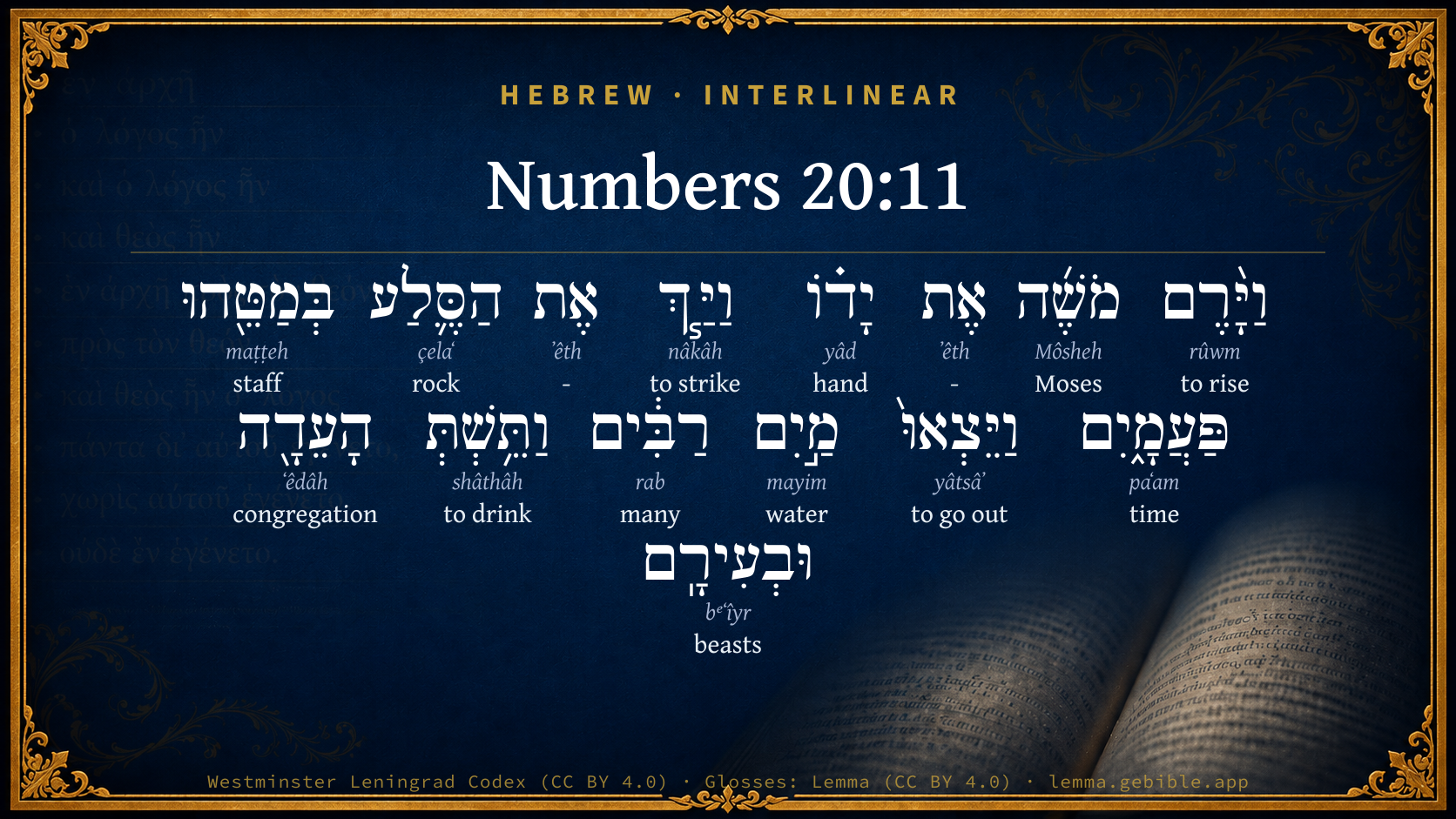
Hebrew (Westminster Leningrad Codex) Numbers 20:11 appears in the Hebrew Old Testament. The text above is from the Westminster Leningrad Codex. Each word links to its Strong’s number, a concise gloss, and parsing drawn from the Open Scriptures Hebrew Bible morphology. Click any word for its full Brown-Driver-Briggs (BDB) entry.
Download image
Cite this verse

Numbers 20:11 (World English Bible). Public Domain. Lemma interlinear Bible study tool, https://lemma.gebible.app/v/numbers/20/11.

Show BibTeX & RIS
BibTeX
RIS
English Translation
Moses lifted up his hand, and struck the rock with his rod twice: and water came forth abundantly, and the congregation drank, and their cattle.
World English Bible · Public Domain
Download a study sheet

One document with this verse’s original text, its word-by-word gloss line, the meaning frame, cross-references with their text, attributed commentary, and full source and license credits — printable, and it pastes into notes with its structure intact.

This verse Autodidact and up

Study sheet (.html) Plain text (.txt)

A passage Seminary Student

Up to 50 verses in one chapter. A passage sheet keeps up to 6 commentary sources and 12 cross-references per verse, in the order this page ranks them, and says so on the sheet whenever that leaves anything out. Ask for a single verse and you get the Autodidact verse sheet above.

Everything on this page stays free to read, with no account — the sheet is a download of what is already on screen, not access to it.

Want to remove ads? Support Godless Engineer
Compare translations 3

The same verse in 3 English versions, stacked beneath the original-language interlinear above. Click any original word for its lexicon entry.

Each is an independent rendering of the whole verse — the interlinear is not word-aligned to these translations.

Highlighted words mark where these versions differ — a whole-verse word diff, not a word-by-word alignment.

  • World English Bible Public Domain
    Moses lifted up his hand, and struck the rock with his rod twice: and water came forth abundantly, and the congregation drank, and their cattle.
  • King James Version Public Domain
    And Moses lifted up his hand, and with his rod he smote the rock twice: and the water came out abundantly, and the congregation drank, and their beasts also.
  • unfoldingWord Literal Text CC BY-SA 4.0
    And Moses raised his hand, and he struck the rock with his staff two times. And much water came out, and the congregation drank and their livestock.

unfoldingWord Literal Text — © unfoldingWord, licensed CC BY-SA 4.0. Word-aligned USFM3 via Door43 (git.door43.org/unfoldingWord/en_ult).

Versions to compare (up to 4)

3 of 4 selected

Show all 18 translations

Every available English version of this verse, each an independent rendering of the whole verse.

  • World English Bible Public Domain
    Moses lifted up his hand, and struck the rock with his rod twice: and water came forth abundantly, and the congregation drank, and their cattle.
  • Berean Standard Bible Public Domain
    Then Moses raised his hand and struck the rock twice with his staff, so that a great amount of water gushed out, and the congregation and their livestock were able to drink.
  • Majority Standard Bible Public Domain
    Then Moses raised his hand and struck the rock twice with his staff, so that a great amount of water gushed out, and the congregation and their livestock were able to drink.
  • King James Version Public Domain
    And Moses lifted up his hand, and with his rod he smote the rock twice: and the water came out abundantly, and the congregation drank, and their beasts also.
  • American Standard Version (1901) Public Domain
    And Moses lifted up his hand, and smote the rock with his rod twice: and water came forth abundantly, and the congregation drank, and their cattle.
  • Revised Version (1885) Public Domain
    And Moses lifted up his hand, and smote the rock with his rod twice: and water came forth abundantly, and the congregation drank, and their cattle.
  • Geneva Bible (1599) Public Domain
    Then Moses lift vp his hande, and with his rod he smote the rocke twise, and the water came out aboundantly: so the Congregation, and their beastes dranke.
  • Douay-Rheims (1899) Public Domain
    And when Moses had lifted up his hand, and struck the rook twice with the rod, there came forth water in great abundance, so that the people and their cattle drank,
  • Young's Literal Translation Public Domain
    and Moses lifteth up his hand, and smiteth the rock with his rod twice; and much water cometh out, and the company drink, also their beasts.
  • Literal Standard Version CC BY-SA 4.0
    And Moses lifts up his hand and strikes the rock with his rod twice; and much water comes out, and the congregation drinks, and their beasts [drink].
  • Unlocked Literal Bible CC BY-SA 4.0
    Then Moses raised his hand and struck the rock twice with his staff, and much water came out. The community drank, and their cattle drank.
  • unfoldingWord Literal Text CC BY-SA 4.0
    And Moses raised his hand, and he struck the rock with his staff two times. And much water came out, and the congregation drank and their livestock.
  • Darby Bible Public Domain
    And Moses lifted up his hand, and with his staff smote the rock twice, and much water came out, and the assembly drank, and their beasts.
  • World Messianic Bible Public Domain
    Moses lifted up his hand, and struck the rock with his rod twice, and water came out abundantly. The congregation and their livestock drank.
  • Webster's Bible Public Domain
    And Moses lifted his hand, and with his rod he smote the rock twice: and the water came out abundantly, and the congregation drank, and their beasts also.
  • Free Bible Version CC BY-SA 4.0
    Then Moses picked up the walking stick and hit the rock twice. Streams of water gushed out so that the people and their livestock could drink.
  • Bible in Basic English Public Domain
    And lifting up his hand, Moses gave the rock two blows with his rod: and water came streaming out, and the people and their cattle had drink enough.
  • JPS Tanakh (1917) Public Domain
    And Moses lifted up his hand, and smote the rock with his rod twice; and water came forth abundantly, and the congregation drank, and their cattle.

Literal Standard Version (2020), Covenant Press — licensed CC BY-SA 4.0. Text via the HelloAO Bible API (eBible.org). Unlocked Literal Bible (unfoldingWord) — licensed CC BY-SA 4.0. Text via the HelloAO Bible API (eBible.org). unfoldingWord Literal Text — © unfoldingWord, licensed CC BY-SA 4.0. Word-aligned USFM3 via Door43 (git.door43.org/unfoldingWord/en_ult). Free Bible Version, Dr. Jonathan Gallagher — licensed CC BY-SA 4.0. Text via the HelloAO Bible API (eBible.org).

Word by word

More ways to search: Search by grammar → Find every occurrence → Compare this word →

Practice this passage: Drill this verse → Learn its vocabulary →

וּבְעִירָֽם
bᵉʻîyr
H1165
“and · beasts · their”
Conjunction + Noun, Common, Masculine, Singular, Construct + Suffix, Personal, 3rd Person, Masculine, Plural
Part of Speech
Conjunction + Noun
Type
Common
Gender
Masculine
Number
Singular
State
Construct
Full BDB Definition

Origin: from H1197 (in the sense of eating)

TWOT: 264a

beasts, cattle
  1. וַיָּ֨רֶם rûwm H7311 “and · to rise” Conjunction + Verb, Hiphil, Sequential Imperfect, 3rd Person, Masculine, Singular
  2. מֹשֶׁ֜ה Môsheh H4872 “Moses” Noun, Proper
  3. אֶת ʼêth H853 “-” Particle, Direct Object
  4. יָד֗וֹ yâd H3027 “hand · his” Noun, Common, Both, Singular, Construct + Suffix, Personal, 3rd Person, Masculine, Singular
  5. וַיַּ֧ךְ nâkâh H5221 “and · to strike” Conjunction + Verb, Hiphil, Sequential Imperfect, 3rd Person, Masculine, Singular
  6. אֶת ʼêth H853 “-” Particle, Direct Object
  7. הַסֶּ֛לַע çelaʻ H5553 “the · rock” Particle, Definite Article + Noun, Common, Masculine, Singular, Absolute
  8. בְּמַטֵּ֖הוּ maṭṭeh H4294 “in/at · staff · his” Preposition + Noun, Common, Masculine, Singular, Construct + Suffix, Personal, 3rd Person, Masculine, Singular
  9. פַּעֲמָ֑יִם paʻam H6471 “times” Noun, Common, Feminine, Dual, Absolute
  10. וַיֵּצְאוּ֙ yâtsâʼ H3318 “and · to go out” Conjunction + Verb, Qal, Sequential Imperfect, 3rd Person, Masculine, Plural
  11. מַ֣יִם mayim H4325 “water(s)” Noun, Common, Masculine, Plural, Absolute
  12. רַבִּ֔ים rab H7227 “many” Adjective, Adjective, Masculine, Plural, Absolute
  13. וַתֵּ֥שְׁתְּ shâthâh H8354 “and · to drink” Conjunction + Verb, Qal, Sequential Imperfect, 3rd Person, Feminine, Singular
  14. הָעֵדָ֖ה ʻêdâh H5712 “the · congregation” Particle, Definite Article + Noun, Common, Feminine, Singular, Absolute

About this verse

These counts appear in no published source. They are computed here, from the morphology-tagged text and Lemma’s own curated glosses. What Lemma adds →

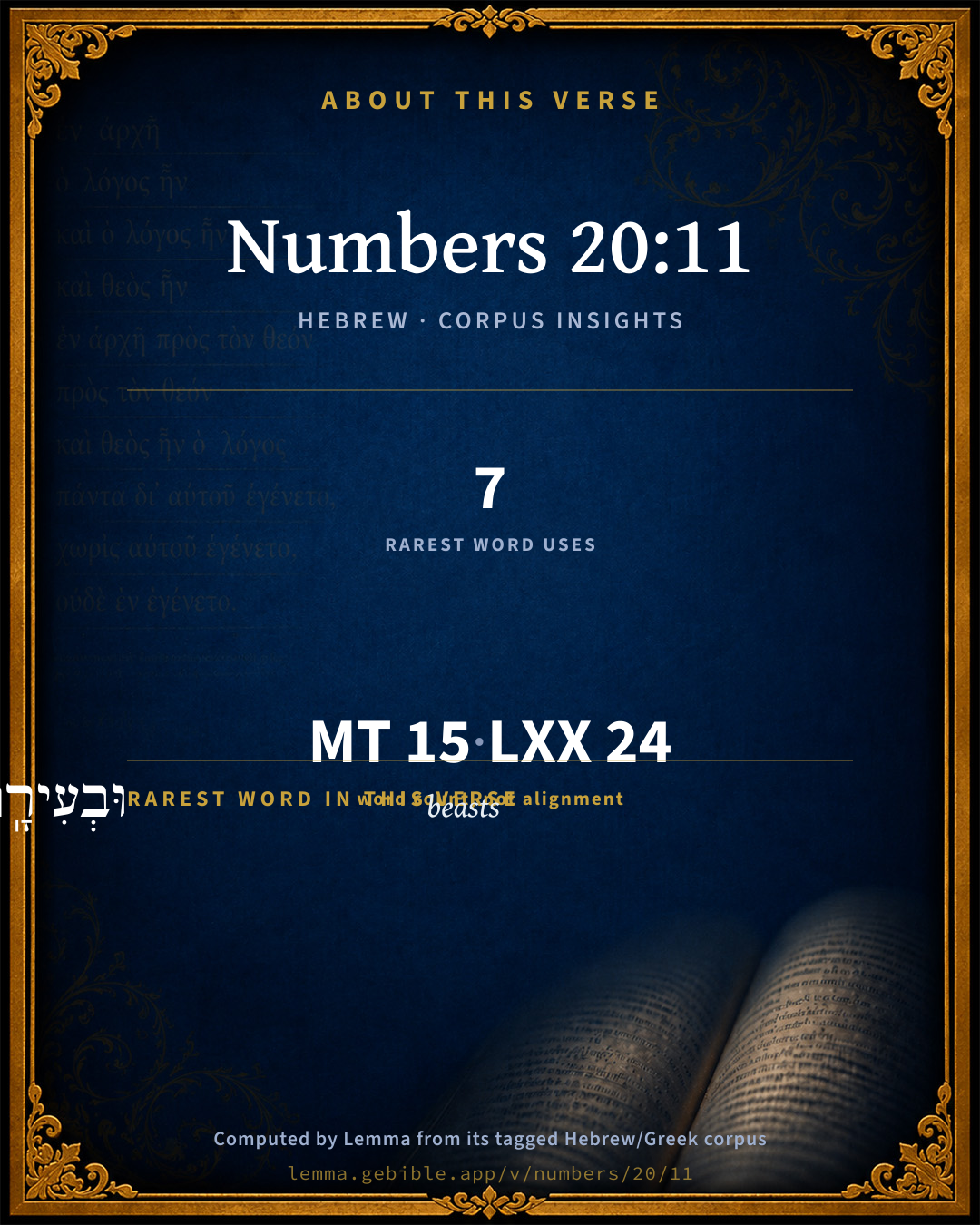
15
words
14
distinct lemmas
Pentateuch
section

Notable vocabulary

The rarest word here is וּבְעִירָֽם beasts H1165 — appearing just 7 times in the whole Hebrew Bible.

Shared distinctive vocabulary

וּבְעִירָֽם beasts H1165 occurs in 6 verses of the Hebrew Bible. Also found in:

Grammatical profile

  • 4 verbs
  • 8 nouns
  • 1 adjective
  • 2 particles

Verb forms

  • וַיָּ֨רֶם Hiphil · Sequential Imperfect
  • וַיַּ֧ךְ Hiphil · Sequential Imperfect
  • וַיֵּצְאוּ֙ Qal · Sequential Imperfect
  • וַתֵּ֥שְׁתְּ Qal · Sequential Imperfect

Hebrew & Septuagint length

In English translation the verse runs 25 words from the Hebrew and 26 from the Septuagint (LXX English) — closely comparable.

A rough comparison of the two English renderings, which tokenize alike — not a word-level alignment.

Word counts can differ between the Hebrew and the Greek without any difference in meaning — e.g. the Hebrew direct-object marker אֵת has no separate Greek word, and Greek often adds the article ὁ.

In the original languages it is 15 Hebrew tokens and 24 Greek tokens — but the two are counted differently (Hebrew bundles its prefixes and suffixes into one token; the Greek is in lemma form), so that isn’t a like-for-like length.

Cross-references

16

Topical passages linked to Numbers 20:11 in the Treasury of Scripture Knowledge — connected by theme and wording, ordered by reader-vote popularity; previews shown in the World English Bible.

  • 1 Corinthians 10:4 and all drank the same spiritual drink. For they drank of a spiritual rock that followed them, and the rock was Christ.
  • Exodus 17:6 Behold, I will stand before you there on the rock in Horeb. You shall strike the rock, and water will come out of it, that the people may drink." Moses did so in the sight of the elders of Israel.
  • Numbers 20:8 Take the rod, and assemble the congregation, you, and Aaron your brother, and speak you to the rock before their eyes, that it give forth its water; and you shall bring forth to them water out of the rock; so you shall give the congregation and their cattle drink.
  • Deuteronomy 8:15 who led you through the great and terrible wilderness, [in which were] fiery serpents and scorpions, and thirsty ground where was no water; who brought you forth water out of the rock of flint;
  • 1 Samuel 15:24 Saul said to Samuel, I have sinned; for I have transgressed the commandment of Yahweh, and your words, because I feared the people, and obeyed their voice.
  • 1 Chronicles 15:13 For because you didn't carry it at the first, Yahweh our God made a breach on us, because we didn't seek him according to the ordinance.
  • Psalms 78:16 He brought streams also out of the rock, And caused waters to run down like rivers.
  • Hosea 13:5 I knew you in the wilderness, In the land of great drought.
  • Matthew 28:20 teaching them to observe all things that I commanded you. Behold, I am with you always, even to the end of the age." Amen.
  • James 1:20 for the anger of man doesn't produce the righteousness of God.
  • Leviticus 10:1 Nadab and Abihu, the sons of Aaron, each took his censer, and put fire in it, and laid incense on it, and offered strange fire before Yahweh, which he had not commanded them.
  • 1 Samuel 15:13–14 Samuel came to Saul; and Saul said to him, Blessed are you by Yahweh: I have performed the commandment of Yahweh.
  • 1 Samuel 15:19 Why then didn't you obey the voice of Yahweh, but flew on the spoil, and did that which was evil in the sight of Yahweh?"
  • 1 Kings 13:21–24 and he cried to the man of God who came from Judah, saying, Thus says Yahweh, Because you have been disobedient to the mouth of Yahweh, and have not kept the commandment which Yahweh your God commanded you,
  • 1 Chronicles 13:9–10 When they came to the threshing floor of Chidon, Uzza put forth his hand to hold the ark; for the oxen stumbled.
  • 1 Chronicles 15:2 Then David said, None ought to carry the ark of God but the Levites: for them has Yahweh chosen to carry the ark of God, and to minister to him forever.

Cross-references courtesy of OpenBible.info (CC BY 4.0).

Hebrew and Greek witnesses Masoretic Hebrew ↔ Greek Septuagint

The same verse in the two great witnesses to the Old Testament, shown verse-for-verse.

These are two independent witnesses, not word-aligned to each other, and the Septuagint is shown in lemma (dictionary) form.

Hebrew Numbers 20:11 Masoretic · Westminster Leningrad Codex

וַיָּ֨רֶם מֹשֶׁ֜ה אֶת יָד֗וֹ וַיַּ֧ךְ אֶת הַסֶּ֛לַע בְּמַטֵּ֖הוּ פַּעֲמָ֑יִם וַיֵּצְאוּ֙ מַ֣יִם רַבִּ֔ים וַתֵּ֥שְׁתְּ הָעֵדָ֖ה וּבְעִירָֽם

Moses lifted up his hand, and struck the rock with his rod twice: and water came forth abundantly, and the congregation drank, and their cattle.

World English Bible · Public Domain

Greek LXX Numbers 20:11 Septuagint · lemma form

καί ἐπιαἴρω μωυσῆς ὁ χείρ αὐτός πατάσσω ὁ πέτρα ὁ ῥάβδος δίς καί ἐκἔρχομαι ὕδωρ πολύς καί πίνω ὁ συναγωγή καί ὁ κτῆνος αὐτός

And Moses lifted up his hand and struck the rock with his rod twice; and much water came forth, and the congregation drank, and their cattle.

LXX2012 (modern English Septuagint) · Public Domain

Hebrew: Westminster Leningrad Codex (CC BY 4.0). Greek: Septuagint (public domain); English from LXX2012 (modern English Septuagint) (Public Domain). How the Septuagint differs from the Hebrew →

Targum (Aramaic paraphrase)

2

The Targum is the ancient Jewish Aramaic paraphrase of the Hebrew Scriptures — an interpretive translation, not the Hebrew text itself. Onkelos (literal) and Pseudo-Jonathan (expansive) render the Torah, and Jonathan the Prophets. Coverage is partial: where no permissively-licensed English translation exists for a verse, only the Aramaic is shown. This is verse-level text, not a word-by-word alignment to the Hebrew.

  1. Targum Onkelos Torah (Genesis–Deuteronomy)
    וַאֲרֵם משֶׁה יָת יְדֵיהּ וּמְחָא יָת כֵּיפָא בְּחוּטְּרֵיהּ תְּרֵין זִמְנִין וּנְפָקוּ מַיָא סַגִיאֵי וּשְׁתִיאַת כְּנִשְׁתָּא וּבְעִירְהוֹן

    (no public-domain English translation for this verse)

    Targum Onkelos — Aramaic: “Onkelos Genesis” (public domain); “Onkelos Exodus” (public domain); “Onkelos Leviticus” (public domain); “Onkelos Numbers” (public domain); “Onkelos Deuteronomy” (public domain). English: “Sefaria Community Translation” (CC0 1.0 (public-domain dedication)); “J.W. Etheridge. The Targums of Onkelos and Jonathan Ben Uzziel on the Pentateuch. London: Longmans, Green, 1862” (public domain). Text via Sefaria.

  2. Targum Pseudo-Jonathan Torah (Genesis–Deuteronomy)
    וּזְקֵף משֶׁה יַת יְדֵיהּ וּמְחָא יַת כֵּיפָא בְּחוּטְרֵיהּ תַּרְתֵּין זִמְנִין בְּזִמְנָא קַמָאָה אֲטִיפַת אַדְמָא וּבְזִמְנָא תִּנְיָינָא נְפָקוּ מַיִין סַגִיאִין וְאִשְׁתִיאַת כְּנִשְׁתָּא וּבְעִירֵיהוֹן

    And Mosheh lifted up his hand, and with his rod struck the rock two times: at the first time it dropped blood; but at the second time there came forth a multitude of waters. And the congregation and their cattle drank.

    Targum Pseudo-Jonathan — Aramaic: “Targum Jonathan on Genesis” (public domain); “Targum Jonathan on Exodus” (public domain); “Targum Jonathan on Leviticus” (public domain); “Targum Jonathan on Numbers” (public domain); “Targum Jonathan on Deuteronomy” (public domain). English: “The Targum of Jonathan ben Uzziel, trans. J. W. Etheridge, London, 1862” (public domain). Text via Sefaria.

Commentary

Notes on Numbers 20:11 from classic Christian and Jewish commentators (each source and its license shown beneath its notes). The classic Christian expositions comment on the surrounding passage and are grouped to its opening verse, so a note may address several verses; the Jewish commentaries on the Tanakh (Rashi and others) are per-verse, so they appear only where the commentator wrote on this verse.

Lemma curates 59 commentaries, every one of them public domain or Creative Commons licensed, each selected and text-cleaned for this edition rather than reprinted as found. About our sources →

Trapp's Complete Commentary

John Trapp

Num 20:11 And Moses lifted up his hand, and with his rod he smote the rock twice: and the water came out abundantly, and the congregation drank, and their beasts [also].

Ver. 11. He smote the rock twice.] In a great heat and pang of passion.

“ Qui non moderabitur irae,

Infectum velit esse dolor quod suaserit, et mens. ” - Horat.

Sometimes both grace and wit are asleep in the holiest and wariest breasts. The best may be miscarried by their passions to their cost. Ira comes of Ire, say grammarians: because an angry man goes out of himself, off from his reason; and when he is pacified, he is said redire ad se, to come again to himself.

And the water came out abundantly.] This cleaving of the hard rock was a work of omnipotency. {Psa 78:15} The works of God are in contrariis medias. {a} This rock was Christ, {1Co 10:4} fitly compared to a rock; (1.) For despicable appearance; {Isa 53:2-3} (2.) For exaltation and advancement; (3.) For firmness and stability; {Mat 16:18} (4.) For scandal and offence to the wicked; {Rom 9:33} (5.) For weight and danger. {Mat 21:44}

And their beasts also.] The wicked, in like sort, coming to the Lord’s supper, do receive there panem Domini, not panem Dominum.

{a} Luther.

John Trapp, A Commentary or Exposition upon All the Books of the Old and New Testament (1647–1656) — public domain. Text from a community e-Sword module.

Jamieson, Fausset & Brown

Robert Jamieson, A. R. Fausset & David Brown

the congregation drank, and their beasts--Physically the water afforded the same kind of needful refreshment to both. But from a religious point of view, this, which was only a common element to the cattle, was a sacrament to the people (Co1 10:3-4) --It possessed a relative sanctity imparted to it by its divine origin and use.

Jamieson, Fausset & Brown — Commentary Critical and Explanatory on the Whole Bible (1871) — public domain (CC PDM 1.0). Text via the HelloAO Bible API.

John Gill's Exposition

And the Lord spake unto Moses and Aaron,.... Out of the cloud, where his glory appeared, and still continued:

because ye believed me not, to sanctify me in the eyes of the children of Israel; that Moses and Aaron committed an evil which was displeasing to the Lord is certain, but what that was is variously represented. Some say their sin was, that the order was to speak to the rock, whereas it was smitten, and not spoken to; but why then was Moses bid to take the rod with him, if it was not to smite with it, as he had done before at Horeb? and besides, this would only have been the sin of Moses, and not of Aaron; others think, that what provoked the Lord was, that the Israelites were called "rebels"; but this is a name the Lord himself gave them, Num 17:10, and was what they justly deserved; and what after this Moses says of them, which, had this been the case, he would have been careful to have abstained from, Deu 9:24. Others are of opinion, that what was displeasing to the Lord was, that the bringing the water out of the rock was ascribed to themselves, and not to him; "must we fetch you water", &c. Others suppose the sin was in smiting the rock twice, and in anger; but this could only be the fault of Moses at most. Dr. Lightfoot (b) thinks the particular fault was this, that Moses expressed his displeasure and resentment to the Israelites, that on their murmuring a new rock was opening, which portended a new and long stay in the wilderness, as the opening of the first rock at Horeb did when he and Aaron were in expectation of being soon out of the wilderness, and now they feared they were beginning anew their abode in it; but it is certain from the text that unbelief was their sin; they were diffident about the will of God to bring water out of the rock for such a rebellious people, and they did not put them in mind of the miracles God had wrought in former time, to encourage their faith; and so the Lord was not sanctified by them before the people, as he ought to have been:

therefore ye shall not bring this congregation into the land which I have given them; the land of Canaan, a grant of which was made to their fathers, and particularly to this generation, and into which they would certainly be brought; but not by Moses and Aaron, who were excluded because of their unbelief, and accordingly both died before the entrance of the people into the land. This, according to the Targum of Jonathan, and Jarchi, was said with an oath; see Heb 3:18.

(b) See his Works, vol. 1. p. 36.

John Gill's Exposition of the Whole Bible (1746–1763) — public domain (CC PDM 1.0). Text via the HelloAO Bible API.

Albert Barnes' Notes on the Bible

The command Num 20:8 was “Speak ye unto the rock.” The act of smiting, and especially with two strokes, indicates violent irritation on the part of Moses; as does also his unseemly mode of addressing the people: “Hear now, ye rebels.” The form too of the question, “must we, etc.,” directs the people not, as ought to have been the case, to God as their deliverer, but to Moses and Aaron personally. In fact the faithful servant of God, worn out by the reiterated perversities of the people, breaks down; and in the actual discharge of his duty as God’s representative before Israel, acts unworthily of the great function entrusted to him. Thus, Moses did not “sanctify God in the eyes of the children of Israel.” Aaron might have checked the intemperate words and acts of Moses, and did not. Hence, God punishes both by withdrawing them from their work for Him, and handing over its accomplishment to another.

Albert Barnes' Notes on the Bible (1834–1885) — public domain. Text from a community e-Sword/MySword module.

Haydock's Catholic Bible Commentary

The rock. This rock was a figure of Christ, and the water that issued out from the rock, of his precious blood, the source of all our good; (Challoner) while the striking twice with the rod, denoted the cross, composed of two pieces of wood. (St. Augustine, q. 35.) (Worthington)

George Leo Haydock (1774–1849), Haydock's Catholic Family Bible and Commentary, 1859 edition — public domain. Excludes Psalms (Douay-Rheims chapter numbering differs from Protestant) and Deuterocanonical books (Catholic canon only).

Matthew Poole's English Annotations

To the men it was a sacrament, 1Co 10:3,4, but to the beasts it was no holy, but a common thing. So that the elements in the sacraments have no inherent and inseparable holiness, but only a relative holiness with respect to their use, out of which they are unholy and common.

Matthew Poole's English Annotations on the Holy Bible (1683–1685) — public domain. Text from a community e-Sword/MySword module.

Whedon's Commentary on the Bible

Daniel D. Whedon

11. Smote the rock twice — As if one blow were not sufficient, showing an excessive dependence on human agency, and a forgetfulness of the divine efficiency. There was no command to smite even once. The injunction to speak to the rock may have been given to show how small a human element was required in the miracle, and at the same time to test the faith and humility of Moses — faith, that only words were sufficient; and humility, since his part of the miracle was so insignificant.

Abundantly — Hebrew, many waters. The magnitude of the miracle is seen in the inadequacy of the natural cause and the greatness of the effect. The earliest attempt to divest this transaction of its supernatural character is found in Tacitus’s Hist., book Num_5:3-5, which is quoted in the note on Exo_17:6.

Daniel D. Whedon (gen. ed.), Commentary on the Old and New Testaments (1874–1909) — public domain. Text from a community e-Sword module.

Rashi

Rabbi Shlomo Yitzchaki (Rashi)

פעמים [HE SMOTE THE ROCK] TWICE, because at the first attempt it did not bring forth more than a few drops, for God had not bidden him smite it, but He had said, (v. 8) “and ye shall speak to the rock”. They had, indeed, spoken, but to a different rock (not that which God had intended) and it had not given forth water. They said, “Perhaps it is necessary to smite it as on the former occasion when it says, (Exodus 17:6) ‘and ye shall smite the rock’, and just that rock intended by God happened to be there and they smote it [but without full effect, and so they smote it a second time] (cf. Midrash Tanchuma, Chukat 9).

Rashi on the Tanakh — English translations: “The Judaica Press complete Tanach with Rashi, translated by A. J. Rosenberg” (CC BY 4.0); “Pentateuch with Rashi's commentary by M. Rosenbaum and A.M. Silbermann, 1929-1934” (public domain); “The Metsudah Tanach series, Lakewood, N.J” (CC BY 4.0); and “The Book of Joshua, Metsudah Publications, 1997” (CC BY 4.0). Text via Sefaria.

Lesson kit

Teaching starters — assembled from the data on this page, not authored interpretation. Every prompt links to the verse data it draws on. Edit before teaching.

Numbers, in the Pentateuch, opens this verse with 15 words (14 distinct Hebrew lemmas). Its most distinctive word is bᵉʻîyr (“beasts”). A historical commentator’s framing appears above. Read the whole chapter for the surrounding context.

Discussion questions

  1. What does “beasts” (bᵉʻîyr) contribute to the verse as a whole?
  2. Genesis 45:17 shares the word «beasts» with this verse. How do the two illuminate each other?
  3. These translations render this verse differently. What is at stake in choosing one wording over another?
  4. The verb «וַיָּ֨רֶם» is Hiphil Sequential Imperfect. How does its form color the action?
  5. Reading how Trapp's Complete Commentary and Jamieson, Fausset & Brown read this verse, where do the two commentators agree and where do they part?

Things to notice

Reading settings

Reading text

Shown beneath each verse's original-language words.

Old Testament
Old Testament edition

Read the OT as the Masoretic Hebrew (MT) or the Greek Septuagint (LXX).

English shown for the Greek Septuagint (in the Hebrew ↔ Greek comparison).

Comparing translations? Open the Compare panel on any verse page to stack up to four side by side.