
1 Kings 3:11

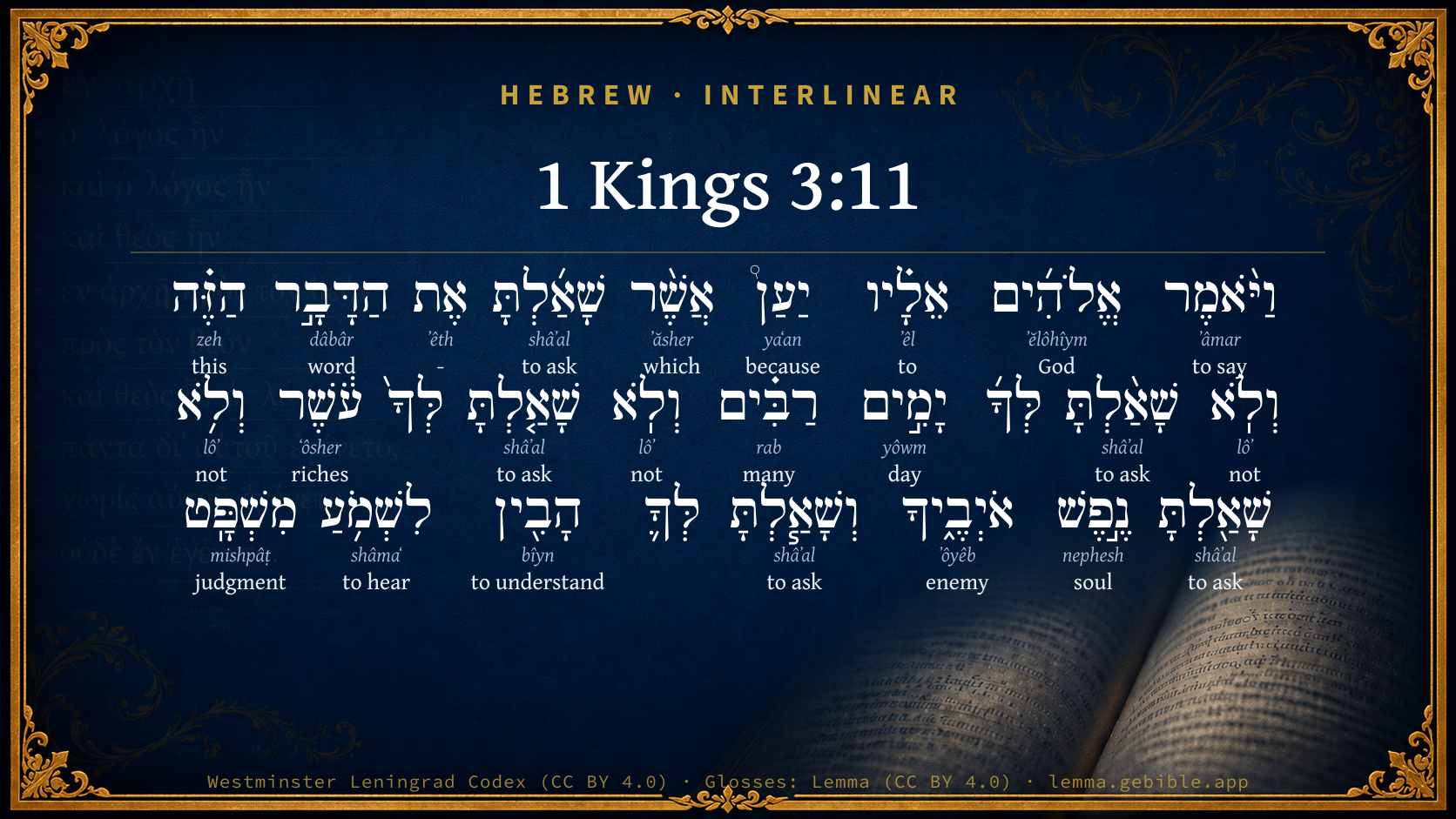
Hebrew (Westminster Leningrad Codex) 1 Kings 3:11 appears in the Hebrew Old Testament. The text above is from the Westminster Leningrad Codex. Each word links to its Strong’s number, a concise gloss, and parsing drawn from the Open Scriptures Hebrew Bible morphology. Click any word for its full Brown-Driver-Briggs (BDB) entry.
Download image
Cite this verse

1 Kings 3:11 (World English Bible). Public Domain. Lemma interlinear Bible study tool, https://lemma.gebible.app/v/1-kings/3/11.

Show BibTeX & RIS
BibTeX
RIS
English Translation
God said to him, Because you have asked this thing, and have not asked for yourself long life, neither have asked riches for yourself, nor have asked the life of your enemies, but have asked for yourself understanding to discern justice;
World English Bible · Public Domain
Download a study sheet

One document with this verse’s original text, its word-by-word gloss line, the meaning frame, cross-references with their text, attributed commentary, and full source and license credits — printable, and it pastes into notes with its structure intact.

This verse Autodidact and up

Study sheet (.html) Plain text (.txt)

A passage Seminary Student

Up to 50 verses in one chapter. A passage sheet keeps up to 6 commentary sources and 12 cross-references per verse, in the order this page ranks them, and says so on the sheet whenever that leaves anything out. Ask for a single verse and you get the Autodidact verse sheet above.

Everything on this page stays free to read, with no account — the sheet is a download of what is already on screen, not access to it.

Want to remove ads? Support Godless Engineer
Compare translations 3

The same verse in 3 English versions, stacked beneath the original-language interlinear above. Click any original word for its lexicon entry.

Each is an independent rendering of the whole verse — the interlinear is not word-aligned to these translations.

Highlighted words mark where these versions differ — a whole-verse word diff, not a word-by-word alignment.

  • World English Bible Public Domain
    God said to him, Because you have asked this thing, and have not asked for yourself long life, neither have asked riches for yourself, nor have asked the life of your enemies, but have asked for yourself understanding to discern justice;
  • King James Version Public Domain
    And God said unto him, Because thou hast asked this thing, and hast not asked for thyself long life; neither hast asked riches for thyself, nor hast asked the life of thine enemies; but hast asked for thyself understanding to discern judgment;
  • unfoldingWord Literal Text CC BY-SA 4.0
    And God said to him, “Because you have requested this thing and you have not requested for yourself many days, and you have not requested riches for yourself, and you have not requested the life of your enemies, but you have requested for yourself to discern to hear justice,

unfoldingWord Literal Text — © unfoldingWord, licensed CC BY-SA 4.0. Word-aligned USFM3 via Door43 (git.door43.org/unfoldingWord/en_ult).

Versions to compare (up to 4)

3 of 4 selected

Show all 18 translations

Every available English version of this verse, each an independent rendering of the whole verse.

  • World English Bible Public Domain
    God said to him, Because you have asked this thing, and have not asked for yourself long life, neither have asked riches for yourself, nor have asked the life of your enemies, but have asked for yourself understanding to discern justice;
  • Berean Standard Bible Public Domain
    So God said to him, “Since you have asked for this instead of requesting long life or wealth for yourself or death for your enemies—but you have asked for discernment to administer justice—
  • Majority Standard Bible Public Domain
    So God said to him, “Since you have asked for this instead of requesting long life or wealth for yourself or death for your enemies—but you have asked for discernment to administer justice—
  • King James Version Public Domain
    And God said unto him, Because thou hast asked this thing, and hast not asked for thyself long life; neither hast asked riches for thyself, nor hast asked the life of thine enemies; but hast asked for thyself understanding to discern judgment;
  • American Standard Version (1901) Public Domain
    And God said unto him, Because thou hast asked this thing, and hast not asked for thyself long life, neither hast asked riches for thyself, nor hast asked the life of thine enemies, but hast asked for thyself understanding to discern justice;
  • Revised Version (1885) Public Domain
    And God said unto him, Because thou hast asked this thing, and hast not asked for thyself long life; neither hast asked riches for thyself, nor hast asked the life of thine enemies; but hast asked for thyself understanding to discern judgment;
  • Geneva Bible (1599) Public Domain
    And God sayde vnto him, Because thou hast asked this thing, and hast not asked for thy selfe long life, neyther hast asked riches for thy selfe, nor hast asked the life of thine enemies, but hast asked for thy selfe vnderstanding to heare iudgement,
  • Douay-Rheims (1899) Public Domain
    And the Lord said to Solomon: Because thou hast asked this thing, and hast not asked for thyself long life or riches, nor the lives of thy enemies, but hast asked for thyself wisdom to discern judgment,
  • Young's Literal Translation Public Domain
    and God saith unto him, `Because that thou hast asked this thing, and hast not asked for thee many days, nor asked for thee riches, nor asked the life of thine enemies, and hast asked for thee discernment to understand judgment,
  • Literal Standard Version CC BY-SA 4.0
    and God says to him, “Because that you have asked for this thing, and have not asked for many days for yourself, nor asked for riches for yourself, nor asked for the life of your enemies, and have asked for discernment for yourself to understand judgment,
  • Unlocked Literal Bible CC BY-SA 4.0
    So God said to him, “Because you have asked this thing and have not asked for yourself long life or riches or the life of your enemies, but have asked for yourself understanding to discern justice.
  • unfoldingWord Literal Text CC BY-SA 4.0
    And God said to him, “Because you have requested this thing and you have not requested for yourself many days, and you have not requested riches for yourself, and you have not requested the life of your enemies, but you have requested for yourself to discern to hear justice,
  • Darby Bible Public Domain
    And God said to him, Because thou hast asked this thing, and hast not asked for thyself long life, neither hast asked riches for thyself, nor hast asked the life of thine enemies, but hast asked for thyself discernment to understand judgment;
  • World Messianic Bible Public Domain
    God said to him, “Because you have asked this thing, and have not asked for yourself long life, nor have you asked for riches for yourself, nor have you asked for the life of your enemies, but have asked for yourself understanding to discern justice,
  • Webster's Bible Public Domain
    And God said to him, Because thou hast asked this thing, and hast not asked for thyself long life; neither hast asked riches for thyself, nor hast asked the life of thy enemies: but hast asked for thyself understanding to discern judgment;
  • Free Bible Version CC BY-SA 4.0
    So God told him, “Because you asked for this, and you didn't ask for a long life, or wealth, or the death of your enemies, but instead you asked for understanding to know what is right,
  • Bible in Basic English Public Domain
    And God said to him, Because your request is for this thing, and not for long life for yourself or for wealth or for the destruction of your haters, but for wisdom to be a judge of causes;
  • JPS Tanakh (1917) Public Domain
    And God said unto him: 'Because thou hast asked this thing, and hast not asked for thyself long life; neither hast asked riches for thyself, nor hast asked the life of thine enemies; but hast asked for thyself understanding to discern justice;

Literal Standard Version (2020), Covenant Press — licensed CC BY-SA 4.0. Text via the HelloAO Bible API (eBible.org). Unlocked Literal Bible (unfoldingWord) — licensed CC BY-SA 4.0. Text via the HelloAO Bible API (eBible.org). unfoldingWord Literal Text — © unfoldingWord, licensed CC BY-SA 4.0. Word-aligned USFM3 via Door43 (git.door43.org/unfoldingWord/en_ult). Free Bible Version, Dr. Jonathan Gallagher — licensed CC BY-SA 4.0. Text via the HelloAO Bible API (eBible.org).

Word by word

More ways to search: Search by grammar → Find every occurrence → Compare this word →

Practice this passage: Drill this verse → Learn its vocabulary →

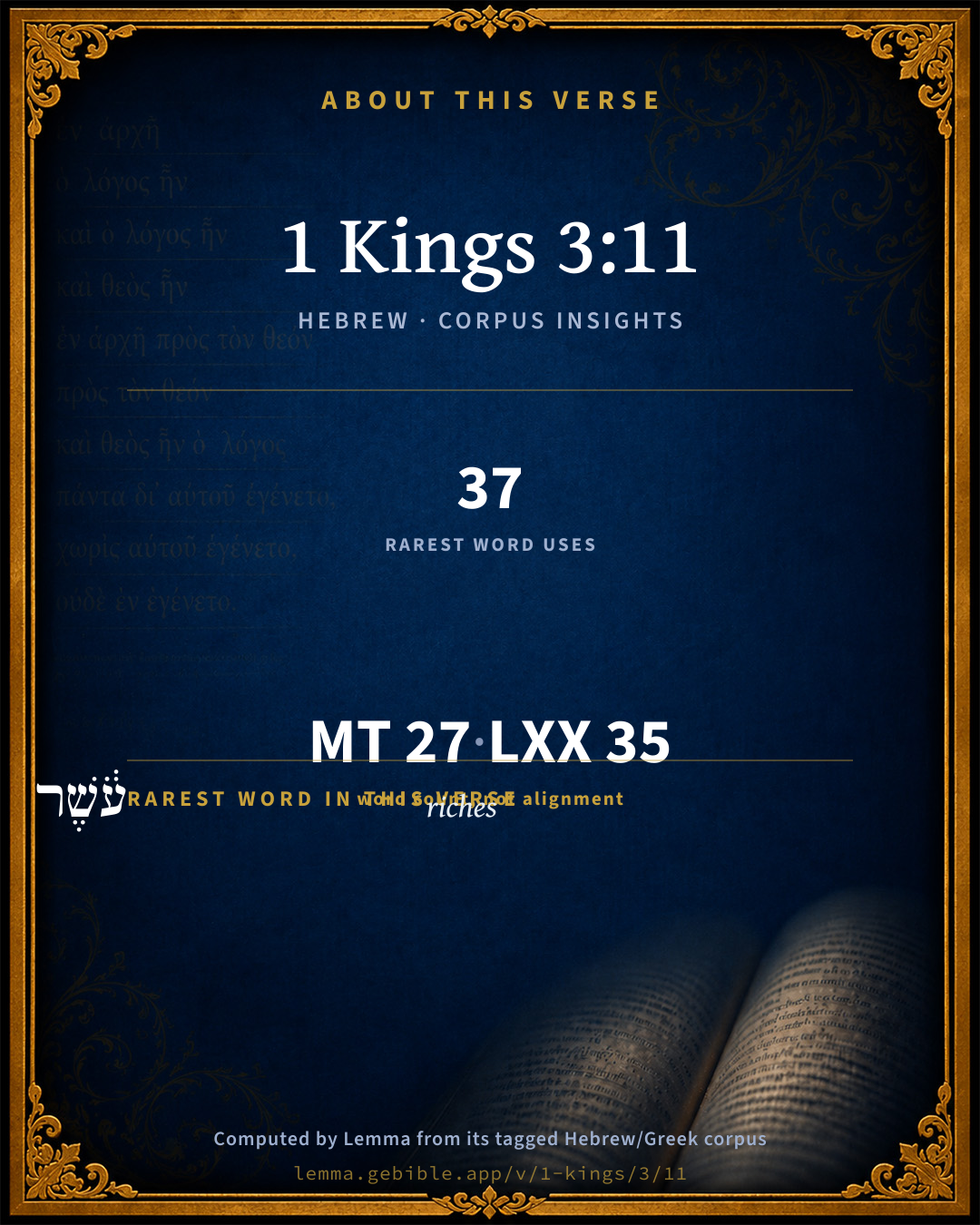
עֹ֔שֶׁר
ʻôsher
H6239
“riches”
Noun, Common, Masculine, Singular, Absolute
Part of Speech
Noun
Type
Common
Gender
Masculine
Number
Singular
State
Absolute
Full BDB Definition

Origin: from H6238

TWOT: 1714a

wealth, riches
  1. וַיֹּ֨אמֶר ʼâmar H559 “and · to say” Conjunction + Verb, Qal, Sequential Imperfect, 3rd Person, Masculine, Singular
  2. אֱלֹהִ֜ים ʼĕlôhîym H430 “God(s)” Noun, Common, Masculine, Plural, Absolute
  3. אֵלָ֗יו ʼêl H413 “to · him” Preposition + Suffix, Personal, 3rd Person, Masculine, Singular
  4. יַעַן֩ yaʻan H3282 “because” Conjunction
  5. אֲשֶׁ֨ר ʼăsher H834 “which” Particle, Relative
  6. שָׁאַ֜לְתָּ shâʼal H7592 “to ask” Verb, Qal, Perfect, 2nd Person, Masculine, Singular
  7. אֶת ʼêth H853 “-” Particle, Direct Object
  8. הַדָּבָ֣ר dâbâr H1697 “the · word” Particle, Definite Article + Noun, Common, Masculine, Singular, Absolute
  9. הַזֶּ֗ה zeh H2088 “the · this” Particle, Definite Article + Pronoun, Demonstrative, Masculine, Singular
  10. וְלֹֽא lôʼ H3808 “and · not” Conjunction + Particle, Negative
  11. שָׁאַ֨לְתָּ shâʼal H7592 “to ask” Verb, Qal, Perfect, 2nd Person, Masculine, Singular
  12. יָמִ֣ים yôwm H3117 “days” Noun, Common, Masculine, Plural, Absolute
  13. רַבִּ֗ים rab H7227 “many” Adjective, Adjective, Masculine, Plural, Absolute
  14. וְלֹֽא lôʼ H3808 “and · not” Conjunction + Particle, Negative
  15. שָׁאַ֤לְתָּ shâʼal H7592 “to ask” Verb, Qal, Perfect, 2nd Person, Masculine, Singular
  16. וְלֹ֥א lôʼ H3808 “and · not” Conjunction + Particle, Negative
  17. שָׁאַ֖לְתָּ shâʼal H7592 “to ask” Verb, Qal, Perfect, 2nd Person, Masculine, Singular
  18. נֶ֣פֶשׁ nephesh H5315 “soul of” Noun, Common, Both, Singular, Construct
  19. אֹיְבֶ֑יךָ ʼôyêb H341 “enemy · you” Verb, Qal, Participle Active, Masculine, Plural, Construct + Suffix, Personal, 2nd Person, Masculine, Singular
  20. וְשָׁאַ֧לְתָּ shâʼal H7592 “and · to ask” Conjunction + Verb, Qal, Perfect, 2nd Person, Masculine, Singular
  21. הָבִ֖ין bîyn H995 “to understand” Verb, Hiphil, Infinitive Construct
  22. לִשְׁמֹ֥עַ shâmaʻ H8085 “to hear” Preposition + Verb, Qal, Infinitive Construct
  23. מִשְׁפָּֽט mishpâṭ H4941 “judgment” Noun, Common, Masculine, Singular, Absolute

About this verse

These counts appear in no published source. They are computed here, from the morphology-tagged text and Lemma’s own curated glosses. What Lemma adds →

27
words
18
distinct lemmas
Historical
section

Shared distinctive vocabulary

עֹ֔שֶׁר riches H6239 occurs in 36 verses of the Hebrew Bible. Also found in:

Grammatical profile

  • 9 verbs
  • 6 nouns
  • 1 adjective
  • 1 pronoun
  • 4 prepositions
  • 1 conjunction
  • 5 particles

Verb forms

  • וַיֹּ֨אמֶר Qal · Sequential Imperfect
  • שָׁאַ֜לְתָּ Qal · Perfect
  • שָׁאַ֨לְתָּ Qal · Perfect
  • שָׁאַ֤לְתָּ Qal · Perfect
  • שָׁאַ֖לְתָּ Qal · Perfect
  • אֹיְבֶ֑יךָ Qal · Participle Active
  • וְשָׁאַ֧לְתָּ Qal · Perfect
  • הָבִ֖ין Hiphil · Infinitive Construct
  • לִשְׁמֹ֥עַ Qal · Infinitive Construct

Repetition

Words recur within this verse — often emphatic in Hebrew:

  • שָׁאַ֜לְתָּ to ask H7592 ×5
  • וְלֹֽא not H3808 ×3

Hebrew & Septuagint length

In English translation the verse runs 41 words from the Hebrew and 44 from the Septuagint (LXX English) — closely comparable.

A rough comparison of the two English renderings, which tokenize alike — not a word-level alignment.

Word counts can differ between the Hebrew and the Greek without any difference in meaning — e.g. the Hebrew direct-object marker אֵת has no separate Greek word, and Greek often adds the article ὁ.

In the original languages it is 27 Hebrew tokens and 35 Greek tokens — but the two are counted differently (Hebrew bundles its prefixes and suffixes into one token; the Greek is in lemma form), so that isn’t a like-for-like length.

Cross-references

6

Topical passages linked to 1 Kings 3:11 in the Treasury of Scripture Knowledge — connected by theme and wording, ordered by reader-vote popularity; previews shown in the World English Bible.

  • Romans 8:26 In the same way, the Spirit also helps our weaknesses, for we don't know how to pray as we ought. But the Spirit himself makes intercession for us with groanings which can't be uttered.
  • James 4:2–3 You lust, and don't have. You kill, covet, and can't obtain. You fight and make war. You don't have, because you don't ask.
  • 1 Kings 3:9 Give your servant therefore an understanding heart to judge your people, that I may discern between good and evil; for who is able to judge this your great people?
  • Proverbs 16:31 Gray hair is a crown of glory. It is attained by a life of righteousness.
  • Psalms 4:6 Many say, "Who will show us any good?" Yahweh, let the light of your face shine on us.
  • Matthew 20:21–22 He said to her, "What do you want?" She said to him, "Command that these, my two sons, may sit, one on your right hand, and one on your left hand, in your Kingdom."

Cross-references courtesy of OpenBible.info (CC BY 4.0).

Hebrew and Greek witnesses Masoretic Hebrew ↔ Greek Septuagint

The same verse in the two great witnesses to the Old Testament, shown verse-for-verse.

These are two independent witnesses, not word-aligned to each other, and the Septuagint is shown in lemma (dictionary) form.

Hebrew 1 Kings 3:11 Masoretic · Westminster Leningrad Codex

וַיֹּ֨אמֶר אֱלֹהִ֜ים אֵלָ֗יו יַעַן֩ אֲשֶׁ֨ר שָׁאַ֜לְתָּ אֶת הַדָּבָ֣ר הַזֶּ֗ה וְלֹֽא שָׁאַ֨לְתָּ לְּךָ֜ יָמִ֣ים רַבִּ֗ים וְלֹֽא שָׁאַ֤לְתָּ לְּךָ֙ עֹ֔שֶׁר וְלֹ֥א שָׁאַ֖לְתָּ נֶ֣פֶשׁ אֹיְבֶ֑יךָ וְשָׁאַ֧לְתָּ לְּךָ֛ הָבִ֖ין לִשְׁמֹ֥עַ מִשְׁפָּֽט

God said to him, Because you have asked this thing, and have not asked for yourself long life, neither have asked riches for yourself, nor have asked the life of your enemies, but have asked for yourself understanding to discern justice;

World English Bible · Public Domain

Greek LXX 1 Kings 3:11 Septuagint · lemma form

καί εἶπον κύριος πρός αὐτός ἀντί ὅς αἰτέω παρά ἐγώ ὁ ῥῆμα οὗτος καί οὐ αἰτέω σεαυτοῦ ἡμέρα πολύς καί οὐ αἰτέω πλοῦτος οὐδέ αἰτέω ψυχή ἐχθρός σύ ἀλλά αἰτέω σεαυτοῦ σύνεσις ὁ εἰςἀκούω κρίμα

And the Lord said to him, Because you have asked this thing of me, and have not asked for yourself long life, and have not asked wealth, nor have asked the lives of your enemies, but have asked for yourself understanding to hear judgment;

LXX2012 (modern English Septuagint) · Public Domain

Hebrew: Westminster Leningrad Codex (CC BY 4.0). Greek: Septuagint (public domain); English from LXX2012 (modern English Septuagint) (Public Domain). How the Septuagint differs from the Hebrew →

Targum (Aramaic paraphrase)

1

The Targum is the ancient Jewish Aramaic paraphrase of the Hebrew Scriptures — an interpretive translation, not the Hebrew text itself. Onkelos (literal) and Pseudo-Jonathan (expansive) render the Torah, and Jonathan the Prophets. Coverage is partial: where no permissively-licensed English translation exists for a verse, only the Aramaic is shown. This is verse-level text, not a word-by-word alignment to the Hebrew.

  1. Targum Jonathan Prophets (Joshua–Malachi)
    וַאֲמַר יְיָ לֵיהּ חֲלַף דִשְׁאַלְתָּא יַת פִּתְגָמָא הָדֵין וְלָא שְׁאַלְתָּא לָךְ יוֹמִין סַגִיאִין וְלָא שְׁאַלְתָּא לָךְ עֻתְרָא וְלָא שְׁאֵלְתָּא נְפַשׁ בַּעֲלֵי דְבָבָךְ וּשְׁאֵלְתָּא לָךְ סַבְּרוּתָא לְמִשְׁמַע דִינָא:

    (no public-domain English translation for this verse)

    Targum Jonathan — Aramaic: “Mikraot Gedolot” (public domain). English: “Sefaria Community Translation” (CC0 1.0 (public-domain dedication)); “London "Chaldee Paraphrase," 1871” (public domain). Text via Sefaria.

Commentary

Notes on 1 Kings 3:11 from classic Christian and Jewish commentators (each source and its license shown beneath its notes). The classic Christian expositions comment on the surrounding passage and are grouped to its opening verse, so a note may address several verses; the Jewish commentaries on the Tanakh (Rashi and others) are per-verse, so they appear only where the commentator wrote on this verse.

Lemma curates 59 commentaries, every one of them public domain or Creative Commons licensed, each selected and text-cleaned for this edition rather than reprinted as found. About our sources →

Trapp's Complete Commentary

John Trapp

1Ki 3:11 And God said unto him, Because thou hast asked this thing, and hast not asked for thyself long life; neither hast asked riches for thyself, nor hast asked the life of thine enemies; but hast asked for thyself understanding to discern judgment;

Ver. 11. And hast not asked for thyself long life.] Which yet most men covet. {Psa 34:12} {See Trapp on "Psa 34:12"}

Neither hast asked riches.] As the many do. {Psa 4:7}

Nor hast asked the life of thine enemies.] Which, oh, how sweet is it to vindictive spirits! And God, we see, here taketh distinct notice of that which men most desire.

John Trapp, A Commentary or Exposition upon All the Books of the Old and New Testament (1647–1656) — public domain. Text from a community e-Sword module.

Joseph Benson's Commentary

1Ki 3:11-12. Nor hast asked the life of thine enemies — That God would take away their lives, or put it into his power to destroy them. Behold I have done according to thy word — I have granted, and do at this present grant thy desire. And accordingly at this time God did infuse into him a far higher degree of wisdom than he had before possessed; and that not only to govern his people, and to know and do the several duties which he owed to God and them, but also the knowledge of divers arts and sciences, and of things human and divine, as appears from 1Ki 4:29-34; and that in a far greater measure and proportion, than with the best natural understanding he could have attained by the most diligent study, if he had been employed therein from a child. So that there was none like thee before thee — Either no king, or rather no man. For in these respects he is preferred, (1Ki 4:31,) not only before all kings, but before all men. No mere man, it appears, since the fall of Adam, ever equalled him in universal knowledge, especially in the art of well governing his people. But, it may be asked, did not the apostles excel him? Not in natural and political knowledge, but only in the knowledge of the mysteries of faith, which were more freely and more fully imparted in these latter times; the ignorance whereof was no disparagement to Solomon’s wisdom, because they were not discoverable by any creature without that divine revelation which God saw fit not to afford in Solomon’s time.

Joseph Benson's Commentary on the Old and New Testaments (1811–1818) — public domain. Text from a community e-Sword module.

Geneva Bible (1599)

Geneva Bible translators

That is, that thine enemy should die.

Geneva Bible (1599) marginal notes — public domain. Text via Bolls.life.

Ellicott's Commentary for English Readers

(11) Because thou hast asked.—It is obvious to note this verse as a fulfilment of the Divine law, “Seek first the kingdom of God and his righteousness, and -all these things shall be added unto you” (Mat_6:33). All these secondary blessings are good, just so far as they conduce to the supreme good, which is the growth of the human nature, by the knowledge of God and by faithfully doing His work on earth, to the perfection designed for it in His wisdom. So long as Solomon used them in subordination to true wisdom, they were a blessing to him; when he made them idols, they became a curse. The connection of these lower gifts with the moral and intellectual gifts of wisdom, is the result of the natural law of God’s Providence, so far as that law overcomes the resistance of evil and folly, still allowed to strive against it.

A Bible Commentary for English Readers, edited by Charles John Ellicott (1878–1897) — public domain. Text from a community e-Sword module.

The Cambridge Bible for Schools and Colleges

gen. ed. J. J. S. Perowne

11. to discern judgement] Literally,‘to hear judgement.’ The word is the same as in 1Ki_3:9, where see note.

The Cambridge Bible for Schools and Colleges (gen. ed. J. J. S. Perowne; Cambridge University Press, 1878–1918) — public domain. Text from a community e-Sword module.

John Gill's Exposition

Behold, I have done according to thy words,.... Expressed in his request: he not only promised he would grant him it, but he had already done it, or at least had begun to do it:

lo, I have given thee a wise and an understanding heart; had greatly increased his wisdom and understanding in things political, things respecting civil government, and also in things natural, in the knowledge of the things of nature as appears from Kg1 4:33; and of the arts and sciences:

so that there was none like thee before thee, neither after thee shall any arise like unto thee: which some restrain to kings, and to the kings of Israel; that there were none of the kings before him, as Saul and David, like him for wisdom, nor any of the kings of Judah and Israel after him; but it may include all men of all nations in the world, since he is said to be wiser than all men; and some other nations, and particular men of other nations, famous for wisdom, are expressly mentioned as inferior to him, Kg1 4:30; but then this must be understood of men since the fall; for Adam, doubtless, had a larger stock of knowledge and understanding in his state of innocence than ever Solomon had; and it must be restrained to political and natural knowledge; for, as for divine knowledge, Kimchi excepts Moses; and we may well except the apostles of Christ for spiritual and evangelical knowledge; and as for our Lord, the antitype of Solomon, he is greater than him in all kind of knowledge, all the treasures of wisdom and knowledge being hid in him, see Mat 12:42.

John Gill's Exposition of the Whole Bible (1746–1763) — public domain (CC PDM 1.0). Text via the HelloAO Bible API.

Albert Barnes' Notes on the Bible

Thine enemies - e. g. Hadad the Edomite 1Ki 11:14-22 and Rezon the son of Eliadah 1Ki 11:23-25, whom Solomon might well have wished to remove.

Albert Barnes' Notes on the Bible (1834–1885) — public domain. Text from a community e-Sword/MySword module.

Matthew Poole's English Annotations

Nor hast asked the life of thine enemies; that God would take away their lives, or put them into thy power to destroy them.

Matthew Poole's English Annotations on the Holy Bible (1683–1685) — public domain. Text from a community e-Sword/MySword module.

Whedon's Commentary on the Bible

Daniel D. Whedon

11. Understanding to discern judgment — Literally, to know to hear judgment; that is, ability to understand how to hear suits or causes, and dispense justice.

Daniel D. Whedon (gen. ed.), Commentary on the Old and New Testaments (1874–1909) — public domain. Text from a community e-Sword module.

The Pulpit Commentary

And God said unto him. Because thou hast asked this thing and hast not asked for thyself long life (Heb. many days); neither hast asked riches for thyself, nor hast asked the life (i.e., destruction in battle) of thine enemies (not so much personal enemies, like Hadad and Rezon, (Rawlinson) as military foes. The meaning is explained by the corresponding word, "honour" (dwObK glory) in ver. 13); but hast asked (The word is repeated, according to Hebrew usage, now for the sixth time) for thyself understanding to discern (Heb. hear; see on ver. 9) Judgment.

The Pulpit Commentary (1880–1919), ed. H.D.M. Spence-Jones & Joseph S. Exell — public domain. Text from a community e-Sword module.

Lesson kit

Teaching starters — assembled from the data on this page, not authored interpretation. Every prompt links to the verse data it draws on. Edit before teaching.

1 Kings, in the Historical, opens this verse with 27 words (18 distinct Hebrew lemmas). Its most distinctive word is ʻôsher (“riches”). A historical commentator’s framing appears above. Read the whole chapter for the surrounding context.

Discussion questions

  1. How does “riches” (ʻôsher) shape what this verse is saying?
  2. Genesis 31:16 shares the word «riches» with this verse. How do the two illuminate each other?
  3. “to ask” occurs 5× in this one verse. What is the effect of the repetition?
  4. These translations render this verse differently; the difference is in the English rendering, not the original. What questions does that raise?
  5. The verb «וַיֹּ֨אמֶר» is Qal Sequential Imperfect. How does its form color the action?
  6. Reading how Trapp's Complete Commentary and Joseph Benson's Commentary read this verse, where do the two commentators agree and where do they part?

Things to notice

Reading settings

Reading text

Shown beneath each verse's original-language words.

Old Testament
Old Testament edition

Read the OT as the Masoretic Hebrew (MT) or the Greek Septuagint (LXX).

English shown for the Greek Septuagint (in the Hebrew ↔ Greek comparison).

Comparing translations? Open the Compare panel on any verse page to stack up to four side by side.