
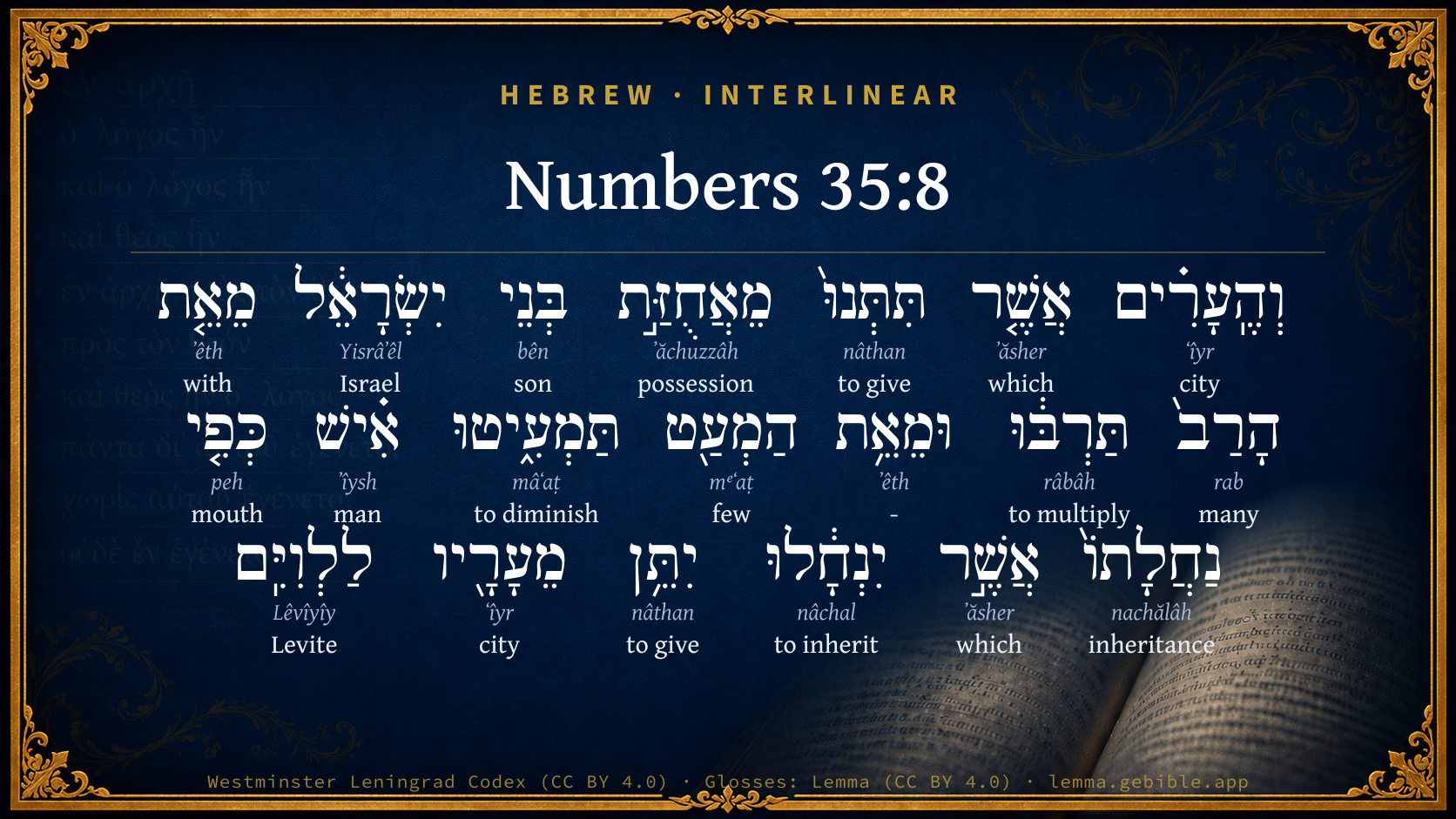
Numbers 35:8

Hebrew (Westminster Leningrad Codex) Numbers 35:8 appears in the Hebrew Old Testament. The text above is from the Westminster Leningrad Codex. Each word links to its Strong’s number, a concise gloss, and parsing drawn from the Open Scriptures Hebrew Bible morphology. Click any word for its full Brown-Driver-Briggs (BDB) entry.
Download image
Cite this verse

Numbers 35:8 (World English Bible). Public Domain. Lemma interlinear Bible study tool, https://lemma.gebible.app/v/numbers/35/8.

Show BibTeX & RIS
BibTeX
RIS
English Translation
Concerning the cities which you shall give of the possession of the children of Israel, from the many you shall take many; and from the few you shall take few: everyone according to his inheritance which he inherits shall give of his cities to the Levites.
World English Bible · Public Domain
Download a study sheet

One document with this verse’s original text, its word-by-word gloss line, the meaning frame, cross-references with their text, attributed commentary, and full source and license credits — printable, and it pastes into notes with its structure intact.

This verse Autodidact and up

Study sheet (.html) Plain text (.txt)

A passage Seminary Student

Up to 50 verses in one chapter. A passage sheet keeps up to 6 commentary sources and 12 cross-references per verse, in the order this page ranks them, and says so on the sheet whenever that leaves anything out. Ask for a single verse and you get the Autodidact verse sheet above.

Everything on this page stays free to read, with no account — the sheet is a download of what is already on screen, not access to it.

Want to remove ads? Support Godless Engineer
Compare translations 3

The same verse in 3 English versions, stacked beneath the original-language interlinear above. Click any original word for its lexicon entry.

Each is an independent rendering of the whole verse — the interlinear is not word-aligned to these translations.

Highlighted words mark where these versions differ — a whole-verse word diff, not a word-by-word alignment.

  • World English Bible Public Domain
    Concerning the cities which you shall give of the possession of the children of Israel, from the many you shall take many; and from the few you shall take few: everyone according to his inheritance which he inherits shall give of his cities to the Levites.
  • King James Version Public Domain
    And the cities which ye shall give shall be of the possession of the children of Israel: from them that have many ye shall give many; but from them that have few ye shall give few: every one shall give of his cities unto the Levites according to his inheritance which he inheriteth.
  • unfoldingWord Literal Text CC BY-SA 4.0
    And the cities that you shall give from the possession of the sons of Israel, you shall increase from with the numerous, and you shall decrease from with the few. A man shall give from his cities to the Levites according to the mouth of his inheritance that he has inherited.”

unfoldingWord Literal Text — © unfoldingWord, licensed CC BY-SA 4.0. Word-aligned USFM3 via Door43 (git.door43.org/unfoldingWord/en_ult).

Versions to compare (up to 4)

3 of 4 selected

Show all 18 translations

Every available English version of this verse, each an independent rendering of the whole verse.

  • World English Bible Public Domain
    Concerning the cities which you shall give of the possession of the children of Israel, from the many you shall take many; and from the few you shall take few: everyone according to his inheritance which he inherits shall give of his cities to the Levites.
  • Berean Standard Bible Public Domain
    The cities that you apportion from the territory of the Israelites should be given to the Levites in proportion to the inheritance of each tribe: more from a larger tribe and less from a smaller one.”
  • Majority Standard Bible Public Domain
    The cities that you apportion from the territory of the Israelites should be given to the Levites in proportion to the inheritance of each tribe: more from a larger tribe and less from a smaller one.”
  • King James Version Public Domain
    And the cities which ye shall give shall be of the possession of the children of Israel: from them that have many ye shall give many; but from them that have few ye shall give few: every one shall give of his cities unto the Levites according to his inheritance which he inheriteth.
  • American Standard Version (1901) Public Domain
    And concerning the cities which ye shall give of the possession of the children of Israel, from the many ye shall take many; and from the few ye shall take few: every one according to his inheritance which he inheriteth shall give of his cities unto the Levites.
  • Revised Version (1885) Public Domain
    And concerning the cities which ye shall give of the possession of the children of Israel, from the many ye shall take many; and from the few ye shall take few: every one according to his inheritance which he inheriteth shall give of his cities unto the Levites.
  • Geneva Bible (1599) Public Domain
    And concerning the cities which yee shall giue, of the possession of the children of Israel: of many ye shall take more, and of few ye shall take lesse: euery one shall giue of his cities vnto the Leuites, according to his inheritance, which hee inheriteth.
  • Douay-Rheims (1899) Public Domain
    And of these cities which shall be given out of the possessions of the children of Israel, from them that have more, more shall be taken: and from them that have less, fewer. Each shall give towns to the Levites according to the extent of their inheritance.
  • Young's Literal Translation Public Domain
    And the cities which ye give `are' of the possession of the sons of Israel, from the many ye multiply, and from the few ye diminish; each, according to his inheritance which they inherit, doth give of his cities to the Levites.'
  • Literal Standard Version CC BY-SA 4.0
    And the cities which you give [are] from the possession of the sons of Israel; from the many you multiply, and from the few you diminish; each, according to his inheritance which they inherit, gives to the Levites from his cities.”
  • Unlocked Literal Bible CC BY-SA 4.0
    The larger tribes of the people of Israel, the tribes that have more land, must provide more cities. The smaller tribes will provide fewer cities. Each tribe must provide for the Levites according to the share that it has received.”
  • unfoldingWord Literal Text CC BY-SA 4.0
    And the cities that you shall give from the possession of the sons of Israel, you shall increase from with the numerous, and you shall decrease from with the few. A man shall give from his cities to the Levites according to the mouth of his inheritance that he has inherited.”
  • Darby Bible Public Domain
    And the cities which ye shall give shall be of the possession of the children of Israel: from them that have much ye shall take much, and from them that have little ye shall take little; each one according to his inheritance which he will inherit shall give of his cities to the Levites.
  • World Messianic Bible Public Domain
    Concerning the cities which you shall give of the possession of the children of Israel, from the many you shall take many, and from the few you shall take few. Everyone according to his inheritance which he inherits shall give some of his cities to the Levites.”
  • Webster's Bible Public Domain
    And the cities which ye shall give shall be of the possession of the children of Israel: from them that have many ye shall give many; but from them that have few ye shall give few: every one shall give of his cities to the Levites according to his inheritance which he inheriteth.
  • Free Bible Version CC BY-SA 4.0
    The towns that you allocate to be given to the Levites from the territory of the Israelites will be more from a larger tribe and less from a smaller one. The number will be in proportion to the size of the land allocation of each tribe.”
  • Bible in Basic English Public Domain
    And these towns are to be given out of the heritage of the children of Israel, taking the greater number from those who have much, and a smaller number from those who have little: everyone, in the measure of his heritage, is to give of his property to the Levites.
  • JPS Tanakh (1917) Public Domain
    And concerning the cities which ye shall give of the possession of the children of Israel, from the many ye shall take many, and from the few ye shall take few; each tribe according to its inheritance which it inheriteth shall give of its cities unto the Levites.'

Literal Standard Version (2020), Covenant Press — licensed CC BY-SA 4.0. Text via the HelloAO Bible API (eBible.org). Unlocked Literal Bible (unfoldingWord) — licensed CC BY-SA 4.0. Text via the HelloAO Bible API (eBible.org). unfoldingWord Literal Text — © unfoldingWord, licensed CC BY-SA 4.0. Word-aligned USFM3 via Door43 (git.door43.org/unfoldingWord/en_ult). Free Bible Version, Dr. Jonathan Gallagher — licensed CC BY-SA 4.0. Text via the HelloAO Bible API (eBible.org).

Word by word

More ways to search: Search by grammar → Find every occurrence → Compare this word →

Practice this passage: Drill this verse → Learn its vocabulary →

תַּמְעִ֑יטוּ
mâʻaṭ
H4591
“to diminish”
Verb, Hiphil, Imperfect, 2nd Person, Masculine, Plural
Part of Speech
Verb
Stem
Hiphil
Form
Imperfect
Person
2nd Person
Gender
Masculine
Number
Plural
Full BDB Definition

Origin: a primitive root

TWOT: 1228

to be or become small, be few, be diminished - (Qal) - to diminish - to be too small - (Piel) to become few - (Hiphil) - to make small, make few, diminish - to give less
  1. וְהֶֽעָרִ֗ים ʻîyr H5892 “and · the · cities” Conjunction + Particle, Definite Article + Noun, Common, Feminine, Plural, Absolute
  2. אֲשֶׁ֤ר ʼăsher H834 “which” Particle, Relative
  3. תִּתְּנוּ֙ nâthan H5414 “to give” Verb, Qal, Imperfect, 2nd Person, Masculine, Plural
  4. מֵאֲחֻזַּ֣ת ʼăchuzzâh H272 “from · possession of” Preposition + Noun, Common, Feminine, Singular, Construct
  5. בְּנֵי bên H1121 “sons of” Noun, Common, Masculine, Plural, Construct
  6. יִשְׂרָאֵ֔ל Yisrâʼêl H3478 “Israel” Noun, Proper
  7. מֵאֵ֤ת ʼêth H854 “from · with” Preposition + Preposition
  8. הָרַב֙ rab H7227 “the · many” Particle, Definite Article + Adjective, Adjective, Masculine, Singular, Absolute
  9. תַּרְבּ֔וּ râbâh H7235 “to multiply” Verb, Hiphil, Imperfect, 2nd Person, Masculine, Plural
  10. וּמֵאֵ֥ת ʼêth H853 “and · from · -” Conjunction + Preposition + Particle, Direct Object
  11. הַמְעַ֖ט mᵉʻaṭ H4592 “the · few” Particle, Definite Article + Adjective, Adjective, Masculine, Singular, Absolute
  12. אִ֗ישׁ ʼîysh H376 “man” Noun, Common, Masculine, Singular, Absolute
  13. כְּפִ֤י peh H6310 “like/as · mouth of” Preposition + Noun, Common, Masculine, Singular, Construct
  14. נַחֲלָתוֹ֙ nachălâh H5159 “inheritance · his” Noun, Common, Feminine, Singular, Construct + Suffix, Personal, 3rd Person, Masculine, Singular
  15. אֲשֶׁ֣ר ʼăsher H834 “which” Particle, Relative
  16. יִנְחָ֔לוּ nâchal H5157 “to inherit” Verb, Qal, Imperfect, 3rd Person, Masculine, Plural
  17. יִתֵּ֥ן nâthan H5414 “to give” Verb, Qal, Imperfect, 3rd Person, Masculine, Singular
  18. מֵעָרָ֖יו ʻîyr H5892 “from · cities · his” Preposition + Noun, Common, Feminine, Plural, Construct + Suffix, Personal, 3rd Person, Masculine, Singular
  19. לַלְוִיִּֽם Lêvîyîy H3881 “to/for the · Levites” Preposition, Determined + Noun, Gentilic, Masculine, Plural, Absolute

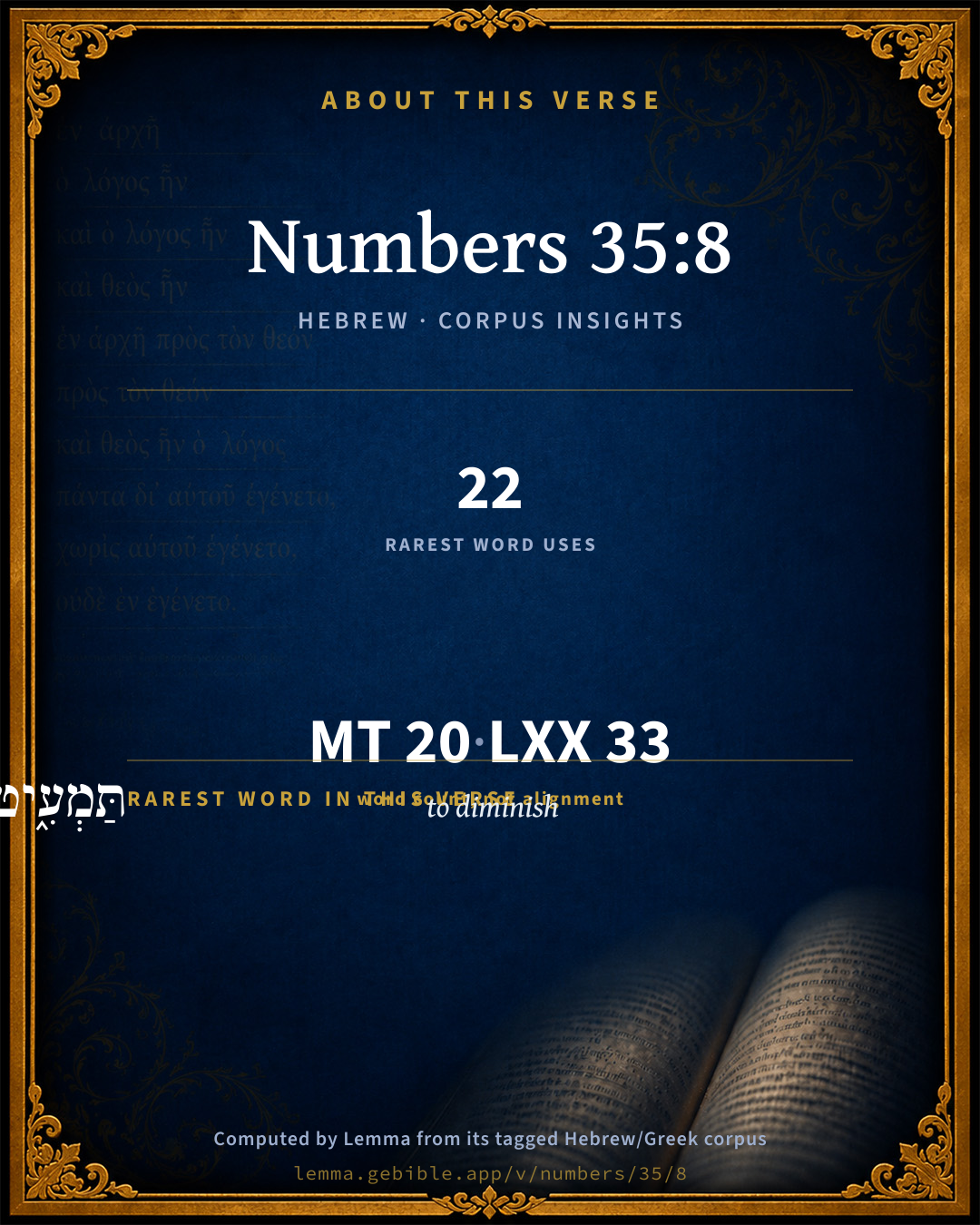
About this verse

These counts appear in no published source. They are computed here, from the morphology-tagged text and Lemma’s own curated glosses. What Lemma adds →

20
words
17
distinct lemmas
Pentateuch
section

Notable vocabulary

The rarest word here is תַּמְעִ֑יטוּ to diminish H4591 — appearing just 22 times in the whole Hebrew Bible.

Shared distinctive vocabulary

תַּמְעִ֑יטוּ to diminish H4591 occurs in 21 verses of the Hebrew Bible. Also found in:

Grammatical profile

  • 5 verbs
  • 9 nouns
  • 2 adjectives
  • 1 preposition
  • 3 particles

Verb forms

  • תִּתְּנוּ֙ Qal · Imperfect
  • תַּרְבּ֔וּ Hiphil · Imperfect
  • תַּמְעִ֑יטוּ Hiphil · Imperfect
  • יִנְחָ֔לוּ Qal · Imperfect
  • יִתֵּ֥ן Qal · Imperfect

Repetition

Words recur within this verse — often emphatic in Hebrew:

  • וְהֶֽעָרִ֗ים city H5892 ×2
  • תִּתְּנוּ֙ to give H5414 ×2
  • אֲשֶׁ֤ר which H834 ×2

Hebrew & Septuagint length

In English translation the verse runs 46 words from the Hebrew and 56 from the Septuagint (LXX English) — closely comparable.

A rough comparison of the two English renderings, which tokenize alike — not a word-level alignment.

Word counts can differ between the Hebrew and the Greek without any difference in meaning — e.g. the Hebrew direct-object marker אֵת has no separate Greek word, and Greek often adds the article ὁ.

In the original languages it is 20 Hebrew tokens and 33 Greek tokens — but the two are counted differently (Hebrew bundles its prefixes and suffixes into one token; the Greek is in lemma form), so that isn’t a like-for-like length.

Cross-references

8

Topical passages linked to Numbers 35:8 in the Treasury of Scripture Knowledge — connected by theme and wording, ordered by reader-vote popularity; previews shown in the World English Bible.

  • Numbers 26:54 To the more you shall give the more inheritance, and to the fewer you shall give the less inheritance: to everyone according to those who were numbered of him shall his inheritance be given.
  • Numbers 33:54 You shall inherit the land by lot according to your families; to the more you shall give the more inheritance, and to the fewer you shall give the less inheritance: wherever the lot falls to any man, that shall be his; according to the tribes of your fathers shall you inherit.
  • Exodus 16:18 When they measured it with an omer, he who gathered much had nothing over, and he who gathered little had no lack. They gathered every man according to his eating.
  • Joshua 21:1–42 Then came near the heads of fathers' [houses] of the Levites to Eleazar the priest, and to Joshua the son of Nun, and to the heads of fathers' [houses] of the tribes of the children of Israel;
  • Genesis 49:7 Cursed be their anger, for it was fierce; And their wrath, for it was cruel. I will divide them in Jacob, Scatter them in Israel.
  • Exodus 32:28–29 The sons of Levi did according to the word of Moses: and there fell of the people that day about three thousand men.
  • Deuteronomy 33:8–11 Of Levi he said, Your Thummim and your Urim are with your godly one, Whom you did prove at Massah, With whom you did strive at the waters of Meribah;
  • 2 Corinthians 8:13–14 For this is not that others may be eased and you distressed,

Cross-references courtesy of OpenBible.info (CC BY 4.0).

Hebrew and Greek witnesses Masoretic Hebrew ↔ Greek Septuagint

The same verse in the two great witnesses to the Old Testament, shown verse-for-verse.

These are two independent witnesses, not word-aligned to each other, and the Septuagint is shown in lemma (dictionary) form.

Hebrew Numbers 35:8 Masoretic · Westminster Leningrad Codex

וְהֶֽעָרִ֗ים אֲשֶׁ֤ר תִּתְּנוּ֙ מֵאֲחֻזַּ֣ת בְּנֵי יִשְׂרָאֵ֔ל מֵאֵ֤ת הָרַב֙ תַּרְבּ֔וּ וּמֵאֵ֥ת הַמְעַ֖ט תַּמְעִ֑יטוּ אִ֗ישׁ כְּפִ֤י נַחֲלָתוֹ֙ אֲשֶׁ֣ר יִנְחָ֔לוּ יִתֵּ֥ן מֵעָרָ֖יו לַלְוִיִּֽם

Concerning the cities which you shall give of the possession of the children of Israel, from the many you shall take many; and from the few you shall take few: everyone according to his inheritance which he inherits shall give of his cities to the Levites.

World English Bible · Public Domain

Greek LXX Numbers 35:8 Septuagint · lemma form

καί ὁ πόλις ὅς δίδωμι ἀπό ὁ κατάσχεσις υἱός ἰσραήλ ἀπό ὁ ὁ πολύς πολύς καί ἀπό ὁ ἐλαχύς ἐλαχύς ἕκαστος κατά ὁ κληρονομία αὐτός ὅς κληρονομέω δίδωμι ἀπό ὁ πόλις ὁ λευίτης

And as for the cities which you⌃ shall give out of the possession of the children of Israel, from those that have much you⌃ shall give much, and from those that have less you⌃ shall give less: they shall give of their cities to the Levites each one according to his inheritance which they shall inherit.

LXX2012 (modern English Septuagint) · Public Domain

Hebrew: Westminster Leningrad Codex (CC BY 4.0). Greek: Septuagint (public domain); English from LXX2012 (modern English Septuagint) (Public Domain). How the Septuagint differs from the Hebrew →

Targum (Aramaic paraphrase)

2

The Targum is the ancient Jewish Aramaic paraphrase of the Hebrew Scriptures — an interpretive translation, not the Hebrew text itself. Onkelos (literal) and Pseudo-Jonathan (expansive) render the Torah, and Jonathan the Prophets. Coverage is partial: where no permissively-licensed English translation exists for a verse, only the Aramaic is shown. This is verse-level text, not a word-by-word alignment to the Hebrew.

  1. Targum Onkelos Torah (Genesis–Deuteronomy)
    וְקִרְוַיָא דִי תִתְּנוּן מֵאֲחוּדַת בְּנֵי יִשְׂרָאֵל מִן סַגִיאֵי תַּסְגוּן וּמִן זְעִירֵי תַּזְעִירוּן גְבַר כְּפוּם אַחֲסַנְתֵּהּ דִי יַחְסְנוּן יִתֵּן מִקִרְווֹהִי לְלֵוָאֵי

    (no public-domain English translation for this verse)

    Targum Onkelos — Aramaic: “Onkelos Genesis” (public domain); “Onkelos Exodus” (public domain); “Onkelos Leviticus” (public domain); “Onkelos Numbers” (public domain); “Onkelos Deuteronomy” (public domain). English: “Sefaria Community Translation” (CC0 1.0 (public-domain dedication)); “J.W. Etheridge. The Targums of Onkelos and Jonathan Ben Uzziel on the Pentateuch. London: Longmans, Green, 1862” (public domain). Text via Sefaria.

  2. Targum Pseudo-Jonathan Torah (Genesis–Deuteronomy)
    וְקוּרְיַין דְתִתְּנוּן מִן אַחֲסָנַת בְּנֵי יִשְרָאֵל מִן שִׁבְטָא דְעַמֵיהּ סַגִי תַּסְגוּן וּמִן שִׁבְטָא דְעַמֵיהּ זְעֵיר תִּזְעֵרוּן גְבַר אֲגַב אַחֲסַנְתֵּיהּ דְיַחְסְנוּן יִתֵּן מִקִירְוֵיהּ לְלֵוָאֵי

    But when you give the cities from the inheritance of the Beni Israel, from the tribe wbose people are many you shall give many, and from the tribe whose people are few you shall diminish; every one shall give of his cities to the Levites, according to the inheritance he possesses.

    Targum Pseudo-Jonathan — Aramaic: “Targum Jonathan on Genesis” (public domain); “Targum Jonathan on Exodus” (public domain); “Targum Jonathan on Leviticus” (public domain); “Targum Jonathan on Numbers” (public domain); “Targum Jonathan on Deuteronomy” (public domain). English: “The Targum of Jonathan ben Uzziel, trans. J. W. Etheridge, London, 1862” (public domain). Text via Sefaria.

Commentary

Notes on Numbers 35:8 from classic Christian and Jewish commentators (each source and its license shown beneath its notes). The classic Christian expositions comment on the surrounding passage and are grouped to its opening verse, so a note may address several verses; the Jewish commentaries on the Tanakh (Rashi and others) are per-verse, so they appear only where the commentator wrote on this verse.

Lemma curates 59 commentaries, every one of them public domain or Creative Commons licensed, each selected and text-cleaned for this edition rather than reprinted as found. About our sources →

Trapp's Complete Commentary

John Trapp

Num 35:8 And the cities which ye shall give [shall be] of the possession of the children of Israel: from [them that have] many ye shall give many; but from [them that have] few ye shall give few: every one shall give of his cities unto the Levites according to his inheritance which he inheriteth.

Ver. 8. From them that have many ye shall give.] By the equity of this proportion, the richer are bound to give more to the minister’s maintenance than the poorer. Let this be noted by those that refuse to give anything to their ministers, because they have not those things, the tithes whereof the law requires for this purpose. See Gal 6:6, {See Trapp on "Gal 6:6"}

John Trapp, A Commentary or Exposition upon All the Books of the Old and New Testament (1647–1656) — public domain. Text from a community e-Sword module.

Jamieson, Fausset & Brown

Robert Jamieson, A. R. Fausset & David Brown

the cities which ye shall give shall be of the possession of the children of Israel--The burden of furnishing those places for the residence and support of the Levitical order was to fall in equitable proportions upon the different tribes (see Num 33:54; Jos 20:7).

Jamieson, Fausset & Brown — Commentary Critical and Explanatory on the Whole Bible (1871) — public domain (CC PDM 1.0). Text via the HelloAO Bible API.

John Gill's Exposition

And the cities which ye shall give shall be of the possession of the children of Israel,.... What shall fall by lot for their inheritance, and they shall be possessed of; and though they are, shall not refuse, nor grudge to give them, according to the direction of God, whose the land is, they holding it under him:

from them that have many ye shall give many, but from them that have few ye shall give few; which rule was observed; for out of Judah, whose lot was large, and out of Simeon, whose inheritance was within that of Judah, because it was so large, nine cities were given, whereas out of the other tribes only four cities out of each were given, and out of one of them but three, see Jos 21:1,

everyone shall give of his cities unto the Levites, according to his inheritance which he inheriteth; and the Levites, being thus dispersed among the several tribes, were of great advantage to them, to instruct them in the knowledge of divine things; so that though hereby Jacob's curse on this tribe had its fulfilment, that it should be divided in Jacob, and scattered in Israel, yet that became a blessing to the rest of the tribes; see Gen 49:7.

John Gill's Exposition of the Whole Bible (1746–1763) — public domain (CC PDM 1.0). Text via the HelloAO Bible API.

Albert Barnes' Notes on the Bible

Nine cities were eventually given to the Levites from the large joint inheritance of Judah and Simeon; three were taken from the territory of Naphtali, and the other tribes gave each four apiece.

Albert Barnes' Notes on the Bible (1834–1885) — public domain. Text from a community e-Sword/MySword module.

Matthew Poole's English Annotations

Ye shall give many: compare Num 33:54; Jos 20:2.

Matthew Poole's English Annotations on the Holy Bible (1683–1685) — public domain. Text from a community e-Sword/MySword module.

Whedon's Commentary on the Bible

Daniel D. Whedon

8. Many… many… few… few — According to Joshua xxi, Judah and Simeon, whose territorial allotments seem to have been blended very early, as predicted by Jacob, (Gen_49:5; Gen_49:7,) gave to the Levites nine of their cities, the other tribes gave four each, except Naphtali, who gave only three, making thirty-eight cities west of the Jordan. The eastern tribes gave ten. The thirteen given by Judah, Simeon, and Benjamin were assigned to the priests, being near the tabernacle and temple, and thirty-five to the three Levitical families. “Called out of the whole nation to be the peculiar possession of Jehovah, to watch over his covenant, and teach Israel his rights and his law, (Deu_31:9-13; Deu_33:8-10; Lev_10:11,) the Levites were to form and set forth among all the tribes the εκλογη (election) of the nation of Jehovah’s possession, and, by their walk as well as by their calling, to remind the Israelites continually of their own divine calling, to foster and preserve the law and testimony of the Lord in Israel, and to awaken and spread the fear of God and piety among all the tribes.” — Keil and Delitzsch. If the Levitical families had been completely isolated, they would have been in danger of spiritual declension. Their association was a safeguard against this evil.

Daniel D. Whedon (gen. ed.), Commentary on the Old and New Testaments (1874–1909) — public domain. Text from a community e-Sword module.

The Pulpit Commentary

And the cities which ye shall give shall be, &c. Rather, "And as to the cities which ye shall give from the possession of the children of Israel, from the many ye shall multiply, and from the few ye shall decrease." What seems to be a general rule of proportionate giving is laid down here, but it was not carried out, and it is not easy to see how it could have been. From the large combined territory of Judah and Simeon nine cities were indeed surrendered, ; (Jos 21) but all the rest, great and small, gave up four apiece, except Naphtali, which gave up three only. As the territory of Naphtali was apparently large in proportion to its numbers, this was probably for no other reason than that the tribe stood last on the list. Every one. Hebrew, vyai. It was in fact each tribe that surrendered so many cities, but since the tribal inheritance was the joint property of all the tribesmen, every man felt that he was a party to the gift. No doubt it was the Divine intention to foster in the tribes as far as possible this local feeling of interest and property in the Levites who dwelt among them. (compare the expression "their scribes and Pharisees" in Luk_5:30) The dispersion of the Levites (however mysteriously connected with the prophecy of Gen_49:5-7) was obviously designed to form a bond of unity for all Israel by diffusing the knowledge and love of the national religion, and by keeping up a constant communication between the future capital and all the provinces. According to the Divine ideal Israel as a whole was "the election" (h eklogh ) from all the earth, the Levites were the eklogh of Israel, and the priests the eklogh of Levi. The priestly family was at present too small to be influential, but the Levites were numerous enough to have leavened the whole nation if they had walked worthy of their calling. They were gathered together in towns of their own, partly no doubt in order to avoid disputes, but partly that they might have a better opportunity of setting forth the true ideal of what Jewish life should be.

The Pulpit Commentary (1880–1919), ed. H.D.M. Spence-Jones & Joseph S. Exell — public domain. Text from a community e-Sword module.

unfoldingWord translationNotes

Door43 World Missions Community

General Information:

Yahweh continues telling Moses what the people must do.

translationWords

tribe

Israel

Levi

unfoldingWord translationNotes — © Distant Shores Media and the Door43 World Missions Community, licensed CC BY-SA 4.0. Source: git.door43.org/Door43/en_tn.

Ramban (Nachmanides)

Rabbi Moshe ben Nachman (Ramban / Nachmanides)

FROM THE MANY YE SHALL TAKE MANY, AND FROM THE FEW YE SHALL TAKE FEW. Here too, in the opinion of our Rabbis [the meaning is that] from the paternal families which received a large amount as their inheritance, they should take many [cities], as He mentioned according to your families, while each tribe received exactly the same amount of land [and therefore had to provide an equal number of cities for the Levites]. And although you will find in the Book of Joshua that the number of cities which they gave to the Levites was not equal, equal” is thus clear, as is proven in the cases of Judah, Shimon, and Naphtali. according to the number of tribes, that was because of the [different] value of the particular cities, since some were more important than the others, for the Land was divided according to its value. ). A proof to this is the fact that from [the tribes of] Judah, Shimon and Benjamin they gave thirteen cities [to the Levites], and from the tribes of Issachar, Asher, Naphtali, and the half-tribe of Menasheh, [also] thirteen [cities were given], and yet these [latter tribes] were larger than the former ones in their population. ), Shimon (Verse 14), and Benjamin (Verse 41) totalled 144,300. Issachar (Verse 25), Asher (Verse 47), and Naphtali (Verse 50) totalled 163,100. The complete tribe of Menasheh (Verse 34) totalled 52,700. Assuming that the half-tribe of Menasheh mentioned in Joshua was exact half [i.e., 26,350] we have a total for the latter group mentioned of 189,450, which is far more than the 144,300 of the first group. And from the tribe of Ephraim they gave four cities [to the Levites], and from the tribe of Dan four cities, Verses 23-24. and yet the children of Dan were double [the population] of the children of Ephraim., Verse 43)! Thus we must say that the cities were not given in proportion to the population of the tribes, but according to the appraised value of the city.

Ramban (Nachmanides) on the Tanakh — English translation: “Commentary on the Torah by Ramban (Nachmanides). Translated and annotated by Charles B. Chavel. New York, Shilo Pub. House, 1971-1976” (CC BY 4.0). Text via Sefaria.

Sforno

Rabbi Ovadia Sforno

Take more from a larger [holding]. They valued the portions monetarily, and the small amount of that tribe that had a small portion was equal in value to the larger portion, given to the Levites, of the tribe that had a larger inheritance.

Sforno on the Tanakh — English translation: “Yalkut, Sifsei Chachomim Chumash, Metsudah Publications, 2009” (CC BY 4.0). Text via Sefaria.

Lesson kit

Teaching starters — assembled from the data on this page, not authored interpretation. Every prompt links to the verse data it draws on. Edit before teaching.

Numbers, in the Pentateuch, opens this verse with 20 words (17 distinct Hebrew lemmas). Its most distinctive word is mâʻaṭ (“to diminish”). A historical commentator’s framing appears above. Read the whole chapter for the surrounding context.

Discussion questions

  1. What does “to diminish” (mâʻaṭ) contribute to the verse as a whole?
  2. Exodus 12:4 shares the word «to diminish» with this verse. How do the two illuminate each other?
  3. “city” occurs 2× in this one verse. What is the effect of the repetition?
  4. These translations render this verse differently; the difference is in the English rendering, not the original. What questions does that raise?
  5. The verb «תִּתְּנוּ֙» is Qal Imperfect. How does its form color the action?
  6. Reading how Trapp's Complete Commentary and Jamieson, Fausset & Brown read this verse, where do the two commentators agree and where do they part?

Things to notice

Reading settings

Reading text

Shown beneath each verse's original-language words.

Old Testament
Old Testament edition

Read the OT as the Masoretic Hebrew (MT) or the Greek Septuagint (LXX).

English shown for the Greek Septuagint (in the Hebrew ↔ Greek comparison).

Comparing translations? Open the Compare panel on any verse page to stack up to four side by side.