
Daniel 9:18

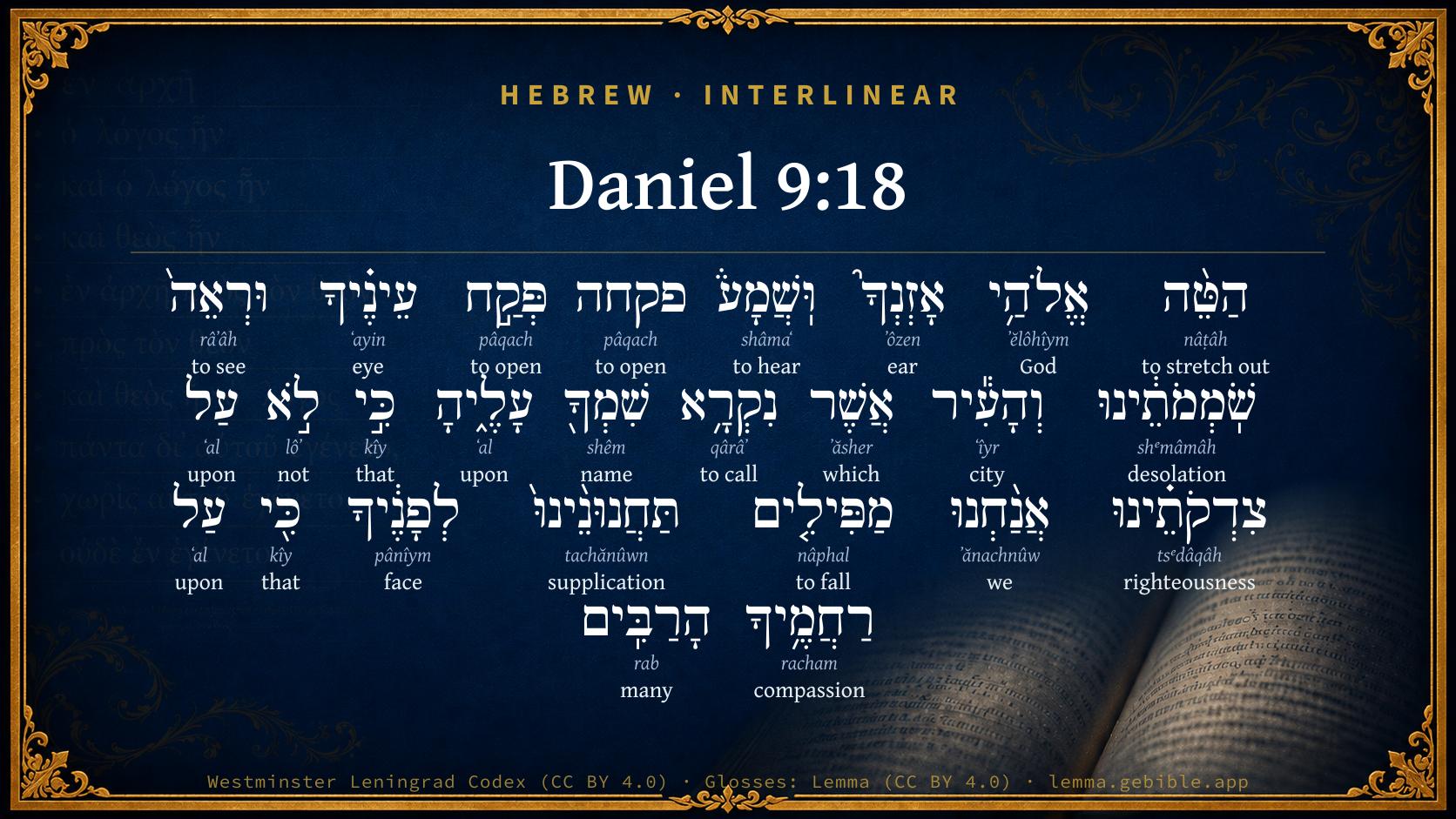
Hebrew (Westminster Leningrad Codex) Daniel 9:18 appears in the Hebrew Old Testament. The text above is from the Westminster Leningrad Codex. Each word links to its Strong’s number, a concise gloss, and parsing drawn from the Open Scriptures Hebrew Bible morphology. Click any word for its full Brown-Driver-Briggs (BDB) entry.
Download image
Cite this verse

Daniel 9:18 (World English Bible). Public Domain. Lemma interlinear Bible study tool, https://lemma.gebible.app/v/daniel/9/18.

Show BibTeX & RIS
BibTeX
RIS
English Translation
My God, turn your ear, and hear; open your eyes, and see our desolations, and the city which is called by your name: for we do not present our petitions before you for our righteousness, but for your great mercies' sake.
World English Bible · Public Domain
Download a study sheet

One document with this verse’s original text, its word-by-word gloss line, the meaning frame, cross-references with their text, attributed commentary, and full source and license credits — printable, and it pastes into notes with its structure intact.

This verse Autodidact and up

Study sheet (.html) Plain text (.txt)

A passage Seminary Student

Up to 50 verses in one chapter. A passage sheet keeps up to 6 commentary sources and 12 cross-references per verse, in the order this page ranks them, and says so on the sheet whenever that leaves anything out. Ask for a single verse and you get the Autodidact verse sheet above.

Everything on this page stays free to read, with no account — the sheet is a download of what is already on screen, not access to it.

Want to remove ads? Support Godless Engineer
Compare translations 3

The same verse in 3 English versions, stacked beneath the original-language interlinear above. Click any original word for its lexicon entry.

Each is an independent rendering of the whole verse — the interlinear is not word-aligned to these translations.

Highlighted words mark where these versions differ — a whole-verse word diff, not a word-by-word alignment.

  • World English Bible Public Domain
    My God, turn your ear, and hear; open your eyes, and see our desolations, and the city which is called by your name: for we do not present our petitions before you for our righteousness, but for your great mercies' sake.
  • King James Version Public Domain
    O my God, incline thine ear, and hear; open thine eyes, and behold our desolations, and the city which is called by thy name: for we do not present our supplications before thee for our righteousnesses, but for thy great mercies.
  • unfoldingWord Literal Text CC BY-SA 4.0
    O my God, incline your ear and hear; open your eyes and see our desolations, and the city that is called by your name. For we are not presenting our supplications before you because of our righteousness, but because of your great mercy.

unfoldingWord Literal Text — © unfoldingWord, licensed CC BY-SA 4.0. Word-aligned USFM3 via Door43 (git.door43.org/unfoldingWord/en_ult).

Versions to compare (up to 4)

3 of 4 selected

Show all 18 translations

Every available English version of this verse, each an independent rendering of the whole verse.

  • World English Bible Public Domain
    My God, turn your ear, and hear; open your eyes, and see our desolations, and the city which is called by your name: for we do not present our petitions before you for our righteousness, but for your great mercies' sake.
  • Berean Standard Bible Public Domain
    Incline Your ear, O my God, and hear; open Your eyes and see the desolation of the city that bears Your name. For we are not presenting our petitions before You because of our righteous acts, but because of Your great compassion.
  • Majority Standard Bible Public Domain
    Incline Your ear, O my God, and hear; open Your eyes and see the desolation of the city that bears Your name. For we are not presenting our petitions before You because of our righteous acts, but because of Your great compassion.
  • King James Version Public Domain
    O my God, incline thine ear, and hear; open thine eyes, and behold our desolations, and the city which is called by thy name: for we do not present our supplications before thee for our righteousnesses, but for thy great mercies.
  • American Standard Version (1901) Public Domain
    O my God, incline thine ear, and hear; open thine eyes, and behold our desolations, and the city which is called by thy name: for we do not present our supplications before thee for our righteousness, but for thy great mercies' sake.
  • Revised Version (1885) Public Domain
    O my God, incline thine ear, and hear; open thine eyes, and behold our desolations, and the city which is called by thy name: for we do not present our supplications before thee for our righteousnesses, but for thy great mercies.
  • Geneva Bible (1599) Public Domain
    O my God, encline thine eare and heare: open thine eyes, and beholde our desolations, and the citie whereupon thy Name is called: for we doe not present our supplications before thee for our owne righteousnes, but for thy great tender mercies.
  • Douay-Rheims (1899) Public Domain
    Incline, O my God, thy ear, and hear: open thy eyes, and see our desolation, and the city upon which thy name is called: for it is not for our justifications that we present our prayers before thy face, but for the multitude of thy tender mercies.
  • Young's Literal Translation Public Domain
    `Incline, O my God, Thine ear, and hear, open Thine eyes and see our desolations, and the city on which Thy name is called; for not for our righteous acts are we causing our supplications to fall before Thee, but for Thy mercies that `are' many.
  • Literal Standard Version CC BY-SA 4.0
    Incline, O my God, Your ear, and hear, open Your eyes and see our desolations, and the city on which Your Name is called; for not for our righteous acts are we causing our supplications to fall before You, but for Your mercies that [are] many.
  • Unlocked Literal Bible CC BY-SA 4.0
    My God, open your ears and listen; open your eyes and see. We have been devastated; look at the city that is called by your name. We do not beg for your help because of our righteousness, but because of your great mercy.
  • unfoldingWord Literal Text CC BY-SA 4.0
    O my God, incline your ear and hear; open your eyes and see our desolations, and the city that is called by your name. For we are not presenting our supplications before you because of our righteousness, but because of your great mercy.
  • Darby Bible Public Domain
    Incline thine ear, O my God, and hear; open thine eyes and behold our desolations, and the city that is called by thy name: for we do not present our supplications before thee because of our righteousnesses, but because of thy manifold mercies.
  • World Messianic Bible Public Domain
    My God, turn your ear and hear. Open your eyes and see our desolations, and the city which is called by your name; for we do not present our petitions before you for our righteousness, but for your great mercies’ sake.
  • Webster's Bible Public Domain
    O my God, incline thy ear, and hear; open thy eyes, and behold our desolations, and the city which is called by thy name: for we do not present our supplications before thee for our righteousnesses, but for thy great mercies.
  • Free Bible Version CC BY-SA 4.0
    Please listen carefully and open your eyes and see the terrible state we are in, and the city that bears your name. We're not making these requests to you for this because of our goodness, but because of your great mercy.
  • Bible in Basic English Public Domain
    O my God, let your ear be turned and give hearing; let your eyes be open and see how we have been made waste and the town which is named by your name: for we are not offering our prayers before you because of our righteousness, but because of your great mercies.
  • JPS Tanakh (1917) Public Domain
    O my God, incline Thine ear, and hear; open Thine eyes, and behold our desolations, and the city upon which Thy name is called; for we do not present our supplications before Thee because of our righteousness, but because of Thy great compassions.

Literal Standard Version (2020), Covenant Press — licensed CC BY-SA 4.0. Text via the HelloAO Bible API (eBible.org). Unlocked Literal Bible (unfoldingWord) — licensed CC BY-SA 4.0. Text via the HelloAO Bible API (eBible.org). unfoldingWord Literal Text — © unfoldingWord, licensed CC BY-SA 4.0. Word-aligned USFM3 via Door43 (git.door43.org/unfoldingWord/en_ult). Free Bible Version, Dr. Jonathan Gallagher — licensed CC BY-SA 4.0. Text via the HelloAO Bible API (eBible.org).

Word by word

More ways to search: Search by grammar → Find every occurrence → Compare this word →

Practice this passage: Drill this verse → Learn its vocabulary →

תַּחֲנוּנֵ֨ינוּ֙
tachănûwn
H8469
“supplications · our”
Noun, Common, Masculine, Plural, Construct + Suffix, Personal, 1st Person, Common, Plural
Part of Speech
Noun
Type
Common
Gender
Masculine
Number
Plural
State
Construct
Full BDB Definition

Origin: from H2603

TWOT: 694g

supplication, supplication for favour - to man - to God
  1. הַטֵּ֨ה nâṭâh H5186 “stretch out” Verb, Hiphil, Imperative, 2nd Person, Masculine, Singular
  2. אֱלֹהַ֥י ʼĕlôhîym H430 “God(s) · my” Noun, Common, Masculine, Plural, Construct + Suffix, Personal, 1st Person, Common, Singular
  3. אָזְנְךָ֮ ʼôzen H241 “ear · your” Noun, Common, Feminine, Singular, Construct + Suffix, Personal, 2nd Person, Masculine, Singular
  4. וּֽשֲׁמָע֒ shâmaʻ H8085 “and · hear” Conjunction + Verb, Qal, Imperative, 2nd Person, Masculine, Singular
  5. פקחה pâqach H6491 “open” Verb, Qal, Imperative, 2nd Person, Masculine, Singular + Suffix, h
  6. פְּקַ֣ח pâqach H6491 “open” Verb, Qal, Imperative, 2nd Person, Masculine, Singular
  7. עֵינֶ֗יךָ ʻayin H5869 “eyes · your” Noun, Common, Both, Dual, Construct + Suffix, Personal, 2nd Person, Masculine, Singular
  8. וּרְאֵה֙ râʼâh H7200 “and · see” Conjunction + Verb, Qal, Imperative, 2nd Person, Masculine, Singular
  9. שֹֽׁמְמֹתֵ֔ינוּ shᵉmâmâh H8077 “desolation · us” Verb, Qal, Participle Active, Feminine, Plural, Construct + Suffix, Personal, 1st Person, Common, Plural
  10. וְהָעִ֕יר ʻîyr H5892 “and · the · city” Conjunction + Particle, Definite Article + Noun, Common, Feminine, Singular, Absolute
  11. אֲשֶׁר ʼăsher H834 “which” Particle, Relative
  12. נִקְרָ֥א qârâʼ H7121 “to call” Verb, Niphal, Perfect, 3rd Person, Masculine, Singular
  13. שִׁמְךָ֖ shêm H8034 “name · your” Noun, Common, Masculine, Singular, Construct + Suffix, Personal, 2nd Person, Masculine, Singular
  14. עָלֶ֑יהָ ʻal H5921 “upon · her” Preposition + Suffix, Personal, 3rd Person, Feminine, Singular
  15. כִּ֣י kîy H3588 “that” Conjunction
  16. לֹ֣א lôʼ H3808 “not” Particle, Negative
  17. עַל ʻal H5921 “upon” Preposition
  18. צִדְקֹתֵ֗ינוּ tsᵉdâqâh H6666 “righteous acts · our” Noun, Common, Feminine, Plural, Construct + Suffix, Personal, 1st Person, Common, Plural
  19. אֲנַ֨חְנוּ ʼănachnûw H587 “we” Pronoun, Personal, 1st Person, Common, Plural
  20. מַפִּילִ֤ים nâphal H5307 “falling” Verb, Hiphil, Participle Active, Masculine, Plural, Absolute
  21. לְפָנֶ֔יךָ pânîym H6440 “to/for · face(s) · your” Preposition + Noun, Common, Both, Plural, Construct + Suffix, Personal, 2nd Person, Masculine, Singular
  22. כִּ֖י kîy H3588 “that” Conjunction
  23. עַל ʻal H5921 “upon” Preposition
  24. רַחֲמֶ֥יךָ racham H7356 “compassion · your” Noun, Common, Masculine, Plural, Construct + Suffix, Personal, 2nd Person, Masculine, Singular
  25. הָרַבִּֽים rab H7227 “the · many” Particle, Definite Article + Adjective, Adjective, Masculine, Plural, Absolute

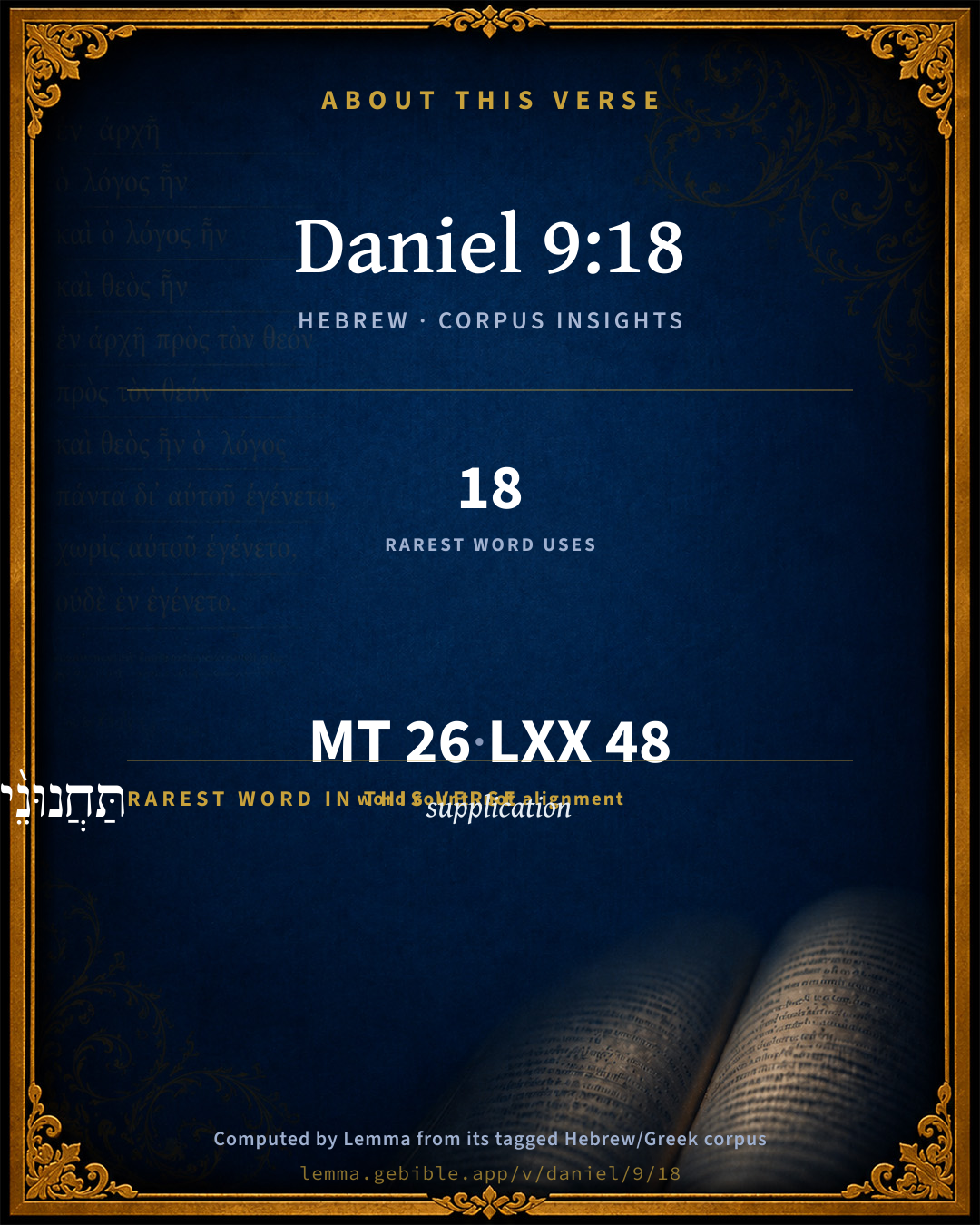
About this verse

These counts appear in no published source. They are computed here, from the morphology-tagged text and Lemma’s own curated glosses. What Lemma adds →

26
words
22
distinct lemmas
Prophets
section

Notable vocabulary

The rarest word here is תַּחֲנוּנֵ֨ינוּ֙ supplication H8469 — appearing just 18 times in the whole Hebrew Bible.

Shared distinctive vocabulary

תַּחֲנוּנֵ֨ינוּ֙ supplication H8469 occurs in 18 verses of the Hebrew Bible. Also found in:

Grammatical profile

  • 8 verbs
  • 9 nouns
  • 1 adjective
  • 1 pronoun
  • 3 prepositions
  • 2 conjunctions
  • 2 particles

Verb forms

  • הַטֵּ֨ה Hiphil · Imperative
  • וּֽשֲׁמָע֒ Qal · Imperative
  • פקחה Qal · Imperative
  • פְּקַ֣ח Qal · Imperative
  • וּרְאֵה֙ Qal · Imperative
  • שֹֽׁמְמֹתֵ֔ינוּ Qal · Participle Active
  • נִקְרָ֥א Niphal · Perfect
  • מַפִּילִ֤ים Hiphil · Participle Active

Repetition

Words recur within this verse — often emphatic in Hebrew:

  • עָלֶ֑יהָ upon H5921 ×3
  • פקחה to open H6491 ×2
  • כִּ֣י that H3588 ×2

Hebrew & Septuagint length

In English translation the verse runs 41 words from the Hebrew and 52 from the Septuagint (LXX English) — closely comparable.

A rough comparison of the two English renderings, which tokenize alike — not a word-level alignment.

Word counts can differ between the Hebrew and the Greek without any difference in meaning — e.g. the Hebrew direct-object marker אֵת has no separate Greek word, and Greek often adds the article ὁ.

In the original languages it is 26 Hebrew tokens and 48 Greek tokens — but the two are counted differently (Hebrew bundles its prefixes and suffixes into one token; the Greek is in lemma form), so that isn’t a like-for-like length.

Cross-references

18

Topical passages linked to Daniel 9:18 in the Treasury of Scripture Knowledge — connected by theme and wording, ordered by reader-vote popularity; previews shown in the World English Bible.

  • Isaiah 37:17 Turn your ear, Yahweh, and hear; open your eyes, Yahweh, and behold; and hear all the words of Sennacherib, who has sent to defy the living God.
  • Jeremiah 36:7 It may be they will present their supplication before Yahweh, and will return everyone from his evil way; for great is the anger and the wrath that Yahweh has pronounced against this people.
  • 2 Kings 19:16 Incline your ear, Yahweh, and hear; open your eyes, Yahweh, and see; and hear the words of Sennacherib, with which he has sent him to defy the living God.
  • Jeremiah 25:29 For, behold, I begin to work evil at the city which is called by my name; and should you be utterly unpunished? You shall not be unpunished; for I will call for a sword on all the inhabitants of the earth, says Yahweh of Hosts.
  • Psalms 80:14–19 Turn again, we beg you, God of hosts. Look down from heaven, and see, and visit this vine,
  • Jeremiah 14:7 Though our iniquities testify against us, work you for your name's sake, Yahweh; for our backslidings are many; we have sinned against you.
  • Jeremiah 15:16 Your words were found, and I ate them; and your words were to me a joy and the rejoicing of my heart: for I am called by your name, Yahweh, God of hosts.
  • Ezekiel 36:32 Nor for your sake do I [this], says the Lord Yahweh, be it known to you: be ashamed and confounded for your ways, house of Israel.
  • Exodus 3:7 Yahweh said, "I have surely seen the affliction of my people who are in Egypt, and have heard their cry because of their taskmasters, for I know their sorrows.
  • 1 Kings 8:29 that your eyes may be open toward this house night and day, even toward the place of which you have said, My name shall be there; to listen to the prayer which your servant shall pray toward this place.
  • Psalms 17:6–7 I have called on you, for you will answer me, God: Turn your ear to me. Hear my speech.
  • Isaiah 63:15–19 Look down from heaven, and see from the habitation of your holiness and of your glory: where are your zeal and your mighty acts? the yearning of your heart and your compassion is restrained toward me.
  • Isaiah 64:6 For we are all become as one who is unclean, and all our righteousness are as a polluted garment: and we all do fade as a leaf; and our iniquities, like the wind, take us away.
  • Jeremiah 7:10–12 and come and stand before me in this house, which is called by my name, and say, We are delivered; that you may do all these abominations?
  • Jeremiah 14:9 Why should you be like a scared man, as a mighty man who can't save? yet you, Yahweh, are in the midst of us, and we are called by your name; don't leave us.
  • Jeremiah 37:20 Now please hear, my lord the king: please let my supplication be presented before you, that you not cause me to return to the house of Jonathan the scribe, lest I die there.
  • 1 Corinthians 1:2 to the assembly of God which is at Corinth; those who are sanctified in Christ Jesus, called to be saints, with all who call on the name of our Lord Jesus Christ in every place, both theirs and ours:
  • Isaiah 64:12 Will you refrain yourself for these things, Yahweh? will you hold your peace, and afflict us very sore?

Cross-references courtesy of OpenBible.info (CC BY 4.0).

Hebrew and Greek witnesses Masoretic Hebrew ↔ Greek Septuagint

The same verse in the two great witnesses to the Old Testament, shown verse-for-verse.

These are two independent witnesses, not word-aligned to each other, and the Septuagint is shown in lemma (dictionary) form.

Hebrew Daniel 9:18 Masoretic · Westminster Leningrad Codex

הַטֵּ֨ה אֱלֹהַ֥י אָזְנְךָ֮ וּֽשֲׁמָע֒ פקחה פְּקַ֣ח עֵינֶ֗יךָ וּרְאֵה֙ שֹֽׁמְמֹתֵ֔ינוּ וְהָעִ֕יר אֲשֶׁר נִקְרָ֥א שִׁמְךָ֖ עָלֶ֑יהָ כִּ֣י לֹ֣א עַל צִדְקֹתֵ֗ינוּ אֲנַ֨חְנוּ מַפִּילִ֤ים תַּחֲנוּנֵ֨ינוּ֙ לְפָנֶ֔יךָ כִּ֖י עַל רַחֲמֶ֥יךָ הָרַבִּֽים

My God, turn your ear, and hear; open your eyes, and see our desolations, and the city which is called by your name: for we do not present our petitions before you for our righteousness, but for your great mercies' sake.

World English Bible · Public Domain

Greek LXX Daniel 9:18 Septuagint · lemma form

προςἔχω κύριος ὁ οὖς σύ καί ἐπιἀκούω ἐγώ ἀναοἴγω ὁ ὀφθαλμός σύ καί ὁράω ὁ ἐρήμωσις ἐγώ καί ὁ πόλις σύ ἐπί ὅς ἐπικαλέω ὁ ὄνομα σύ ἐπί αὐτός οὐ γάρ ἐπί ὁ δικαιοσύνη ἐγώ ἐγώ δέω ἐν ὁ προσευχή ἐγώ ἐνώπιον σύ ἀλλά διά ὁ σός ἔλεος

Incline your ear, O my God, and hear; open your eyes and behold our desolation, and that of your city on which your name is called: for we do not bring our pitiful case before you on the ground of our righteousness, but on the ground of your manifold compassions, O Lord.

LXX2012 (modern English Septuagint) · Public Domain

On this verse, The Pulpit Commentary discusses the Septuagint’s reading. Read the note in Commentary ↓

Hebrew: Westminster Leningrad Codex (CC BY 4.0). Greek: Septuagint (public domain); English from LXX2012 (modern English Septuagint) (Public Domain). How the Septuagint differs from the Hebrew →

Commentary

Notes on Daniel 9:18 from classic Christian and Jewish commentators (each source and its license shown beneath its notes). The classic Christian expositions comment on the surrounding passage and are grouped to its opening verse, so a note may address several verses; the Jewish commentaries on the Tanakh (Rashi and others) are per-verse, so they appear only where the commentator wrote on this verse.

Lemma curates 59 commentaries, every one of them public domain or Creative Commons licensed, each selected and text-cleaned for this edition rather than reprinted as found. About our sources →

Trapp's Complete Commentary

John Trapp

Dan 9:18 O my God, incline thine ear, and hear; open thine eyes, and behold our desolations, and the city which is called by thy name: for we do not present our supplications before thee for our righteousnesses, but for thy great mercies.

Ver. 18. O my God, incline thine ear and hear; open thine eyes, and behold, &c.] Thus growing to a conclusion of his prayer he prays more earnestly: he stretcheth out his petitions, as it were, εκτενης, upon the tenters, with those good souls in Act 12:5; he stirreth up himself and taketh better hold, as resolved not to let him go without the blessing. The like, before him, did good Hezekiah, with whom he concurreth in the very letter of his request. {Isa 37:17} {See Trapp on "Isa 37:17"}

For our own righteousnesses.] Which are nothing better than a rotten rag, a menstruous clout, such as a man would not deign to take up or touch.

But for thy great mercies.] Through the merits of the promised Messiah.

John Trapp, A Commentary or Exposition upon All the Books of the Old and New Testament (1647–1656) — public domain. Text from a community e-Sword module.

Joseph Benson's Commentary

Dan 9:18-19. O my God, incline thine ear and hear — The prophet’s importunity, in these verses, is very remarkable and affecting, and shows how exceedingly he had it at heart to have his request granted. Open thine eyes, and behold our desolations — Especially the desolations of thy city and temple: or, look with pity upon a most distressing and piteous case. For we do not present our supplications before thee for our righteousness — That is, our righteous acts. We do not hope to have success for the sake of any thing we have done, do, or ever can do, as if we were worthy to receive thy favour, as if we could merit it by any good in us, or could demand any thing as a debt; but for thy great mercies — The only sources of all our blessings. Grant what we ask, to make it appear thou art a merciful God. Observe, reader, the good things we request of God we call mercies, because we expect them purely from God’s mercy. And because misery is the proper object of mercy, therefore the prophet here spreads the deplorable condition of God’s church and people before him, as it were, to move his compassion. O Lord, hear; O Lord, forgive; defer not — Forgive our sins, and then hasten our deliverance. That the mercy which we ask may be granted, let the sin, that stands in the way of our receiving it, be removed; O Lord, hearken and do — Not hearken and speak only, but hearken and do: do that for us which none else can do, and that speedily. As he now sees the appointed day approaching, he could pray in faith that God would make haste to them, and not defer the expected blessing.

Joseph Benson's Commentary on the Old and New Testaments (1811–1818) — public domain. Text from a community e-Sword module.

Tyndale Open Study Notes

Tyndale Open Resources

9:18 because of your mercy: God’s compassionate and merciful character gave Daniel hope (cp. Exod 34:6; Jon 4:1-3; Mic 6:8).

Tyndale Open Study Notes — © Tyndale Open Resources, licensed CC BY-SA 4.0. Text via the HelloAO Bible API.

Geneva Bible (1599)

Geneva Bible translators

Declaring, that the godly flee only unto God’s mercies, and renounce their own works, when they seek for remission of their sins.

Geneva Bible (1599) marginal notes — public domain. Text via Bolls.life.

Jamieson, Fausset & Brown

Robert Jamieson, A. R. Fausset & David Brown

present . . . supplications--literally, "cause to fall," &c. (compare Note, see on Jer 36:7).

Jamieson, Fausset & Brown — Commentary Critical and Explanatory on the Whole Bible (1871) — public domain (CC PDM 1.0). Text via the HelloAO Bible API.

John Calvin's Commentaries

This short clause breathes a wonderful fervor and vehemence of prayer; for Daniel pours forth his words as if he were carried out of himself. God’s children are often in an ecstasy in prayer; they moan and plead with God, use various modes of speech and much tautology, and cannot satisfy themselves. In forms of speech, indeed, hypocrites are sometimes superior; they not only rival God’s sincere worshippers, but are altogether carried along by outward pomps, and by a vast heap of words in their prayers, they arrive at much elegance and splendor, and even become great rhetoricians. But Daniel here only displays some portion of his feelings; there is no doubt of his wishing to bear witness to the whole Church how vehemently and fervently he prayed with the view of inflaming others with similar ardor. In this verse, he says, O my God, incline thine ear and hear. It would have been sufficient simply to have said, hearken; but as God seemed to remain deaf notwithstanding so many prayers and entreaties, the Prophet begs him to incline his ear. There is a silent antithesis here, because the faithful had seemed to be uttering words to the deaf, while their groans had been continually carried upwards to heaven during seventy years without the slightest effect. He adds next, open thine eyes and see. For God’s neglecting to answer must have cast down the hopes of the pious, because the Israelites were treated so undeservedly. They were oppressed by every possible form of reproach, and suffered the most grievous molestation in their fortunes as well as in everything else. Yet God passed by all these calamities of his people, as if his eyes were shut; and for this reason Daniel now prays him to open his eyes. It is profitable to notice these circumstances with diligence, for the purpose of learning how to pray to God; first, when at peace and able to utter our petitions without the slightest disquietude, and next, when sorrow and anxiety seize upon all our senses, and darkness everywhere surrounds us; even then our prayers should be steadily continued in the midst of these great obstacles. And we gather at the same time, while God presses us to the very extremity of our lives, how we ought to be still more importunate, because the new object; of this our severe affliction, is to awaken us amidst our slothfulness. Thus it is said in the Psalms, (Psalm 32:6,) The saint will approach thee in an accepted time. Our opportunity arises when the very vast necessities overwhelm us, because God then stirs us up, and, as I have said, corrects our slowness. Let us learn, therefore, to accustom ourselves to vehemence in prayer whenever God urges and incites us by stimulus of this kind.

He next says, Look upon our desolation’s — of this we have already said enough — and on the city on which thy name is called Again Daniel sets before himself the sure foundation of his confidence, — Jerusalem had been chosen as God’s sanctuary. We know God’s adoption to have been without repentance, as Paul says. (Romans 11:29.) Daniel, therefore, here takes the very strongest method of appealing to God’s honor, by urging his wish to be worshipped on Mount Zion, and by his destining Jerusalem for himself as a royal seat. The phrase, to be called by God’s name, means, reckoning either the place or the nation as belonging to God. For God’s name is said to be called upon us, when we profess to be his people, and he distinguishes us by his mark, as if he would openly shew to the eyes of mankind his recognition of our profession. Thus God’s name was called upon Jerusalem, because his election had been celebrated already for many ages, and he had also gathered together one peculiar people, and pointed out a place where he wished sacrifices to be offered.

He adds afterwards, Because we do not pour forth our prayers before thy face upon or through our own righteousness, (כי ki, “but,” is in my opinion put adversatively here,) but on account of thy many or great mercies Daniel more clearly confirms what was said yesterday, shewing how his hope was founded in God’s mercy alone. But I have stated how he expresses his meaning more clearly by opposing two members of a sentence naturally contrary to each other. Not in our righteousness, says he, but in thy compassion’s Although this comparison is not always put so distinctly, yet this rule must be held — whenever the saints rely upon the grace of God, they renounce at the same time all their merits, and find nothing in themselves to render God propitious. But this passage must be diligently noticed, where Daniel carefully excludes whatever opposes God’s gratuitous goodness; and he next shews how, by bringing forward anything of their own, as if men could deserve God’s grace, they diminish in an equal degree from his mercy. Daniel’s words also contain another truth, manifesting the impossibility of reconciling two opposite things, viz., the faithful taking refuge in God’s mercy, and yet bringing anything of their own and resting upon their merits. As, therefore, a complete repugnance exists between the gratuitous goodness of God and all the merits of man, how stupid are those who strive to combine them, according to the usual practice of the Papacy! And even now, those who do not yield willingly to God and his word, wish to throw a covering over their error, by ascribing half the praise to God and his mercy, and retaining the remainder as peculiar to man. But all doubt is removed when Daniel places these two principles in opposition to each other, according to my former remark — the righteousness of man and the mercy of God. Our merits, in truth, will no more unite with the grace of God than fire and water, mingled in the vain attempt to seek some agreement between flyings so opposite. He next calls these mercies “great,” as we previously remarked the use of a great variety of words to express the various ways in which the people were amenable to his judgment. Here, therefore, he implores God’s mercies as both many and great, as the people’s wickedness had arrived at its very utmost pitch.

As for the following expression, The people pour down their prayers before God, Scripture seems in some degree at variance with itself, through the frequent use of a different metaphor, representing prayers as raised towards heaven. This phrase often occurs, — O God, we elevate or raise our prayers to thee. Here also, as in other places, the Spirit dictates a different form of expression, representing the faithful as casting down upon the ground their vows and prayers. Each of these expressions is equally suitable, because, as we said yesterday, both repentance and faith ought to be united in our prayers. But repentance throws men downwards, and faith raises them upwards again. At the first glance these two ideas do not seem easily reconciled; but by weighing these two members of a true and logical form of speech, we shall not find it possible to raise our prayers and vows to heaven, without depressing them, so to speak, to the very lowest depths. For on the one hand, when the sinner comes into the presence of God, he must necessarily fall completely down, nay, vanish as if lifeless before him. This is the genuine effect of repentance. And in this way the saints cast down all their prayers, whenever they suppliantly acknowledge themselves unworthy of the notice of the Almighty. Christ sets before us a picture of this kind in the character of the publican, who beats on his breast and begs for pardon with a dejected countenance. (Luke 18:13.) Thus also the sons of God throw down their prayers in that spirit of humility which springs from penitence. Then they raise their prayers by faith for when God invites them to himself, and gives them the witness to his propitious disposition, they raise themselves up and overtop the clouds, yea, even heaven itself. Whence this doctrine also shines forth Thou art a God who hearest prayer, as we read in the Psalms. (Psalm 65:2.) In consequence of the faithful determining God to be propitious, they boldly approach his presence, and pray with minds erect, through an assurance that God is well pleased with the sacrifice which they offer. It follows:

John Calvin's Commentaries (1540-1563) — public domain. Text from the Calvin Translation Society English edition (1840s-50s) via the Christian Classics Ethereal Library (ccel.org). Calvin's coverage is partial (roughly two-thirds of the Bible); uncommented books and verses are honest gaps, never fabricated. The 19th-century editor's footnotes and remarks are omitted so the notes are faithfully Calvin's own voice.

The Cambridge Bible for Schools and Colleges

gen. ed. J. J. S. Perowne

18. incline … and behold (lit. see)] Almost exactly the words in Hezekiah’s prayer, 2Ki_19:16 (= Isa_37:17).

desolations] Dan_9:26 : cf. Isa_49:19; Isa_61:4 (twice).

over which thy name hath been called] i.e. of which Thou art the Owner. The sense of the expression appears from 2Sa_12:28, ‘lest I take the city, and my name be called over it,’ in token, viz. of my having conquered it. The expression is often used, especially in Deuteronomic writers, of the people of Israel, Jerusalem, or the Temple, as Dan_9:19; Deu_28:10; Jer_7:10-11; Jer_7:14; Jer_7:30; Jer_14:9; Jer_25:29; 1Ki_8:43; Isa_63:10. The paraphrase of A.V., R.V., ‘which is called by my name,’ weakens and obscures the real force of the expression. Cf. further on Amo_9:12.

present] lit. cause to fall: so Dan_9:20, Jer_38:26; Jer_42:2; Jer_42:9; cf. Jer_36:7 (lit ‘their supplication will fall before Jehovah’), Jer_37:20 (here in the sense of being accepted). The expression does not occur elsewhere in the O.T.: Prof. Kirkpatrick compares, however, Bar_2:19 (οὐ … καταβάλλομεν τὸν ἔλεον we do not cast down our supplication).

for … for] properly on (the ground of).

thy great compassions] Dan_9:9. The same expression in Neh_9:19; Neh_9:27; Neh_9:31 (A.V., R.V., ‘manifold mercies’): cf. 2Sa_24:14 (‘for his compassions are great’), Psa_119:156.

The Cambridge Bible for Schools and Colleges (gen. ed. J. J. S. Perowne; Cambridge University Press, 1878–1918) — public domain. Text from a community e-Sword module.

John Gill's Exposition

O my God, incline thine ear, and hear,.... The petitions now put up, for Christ's sake:

open thine eyes, and behold our desolations; the city and temple a heap of rubbish, and the whole land forsaken of its inhabitants, and lying waste and uncultivated, or, however, at most possessed by enemies; and things being thus, it seemed as if the Lord shut his eyes to them, and therefore is desired to open them, and look with pity and compassion on the case of his people, and deliver them out of all their troubles:

and the city which is called by thy name; or, "on which thy name is called" (k); as Jerusalem was, being called the city of our God, the city of the great King, Psa 48:1 and in which also his name was called upon, both by the inhabitants of it in their private houses, and by the priests and Levites, and others, in the temple, which stood in it:

for we do not present our supplications before thee; or, "cause them to fall before thee" (l); expressing the humble and lowly manner in which they presented their petitions to God, and respecting the gesture they used in prayer, bowing themselves to the ground, and falling prostrate upon it; and as was the custom of the eastern people when they supplicated their princes: and this Daniel, in the name of his people, did; not, says he,

for our righteousnesses, but for thy great mercies; not pleading their good works and righteous actions, and the merits of them, which had none in them, and were no other than as filthy rags, and could not recommend them to God, or be used as a plea and argument to obtain any good thing from him; but throwing themselves upon the abundant grace and mercy of God in Christ, mercy they pleaded, and not merit; and made mention of the righteousness of Christ, and not their own; as all good men, who are truly sensible of themselves, and of the grace of God, will do.

(k) "super quam invocatum est nomen tuum", Vatablus, Pagninus, Calvin; "super qua nomen tuum nuncupatum est", Cocceius. (l) "nos cadere facientes", Montanus; "nos cadere facimus", Gejerus, Michaelis.

John Gill's Exposition of the Whole Bible (1746–1763) — public domain (CC PDM 1.0). Text via the HelloAO Bible API.

Albert Barnes' Notes on the Bible

O my God, incline thine ear, and hear - Pleading earnestly for his attention and his favor, as one does to a man.

Open thine eyes - As if his eyes had been closed upon the condition of the city, and he did not see it. Of course, all this is figurative, and is the language of strong and earnest pleading when the heart is greatly interested.

And the city which is called by thy name - Margin, “whereupon thy name is called.” The margin expresses the sense more literally; but the meaning is, that the city had been consecrated to God, and was called his - the city of Jehovah. It was known as the place of his sanctuary - the city where his worship was celebrated, and which was regarded as his peculiar dwelling place on the earth. Compare Psa 48:1-3; Psa 87:3. This is a new ground of entreaty, that the city belonged to God, and that he would remember the close connection between the prosperity of that city and the glory of his own name.

Albert Barnes' Notes on the Bible (1834–1885) — public domain. Text from a community e-Sword/MySword module.

Matthew Poole's English Annotations

Observe here,

1. How he entitles God to the city for his name. It was the city of God, Psa 48:1,2,8; Jer 25:29. It is a good argument in prayer to entitle ourselves to God; yea, to interest God to ourselves, and to our cause. Observe,

2. How careful and cautious the prophet is to flee to mercy, and to renounce merit. Thus all the saints.

Matthew Poole's English Annotations on the Holy Bible (1683–1685) — public domain. Text from a community e-Sword/MySword module.

The Pulpit Commentary

Vers. 18, 19. O my God, incline thine ear, and hear; open thine eyes, and behold our desolations, and the city which is called by thy Name: for we do not present our supplications before thee for our righteousnesses, but for thy great mercies. O Lord, hear; O Lord, forgive; O Lord. hearken and do; defer not, for thine own sake, O my God; for thy city and thy people are called by thy Name. The version of the Seventy differs but little from the Massoretic; they read "hear me" instead of simply "hear." The translator also connects the "desolation "with the city, against grammar. The LXX adds, "Be propitious to us (su iJlateuson)." The repetition of the vocative in the nineteenth verse is omitted, but "Zion" and "Israel" are inserted after "city" and "people" respectively. Theodotion is in yet closer agreement with the received text. The Peshitta is very close, but adds "ruin" to "desolation." The Vulgate affords no cause of remark. Our desolations. The word used here occurs in Lamentations. In the prophecies of Jeremiah a cognate word is used, differing from that before us only in vocalization (comp. Jer_25:12, where it is applied to Babylon after the seventy years of Babylonian rule are ended) Which is called by thy Name. This phrase is used repeatedly in Jeremiah 7. of the temple. Present our supplications. The words used suggest the posture in presenting a petition falling down before the person to whom it is addressed. It is one frequently used in Jeremiah, sometimes of persons, (Jer_38:26) of God. (Jer_42:9) Not on account of our righteousnesses. There is a marked advance in spiritual insight exhibited by this. The old position was reward according to righteousness, and mercy because of it. The Jews before the Captivity had very much the heathen idea of paying God by sacrifice for benefits received or asked; but the long cessation of sacrifice raised them above this. But for thy great mercies. This plea to God because in the past he has multiplied his mercies, is in the same elevated plane. We find a similar line in Nehemiah 9., only as an occasion of thanksgiving. It is remarked by Professor Fuller that the repetition of the word Adonai, and the short sentences, give a feeling of intensity to the prayer suitable to the circumstances. The words used are all echoes of Jeremiah; e.g. "forgive," "hearken," are used in connections that would suit Daniel"s study of Jeremiah. It is impossible not to observe to how great an extent this prayer is coloured by Jeremiah.

Excursus on Baruch and Daniel.

Professor Ewald, in his "History of Israel" (v. 206), and afterwards in his "Prophets of Israel," emphasizes the resemblance between the opening chapters of the apocryphal Book of Baruch and the ninth chapter of Daniel. After, in the first place, arbitrarily assigning Baruch to the Persian period, he assumes a tendency to rebel against the Persians a thing of which we have no evidence. Certainly we have no proof against this, because we have no history of the period at all. He assumes that there was constant communication between the Jewish community in Jerusalem and that in Babylon during this period, which, though possible, is not certain. The further assumption, however, that the Babylonian Jewish community would take such a cumbrous device as the apocryphal Book of Baruch to convey their advice to the Jews of Jerusalem, to avoid rebellion, is a strange one for a man of Ewald"s acuteness. By the introductory hypothesis in the Book of Baruch, the Jewish community of Babylon send a letter by Baruch to the remnant of the Jews in Jerusalem. If that were so, then it is in Jerusalem, not in Babylon, that this letter, or a copy of it, might be supposed to turn up. Therefore the falsarius is to be looked for among the Jews of Jerusalem, not among those of Babylon. In Jerusalem would, of necessity, the farce of finding this epistle be enacted. Altogether, there seems no support for the date or origin assigned by Ewald to this book. Of course, if we could have assumed the conclusion of Ewald in regard to the date of Baruch to be correct, it would have been of advantage in our further argument.

Ewald further assumes that the opening portion of Baruch has been the original from which the prayer in the ninth chapter of Daniel has been imitated. The resemblance cannot be denied, the question to be decided is Which is the original and which the imitation? It is a general rule, andone of almost universal application, that the shorter form of a poetical composition and the prayer in Daniel and in Baruch has that character is the more original. Unquestionably, if we apply this test, the prayer inthe Book of Baruch is later than the parallel prayer in Daniel 9. In Baruch the prayer occupies at least sixty verses, in Daniel only sixteen. We would not press the mere fact of brevity, did this stand alone as evidence for the priority of Daniel, as it is possible, but we think little more than barely possible, that the version in Daniel might be a summary of that in Baruch, though summaries are much rarer in poetic literature than expansions. The nature of the differences seem more naturally to be due to expansion than to summarizing.

Thus if we compare two closely parallel passages (RAPC Bar 2:9-12 and, Dan_9:14, Dan_9:15) we find the differences are all due to expansions in Baruch on changes that might appear to make the succession of thought easier. Of the latter, an example is" works which he has commanded us," compared with" works which he doeth." The former makes the transition to the thought of disobedience easier. It is possible this change may have been due to the translator misreading the Hebrew before him. The expansions are more obviously additions to the text they have the invariable character of such things, additions to the words of a passage without being any real addition to the sense. Thus the last clause of Dan_9:14, "For we obeyed not his voice," is expanded into "Yet we have not hearkened unto his voice to walk in the commandments of the Lord, which he hath set before us." After the first eight words, which may be regarded as exactly equivalent to the six in Daniel, the rest is mere expansion. Again, the last obtuse of Dan_9:15, "we have sinned, we have done wickedly," is expanded into "O Lord our God, we have sinned, we have done ungodly, we have dealt unrighteously in all thine ordinances." Any one can see that here the differences are mere expansion, without any addition to the thought. We might carry our investigation further, and would only make our point clearer; but this would be mere loss of time. This expansion and paraphrasing prove the dependence of Baruch upon Daniel, and therefore the priority of the latter.

More important is the utter failure of the writer of Baruch to comprehend the condition of matters at the time he supposes himself writing. In RAPC Bar 1:2 we are told that the Chaldeans "had taken Jerusalem, and burned it with fire." Jerusalem thereafter ceased to be inhabited, for Gedaliah stayed in Mizpah. Yet (RAPC Bar 1:10) the Babylonian Jews say they have sent money "to buy you burnt offerings, and sin offerings," which it would be impossible to present before God as the temple was a mass of ruins. Jer_41:5 cannot be quoted against this, because the Shechemites and Samaritians there mentioned are carrying an unbloody sacrifice, which might be offered to the Lord at the ruins; but there is no word of burnt offerings or sin offerings. And in harmony with this there is no stress laid in the prayer in Baruch, as there is in the prayer in Daniel, on the absoluteness of the desolation of Zion. On the supposition in the Book of Baruch, Jerusalem had still inhabitants, and there was still a high priest, a state of matters utterly at variance with that implied in the Book of Ezra. No such anachronism can be detected in Daniel; his whole prayer speaks consistently of the desolation of Jerusalem. We do but mention the fact that the high priest "Joachim, sen of Cheleias, sen of Salem" (RAPC Bar 1:7) has no existence in the list of the priests we find in Chronicles and Nehemiah. in 1Ch_6:15 we are told that Jehozadak "went into captivity," and we know that Joshua was his son. We shall lay no stress on the otherwise unheard-of return to the land of Judah of the vessels "which Sedecias, the son of Joaias, king of Judah had made", (RAPC Bar 1:8) nor on the date in the first verse, "the fifth year in the seventh day of the mouth;" they are in perfect harmony with the general non-historical tone of the whole book. The Book of Daniel has nothing like them.

Another historical blunder must be noted one that proves the dependence of Baruch on Daniel, and disproves the opposite view. The Babylonian Jews declare their intention (RAPC Bar 1:12) to live "under the shadow of Nebuchodonosor King of Babylon, and under the shadow of Balthasar his son." This makes Belshazzar the son of Nebuchadnezzar, and his associate on the throne, in contradiction of history as we know it now. We know now that Belshazzar was not the son of Nebuchadnezzar, but of Nabunahid. He may have been the grandson of the great conqueror, but not his actual son. The statements in Daniel, while liable to be interpreted in the sense in which the author of Baruch has taken them, do not necessitate this sense, as we have shown above. In Daniel Belshazzar is never described as the son of Nebuchadnezzar in the same way as Darius is called the son of Ahasuerus. It is true Nebuchadnezzar is called his father, and he himself, according to the Massoretic text, speaks of him as his father; but this means no more, in the court language of Assyria, than that he was his predecessor and was famous. As there is no note of chronological succession in Daniel, Belshazzar"s occupation of the throne as representative of his father Nabunahid might be any number of years after the death of Nebuchadnezzar, without contradicting anything in it. A writer acquainted with Daniel, and living long after the events, would naturally drop into the blunder of the writer of Baruch, and make Belshazzar the son of Nebuchadnezzar. On the other hand, it is difficult to imagine the writer of Daniel if he were a novelist having Baruch in his hand, and not introducing Belshazzar alongside of Nebuchadnezzar. The artistic possibilities of the situation would have been too great to be resisted. We then feel ourselves necessitated to place Baruch long posterior to Daniel.

It is difficult to settle the date of Baruch. The latter two chapters, which are certainly by a hand other than the first three, and probably later, have signs in them that make them late. Bar. 5. is an imitation of the Psalter of Solomon 11. The utter inability to comprehend the cessation of burnt offering and sin offering, implied in RAPC Bar 1:10, shows that it was written before the destruction of the temple under Vespasian. It is scarcely possible that it could have been written after the desolation of the temple by Epiphanes. This definitely overthrows the theory of Kneueker, that Baruch was written in Rome after the capture of Jerusalem by Titus. One who had seen the desolation of Jerusalem under the Romans would not have been under the hallucination of the writer of Baruch, or imagined that burnt sacrifices could have been offered by a high priest in Jerusalem after the destruction of Jerusalem by Nebuchadnezzar. Not unlikely the first three chapters were composed in the reign of the Lagid princes, and had for their object to reconcile the Jews to subjection to the foreign yoke. Israel certainly was still scattered among the countries. The huge Jewish communities in Egypt and Babylon, not to speak of the smaller communities scattered over every city round the basin of the Mediterranean, amply proved that. They were no longer an independent nation, they were always subject to some power, and that was a cause of humiliation. If we are right in our idea of the date of the Book of Baruch, and of the relation between it and the Book of Daniel, we have proved that Daniel must have existed long prior to the Maccabean struggle.

The Pulpit Commentary (1880–1919), ed. H.D.M. Spence-Jones & Joseph S. Exell — public domain. Text from a community e-Sword module.

Rashi

Rabbi Shlomo Yitzchaki (Rashi)

and see our desolations and the desolations of the city upon which Your name is called, because not upon the support of our righteousness do we cast our supplications to benefit us, but we have come upon Your mercies.

Rashi on the Tanakh — English translations: “The Judaica Press complete Tanach with Rashi, translated by A. J. Rosenberg” (CC BY 4.0); “Pentateuch with Rashi's commentary by M. Rosenbaum and A.M. Silbermann, 1929-1934” (public domain); “The Metsudah Tanach series, Lakewood, N.J” (CC BY 4.0); and “The Book of Joshua, Metsudah Publications, 1997” (CC BY 4.0). Text via Sefaria.

Lesson kit

Teaching starters — assembled from the data on this page, not authored interpretation. Every prompt links to the verse data it draws on. Edit before teaching.

Daniel, in the Prophets, opens this verse with 26 words (22 distinct Hebrew lemmas). Its most distinctive word is tachănûwn (“supplication”). A historical commentator’s framing appears above. Read the whole chapter for the surrounding context.

Discussion questions

  1. The word tachănûwn carries the sense “supplication.” How does it shape the verse?
  2. How does 2 Chronicles 6:21, which shares the word «supplication», read alongside this verse?
  3. What does the repetition of “upon” (3× in this one verse) do in this verse?
  4. These translations render this verse differently. What is at stake in choosing one wording over another?
  5. «הַטֵּ֨ה» is a Hiphil Imperative verb. How does that grammatical form shape the action described?
  6. Compare how Trapp's Complete Commentary and Joseph Benson's Commentary read this verse. Where do they agree or differ?

Things to notice

Reading settings

Reading text

Shown beneath each verse's original-language words.

Old Testament
Old Testament edition

Read the OT as the Masoretic Hebrew (MT) or the Greek Septuagint (LXX).

English shown for the Greek Septuagint (in the Hebrew ↔ Greek comparison).

Comparing translations? Open the Compare panel on any verse page to stack up to four side by side.