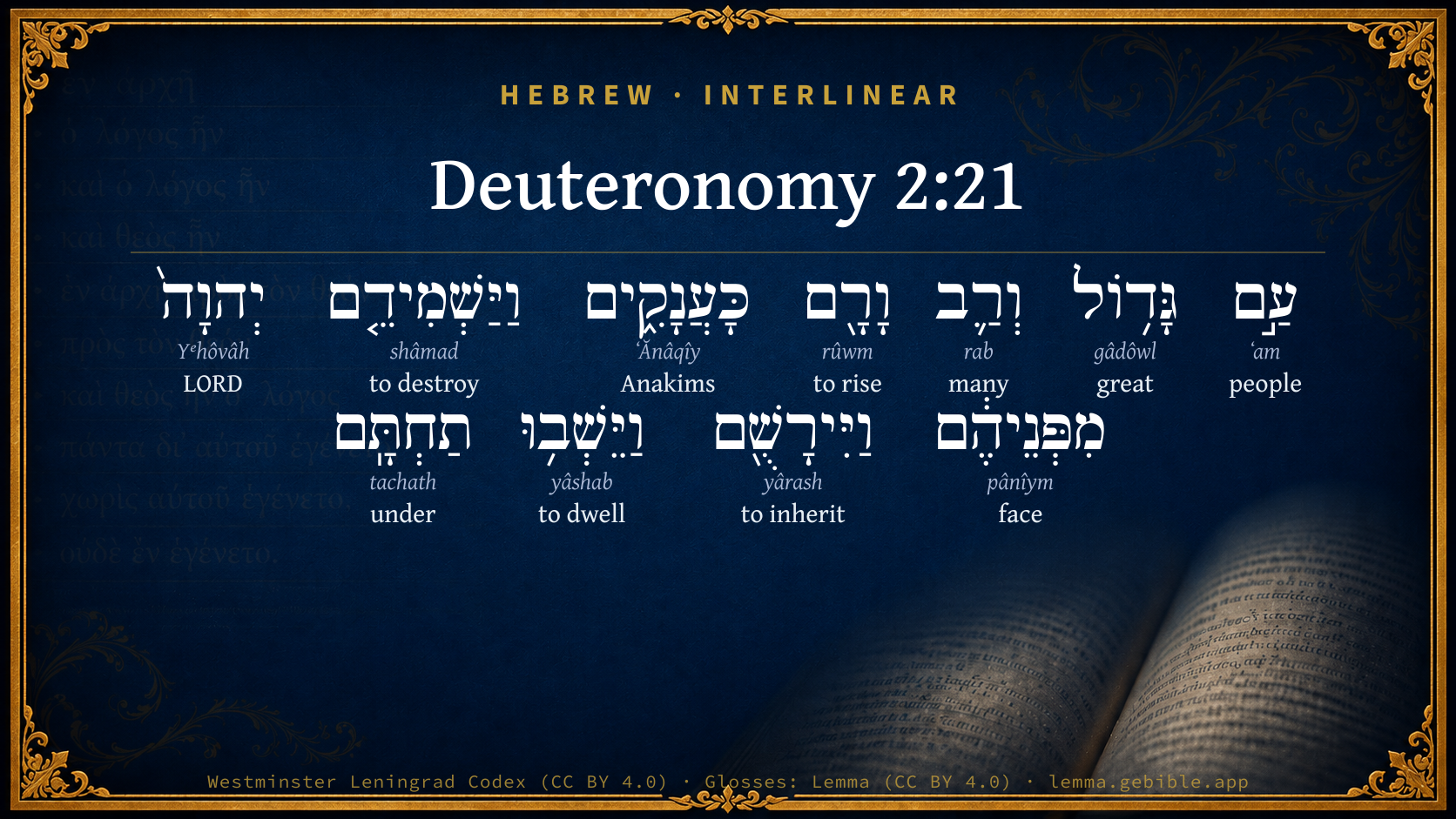
Deuteronomy 2:21

Hebrew (Westminster Leningrad Codex) Deuteronomy 2:21 appears in the Hebrew Old Testament. The text above is from the Westminster Leningrad Codex. Each word links to its Strong’s number, a concise gloss, and parsing drawn from the Open Scriptures Hebrew Bible morphology. Click any word for its full Brown-Driver-Briggs (BDB) entry.
Download image
Cite this verse

Deuteronomy 2:21 (World English Bible). Public Domain. Lemma interlinear Bible study tool, https://lemma.gebible.app/v/deuteronomy/2/21.

Show BibTeX & RIS
BibTeX
RIS
English Translation
a people great, and many, and tall, as the Anakim; but Yahweh destroyed them before them; and they succeeded them, and lived in their place;
World English Bible · Public Domain
Download a study sheet

One document with this verse’s original text, its word-by-word gloss line, the meaning frame, cross-references with their text, attributed commentary, and full source and license credits — printable, and it pastes into notes with its structure intact.

This verse Autodidact and up

Study sheet (.html) Plain text (.txt)

A passage Seminary Student

Up to 50 verses in one chapter. A passage sheet keeps up to 6 commentary sources and 12 cross-references per verse, in the order this page ranks them, and says so on the sheet whenever that leaves anything out. Ask for a single verse and you get the Autodidact verse sheet above.

Everything on this page stays free to read, with no account — the sheet is a download of what is already on screen, not access to it.

Want to remove ads? Support Godless Engineer
Compare translations 3

The same verse in 3 English versions, stacked beneath the original-language interlinear above. Click any original word for its lexicon entry.

Each is an independent rendering of the whole verse — the interlinear is not word-aligned to these translations.

Highlighted words mark where these versions differ — a whole-verse word diff, not a word-by-word alignment.

  • World English Bible Public Domain
    a people great, and many, and tall, as the Anakim; but Yahweh destroyed them before them; and they succeeded them, and lived in their place;
  • King James Version Public Domain
    A people great, and many, and tall, as the Anakims; but the LORD destroyed them before them; and they succeeded them, and dwelt in their stead:
  • unfoldingWord Literal Text CC BY-SA 4.0
    a people great and numerous and tall as the Anakites. But Yahweh destroyed them from their faces, and they dispossessed them and lived in their place,

unfoldingWord Literal Text — © unfoldingWord, licensed CC BY-SA 4.0. Word-aligned USFM3 via Door43 (git.door43.org/unfoldingWord/en_ult).

Versions to compare (up to 4)

3 of 4 selected

Show all 18 translations

Every available English version of this verse, each an independent rendering of the whole verse.

  • World English Bible Public Domain
    a people great, and many, and tall, as the Anakim; but Yahweh destroyed them before them; and they succeeded them, and lived in their place;
  • Berean Standard Bible Public Domain
    They were a people great and many, as tall as the Anakites. But the LORD destroyed them from before the Ammonites, who drove them out and settled in their place,
  • Majority Standard Bible Public Domain
    They were a people great and many, as tall as the Anakites. But the LORD destroyed them from before the Ammonites, who drove them out and settled in their place,
  • King James Version Public Domain
    A people great, and many, and tall, as the Anakims; but the LORD destroyed them before them; and they succeeded them, and dwelt in their stead:
  • American Standard Version (1901) Public Domain
    a people great, and many, and tall, as the Anakim; but Jehovah destroyed them before them; and they succeeded them, and dwelt in their stead;
  • Revised Version (1885) Public Domain
    a people great, and many, and tall, as the Anakim; but the LORD destroyed them before them; and they succeeded them, and dwelt in their stead:
  • Geneva Bible (1599) Public Domain
    A people that was great, and many, and tall, as the Anakims: but the Lord destroyed them before them, and they succeeded them in their inheritance, and dwelt in their stead:
  • Douay-Rheims (1899) Public Domain
    A people great and many, and of tall stature, like the Enacims whom the Lord destroyed before their face: and he made them to dwell in their stead,
  • Young's Literal Translation Public Domain
    a people great, and numerous, and tall, as the Anakim, and Jehovah destroyeth them before them, and they dispossess them, and dwell in their stead,
  • Literal Standard Version CC BY-SA 4.0
    a people great, and numerous, and tall as the Anakim, and YHWH destroys them before them, and they dispossess them, and dwell in their stead,
  • Unlocked Literal Bible CC BY-SA 4.0
    a people as great, as many, and as tall as the Anakim. But Yahweh destroyed them before the Ammonites, and they succeeded them and lived in their place.
  • unfoldingWord Literal Text CC BY-SA 4.0
    a people great and numerous and tall as the Anakites. But Yahweh destroyed them from their faces, and they dispossessed them and lived in their place,
  • Darby Bible Public Domain
    a people great, and many, and tall as the Anakim; and Jehovah destroyed them before them, and they dispossessed them, and dwelt in their stead;
  • World Messianic Bible Public Domain
    a great people, many, and tall, as the Anakim; but the LORD destroyed them from before Israel, and they succeeded them, and lived in their place,
  • Webster's Bible Public Domain
    A people great, and many, and tall as the Anakims; but the LORD destroyed them before them; and they succeeded them, and dwelt in their stead:
  • Free Bible Version CC BY-SA 4.0
    They were a strong and numerous people, as tall as the Anakim. But the Lord destroyed them when the Ammonites invaded and drove them out and settled there,
  • Bible in Basic English Public Domain
    They were a great people, tall as the Anakim, and equal to them in number; but the Lord sent destruction on them and the children of Ammon took their place, living in their land;
  • JPS Tanakh (1917) Public Domain
    a people great, and many, and tall, as the Anakim; but the LORD destroyed them before them; and they succeeded them, and dwelt in their stead;

Literal Standard Version (2020), Covenant Press — licensed CC BY-SA 4.0. Text via the HelloAO Bible API (eBible.org). Unlocked Literal Bible (unfoldingWord) — licensed CC BY-SA 4.0. Text via the HelloAO Bible API (eBible.org). unfoldingWord Literal Text — © unfoldingWord, licensed CC BY-SA 4.0. Word-aligned USFM3 via Door43 (git.door43.org/unfoldingWord/en_ult). Free Bible Version, Dr. Jonathan Gallagher — licensed CC BY-SA 4.0. Text via the HelloAO Bible API (eBible.org).

Word by word

More ways to search: Search by grammar → Find every occurrence → Compare this word →

Practice this passage: Drill this verse → Learn its vocabulary →

כָּעֲנָקִ֑ים
ʻĂnâqîy
H6062
“like/as the · Anakims”
Preposition, Determined + Noun, Common, Masculine, Plural, Absolute
Part of Speech
Preposition + Noun
Type
Common
Gender
Masculine
Number
Plural
State
Absolute
Full BDB Definition

Origin: from H6061

TWOT: None

Anakims = "long-necked" - a tribe of giants, descendants of Anak, which dwelled in southern Canaan
  1. עַ֣ם ʻam H5971 “people” Noun, Common, Masculine, Singular, Absolute
  2. גָּד֥וֹל gâdôwl H1419 “great” Adjective, Adjective, Masculine, Singular, Absolute
  3. וְרַ֛ב rab H7227 “and · many” Conjunction + Adjective, Adjective, Masculine, Singular, Absolute
  4. וָרָ֖ם rûwm H7311 “and · rising” Conjunction + Verb, Qal, Participle Active, Masculine, Singular, Absolute
  5. וַיַּשְׁמִידֵ֤ם shâmad H8045 “and · to destroy · them” Conjunction + Verb, Hiphil, Sequential Imperfect, 3rd Person, Masculine, Singular + Suffix, Personal, 3rd Person, Masculine, Plural
  6. יְהוָה֙ Yᵉhôvâh H3068 “LORD” Noun, Proper
  7. מִפְּנֵיהֶ֔ם pânîym H6440 “from · face(s) · their” Preposition + Noun, Common, Both, Plural, Construct + Suffix, Personal, 3rd Person, Masculine, Plural
  8. וַיִּירָשֻׁ֖ם yârash H3423 “and · to inherit · them” Conjunction + Verb, Qal, Sequential Imperfect, 3rd Person, Masculine, Plural + Suffix, Personal, 3rd Person, Masculine, Plural
  9. וַיֵּשְׁב֥וּ yâshab H3427 “and · to dwell” Conjunction + Verb, Qal, Sequential Imperfect, 3rd Person, Masculine, Plural
  10. תַחְתָּֽם tachath H8478 “under · them” Preposition + Suffix, Personal, 3rd Person, Masculine, Plural

About this verse

These counts appear in no published source. They are computed here, from the morphology-tagged text and Lemma’s own curated glosses. What Lemma adds →

11
words
11
distinct lemmas
Pentateuch
section

Notable vocabulary

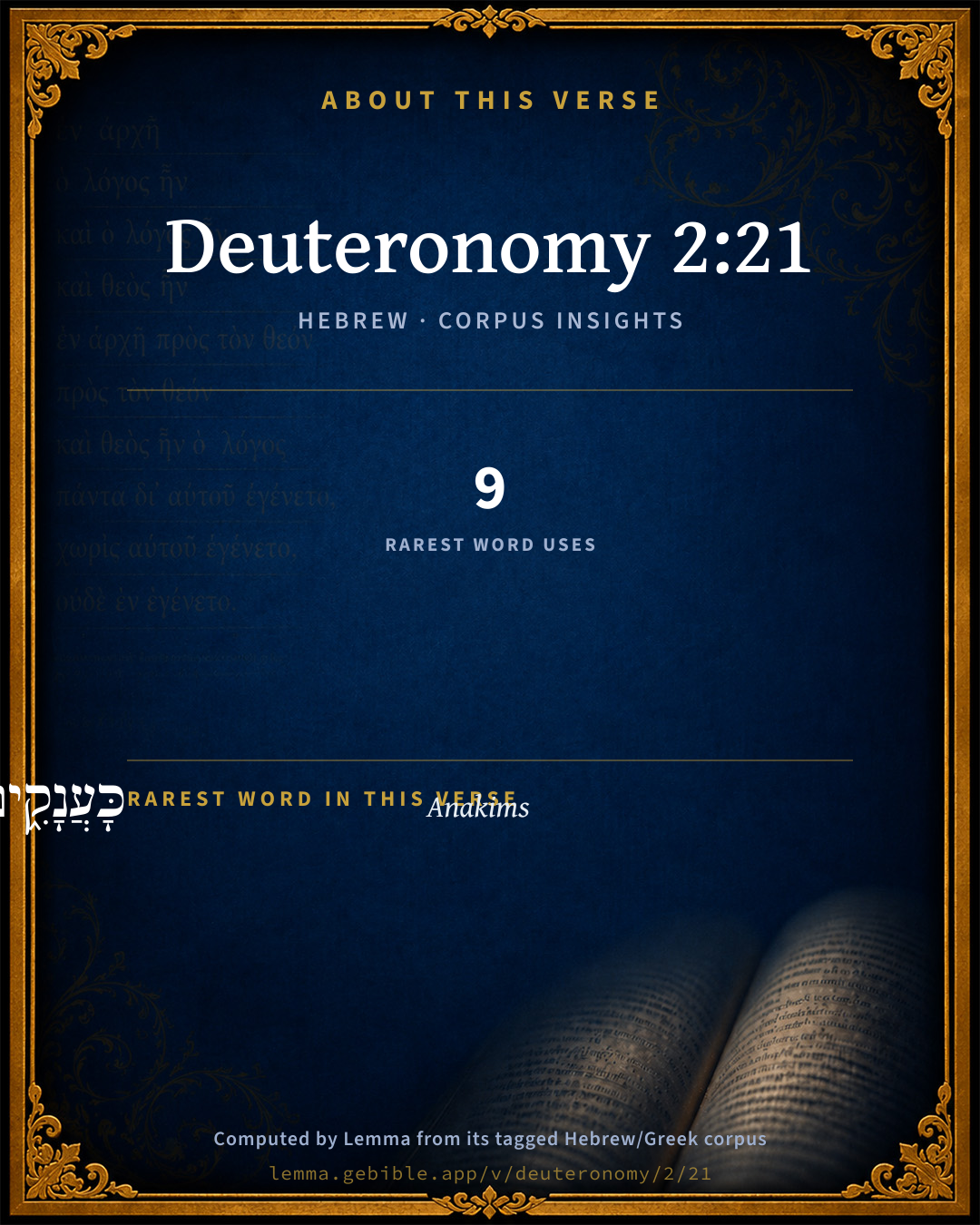
The rarest word here is כָּעֲנָקִ֑ים Anakims H6062 — appearing just 9 times in the whole Hebrew Bible.

Shared distinctive vocabulary

כָּעֲנָקִ֑ים Anakims H6062 occurs in 9 verses of the Hebrew Bible. Also found in:

Grammatical profile

  • 4 verbs
  • 4 nouns
  • 2 adjectives
  • 1 preposition

Verb forms

  • וָרָ֖ם Qal · Participle Active
  • וַיַּשְׁמִידֵ֤ם Hiphil · Sequential Imperfect
  • וַיִּירָשֻׁ֖ם Qal · Sequential Imperfect
  • וַיֵּשְׁב֥וּ Qal · Sequential Imperfect

Hebrew & Septuagint length

In English translation the verse runs 25 words from the Hebrew and 36 from the Septuagint (LXX English) — the Septuagint runs noticeably longer here. See the side-by-side →

A rough comparison of the two English renderings, which tokenize alike — not a word-level alignment.

Word counts can differ between the Hebrew and the Greek without any difference in meaning — e.g. the Hebrew direct-object marker אֵת has no separate Greek word, and Greek often adds the article ὁ.

Cross-references

7

Topical passages linked to Deuteronomy 2:21 in the Treasury of Scripture Knowledge — connected by theme and wording, ordered by reader-vote popularity; previews shown in the World English Bible.

  • Deuteronomy 1:28 Where are we going up? our brothers have made our heart to melt, saying, The people are greater and taller than we; the cities are great and fortified up to the sky; and moreover we have seen the sons of the Anakim there.
  • Deuteronomy 2:10–11 (The Emim lived therein before, a people great, and many, and tall, as the Anakim:
  • Deuteronomy 2:22 as he did for the children of Esau, who dwell in Seir, when he destroyed the Horites from before them; and they succeeded them, and lived in their place even to this day:
  • Deuteronomy 3:11 (For only Og king of Bashan remained of the remnant of the Rephaim; behold, his bedstead was a bedstead of iron; isn't it in Rabbah of the children of Ammon? nine cubits was the length of it, and four cubits the breadth of it, after the cubit of a man.)
  • Judges 11:24 Won't you possess that which Chemosh your god gives you to possess? So whoever Yahweh our God has dispossessed from before us, them will we possess.
  • Jeremiah 27:7–8 All the nations shall serve him, and his son, and his son's son, until the time of his own land come: and then many nations and great kings shall make him their bondservant.
  • Habakkuk 1:10–11 Yes, he scoffs at kings, and princes are a derision to him. He laughs at every stronghold, for he builds up an earthen ramp, and takes it.

Cross-references courtesy of OpenBible.info (CC BY 4.0).

Hebrew and Greek witnesses Masoretic Hebrew ↔ Greek Septuagint

The same verse in the two great witnesses to the Old Testament, shown verse-for-verse.

Here the Septuagint runs noticeably longer than the Hebrew — LXX2012 (modern English Septuagint) 36 words vs World English Bible 25. A rough length comparison of the two English translations, not a word-level alignment — read both below.

These are two independent witnesses, not word-aligned to each other, and the Septuagint is shown in lemma (dictionary) form.

Hebrew Deuteronomy 2:21 Masoretic · Westminster Leningrad Codex

עַ֣ם גָּד֥וֹל וְרַ֛ב וָרָ֖ם כָּעֲנָקִ֑ים וַיַּשְׁמִידֵ֤ם יְהוָה֙ מִפְּנֵיהֶ֔ם וַיִּירָשֻׁ֖ם וַיֵּשְׁב֥וּ תַחְתָּֽם

a people great, and many, and tall, as the Anakim; but Yahweh destroyed them before them; and they succeeded them, and lived in their place;

World English Bible · Public Domain

Greek LXX Deuteronomy 2:21 Septuagint · lemma form

ἔθνος μέγας καί πολύς καί δυνατός σύ ὥσπερ ὁ ενακιμ καί ἀποὀλλύω αὐτός κύριος πρό πρόσωπον αὐτός καί κατακληρονομέω καί καταοἰκίζω ἀντί αὐτός ἕως ὁ ἡμέρα οὗτος

A great nation and populous, and mightier than you, as also the Enakim: yet the Lord destroyed them from before them, and they inherited their land, and they lived there instead of them until this day.

LXX2012 (modern English Septuagint) · Public Domain

Hebrew: Westminster Leningrad Codex (CC BY 4.0). Greek: Septuagint (public domain); English from LXX2012 (modern English Septuagint) (Public Domain). How the Septuagint differs from the Hebrew →

Targum (Aramaic paraphrase)

2

The Targum is the ancient Jewish Aramaic paraphrase of the Hebrew Scriptures — an interpretive translation, not the Hebrew text itself. Onkelos (literal) and Pseudo-Jonathan (expansive) render the Torah, and Jonathan the Prophets. Coverage is partial: where no permissively-licensed English translation exists for a verse, only the Aramaic is shown. This is verse-level text, not a word-by-word alignment to the Hebrew.

  1. Targum Onkelos Torah (Genesis–Deuteronomy)
    עַם רַב וְסַגִי וְתַקִיף כְּגִבְּרַיָא וְשֵׁצִנוּן יְיָ מִקֳדָמֵ יהוֹן וְתָרֵכֻנוּן וִיתִיבוּ בְאַתְרֵיהוֹן

    (no public-domain English translation for this verse)

    Targum Onkelos — Aramaic: “Onkelos Genesis” (public domain); “Onkelos Exodus” (public domain); “Onkelos Leviticus” (public domain); “Onkelos Numbers” (public domain); “Onkelos Deuteronomy” (public domain). English: “Sefaria Community Translation” (CC0 1.0 (public-domain dedication)); “J.W. Etheridge. The Targums of Onkelos and Jonathan Ben Uzziel on the Pentateuch. London: Longmans, Green, 1862” (public domain). Text via Sefaria.

  2. Targum Pseudo-Jonathan Torah (Genesis–Deuteronomy)
    עַמָּא רַבָּא וַחֲסִינָא הֵי כְּגִנְבָּרַיָא וְשֵׁיצִינוּן מֵימְרָא דַיְיָ מִן קֳדָמֵיהוֹן וְתָרֵיכִינוּן וִיתוּבוּ בְּאַתְרֵיהוֹן

    a people great and mighty as giants: but the Word of the Lord destroyed them, and drave them out before them, and they dwelt in their place;

    Targum Pseudo-Jonathan — Aramaic: “Targum Jonathan on Genesis” (public domain); “Targum Jonathan on Exodus” (public domain); “Targum Jonathan on Leviticus” (public domain); “Targum Jonathan on Numbers” (public domain); “Targum Jonathan on Deuteronomy” (public domain). English: “The Targum of Jonathan ben Uzziel, trans. J. W. Etheridge, London, 1862” (public domain). Text via Sefaria.

Commentary

Notes on Deuteronomy 2:21 from classic Christian and Jewish commentators (each source and its license shown beneath its notes). The classic Christian expositions comment on the surrounding passage and are grouped to its opening verse, so a note may address several verses; the Jewish commentaries on the Tanakh (Rashi and others) are per-verse, so they appear only where the commentator wrote on this verse.

Lemma curates 59 commentaries, every one of them public domain or Creative Commons licensed, each selected and text-cleaned for this edition rather than reprinted as found. About our sources →

Ellicott's Commentary for English Readers

(21) The Lord destroyed them before them.—It is noticeable that the conquest of Canaan is here brought into the domain of common history, by comparison with the conquests of gigantic races accomplished by Edom, Moab, and Ammon. The value of this analogy to Moses and Israel is plain. If the children of Lot, Ishmael, and Esau—who were but Gentiles, although they were Abraham’s seed—were able to dispossess these gigantic races, how much more would Israel be able to dispossess the Canaanites under the personal guidance of Jehovah?

A Bible Commentary for English Readers, edited by Charles John Ellicott (1878–1897) — public domain. Text from a community e-Sword module.

John Gill's Exposition

A people great and many, and tall as the Anakims,.... As the Emims were, Deu 2:10 but the Lord destroyed them before them; destroyed the Zamzummims before the children of Amman; or otherwise they would have been an too much for them, being so numerous, and of such a gigantic stature:

and they succeeded them, and dwelt in their stead; and in this way, and by these means, he gave them their land for a possession, Deu 2:19.

John Gill's Exposition of the Whole Bible (1746–1763) — public domain (CC PDM 1.0). Text via the HelloAO Bible API.

Haydock's Catholic Bible Commentary

Enacims. See on this race of giants what has been said, Numbers xiii. 23. They made place for the Zomzommim, as the latter did for the Ammonites. (Haydock)

George Leo Haydock (1774–1849), Haydock's Catholic Family Bible and Commentary, 1859 edition — public domain. Excludes Psalms (Douay-Rheims chapter numbering differs from Protestant) and Deuterocanonical books (Catholic canon only).

Matthew Poole's English Annotations

The Lord therefore will certainly do as much for his own people.

Matthew Poole's English Annotations on the Holy Bible (1683–1685) — public domain. Text from a community e-Sword/MySword module.

Lesson kit

Teaching starters — assembled from the data on this page, not authored interpretation. Every prompt links to the verse data it draws on. Edit before teaching.

Deuteronomy, in the Pentateuch, opens this verse with 11 words (11 distinct Hebrew lemmas). Its most distinctive word is ʻĂnâqîy (“Anakims”). The Greek Septuagint runs longer here. A historical commentator’s framing appears above. Read the whole chapter for the surrounding context.

Discussion questions

  1. How does “Anakims” (ʻĂnâqîy) shape what this verse is saying?
  2. Deuteronomy 1:28 shares the word «Anakims» with this verse. How do the two illuminate each other?
  3. Compared with the Hebrew, the Septuagint runs longer here. What questions does that raise?
  4. The translations on this page render this verse differently — a whole-verse word diff, not a word-by-word alignment. What might account for the different wordings?
  5. The verb «וָרָ֖ם» is Qal Participle Active. How does its form color the action?
  6. Reading how Ellicott's Commentary for English Readers and John Gill's Exposition read this verse, where do the two commentators agree and where do they part?

Things to notice

Reading settings

Reading text

Shown beneath each verse's original-language words.

Old Testament
Old Testament edition

Read the OT as the Masoretic Hebrew (MT) or the Greek Septuagint (LXX).

English shown for the Greek Septuagint (in the Hebrew ↔ Greek comparison).

Comparing translations? Open the Compare panel on any verse page to stack up to four side by side.