Daniel 8:26

Hebrew (Westminster Leningrad Codex) Daniel 8:26 appears in the Hebrew Old Testament. The text above is from the Westminster Leningrad Codex. Each word links to its Strong’s number, a concise gloss, and parsing drawn from the Open Scriptures Hebrew Bible morphology. Click any word for its full Brown-Driver-Briggs (BDB) entry.
Download image
Cite this verse

Daniel 8:26 (World English Bible). Public Domain. Lemma interlinear Bible study tool, https://lemma.gebible.app/v/daniel/8/26.

Show BibTeX & RIS
BibTeX
RIS
English Translation
The vision of the evenings and mornings which has been told is true: but seal up the vision; for it belongs to many days [to come].
World English Bible · Public Domain
Download a study sheet

One document with this verse’s original text, its word-by-word gloss line, the meaning frame, cross-references with their text, attributed commentary, and full source and license credits — printable, and it pastes into notes with its structure intact.

This verse Autodidact and up

Study sheet (.html) Plain text (.txt)

A passage Seminary Student

Up to 50 verses in one chapter. A passage sheet keeps up to 6 commentary sources and 12 cross-references per verse, in the order this page ranks them, and says so on the sheet whenever that leaves anything out. Ask for a single verse and you get the Autodidact verse sheet above.

Everything on this page stays free to read, with no account — the sheet is a download of what is already on screen, not access to it.

Want to remove ads? Support Godless Engineer
Compare translations 3

The same verse in 3 English versions, stacked beneath the original-language interlinear above. Click any original word for its lexicon entry.

Each is an independent rendering of the whole verse — the interlinear is not word-aligned to these translations.

Highlighted words mark where these versions differ — a whole-verse word diff, not a word-by-word alignment.

  • World English Bible Public Domain
    The vision of the evenings and mornings which has been told is true: but seal up the vision; for it belongs to many days [to come].
  • King James Version Public Domain
    And the vision of the evening and the morning which was told is true: wherefore shut thou up the vision; for it shall be for many days.
  • unfoldingWord Literal Text CC BY-SA 4.0
    The vision of the evenings and mornings that has been told is true. But seal up the vision, for it refers to many days in the future.”

unfoldingWord Literal Text — © unfoldingWord, licensed CC BY-SA 4.0. Word-aligned USFM3 via Door43 (git.door43.org/unfoldingWord/en_ult).

Versions to compare (up to 4)

3 of 4 selected

Show all 18 translations

Every available English version of this verse, each an independent rendering of the whole verse.

  • World English Bible Public Domain
    The vision of the evenings and mornings which has been told is true: but seal up the vision; for it belongs to many days [to come].
  • Berean Standard Bible Public Domain
    The vision of the evenings and the mornings that has been spoken is true. Now you must seal up the vision, for it concerns the distant future.”
  • Majority Standard Bible Public Domain
    The vision of the evenings and the mornings that has been spoken is true. Now you must seal up the vision, for it concerns the distant future.”
  • King James Version Public Domain
    And the vision of the evening and the morning which was told is true: wherefore shut thou up the vision; for it shall be for many days.
  • American Standard Version (1901) Public Domain
    And the vision of the evenings and mornings which hath been told is true: but shut thou up the vision; for it belongeth to many days `to come'.
  • Revised Version (1885) Public Domain
    And the vision of the evenings and mornings which hath been told is true: but shut thou up the vision; for it belongeth to many days to come.
  • Geneva Bible (1599) Public Domain
    And the vision of the euening and the morning, which is declared, is true: therefore seale thou vp the vision, for it shall be after many dayes.
  • Douay-Rheims (1899) Public Domain
    And the vision of the evening and the morning, which was told, is true: thou therefore seal up the vision, because it shall come to pass after many days.
  • Young's Literal Translation Public Domain
    And the appearance of the evening and of the morning, that is told, is true; and thou, hide thou the vision, for `it is' after many days.'
  • Literal Standard Version CC BY-SA 4.0
    And the appearance of the evening and of the morning, that is told, is true; and you, hide the vision, for [it is] after many days.
  • Unlocked Literal Bible CC BY-SA 4.0
    The vision about the evenings and mornings that has been told is true. But seal up the vision, for it refers to many days in the future.”
  • unfoldingWord Literal Text CC BY-SA 4.0
    The vision of the evenings and mornings that has been told is true. But seal up the vision, for it refers to many days in the future.”
  • Darby Bible Public Domain
    And the vision of the evening and the morning which hath been told is true; but close thou up the vision, for it is for many days [to come].
  • World Messianic Bible Public Domain
    “The vision of the evenings and mornings which has been told is true; but seal up the vision, for it belongs to many days to come.”
  • Webster's Bible Public Domain
    And the vision of the evening and the morning which was told is true: wherefore shut thou up the vision; for it shall be for many days.
  • Free Bible Version CC BY-SA 4.0
    The vision about the evenings and mornings that has been explained to you is true, but for now seal up this vision because it refers to the distant future.”
  • Bible in Basic English Public Domain
    And the vision of evenings and mornings which has been talked of is true: and keep the vision secret; for it has to do with the far-off future.
  • JPS Tanakh (1917) Public Domain
    And the vision of the evenings and mornings which hath been told is true; but thou, shut thou up the vision; for it belongeth to many days to come.'

Literal Standard Version (2020), Covenant Press — licensed CC BY-SA 4.0. Text via the HelloAO Bible API (eBible.org). Unlocked Literal Bible (unfoldingWord) — licensed CC BY-SA 4.0. Text via the HelloAO Bible API (eBible.org). unfoldingWord Literal Text — © unfoldingWord, licensed CC BY-SA 4.0. Word-aligned USFM3 via Door43 (git.door43.org/unfoldingWord/en_ult). Free Bible Version, Dr. Jonathan Gallagher — licensed CC BY-SA 4.0. Text via the HelloAO Bible API (eBible.org).

Word by word

More ways to search: Search by grammar → Find every occurrence → Compare this word →

Practice this passage: Drill this verse → Learn its vocabulary →

סְתֹ֣ם
çâtham
H5640
“stop up”
Verb, Qal, Imperative, 2nd Person, Masculine, Singular
Part of Speech
Verb
Stem
Qal
Form
Imperative
Person
2nd Person
Gender
Masculine
Number
Singular
Full BDB Definition

Origin: a primitive root

TWOT: 1550

to stop up, shut up, keep close - (Qal) - to stop up - to shut up, keep close - secret (participle) - (Niphal) to be stopped up - (Piel) to stop up
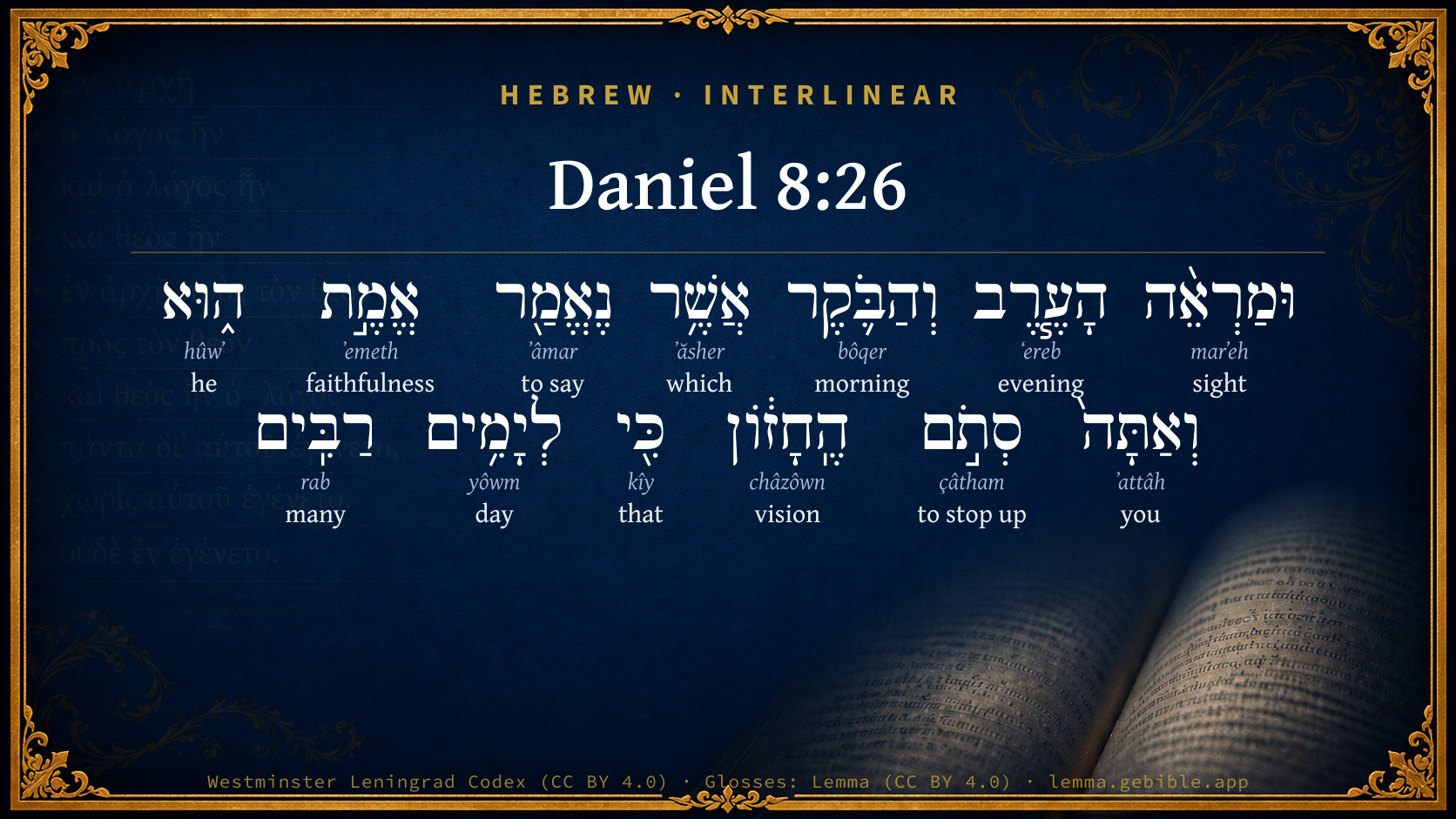
  1. וּמַרְאֵ֨ה marʼeh H4758 “and · sight of” Conjunction + Noun, Common, Masculine, Singular, Construct
  2. הָעֶ֧רֶב ʻereb H6153 “the · evening” Particle, Definite Article + Noun, Common, Masculine, Singular, Absolute
  3. וְהַבֹּ֛קֶר bôqer H1242 “and · the · morning” Conjunction + Particle, Definite Article + Noun, Common, Masculine, Singular, Absolute
  4. אֲשֶׁ֥ר ʼăsher H834 “which” Particle, Relative
  5. נֶאֱמַ֖ר ʼâmar H559 “to say” Verb, Niphal, Perfect, 3rd Person, Masculine, Singular
  6. אֱמֶ֣ת ʼemeth H571 “faithfulness” Noun, Common, Feminine, Singular, Absolute
  7. ה֑וּא hûwʼ H1931 “he” Pronoun, Personal, 3rd Person, Masculine, Singular
  8. וְאַתָּה֙ ʼattâh H859 “and · you” Conjunction + Pronoun, Personal, 2nd Person, Masculine, Singular
  9. הֶֽחָז֔וֹן châzôwn H2377 “the · vision” Particle, Definite Article + Noun, Common, Masculine, Singular, Absolute
  10. כִּ֖י kîy H3588 “that” Conjunction
  11. לְיָמִ֥ים yôwm H3117 “to/for · days” Preposition + Noun, Common, Masculine, Plural, Absolute
  12. רַבִּֽים rab H7227 “many” Adjective, Adjective, Masculine, Plural, Absolute

About this verse

These counts appear in no published source. They are computed here, from the morphology-tagged text and Lemma’s own curated glosses. What Lemma adds →

13
words
13
distinct lemmas
Prophets
section

Notable vocabulary

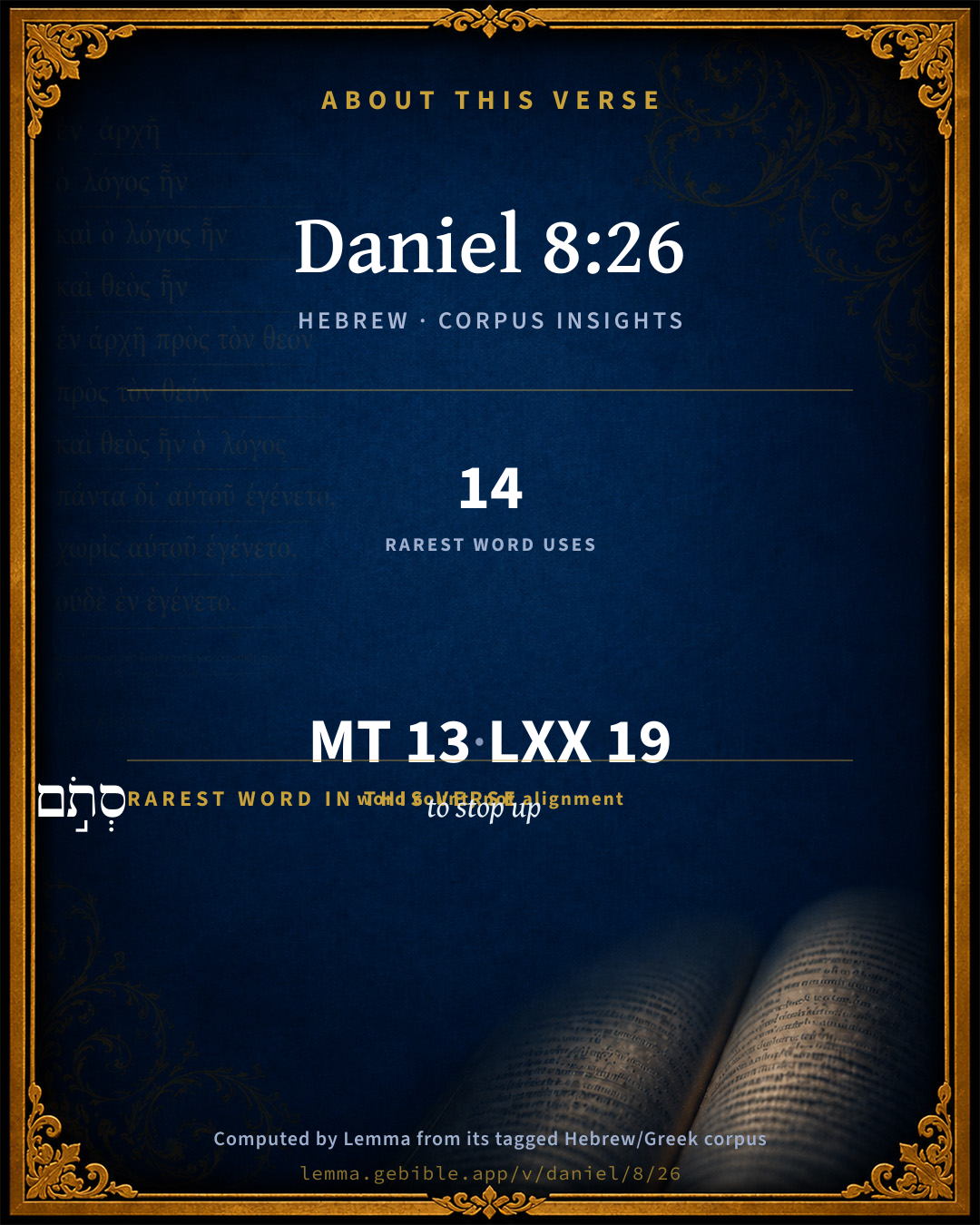
The rarest word here is סְתֹ֣ם to stop up H5640 — appearing just 14 times in the whole Hebrew Bible.

Shared distinctive vocabulary

סְתֹ֣ם to stop up H5640 occurs in 14 verses of the Hebrew Bible. Also found in:

Grammatical profile

  • 2 verbs
  • 6 nouns
  • 1 adjective
  • 2 pronouns
  • 1 conjunction
  • 1 particle

Verb forms

  • נֶאֱמַ֖ר Niphal · Perfect
  • סְתֹ֣ם Qal · Imperative

Hebrew & Septuagint length

In English translation the verse runs 26 words from the Hebrew and 25 from the Septuagint (LXX English) — closely comparable.

A rough comparison of the two English renderings, which tokenize alike — not a word-level alignment.

Word counts can differ between the Hebrew and the Greek without any difference in meaning — e.g. the Hebrew direct-object marker אֵת has no separate Greek word, and Greek often adds the article ὁ.

In the original languages it is 13 Hebrew tokens and 19 Greek tokens — but the two are counted differently (Hebrew bundles its prefixes and suffixes into one token; the Greek is in lemma form), so that isn’t a like-for-like length.

Cross-references

10

Topical passages linked to Daniel 8:26 in the Treasury of Scripture Knowledge — connected by theme and wording, ordered by reader-vote popularity; previews shown in the World English Bible.

  • Daniel 10:1 In the third year of Cyrus king of Persia a thing was revealed to Daniel, whose name was called Belteshazzar; and the thing was true, even a great warfare: and he understood the thing, and had understanding of the vision.
  • Daniel 12:9 He said, Go your way, Daniel; for the words are shut up and sealed until the time of the end.
  • Daniel 10:14 Now I have come to make you understand what shall happen to your people in the latter days; for the vision is yet for [many] days:
  • Daniel 12:4 But you, Daniel, shut up the words, and seal the book, even to the time of the end: many shall run back and forth, and knowledge shall be increased."
  • Ezekiel 12:27 Son of man, behold, they of the house of Israel say, The vision that he sees is for many day to come, and he prophesies of times that are far off.
  • Revelation 22:10 He said to me, "Don't seal up the words of the prophecy of this book, for the time is at hand.
  • Isaiah 24:22 They shall be gathered together, as prisoners are gathered in the pit, and shall be shut up in the prison; and after many days shall they be visited.
  • Daniel 8:11–15 Yes, it magnified itself, even to the prince of the host; and it took away from him the continual [burnt offering], and the place of his sanctuary was cast down.
  • Hosea 3:3–4 I said to her, "You shall stay with me many days. You shall not play the prostitute, and you shall not be with any other man. I will also be so toward you."
  • Revelation 10:4 When the seven thunders sounded, I was about to write; but I heard a voice from the sky saying, "Seal up the things which the seven thunders said, and don't write them."

Cross-references courtesy of OpenBible.info (CC BY 4.0).

Hebrew and Greek witnesses Masoretic Hebrew ↔ Greek Septuagint

The same verse in the two great witnesses to the Old Testament, shown verse-for-verse.

These are two independent witnesses, not word-aligned to each other, and the Septuagint is shown in lemma (dictionary) form.

Hebrew Daniel 8:26 Masoretic · Westminster Leningrad Codex

וּמַרְאֵ֨ה הָעֶ֧רֶב וְהַבֹּ֛קֶר אֲשֶׁ֥ר נֶאֱמַ֖ר אֱמֶ֣ת ה֑וּא וְאַתָּה֙ סְתֹ֣ם הֶֽחָז֔וֹן כִּ֖י לְיָמִ֥ים רַבִּֽים

The vision of the evenings and mornings which has been told is true: but seal up the vision; for it belongs to many days [to come].

World English Bible · Public Domain

Greek LXX Daniel 8:26 Septuagint · lemma form

ὁ ὅραμα ὁ ἑσπέρα καί πρωΐ εὑρίσκω ἐπί ἀλήθεια καί νῦν φράσσω ὁ ὅραμα ἔτι γάρ εἰς ἡμέρα πολύς

And the vision of the evening and morning that was mentioned is true: and do you seal the vision; for it is for many days.

LXX2012 (modern English Septuagint) · Public Domain

On this verse, The Pulpit Commentary discusses the Septuagint’s reading. Read the note in Commentary ↓

Hebrew: Westminster Leningrad Codex (CC BY 4.0). Greek: Septuagint (public domain); English from LXX2012 (modern English Septuagint) (Public Domain). How the Septuagint differs from the Hebrew →

Commentary

Notes on Daniel 8:26 from classic Christian and Jewish commentators (each source and its license shown beneath its notes). The classic Christian expositions comment on the surrounding passage and are grouped to its opening verse, so a note may address several verses; the Jewish commentaries on the Tanakh (Rashi and others) are per-verse, so they appear only where the commentator wrote on this verse.

Lemma curates 59 commentaries, every one of them public domain or Creative Commons licensed, each selected and text-cleaned for this edition rather than reprinted as found. About our sources →

Trapp's Complete Commentary

John Trapp

Dan 8:26 And the vision of the evening and the morning which was told [is] true: wherefore shut thou up the vision; for it [shall be] for many days.

Ver. 26. And the vision of the evening.] See Dan 8:14. Lyra by the "morning" would have understood the time of Antiochus; by the "evening" the time of antichrist, who was prefigured by Antiochus.

Is true.] Heb., Truth, and so plain that I need say no more of it.

Wherefore shut thou up the vision.] Keep it to thyself in sacred silence, and reserve it in writing for posterity. See Dan 12:4-9 Isa 8:16.

For it shall be for many days,] i.e., For about three hundred years hence. The Lord would have visions concealed till toward the accomplishment.

John Trapp, A Commentary or Exposition upon All the Books of the Old and New Testament (1647–1656) — public domain. Text from a community e-Sword module.

Joseph Benson's Commentary

Dan 8:26. And the vision of the evening and the morning, &c., is true — The vision of the 2300 evenings and mornings, mentioned Dan 8:13, is certain. The angel here tells him, that these calamities would certainly last during the time expressed by that number of days, and then would have an end. Wherefore shut thou up the vision, for it shall be for many days — Some consider these words as expressing the same thing that is meant by shutting up the words, and sealing the book, Dan 12:4. The sense in both places, they think, is, that the full meaning of the prophecy should be concealed from people in general, till the accomplishment of the events foretold. Thus we find that shutting and opening, sealing and unfolding, are opposed in the prophetical language, and import the same as concealing and revealing. Thus taken the words imply, that prophecies are never fully understood till they are accomplished: and the nearer the time approaches of their accomplishment, the more light shall diligent inquirers have for the explaining them. But the words may also imply a command to Daniel to commit this vision to writing, and then to take such care of the copy as would ensure its preservation, even till the things spoken of in it should be fulfilled; that so the prophecies might be compared with the events accomplishing them, and it might be seen how exactly they had been foretold. And in order that Daniel might take proper measures for preserving the account of these visions, and that posterity might take the same care, the angel concludes with observing, that the vision should be for many days; that is, that the accomplishment of it would not take place till after a long space of time; it being a term of near four hundred years from the first intimation of the vision, in the third of Belshazzar, to the cleansing of the sanctuary by Judas, in the time of Antiochus. It is of importance to observe here, that in remembrance of this great mercy which God had showed to his people, in delivering them from the tyranny and idolatry of Antiochus, a solemn feast was instituted, called Εγκαινια, or the feast of dedication, which was annually observed, in consequence of cleansing the sanctuary, and the consecration of the altar, by Judas Maccabeus, for the space of eight days, from the 25th day of the month Casleu, 1Ma 4:59. And to this St. John alludes, Joh 10:22, where he speaks of the feast of dedication.

Joseph Benson's Commentary on the Old and New Testaments (1811–1818) — public domain. Text from a community e-Sword module.

Tyndale Open Study Notes

Tyndale Open Resources

8:26 about the 2,300 evenings and mornings: This could refer to a period of 1,150 days (1,150 evenings + 1,150 mornings, about 31/2 years) or 2,300 days (about 7 years). Antiochus IV deposed high priest Onias III in 171 BC. He desecrated the Temple in December 167 BC and offered unclean sacrifices. The Temple and the altar were cleansed and used again in December 164 BC, seven years after Onias was deposed and just over three years after the Temple was desecrated (see 1 Maccabees 1:54; 4:52-53; 2 Maccabees 10:5). • keep this vision a secret: It would have been unwise for Daniel to share this vision at that time during Belshazzar’s reign, when it would have smelled of insurrection or treason.

Tyndale Open Study Notes — © Tyndale Open Resources, licensed CC BY-SA 4.0. Text via the HelloAO Bible API.

Geneva Bible (1599)

Geneva Bible translators

Read verse 14.

Geneva Bible (1599) marginal notes — public domain. Text via Bolls.life.

Jamieson, Fausset & Brown

Robert Jamieson, A. R. Fausset & David Brown

shut . . . up . . . vision--implying the vision was not to be understood for the present. In Rev 22:10 it is said, "Seal not the vision, for the time is at hand." What in Daniel's time was hidden was more fully explained in Revelation, and as the time draws nearer, it will be clearer still.

it shall be for many days--It refers to remote times (Eze 12:27).

Jamieson, Fausset & Brown — Commentary Critical and Explanatory on the Whole Bible (1871) — public domain (CC PDM 1.0). Text via the HelloAO Bible API.

Adam Clarke's Commentary

Verse 26. The vision of the evening and the morning which was told is true] That mentioned in Da 8:14.

For it shall be for many days.] Not less than two thousand three hundred years!

Adam Clarke's Commentary on the Bible (1810–1826) — public domain. Text from a community e-Sword/MySword module.

John Calvin's Commentaries

The angel again confirms the assertion that no part of this vision was shewn to the Prophet in vain, because not even the slightest portion of it should fail of its effect. The necessity of this method of confirming our faith is notorious, because, although the events may be well known to us, yet we cannot acquiesce in God’s word, unless he should testify so repeatedly to the truth of his assertions, and sanction by such repetition whatever appears to us ambiguous. When it becomes perfectly obvious that the angel discourses upon obscure events, and such as were utterly incredible at the time, it does not surprise us when he announces again, that the Prophet had seen nothing which God would not accomplish. This vision, therefore, says he, is truth. He calls it “the vision of the evening and morning,” because while the angel was treating of the six years and almost a half, he used this form of speech. And we said this was purposely expressed, lest any one should extend it to years or months, as some did; as if the angel had said, — Behold! by calculating single days up to six years and about a half, the completion of this prophecy when the Temple shall be cleansed, shall be accurately discovered. Again it is asserted, that the vision is certain, because God had computed day by day the time of the profanation of the Temple until the period of its cleansing. Do thou, therefore, says he, seal or close the vision, because it is for many days. It may surprise us why God should wish what he had explained to his servant to remain concealed. For Daniel was not instructed in futurity for his own private advantage, but for the common usefulness of the whole people. It seems, therefore, contrary to his office to be commanded to close up the vision, and to keep it in complete obscurity. But the angel means, if the greater part of the people should reject this prophecy, this formed no reason why Daniel should hesitate. Be thou, therefore, the guardian of this prophecy, as if God had deposited a treasure in the hands of his servant, and had said, “Pay no regard to any who despise this prophecy; many may deride thee, and others think thou art narrating fables, and very few will have confidence in thee but do not relax on this account, but faithfully guard this treasure,” since it is for many days; that is, although its effect is not immediately apparent, because God will suspend for some time the punishments of which entreats, and will not restore the Temple all at once, nor wrest His people immediately out of the hand of the tyrant. In consequence, then, of his deferring his judgments as well as his pity for many days, do thou close up this visions, that is, keep it to thyself, as if thou art alone. Thus God does not simply command his Prophet to be silent, or to conceal what he had learnt, but rather confirms him in his consistency, lest he should estimate this prophecy according to the ordinary opinions of his countrymen. And at the same time he shews, that though the Jews did not pay attention to what Daniel announced to them, yet nothing whatever should be in vain. It follows, —

John Calvin's Commentaries (1540-1563) — public domain. Text from the Calvin Translation Society English edition (1840s-50s) via the Christian Classics Ethereal Library (ccel.org). Calvin's coverage is partial (roughly two-thirds of the Bible); uncommented books and verses are honest gaps, never fabricated. The 19th-century editor's footnotes and remarks are omitted so the notes are faithfully Calvin's own voice.

Ellicott's Commentary for English Readers

(26) The concluding words of the angel are intended to comfort the Jewish Church in the days of her persecution. They teach her that God has foreseen her affliction, that it comes from Him in His love, and that it shall last only for a short while. This promise accounts for the firmness which was exhibited by the saints of the Maccabees, which entitles their faith to a place in the same list of faithful men which contains the names of Abel, Abraham, and Moses (Heb_11:34-38).

Shut thou up.—The revelation is to be kept safe, because the time of fulfilment is far off, and then the comforting words will be needed. Comp. Rev_22:10, where the opposite counsel is given, “seal it not, for the time of fulfilment is near.”

A Bible Commentary for English Readers, edited by Charles John Ellicott (1878–1897) — public domain. Text from a community e-Sword module.

The Cambridge Bible for Schools and Colleges

gen. ed. J. J. S. Perowne

26. the vision of the evenings and mornings (Dan_8:14) which hath been told, is true] a solemn asseveration of the truth of what has been told (cf. Dan_10:1, Dan_11:2, Dan_12:7; also Rev_19:9; Rev_21:5; Rev_22:6), intended here as an encouragement to the persecuted Israelites, who may rest assured that their sufferings will ere long reach the appointed limit.

but thou (emph.), shut thou up the vision] keep it secret (cf. Dan_12:4). The vision is supposed to have been seen in the third year of Belshazzar (Dan_8:1), but it relates to the age of Antiochus; it is consequently to remain hidden till then, partly because it would not be intelligible before, partly in order to explain why no one had ever heard of it till the days of Antiochus himself. For the idea of a revelation given in the interests of a distant future, cf. Enoch i. 2, civ. 13.

for it belongeth to many days (to come)] i.e. it relates to a distant future. The expression is exactly the same (in the Heb.) as in Exo_12:27.

The Cambridge Bible for Schools and Colleges (gen. ed. J. J. S. Perowne; Cambridge University Press, 1878–1918) — public domain. Text from a community e-Sword module.

John Gill's Exposition

And the vision of the evening and the morning which was told is true,.... That is, of the 2300 evenings and mornings, or natural days; unto which time the daily sacrifice was to cease, and the sanctuary and host trodden under foot; and then the sanctuary would be cleansed. This account is "true", and not only to be believed, but is clear and plain, and to be literally understood of so many days, of such a term of time exactly, having no obscurity in it:

wherefore shut thou up the vision; the whole vision of the ram and he goat, and the little horn: the meaning is, that he should keep it to himself, and conceal it from men; not from his own people, for whose sake it was given, but from the Chaldeans, whose destruction was near; and who would be succeeded by the Persians, who might be disgusted with this prophecy, should they see it, it foretelling the destruction of their empire: or this order was given to suggest to Daniel that the fulfilment of it would be deferred some time, during which it would not be so easy to be understood as when it was near accomplishing and accomplished; and then prophecy and facts might be compared together:

for it shall be for many days; it were three hundred years, or more, from the reign of Belshazzar to the death of Antiochus, in which this vision ends.

John Gill's Exposition of the Whole Bible (1746–1763) — public domain (CC PDM 1.0). Text via the HelloAO Bible API.

Albert Barnes' Notes on the Bible

And the vision of the evening and the morning - That is, of the two thousand three hundred days. See Dan 8:14, and the margin on that verse. The meaning here is, “the vision pertaining to that succession of evenings and mornings.” Perhaps this appellation was given to it particularly because it pertained so much to the evening and morning sacrifice.

Is true - Shall be certainly accomplished. This was said by the angel, giving thus to Daniel the assurance that what he had seen Dan 8:9-14 was no illusion, but would certainly come to pass.

Wherefore shut thou up the visions - Seal it up. Make a record of it, that it may be preserved, and that its fulfillment may be marked. See the notes at Isa 8:16.

For it shall be for many days - That is, many days will elapse before it will be accomplished. Let a fair record, therefore, be made of it, and let it be sealed up, that it may be preserved to prepare the people for these events. “When” these things would come thus fearfully upon the people of Judea, they would be the better able to bear these trials, knowing the period when they would terminate.

Albert Barnes' Notes on the Bible (1834–1885) — public domain. Text from a community e-Sword/MySword module.

Haydock's Catholic Bible Commentary

Morning of this day, or of what shall happen in certain full days. (ver. 14.) --- Seal. When the predictions were to take place, soon they were dated and published. (Calmet) --- This will remain obscure till after the event. (St. Jerome) --- What regarded the temple, happened in 300 years’ time. But it alludes also to antichrist. (St. Gregory, Mor. xxx. 12.) (Worthington)

George Leo Haydock (1774–1849), Haydock's Catholic Family Bible and Commentary, 1859 edition — public domain. Excludes Psalms (Douay-Rheims chapter numbering differs from Protestant) and Deuterocanonical books (Catholic canon only).

Matthew Poole's English Annotations

The vision is true, i.e. of the two thousand three hundred days before, Dan 8:14. This exposition of it is true, plain, and certain. and therefore to be believed and seriously minded. Shut thou up the vision; lay it up in thy heart, keep it secret, reveal it to none till it be fulfilled. He doth not mean that it should be concealed from the people of God that were wise in heart, for they were concerned in it, and therefore it was revealed to Daniel; but he would not have it revealed to the Chaldeans and profane heathens, and therefore it was written in Hebrew, and not in Chaldee. It was to be fulfilled in after-times, and therefore to be safely laid up, and wisely to be thought on and improved. Therefore it is added,

for it shall be for many days; three hundred years after this, in the time of the Seleucidae; long after Daniel’s days and that generation. See Rev 22:10.

Matthew Poole's English Annotations on the Holy Bible (1683–1685) — public domain. Text from a community e-Sword/MySword module.

Whedon's Commentary on the Bible

Daniel D. Whedon

26. Wherefore shut thou up, etc. — Rather, nevertheless shut thou up the vision. (See Dan_9:24; Dan_12:4.) Although a true prophecy, it was to be hidden from the minds of men, if not from their eyes, until a later time. Two large legal documents of the fifth century B.C. were found in perfect condition by Dr. Petrie, which had been hidden away in an earthen pot probably at the time they were drawn up. (Compare Jer_32:11.) However, there is no account in Daniel or elsewhere of any such discovery in the days of Antiochus Epiphanes — to which time this prophecy chiefly refers. It is better, therefore, to understand this verse as part of the apocalyptic vision. The author uses here the common literary method of his day in enforcing the thought that the chief lessons of the vision were not for the contemporaries of Nebuchadnezzar and Daniel, but for those who should live long afterward. It could not be understood until then.

Daniel D. Whedon (gen. ed.), Commentary on the Old and New Testaments (1874–1909) — public domain. Text from a community e-Sword module.

The Pulpit Commentary

And the vision of the evening and the morning which was told is true: wherefore shut thou up the vision; for it shall be for many days. The rendering of the LXX here is, "The vision of the evening and morning was found true, and tile vision has been secured for many days." rm rva (asher neemar) has been read l axmn, although it is difficult to see the genesis of such a reading from the Massoretic, or vice versa. The LXX rendering of ought to be observed not "shut up," in the sense of being "sealed," but "defended from interference by being secured as with a hedge." Theodotion and the Peshitta agree with the Massoretic text, but have construct of . The vision of the evening and the morning refers to ver. 14. The phrase used. here differs by the insertion of the definite article: but this merely intimates a reference. This statement does not mean that the period indicated by the two thousand three hundred evenings and mornings would end with the death of Antiochus. Certainly, his death occurred in the year following the cleansing of the temple. (RAPC 1Ma 6:16) If the writer reckons the beginning of the year according to the Macedonian Calendar, almost a year must have elapsed between the temple-cleansing and the death of Antiochus; but it is the cleansing that is the terminus ad quem, not the death of Antiochus. The pollution of the temple was the event that, of all others, would be trying to the faith and patience of Jewish believers; therefore attention is directed to this. As the beginning of this season of trial is the point to which the whole history of the Greek Empire travels, so the termination of this desecration is the end contemplated. Shut thou up the vision. Certainly the verb satham means sometimes "to hide;" and it is also certain that it is a characteristic of apocalyptic literature to contain, in the text, elaborate directions fur hiding the vision; e.g. the Apocalypse of Moses. It has been argued that this is a preparation for the publication of Daniel in the age of the Maccabees, so long after the date at which it purports to be written. But there is no description of how the book is to be hidden, as in the Assumption of Moses. Moreover, the translators of the LXX did not understand satham as "hide." If it had been hidden, and had been discovered, he would have known and translated accordingly. Then when we turn to the next verse, we find that Daniel himself did not understand the command as meaning that he was to keep the vision secret from his contemporaries; so far from that being the case, one at" his reasons for distress is that no one understood the vision. The vision shall be far many days. That is to say, that a long interval divided the time when the revelation was made from the time of its fulfilment; (Eze_12:27) the vision he sees is for many days to come. Before the beginning of the history revealed to Daniel, certainly not many years intervened; but between the days of Belshazzar and those of Antiochus was an interval of approximately four centuries. The Persian Empire rose and fell, and the Macedonian Empire rose and was approaching its fall. At the end of the period, the light of the vision fell most clearly. It was not necessary that Daniel should know the events portrayed to foretell them truly, any more than it was needful that the Second Isaiah should know the exact historical events portrayed so clearly in his fifty-third chapter. Daniel could not fail to know of Persia, and it even did not require more than a knowledge of the past, and ordinary powers of political forecast, to see that Cyrus might, and probably would, found a world-empire. He knew of the Greeks: there were Greeks in the army of Nebuchadnezzar. Moreover, we learn from Herodotus (1:77) that Nabu-nahid Labynetus had made an alliance with Croesus, in order to check the advance of Cyrus. We know from Herodotus (1:26, 27) that Croesus subdued all the Greek cities in Asia Minor. To Daniel, who possibly had favoured this alliance with the Western monarch, the King of Javan would mean, not Alexander the Great, as it means to us, but Croesus. But his hopes that Babylon will be delivered by the help of Croesus are shown to be groundless, by the intimation that it will be "for many days." The intimation that he had made to Belshazzar, of the interpretation of the inscription on the palace wall, did not necessarily, in his mind, militate against the hope that repentance might lead to respite. Daniel may have made use of political expedients to help in the result he wished.

The Pulpit Commentary (1880–1919), ed. H.D.M. Spence-Jones & Joseph S. Exell — public domain. Text from a community e-Sword module.

John Wesley's Explanatory Notes

Shut thou up - Lay it up in thy heart. For many days - Three hundred years after this; long after Daniel's days.

John Wesley, Explanatory Notes Upon the Whole Bible (1754–1765) — public domain. Text via the GEBible commentary corpus.

unfoldingWord translationNotes

Door43 World Missions Community

General Information:

The angel continues to instruct Daniel about the visions that Daniel saw.

seal up the vision

The angel speaks about the vision as if it were a scroll that could be closed with a wax seal. This prevented anyone from seeing the contents until the seal was broken. AT: "close and seal up what you have written about the vision" or "do not tell anyone about the vision now" (See: Metaphor)

translationWords

vision

true

seal

unfoldingWord translationNotes — © Distant Shores Media and the Door43 World Missions Community, licensed CC BY-SA 4.0. Source: git.door43.org/Door43/en_tn.

Rashi

Rabbi Shlomo Yitzchaki (Rashi)

And the vision of the evening and the morning which was said to you in the preceding dream, is true.

and you close up the vision Do not explain it, but close it up in your heart, for it will come about in many days.

Rashi on the Tanakh — English translations: “The Judaica Press complete Tanach with Rashi, translated by A. J. Rosenberg” (CC BY 4.0); “Pentateuch with Rashi's commentary by M. Rosenbaum and A.M. Silbermann, 1929-1934” (public domain); “The Metsudah Tanach series, Lakewood, N.J” (CC BY 4.0); and “The Book of Joshua, Metsudah Publications, 1997” (CC BY 4.0). Text via Sefaria.

Lesson kit

Teaching starters — assembled from the data on this page, not authored interpretation. Every prompt links to the verse data it draws on. Edit before teaching.

Daniel, in the Prophets, opens this verse with 13 words (13 distinct Hebrew lemmas). Its most distinctive word is çâtham (“to stop up”). A historical commentator’s framing appears above. Read the whole chapter for the surrounding context.

Discussion questions

  1. What does “to stop up” (çâtham) contribute to the verse as a whole?
  2. How does Genesis 26:15, which shares the word «to stop up», read alongside this verse?
  3. These translations render this verse differently. What is at stake in choosing one wording over another?
  4. «נֶאֱמַ֖ר» is a Niphal Perfect verb. How does that grammatical form shape the action described?
  5. Compare how Trapp's Complete Commentary and Joseph Benson's Commentary read this verse. Where do they agree or differ?

Things to notice

Reading settings

Reading text

Shown beneath each verse's original-language words.

Old Testament
Old Testament edition

Read the OT as the Masoretic Hebrew (MT) or the Greek Septuagint (LXX).

English shown for the Greek Septuagint (in the Hebrew ↔ Greek comparison).

Comparing translations? Open the Compare panel on any verse page to stack up to four side by side.