
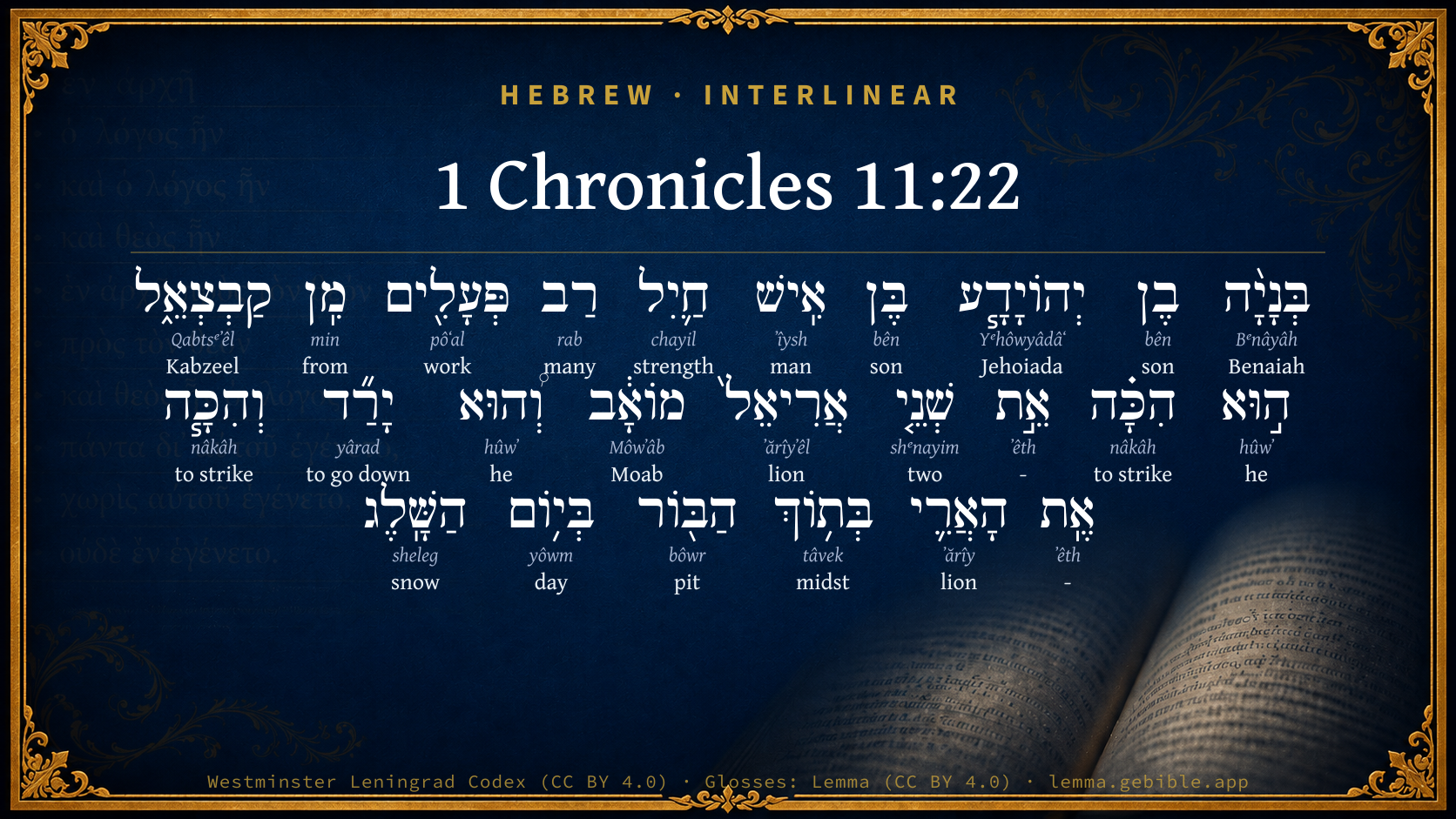
1 Chronicles 11:22

Hebrew (Westminster Leningrad Codex) 1 Chronicles 11:22 appears in the Hebrew Old Testament. The text above is from the Westminster Leningrad Codex. Each word links to its Strong’s number, a concise gloss, and parsing drawn from the Open Scriptures Hebrew Bible morphology. Click any word for its full Brown-Driver-Briggs (BDB) entry.
Download image
Cite this verse

1 Chronicles 11:22 (World English Bible). Public Domain. Lemma interlinear Bible study tool, https://lemma.gebible.app/v/1-chronicles/11/22.

Show BibTeX & RIS
BibTeX
RIS
English Translation
Benaiah the son of Jehoiada, the son of a valiant man of Kabzeel, who had done mighty deeds, he killed the two [sons of] Ariel of Moab: he went down also and killed a lion in the midst of a pit in time of snow.
World English Bible · Public Domain
Download a study sheet

One document with this verse’s original text, its word-by-word gloss line, the meaning frame, cross-references with their text, attributed commentary, and full source and license credits — printable, and it pastes into notes with its structure intact.

This verse Autodidact and up

Study sheet (.html) Plain text (.txt)

A passage Seminary Student

Up to 50 verses in one chapter. A passage sheet keeps up to 6 commentary sources and 12 cross-references per verse, in the order this page ranks them, and says so on the sheet whenever that leaves anything out. Ask for a single verse and you get the Autodidact verse sheet above.

Everything on this page stays free to read, with no account — the sheet is a download of what is already on screen, not access to it.

Want to remove ads? Support Godless Engineer
Compare translations 3

The same verse in 3 English versions, stacked beneath the original-language interlinear above. Click any original word for its lexicon entry.

Each is an independent rendering of the whole verse — the interlinear is not word-aligned to these translations.

Highlighted words mark where these versions differ — a whole-verse word diff, not a word-by-word alignment.

  • World English Bible Public Domain
    Benaiah the son of Jehoiada, the son of a valiant man of Kabzeel, who had done mighty deeds, he killed the two [sons of] Ariel of Moab: he went down also and killed a lion in the midst of a pit in time of snow.
  • King James Version Public Domain
    Benaiah the son of Jehoiada, the son of a valiant man of Kabzeel, who had done many acts; he slew two lionlike men of Moab: also he went down and slew a lion in a pit in a snowy day.
  • unfoldingWord Literal Text CC BY-SA 4.0
    Benaiah, the son of Jehoiada, a son of a man of valor, many of deeds, from Kabzeel. He, he struck the two Ariel of Moab. And he, he went down and struck a lion in the midst of the pit on a day of snow.

unfoldingWord Literal Text — © unfoldingWord, licensed CC BY-SA 4.0. Word-aligned USFM3 via Door43 (git.door43.org/unfoldingWord/en_ult).

Versions to compare (up to 4)

3 of 4 selected

Show all 18 translations

Every available English version of this verse, each an independent rendering of the whole verse.

  • World English Bible Public Domain
    Benaiah the son of Jehoiada, the son of a valiant man of Kabzeel, who had done mighty deeds, he killed the two [sons of] Ariel of Moab: he went down also and killed a lion in the midst of a pit in time of snow.
  • Berean Standard Bible Public Domain
    And Benaiah son of Jehoiada was a man of valor from Kabzeel, a man of many exploits. He struck down two champions of Moab, and on a snowy day he went down into a pit and killed a lion.
  • Majority Standard Bible Public Domain
    And Benaiah son of Jehoiada was a man of valor from Kabzeel, a man of many exploits. He struck down two champions of Moab, and on a snowy day he went down into a pit and killed a lion.
  • King James Version Public Domain
    Benaiah the son of Jehoiada, the son of a valiant man of Kabzeel, who had done many acts; he slew two lionlike men of Moab: also he went down and slew a lion in a pit in a snowy day.
  • American Standard Version (1901) Public Domain
    Benaiah the son of Jehoiada, the son of a valiant man of Kabzeel, who had done mighty deeds, he slew the two `sons of' Ariel of Moab: he went down also and slew a lion in the midst of a pit in time of snow.
  • Revised Version (1885) Public Domain
    Benaiah the son of Jehoiada, the son of a valiant man of Kabzeel, who had done mighty deeds, he slew the two sons of Ariel of Moab: he went down also and slew a lion in the midst of a pit in time of snow.
  • Geneva Bible (1599) Public Domain
    Benaiah the sonne of Iehoiada (the sonne of a valiant man) which had done many actes, and was of Kabzeel, he slewe two strong men of Moab: he went downe also and slewe a lion in the middes of a pit in time of snowe.
  • Douay-Rheims (1899) Public Domain
    Banaias the son of Joiada, a most valiant man, of Cabseel, who had done many acts: he slew the two ariels of Moab: and he went down, and killed a lion in the midst of a pit in the time of snow.
  • Young's Literal Translation Public Domain
    Benaiah son of Jehoiada, son of a man of valour, of great deeds, from Kabzeel: he hath smitten the two lion-like Moabites, and he hath gone down and smitten the lion in the midst of the pit, in the day of snow.
  • Literal Standard Version CC BY-SA 4.0
    Benaiah son of Jehoiada, son of a man of valor, of great deeds, from Kabzeel: he has struck the two lion-like Moabites, and he has gone down and struck the lion in the midst of the pit, in the day of snow.
  • Unlocked Literal Bible CC BY-SA 4.0
    Benaiah son of Jehoiada was a brave warrior from Kabzeel, who did great deeds. He killed the two sons of Ariel of Moab. He also went down into a pit and killed a lion on a day when the snow was falling.
  • unfoldingWord Literal Text CC BY-SA 4.0
    Benaiah, the son of Jehoiada, a son of a man of valor, many of deeds, from Kabzeel. He, he struck the two Ariel of Moab. And he, he went down and struck a lion in the midst of the pit on a day of snow.
  • Darby Bible Public Domain
    Benaiah the son of Jehoiada, the son of a valiant man, great in exploits, of Kabzeel: he it was that smote two lions of Moab; and he went down and smote a lion in the midst of a pit on a snowy day.
  • World Messianic Bible Public Domain
    Benaiah the son of Jehoiada, the son of a valiant man of Kabzeel, who had done mighty deeds, killed the two sons of Ariel of Moab. He also went down and killed a lion in the middle of a pit on a snowy day.
  • Webster's Bible Public Domain
    Benaiah the son of Jehoiada, the son of a valiant man of Kabzeel, who had done many acts; he slew two lion-like men of Moab: also he went down and slew a lion in a pit in a snowy day.
  • Free Bible Version CC BY-SA 4.0
    Benaiah, son of Jehoiada, a strong warrior from Kabzeel, did many amazing things. He killed two sons of Ariel of Moab. He also went after a lion into a pit in the snow and killed it.
  • Bible in Basic English Public Domain
    Benaiah, the son of Jehoiada, a fighting-man of Kabzeel, had done great acts; he put to death two young lions going into their secret place; and he went down into a hole and put a lion to death in time of snow.
  • JPS Tanakh (1917) Public Domain
    Beniah the son of Jehoiada, the son of a valiant man of Kabzeel, who had done mighty deeds, he smote the two altar-hearths of Moab; he went down also and slew a lion in the midst of a pit in time of snow.

Literal Standard Version (2020), Covenant Press — licensed CC BY-SA 4.0. Text via the HelloAO Bible API (eBible.org). Unlocked Literal Bible (unfoldingWord) — licensed CC BY-SA 4.0. Text via the HelloAO Bible API (eBible.org). unfoldingWord Literal Text — © unfoldingWord, licensed CC BY-SA 4.0. Word-aligned USFM3 via Door43 (git.door43.org/unfoldingWord/en_ult). Free Bible Version, Dr. Jonathan Gallagher — licensed CC BY-SA 4.0. Text via the HelloAO Bible API (eBible.org).

Word by word

More ways to search: Search by grammar → Find every occurrence → Compare this word →

Practice this passage: Drill this verse → Learn its vocabulary →

אֲרִיאֵל֙
ʼărîyʼêl
H739
“lion”
Noun, Proper
Part of Speech
Noun
Type
Proper
Full BDB Definition

Origin: from H738 and H410

TWOT: 159a

meaning uncertain - (CLBL) possibly lion-like - (BDB) possibly two sons of Ariel of Moab
  1. בְּנָיָ֨ה Bᵉnâyâh H1141 “Benaiah” Noun, Proper
  2. בֶן bên H1121 “son of” Noun, Common, Masculine, Singular, Construct
  3. יְהוֹיָדָ֧ע Yᵉhôwyâdâʻ H3077 “Jehoiada” Noun, Proper
  4. בֶּן bên H1121 “son of” Noun, Common, Masculine, Singular, Construct
  5. אִֽישׁ ʼîysh H376 “man of” Noun, Common, Masculine, Singular, Construct
  6. חַ֛יִל chayil H2428 “strength” Noun, Common, Masculine, Singular, Absolute
  7. רַב rab H7227 “many of” Adjective, Adjective, Masculine, Singular, Construct
  8. פְּעָלִ֖ים pôʻal H6467 “works” Noun, Common, Masculine, Plural, Absolute
  9. מִֽן min H4480 “from” Preposition
  10. קַבְצְאֵ֑ל Qabtsᵉʼêl H6909 “Kabzeel” Noun, Proper
  11. ה֣וּא hûwʼ H1931 “he” Pronoun, Personal, 3rd Person, Masculine, Singular
  12. הִכָּ֗ה nâkâh H5221 “to strike” Verb, Hiphil, Perfect, 3rd Person, Masculine, Singular
  13. אֵ֣ת ʼêth H853 “-” Particle, Direct Object
  14. שְׁנֵ֤י shᵉnayim H8147 “two” Adjective, Cardinal number, Masculine, Dual, Construct
  15. מוֹאָ֔ב Môwʼâb H4124 “Moab” Noun, Proper
  16. וְ֠הוּא hûwʼ H1931 “and · he” Conjunction + Pronoun, Personal, 3rd Person, Masculine, Singular
  17. יָרַ֞ד yârad H3381 “to go down” Verb, Qal, Perfect, 3rd Person, Masculine, Singular
  18. וְהִכָּ֧ה nâkâh H5221 “and · to strike” Conjunction + Verb, Hiphil, Perfect, 3rd Person, Masculine, Singular
  19. אֶֽת ʼêth H853 “-” Particle, Direct Object
  20. הָאֲרִ֛י ʼărîy H738 “the · lion” Particle, Definite Article + Noun, Common, Masculine, Singular, Absolute
  21. בְּת֥וֹךְ tâvek H8432 “in/at · midst of” Preposition + Noun, Common, Masculine, Singular, Construct
  22. הַבּ֖וֹר bôwr H953 “the · pit” Particle, Definite Article + Noun, Common, Masculine, Singular, Absolute
  23. בְּי֥וֹם yôwm H3117 “in/at · day of” Preposition + Noun, Common, Masculine, Singular, Construct
  24. הַשָּֽׁלֶג sheleg H7950 “the · snow” Particle, Definite Article + Noun, Common, Masculine, Singular, Absolute

About this verse

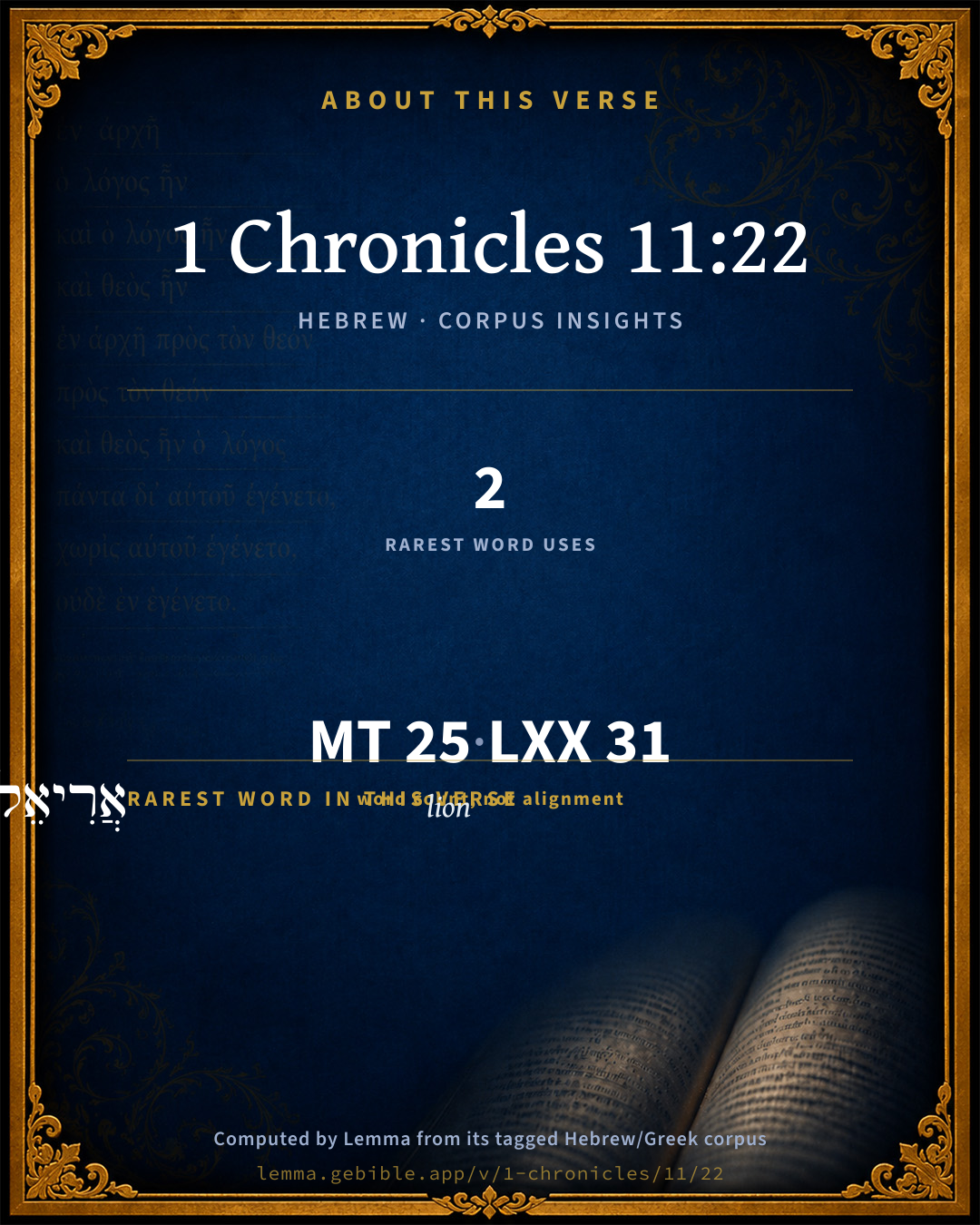
These counts appear in no published source. They are computed here, from the morphology-tagged text and Lemma’s own curated glosses. What Lemma adds →

25
words
21
distinct lemmas
Historical
section

Notable vocabulary

The rarest word here is אֲרִיאֵל֙ lion H739 — appearing just 2 times in the whole Hebrew Bible.

Shared distinctive vocabulary

אֲרִיאֵל֙ lion H739 occurs in 2 verses of the Hebrew Bible. Also found in:

Grammatical profile

  • 3 verbs
  • 15 nouns
  • 2 adjectives
  • 2 pronouns
  • 1 preposition
  • 2 particles

Verb forms

  • הִכָּ֗ה Hiphil · Perfect
  • יָרַ֞ד Qal · Perfect
  • וְהִכָּ֧ה Hiphil · Perfect

Repetition

Words recur within this verse — often emphatic in Hebrew:

  • בֶן son H1121 ×2
  • הִכָּ֗ה to strike H5221 ×2
  • ה֣וּא he H1931 ×2

Hebrew & Septuagint length

In English translation the verse runs 45 words from the Hebrew and 41 from the Septuagint (LXX English) — closely comparable.

A rough comparison of the two English renderings, which tokenize alike — not a word-level alignment.

Word counts can differ between the Hebrew and the Greek without any difference in meaning — e.g. the Hebrew direct-object marker אֵת has no separate Greek word, and Greek often adds the article ὁ.

In the original languages it is 25 Hebrew tokens and 31 Greek tokens — but the two are counted differently (Hebrew bundles its prefixes and suffixes into one token; the Greek is in lemma form), so that isn’t a like-for-like length.

Cross-references

13

Topical passages linked to 1 Chronicles 11:22 in the Treasury of Scripture Knowledge — connected by theme and wording, ordered by reader-vote popularity; previews shown in the World English Bible.

  • Joshua 15:21 The uttermost cities of the tribe of the children of Judah toward the border of Edom in the South were Kabzeel, and Eder, and Jagur,
  • 2 Samuel 8:18 and Benaiah the son of Jehoiada [was over] the Cherethites and the Pelethites; and David's sons were chief ministers.
  • 2 Samuel 23:20–23 Benaiah the son of Jehoiada, the son of a valiant man of Kabzeel, who had done mighty deeds, he killed the two [sons of] Ariel of Moab: he went down also and killed a lion in the midst of a pit in time of snow.
  • Judges 14:5–6 Then went Samson down, and his father and his mother, to Timnah, and came to the vineyards of Timnah: and, behold, a young lion roared against him.
  • 1 Samuel 17:34–36 David said to Saul, Your servant was keeping his father's sheep; and when there came a lion, or a bear, and took a lamb out of the flock,
  • 2 Samuel 1:23 Saul and Jonathan were lovely and pleasant in their lives, In their death they were not divided: They were swifter than eagles, They were stronger than lions.
  • 2 Samuel 20:23 Now Joab was over all the host of Israel; and Benaiah the son of Jehoiada was over the Cherethites and over the Pelethites;
  • 1 Kings 1:8 But Zadok the priest, and Benaiah the son of Jehoiada, and Nathan the prophet, and Shimei, and Rei, and the mighty men who belonged to David, were not with Adonijah.
  • 1 Kings 1:38 So Zadok the priest, and Nathan the prophet, and Benaiah the son of Jehoiada, and the Cherethites and the Pelethites, went down, and caused Solomon to ride on king David's mule, and brought him to Gihon.
  • 1 Kings 2:30 Benaiah came to the Tent of Yahweh, and said to him, Thus says the king, Come forth. He said, No; but I will die here. Benaiah brought the king word again, saying, Thus said Joab, and thus he answered me.
  • 1 Kings 2:34–35 Then Benaiah the son of Jehoiada went up, and fell on him, and killed him; and he was buried in his own house in the wilderness.
  • 1 Chronicles 12:8 Of the Gadites there separated themselves to David to the stronghold in the wilderness, mighty men of valor, men trained for war, that could handle shield and spear; whose faces were like the faces of lions, and they were as swift as the roes on the mountains;
  • 1 Chronicles 27:5–6 The third captain of the host for the third month was Benaiah, the son of Jehoiada the priest, chief: and in his division were twenty-four thousand.

Cross-references courtesy of OpenBible.info (CC BY 4.0).

Hebrew and Greek witnesses Masoretic Hebrew ↔ Greek Septuagint

The same verse in the two great witnesses to the Old Testament, shown verse-for-verse.

These are two independent witnesses, not word-aligned to each other, and the Septuagint is shown in lemma (dictionary) form.

Hebrew 1 Chronicles 11:22 Masoretic · Westminster Leningrad Codex

בְּנָיָ֨ה בֶן יְהוֹיָדָ֧ע בֶּן אִֽישׁ חַ֛יִל רַב פְּעָלִ֖ים מִֽן קַבְצְאֵ֑ל ה֣וּא הִכָּ֗ה אֵ֣ת שְׁנֵ֤י אֲרִיאֵל֙ מוֹאָ֔ב וְ֠הוּא יָרַ֞ד וְהִכָּ֧ה אֶֽת הָאֲרִ֛י בְּת֥וֹךְ הַבּ֖וֹר בְּי֥וֹם הַשָּֽׁלֶג

Benaiah the son of Jehoiada, the son of a valiant man of Kabzeel, who had done mighty deeds, he killed the two [sons of] Ariel of Moab: he went down also and killed a lion in the midst of a pit in time of snow.

World English Bible · Public Domain

Greek LXX 1 Chronicles 11:22 Septuagint · lemma form

καί βαναιας υἱός ιωδαε υἱός ἀνήρ δυνατός πολύς ἔργον αὐτός ὑπέρ καβασαηλ οὗτος πατάσσω ὁ δύο αριηλ μωαβ καί οὗτος καταβαίνω καί πατάσσω ὁ λέων ἐν ὁ λάκκος ἐν ἡμέρα χιών

And Banaia the son of Jodae was the son of a mighty man: many were his acts for Cabasael: he struck two lion-like men of Moab, and he went down and struck a lion in a pit on a snowy day.

LXX2012 (modern English Septuagint) · Public Domain

On this verse, Ellicott's Commentary for English Readers discusses the Septuagint’s reading. Read the note in Commentary ↓

Hebrew: Westminster Leningrad Codex (CC BY 4.0). Greek: Septuagint (public domain); English from LXX2012 (modern English Septuagint) (Public Domain). How the Septuagint differs from the Hebrew →

Commentary

Notes on 1 Chronicles 11:22 from classic Christian and Jewish commentators (each source and its license shown beneath its notes). The classic Christian expositions comment on the surrounding passage and are grouped to its opening verse, so a note may address several verses; the Jewish commentaries on the Tanakh (Rashi and others) are per-verse, so they appear only where the commentator wrote on this verse.

Lemma curates 59 commentaries, every one of them public domain or Creative Commons licensed, each selected and text-cleaned for this edition rather than reprinted as found. About our sources →

Trapp's Complete Commentary

John Trapp

1Ch 11:22 Benaiah the son of Jehoiada, the son of a valiant man of Kabzeel, who had done many acts; he slew two lionlike men of Moab: also he went down and slew a lion in a pit in a snowy day.

Ver. 22. Who had done many acts.] Egregiorum facinorum fuit patrator. Gallice, Homme d’execution: Anglice, A man of his hands; Heb., A master of acts.

Also he went down, &c.] See 2Sa 23:20.

John Trapp, A Commentary or Exposition upon All the Books of the Old and New Testament (1647–1656) — public domain. Text from a community e-Sword module.

The Biblical Illustrator

Joseph S. Exell

1Ch_11:22

The son of a valiant man of Kabzeel.

Valiant men

If we are to expect the virtues of the fathers repeated in the sons, what wonderful progress the ages ought to have seen? It is a marvellous fact that whatever a father may be able to bequeath to his children he is unable to give them the information which he himself has acquired. Every man must learn the alphabet for himself. Some degree of mental force maybe traceable to heredity, and unquestionably it is so; at the same time that mental force is to be exercised by its owner on quite independent grounds. We cannot live long on the reputation of our fathers. A curious law of recession seems to operate on the progress of mankind. The son of Aristotle is not Aristotle plus; he may indeed be Aristotle minus in an alarming degree, quite an indifferent figure, an incapable person, a living irony upon the greatness of the father to whom he belongs; yet in the next generation there may be a distinct advance, and even the original greatness may be transcended. We must never forget the responsibility of having a great father. (J. Parker, D. D.)

The Biblical Illustrator, edited by Joseph S. Exell (c. 1880s–1900s) — public domain. Text from a community e-Sword module.

Geneva Bible (1599)

Geneva Bible translators

Or, lions.

Geneva Bible (1599) marginal notes — public domain. Text via Bolls.life.

Jamieson, Fausset & Brown

Robert Jamieson, A. R. Fausset & David Brown

Benaiah . . . of Kabzeel--a town in the south of Judah (Jos 15:21; Neh 11:25). It is said that "he had done many acts," though three only are mentioned as specimens of his daring energy and fearless courage.

slew two lionlike men of Moab--literally, "lions of God," that is, great lions or champions. This gallant feat was probably achieved in David's hostile invasion of Moab (Sa2 8:2).

also he went down and slew a lion in a pit in a snowy day--probably a cave into which Benaiah had taken refuge from the snowstorm, and in which he encountered a savage lion which had its lair there. In a spacious cave the achievement would be far greater than if the monster had been previously snared or cabined in a pit.

Jamieson, Fausset & Brown — Commentary Critical and Explanatory on the Whole Bible (1871) — public domain (CC PDM 1.0). Text via the HelloAO Bible API.

Adam Clarke's Commentary

Verse 22. Benaiah - slew two lion - like men of Moab] The Targum says, "Benaiah was a valiant man, fearing sin, and of a righteous conduct in Kabzeel; he slew two of the nobles of Moab, who were like two strong lions. He was a great and righteous man as any in the second sanctuary. On a certain day, having struck his foot against a dead tortoise, he went down to Shiloh, and having broken pieces of ice, he washed himself with them, and afterward went up, and read the book of the law of the priests, in which much is contained, in a short winter's day, viz., the tenth of the month Tebeth."

Adam Clarke's Commentary on the Bible (1810–1826) — public domain. Text from a community e-Sword/MySword module.

Ellicott's Commentary for English Readers

(22-25) Benaiah the son of Jehoiada.—Captain of the royal guard (1Ch_18:17) and third “captain of the host” (1Ch_27:5-6).

Son of a valiant man.—“Son” is probably a spurious addition here, as elsewhere. The Syriac has “Benaiah son of Joiada, a strong warrior.” The LXX., however, reads, “son of a mighty man.”

Kabzeel.—A town of southern Judah, site unknown (Jos_15:21); Neh_11:25 (Jekabzeel).

Who had done many acts.—The margin is correct. This poetic phrase only occurs in this and the parallel passage.

He slew two lionlike men of Moab.—See 1Ch_18:2. So the Syriac: “He slew two giants of Moab.” The Hebrew has, “He smote the two Ariel of Moab.” Ariel, “lion of God”—a title of heroes with the Arabs and Persians—appears to be used as an appellative (Isa_33:7): “Lo, the heroes (‘arîêlîm) cry without!” (Heb.) The LXX. of 2Sa_23:20 reads, “The two sons of Ariel of Moab;” whence some think that Ariel denotes here the king of Moab; but the former sense is better.

Also he went down and slew a lion.—Literally, And he (it was who) went down and smote the lion in the middle of the cistern in the day of snow. The article pointedly refers to some well-known feat of Benaiah’s.

A Bible Commentary for English Readers, edited by Charles John Ellicott (1878–1897) — public domain. Text from a community e-Sword module.

The Cambridge Bible for Schools and Colleges

gen. ed. J. J. S. Perowne

22. Benaiah] See 2Sa_8:18; 1Ki_1:8 ff; 1Ki_2:25-35.

Kabzeel] It was in the south of Judah; Jos_15:21.

done many acts] R.V. done mighty deeds.

he slew two lionlike men of Moab] R.V. “the two sons of Ariel of Moab” (so LXX. of 2Sa_23:20). The phrase however is very difficult to interpret. Another translation is “he slew the two champions of Moab.” A fourth (perhaps the best) is “he smote the two altar-pillars of Moab,” i.e. he overthrew the two high columns on which the sacred fire of the Moabites was kept (Robertson Smith, Religion of the Semites, Additional Note L). To injure or deile the sacred place of an enemy was a common practice in ancient war.

in a snowy day] R.V. in time of snow.

The Cambridge Bible for Schools and Colleges (gen. ed. J. J. S. Perowne; Cambridge University Press, 1878–1918) — public domain. Text from a community e-Sword module.

Haydock's Catholic Bible Commentary

Two ariels. That is, two lions, or lion-like men; for ariel, in Hebrew, signifies "a lion (Challoner) of God," the strongest compound word for "a man of valour. The courage of a lion is so singular, that a man of extraordinary heroism is frequently called a lion, by way of emphasis; and the word God is frequently applied in Scripture to things particularly great." (Kennicott) --- V is wanting at the beginning and end of the name of Banaias, (here Benaia, instead of Ubenaiahu and Banaias, 2 Kings.) The last letter (ver. 24) serves to distinguish this third captain in waiting on the king, from the eleventh, ver. 31., and chap. xxvii. 5., and 14. (Haydock) -- Hebrew, "And Benaihu, the son of Jehoiada, the son of a valiant man of Kabzeel, mighty in exploits; he slew two men of Moab, who were stouter than lions. He also went down and slew a lion in a pit, in a snowy day." (Kennicott) --- We have observed, that "And" is not found in the printed Hebrew nor is it in the Protestant, "Benaiah....slew two lion-like men, of Moad." Literally, "ariels;" (Septuagint) that is, "lions of God," or two of Moab equal to (Haydock) the strongest lions. (Worthington) --- Yet it is not certain whether these were not real lions, as well as the following. (Haydock) --- St. Jerome translates, two lions of Moab, 2 Kings xxiii. 20. (Calmet) --- Lion: ari is written arih, 2 Kings. (Haydock)

George Leo Haydock (1774–1849), Haydock's Catholic Family Bible and Commentary, 1859 edition — public domain. Excludes Psalms (Douay-Rheims chapter numbering differs from Protestant) and Deuterocanonical books (Catholic canon only).

The Pulpit Commentary

Benaiah, His father Jehoiada was chief priest. (1Ch_27:5) Benaiah was, therefore, a Levite by tribe, though Kabzeel (Jos_15:21) was in Judah far south. He was "captain of the host for the third month and in his course were twenty and four thousand". (1Ch_27:5) When in our ver. 25 it is said that "David set him over his guard," the allusion probably is to his uniform and prolonged command of "the Cherethites and Pelethites" (2Sa_8:18 2Sa_20:23; 1 Kings. (1Ch_18:17) His fidelity and influence remained into Solomon"s time. (1Ki_1:8, 1Ki_1:10, 1Ki_1:32, 1Ki_1:38, 44 2:35 4:4)

Benaiah the son of Jehoiada.

the son of Jehoiada, the son of a valiant man of Kabzeel, who had done many acts; he slew two lionlike men of Moab: also he went down and slew a lion in a pit in a snowy day. And he slew an Egyptian, a man of great stature, five cubits high; and in the Egyptian"s hand was a spear like a weaver"s beam; and he went down to him with a staff, and plucked the spear out of the Egyptian"s hand, and slew him with his own spear." I venture to treat of this hero, although far removed from any nineteenth-century characteristics. He was a priest, son of a high priest, yet a warrior. To find one like him in office and quality one has to go back to the fighting bishops of the Middle Ages. We do not read of his ministering at the altar. Yet we must not, therefore, imagine him some degenerate son of Aaron, affording warning rather than example. For there is something savoury in his brief story, which occurs twice in the Bible, and just because of its unusual combinations of characteristics it is worth our lingering on it. Let me urge some simple lessons which may be of use, at least to the more combative of our readers. Observe

I THAT MANLINESS IS A GREAT DESIDERATUM IN A PRIESTHOOD. To make a true priest of God, the first and greatest thing required is godliness, and the second is like unto it manliness; and on these two qualities hang all effective discharge of priestly duties. It may be objected that this remark does not necessarily spring from Benaiah, who, though of the tribe of Levi, might be an exception to rather than a specimen of the priestly order. And I should admit the relevancy of the remark were it not that the tribe of Levi seems, in Egypt, to have been conspicuous for its courage and leading qualities (for otherwise the eminence of Aaron before Moses received his commission would be inexplicable); that the tribe of Levi was called pre-eminently the host," during all the encampments in the wilderness; that in David"s time the tribe of Levi seems to have afforded one of the monthly army corps of twenty-four thousand men; (1Ch_27:5) that from the days of Phinehas to those of the Maccabees, and even later, the priesthood furnished many of Israel"s noblest warriors; so that, without pressing or straining anything, we have the fact clear that the manliness of the tribe of the Levites was one reason of its selection for the priesthood, or at least one characteristic of it. There is a vulgar manliness, loud, blatant, coarse, unfamiliar with any of the finer questionings or feelings of the soul. Far from all priestly work be such. But the noblest manliness is not coarse. It blends gentleness with courage, is a thing of force of spirit rather than of bodily strength, marked by vigour and truth, daring rather than any braggart delight in blows. And it should be remembered that weak and feeble spirits are nowhere more out of place than in the Christian ministry. To make a true minister of the gospel of Jesus Christ you want essentially, as the raw material out of which God makes him manliness. Courage to avow the faith when all may be denying it; to stand alone; to resist all seduction to smother doubt and to repeat hearsay; to dare to do right; to have the inspiring power which nerves others to dare it as well; to rebuke; to warn; to count and accept the cost of faithfulness to principles; to be a leader and commander to the people; for these things is manliness not needed? is courage not supremely requisite? Peter said, Add to your faith manliness (virtue in the Latin sense, not in the English). Christ said of Peter, "Thou art a rock, and on this rock I will build my Church." In Hebrews 11, you could almost substitute the word "courage" for the word "faith," so constantly and inseparably are they united. The great names of the Church are no less illustrious for courage than for spiritual insight. Paul, Athanasius standing "alone against the world," Luther, Calvin, Knox, Wesley, Carey, Williams, Livingstone; you have just to go over the great names of the Church"s history to see that the names of those greatly good have been those preeminently of men greatly brave as well. Whatever your work, Christian, if you would be a true priest of God you must be brave. "Put on thy strength, O Zion." Religion never enervates when it is the real thing, but uses and increases all the braver qualities of the spirit. Faith is a fight in all directions. We have sometimes fostered a piety too sentimental, phrasy, and self-conscious. From the manliness which God approved in in the old priesthood, and which Benaiah had in prime fulness, learn that godliness and manliness should meet to make a thorough character. Observe (what, indeed, flows from this)

II THAT THE COMBATIVE QUALITY IN MAN, WHILE IT NEEDS HALLOWING, ADMITS OF IT. Man is very largely a fighting animal. His modes of attack come almost as instinctively as the various modes of assault used by the lower animals. The taste for conflict distinguishing all men, true religion does not destroy, but seeks to hallow it. The mental analyst will tell you that be needs some admixture of the combative element to produce some of the finest qualities of nature. It is that which gives hardness and a staying power to the man. There is no decision of character without it. We need the power of standing up against our enemies to stand up against ourselves. There is no pertinacity of purpose without it. He who has not a little of the combative element soon gives in. There is no conquest of difficulties without it. We shrink from every trouble, say a lion is in the street, if there is nothing of this quality in us. So that the combative quality is not one of nature"s mistakes that grace has just to weed out, but something it has to hallow; an edged tool, in learning the uses of which we often cut our fingers, but something not on that account to be thrown away. It may be hallowed, but it needs a good deal of effort to secure a thorough hallowing of it. It is apt to he a reckless quality, striking wildly; the weapon of the passions rather than of the reason; used by and intensifying animosity; the source of strife and confusion, and the "every evil work" which attend them shedding blood, devastating kingdoms, burdening conscience with guilt, running riotous in its wrong. When rightly used, one of the grandest blessings of life; when ill used, one of its great curses. If so valuable hallowed, so mischievous unhallowed, the question rises When is it hallowed, and truly and divinely used? And I think Benaiah"s case gives us, somewhat roughly, perhaps, but clearly, the true answer to the question. It is used rightly and hallowed when directed against the enemies of the public good. Sometimes against an Egyptian host mustered to battle, sometimes against the Moabites, and sometimes against the wild beasts. An evangelical generalization might not be far out of it which stated it that the combative clement is wisely employed when it operates against whatever injures our own character or our neighbour"s well-being. The man fights foolishly who does not begin the conflict by fighting with himself. It were vain to fight against Egyptians and Moabites, and then give in and let some lion destroy the power so valuable power which might have done such splendid service. To say "No" to our own weaknesses, to protect the interests of others, to oppose whatever by its falsehood, sin, or mischief threatens the true well-being of our friends and neighbours. Oh, how much there is that needs fighting! how much of evil in our own hearts! how much in the world! How much of evil is daily assailing and destroying the happiness and well-being of multitudes, but for want of brave hearts that think of more than merely getting to heaven themselves, and that are willing to make some sacrifice of comfort and ease and to risk what is dearer than either! "Fight the good fight of faith; lay hold on eternal life;" and oppose whatever harms your brethren.

III THAT THERE ARE A GOOD MANY DIFFERENT KINDS OF ENEMIES TO BE TACKLED IN" THE COURSE OF OUR LIFE. Sometimes Egyptians; sometimes Moabites; sometimes lions; sometimes some other foe, like the Philistines encamped round Bethlehem, through whom Benaiah and two others broke to fetch David a draught of water from its well. Yes; there is more than one or two or even three sorts of enemies against which we have here to fight. Now it is a subtle whisper that denies there is any Providence here or heaven hereafter; now it is some passion that, rising up within us, clamours for mastery ever the reason and duty; now it is greed, which makes the fingers stick to the money they should part with; now it is one of what are called the minor faults, but which yet are capable of inflicting much pain and injury that needs to be put down; now it is the ignorance of the children of the people; now it is their vices, their drunkenness; now it is the system which is permitted to increase the wealth of individuals at the expense of corrupting the life of the people. Oh for a few Benaiahs, that in conflict with such evils will put forth a noble strength. Let us not live a merely private life. Rise and assail the foe which is injuring society, beginning, I must say again, with the enemies that fight in your own heart unbelief in Christ, unwillingness to follow him, indulgence of your own weakness. There are too many Reubens in every age who, when great issues are being fought out big with bliss or woe to generations, "abide" ignobly "among the bleating of the sheep." Keener interest in all efforts of philanthropy and politics to further human well-being, is what is required at our hand. Lastly, observe that

IV IN ALL FIGHTING, THE SOUL IS THE MAIN THING. Doubtless Benaiah had great muscular strength, but that was but a little of his equipment. The splendid audacity that engaged with the Egyptian, meaning to kill him with his own spear. The fine superiority to thought of consequences to himself of engaging with that hungry lion on a winter"s day, in close quarters, where neither could escape the other. It was that brave spirit in him which, never shrinking from attempts that seemed impossible, nor kept back by the discretion that seeks to save its skin, wrought its grand marvels. Oh, bow little of this grand courage marks us! How much solicitude we have about our name, our peace, what people may think of us, our money, the chance of failing] In this world the timid don"t always go most safely. It is the brave heart that comes best out of all its conflicts. Pluck up a little strength, and call to God for more, and venture bravely wherever duty calls you, and, like Benaiah, you will find fame, safety, usefulness, attendant on your steps. G.

The Pulpit Commentary (1880–1919), ed. H.D.M. Spence-Jones & Joseph S. Exell — public domain. Text from a community e-Sword module.

unfoldingWord translationNotes

Door43 World Missions Community

Benaiah ... Jehoiada ... Ariel

These are the names of men. (See: How to Translate Names)

five cubits

A "cubit" is a unit of measurement equal to 46 centimeters. AT: "2.3 meters" (See: Biblical Distance)

a spear like a weaver's beam

This compares the size of the spear with the size of a weaver's beam. AT: "a spear the size of a weaver's beam" (See: Assumed Knowledge and Implicit Information)

he went down to him

"Benaiah went down to the Egyptian." This idiom means that he met him in battle. AT: "he attacked him" (See: Idiom)

translationWords

might

Moab

pit

lions

snow

Egypt

spear

staff

unfoldingWord translationNotes — © Distant Shores Media and the Door43 World Missions Community, licensed CC BY-SA 4.0. Source: git.door43.org/Door43/en_tn.

Rashi

Rabbi Shlomo Yitzchaki (Rashi)

a valiant man בֶּן אִישׁ חַַיִל, similar to בֶּן בְּלִיַּעַל, an unscrupulous man, and in Samuel (II 23:20) it is written: בֶּן אִישׁ חַי for it is customary for people, when they see an agile person, to say, “This one is full of life.”

mighty men אֲרִיאֵל mighty men, possessing strength of a lion, a mighty man, and [it] is also an expression of (Ezek. 17: 20): “...and he took the mighty (אֵילֵי) of the land.”

who accomplished many feats He accomplished many feats of heroism.

and he descended and smote the lion in the midst of a pit on a snowy day and he did not fear the cold, and some say [that the heroism] of the snowy day is that throughout the whole year the lion is not as dangerous as on a snowy day. When a person comes against him, he throws the snow with his feet between the person’s eyes until he is unable to see, and he kills him. I heard this [meaning] of this [verse].

Rashi on the Tanakh — English translations: “The Judaica Press complete Tanach with Rashi, translated by A. J. Rosenberg” (CC BY 4.0); “Pentateuch with Rashi's commentary by M. Rosenbaum and A.M. Silbermann, 1929-1934” (public domain); “The Metsudah Tanach series, Lakewood, N.J” (CC BY 4.0); and “The Book of Joshua, Metsudah Publications, 1997” (CC BY 4.0). Text via Sefaria.

Lesson kit

Teaching starters — assembled from the data on this page, not authored interpretation. Every prompt links to the verse data it draws on. Edit before teaching.

1 Chronicles, in the Historical, opens this verse with 25 words (21 distinct Hebrew lemmas). Its most distinctive word is ʼărîyʼêl (“lion”). A historical commentator’s framing appears above. Read the whole chapter for the surrounding context.

Discussion questions

  1. How does “lion” (ʼărîyʼêl) shape what this verse is saying?
  2. How does 2 Samuel 23:20, which shares the word «lion», read alongside this verse?
  3. What does the repetition of “son” (2× in this one verse) do in this verse?
  4. The translations on this page render this verse differently — a whole-verse word diff, not a word-by-word alignment. What might account for the different wordings?
  5. «הִכָּ֗ה» is a Hiphil Perfect verb. How does that grammatical form shape the action described?
  6. Compare how Trapp's Complete Commentary and The Biblical Illustrator read this verse. Where do they agree or differ?

Things to notice

Reading settings

Reading text

Shown beneath each verse's original-language words.

Old Testament
Old Testament edition

Read the OT as the Masoretic Hebrew (MT) or the Greek Septuagint (LXX).

English shown for the Greek Septuagint (in the Hebrew ↔ Greek comparison).

Comparing translations? Open the Compare panel on any verse page to stack up to four side by side.