Psalms 19:10

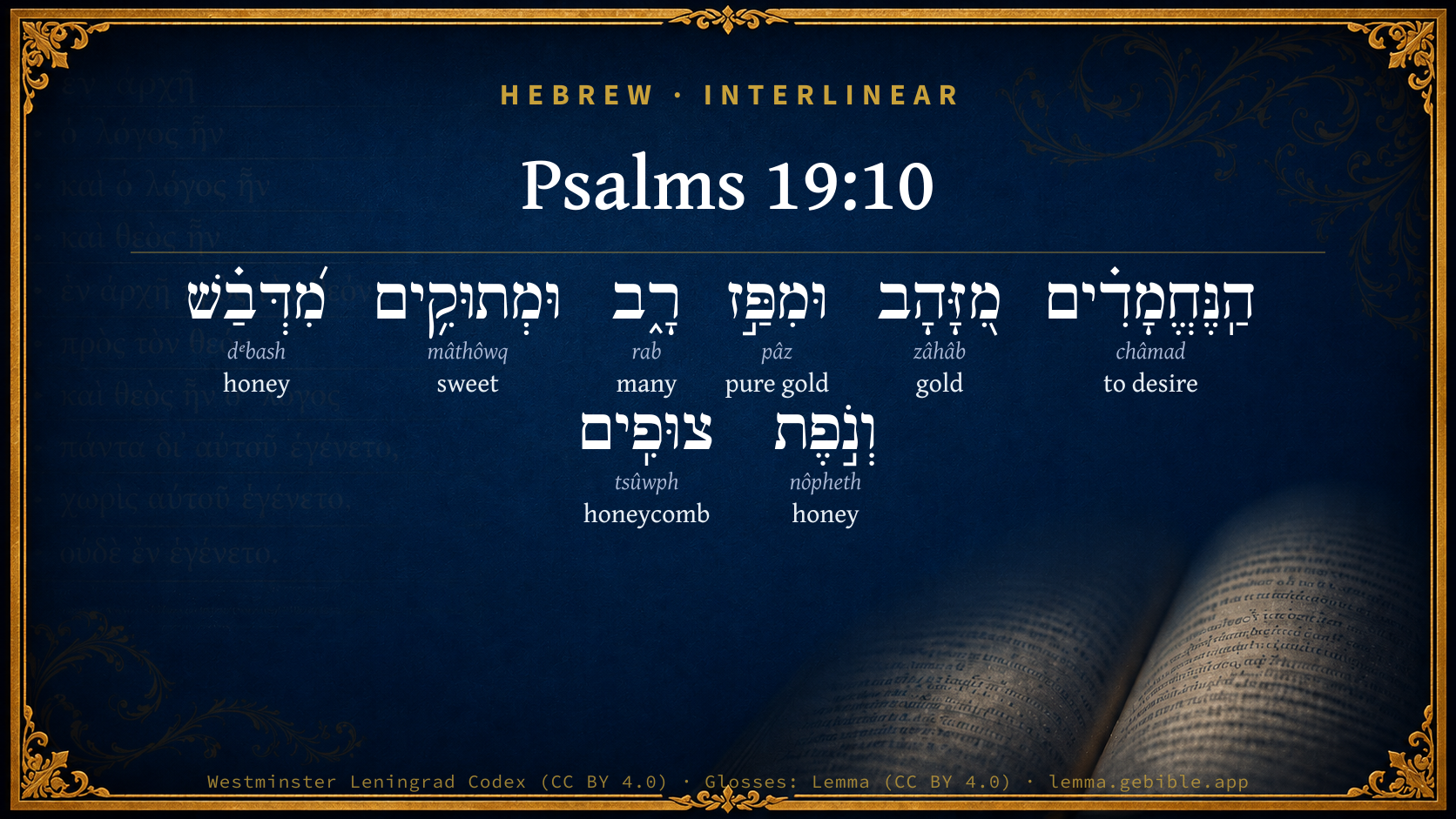
Hebrew (Westminster Leningrad Codex) Psalms 19:10 appears in the Hebrew Old Testament. The text above is from the Westminster Leningrad Codex. Each word links to its Strong’s number, a concise gloss, and parsing drawn from the Open Scriptures Hebrew Bible morphology. Click any word for its full Brown-Driver-Briggs (BDB) entry.
Download image
Cite this verse

Psalms 19:10 (World English Bible). Public Domain. Lemma interlinear Bible study tool, https://lemma.gebible.app/v/psalms/19/10.

Show BibTeX & RIS
BibTeX
RIS
English Translation
More to be desired are they than gold, yes, than much fine gold; Sweeter also than honey and the extract of the honeycomb.
World English Bible · Public Domain
Highlights
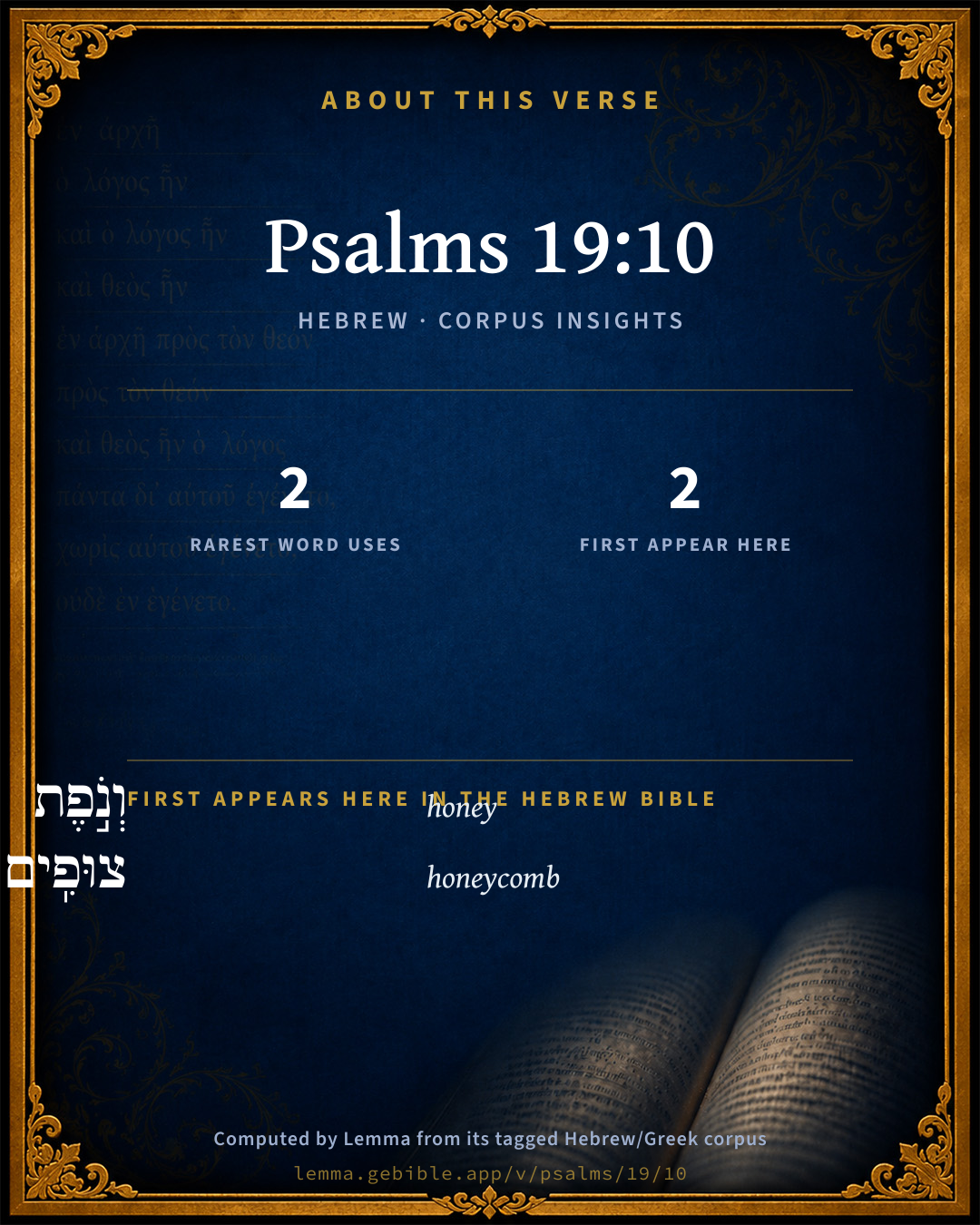
  • 2 first appearances in the Hebrew Bible
Full analysis ↓
Download a study sheet

One document with this verse’s original text, its word-by-word gloss line, the meaning frame, cross-references with their text, attributed commentary, and full source and license credits — printable, and it pastes into notes with its structure intact.

This verse Autodidact and up

Study sheet (.html) Plain text (.txt)

A passage Seminary Student

Up to 50 verses in one chapter. A passage sheet keeps up to 6 commentary sources and 12 cross-references per verse, in the order this page ranks them, and says so on the sheet whenever that leaves anything out. Ask for a single verse and you get the Autodidact verse sheet above.

Everything on this page stays free to read, with no account — the sheet is a download of what is already on screen, not access to it.

Want to remove ads? Support Godless Engineer
Compare translations 3

The same verse in 3 English versions, stacked beneath the original-language interlinear above. Click any original word for its lexicon entry.

Each is an independent rendering of the whole verse — the interlinear is not word-aligned to these translations.

Highlighted words mark where these versions differ — a whole-verse word diff, not a word-by-word alignment.

  • World English Bible Public Domain
    More to be desired are they than gold, yes, than much fine gold; Sweeter also than honey and the extract of the honeycomb.
  • King James Version Public Domain
    More to be desired are they than gold, yea, than much fine gold: sweeter also than honey and the honeycomb.
  • unfoldingWord Literal Text CC BY-SA 4.0
    They are to be desired more than gold, and more than much fine gold, and they are more sweet than honey and nectar of honeycombs.

unfoldingWord Literal Text — © unfoldingWord, licensed CC BY-SA 4.0. Word-aligned USFM3 via Door43 (git.door43.org/unfoldingWord/en_ult).

Versions to compare (up to 4)

3 of 4 selected

Show all 18 translations

Every available English version of this verse, each an independent rendering of the whole verse.

  • World English Bible Public Domain
    More to be desired are they than gold, yes, than much fine gold; Sweeter also than honey and the extract of the honeycomb.
  • Berean Standard Bible Public Domain
    They are more precious than gold, than much pure gold; they are sweeter than honey, than honey from the comb.
  • Majority Standard Bible Public Domain
    They are more precious than gold, than much pure gold; they are sweeter than honey, than honey from the comb.
  • King James Version Public Domain
    More to be desired are they than gold, yea, than much fine gold: sweeter also than honey and the honeycomb.
  • American Standard Version (1901) Public Domain
    More to be desired are they than gold, yea, than much fine gold; Sweeter also than honey and the droppings of the honeycomb.
  • Revised Version (1885) Public Domain
    More to be desired are they than gold, yea, than much fine gold: sweeter also than honey and the honeycomb.
  • Geneva Bible (1599) Public Domain
    And more to be desired then golde, yea, then much fine golde: sweeter also then honie and the honie combe.
  • Douay-Rheims (1899) Public Domain
    The fear of the Lord is holy, enduring for ever and ever: the judgments of the Lord are true, justified in themselves.
  • Young's Literal Translation Public Domain
    They are more desirable than gold, Yea, than much fine gold; and sweeter than honey, Even liquid honey of the comb.
  • Literal Standard Version CC BY-SA 4.0
    They are more desirable than gold, || Indeed, than much fine gold; and sweeter than honey, || Even liquid honey of the comb.
  • Unlocked Literal Bible CC BY-SA 4.0
    They are of greater value than gold, even more than much fine gold; they are sweeter than honey and the dripping honey from the honeycomb.
  • unfoldingWord Literal Text CC BY-SA 4.0
    They are to be desired more than gold, and more than much fine gold, and they are more sweet than honey and nectar of honeycombs.
  • Darby Bible Public Domain
    They are more precious than gold, yea, than much fine gold; and sweeter than honey and the dropping of the honeycomb.
  • World Messianic Bible Public Domain
    They are more to be desired than gold, yes, than much fine gold, sweeter also than honey and the extract of the honeycomb.
  • Webster's Bible Public Domain
    \\19:9\\The fear of the LORD is clean, enduring for ever: the judgments of the LORD are true and righteous altogether.
  • Free Bible Version CC BY-SA 4.0
    They are more to be valued than gold, even the finest gold; they are sweeter than honey, even the purest honey coming straight from the honeycomb.
  • Bible in Basic English Public Domain
    More to be desired are they than gold, even than much shining gold; sweeter than the dropping honey.
  • JPS Tanakh (1917) Public Domain
    (19-11) More to be desired are they than gold, yea, than much fine gold; sweeter also than honey and the honeycomb.

Literal Standard Version (2020), Covenant Press — licensed CC BY-SA 4.0. Text via the HelloAO Bible API (eBible.org). Unlocked Literal Bible (unfoldingWord) — licensed CC BY-SA 4.0. Text via the HelloAO Bible API (eBible.org). unfoldingWord Literal Text — © unfoldingWord, licensed CC BY-SA 4.0. Word-aligned USFM3 via Door43 (git.door43.org/unfoldingWord/en_ult). Free Bible Version, Dr. Jonathan Gallagher — licensed CC BY-SA 4.0. Text via the HelloAO Bible API (eBible.org).

Word by word

More ways to search: Search by grammar → Find every occurrence → Compare this word →

Practice this passage: Drill this verse → Learn its vocabulary →

About this verse

These counts appear in no published source. They are computed here, from the morphology-tagged text and Lemma’s own curated glosses. What Lemma adds →

8
words
8
distinct lemmas
Wisdom
section

Notable vocabulary

The rarest word here is צוּפִֽים honeycomb H6688 — appearing just 2 times in the whole Hebrew Bible.

First appearance in Scripture

These words make their first canonical appearance in the Hebrew Bible here:

  • וְנֹ֣פֶת honey H5317
  • צוּפִֽים honeycomb H6688

Shared distinctive vocabulary

צוּפִֽים honeycomb H6688 occurs in 2 verses of the Hebrew Bible. Also found in:

Grammatical profile

  • 1 verb
  • 5 nouns
  • 2 adjectives

Verb forms

  • הַֽנֶּחֱמָדִ֗ים Niphal · Participle Active

Hebrew & Septuagint length

In English translation the verse runs 23 words from the Hebrew and 17 from the Septuagint (LXX English) — closely comparable.

A rough comparison of the two English renderings, which tokenize alike — not a word-level alignment.

Word counts can differ between the Hebrew and the Greek without any difference in meaning — e.g. the Hebrew direct-object marker אֵת has no separate Greek word, and Greek often adds the article ὁ.

Cross-references

12

Topical passages linked to Psalms 19:10 in the Treasury of Scripture Knowledge — connected by theme and wording, ordered by reader-vote popularity; previews shown in the World English Bible.

  • Psalms 119:72 The law of your mouth is better to me than thousands of pieces of gold and silver.
  • Psalms 119:103 How sweet are your promises to my taste, More than honey to my mouth!
  • Psalms 119:127 Therefore I love your commandments more than gold, Yes, more than pure gold.
  • Proverbs 3:13–15 Happy is the man who finds wisdom, The man who gets understanding.
  • Proverbs 16:16 How much better it is to get wisdom than gold! Yes, to get understanding is to be chosen rather than silver.
  • Job 23:12 I haven't gone back from the commandment of his lips. I have treasured up the words of his mouth more than my necessary food.
  • Proverbs 8:10–11 Receive my instruction rather than silver; Knowledge rather than choice gold.
  • Proverbs 8:19 My fruit is better than gold, yes, than fine gold; My yield than choice silver.
  • Job 28:15–17 It can't be gotten for gold, Neither shall silver be weighed for its price.
  • Psalms 63:5 My soul shall be satisfied as with the richest food. My mouth shall praise you with joyful lips,
  • Proverbs 24:13 My son, eat honey, for it is good; The droppings of the honeycomb, which are sweet to your taste:
  • 1 Samuel 14:26–29 When the people were come to the forest, behold, the honey dropped: but no man put his hand to his mouth; for the people feared the oath.

Cross-references courtesy of OpenBible.info (CC BY 4.0).

Hebrew and Greek witnesses Masoretic Hebrew ↔ Greek Septuagint

The same verse in the two great witnesses to the Old Testament, shown verse-for-verse.

You’re reading Greek Psalm 18 (Hebrew Psalm 19). The Septuagint counts the superscription, so verse numbers can differ from the Hebrew — chapter-level alignment, not verse-by-verse. Numbering follows Rahlfs.

These are two independent witnesses, not word-aligned to each other, and the Septuagint is shown in lemma (dictionary) form.

Hebrew Psalms 19:10 Masoretic · Westminster Leningrad Codex

הַֽנֶּחֱמָדִ֗ים מִ֭זָּהָב וּמִפַּ֣ז רָ֑ב וּמְתוּקִ֥ים מִ֝דְּבַ֗שׁ וְנֹ֣פֶת צוּפִֽים

More to be desired are they than gold, yes, than much fine gold; Sweeter also than honey and the extract of the honeycomb.

World English Bible · Public Domain

Greek LXX Greek Psalm 18:10 Septuagint · lemma form

ὁ φόβος κύριος ἁγνός διαμένω εἰς αἰών αἰών ὁ κρίμα κύριος ἀληθινός δικαιόω ἐπί ὁ αὐτός

To be desired more than gold, and much precious stone: sweeter also than honey and the honey-comb.

LXX2012 (modern English Septuagint) · Public Domain

On this verse, John Calvin's Commentaries discusses the Septuagint’s reading. Read the note in Commentary ↓

Hebrew: Westminster Leningrad Codex (CC BY 4.0). Greek: Septuagint (public domain); English from LXX2012 (modern English Septuagint) (Public Domain). How the Septuagint differs from the Hebrew →

Commentary

Notes on Psalms 19:10 from classic Christian and Jewish commentators (each source and its license shown beneath its notes). The classic Christian expositions comment on the surrounding passage and are grouped to its opening verse, so a note may address several verses; the Jewish commentaries on the Tanakh (Rashi and others) are per-verse, so they appear only where the commentator wrote on this verse.

Lemma curates 59 commentaries, every one of them public domain or Creative Commons licensed, each selected and text-cleaned for this edition rather than reprinted as found. About our sources →

Trapp's Complete Commentary

John Trapp

Psa 19:10 More to be desired [are they] than gold, yea, than much fine gold: sweeter also than honey and the honeycomb.

Ver. 10. More to be desired are they than gold] Old people are all for profit, young for pleasure; here is gold for the one, yea, the finest gold (gold of Fez, Aceto melle , Plin. l. xi. c. 15), in great quantity; here is honey for the other, yea, live honey dropping from the comb, liquor of the honeycomb. As manna had all sorts of sweet tastes in it; so hath the word to those that have spiritual senses exercised to discern good and evil. Great is the sweetness of human learning to those that have got a taste of it, as it was to Pythagoras and Plato, who travelled far for it; to Julian the apostate, who preferred the study of it before all pastimes whatsoever; to M. Aurelius, the emperor, who said he would not leave the knowledge he might learn in one hour for all the gold that he possessed; to Alphonsus, king of Arragon, who preferred his skill in the mathematics before the empire of Germany when it was offered unto him; he professed that he had rather lose his jewels than his books, and all his kingdoms rather than that little learning he had attained unto. How, then, should we prize divine learning, which is infinitely more precious, profitable, and pleasant! David had much of it, and yet he cries to God ever and anon, "Teach me thy statutes." Moses was but newly come down from the mount, and he presently prays, as one insatiate, "Lord, show me thy glory." The angels themselves know not so much of the mystery of Christ but they would fain know more, 1Pe 1:12 Eph 3:10, &c.

John Trapp, A Commentary or Exposition upon All the Books of the Old and New Testament (1647–1656) — public domain. Text from a community e-Sword module.

The Biblical Illustrator

Joseph S. Exell

Psa_19:10

More to be desired are they than gold.

The Holy Scriptures

I. The excellence of the holy scriptures. None are ignorant of the value of money. Money gives access to every other possession. Point out the vanity of riches. They cannot benefit the possessor beyond this life. They are unsatisfying in their nature. The attainment of them is only within the reach of a few in every community. And they bring temptations to sin. Then, is not the Word of God more to be desired than gold?

II. The way to know the value of Scripture, and to taste its sweetness. Many are but formal readers. To read aright, you must be renewed in the spirit of your minds. There must be a Divine illumination. Pray more for the Spirits influence. If we would understand the value of the Scriptures, we shall find it useful to reflect upon their designs and our circumstances. And we must read them with patient perseverance. (Carus Wilson.)

The Bible valued above all else

On yon stormy shore, where, amid the wreck the night had wrought, and the waves, still thundering as they sullenly retire, had left on the beach, lies the naked form of a drowned sailor boy. He had stripped for one last, brave fight for life, and wears nought but a handkerchief bound round his cold breast. Insensible to pity, and unawed by the presence of death, those who sought the wreck, as vultures swoop down on their prey, rushed on the body, and tore away the handkerchief--tore it open, certain that it held within its folds gold, his little fortune, something very valuable for a man in such an hour to say, Ill sink or swim with it. They were right. But it was not gold. It was the poor lads Bible--also a parting gift, and the more precious that it was a mothers.

The priceless worth of the Bible

A Christian soldier told us of a comrade who called the Bible his Klondyke, and, as samples of what he called good lumps of gold, gave us Psa_91:15. I will answer him. I will be with him . . . I will deliver him . . . satisfy him, and show him My salvation. Let us put in for a claim in this Klondyke, and dig for its hid treasures.

The excellence of the Scriptures

I. The important discoveries which the Scriptures contain. They make known to us the glory of the invisible God, as a pure and perfect Spirit, infinite, eternal, and unchangeable in His being, wisdom, power, holiness, justice, goodness, and truth. An explicit revelation of His will to man, and of the manner in which He requires to be worshipped and served. Here is discovered to us our once innocent and exalted, but now guilty and fallen, state. Here is made known to us the way of salvation, by which we may be restored to the favour, the image, and the enjoyment of God.

II. The effects which they produce upon the condition of mankind. Even in respect of outward civilisation much advantage has arisen to the world from the introduction of the Scriptures. Even where they are not attended with saving efficacy they are often seen to produce a considerable influence upon the external manners, and sometimes too upon the inward dispositions of men. But the transcendent excellence of the Scriptures is peculiarly manifested in their efficacy, when accompanied with the influence of Divine grace. The Scriptures are the means of spiritual illumination, of conversion and regeneration, of sanctification and a meetness for eternal life.

III. The admirable adaption of the scriptures to the various circumstances of men. Here is something suited to every rank and every age. The Scriptures set forth a perfect rule of duty, with which no system of heathen morality is once to be compared, and they exhibit incitements and encouragements, as well as examples of holiness, which are nowhere else to be found. Their excellency is especially seen in their tendency and efficacy to afford consolation in time of trouble and in the prospect of death. Lessons--

1. Admire the distinguishing goodness of God toward us.

2. Diligently use Gods gift.

3. Recognise the obligation to circulate the Scriptures among our fellow men. (D. Dickson.)

Sweeter also than honey and the honeycomb.

The Bible sweeter than honey

Among the insects which subsist on the sweet sap of flowers there are two very different classes. One is remarkable for its imposing plumage, which shows in the sunbeams like the dust of gems; and as you watch its jaunty gyrations over the fields, and its minuet dance from flower to flower, you cannot help admiring its graceful activity. In the same field there is another worker, whose brown vest and straightforward flight may not have arrested your eye. His fluttering neighbour darts down here and there, and sips elegantly wherever he can find a drop of ready nectar; but this dingy plodder makes a point of alighting everywhere, and wherever he alights he either finds honey or makes it. What is the end? The one died last October along with the flower; the other is warm in his hive tonight, amidst the fragrant stores which he gathered beneath the bright beams of summer. Honey is the sweetest of all substances, and the ancients, who were unacquainted with sugar, attached even more importance to it than we do. A land flowing with milk and honey presented the very strongest attractions to the Oriental taste. The idea conveyed by the text is this: that the truth of God, as revealed to us in the Bible, affords more real pleasure to the soul than that which epicures consider the most desirable luxury does to the palate. In that remarkable book, The Eclipse of Faith, there is a chapter entitled The Blank Bible, in which the author describes a dream, wherein he fancied that on taking up his Greek Testament one morning, to read his accustomed chapter, the old familiar volume seemed to be a total blank. Supposing that some book like it had, by accident, got into its place, he did not stop to hunt it up, but took down a large copy of the Bible, and this, to his amazement, proved also to be a blank from beginning to end. While musing on this unaccountable phenomenon, his servant came in and said that thieves must have been in the house during the night, since her Bible had been carried off, and another volume of the same size, but containing but blank paper, had been left in its place. The dreamer then went forth into the street, and heard a similar report from all whom he met. It was curious to observe the different effect of this calamity on the various characters whom he encountered. An interest, almost universal, was now felt for a book which had hitherto been sadly undervalued. Some to whom their Bible had been a blank book for twenty years, and who would never have known whether it was full or empty but for the lamentations of their neighbours, were among the loudest in their expressions of sorrow. In marked contrast with these was the sincere regret of an aged woman, long kept a prisoner in her narrow chamber by sickness, and to whom the Bible had been, as to so many thousands more, her faithful companion ill solitude. I found her gazing intently on the blank Bible (says our author), which had been so recently bright to her with the lustre of immortal hopes. She burst into tears as she saw me. And has your faith left you too, nay gentle friend? said

I. No, she answered; and I trust it never will. He who has taken away the Bible has not taken away my memory, and I now recall all that is most precious in that book which has so long been my meditation. I think I can say that I loved it more than any possession on earth. Even the warnings of the Bible are wholesome for us, for by them we are made to know our own evil. Merle dAubigne, during a visit to England, related an incident which happened in 1855, in connection with the circulation of the Bible among soldiers. A colporteur reached Toulon just as the French troops were embarking for the Crimea. He offered a Testament to a soldier, who asked what book it was. The Word of God, was the answer. Let me have it, then, said the man; and when he had received it he added most irreverently, it will do very well to light my pipe. The colporteur felt sorry that a book which might have been of service to somebody had been thus thrown away; but there was no help for it, and he went his way. About a year later he happened to be in the interior of France, and took lodging at an inn, where he found the family in great distress, from the recent death of a son. The poor mother explained that the young man had been wounded in the Crimean War, and had only been able to reach home to die. I have much consolation, she added; he was so peaceful and happy, and he brought comfort to his father and to me. How was this? asked the colporteur. Oh, she said, he found all his comfort in one little book, which he had always with him. So saying, she showed him a soiled copy of the New Testament (the very one which he himself had given to the reckless young soldier), and read on the inside of the cover, Received at Toulon (with the date), despised, neglected, read, believed, and found salvation. Sweeter than honey are these Divine oracles of God, and in keeping of them there is great reward. (Anon.)

The Biblical Illustrator, edited by Joseph S. Exell (c. 1880s–1900s) — public domain. Text from a community e-Sword module.

Joseph Benson's Commentary

Psa 19:10. More to be desired are they than gold — Than the wealth of this world, although so generally preferred before them; yea, than much fine gold — Than gold of the best quality, and in the greatest quantity; than all the treasures and precious things which are brought from other countries. Sweeter also — Namely, to the soul of the pious believer; than honey and the honeycomb — Than the sweetest thing we know of is to the bodily taste: yielding more true, and noble, and lasting satisfaction and happiness than any or all the delights of sense. Observe, reader, the pleasures of sense are the delight of brutes, and therefore debase the soul of man: the pleasures of religion are the delight of angels, and exalt it. The pleasures of sense are deceitful, they soon surfeit, and yet never satisfy; but those of religion are substantial, and satisfying, and there is no danger of exceeding in the pursuit or enjoyment of them.

Joseph Benson's Commentary on the Old and New Testaments (1811–1818) — public domain. Text from a community e-Sword module.

Keil & Delitzsch

C. F. Keil & F. Delitzsch

(Heb.: 19:10-14) With הנּחמדים (for which, preferring a simple Sheb with the gutturals, Ben-Naphtali writes הנּחמּמדים) the poet sums up the characteristics enumerated; the article is summative, as in השּׁשּׁי at the close of the hexahemeron, Gen 1:31. פּז is the finest purified gold, cf. Kg1 10:18 with Ch2 9:17. נפת צוּפים "the discharge (from נפת = Arab. nft) of the honeycombs" is the virgin honey, i.e., the honey that flows of itself out of the cells. To be desired are the revealed words of God, to him who possesses them as an outward possession; and to him who has received them inwardly they are sweet. The poet, who is himself conscious of being a servant of God, and of striving to act as such, makes use of these words for the end for which they are revealed: he is נזהר, one who suffers himself to be enlightened, instructed, and warned by them. גּם belongs to נזהר (according to the usual arrangement of the words, e.g., Hos 6:11), just as in Psa 19:14 it belongs to חשׂך. He knows that בּשׁמרם (with a subjective suffix in an objective sense, cf. Pro 25:7, just as we may also say:) in their observance is, or is included, great reward. עקב is that which follows upon one's heels (עקב), or comes immediately after anything, and is used here of the result of conduct. Thus, then, inasmuch as the Law is not only a copy of the divine will, but also a mirror of self-knowledge, in which a man may behold and come to know himself, he prays for forgiveness in respect of the many sins of infirmity, - though for the most part unperceived by him, - to which, even the pardoned one succumbs. שׁניאה (in the terminology of the Law, שׁננה, ἀγνόημα) comprehends the whole province of the peccatum involuntarium, both the peccatum ignoranitiae and the peccatum infirmitatis. The question delicta quis intelligit is equivalent to the negative clause: no one can discern his faults, on account of the heart of man being unfathomable and on account of the disguise, oftentimes so plausible, and the subtlety of sin. Hence, as an inference, follows the prayer: pronounce me free also מנּסתּרות, ab occultis (peccatis, which, however, cannot be supplied on grammatical grounds), equivalent to mee`alumiym (Psa 90:8), i.e., all those sins, which even he, who is most earnestly striving after sanctification, does not discern, although he may desire to know them, by reason of the ever limited nature of his knowledge both of himself and of sin.

(Note: In the Arab proverb, "no sin which is persisted in is small, no sin great for which forgiveness is sought of God," Arab. ṣgı̂rt, directly means a little and Arab. kbı̂rt, a great sin, vid., Allgem. Literar. Zeitschr. 1844, No. 46, p. 363.)

נקּה, δικαιοῦν, is a vox judicialis, to declare innocent, pronounce free from, to let go unpunished. The prayer for justification is followed in Psa 19:14 by the prayer for sanctification, and indeed for preservation against deliberate sins. From זוּד, זיד, to seethe, boil over, Hiph. to sin wilfully, deliberately, insolently, - opp. of sin arising from infirmity, Exo 21:14; Deu 18:22; Deu 17:12, - is formed זד an insolent sinner, one who does not sin בּשׁננה, but בּזדון (cf. Sa1 17:28, where David's brethren bring this reproach against him), or בּיר רמה, and the neuter collective זדים (cf. סטים, Psa 101:3; Hos 5:2) peccata proaeretica or contra conscientiam, which cast one out of the state of grace or favour, Num 15:27-31. For if זדים had been intended of arrogant and insolent possessors of power (Ewald), the prayer would have taken some other form than that of "keeping back" (חשׂך as in Sa1 25:39 in the mouth of David). זדים, presumptuous sins, when they are repeated, become dominant sins, which irresistibly enslave the man (משׁל with a non-personal subject, as in Isa 3:4, cf. Psa 103:19); hence the last member of the climax (which advances from the peccatum involuntarium to the proaereticum, and from this to the regnans): let them not have dominion over me (בי with Dech in Baer; generally wrongly marked with Munach).

Then (אז), when Thou bestowest this twofold favour upon me, the favour of pardon and the grace of preservation, shall I be blameless (איתם 1 fut. Kal, instead of אתּם, with י as a characteristic of ē) and absolved (ונקּיתי not Piel, as in Psa 19:13, but Niph., to be made pure, absolved) from great transgression. פּשׁע

(Note: The Gaja with מפּשׁע is intended in this instance, where מפשׁע רב are to be read in close connection, to secure distinctness of pronunciation for the unaccented ע, as e.g., is also the case in Psa 78:13, ים בּקע (bāḳa‛jām).)

from פּשׁע (root פש), to spread out, go beyond the bounds, break through, trespass, is a collective name for deliberate and reigning, dominant sin, which breaks through man's relation of favour with God, and consequently casts him out of favour, - in one word, for apostasy. Finally, the psalmist supplicates a gracious acceptance of his prayer, in which both mouth and heart accord, supported by the faithfulness, stable as the rock (צוּרי), and redeeming love (גּואלי redemptor, vindex, root גל, חל, to loose, redeem) of his God. היה לרצון is a standing expression of the sacrificial tra, e.g., Lev 1:3. The לפניך, which, according to Exo 28:38, belongs to לרצון, stands in the second member in accordance with the "parallelism by postponement." Prayer is a sacrifice offered by the inner man. The heart meditates and fashions it; and the mouth presents it, by uttering that which is put into the form of words.

Keil & Delitzsch — Biblical Commentary on the Old Testament (1861–1891) — public domain (CC PDM 1.0). Text via the HelloAO Bible API. (Old Testament only.)

J. A. Alexander on Psalms

Joseph Addison Alexander

11. (Psa 19:10). (Judgments) to be desired more than gold, and much fine gold; and sweeter than honey and the dropping of the combs. The description of the law of God is wound up by comparing it to the costliest and sweetest substance in common use. The sense of the passive participle is like that in Psa 18:4 (3). Its plural form, and the article prefixed to it in Hebrew, shew that it is to be construed with judgments, and that the sentence, is continued from the foregoing verse, as in Psa 18:31 (30), Psa 18:33 (32), Psa 18:34 (33), Psa 18:35 (34), Psa 18:48 (47), Psa 18:51 (50).—The Hebrew answering to fine gold is a single word, not used in prose, and by some supposed to mean solid or massive gold, but according to a more probable etymology denoting purified or fine gold. The combination here used is found also in Psa 119:127. See also Pro 8:19, and compare Psa 21:4 (3), below. To make the resemblance of the clauses perfect, the usual word for honey is followed by a beautiful periphrasis, denoting that kind which was most highly valued. The ideas expressed by both comparisons are those of value and delightfulness.—As the preceding verses describe what the law is in itself and in its general effects, so this seems to express what it is to the Psalmist's apprehensions and affections, thus affording a transition from the comprehensive doctrines of the foregoing context to the practical and personal approbation of those doctrines, which now follows and concludes the Psalm.

Joseph Addison Alexander, The Psalms Translated and Explained (1850) — public domain. Text from a community e-Sword module.

Geneva Bible (1599)

Geneva Bible translators

Except God’s word be esteemed above all worldly things, it is contemned.

Geneva Bible (1599) marginal notes — public domain. Text via Bolls.life.

Adam Clarke's Commentary

Verse 10. More to be desired are they than gold] This is strictly true; but who believes it? By most men gold is preferred both to God and his judgments; and they will barter every heavenly portion for gold and silver!

Sweeter also than honey] To those whose mental taste is rectified, who have a spiritual discernment.

Honey-comb.] Honey is sweet; but honey just out of the comb has a sweetness, richness and flavour, far beyond what it has after it becomes exposed to the air. Only those who have eaten of honey from the comb can feel the force of the psalmist's comparison: it is better than gold, yea, than fine gold in the greatest quantity; it is sweeter than honey, yea, than honey from the comb.

Adam Clarke's Commentary on the Bible (1810–1826) — public domain. Text from a community e-Sword/MySword module.

John Calvin's Commentaries

10. More to be desired are they than gold. The Psalmist now exalts the law of God both on account of its price and sweetness. This commendation depends on the commendations given in the preceding verses; for the many and great advantages which he has just now enumerated, ought justly to make us account heavenly truth the highest and most excellent treasure, and to despise, when compared with it, all the gold and silver of the world. Instead of the word fine gold, which the Latins have called Aurum obryzum, “Lequel les Latins ont nomm, Aurum obryzum.” — Fr.

The rendering of the Septuagint is, λιθον τιμιον, precious stone; and in Psalm 119:127, they translate the same Hebrew word, τοπαζιον, a topaz, which is a precious stone. This last Greek word, according to Hesychius, is derived from the Hebrew word פז, paz.

The word is evidently used for fine gold in Psalm 21:3, and Job 28:17.

Or to consolidate: and hence פז, paz, means solid gold, or gold “well purified” for the more it is purified, it is the more solid, and consequently of greater weight and value.

“Veu qu’en commandant elle nous espouante, a cause que nous deraillons tous en l’observation d’icelle?” — Fr.

John Calvin's Commentaries (1540-1563) — public domain. Text from the Calvin Translation Society English edition (1840s-50s) via the Christian Classics Ethereal Library (ccel.org). Calvin's coverage is partial (roughly two-thirds of the Bible); uncommented books and verses are honest gaps, never fabricated. The 19th-century editor's footnotes and remarks are omitted so the notes are faithfully Calvin's own voice.

Ellicott's Commentary for English Readers

(10) Honeycomb.—(See margin.) The honey that drops from the comb is the finest and purest.

A Bible Commentary for English Readers, edited by Charles John Ellicott (1878–1897) — public domain. Text from a community e-Sword module.

The Cambridge Bible for Schools and Colleges

gen. ed. J. J. S. Perowne

10. Such is the law in all its parts; a treasure to be coveted; the sweetest of enjoyments when received into the heart. Cp. Psa_119:72; Psa_119:103; Psa_119:127.

the honeycomb] Lit. the droppings of the honeycomb, the purest honey which drops naturally from the comb.

The Cambridge Bible for Schools and Colleges (gen. ed. J. J. S. Perowne; Cambridge University Press, 1878–1918) — public domain. Text from a community e-Sword module.

John Gill's Exposition

Moreover, by them is thy servant warned,.... By whom the psalmist means himself, who was the servant of the Lord, not only in common with other saints, but as he was a king and prophet, and as such he received advantage from the word of God; all his instructions as a prophet, and all his rules of government as a king; and the whole of that wisdom, prudence, and knowledge, with which the conducted in both offices, were from the Lord by his word: and it may be applied to any servant of the Lord, and especially in an ecclesiastical office, as an apostle of Christ, and minister of the word; who serve God in the Gospel of his Son, and, by means of the Scriptures, are furnished for every good work; and also to believers in Christ in common; who, of whatsoever rank and quality, in whatsoever state and condition of life, whether high or low, rich or poor, bond or free, are Christ's servants; and whatsoever is written is for their instruction, and by the word of God they are "warned"; the Scriptures are a way mark to them, to direct them in a right way, and to caution them against turning to the right or left; either to immoral practices, or the errors and heresies of wicked men: it is a lamp to their feet, and a light to their path, and teaches them to walk circumspectly, and warns them of rocks, gins, and snares in the way; or, as the words may be rendered, "by them is thy servant made clear", or "bright" (k); so the word is used in Dan 12:3; that is, in his understanding: the psalmist confirms, by his own experience, what he had said before of the word, Psa 19:8; that it enlightened the eyes: the light of the glorious Gospel of Christ shining into the heart gives the light of the glory of God in the person of Christ; it illuminates and irradiates the mind, and gives clear ideas of the glory and perfections of God, of his counsels and covenant, of his works of nature and of grace; and makes a bright discovery of the person, offices, and grace of Christ; and of the blessed Spirit, and his operations; and of the blessings of grace, and of eternal glory and happiness;

and in keeping of them there is great reward; which is to be understood, not of keeping the law of Moses, and the precepts of that, which, if a man did keep perfectly and constantly, he should live in them; but of observing the word of God, and by diligent searching into it, reading and learning it, and meditating on it, to get and obtain knowledge of divine things; which carries its own reward with it, and is better than thousands of gold and silver; and of laying up the word of God, and the truths of the Gospel, and keeping them in mind and memory, which is very profitable and serviceable, to promote spiritual peace and comfort, and to preserve from sin, doctrinal and practical; and also of yielding a cheerful obedience to the Gospel, by cordially embracing and professing the doctrines, and submitting to the ordinances of it; from all which arise great profit, and much reward: such come at the knowledge of Jesus Christ, which is preferable to everything else, and is more precious than rubies; and all desirable things; such enjoy the presence of Christ, have much peace and comfort in their souls; they are made wise unto salvation, and are fitted for every good word and work.

(k) "illustratur", Pagninus, Montanus, Rivetus.

John Gill's Exposition of the Whole Bible (1746–1763) — public domain (CC PDM 1.0). Text via the HelloAO Bible API.

Albert Barnes' Notes on the Bible

More to be desired are they than gold - That is, his law; or, as in the preceding verse, his judgments. They are more valuable than gold; they are of such a nature that the soul should more desire to be in possession of them than to be in possession of gold, and should value them more. The psalmist here and in the following verses describes his estimate of the worth of revealed truth as he perceived it. In the previous verses he had shown its value in the abstract; he here speaks of his own feelings in regard to it, and shows that he esteems it more than he did the objects most prized and valued among men.

Yea, than much fine gold - The word used here - פז pâz - means properly that which is purified or pure, and thus becomes an epithet of gold, particularly of gold that is purified. It is rendered fine gold here, as in Psa 119:127; Pro 8:19; Son 5:11, Son 5:15; Isa 13:12; Lam 4:2; and pure gold in Psa 21:3. The word does not occur elsewhere. Gold is an article of principal value among men; and the object here is to show that to a pious mind the revealed truth of God is esteemed to be the most valuable of all things - a treasure above all which men can accumulate, and all which men can prize. Every truly pious heart will respond to the sentiment expressed here.

Sweeter also than honey - Honey, the sweetest of all substances, and regarded as an article of luxury, or as most grateful to the taste. It entered largely into the food of the inhabitants of Palestine, as it does now in Switzerland and in some parts of Africa. The idea is that the truth of God, as revealed, is more grateful to the heart, or affords more pleasure to the soul, than that which is esteemed as the highest luxury to the palate. The meaning is, that it is loved; it is pleasant; it is agreeable; it is not regarded merely as necessary, and admitted to the soul because it is needful, as medicine is, but it is received into the soul because it is delighted in, or is more agreeable and pleasant than the most luscious article of food is to the taste. To this, also, the heart of every one who “has tasted the good word of God” will respond.

And the honeycomb - Margin, dropping of honeycombs. So the Hebrew. The allusion is to honey that drops from the combs, and therefore the most pure honey. That which is pressed from the combs will have almost inevitably a mixture of bee-bread and of the combs themselves. That which naturally flows from the comb will be pure.

Albert Barnes' Notes on the Bible (1834–1885) — public domain. Text from a community e-Sword/MySword module.

Matthew Poole's English Annotations

Than much fine gold; than gold of the best quality, and in the greatest quantity.

Sweeter also than honey; which was most sweet in those Eastern countries.

The honeycomb; than that honey which the bees have most diligently wrought in their combs, and which freely flows from them; which is sweeter than the rest.

Matthew Poole's English Annotations on the Holy Bible (1683–1685) — public domain. Text from a community e-Sword/MySword module.

The Treasury of David

Charles H. Spurgeon

Ver. 10. More to be desired are they than fine gold, yea, than much fine gold. Bible truth is enriching to the soul in the highest degree; the metaphor is one which gathers force as it is brought out; goldfine goldmuch fine gold; it is good, better, best, and therefore it is not only to be desired with a miser's avidity, but with more than that. As spiritual treasure is more noble than mere material wealth, so should it be desired and sought after with greater eagerness. Men speak of solid gold, but what is so solid as solid truth? For love of gold pleasure is forsworn, ease renounced, and life endangered; shall we not be ready to do as much for love of truth?

Sweeter also than honey and the honeycomb. Trapp says, "Old people are all for profit, the young for pleasure; here's gold for the one, yea, the finest gold in great quantity; here's honey for the other, yea, live honey dropping from the comb." The pleasures arising from a right understanding of the divine testimonies are of the most delightful order; earthly enjoyments are utterly contemptible, if compared with them. The sweetest joys, yea, the sweetest of the sweetest falls to his portion who has God's truth to be his heritage.

Ver. 10. Sweeter than honey and the honeycomb. Love the word written. Ps 119:97. "Oh, how love I thy law!" "Lord, "said Augustine, "let the holy Scriptures be my chaste delight." Chrysostom compares the Scripture to a garden, every truth is a fragrant flower, which we should wear, not on our bosom, but in our heart. David counted the word "sweeter than honey and the honeycomb." There is that in Scripture which may breed delight. It shows us the way to riches: De 28:5 Pr 3:10; to long life: Ps 34:12; to a kingdom: Heb 12:28. Well, then, may we count those the sweetest hours which are spent in reading the holy Scriptures; well may we say with the prophet (Jer 15:16), "Thy words were found and I did eat them; and they were the joy and rejoicing of my heart." Thomas Watson.

Ver. 10. Sweeter than honey and the honeycomb. There is no difference made amongst us between the delicacy of honey in the comb and that which is separated from it. From the information of Dr. Halle, concerning the diet of the Moors of Barbary, we learn that they esteem honey a very wholesome breakfast, "and the most delicious that which is in the comb with the young bees in it, before they come out of their cases, whilst they still look milk white." (Miscellanea Curiosa vol. 3. pg 382.) The distinction made by the psalmist is then perfectly just and conformable to custom and practice, at least of more modern, and probably, equally so of ancient times. Samuel Burder, A.M., in "Oriental Customs, "1812.

Ver. 10. Two arguments for loving God's statutesProfit and Pleasure.

Ver. 10. The inexpressible delights of meditation on Scripture.

Psalms 19:11*

Charles H. Spurgeon's The Treasury of David (1869–1885) — public domain. Psalms only. Text from a community e-Sword/MySword module.

Whedon's Commentary on the Bible

Daniel D. Whedon

10. More to be desired—An expression of the excellence and sweetness of God’s law to those who love it, above all that is desirable of earth.

Daniel D. Whedon (gen. ed.), Commentary on the Old and New Testaments (1874–1909) — public domain. Text from a community e-Sword module.

The Pulpit Commentary

More to be desired are they than gold, yea, than much fine gold. (For the difference between "gold" (bhz) and "fine gold" (zp), see the "Homiletic Commentary on Job," p. 458) God"s Law is a far greater good to man, and therefore far more to be desired, than any amount of riches; much more must it be preferable to honey and the honeycomb.

The Pulpit Commentary (1880–1919), ed. H.D.M. Spence-Jones & Joseph S. Exell — public domain. Text from a community e-Sword module.

Radak

Rabbi David Kimhi (Radak)

The fear of the Lord is clean: – with reference to the things a man does in secret or without their being known, like theft, or falsifying measures and weights, and such like; and these are the things about which it is said, “But thou shall fear thy God, I am the Lord” (Lev. 19:11, 12, 14, 32; 25:17, 36, 43). And the fear which is clean is without dross; for a man will refrain from performing wicked deeds which are public from fear of men; but such metal is not pure, for there is alloy in it; but if from performing secret things a man refrains by reason of the fear of God only, that fear is clean, for in it there is no alloy. And he says:

enduring for ever: – because these are commandments which are limited as regards place and time, while the things which stand in the fear of the Lord endure for ever. They have no time-limit. Or he says endure for ever with reference to the whole Law, inasmuch as God did not appoint it for a time only, but it is for ever and ever. It is not as the unbelieving Nazarenes say when they assert that the Law which was given on Mount Sinai was valid only for a time, until the advent of Jesus the Nazarene; that unto his time it was carnal, while after his advent he commanded it to be understood spiritually; but their words are windy, empty, and vain. For the. commandments, which they say are figurative and not to be understood according to their literal sense, God enjoined explicitly and not by way of figure. Such being the case, no one would understand the rest of the commandments in a figurative sense, but according to their literal meaning; for if the commandments were figurative they would be uncertain; one would say that the hidden meaning is such and such, and another would say it is so and so; but the Scripture says (Deut. 30:11) “For this commandment which I command thee this day is not too hard for thee, neither is it far off.” And if there had been in the commandments hidden meanings, and if they were not to be understood in their literal sense, then they would be “hard ”and “far off.”

The judgments of the Lord are true, righteous altogether: – Already we have interpreted the “judgments” as being the regulations (which govern the relations) between a man and his fellow, and they are all words of truth open to the eyes, and they are all righteous altogether in none of them is there injustice. There are some, however, who explain the reason for his juxtaposition of the Law and the sun as designed to shew the benefit derived from it (the Law) as greater than that of the sun; for there are some things which the sun injures, but the Law is beneficial in all matters, and therefore he says the Law of the Lord is perfect; it is complete, for in all the ways of this world and the world to come men find benefit in it. And he says restoring the soul, for as for the sun, when a man rests in its heat too much, he may be seized with a fatal illness, as it says of Jonah (4:8), “And the sun beat upon the head of Jonah that he fainted.” The Law, however, is not so, for it restoreth the soul to the body, which is preserved by it. It happens also sometimes that the sun enters into a man's brain and he goes mad; but the Law is not so, but giveth understanding to the simple. Also when a man remains (exposed) to the sun much, he is fearful of heat; but not so is it with the treasures of the Lord, for they rejoice the heart. As for the sun, when a man looks at its body intently his eyes grow dim, but it is not so with the commandment of the Lord, for it is pure, giving light to the eyes. The clouds conceal the sun; the fear of the Lord, however, is clean and bright, and nothing conceals nor hides it. The sun gives light by-day, but not by night; the fear of the Lord abideth for ever. The light and heat of the sun are not equal all through the day, for till midday it increases and from midday, and onwards it decreases; but it is not so with the judgments of the Lord, for they are true, righteous altogether, and do not contradict one another.

Radak on the Tanakh — English translations: “Sefaria Community Translation” (CC0 1.0 (public-domain dedication)); “Eliyahu Munk, HaChut Hameshulash” (CC BY 4.0); “Rabbi Mike Feuer, Jerusalem Anthology” (CC BY 4.0); and “R. David Kimhi on the first book of Psalms, Translated by R.G. Finch, London, 1919” (public domain). Text via Sefaria.

Lesson kit

Teaching starters — assembled from the data on this page, not authored interpretation. Every prompt links to the verse data it draws on. Edit before teaching.

Psalms, in the Wisdom, opens this verse with 8 words (8 distinct Hebrew lemmas). Its most distinctive word is tsûwph (“honeycomb”). A historical commentator’s framing appears above. Read the whole chapter for the surrounding context.

Discussion questions

  1. How does “honeycomb” (tsûwph) shape what this verse is saying?
  2. 2 words make their first appearance in Scripture here. What does this debut establish?
  3. How does Proverbs 16:24, which shares the word «honeycomb», read alongside this verse?
  4. These translations render this verse differently; the difference is in the English rendering, not the original. What questions does that raise?
  5. «הַֽנֶּחֱמָדִ֗ים» is a Niphal Participle Active verb. How does that grammatical form shape the action described?
  6. Compare how Trapp's Complete Commentary and The Biblical Illustrator read this verse. Where do they agree or differ?

Things to notice

  • 2 words make their first canonical appearance in Scripture here.
  • These translations choose different wording for 9 words in this verse.
  • 8 distinct Hebrew lemmas span 8 words in this verse.

Reading settings

Reading text

Shown beneath each verse's original-language words.

Old Testament
Old Testament edition

Read the OT as the Masoretic Hebrew (MT) or the Greek Septuagint (LXX).

English shown for the Greek Septuagint (in the Hebrew ↔ Greek comparison).

Comparing translations? Open the Compare panel on any verse page to stack up to four side by side.