Nehemiah 5:2

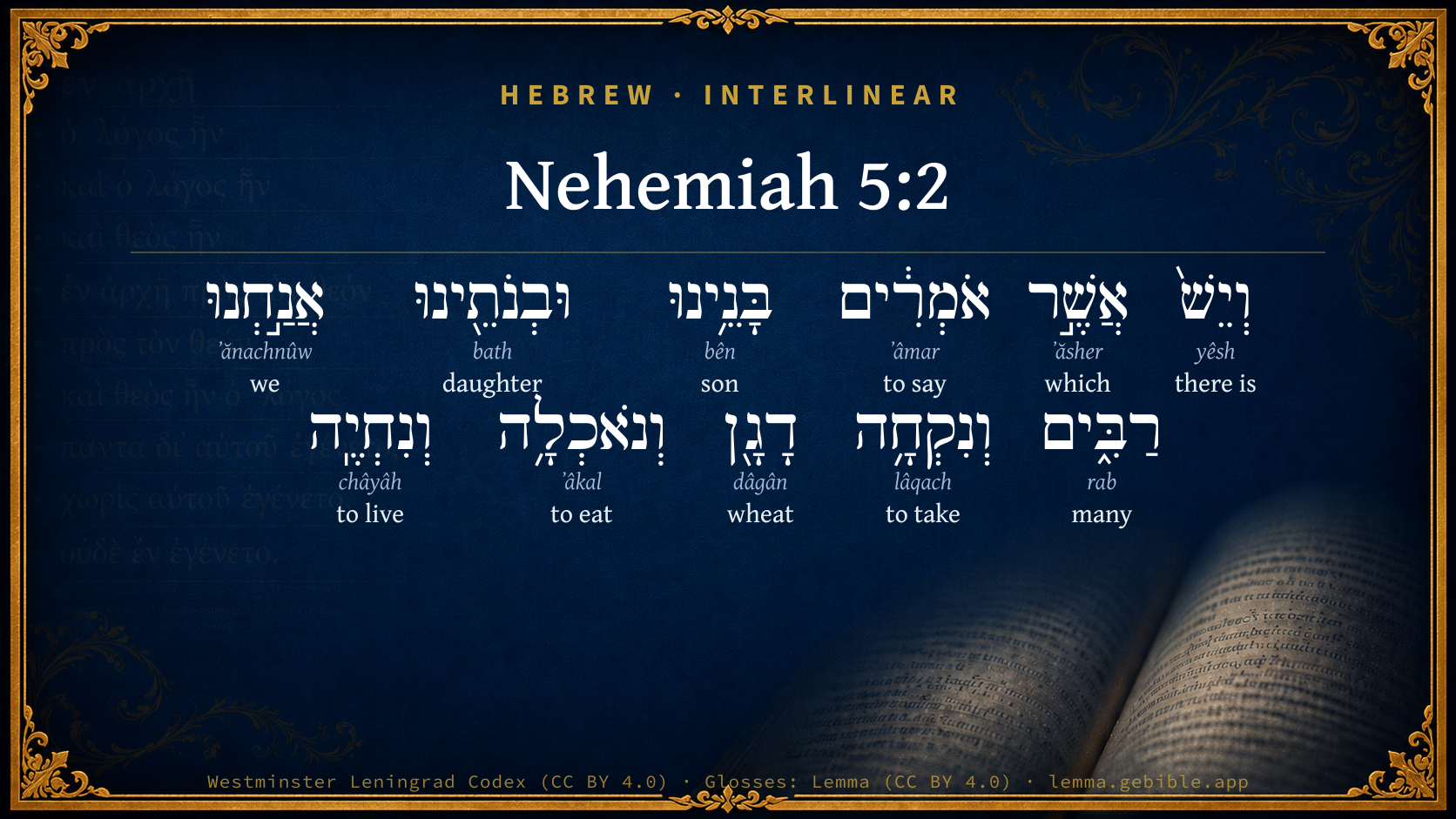
Hebrew (Westminster Leningrad Codex) Nehemiah 5:2 appears in the Hebrew Old Testament. The text above is from the Westminster Leningrad Codex. Each word links to its Strong’s number, a concise gloss, and parsing drawn from the Open Scriptures Hebrew Bible morphology. Click any word for its full Brown-Driver-Briggs (BDB) entry.
Download image
Cite this verse

Nehemiah 5:2 (World English Bible). Public Domain. Lemma interlinear Bible study tool, https://lemma.gebible.app/v/nehemiah/5/2.

Show BibTeX & RIS
BibTeX
RIS
English Translation
For there were that said, We, our sons and our daughters, are many: let us get grain, that we may eat and live.
World English Bible · Public Domain
Download a study sheet

One document with this verse’s original text, its word-by-word gloss line, the meaning frame, cross-references with their text, attributed commentary, and full source and license credits — printable, and it pastes into notes with its structure intact.

This verse Autodidact and up

Study sheet (.html) Plain text (.txt)

A passage Seminary Student

Up to 50 verses in one chapter. A passage sheet keeps up to 6 commentary sources and 12 cross-references per verse, in the order this page ranks them, and says so on the sheet whenever that leaves anything out. Ask for a single verse and you get the Autodidact verse sheet above.

Everything on this page stays free to read, with no account — the sheet is a download of what is already on screen, not access to it.

Want to remove ads? Support Godless Engineer
Compare translations 3

The same verse in 3 English versions, stacked beneath the original-language interlinear above. Click any original word for its lexicon entry.

Each is an independent rendering of the whole verse — the interlinear is not word-aligned to these translations.

Highlighted words mark where these versions differ — a whole-verse word diff, not a word-by-word alignment.

  • World English Bible Public Domain
    For there were that said, We, our sons and our daughters, are many: let us get grain, that we may eat and live.
  • King James Version Public Domain
    For there were that said, We, our sons, and our daughters, are many: therefore we take up corn for them, that we may eat, and live.
  • unfoldingWord Literal Text CC BY-SA 4.0
    And there were those who said, “Our sons and our daughters, we are many. And let us take grain, so we can eat, and we can live.”

unfoldingWord Literal Text — © unfoldingWord, licensed CC BY-SA 4.0. Word-aligned USFM3 via Door43 (git.door43.org/unfoldingWord/en_ult).

Versions to compare (up to 4)

3 of 4 selected

Show all 18 translations

Every available English version of this verse, each an independent rendering of the whole verse.

  • World English Bible Public Domain
    For there were that said, We, our sons and our daughters, are many: let us get grain, that we may eat and live.
  • Berean Standard Bible Public Domain
    Some were saying, “We and our sons and daughters are numerous. We must get grain in order to eat and stay alive.”
  • Majority Standard Bible Public Domain
    Some were saying, “We and our sons and daughters are numerous. We must get grain in order to eat and stay alive.”
  • King James Version Public Domain
    For there were that said, We, our sons, and our daughters, are many: therefore we take up corn for them, that we may eat, and live.
  • American Standard Version (1901) Public Domain
    For there were that said, We, our sons and our daughters, are many: let us get grain, that we may eat and live.
  • Revised Version (1885) Public Domain
    For there were that said, We, our sons and our daughters, are many: let us get corn, that we may eat and live.
  • Geneva Bible (1599) Public Domain
    For there were that said, We, our sonnes and our daughters are many, therefore we take vp corne, that we may eate and liue.
  • Douay-Rheims (1899) Public Domain
    And there were some that said: Our sons and our daughters are very many: Yet us take up corn for the price of them, and let us eat and live.
  • Young's Literal Translation Public Domain
    yea, there are who are saying, `Our sons, and our daughters, we -- are many, and we receive corn, and eat, and live.'
  • Literal Standard Version CC BY-SA 4.0
    indeed, there are [those] who are saying, “Our sons, and our daughters, we—are many, and we receive grain, and eat, and live.”
  • Unlocked Literal Bible CC BY-SA 4.0
    For there were some who said, “With our sons and daughters we are many. So let us get grain that we may eat and stay alive.”
  • unfoldingWord Literal Text CC BY-SA 4.0
    And there were those who said, “Our sons and our daughters, we are many. And let us take grain, so we can eat, and we can live.”
  • Darby Bible Public Domain
    And there were that said, We, our sons and our daughters, are many, and we must procure corn that we may eat and live.
  • World Messianic Bible Public Domain
    For there were some who said, “We, our sons and our daughters, are many. Let us get grain, that we may eat and live.”
  • Webster's Bible Public Domain
    For there were that said, We, our sons, and our daughters, are many: therefore we take up corn for them, that we may eat, and live.
  • Free Bible Version CC BY-SA 4.0
    They were complaining, “Our families are so large we need more food so we can eat and live.”
  • Bible in Basic English Public Domain
    For there were some who said, We, our sons and our daughters, are a great number: let us get grain, so that we may have food for our needs.
  • JPS Tanakh (1917) Public Domain
    For there were that said: 'We, our sons and our daughters, are many; let us get for them corn, that we may eat and live.'

Literal Standard Version (2020), Covenant Press — licensed CC BY-SA 4.0. Text via the HelloAO Bible API (eBible.org). Unlocked Literal Bible (unfoldingWord) — licensed CC BY-SA 4.0. Text via the HelloAO Bible API (eBible.org). unfoldingWord Literal Text — © unfoldingWord, licensed CC BY-SA 4.0. Word-aligned USFM3 via Door43 (git.door43.org/unfoldingWord/en_ult). Free Bible Version, Dr. Jonathan Gallagher — licensed CC BY-SA 4.0. Text via the HelloAO Bible API (eBible.org).

Word by word

More ways to search: Search by grammar → Find every occurrence → Compare this word →

Practice this passage: Drill this verse → Learn its vocabulary →

דָגָ֖ן
dâgân
H1715
“wheat”
Noun, Common, Masculine, Singular, Absolute
Part of Speech
Noun
Type
Common
Gender
Masculine
Number
Singular
State
Absolute
Full BDB Definition

Origin: from H1711

TWOT: 403a

wheat, cereal, grain, corn
  1. וְיֵשׁ֙ yêsh H3426 “and · there is” Conjunction + Particle, Demonstrative
  2. אֲשֶׁ֣ר ʼăsher H834 “which” Particle, Relative
  3. אֹמְרִ֔ים ʼâmar H559 “saying” Verb, Qal, Participle Active, Masculine, Plural, Absolute
  4. בָּנֵ֥ינוּ bên H1121 “sons · our” Noun, Common, Masculine, Plural, Construct + Suffix, Personal, 1st Person, Common, Plural
  5. וּבְנֹתֵ֖ינוּ bath H1323 “and · daughters · our” Conjunction + Noun, Common, Feminine, Plural, Construct + Suffix, Personal, 1st Person, Common, Plural
  6. אֲנַ֣חְנוּ ʼănachnûw H587 “we” Pronoun, Personal, 1st Person, Common, Plural
  7. רַבִּ֑ים rab H7227 “many” Adjective, Adjective, Masculine, Plural, Absolute
  8. וְנִקְחָ֥ה lâqach H3947 “and · to take” Conjunction + Verb, Qal, Cohortative, 1st Person, Common, Plural
  9. וְנֹאכְלָ֥ה ʼâkal H398 “and · to eat” Conjunction + Verb, Qal, Cohortative, 1st Person, Common, Plural
  10. וְנִחְיֶֽה châyâh H2421 “and · to live” Conjunction + Verb, Qal, Imperfect, 1st Person, Common, Plural

About this verse

These counts appear in no published source. They are computed here, from the morphology-tagged text and Lemma’s own curated glosses. What Lemma adds →

11
words
11
distinct lemmas
Historical
section

Shared distinctive vocabulary

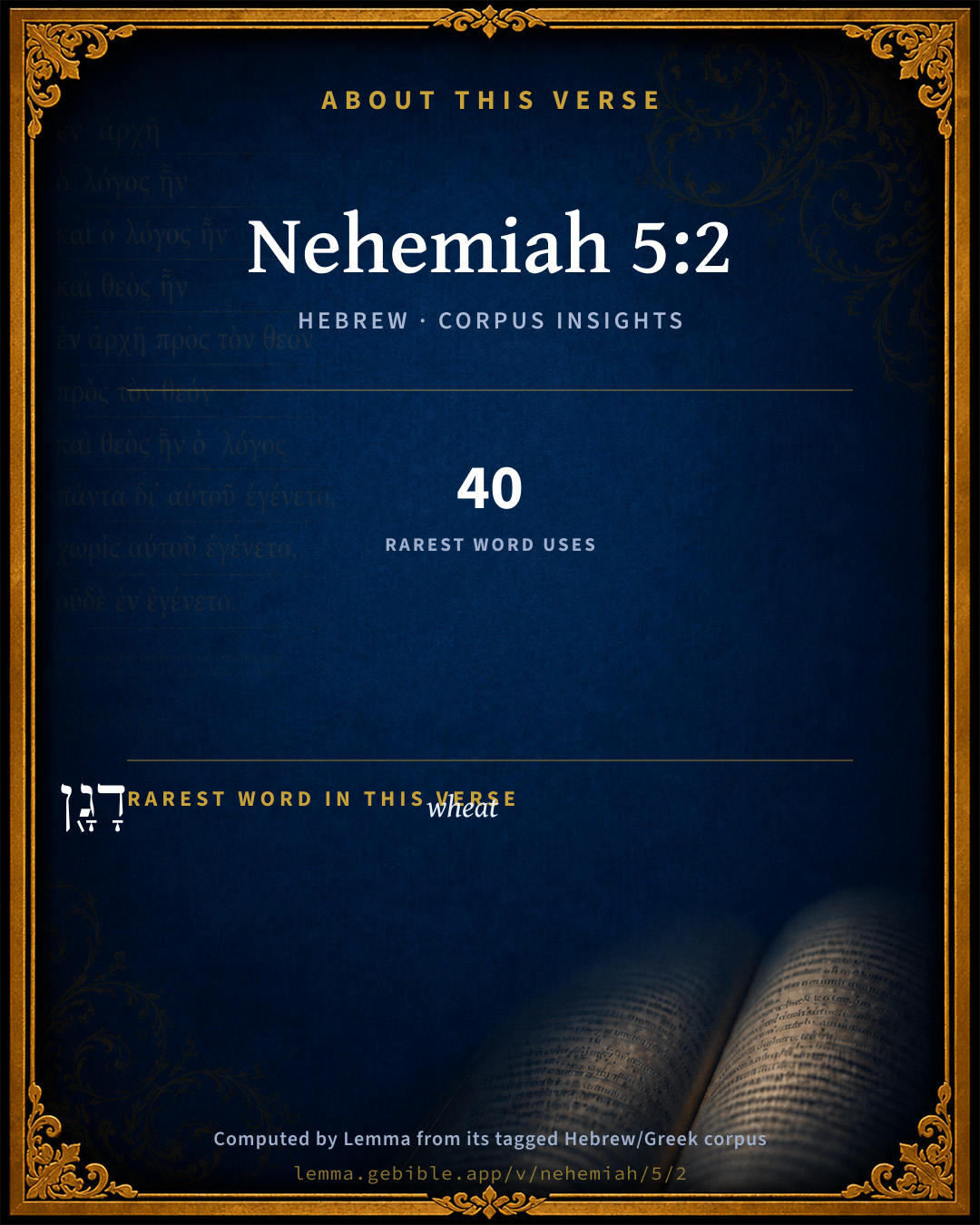
דָגָ֖ן wheat H1715 occurs in 40 verses of the Hebrew Bible. Also found in:

Grammatical profile

  • 4 verbs
  • 3 nouns
  • 1 adjective
  • 1 pronoun
  • 2 particles

Verb forms

  • אֹמְרִ֔ים Qal · Participle Active
  • וְנִקְחָ֥ה Qal · Cohortative
  • וְנֹאכְלָ֥ה Qal · Cohortative
  • וְנִחְיֶֽה Qal · Imperfect

Cross-references

6

Topical passages linked to Nehemiah 5:2 in the Treasury of Scripture Knowledge — connected by theme and wording, ordered by reader-vote popularity; previews shown in the World English Bible.

  • Psalms 128:2–4 For you will eat the labor of your hands. You will be happy, and it will be well with you.
  • Malachi 2:2 If you will not listen, and if you will not lay it to heart, to give glory to my name," says Yahweh of Hosts, "then will I send the curse on you, and I will curse your blessings. Indeed, I have cursed them already, because you do not lay it to heart.
  • Genesis 41:57 All countries came into Egypt, to Joseph, to buy grain, because the famine was severe in all the earth.
  • Genesis 42:2 He said, "Behold, I have heard that there is grain in Egypt. Go down there, and buy for us from there, so that we may live, and not die."
  • Genesis 43:8 Judah said to Israel, his father, "Send the boy with me, and we will arise and go, so that we may live, and not die, both we, and you, and also our little ones.
  • Psalms 127:3–5 Behold, children are a heritage of Yahweh. The fruit of the womb is his reward.

Cross-references courtesy of OpenBible.info (CC BY 4.0).

Hebrew and Greek witnesses Masoretic Hebrew ↔ Greek Septuagint

The same verse in the two great witnesses to the Old Testament, shown verse-for-verse.

These are two independent witnesses, not word-aligned to each other, and the Septuagint is shown in lemma (dictionary) form.

Hebrew Nehemiah 5:2 Masoretic · Westminster Leningrad Codex

וְיֵשׁ֙ אֲשֶׁ֣ר אֹמְרִ֔ים בָּנֵ֥ינוּ וּבְנֹתֵ֖ינוּ אֲנַ֣חְנוּ רַבִּ֑ים וְנִקְחָ֥ה דָגָ֖ן וְנֹאכְלָ֥ה וְנִחְיֶֽה

For there were that said, We, our sons and our daughters, are many: let us get grain, that we may eat and live.

World English Bible · Public Domain

Greek LXX Structure differs

The Septuagint has no separate book of Nehemiah. Its Greek text is the second half of Esdras B (2 Esdras), chapters 11–23; Ezra is the first half (1–10).

A verse-for-verse comparison isn’t shown here because the chapters and verses don’t line up. Switch to the LXX edition with the MT / LXX toggle above to read the Greek directly.

On this verse, Haydock's Catholic Bible Commentary discusses the Septuagint’s reading. Read the note in Commentary ↓

Hebrew: Westminster Leningrad Codex (CC BY 4.0). Greek: Septuagint (public domain); English from a public-domain English Septuagint. How the Septuagint differs from the Hebrew →

Commentary

Notes on Nehemiah 5:2 from classic Christian and Jewish commentators (each source and its license shown beneath its notes). The classic Christian expositions comment on the surrounding passage and are grouped to its opening verse, so a note may address several verses; the Jewish commentaries on the Tanakh (Rashi and others) are per-verse, so they appear only where the commentator wrote on this verse.

Lemma curates 59 commentaries, every one of them public domain or Creative Commons licensed, each selected and text-cleaned for this edition rather than reprinted as found. About our sources →

The Cambridge Bible for Schools and Colleges

gen. ed. J. J. S. Perowne

2. For there were that said] This and the two following verses describe the people’s complaint. Their misfortunes were brought to a climax by the condition of hostilities, which put an end to trade and threatened town and country with ruin. The class referred to in this verse are the labourers, who depended upon wages.

We … are many] The number of the poorer population in comparison with the wealthy was probably disproportionately large. The community since the return under Zerubbabel had never been prosperous. It had suffered much from the ill-treatment of the neighbouring peoples, more especially of the Samaritans. The pressure of the work on the wall, coupled with the expectation of attack, brought matters to a crisis. It was impossible to obtain regular employment, and prices had gone up. They had no property like those mentioned in Neh_5:3-4, upon the security of which they could borrow money.

therefore we take up corn for them &c.] R.V. let us get corn &c. The words in the A.V. are ambiguous. The clause expresses the wish. It is the utterance of the poor who have grown desperate. They demand food for themselves and their families. They cannot acquiesce in starvation, when they know that wealthy capitalists—their own fellow-countrymen—have made money out of their necessities and could well afford in a time of common peril to render them relief. Hence the words have a ring of menace. ‘If we are not given corn, let us take it’. It was equivalent to a threat either to use violence or to surrender the city to its enemies.

The Vulgate ‘accipiamus pro pretio eorum frumentum’ gives a different interpretation of the words. It supposes that these poor starving people offered to sell their children as slaves in order that they might get money to buy food for themselves. This gives a sense approximating that of the conjecture to read ‘’orebhim’ for ‘rabbim’, ‘We give in pledge our sons and our daughters.’ In favour of this conjecture it is claimed (1) that the alteration is very slight, (2) that it brings Neh_5:2 into close parallelism with Neh_5:3, (3) that it obviates the awkwardness of the present text ‘our sons and our daughters, we are many,’ (4) that the present text is at variance with Scripture in making the size of families a subject of complaint. The conjecture is ingenious. But the existing text gives a good sense (see above), and is supported by the versions, which do not show any variation of reading. The position of the words ‘our sons and our daughters, we’ &c. emphasizes the thought uppermost in the people’s mind. The conjecture doubtless increases the verbal parallelism between Neh_5:2-3. But this parallelism does not exist between Neh_5:3-4, and the proposed alteration gives an artificial appearance to the language used. Lastly the conjecture anticipates the statement contained in Neh_5:5. The fact that parents were on the point of giving their children in pledge as slaves forms the climax of the complaint. We should not therefore expect to find it mentioned in the present verse.

The Cambridge Bible for Schools and Colleges (gen. ed. J. J. S. Perowne; Cambridge University Press, 1878–1918) — public domain. Text from a community e-Sword module.

Trapp's Complete Commentary

John Trapp

Neh 5:2 For there were that said, We, our sons, and our daughters, [are] many: therefore we take up corn [for them], that we may eat, and live.

Ver. 2. We, our sons, and our daughters are many] That is a mercy, had we but keeping for them. Their wives were very fruitful; sed luctuosa faecunditate (as Jerome saith of Laeta); for they had more mouths than meat for them. Tho young children asked for bread, and no man brake it unto them, Lam 4:4.

Therefore we take up corn for them] Grain upon use, to keep us from starving; and that by pawning or selling our dear children to the rich creditors for servants; till we can redeem them, which we are never like to do, Neh 5:5.

That we may eat and live] Merely to keep us alive; for else we would never have made our poor children bondslaves. But Necessitas durum telum, hunger is so pinching a pain, that a woman will eat her own child, as in the siege of Jerusalem, Samaria, Saguntum; yea, a man his own flesh, rather than die with hunger. Hitherto the poorest sort. Follows now another cry.

John Trapp, A Commentary or Exposition upon All the Books of the Old and New Testament (1647–1656) — public domain. Text from a community e-Sword module.

Joseph Benson's Commentary

Neh 5:2. We, our sons, and our daughters, are many — Which indeed is in itself a blessing, but to us is turned into a curse. The families that were most necessitous were most numerous. Those who have great families and little substance must learn to live by faith in God’s providence and promises: and those who have little families and great substance must make their abundance a supply for the wants of others. We take up corn for them, that we may eat and live — That is, we are compelled by our and their necessities to take up corn on unreasonable terms. Or, the sense of the words may be, Where, or how, shall we get corn, that we may eat and live?

Joseph Benson's Commentary on the Old and New Testaments (1811–1818) — public domain. Text from a community e-Sword module.

Tyndale Open Study Notes

Tyndale Open Resources

5:2 Some farmers had diverted their efforts from raising crops to building the wall, leaving their large families in need of food to survive. Someone had to feed their families, or they would have to stop work on the wall and go home to work in their fields.

Tyndale Open Study Notes — © Tyndale Open Resources, licensed CC BY-SA 4.0. Text via the HelloAO Bible API.

Geneva Bible (1599)

Geneva Bible translators

This is the complaint of the people, showing to what extremity they were brought unto.

Geneva Bible (1599) marginal notes — public domain. Text via Bolls.life.

Adam Clarke's Commentary

Verse 2. We, our sons, and our daughters, are many] Our families are larger than we can provide for; we are obliged to go in debt; and our richer brethren take advantage of our necessitous situation, and oppress us. The details which are given in the next verse are sufficiently plain.

Adam Clarke's Commentary on the Bible (1810–1826) — public domain. Text from a community e-Sword/MySword module.

Ellicott's Commentary for English Readers

(2) We take up.—Let us receive. This is a general appeal for the governor’s help.

A Bible Commentary for English Readers, edited by Charles John Ellicott (1878–1897) — public domain. Text from a community e-Sword module.

John Gill's Exposition

For there were that said, we, our sons, and our daughters, are many,.... Not that they complained of the number of their children, for a numerous offspring was always reckoned a blessing with the Jews; but this they observed to show that their families, being large, required a considerable quantity of food to support them:

therefore we take up corn for them, that we may eat and live; that is, they were obliged to take it at an exorbitant price, which is the thing complained of; or otherwise they must starve, the rich taking the advantage of their poverty and present dearth.

John Gill's Exposition of the Whole Bible (1746–1763) — public domain (CC PDM 1.0). Text via the HelloAO Bible API.

Albert Barnes' Notes on the Bible

Are many - A slight emendation brings this verse into exact parallelism with the next, and gives the sense - “We have pledged our sons and our daughters, that we might get corn, and eat and live.” Compare Neh 5:5.

Albert Barnes' Notes on the Bible (1834–1885) — public domain. Text from a community e-Sword/MySword module.

Haydock's Catholic Bible Commentary

Very. Syriac, "and our brethren are too numerous" to find meat. --- For, &c. Hebrew, Septuagint, &c., "by force." (Abenezra, &c.) --- Yet most people explain it in the sense of the Vulgate. It was permitted to sell children in extreme distress, Exodus xxi. 7. (Grotius) (Calmet)

George Leo Haydock (1774–1849), Haydock's Catholic Family Bible and Commentary, 1859 edition — public domain. Excludes Psalms (Douay-Rheims chapter numbering differs from Protestant) and Deuterocanonical books (Catholic canon only).

Matthew Poole's English Annotations

We, our sons, and our daughters, are many; which is in itself a blessing, but to us is turned into a curse.

We take up corn for them, i.e. we are forced by our and their necessities to take up corn, to wit, upon their own unreasonable terms, as is here implied, and plainly expressed in the following relation. Others, Let us take up, &c., i.e. seeing we do the public work, let provision be made for us and our children out of the public stock. But this is no petition, but a complaint, as will appear.

Matthew Poole's English Annotations on the Holy Bible (1683–1685) — public domain. Text from a community e-Sword/MySword module.

Whedon's Commentary on the Bible

Daniel D. Whedon

2. There were that said — These seem to have been persons who held about the civil status of the Roman proletaries, who owned no property, but served the state with their children, and procured a livelihood by labouring for others. These were the lowest class of citizens.

Our sons, and our daughters, are many — That which was to the true Israelite the highest gratification and pleasure — a pledge that Jehovah’s blessing was with him — was in this case the occasion of oppression and sorrow.

We take up corn for them — The words for them should be omitted. To take up corn, means to receive or obtain it, not by violence, but by some specific arrangement with the wealthier classes who had corn to sell. How these poorer classes obtained their corn is not said, but the most natural inference is, (compare Neh_5:5; Neh_5:8,) that they sold themselves and their children as bond-servants to the richer Jews, according to the provisions of the law. Exo_21:7; Lev_25:39.

That we may eat, and live — Better, thought they, are food and life in bondage, than starvation and death in freedom.

Daniel D. Whedon (gen. ed.), Commentary on the Old and New Testaments (1874–1909) — public domain. Text from a community e-Sword module.

The Pulpit Commentary

There were that said, We, our sons, and our daughters, are many. Those who had large families were foremost in making complaint. They found their numerous progeny not the blessing that abundant offspring is ordinarily reckoned in Holy Scripture, but a burthen and an anxiety. Therefore we take up corn for them. We are obliged to get corn for them, or they would die, and have to run in debt for it. Corn, wine, and oil seem to have been lent, no less than money (ver. 11).

The Pulpit Commentary (1880–1919), ed. H.D.M. Spence-Jones & Joseph S. Exell — public domain. Text from a community e-Sword module.

John Wesley's Explanatory Notes

Many - Which is in itself a blessing, but to us is turned into a curse. Take up - We are forced to take up corn, upon unreasonable terms.

John Wesley, Explanatory Notes Upon the Whole Bible (1754–1765) — public domain. Text via the GEBible commentary corpus.

Rashi

Rabbi Shlomo Yitzchaki (Rashi)

There were some who were saying He gives a reason for his words: Why were they crying? Some of the poor people were saying, “We are many with our sons and daughters and have to buy corn. Now we will have to sell our sons and daughters in order to buy corn in order to live.” So were they crying about the rich Jews who did not wish to support them.

Rashi on the Tanakh — English translations: “The Judaica Press complete Tanach with Rashi, translated by A. J. Rosenberg” (CC BY 4.0); “Pentateuch with Rashi's commentary by M. Rosenbaum and A.M. Silbermann, 1929-1934” (public domain); “The Metsudah Tanach series, Lakewood, N.J” (CC BY 4.0); and “The Book of Joshua, Metsudah Publications, 1997” (CC BY 4.0). Text via Sefaria.

Lesson kit

Teaching starters — assembled from the data on this page, not authored interpretation. Every prompt links to the verse data it draws on. Edit before teaching.

Nehemiah, in the Historical, opens this verse with 11 words (11 distinct Hebrew lemmas). Its most distinctive word is dâgân (“wheat”). A historical commentator’s framing appears above. Read the whole chapter for the surrounding context.

Discussion questions

  1. What does “wheat” (dâgân) contribute to the verse as a whole?
  2. Genesis 27:28 shares the word «wheat» with this verse. How do the two illuminate each other?
  3. These translations render this verse differently; the difference is in the English rendering, not the original. What questions does that raise?
  4. The verb «אֹמְרִ֔ים» is Qal Participle Active. How does its form color the action?
  5. Reading how The Cambridge Bible for Schools and Colleges and Trapp's Complete Commentary read this verse, where do the two commentators agree and where do they part?

Things to notice

Reading settings

Reading text

Shown beneath each verse's original-language words.

Old Testament
Old Testament edition

Read the OT as the Masoretic Hebrew (MT) or the Greek Septuagint (LXX).

English shown for the Greek Septuagint (in the Hebrew ↔ Greek comparison).

Comparing translations? Open the Compare panel on any verse page to stack up to four side by side.