
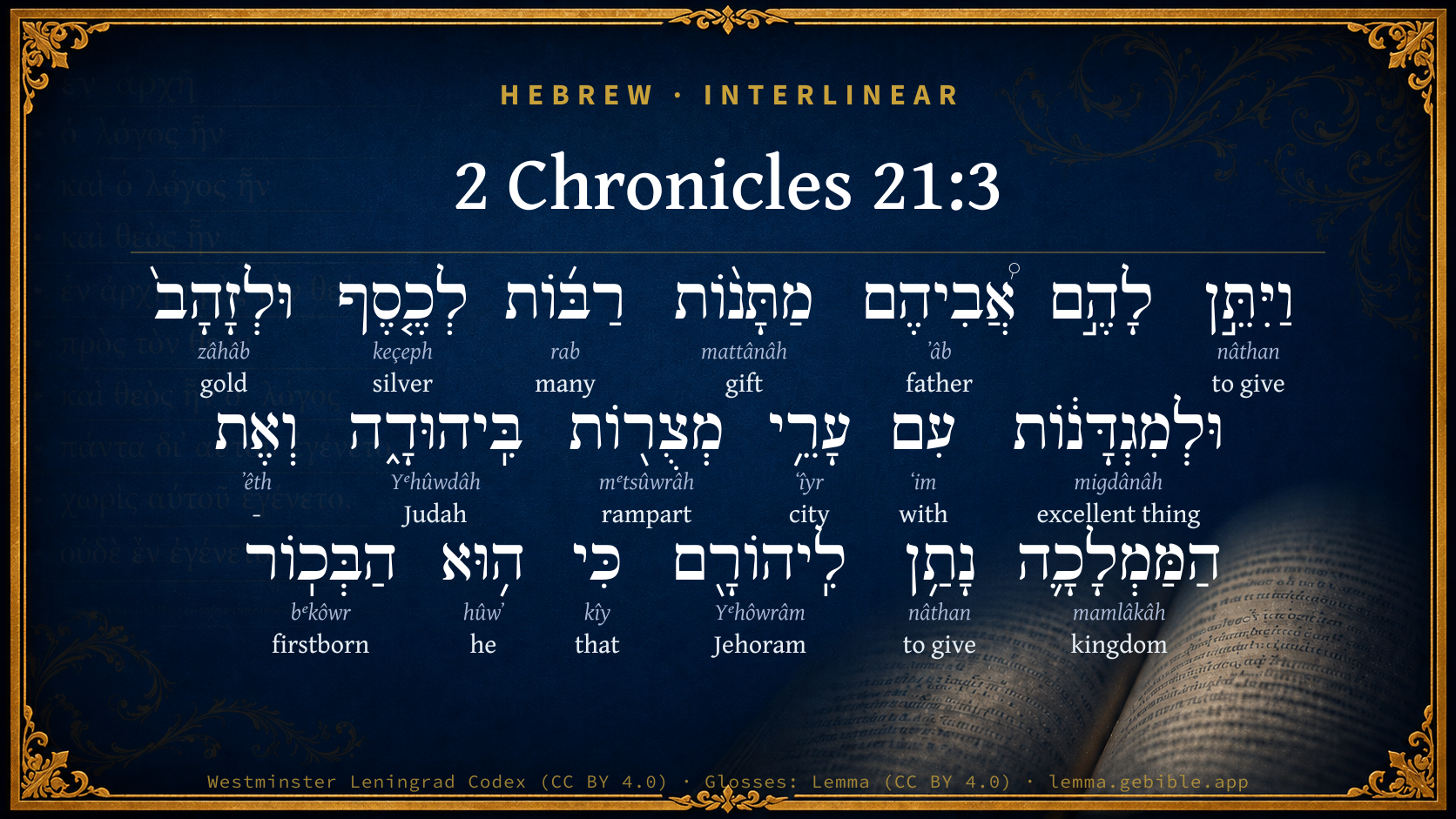
2 Chronicles 21:3

Hebrew (Westminster Leningrad Codex) 2 Chronicles 21:3 appears in the Hebrew Old Testament. The text above is from the Westminster Leningrad Codex. Each word links to its Strong’s number, a concise gloss, and parsing drawn from the Open Scriptures Hebrew Bible morphology. Click any word for its full Brown-Driver-Briggs (BDB) entry.
Download image
Cite this verse

2 Chronicles 21:3 (World English Bible). Public Domain. Lemma interlinear Bible study tool, https://lemma.gebible.app/v/2-chronicles/21/3.

Show BibTeX & RIS
BibTeX
RIS
English Translation
Their father gave them great gifts, of silver, and of gold, and of precious things, with fortified cities in Judah: but the kingdom gave he to Jehoram, because he was the firstborn.
World English Bible · Public Domain
Download a study sheet

One document with this verse’s original text, its word-by-word gloss line, the meaning frame, cross-references with their text, attributed commentary, and full source and license credits — printable, and it pastes into notes with its structure intact.

This verse Autodidact and up

Study sheet (.html) Plain text (.txt)

A passage Seminary Student

Up to 50 verses in one chapter. A passage sheet keeps up to 6 commentary sources and 12 cross-references per verse, in the order this page ranks them, and says so on the sheet whenever that leaves anything out. Ask for a single verse and you get the Autodidact verse sheet above.

Everything on this page stays free to read, with no account — the sheet is a download of what is already on screen, not access to it.

Want to remove ads? Support Godless Engineer
Compare translations 3

The same verse in 3 English versions, stacked beneath the original-language interlinear above. Click any original word for its lexicon entry.

Each is an independent rendering of the whole verse — the interlinear is not word-aligned to these translations.

Highlighted words mark where these versions differ — a whole-verse word diff, not a word-by-word alignment.

  • World English Bible Public Domain
    Their father gave them great gifts, of silver, and of gold, and of precious things, with fortified cities in Judah: but the kingdom gave he to Jehoram, because he was the firstborn.
  • King James Version Public Domain
    And their father gave them great gifts of silver, and of gold, and of precious things, with fenced cities in Judah: but the kingdom gave he to Jehoram; because he was the firstborn.
  • unfoldingWord Literal Text CC BY-SA 4.0
    And their father gave to them many gifts of silver and of gold and of precious things with fortified cities in Judah. And the kingdom he gave to Jehoram for he was the firstborn.

unfoldingWord Literal Text — © unfoldingWord, licensed CC BY-SA 4.0. Word-aligned USFM3 via Door43 (git.door43.org/unfoldingWord/en_ult).

Versions to compare (up to 4)

3 of 4 selected

Show all 18 translations

Every available English version of this verse, each an independent rendering of the whole verse.

  • World English Bible Public Domain
    Their father gave them great gifts, of silver, and of gold, and of precious things, with fortified cities in Judah: but the kingdom gave he to Jehoram, because he was the firstborn.
  • Berean Standard Bible Public Domain
    Their father had given them many gifts of silver and gold and precious things, as well as the fortified cities in Judah; but he gave the kingdom to Jehoram because he was the firstborn.
  • Majority Standard Bible Public Domain
    Their father had given them many gifts of silver and gold and precious things, as well as the fortified cities in Judah; but he gave the kingdom to Jehoram because he was the firstborn.
  • King James Version Public Domain
    And their father gave them great gifts of silver, and of gold, and of precious things, with fenced cities in Judah: but the kingdom gave he to Jehoram; because he was the firstborn.
  • American Standard Version (1901) Public Domain
    And their father gave them great gifts, of silver, and of gold, and of precious things, with fortified cities in Judah: but the kingdom gave he to Jehoram, because he was the first-born.
  • Revised Version (1885) Public Domain
    And their father gave them great gifts, of silver, and of gold, and of precious things, with fenced cities in Judah: but the kingdom gave he to Jehoram, because he was the firstborn.
  • Geneva Bible (1599) Public Domain
    And their father gaue them great giftes of siluer and of golde, and of precious things, with strong cities in Iudah, but the kingdome gaue he to Iehoram: for he was the eldest.
  • Douay-Rheims (1899) Public Domain
    And their father gave them great gifts of silver, and of gold, and pensions, with strong cities in Juda: but the kingdom he gave to Joram, because he was the eldest.
  • Young's Literal Translation Public Domain
    and their father giveth to them many gifts of silver and of gold, and of precious things, with fenced cities in Judah, and the kingdom he hath given to Jehoram, for He `is' the first-born.
  • Literal Standard Version CC BY-SA 4.0
    and their father gives to them many gifts of silver and of gold, and of precious things, with fortified cities in Judah, and he has given the kingdom to Jehoram, for he [is] the firstborn.
  • Unlocked Literal Bible CC BY-SA 4.0
    Their father had given them large gifts of silver, gold, and other precious things, and also fortified cities in Judah, but he gave the kingdom to Jehoram.
  • unfoldingWord Literal Text CC BY-SA 4.0
    And their father gave to them many gifts of silver and of gold and of precious things with fortified cities in Judah. And the kingdom he gave to Jehoram for he was the firstborn.
  • Darby Bible Public Domain
    And their father had given them great gifts of silver and of gold and of precious things, besides fortified cities in Judah; but the kingdom he gave to Jehoram, for he was the firstborn.
  • World Messianic Bible Public Domain
    Their father gave them great gifts of silver, of gold, and of precious things, with fortified cities in Judah; but he gave the kingdom to Jehoram, because he was the firstborn.
  • Webster's Bible Public Domain
    And their father gave them great gifts of silver, and of gold, and of precious things, with fortified cities in Judah: but the kingdom he gave to Jehoram; because he was the first-born.
  • Free Bible Version CC BY-SA 4.0
    Their father had given them many gifts of silver and gold and valuable items, as well as the fortified towns in Judah; but he gave the kingdom to Jehoram because he was the firstborn.
  • Bible in Basic English Public Domain
    And their father gave them much silver and gold and things of great value, as well as walled towns in Judah; but the kingdom he gave to Jehoram, because he was the oldest.
  • JPS Tanakh (1917) Public Domain
    And their father gave them great gifts, of silver, and of gold, and of precious things, with fortified cities in Judah; but the kingdom gave he to Jehoram, because he was the first-born.

Literal Standard Version (2020), Covenant Press — licensed CC BY-SA 4.0. Text via the HelloAO Bible API (eBible.org). Unlocked Literal Bible (unfoldingWord) — licensed CC BY-SA 4.0. Text via the HelloAO Bible API (eBible.org). unfoldingWord Literal Text — © unfoldingWord, licensed CC BY-SA 4.0. Word-aligned USFM3 via Door43 (git.door43.org/unfoldingWord/en_ult). Free Bible Version, Dr. Jonathan Gallagher — licensed CC BY-SA 4.0. Text via the HelloAO Bible API (eBible.org).

Word by word

More ways to search: Search by grammar → Find every occurrence → Compare this word →

Practice this passage: Drill this verse → Learn its vocabulary →

וּלְמִגְדָּנ֔וֹת
migdânâh
H4030
“and · to/for · excellent things”
Conjunction + Preposition + Noun, Common, Feminine, Plural, Absolute
Part of Speech
Conjunction + Preposition + Noun
Type
Common
Gender
Feminine
Number
Plural
State
Absolute
Full BDB Definition

Origin: from the same as H4022

TWOT: 1144b

choice thing, excellent thing
  1. וַיִּתֵּ֣ן nâthan H5414 “and · to give” Conjunction + Verb, Qal, Sequential Imperfect, 3rd Person, Masculine, Singular
  2. אֲ֠בִיהֶם ʼâb H1 “father · their” Noun, Common, Masculine, Singular, Construct + Suffix, Personal, 3rd Person, Masculine, Plural
  3. מַתָּנ֨וֹת mattânâh H4979 “gifts” Noun, Common, Feminine, Plural, Absolute
  4. רַבּ֜וֹת rab H7227 “many” Adjective, Adjective, Feminine, Plural, Absolute
  5. לְכֶ֤סֶף keçeph H3701 “to/for · silver” Preposition + Noun, Common, Masculine, Singular, Absolute
  6. וּלְזָהָב֙ zâhâb H2091 “and · to/for · gold” Conjunction + Preposition + Noun, Common, Masculine, Singular, Absolute
  7. עִם ʻim H5973 “with” Preposition
  8. עָרֵ֥י ʻîyr H5892 “cities of” Noun, Common, Feminine, Plural, Construct
  9. מְצֻר֖וֹת mᵉtsûwrâh H4694 “ramparts” Noun, Common, Feminine, Plural, Absolute
  10. בִּֽיהוּדָ֑ה Yᵉhûwdâh H3063 “in/at · Judah” Preposition + Noun, Proper
  11. וְאֶת ʼêth H853 “and · -” Conjunction + Particle, Direct Object
  12. הַמַּמְלָכָ֛ה mamlâkâh H4467 “the · kingdom” Particle, Definite Article + Noun, Common, Feminine, Singular, Absolute
  13. נָתַ֥ן nâthan H5414 “to give” Verb, Qal, Perfect, 3rd Person, Masculine, Singular
  14. לִֽיהוֹרָ֖ם Yᵉhôwrâm H3088 “to/for · Jehoram” Preposition + Noun, Proper
  15. כִּי kîy H3588 “that” Conjunction
  16. ה֥וּא hûwʼ H1931 “he” Pronoun, Personal, 3rd Person, Masculine, Singular
  17. הַבְּכֽוֹר bᵉkôwr H1060 “the · firstborn” Particle, Definite Article + Noun, Common, Masculine, Singular, Absolute

About this verse

These counts appear in no published source. They are computed here, from the morphology-tagged text and Lemma’s own curated glosses. What Lemma adds →

19
words
17
distinct lemmas
Historical
section

Notable vocabulary

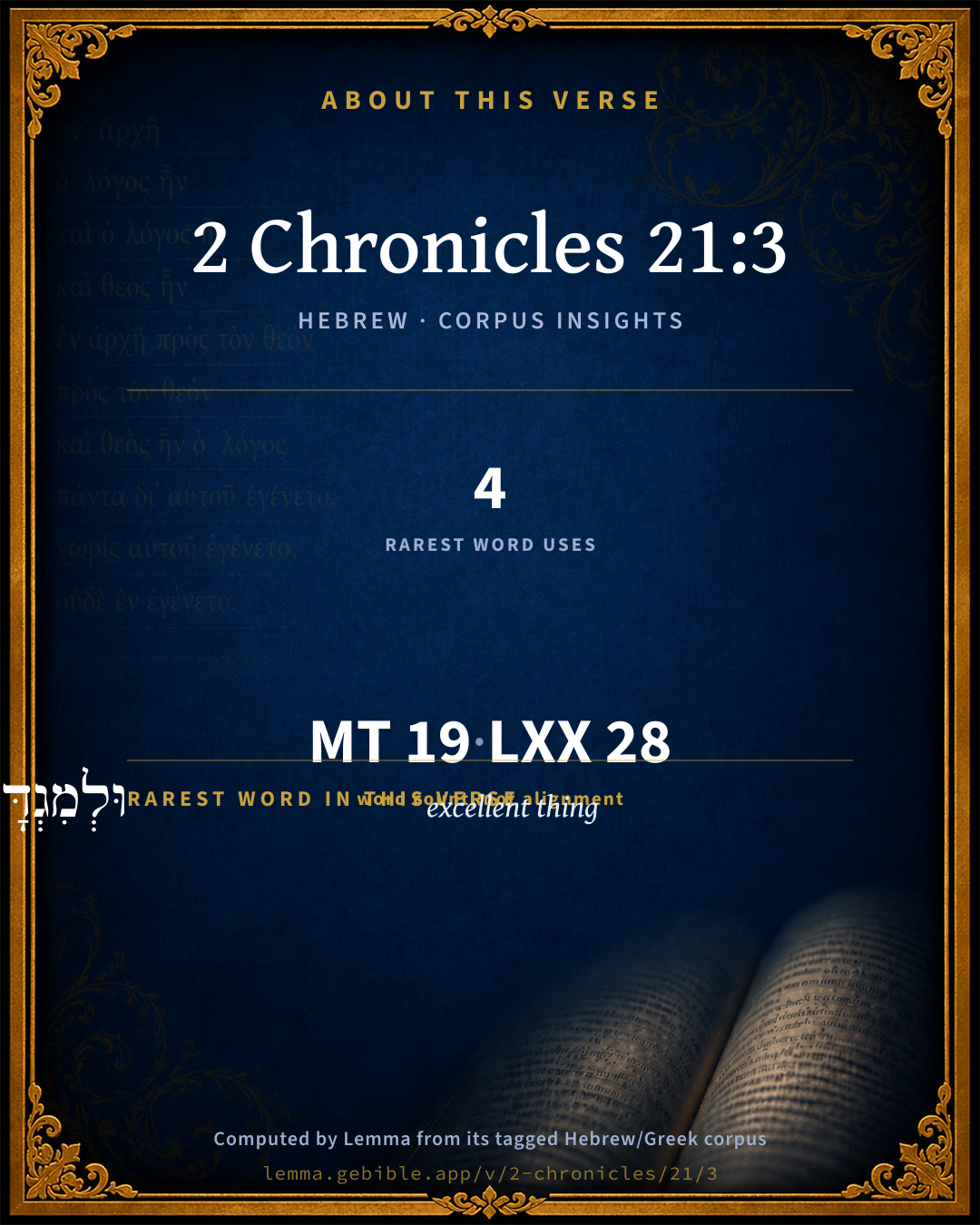
The rarest word here is וּלְמִגְדָּנ֔וֹת excellent thing H4030 — appearing just 4 times in the whole Hebrew Bible.

Shared distinctive vocabulary

וּלְמִגְדָּנ֔וֹת excellent thing H4030 occurs in 4 verses of the Hebrew Bible. Also found in:

Grammatical profile

  • 2 verbs
  • 11 nouns
  • 1 adjective
  • 1 pronoun
  • 2 prepositions
  • 1 conjunction
  • 1 particle

Verb forms

  • וַיִּתֵּ֣ן Qal · Sequential Imperfect
  • נָתַ֥ן Qal · Perfect

Repetition

A word recurs within this verse — often emphatic in Hebrew:

  • וַיִּתֵּ֣ן to give H5414 ×2

Hebrew & Septuagint length

In English translation the verse runs 32 words from the Hebrew and 30 from the Septuagint (LXX English) — closely comparable.

A rough comparison of the two English renderings, which tokenize alike — not a word-level alignment.

Word counts can differ between the Hebrew and the Greek without any difference in meaning — e.g. the Hebrew direct-object marker אֵת has no separate Greek word, and Greek often adds the article ὁ.

In the original languages it is 19 Hebrew tokens and 28 Greek tokens — but the two are counted differently (Hebrew bundles its prefixes and suffixes into one token; the Greek is in lemma form), so that isn’t a like-for-like length.

Cross-references

4

Topical passages linked to 2 Chronicles 21:3 in the Treasury of Scripture Knowledge — connected by theme and wording, ordered by reader-vote popularity; previews shown in the World English Bible.

  • 2 Chronicles 11:23 He dealt wisely, and dispersed of all his sons throughout all the lands of Judah and Benjamin, to every fortified city: and he gave them food in abundance. He sought [for them] many wives.
  • Genesis 25:6 but to the sons of the concubines who Abraham had, Abraham gave gifts. He sent them away from Isaac his son, while he yet lived, eastward, to the east country.
  • Deuteronomy 21:15–17 If a man have two wives, the one beloved, and the other hated, and they have borne him children, both the beloved and the hated; and if the firstborn son be hers who was hated;
  • 2 Chronicles 11:5 Rehoboam lived in Jerusalem, and built cities for defense in Judah.

Cross-references courtesy of OpenBible.info (CC BY 4.0).

Hebrew and Greek witnesses Masoretic Hebrew ↔ Greek Septuagint

The same verse in the two great witnesses to the Old Testament, shown verse-for-verse.

These are two independent witnesses, not word-aligned to each other, and the Septuagint is shown in lemma (dictionary) form.

Hebrew 2 Chronicles 21:3 Masoretic · Westminster Leningrad Codex

וַיִּתֵּ֣ן לָהֶ֣ם אֲ֠בִיהֶם מַתָּנ֨וֹת רַבּ֜וֹת לְכֶ֤סֶף וּלְזָהָב֙ וּלְמִגְדָּנ֔וֹת עִם עָרֵ֥י מְצֻר֖וֹת בִּֽיהוּדָ֑ה וְאֶת הַמַּמְלָכָ֛ה נָתַ֥ן לִֽיהוֹרָ֖ם כִּי ה֥וּא הַבְּכֽוֹר

Their father gave them great gifts, of silver, and of gold, and of precious things, with fortified cities in Judah: but the kingdom gave he to Jehoram, because he was the firstborn.

World English Bible · Public Domain

Greek LXX 2 Chronicles 21:3 Septuagint · lemma form

καί δίδωμι αὐτός ὁ πατήρ αὐτός δόμα πολύς ἀργύριον καί χρυσίον καί ὅπλον μετά πόλις τειχίζω ἐν ἰουδά καί ὁ βασιλεία δίδωμι ὁ ιωραμ ὅτι οὗτος ὁ πρωτότοκος

And their father gave them many gifts, silver, and gold, and arms, together with fortified cities in Juda: but he gave the kingdom to Joram, for he was the firstborn.

LXX2012 (modern English Septuagint) · Public Domain

Hebrew: Westminster Leningrad Codex (CC BY 4.0). Greek: Septuagint (public domain); English from LXX2012 (modern English Septuagint) (Public Domain). How the Septuagint differs from the Hebrew →

Commentary

Notes on 2 Chronicles 21:3 from classic Christian and Jewish commentators (each source and its license shown beneath its notes). The classic Christian expositions comment on the surrounding passage and are grouped to its opening verse, so a note may address several verses; the Jewish commentaries on the Tanakh (Rashi and others) are per-verse, so they appear only where the commentator wrote on this verse.

Lemma curates 59 commentaries, every one of them public domain or Creative Commons licensed, each selected and text-cleaned for this edition rather than reprinted as found. About our sources →

Trapp's Complete Commentary

John Trapp

2Ch 21:3 And their father gave them great gifts of silver, and of gold, and of precious things, with fenced cities in Judah: but the kingdom gave he to Jehoram; because he [was] the firstborn.

Ver. 3. With fenced cities.] Herein he dealt wisely; as it is said of Rehoboam for the like. {2Ch 11:2-3} But "the race is not always to the swift, nor the battle to the strong, nor yet bread to the wise," &c. {Ecc 9:11-12}

John Trapp, A Commentary or Exposition upon All the Books of the Old and New Testament (1647–1656) — public domain. Text from a community e-Sword module.

Joseph Benson's Commentary

2Ch 21:3. With fenced cities of Judah — Over which he made them governors. This he seems to have done prudently; thus providing well for them, that they might not be tempted to envy their brother the kingdom, nor to quarrel among themselves: but “things excellently designed,” says Strigelius, from Cicero, “have often a very ill event.” This wealth and authority of theirs, made their brother first fear them, and then, through his wicked covetousness, contrive to cut them off, that he might get possession of their riches and power. Because he was the firstborn — Whom Jehoshaphat supposed he ought to prefer on account of the law, recorded Deu 21:15, though otherwise, it is probable, he would not have done it, having doubtless, before this time, observed his perverse and wicked inclinations, and how much he was swayed by his idolatrous wife.

Joseph Benson's Commentary on the Old and New Testaments (1811–1818) — public domain. Text from a community e-Sword module.

Adam Clarke's Commentary

Verse 3. The kingdom gave he to Jehoram] He made him co-partner with himself in the kingdom about three years before his death; so that he reigned only five years after the death of his father Jehoshaphat. See the notes on 2Kg 8:16, c. and on the same, 2Ch 1:17, where an attempt is made to settle this disturbed chronology.

Adam Clarke's Commentary on the Bible (1810–1826) — public domain. Text from a community e-Sword/MySword module.

The Cambridge Bible for Schools and Colleges

gen. ed. J. J. S. Perowne

3. their father gave them] Rehoboam did the same; 2Ch_11:23.

precious things] Heb. migdânôth; cp. 2Ch_32:23 (“presents,” A.V.; “precious things,” R.V.).

The Cambridge Bible for Schools and Colleges (gen. ed. J. J. S. Perowne; Cambridge University Press, 1878–1918) — public domain. Text from a community e-Sword module.

John Gill's Exposition

Now when Jehoram was risen up to the kingdom of his father,.... Succeeded him in it, and reigned alone, for he had reigned with his father some years before his death; see Gill on Kg2 8:16,

he strengthened himself; in the kingdom, by some means or another closely attaching the greater part of the princes, and people of the land, unto him, when he thought himself well settled and established on the throne; though some understand it of making strong, or hardening his heart to do what is next mentioned:

and slew all his brethren with the sword; either to get their riches into his hands, or lest, being religious princes, they should oppose his restoring idolatry, and for that reason the people should depose him, and set up one of them; and therefore he dispatched them out of the way to secure himself, and carry his point:

and divers also of the princes of Israel; such who had removed out of the ten tribes, for the sake of religion, and therefore would never agree to the introduction of idolatry among them, for which reason Jehoram slew them; and perhaps they might express their disapprobation and abhorrence of his murder of his brethren.

John Gill's Exposition of the Whole Bible (1746–1763) — public domain (CC PDM 1.0). Text via the HelloAO Bible API.

Albert Barnes' Notes on the Bible

Jehoshaphat departed from Rehoboam’s policy (2Ch 11:23 note), actually making over to his sons the “fenced cities” in which they dwelt. This, it is probable, provoked the jealousy of Jehoram, and induced him to put them to death 2Ch 21:4.

Because he was the firstborn - Compare Deu 21:15-17. Exceptions to this rule in the northern and southern kingdoms are Solomon, where divine appointment superseded the natural order, Abijah 2Ch 11:22 note), and Jehoahaz (2Ki 23:30 note).

Albert Barnes' Notes on the Bible (1834–1885) — public domain. Text from a community e-Sword/MySword module.

Haydock's Catholic Bible Commentary

Pensions. Heb. "precious things." Sept. "arms."

George Leo Haydock (1774–1849), Haydock's Catholic Family Bible and Commentary, 1859 edition — public domain. Excludes Psalms (Douay-Rheims chapter numbering differs from Protestant) and Deuterocanonical books (Catholic canon only).

Matthew Poole's English Annotations

Whom he conceived that he ought to prefer by virtue of that law of God, Deu 21:15, though otherwise he would not have done it, having probably ere this time perceived his perverse and wicked inclinations, and how much he was swayed by his idolatrous wife. Now he saw his error when it was too late.

Matthew Poole's English Annotations on the Holy Bible (1683–1685) — public domain. Text from a community e-Sword/MySword module.

The Pulpit Commentary

The father"s foreseeing care issued very differently from what he had thought, waking now the greed and murderous intent of Jehoram. Jehoshaphat, nevertheless, was but following in the wake of the head of the separated kingdom of Judah, Rehoboam, (2Ch_11:22, 2Ch_11:23) wherein he is said to have "dealt wisely;" even the parallel (in the matter of one son Abijah, sen of Maachah, the favourite wife, being appointed king) obtaining there in an aggravated form, as he was not the eldest son. This case, with those of Solomon and Jehoahaz (by the favour not of the parent but of the people, 2Ki_23:30), formed the exceptions to the usual observance of and honour done to the principle of primogeniture. (Deu_21:15-17)

The Pulpit Commentary (1880–1919), ed. H.D.M. Spence-Jones & Joseph S. Exell — public domain. Text from a community e-Sword module.

Lesson kit

Teaching starters — assembled from the data on this page, not authored interpretation. Every prompt links to the verse data it draws on. Edit before teaching.

2 Chronicles, in the Historical, opens this verse with 19 words (17 distinct Hebrew lemmas). Its most distinctive word is migdânâh (“excellent thing”). A historical commentator’s framing appears above. Read the whole chapter for the surrounding context.

Discussion questions

  1. The word migdânâh carries the sense “excellent thing.” How does it shape the verse?
  2. Genesis 24:53 shares the word «excellent thing» with this verse. How do the two illuminate each other?
  3. “to give” occurs 2× in this one verse. What is the effect of the repetition?
  4. The translations on this page render this verse differently — a whole-verse word diff, not a word-by-word alignment. What might account for the different wordings?
  5. The verb «וַיִּתֵּ֣ן» is Qal Sequential Imperfect. How does its form color the action?
  6. Reading how Trapp's Complete Commentary and Joseph Benson's Commentary read this verse, where do the two commentators agree and where do they part?

Things to notice

Reading settings

Reading text

Shown beneath each verse's original-language words.

Old Testament
Old Testament edition

Read the OT as the Masoretic Hebrew (MT) or the Greek Septuagint (LXX).

English shown for the Greek Septuagint (in the Hebrew ↔ Greek comparison).

Comparing translations? Open the Compare panel on any verse page to stack up to four side by side.