
Genesis 33:9

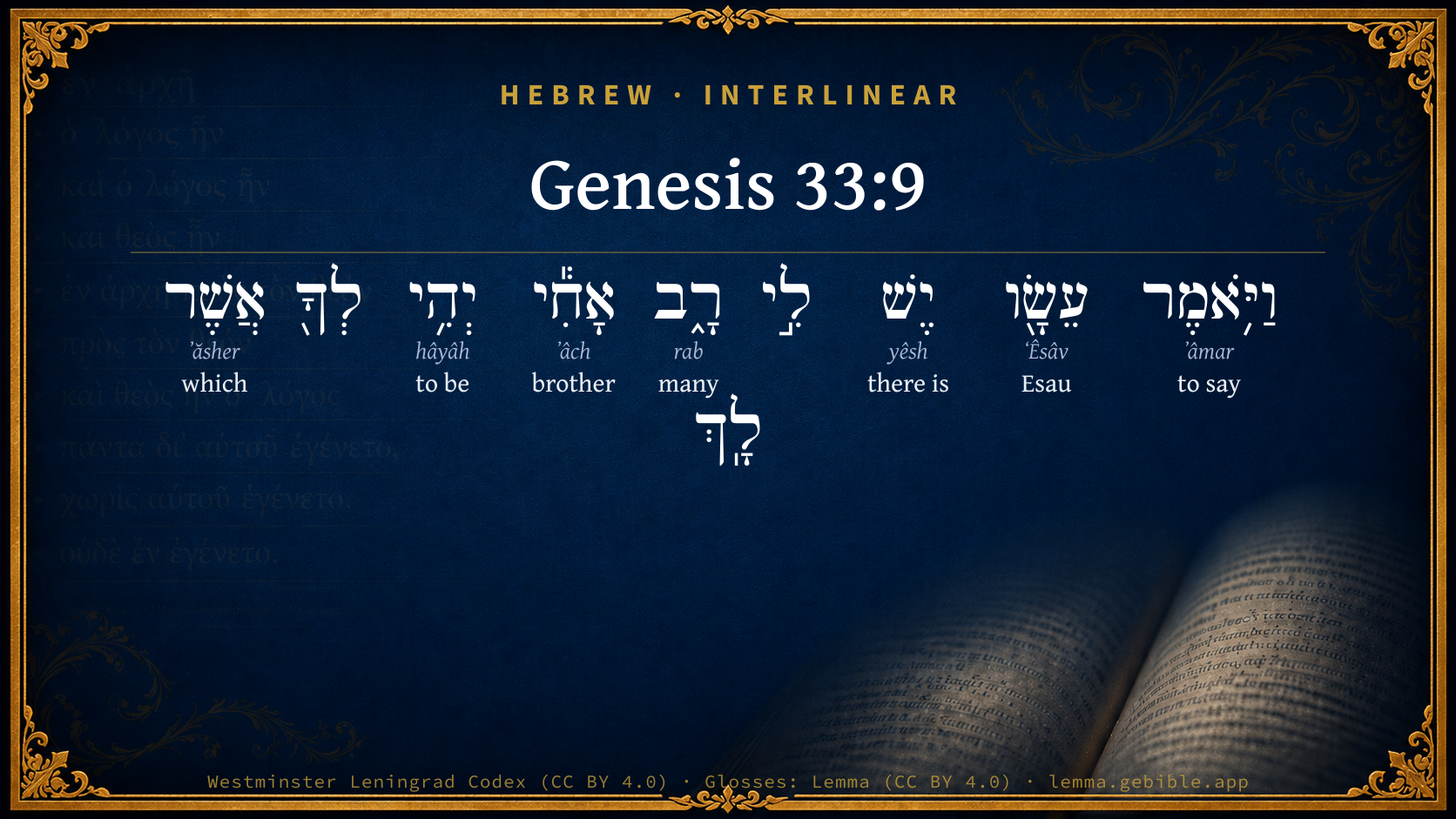
Hebrew (Westminster Leningrad Codex) Genesis 33:9 appears in the Hebrew Old Testament. The text above is from the Westminster Leningrad Codex. Each word links to its Strong’s number, a concise gloss, and parsing drawn from the Open Scriptures Hebrew Bible morphology. Click any word for its full Brown-Driver-Briggs (BDB) entry.
Download image
Cite this verse

Genesis 33:9 (World English Bible). Public Domain. Lemma interlinear Bible study tool, https://lemma.gebible.app/v/genesis/33/9.

Show BibTeX & RIS
BibTeX
RIS
English Translation
Esau said, "I have enough, my brother; let that which you have be yours."
World English Bible · Public Domain
Download a study sheet

One document with this verse’s original text, its word-by-word gloss line, the meaning frame, cross-references with their text, attributed commentary, and full source and license credits — printable, and it pastes into notes with its structure intact.

This verse Autodidact and up

Study sheet (.html) Plain text (.txt)

A passage Seminary Student

Up to 50 verses in one chapter. A passage sheet keeps up to 6 commentary sources and 12 cross-references per verse, in the order this page ranks them, and says so on the sheet whenever that leaves anything out. Ask for a single verse and you get the Autodidact verse sheet above.

Everything on this page stays free to read, with no account — the sheet is a download of what is already on screen, not access to it.

Want to remove ads? Support Godless Engineer
Compare translations 3

The same verse in 3 English versions, stacked beneath the original-language interlinear above. Click any original word for its lexicon entry.

Each is an independent rendering of the whole verse — the interlinear is not word-aligned to these translations.

Highlighted words mark where these versions differ — a whole-verse word diff, not a word-by-word alignment.

  • World English Bible Public Domain
    Esau said, "I have enough, my brother; let that which you have be yours."
  • King James Version Public Domain
    And Esau said, I have enough, my brother; keep that thou hast unto thyself.
  • unfoldingWord Literal Text CC BY-SA 4.0
    Then Esau said, “I have plenty, my brother. Let what to you be yours.”

unfoldingWord Literal Text — © unfoldingWord, licensed CC BY-SA 4.0. Word-aligned USFM3 via Door43 (git.door43.org/unfoldingWord/en_ult).

Versions to compare (up to 4)

3 of 4 selected

Show all 18 translations

Every available English version of this verse, each an independent rendering of the whole verse.

  • World English Bible Public Domain
    Esau said, "I have enough, my brother; let that which you have be yours."
  • Berean Standard Bible Public Domain
    “I already have plenty, my brother,” Esau replied. “Keep what belongs to you.”
  • Majority Standard Bible Public Domain
    “I already have plenty, my brother,” Esau replied. “Keep what belongs to you.”
  • King James Version Public Domain
    And Esau said, I have enough, my brother; keep that thou hast unto thyself.
  • American Standard Version (1901) Public Domain
    And Esau said, I have enough, my brother; let that which thou hast be thine.
  • Revised Version (1885) Public Domain
    And Esau said, I have enough; my brother, let that thou hast be thine.
  • Geneva Bible (1599) Public Domain
    And Esau said, I haue ynough, my brother: keepe that thou hast to thy selfe.
  • Douay-Rheims (1899) Public Domain
    But he said: I have plenty, my brother, keep what is thine for thyself.
  • Young's Literal Translation Public Domain
    And Esau saith, `I have abundance, my brother, let it be to thyself that which thou hast.'
  • Literal Standard Version CC BY-SA 4.0
    And Esau says, “I have abundance, my brother, that which you have, let it be for yourself.”
  • Unlocked Literal Bible CC BY-SA 4.0
    Esau said, “I have enough, my brother. Keep what you have for yourself.”
  • unfoldingWord Literal Text CC BY-SA 4.0
    Then Esau said, “I have plenty, my brother. Let what to you be yours.”
  • Darby Bible Public Domain
    And Esau said, I have enough, my brother; let what thou hast be thine.
  • World Messianic Bible Public Domain
    Esau said, “I have enough, my brother; let that which you have be yours.”
  • Webster's Bible Public Domain
    And Esau said, I have enough, my brother; keep what thou hast to thyself.
  • Free Bible Version CC BY-SA 4.0
    “I have more than enough, my brother! You keep what you have,” said Esau.
  • Bible in Basic English Public Domain
    But Esau said, I have enough; keep what is yours, my brother, for yourself.
  • JPS Tanakh (1917) Public Domain
    And Esau said: 'I have enough; my brother, let that which thou hast be thine.'

Literal Standard Version (2020), Covenant Press — licensed CC BY-SA 4.0. Text via the HelloAO Bible API (eBible.org). Unlocked Literal Bible (unfoldingWord) — licensed CC BY-SA 4.0. Text via the HelloAO Bible API (eBible.org). unfoldingWord Literal Text — © unfoldingWord, licensed CC BY-SA 4.0. Word-aligned USFM3 via Door43 (git.door43.org/unfoldingWord/en_ult). Free Bible Version, Dr. Jonathan Gallagher — licensed CC BY-SA 4.0. Text via the HelloAO Bible API (eBible.org).

Word by word

More ways to search: Search by grammar → Find every occurrence → Compare this word →

Practice this passage: Drill this verse → Learn its vocabulary →

עֵשָׂ֖ו
ʻÊsâv
H6215
“Esau”
Noun, Proper
Part of Speech
Noun
Type
Proper
Full BDB Definition

Origin: apparently a form of the pass. part. of H6213 in the original sense of handling

TWOT: None

Esau = "hairy" - eldest son of Isaac and Rebecca and twin brother of Jacob; sold the birthright for food when he was hungry and the divine blessing went to Jacob; progenitor of the Arab peoples
  1. וַיֹּ֥אמֶר ʼâmar H559 “and · to say” Conjunction + Verb, Qal, Sequential Imperfect, 3rd Person, Masculine, Singular
  2. יֶשׁ yêsh H3426 “there is” Particle, Demonstrative
  3. רָ֑ב rab H7227 “many” Adjective, Adjective, Masculine, Singular, Absolute
  4. אָחִ֕י ʼâch H251 “brother · my” Noun, Common, Masculine, Singular, Construct + Suffix, Personal, 1st Person, Common, Singular
  5. יְהִ֥י hâyâh H1961 “to be” Verb, Qal, Jussive, 3rd Person, Masculine, Singular
  6. אֲשֶׁר ʼăsher H834 “which” Particle, Relative

About this verse

These counts appear in no published source. They are computed here, from the morphology-tagged text and Lemma’s own curated glosses. What Lemma adds →

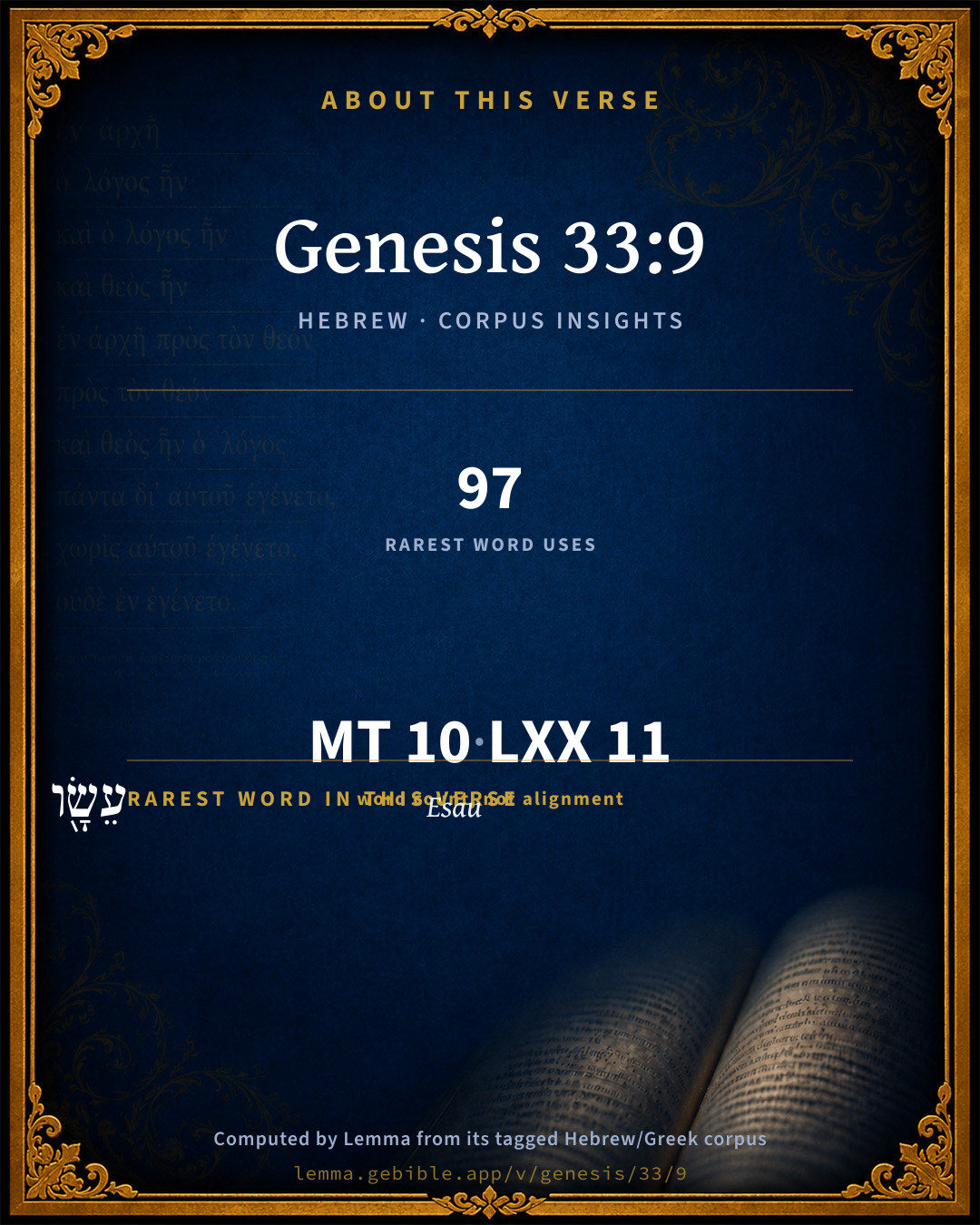
10
words
7
distinct lemmas
Pentateuch
section

Grammatical profile

  • 2 verbs
  • 2 nouns
  • 1 adjective
  • 3 prepositions
  • 2 particles

Verb forms

  • וַיֹּ֥אמֶר Qal · Sequential Imperfect
  • יְהִ֥י Qal · Jussive

Hebrew & Septuagint length

In English translation the verse runs 14 words from the Hebrew and 11 from the Septuagint (LXX English) — closely comparable.

A rough comparison of the two English renderings, which tokenize alike — not a word-level alignment.

Word counts can differ between the Hebrew and the Greek without any difference in meaning — e.g. the Hebrew direct-object marker אֵת has no separate Greek word, and Greek often adds the article ὁ.

In the original languages it is 10 Hebrew tokens and 11 Greek tokens — but the two are counted differently (Hebrew bundles its prefixes and suffixes into one token; the Greek is in lemma form), so that isn’t a like-for-like length.

Cross-references

11

Topical passages linked to Genesis 33:9 in the Treasury of Scripture Knowledge — connected by theme and wording, ordered by reader-vote popularity; previews shown in the World English Bible.

  • Genesis 27:39 Isaac his father answered him, "Behold, of the fatness of the earth will be your dwelling, and of the dew of the sky from above.
  • Philemon 1:7 For we have much joy and comfort in your love, because the hearts of the saints have been refreshed through you, brother.
  • Genesis 4:9 Yahweh said to Cain, "Where is Abel, your brother?" He said, "I don't know. Am I my brother's keeper?"
  • Genesis 27:41 Esau hated Jacob because of the blessing with which his father blessed him. Esau said in his heart, "The days of mourning for my father are at hand. Then I will kill my brother Jacob."
  • Judges 20:23 The children of Israel went up and wept before Yahweh until even; and they asked of Yahweh, saying, Shall I again draw near to battle against the children of Benjamin my brother? Yahweh said, Go up against him.
  • Proverbs 16:7 When a man's ways please Yahweh, He makes even his enemies to be at peace with him.
  • Ecclesiastes 4:8 There is one who is alone, and he has neither son nor brother. There is no end to all of his labor, neither are his eyes satisfied with wealth. For whom then, do I labor, and deprive my soul of enjoyment? This also is vanity, yes, it is a miserable business.
  • Acts 9:17 Ananias departed, and entered into the house. Laying his hands on him, he said, "Brother Saul, the Lord, who appeared to you on the road by which you came, has sent me, that you may receive your sight, and be filled with the Holy Spirit."
  • Acts 21:20 They, when they heard it, glorified God. They said to him, "You see, brother, how many thousands there are among the Jews of those who have believed, and they are all zealous for the law.
  • Philemon 1:16 no longer as a slave, but more than a slave, a beloved brother, especially to me, but how much rather to you, both in the flesh and in the Lord.
  • Proverbs 30:15 "The leach has two daughters: 'Give, give.' "There are three things that are never satisfied; Four that don't say, 'Enough:'

Cross-references courtesy of OpenBible.info (CC BY 4.0).

Hebrew and Greek witnesses Masoretic Hebrew ↔ Greek Septuagint

The same verse in the two great witnesses to the Old Testament, shown verse-for-verse.

These are two independent witnesses, not word-aligned to each other, and the Septuagint is shown in lemma (dictionary) form.

Hebrew Genesis 33:9 Masoretic · Westminster Leningrad Codex

וַיֹּ֥אמֶר עֵשָׂ֖ו יֶשׁ לִ֣י רָ֑ב אָחִ֕י יְהִ֥י לְךָ֖ אֲשֶׁר לָֽךְ

Esau said, "I have enough, my brother; let that which you have be yours."

World English Bible · Public Domain

Greek LXX Genesis 33:9 Septuagint · lemma form

εἶπον δέ ησαυ εἰμί ἐγώ πολύς ἀδελφός εἰμί σύ ὁ σός

And Esau said, I have much, my brother; keep your own.

LXX2012 (modern English Septuagint) · Public Domain

Hebrew: Westminster Leningrad Codex (CC BY 4.0). Greek: Septuagint (public domain); English from LXX2012 (modern English Septuagint) (Public Domain). How the Septuagint differs from the Hebrew →

Targum (Aramaic paraphrase)

2

The Targum is the ancient Jewish Aramaic paraphrase of the Hebrew Scriptures — an interpretive translation, not the Hebrew text itself. Onkelos (literal) and Pseudo-Jonathan (expansive) render the Torah, and Jonathan the Prophets. Coverage is partial: where no permissively-licensed English translation exists for a verse, only the Aramaic is shown. This is verse-level text, not a word-by-word alignment to the Hebrew.

  1. Targum Onkelos Torah (Genesis–Deuteronomy)
    וַאֲמַר עֵשָׂו אִית לִי סַגִּי אָחִי אַצְלַח בְּדִילָךְ

    (no public-domain English translation for this verse)

    Targum Onkelos — Aramaic: “Onkelos Genesis” (public domain); “Onkelos Exodus” (public domain); “Onkelos Leviticus” (public domain); “Onkelos Numbers” (public domain); “Onkelos Deuteronomy” (public domain). English: “Sefaria Community Translation” (CC0 1.0 (public-domain dedication)); “J.W. Etheridge. The Targums of Onkelos and Jonathan Ben Uzziel on the Pentateuch. London: Longmans, Green, 1862” (public domain). Text via Sefaria.

  2. Targum Pseudo-Jonathan Torah (Genesis–Deuteronomy)
    וַאֲמַר עֵשָו אִית לִי נִכְסִין סַגִיאִין אָחִי יִתְקַיֵים לָךְ מַאן דְאִית לָךְ

    And Esau said, I have much substance, my brother; let what thou hast be confirmed to thee.

    Targum Pseudo-Jonathan — Aramaic: “Targum Jonathan on Genesis” (public domain); “Targum Jonathan on Exodus” (public domain); “Targum Jonathan on Leviticus” (public domain); “Targum Jonathan on Numbers” (public domain); “Targum Jonathan on Deuteronomy” (public domain). English: “The Targum of Jonathan ben Uzziel, trans. J. W. Etheridge, London, 1862” (public domain). Text via Sefaria.

Commentary

Notes on Genesis 33:9 from classic Christian and Jewish commentators (each source and its license shown beneath its notes). The classic Christian expositions comment on the surrounding passage and are grouped to its opening verse, so a note may address several verses; the Jewish commentaries on the Tanakh (Rashi and others) are per-verse, so they appear only where the commentator wrote on this verse.

Lemma curates 59 commentaries, every one of them public domain or Creative Commons licensed, each selected and text-cleaned for this edition rather than reprinted as found. About our sources →

Trapp's Complete Commentary

John Trapp

Gen 33:9 And Esau said, I have enough, my brother; keep that thou hast unto thyself.

Ver. 10. As though I had seen the face of God.] I cannot but see God, and his goodness, in thy so unexpected kindness. "The Lord hath done great things for me, whereof I am glad," {Psa 126:3} and think my present well bestowed.

John Trapp, A Commentary or Exposition upon All the Books of the Old and New Testament (1647–1656) — public domain. Text from a community e-Sword module.

The Biblical Illustrator

Joseph S. Exell

Gen_33:9; Gen_33:11

I have enough

Contentment from two points of view

I.

HERE IS AN UNGODLY MAN WHO HAS ENOUGH (Gen_33:9). Esau. Unconverted men are sometimes contented with their lot in this life.

1. It is not always or often so: they are mostly a dissatisfied company.

2. It is sometimes so: as in the case of Esau. This may arise from--

(1) A want of energy.

(2) A naturally easy disposition, readily pleased.

(3) Utter recklessness, which only considers present pleasure.

3. It has some good points about it.

(1) As preventing greed, and the oppression which comes of it.

(2) As often promoting a good-natured liberality, and the disposition to live and let live.

4. Yet it has its evil side.

(1) It leads men to boast of their wealth or acquirements, who would not do so if they were craving for more.

(2) It tends to breed a contempt for spiritual riches.

(3) It may thus be a sign of having ones portion in this life.

II. HERE IS A GODLY MAN WHO HAS ENOUGH (Gen_33:11). Jacob.

1. It is a pity that this is not true of every Christian man.

2. It is delightful to have enough. Contentment surpasses riches.

3. It is pleasant to have somewhat to spare for the poor (Eph_4:28).

4. It is blessed to have all this through our God. Jacob said, God hath dealt graciously with me, and I have enough.

5. It is best of all to have all things. In the margin we read that Jacob said, I have all things. All things are yours (1Co_3:22).

(1) All that the believer needs is promised in the covenant.

(2) All things in providence work together for his good.

(3) In having God for his portion he has more than all.

Thus he has enough of strength and grace. Enough in Christ, in the Word, and in the Spirit. Enough in Gods love, power and faithfulness, and an immeasurable supply in God Himself, whose name is God All-sufficient. The child of God should be ashamed of discontent, since even a common sinner may be free from it. He should be heartily satisfied; for he has all things, and what more can he desire? O rest in the Lord (Psa_37:7). (C. H. Spurgeon.)

Lessons

1. Natural affection will urge to inquire of the outward state of brethren as well as of relations.

2. Modesty in nature will expostulate about brethrens offers of love rather then covetously take them.

3. Providential occurrences of good pretended may occasion natural men to inquire about them.

4. Humble souls as under providence they do seek favour with men by presents, so they profess it (Gen_33:8).

5. It is possible for natural men to have a kind of sufficiency and content in their possessions.

6. Nature may desire others to keep their own, as it is contented with its portion.

7. Nature is apt to think earthly possessions enough without God (Gen_33:9).

8. Ingenuity and grace is not only liberal, but urgent to have fruits of love accepted.

9. Acceptance of loving presents is a token of acceptance of persons.

10. It is just cause of importunity in pressing pacifying presents when Gods face is seen in reconciled adversaries.

11. Unexpected love from displeased ones engageth to press kindness on them (Gen_33:10).

12. Presents of gracious souls from God to men are blessings.

13. Grace is importunate with man as well as with God to win Him.

14. Gods gracious respects to saints causeth them so to respect their brethren.

15. Gods Jacobs, gracious souls, they have not only enough, but all in the grace of God.

16. The all-sufficiency which God giveth His saints makes them so pressing kindness to others.

17. Nature is overcome by the importunity of grace to accept an outward blessing.

18. Brotherly conference is the way of winning upon men of bad spirits. All this between Jacob and Esau is by loving parley. (G. Hughes, B. D.)

Christian contentment

A poor Christian woman, who was breaking her fast upon a crust and a cup of water, exclaimed, What! all this and Christ too! (C. H. Spurgeon.)

A Puritan preacher asking a blessing on a herring and potatoes, said, Lord, we thank Thee that Thou hast ransacked sea and land to find food for Thy children. (C. H. Spurgeon.)

Angelic content

The great cry with everybody is, Get on! get on! just as if the world were travelling post. How astonished these people will be, if they arrive in heaven, to find the angels, who are much wiser than they, laying no schemes to be made archangels! (Maxims for Meditation.)

Content from a quiet mind

Is not the bee as well contented with feeding on the dew, or sucking from a flower, as the ox that grazeth on the mountains? Contentment lies within a man, in the heart; and the way to be comfortable is not by having our barrels filled, but our minds quieted. The contented man (saith Seneca)is the happy man . . . Discontent robs a man of the power to enjoy what he possesses. A drop or two of vinegar will sour a whole glass of wine. (T. Watson.)

Contentment of the unregenerate

As a typical instance of the contentment of some unregenerate persons, note the following: A captain of a whale-ship told one of the wretched natives of Greenland that he sincerely pitied the miserable life to which he was condemned. Miserable! exclaimed the savage. I have always had a fish-bone through my nose, and plenty of train-oil to drink: what more could I desire? (C. H. Spurgeon.)

I have enough

1. The first man who ever said so.

2. What even non-spiritual men may say. Should not Christians say more?

3. Property should be a heart-store.

4. Enough can never be true of spiritual blessings.

5. The evils of avaricious grasping.

6. We must not be avaricious, even on the plea that it is for others,

7. Christianity should be proved by contentment. Examples of

Christ and Paul. (J. Parker, D. D.)

The Biblical Illustrator, edited by Joseph S. Exell (c. 1880s–1900s) — public domain. Text from a community e-Sword module.

The Cambridge Bible for Schools and Colleges

gen. ed. J. J. S. Perowne

9. enough] Heb. “abundance,” or “plenty.”

The Cambridge Bible for Schools and Colleges (gen. ed. J. J. S. Perowne; Cambridge University Press, 1878–1918) — public domain. Text from a community e-Sword module.

John Gill's Exposition

And Esau said, I have enough, my brother,.... Or "I have much" (o), and stand in no need of this present, or have much more than thou hast:

keep that thou hast unto thyself; for the use of himself and family, which is large; in this Esau showed himself not only not a covetous man, but that he was truly reconciled to his brother, and needed not anything from him, to make up the difference between them.

(o) "est mihi multum", Pagninus, Montanus, Drusius; "plurima", V. L. "quamplurima", Vatablus.

John Gill's Exposition of the Whole Bible (1746–1763) — public domain (CC PDM 1.0). Text via the HelloAO Bible API.

Matthew Poole's English Annotations

I neither need it for my use, nor desire it as a compensation for thy former injuries.

Matthew Poole's English Annotations on the Holy Bible (1683–1685) — public domain. Text from a community e-Sword/MySword module.

The Pulpit Commentary

And Esau said, I have enough (literally, Here is to me abundance), my brother (it is impossible not to admire the generous and affectionate disposition of Esau); keep that thou hast unto thyself (literally, let be to thee what is to thee, i.e. what belongs to thee).

The Pulpit Commentary (1880–1919), ed. H.D.M. Spence-Jones & Joseph S. Exell — public domain. Text from a community e-Sword module.

unfoldingWord translationNotes

Door43 World Missions Community

I have enough

The word "animals" or "property" is understood. AT: "I have enough animals" or "I have enough property" (See: Ellipsis)

if I have found favor in your eyes

The phrase "found favor" is an idiom which means to be approved of by someone. Here "eyes" are a metonym for sight, and sight is a metaphor representing his evaluation. AT: "if you are pleased with me" (See: Idiom and Metonymy and Metaphor)

my gift from my hand

Here "hand" refers to Jacob. AT: "this gift that I am giving to you" (See: Synecdoche)

my hand, for indeed

This can be translated as a new sentence: "my hand. For certainly"

I have seen your face, and it is like seeing the face of God

The meaning of this simile is unclear. Possible meanings are 1) Jacob is happy that Esau has forgiven him like God has forgiven him or 2) Jacob is amazed to see his brother again like he was amazed to see God or 3) Jacob is humbled to be in Esau's presence like he was humbled to be in God's presence. (See: Simile)

I have seen your face

Here "face" stands for Esau. It may be best to translate as "face" because of the importance of the word "face" here with "face of God" and "face to face" in Genesis 32:30. (See: Synecdoche)

that was brought to you

This can be stated in active form. AT: "that my servants brought to you" (See: Active or Passive)

God has dealt graciously with me

"God has treated me very well" or "God has blessed me very much"

Thus Jacob urged him, and Esau accepted it

It was customary to refuse a gift first, but then to accept the gift before the giver was offended.

translationWords

Esau

brother

Jacob

favor

hand

face

unfoldingWord translationNotes — © Distant Shores Media and the Door43 World Missions Community, licensed CC BY-SA 4.0. Source: git.door43.org/Door43/en_tn.

Rashi

Rabbi Shlomo Yitzchaki (Rashi)

יהי לך אשר לך BE THINE THAT WHICH IS THINE — In these words he admitted his right to the blessings (Genesis Rabbah 78:11).

Rashi on the Tanakh — English translations: “The Judaica Press complete Tanach with Rashi, translated by A. J. Rosenberg” (CC BY 4.0); “Pentateuch with Rashi's commentary by M. Rosenbaum and A.M. Silbermann, 1929-1934” (public domain); “The Metsudah Tanach series, Lakewood, N.J” (CC BY 4.0); and “The Book of Joshua, Metsudah Publications, 1997” (CC BY 4.0). Text via Sefaria.

Radak

Rabbi David Kimhi (Radak)

ויאמר עשו, “I do not need your gift for יש לי רב, I possess a great deal.” In Bereshit Rabbah 78,11 the words יש לי רב are understood as meaning: “keep what is yours.” Rabbi Eleazar paraphrased that the validity of a decree of divorce can be attested to only by the people who have signed it. You should not say that if our patriarch Yaakov had not fooled his father he would not have received the blessings. [Yaakov wanted to show Esau that none of these blessings had been fulfilled for him, and that his wealth was totally independent of what his father had assured him of instead of Esau. Ed.] After all these years, Esau finally acknowledged that he had not suffered as a result of Yaakov’s being blessed, so that he said “keep what is yours!”

Radak on the Tanakh — English translations: “Sefaria Community Translation” (CC0 1.0 (public-domain dedication)); “Eliyahu Munk, HaChut Hameshulash” (CC BY 4.0); “Rabbi Mike Feuer, Jerusalem Anthology” (CC BY 4.0); and “R. David Kimhi on the first book of Psalms, Translated by R.G. Finch, London, 1919” (public domain). Text via Sefaria.

Lesson kit

Teaching starters — assembled from the data on this page, not authored interpretation. Every prompt links to the verse data it draws on. Edit before teaching.

Genesis, in the Pentateuch, opens this verse with 10 words (7 distinct Hebrew lemmas). Its most distinctive word is ʻÊsâv (“Esau”). A historical commentator’s framing appears above. Read the whole chapter for the surrounding context.

Discussion questions

  1. The word ʻÊsâv carries the sense “Esau.” How does it shape the verse?
  2. How does Genesis 27:39, which shares this passage’s theme, read alongside this verse?
  3. These translations render this verse differently; the difference is in the English rendering, not the original. What questions does that raise?
  4. «וַיֹּ֥אמֶר» is a Qal Sequential Imperfect verb. How does that grammatical form shape the action described?
  5. Compare how Trapp's Complete Commentary and The Biblical Illustrator read this verse. Where do they agree or differ?

Things to notice

Reading settings

Reading text

Shown beneath each verse's original-language words.

Old Testament
Old Testament edition

Read the OT as the Masoretic Hebrew (MT) or the Greek Septuagint (LXX).

English shown for the Greek Septuagint (in the Hebrew ↔ Greek comparison).

Comparing translations? Open the Compare panel on any verse page to stack up to four side by side.