Genesis 36:7

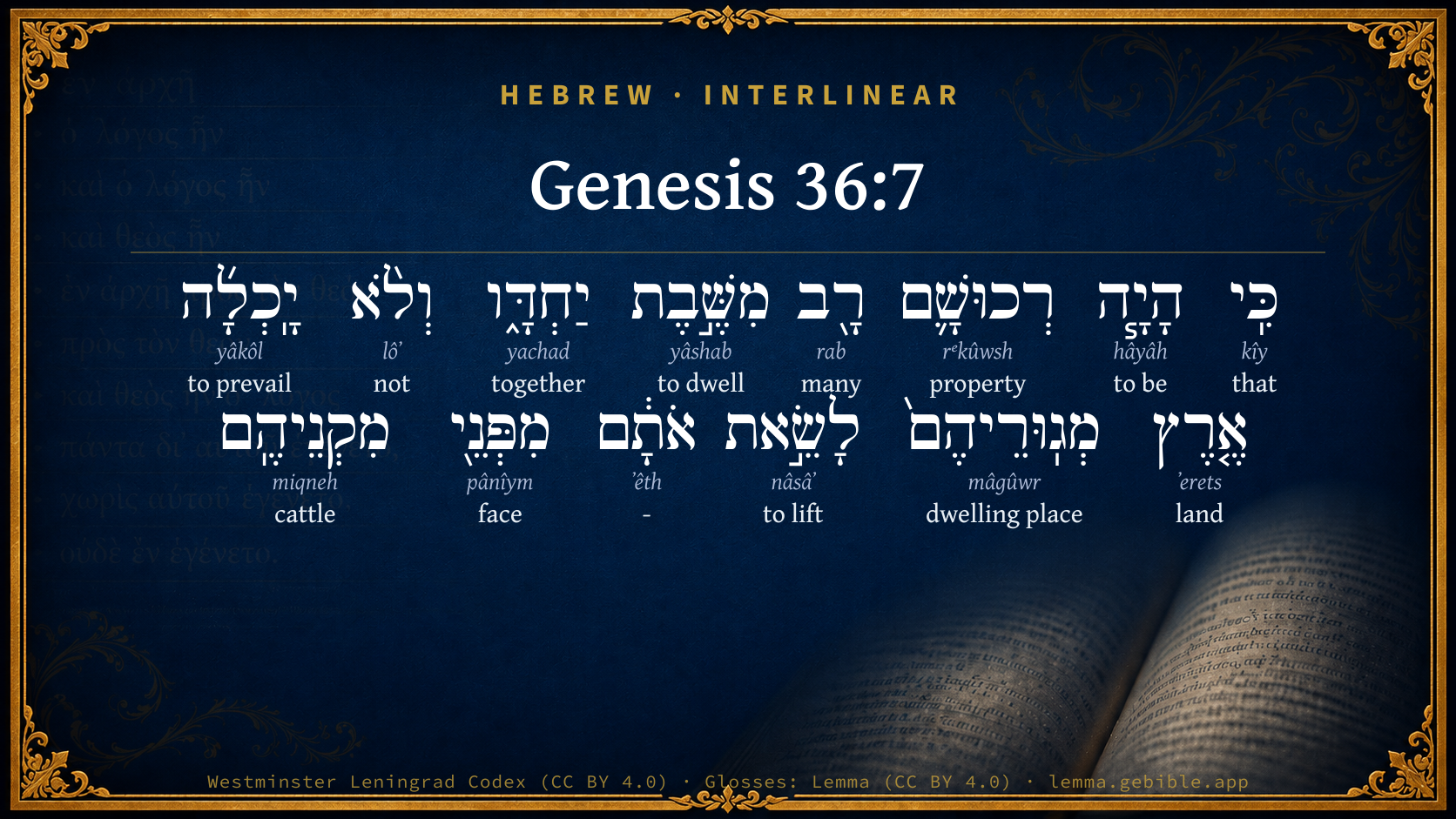
Hebrew (Westminster Leningrad Codex) Genesis 36:7 appears in the Hebrew Old Testament. The text above is from the Westminster Leningrad Codex. Each word links to its Strong’s number, a concise gloss, and parsing drawn from the Open Scriptures Hebrew Bible morphology. Click any word for its full Brown-Driver-Briggs (BDB) entry.
Download image
Cite this verse

Genesis 36:7 (World English Bible). Public Domain. Lemma interlinear Bible study tool, https://lemma.gebible.app/v/genesis/36/7.

Show BibTeX & RIS
BibTeX
RIS
English Translation
For their substance was too great for them to dwell together, and the land of their travels couldn't bear them because of their cattle.
World English Bible · Public Domain
Download a study sheet

One document with this verse’s original text, its word-by-word gloss line, the meaning frame, cross-references with their text, attributed commentary, and full source and license credits — printable, and it pastes into notes with its structure intact.

This verse Autodidact and up

Study sheet (.html) Plain text (.txt)

A passage Seminary Student

Up to 50 verses in one chapter. A passage sheet keeps up to 6 commentary sources and 12 cross-references per verse, in the order this page ranks them, and says so on the sheet whenever that leaves anything out. Ask for a single verse and you get the Autodidact verse sheet above.

Everything on this page stays free to read, with no account — the sheet is a download of what is already on screen, not access to it.

Want to remove ads? Support Godless Engineer
Compare translations 3

The same verse in 3 English versions, stacked beneath the original-language interlinear above. Click any original word for its lexicon entry.

Each is an independent rendering of the whole verse — the interlinear is not word-aligned to these translations.

Highlighted words mark where these versions differ — a whole-verse word diff, not a word-by-word alignment.

  • World English Bible Public Domain
    For their substance was too great for them to dwell together, and the land of their travels couldn't bear them because of their cattle.
  • King James Version Public Domain
    For their riches were more than that they might dwell together; and the land wherein they were strangers could not bear them because of their cattle.
  • unfoldingWord Literal Text CC BY-SA 4.0
    because their possession were great for them to remain together, and the land of their sojournings was not able to support them because of their livestock.

unfoldingWord Literal Text — © unfoldingWord, licensed CC BY-SA 4.0. Word-aligned USFM3 via Door43 (git.door43.org/unfoldingWord/en_ult).

Versions to compare (up to 4)

3 of 4 selected

Show all 18 translations

Every available English version of this verse, each an independent rendering of the whole verse.

  • World English Bible Public Domain
    For their substance was too great for them to dwell together, and the land of their travels couldn't bear them because of their cattle.
  • Berean Standard Bible Public Domain
    For their possessions were too great for them to dwell together; the land where they stayed could not support them because of their livestock.
  • Majority Standard Bible Public Domain
    For their possessions were too great for them to dwell together; the land where they stayed could not support them because of their livestock.
  • King James Version Public Domain
    For their riches were more than that they might dwell together; and the land wherein they were strangers could not bear them because of their cattle.
  • American Standard Version (1901) Public Domain
    For their substance was too great for them to dwell together; and the land of their sojournings could not bear them because of their cattle.
  • Revised Version (1885) Public Domain
    For their substance was too great for them to dwell together; and the land of their sojournings could not bear them because of their cattle.
  • Geneva Bible (1599) Public Domain
    For their riches were so great, that they could not dwell together, and the lande, wherein they were strangers, coulde not receiue them because of their flockes.
  • Douay-Rheims (1899) Public Domain
    For they were exceeding rich, and could not dwell together: neither was the land in which they sojourned able to bear them, for the multitude of their flocks.
  • Young's Literal Translation Public Domain
    for their substance was more abundant than to dwell together, and the land of their sojournings was not able to bear them because of their cattle;
  • Literal Standard Version CC BY-SA 4.0
    for their substance was more abundant than to dwell together, and the land of their sojournings was not able to bear them because of their livestock;
  • Unlocked Literal Bible CC BY-SA 4.0
    He did this because their possessions were too many for them to stay together. The land where they had settled could not support them because of their livestock.
  • unfoldingWord Literal Text CC BY-SA 4.0
    because their possession were great for them to remain together, and the land of their sojournings was not able to support them because of their livestock.
  • Darby Bible Public Domain
    For their property was too great for them to dwell together, and the land where they were sojourners could not bear them, because of their cattle.
  • World Messianic Bible Public Domain
    For their substance was too great for them to dwell together, and the land of their travels couldn’t bear them because of their livestock.
  • Webster's Bible Public Domain
    For their riches were more than that they might dwell together: and the land wherein they were strangers could not sustain them, because of their cattle.
  • Free Bible Version CC BY-SA 4.0
    He did this because the land they were living in couldn't support both of them with all their livestock.
  • Bible in Basic English Public Domain
    For their wealth was so great that the land was not wide enough for the two of them and all their cattle.
  • JPS Tanakh (1917) Public Domain
    For their substance was too great for them to dwell together; and the land of their sojournings could not bear them because of their cattle.

Literal Standard Version (2020), Covenant Press — licensed CC BY-SA 4.0. Text via the HelloAO Bible API (eBible.org). Unlocked Literal Bible (unfoldingWord) — licensed CC BY-SA 4.0. Text via the HelloAO Bible API (eBible.org). unfoldingWord Literal Text — © unfoldingWord, licensed CC BY-SA 4.0. Word-aligned USFM3 via Door43 (git.door43.org/unfoldingWord/en_ult). Free Bible Version, Dr. Jonathan Gallagher — licensed CC BY-SA 4.0. Text via the HelloAO Bible API (eBible.org).

Word by word

More ways to search: Search by grammar → Find every occurrence → Compare this word →

Practice this passage: Drill this verse → Learn its vocabulary →

מְגֽוּרֵיהֶם֙
mâgûwr
H4033
“dwelling places · their”
Noun, Common, Masculine, Plural, Construct + Suffix, Personal, 3rd Person, Masculine, Plural
Part of Speech
Noun
Type
Common
Gender
Masculine
Number
Plural
State
Construct
Full BDB Definition

Origin: from H1481 in the sense lodging

TWOT: 330c

sojourning place, dwelling-place, sojourning - dwelling-place - sojourning, lifetime
  1. כִּֽי kîy H3588 “that” Conjunction
  2. הָיָ֧ה hâyâh H1961 “to be” Verb, Qal, Perfect, 3rd Person, Masculine, Singular
  3. רְכוּשָׁ֛ם rᵉkûwsh H7399 “property · their” Noun, Common, Masculine, Singular, Construct + Suffix, Personal, 3rd Person, Masculine, Plural
  4. רָ֖ב rab H7227 “many” Adjective, Adjective, Masculine, Singular, Absolute
  5. מִשֶּׁ֣בֶת yâshab H3427 “from · to dwell” Preposition + Verb, Qal, Infinitive Construct
  6. יַחְדָּ֑ו yachad H3162 “together” Adverb
  7. וְלֹ֨א lôʼ H3808 “and · not” Conjunction + Particle, Negative
  8. יָֽכְלָ֜ה yâkôl H3201 “to prevail” Verb, Qal, Perfect, 3rd Person, Feminine, Singular
  9. אֶ֤רֶץ ʼerets H776 “land of” Noun, Common, Both, Singular, Construct
  10. לָשֵׂ֣את nâsâʼ H5375 “to lift” Preposition + Verb, Qal, Infinitive Construct
  11. אֹתָ֔ם ʼêth H853 “- · them” Particle, Direct Object + Suffix, Personal, 3rd Person, Masculine, Plural
  12. מִפְּנֵ֖י pânîym H6440 “from · face(s) of” Preposition + Noun, Common, Both, Plural, Construct
  13. מִקְנֵיהֶֽם miqneh H4735 “cattle · their” Noun, Common, Masculine, Singular, Construct + Suffix, Personal, 3rd Person, Masculine, Plural

About this verse

These counts appear in no published source. They are computed here, from the morphology-tagged text and Lemma’s own curated glosses. What Lemma adds →

14
words
14
distinct lemmas
Pentateuch
section

Notable vocabulary

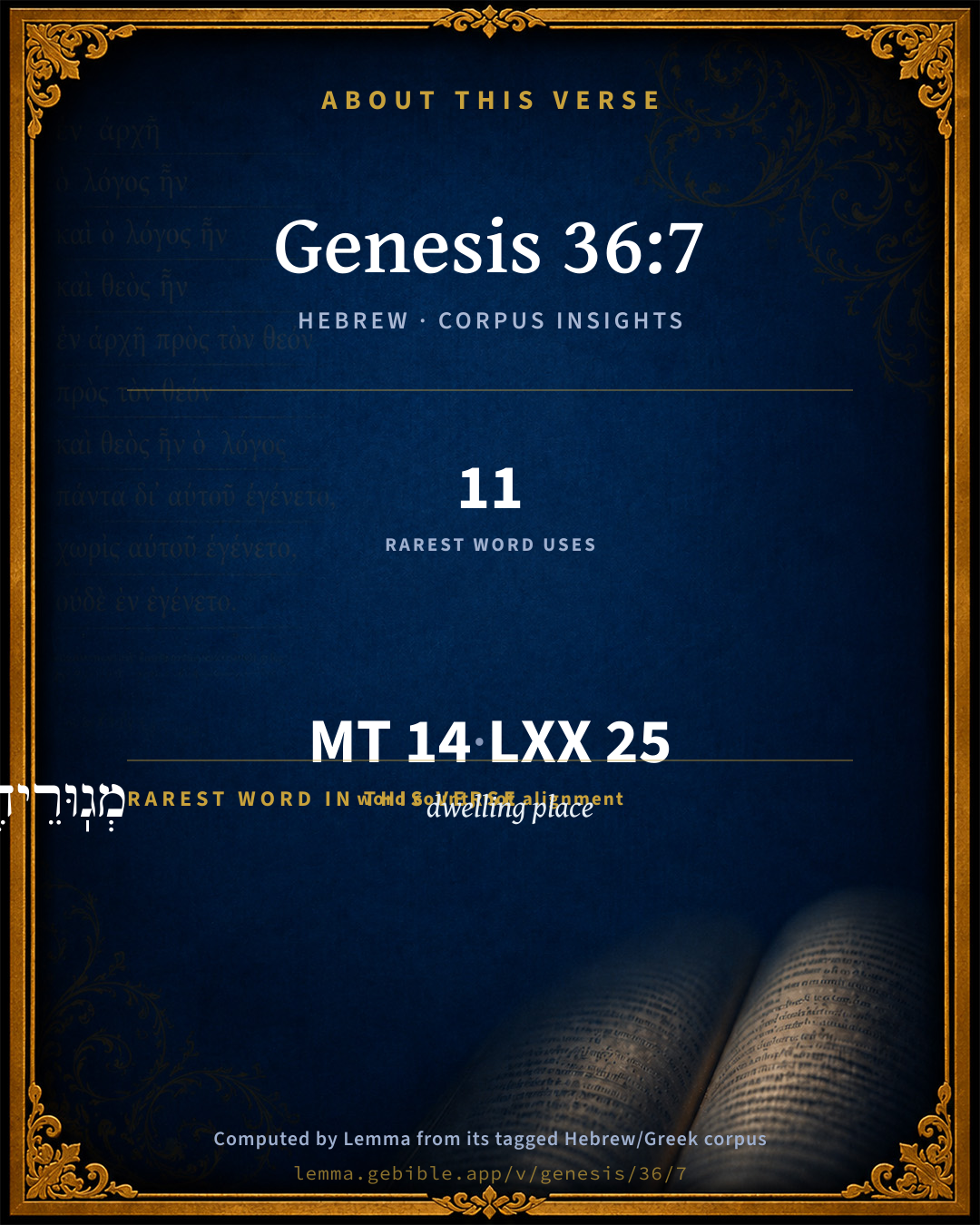
The rarest word here is מְגֽוּרֵיהֶם֙ dwelling place H4033 — appearing just 11 times in the whole Hebrew Bible.

Shared distinctive vocabulary

מְגֽוּרֵיהֶם֙ dwelling place H4033 occurs in 10 verses of the Hebrew Bible. Also found in:

Grammatical profile

  • 4 verbs
  • 5 nouns
  • 1 adjective
  • 1 conjunction
  • 1 adverb
  • 2 particles

Verb forms

  • הָיָ֧ה Qal · Perfect
  • מִשֶּׁ֣בֶת Qal · Infinitive Construct
  • יָֽכְלָ֜ה Qal · Perfect
  • לָשֵׂ֣את Qal · Infinitive Construct

Hebrew & Septuagint length

In English translation the verse runs 24 words from the Hebrew and 28 from the Septuagint (LXX English) — closely comparable.

A rough comparison of the two English renderings, which tokenize alike — not a word-level alignment.

Word counts can differ between the Hebrew and the Greek without any difference in meaning — e.g. the Hebrew direct-object marker אֵת has no separate Greek word, and Greek often adds the article ὁ.

In the original languages it is 14 Hebrew tokens and 25 Greek tokens — but the two are counted differently (Hebrew bundles its prefixes and suffixes into one token; the Greek is in lemma form), so that isn’t a like-for-like length.

Cross-references

5

Topical passages linked to Genesis 36:7 in the Treasury of Scripture Knowledge — connected by theme and wording, ordered by reader-vote popularity; previews shown in the World English Bible.

  • Genesis 13:6 The land was not able to bear them, that they might live together: for their substance was great, so that they could not live together.
  • Genesis 17:8 I will give to you, and to your seed after you, the land where you are traveling, all the land of Canaan, for an everlasting possession. I will be their God."
  • Genesis 28:4 and give you the blessing of Abraham, to you, and to your seed with you, that you may inherit the land where you travel, which God gave to Abraham."
  • Genesis 13:11 So Lot chose the Plain of the Jordan for himself. Lot traveled east, and they separated themselves the one from the other.
  • Hebrews 11:9 By faith, he lived as an alien in the land of promise, as in a land not his own, dwelling in tents, with Isaac and Jacob, the heirs with him of the same promise.

Cross-references courtesy of OpenBible.info (CC BY 4.0).

Hebrew and Greek witnesses Masoretic Hebrew ↔ Greek Septuagint

The same verse in the two great witnesses to the Old Testament, shown verse-for-verse.

These are two independent witnesses, not word-aligned to each other, and the Septuagint is shown in lemma (dictionary) form.

Hebrew Genesis 36:7 Masoretic · Westminster Leningrad Codex

כִּֽי הָיָ֧ה רְכוּשָׁ֛ם רָ֖ב מִשֶּׁ֣בֶת יַחְדָּ֑ו וְלֹ֨א יָֽכְלָ֜ה אֶ֤רֶץ מְגֽוּרֵיהֶם֙ לָשֵׂ֣את אֹתָ֔ם מִפְּנֵ֖י מִקְנֵיהֶֽם

For their substance was too great for them to dwell together, and the land of their travels couldn't bear them because of their cattle.

World English Bible · Public Domain

Greek LXX Genesis 36:7 Septuagint · lemma form

εἰμί γάρ αὐτός ὁ ὑποἄρχω πολύς ὁ οἰκέω ἅμα καί οὐ δύναμαι ὁ γῆ ὁ παροίκησις αὐτός φέρω αὐτός ἀπό ὁ πλῆθος ὁ ὑποἄρχω αὐτός

For their substance was too great for them to dwell together; and the land of their sojourning could not bear them, because of the abundance of their possessions.

LXX2012 (modern English Septuagint) · Public Domain

Hebrew: Westminster Leningrad Codex (CC BY 4.0). Greek: Septuagint (public domain); English from LXX2012 (modern English Septuagint) (Public Domain). How the Septuagint differs from the Hebrew →

Targum (Aramaic paraphrase)

2

The Targum is the ancient Jewish Aramaic paraphrase of the Hebrew Scriptures — an interpretive translation, not the Hebrew text itself. Onkelos (literal) and Pseudo-Jonathan (expansive) render the Torah, and Jonathan the Prophets. Coverage is partial: where no permissively-licensed English translation exists for a verse, only the Aramaic is shown. This is verse-level text, not a word-by-word alignment to the Hebrew.

  1. Targum Onkelos Torah (Genesis–Deuteronomy)
    אֲרֵי הֲוָה קִנְיָנְהוֹן סַגִּי מִלְמִתַּב כַּחֲדָא וְלָא יְכִילַת אֲרַע תּוֹתָבוּתְהוֹן לְסוֹבָרָא יָתְהוֹן מִן קֳדָם גֵּיתֵיהוֹן

    (no public-domain English translation for this verse)

    Targum Onkelos — Aramaic: “Onkelos Genesis” (public domain); “Onkelos Exodus” (public domain); “Onkelos Leviticus” (public domain); “Onkelos Numbers” (public domain); “Onkelos Deuteronomy” (public domain). English: “Sefaria Community Translation” (CC0 1.0 (public-domain dedication)); “J.W. Etheridge. The Targums of Onkelos and Jonathan Ben Uzziel on the Pentateuch. London: Longmans, Green, 1862” (public domain). Text via Sefaria.

  2. Targum Pseudo-Jonathan Torah (Genesis–Deuteronomy)
    אֲרוּם הֲוָה נִכְסֵיהוֹן סַגִי מִלְמֵיתַב כַּחֲדָא וְלָא כְּהִילַת אַרְעָא תוֹתָבוּתְהוֹן לְסוֹבָרָא יַתְהוֹם מִן קֳדָם גֵיתֵיהוֹן

    for their possessions would be too great for them to dwell together, neither would the land of their sojourning maintain them, on account of their flocks.

    Targum Pseudo-Jonathan — Aramaic: “Targum Jonathan on Genesis” (public domain); “Targum Jonathan on Exodus” (public domain); “Targum Jonathan on Leviticus” (public domain); “Targum Jonathan on Numbers” (public domain); “Targum Jonathan on Deuteronomy” (public domain). English: “The Targum of Jonathan ben Uzziel, trans. J. W. Etheridge, London, 1862” (public domain). Text via Sefaria.

Commentary

Notes on Genesis 36:7 from classic Christian and Jewish commentators (each source and its license shown beneath its notes). The classic Christian expositions comment on the surrounding passage and are grouped to its opening verse, so a note may address several verses; the Jewish commentaries on the Tanakh (Rashi and others) are per-verse, so they appear only where the commentator wrote on this verse.

Lemma curates 59 commentaries, every one of them public domain or Creative Commons licensed, each selected and text-cleaned for this edition rather than reprinted as found. About our sources →

Trapp's Complete Commentary

John Trapp

Gen 36:7 For their riches were more than that they might dwell together; and the land wherein they were strangers could not bear them because of their cattle.

Ver. 7. For their riches were more, &c.] And besides, mount Seir was more fit for a hunter. A good ease it was to Jacob, who had little joy in his neighbourhood. "God will not take the ungodly by the hand"; {Job 8:20, marg.} no more will his people. When they are forced to be in ill company, they cry, "Oh that I had the wings of a dove! that I might flee away": {Psa 55:6} or if that "Oh" will not set them at liberty, they take up that "Woe," to express their misery; "Woe is me, that I sojourn in Meshech!" &c. {Psa 120:5} It was once the prayer of a good gentlewoman, when she came to die, being in much trouble of conscience: O Lord, let me not go to hell, where the wicked are; for, Lord, thou knowest I never loved their company here. {a}

{a} Moses’s Choice, by M. Bur., p. 330.

John Trapp, A Commentary or Exposition upon All the Books of the Old and New Testament (1647–1656) — public domain. Text from a community e-Sword module.

The Biblical Illustrator

Joseph S. Exell

Gen_36:7

For their riches were more

Riches cannot secure happiness

I wish I were rich, I would buy everything, cried Charlie.

The sun, moon, and stars? inquired William. No; everything that can be had for money. Thats not happiness, said William. Get your hat, Charlie, and come with me to Mr. Morrisons, said his father. Oh, please not, papa, he is such a disagreeable, miserable old man, with his cross looks and gouty foot, hobbling about and groaning. I think you would like to live with him, said his father. I, papa? I would rather live down a coal-pit! With him you would have all that can be bought with money. I see it wont do, said Charlie. Health cannot be bought with money. Nor good temper, nor friendship, nor life, said William. Above all, added their papa, the favour of God cannot be bought with money. Be content with as much of it as God gives, and seek to use it aright.

The fear of God and sweet content Yield riches that will neer be spent..

The Biblical Illustrator, edited by Joseph S. Exell (c. 1880s–1900s) — public domain. Text from a community e-Sword module.

Tyndale Open Study Notes

Tyndale Open Resources

36:7-8 Esau, like Lot, left for the eastern land (cp. 13:5-6).

Tyndale Open Study Notes — © Tyndale Open Resources, licensed CC BY-SA 4.0. Text via the HelloAO Bible API.

Ellicott's Commentary for English Readers

(7) The land wherein they were strangers.—The large growth of their wealth made the separation of Esau and Jacob as inevitable as had been that of Abraham and Lot. It is a usual incident in the life of nomads, and a tribe can multiply only to the extent of the capabilities of their district to support them. When this is reached, one portion of the tribe must seek a new home. This necessity was in the present case aggravated by Esau and Jacob being only sojourners in Canaan, surrounded by tribes who claimed to be owners of the soil: and this may have helped in determining Esau’s choice; for in right of Aholibamah, he was in her country a duke. Maimonides also observes, that though Esau had gone on hunting expeditions to Seir, and even possibly for plunder, yet that he was not sufficiently powerful to take possession of the country until by Isaac’s death the number of his retainers was largely multiplied.

A Bible Commentary for English Readers, edited by Charles John Ellicott (1878–1897) — public domain. Text from a community e-Sword module.

The Cambridge Bible for Schools and Colleges

gen. ed. J. J. S. Perowne

7. For their substance was too great] The departure of Esau into Seir is here explained as necessitated by the growing wealth of Esau and Jacob in Canaan: cf. the separation of Abraham and Lot in ch. 13. Obviously the explanation given here does not agree with the representation in Gen_32:3 and Gen_33:14-16. “Substance,” cf. Gen_12:5, Gen_15:14.

The Cambridge Bible for Schools and Colleges (gen. ed. J. J. S. Perowne; Cambridge University Press, 1878–1918) — public domain. Text from a community e-Sword module.

John Gill's Exposition

Thus dwelt Esau in Mount Seir,.... Before he is said to be in the land of Seir, Gen 32:3; now to dwell in a mount of that name; from which driving the Horites, he seized upon and dwelt in it; it had not its name from his own rough, shaggy hair, as Josephus says (r), much less from the satyrs, and hairy demons that frequented it, as R. Abraham Seba (s), but rather from Seir the Horite who inhabited the land, Gen 36:20; unless he had his name from the mountain which might be so called, from its being rough and rugged like shaggy hair, and being covered with bushes and brambles which carried such a resemblance; and so it stands opposed to Mount Halak near it, Jos 11:17, which signifies the bald or smooth mountain, being destitute of shrubs, &c. The Targum of Jonathan calls this mountain Mount Gabla, and one part of the land of Edom, or Idumea, was called Gobolites, as Josephus (t) relates, perhaps the same with Gebal, Psa 83:7; hither Esau went and took up his residence, after things were amicably adjusted between him and his brother Jacob; the Jews say (u), that Isaac left, all he had to his two sons, and that after they had buried him, Esau said to Jacob, let us divide what our father has left us into two parts, and I will choose because I am the firstborn; so Jacob divided it into two parts; all that his father had left he made one part, and the land of Israel the other part, and Esau took what his father left, see Gen 36:6; and the land of Israel and the cave of Machpelah he delivered to Jacob, and they drew up everlasting writings between them. Now this or something like it being the case, and those the circumstances of fixings, thus, and by that means, so it came to pass, that Esau dwelt in Seir; and Jacob remained secure and quiet in the land of Canaan:

Esau is Edom, so called from the red pottage he had of Jacob, which is repeated to fix the odium of that transaction upon him, as well as for the sake of what follows, showing the reason why his posterity were called Edomites.

(r) Antiqu. l. 1. c. 20. sect. 3. (s) Tzeror Hammor, fol. 47. 1. (t) Antiqu. l. 2. c. 1. sect. 2. (u) Pirke Eliezer, c. 38. fol. 43. 1.

John Gill's Exposition of the Whole Bible (1746–1763) — public domain (CC PDM 1.0). Text via the HelloAO Bible API.

Matthew Poole's English Annotations

Which words contain the reason why that land which was large and fruitful could not bear them, because they were not entire possessors of it, but only sojourners in it, and therefore must take the owners’ leavings, which were not sufficient for both of them and their numerous families.

Matthew Poole's English Annotations on the Holy Bible (1683–1685) — public domain. Text from a community e-Sword/MySword module.

The Pulpit Commentary

For their riches were more than that they might dwell together; and the land wherein they were strangers literally, of their wanderings (cf. Gen_28:4 Gen_37:1) could not bear them because of their cattle. This does not necessarily imply that Jacob was established in Canaan before Esau removed. Esau may have recognized the impossibility of two so rich and powerful chieftains as himself and his brother occupying Canaan, and may have retired Before Jacob actually took possession (Keil, Inglis).

The Pulpit Commentary (1880–1919), ed. H.D.M. Spence-Jones & Joseph S. Exell — public domain. Text from a community e-Sword module.

Rashi

Rabbi Shlomo Yitzchaki (Rashi)

ולא יכלה ארץ מגוריהם AND THE LAND OF THEIR SOJOURNINGS COULD NOT — supply sufficient pasture for the cattle which they had. A Midrashic comment (Genesis Rabbah 82:13) on מפני יעקב אחיו [HE WENT TO A COUNTRY] ON ACCOUNT OF HIS BROTHER JACOB is: on account of the bond of indebtedness involved in the decree, (Genesis 14:13) “thy seed shall be a stranger etc… and they shall afflict them etc.” that was imposed upon Isaac’s descendants. He said, “I shall go hence — I desire no part either in the gift of this land which has been made to him (to my father) nor in the payment of this bond". Another reason why he went away was on account of the shame he felt at having sold his birthright (cf. Genesis Rabbah 82:13).

Rashi on the Tanakh — English translations: “The Judaica Press complete Tanach with Rashi, translated by A. J. Rosenberg” (CC BY 4.0); “Pentateuch with Rashi's commentary by M. Rosenbaum and A.M. Silbermann, 1929-1934” (public domain); “The Metsudah Tanach series, Lakewood, N.J” (CC BY 4.0); and “The Book of Joshua, Metsudah Publications, 1997” (CC BY 4.0). Text via Sefaria.

Ramban (Nachmanides)

Rabbi Moshe ben Nachman (Ramban / Nachmanides)

AND THE LAND OF THEIR SOJOURNINGS. The meaning thereof is “the city of their sojournings,” which is Hebron, where Abraham and Isaac sojourned, for the land of Canaan could support a thousand times more than Jacob and Esau. But when Esau saw that he could not stay in his city and in his place, he left the entire country to his brother and went his way.

Ramban (Nachmanides) on the Tanakh — English translation: “Commentary on the Torah by Ramban (Nachmanides). Translated and annotated by Charles B. Chavel. New York, Shilo Pub. House, 1971-1976” (CC BY 4.0). Text via Sefaria.

Lesson kit

Teaching starters — assembled from the data on this page, not authored interpretation. Every prompt links to the verse data it draws on. Edit before teaching.

Genesis, in the Pentateuch, opens this verse with 14 words (14 distinct Hebrew lemmas). Its most distinctive word is mâgûwr (“dwelling place”). A historical commentator’s framing appears above. Read the whole chapter for the surrounding context.

Discussion questions

  1. The word mâgûwr carries the sense “dwelling place.” How does it shape the verse?
  2. Genesis 17:8 shares the word «dwelling place» with this verse. How do the two illuminate each other?
  3. These translations render this verse differently. What is at stake in choosing one wording over another?
  4. The verb «הָיָ֧ה» is Qal Perfect. How does its form color the action?
  5. Reading how Trapp's Complete Commentary and The Biblical Illustrator read this verse, where do the two commentators agree and where do they part?

Things to notice

Reading settings

Reading text

Shown beneath each verse's original-language words.

Old Testament
Old Testament edition

Read the OT as the Masoretic Hebrew (MT) or the Greek Septuagint (LXX).

English shown for the Greek Septuagint (in the Hebrew ↔ Greek comparison).

Comparing translations? Open the Compare panel on any verse page to stack up to four side by side.