
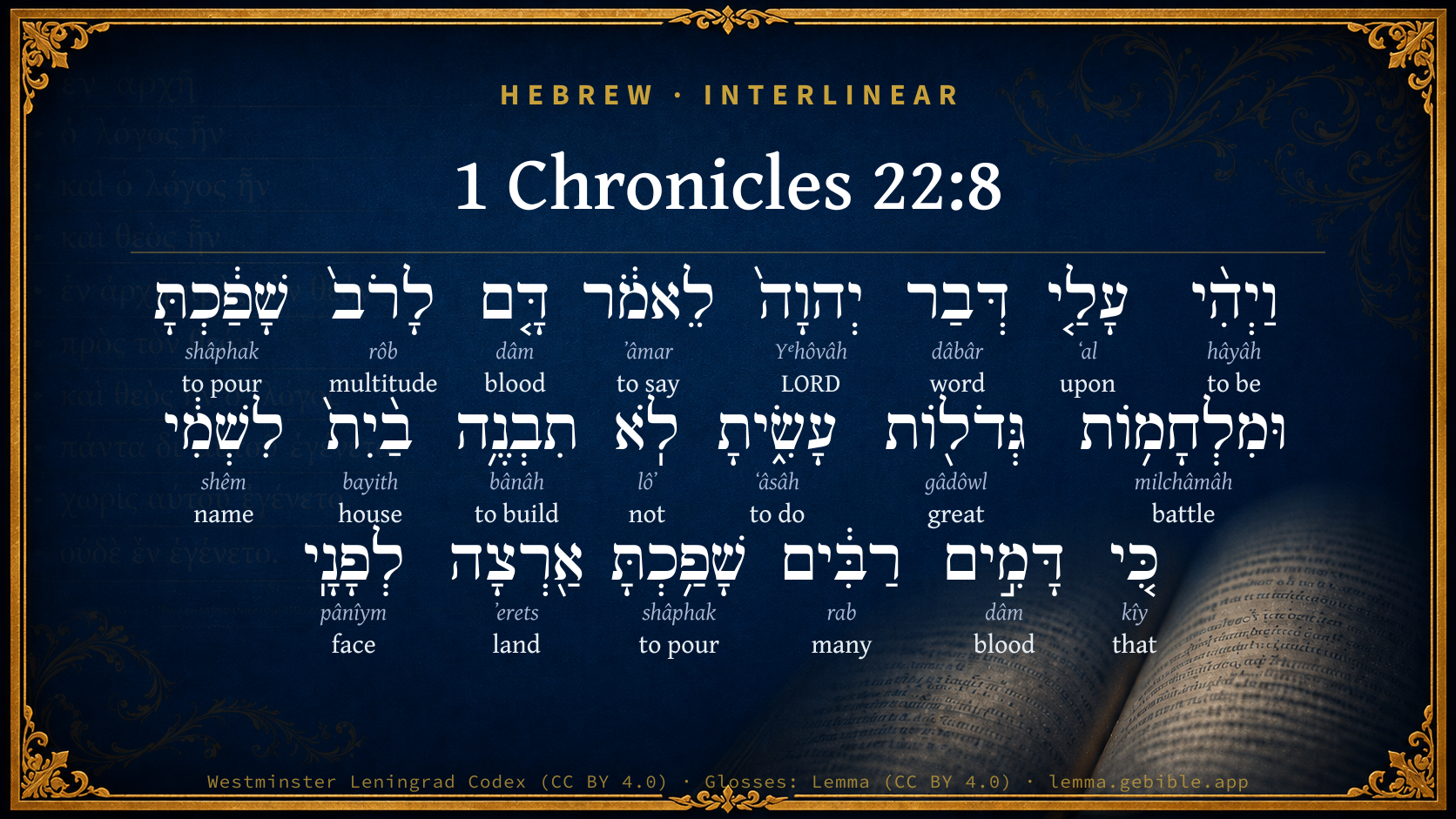
1 Chronicles 22:8

Hebrew (Westminster Leningrad Codex) 1 Chronicles 22:8 appears in the Hebrew Old Testament. The text above is from the Westminster Leningrad Codex. Each word links to its Strong’s number, a concise gloss, and parsing drawn from the Open Scriptures Hebrew Bible morphology. Click any word for its full Brown-Driver-Briggs (BDB) entry.
Download image
Cite this verse

1 Chronicles 22:8 (World English Bible). Public Domain. Lemma interlinear Bible study tool, https://lemma.gebible.app/v/1-chronicles/22/8.

Show BibTeX & RIS
BibTeX
RIS
English Translation
But the word of Yahweh came to me, saying, You have shed blood abundantly, and have made great wars: you shall not build a house to my name, because you have shed much blood on the earth in my sight.
World English Bible · Public Domain
Download a study sheet

One document with this verse’s original text, its word-by-word gloss line, the meaning frame, cross-references with their text, attributed commentary, and full source and license credits — printable, and it pastes into notes with its structure intact.

This verse Autodidact and up

Study sheet (.html) Plain text (.txt)

A passage Seminary Student

Up to 50 verses in one chapter. A passage sheet keeps up to 6 commentary sources and 12 cross-references per verse, in the order this page ranks them, and says so on the sheet whenever that leaves anything out. Ask for a single verse and you get the Autodidact verse sheet above.

Everything on this page stays free to read, with no account — the sheet is a download of what is already on screen, not access to it.

Want to remove ads? Support Godless Engineer
Compare translations 3

The same verse in 3 English versions, stacked beneath the original-language interlinear above. Click any original word for its lexicon entry.

Each is an independent rendering of the whole verse — the interlinear is not word-aligned to these translations.

Highlighted words mark where these versions differ — a whole-verse word diff, not a word-by-word alignment.

  • World English Bible Public Domain
    But the word of Yahweh came to me, saying, You have shed blood abundantly, and have made great wars: you shall not build a house to my name, because you have shed much blood on the earth in my sight.
  • King James Version Public Domain
    But the word of the LORD came to me, saying, Thou hast shed blood abundantly, and hast made great wars: thou shalt not build an house unto my name, because thou hast shed much blood upon the earth in my sight.
  • unfoldingWord Literal Text CC BY-SA 4.0
    But the word of Yahweh was to me, saying, ‘You have shed blood to abundance, and you have made great wars. You shall not build a house for my name, for you have shed much blood on the earth to my face.

unfoldingWord Literal Text — © unfoldingWord, licensed CC BY-SA 4.0. Word-aligned USFM3 via Door43 (git.door43.org/unfoldingWord/en_ult).

Versions to compare (up to 4)

3 of 4 selected

Show all 18 translations

Every available English version of this verse, each an independent rendering of the whole verse.

  • World English Bible Public Domain
    But the word of Yahweh came to me, saying, You have shed blood abundantly, and have made great wars: you shall not build a house to my name, because you have shed much blood on the earth in my sight.
  • Berean Standard Bible Public Domain
    but this word of the LORD came to me: ‘You have shed much blood and waged great wars. You are not to build a house for My Name because you have shed so much blood on the ground before Me.
  • Majority Standard Bible Public Domain
    but this word of the LORD came to me: ‘You have shed much blood and waged great wars. You are not to build a house for My Name because you have shed so much blood on the ground before Me.
  • King James Version Public Domain
    But the word of the LORD came to me, saying, Thou hast shed blood abundantly, and hast made great wars: thou shalt not build an house unto my name, because thou hast shed much blood upon the earth in my sight.
  • American Standard Version (1901) Public Domain
    But the word of Jehovah came to me, saying, Thou hast shed blood abundantly, and hast made great wars: thou shalt not build a house unto my name, because thou hast shed much blood upon the earth in my sight.
  • Revised Version (1885) Public Domain
    But the word of the LORD came to me, saying, Thou hast shed blood abundantly, and hast made great wars: thou shalt not build an house unto my name, because thou hast shed much blood upon the earth in my sight:
  • Geneva Bible (1599) Public Domain
    But the worde of the Lord came to me, saying, Thou hast shed much blood, and hast made great battels: thou shalt not builde an house vnto my Name: for thou hast shead much blood vpon the earth in my sight.
  • Douay-Rheims (1899) Public Domain
    But the word of the Lord came to me, saying: Thou hast shed much blood, and fought many battles, so thou canst not build a house to my name, after shedding so much blood before me:
  • Young's Literal Translation Public Domain
    and the word of Jehovah `is' against me, saying, Blood in abundance thou hast shed, and great wars thou hast made: thou dost not build a house to My name, for much blood thou hast shed to the earth before Me.
  • Literal Standard Version CC BY-SA 4.0
    and the word of YHWH [is] against me, saying, You have shed blood in abundance, and you have made great wars; you do not build a house for My Name, for you have shed much blood to the earth before Me.
  • Unlocked Literal Bible CC BY-SA 4.0
    But Yahweh came to me and said, 'You have shed much blood and have fought many battles. You will not build a house for my name, because you have shed much blood on the earth in my sight.
  • unfoldingWord Literal Text CC BY-SA 4.0
    But the word of Yahweh was to me, saying, ‘You have shed blood to abundance, and you have made great wars. You shall not build a house for my name, for you have shed much blood on the earth to my face.
  • Darby Bible Public Domain
    But the word of Jehovah came to me saying, Thou hast shed blood abundantly, and hast made great wars: thou shalt not build a house unto my name, for thou hast shed much blood upon the earth in my sight.
  • World Messianic Bible Public Domain
    But the LORD’s word came to me, saying, ‘You have shed blood abundantly and have made great wars. You shall not build a house to my name, because you have shed much blood on the earth in my sight.
  • Webster's Bible Public Domain
    But the word of the LORD came to me, saying, Thou hast shed blood abundantly, and hast made great wars: thou shalt not build a house to my name, because thou hast shed much blood upon the earth in my sight.
  • Free Bible Version CC BY-SA 4.0
    But the Lord told me, ‘You have shed a lot of blood and engaged in many wars. You are not to build a house to honor me because I have seen you shed so much blood on the earth.
  • Bible in Basic English Public Domain
    But the word of the Lord came to me saying, You have taken lives without number and made great wars; I will not let you be the builder of a house for my name, because of the lives you have taken on the earth before my eyes.
  • JPS Tanakh (1917) Public Domain
    But the word of the LORD came to me, saying: Thou hast shed blood abundantly, and hast made great wars; thou shalt not build a house unto My name, because thou hast shed much blood upon the earth in My sight.

Literal Standard Version (2020), Covenant Press — licensed CC BY-SA 4.0. Text via the HelloAO Bible API (eBible.org). Unlocked Literal Bible (unfoldingWord) — licensed CC BY-SA 4.0. Text via the HelloAO Bible API (eBible.org). unfoldingWord Literal Text — © unfoldingWord, licensed CC BY-SA 4.0. Word-aligned USFM3 via Door43 (git.door43.org/unfoldingWord/en_ult). Free Bible Version, Dr. Jonathan Gallagher — licensed CC BY-SA 4.0. Text via the HelloAO Bible API (eBible.org).

Word by word

More ways to search: Search by grammar → Find every occurrence → Compare this word →

Practice this passage: Drill this verse → Learn its vocabulary →

שָׁפַ֔כְתָּ
shâphak
H8210
“to pour”
Verb, Qal, Perfect, 2nd Person, Masculine, Singular
Part of Speech
Verb
Stem
Qal
Form
Perfect
Person
2nd Person
Gender
Masculine
Number
Singular
Full BDB Definition

Origin: a primitive root

TWOT: 2444

to pour, pour out, spill - (Qal) - to pour, pour out - to shed (blood) - to pour out (anger or heart) (figuratively) - (Niphal) to be poured out, be shed - (Pual) to be poured out, be shed - (Hithpael) - to be poured out - to pour out oneself
  1. וַיְהִ֨י hâyâh H1961 “and · to be” Conjunction + Verb, Qal, Sequential Imperfect, 3rd Person, Masculine, Singular
  2. עָלַ֤י ʻal H5921 “upon · me” Preposition + Suffix, Personal, 1st Person, Common, Singular
  3. דְּבַר dâbâr H1697 “word of” Noun, Common, Masculine, Singular, Construct
  4. יְהוָה֙ Yᵉhôvâh H3068 “LORD” Noun, Proper
  5. לֵאמֹ֔ר ʼâmar H559 “to say” Preposition + Verb, Qal, Infinitive Construct
  6. דָּ֤ם dâm H1818 “blood” Noun, Common, Masculine, Singular, Absolute
  7. לָרֹב֙ rôb H7230 “to/for · multitude” Preposition + Noun, Common, Both, Singular, Absolute
  8. וּמִלְחָמ֥וֹת milchâmâh H4421 “and · battles” Conjunction + Noun, Common, Feminine, Plural, Absolute
  9. גְּדֹל֖וֹת gâdôwl H1419 “great” Adjective, Adjective, Feminine, Plural, Absolute
  10. עָשִׂ֑יתָ ʻâsâh H6213 “to do” Verb, Qal, Perfect, 2nd Person, Masculine, Singular
  11. לֹֽא lôʼ H3808 “not” Particle, Negative
  12. תִבְנֶ֥ה bânâh H1129 “to build” Verb, Qal, Imperfect, 2nd Person, Masculine, Singular
  13. בַ֨יִת֙ bayith H1004 “house” Noun, Common, Masculine, Singular, Absolute
  14. לִשְׁמִ֔י shêm H8034 “to/for · name · my” Preposition + Noun, Common, Masculine, Singular, Construct + Suffix, Personal, 1st Person, Common, Singular
  15. כִּ֚י kîy H3588 “that” Conjunction
  16. דָּמִ֣ים dâm H1818 “blood” Noun, Common, Masculine, Plural, Absolute
  17. רַבִּ֔ים rab H7227 “many” Adjective, Adjective, Masculine, Plural, Absolute
  18. שָׁפַ֥כְתָּ shâphak H8210 “to pour” Verb, Qal, Perfect, 2nd Person, Masculine, Singular
  19. אַ֖רְצָה ʼerets H776 “land · toward” Noun, Common, Both, Singular, Absolute + Suffix, Demonstrative
  20. לְפָנָֽי pânîym H6440 “to/for · face(s) · my” Preposition + Noun, Common, Both, Plural, Construct + Suffix, Personal, 1st Person, Common, Singular

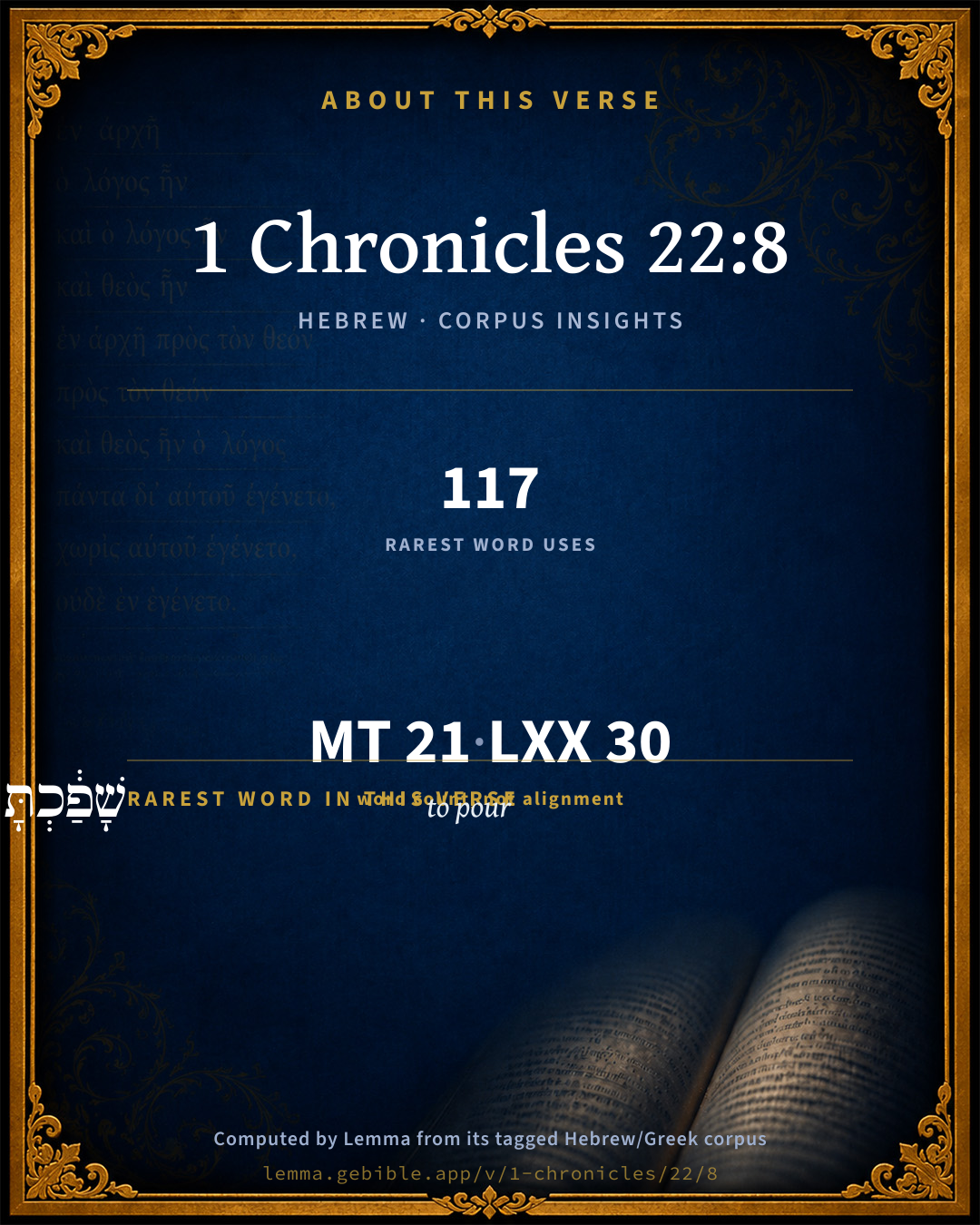
About this verse

These counts appear in no published source. They are computed here, from the morphology-tagged text and Lemma’s own curated glosses. What Lemma adds →

21
words
19
distinct lemmas
Historical
section

Grammatical profile

  • 6 verbs
  • 10 nouns
  • 2 adjectives
  • 1 preposition
  • 1 conjunction
  • 1 particle

Verb forms

  • וַיְהִ֨י Qal · Sequential Imperfect
  • לֵאמֹ֔ר Qal · Infinitive Construct
  • שָׁפַ֔כְתָּ Qal · Perfect
  • עָשִׂ֑יתָ Qal · Perfect
  • תִבְנֶ֥ה Qal · Imperfect
  • שָׁפַ֥כְתָּ Qal · Perfect

Repetition

Words recur within this verse — often emphatic in Hebrew:

  • דָּ֤ם blood H1818 ×2
  • שָׁפַ֔כְתָּ to pour H8210 ×2

Hebrew & Septuagint length

In English translation the verse runs 40 words from the Hebrew and 41 from the Septuagint (LXX English) — closely comparable.

A rough comparison of the two English renderings, which tokenize alike — not a word-level alignment.

Word counts can differ between the Hebrew and the Greek without any difference in meaning — e.g. the Hebrew direct-object marker אֵת has no separate Greek word, and Greek often adds the article ὁ.

In the original languages it is 21 Hebrew tokens and 30 Greek tokens — but the two are counted differently (Hebrew bundles its prefixes and suffixes into one token; the Greek is in lemma form), so that isn’t a like-for-like length.

Cross-references

6

Topical passages linked to 1 Chronicles 22:8 in the Treasury of Scripture Knowledge — connected by theme and wording, ordered by reader-vote popularity; previews shown in the World English Bible.

  • 1 Kings 5:3 You know how that David my father could not build a house for the name of Yahweh his God for the wars which were about him on every side, until Yahweh put them under the soles of his feet.
  • 1 Chronicles 28:3 But God said to me, You shall not build a house for my name, because you are a man of war, and have shed blood.
  • 1 Chronicles 17:4–10 Go and tell David my servant, Thus says Yahweh, You shall not build me a house to dwell in:
  • Numbers 31:24 You shall wash your clothes on the seventh day, and you shall be clean; and afterward you shall come into the camp.
  • 2 Samuel 7:5–11 Go and tell my servant David, Thus says Yahweh, Shall you build me a house for me to dwell in?
  • Numbers 31:20 As to every garment, and all that is made of skin, and all work of goats' [hair], and all things made of wood, you shall purify yourselves.

Cross-references courtesy of OpenBible.info (CC BY 4.0).

Hebrew and Greek witnesses Masoretic Hebrew ↔ Greek Septuagint

The same verse in the two great witnesses to the Old Testament, shown verse-for-verse.

These are two independent witnesses, not word-aligned to each other, and the Septuagint is shown in lemma (dictionary) form.

Hebrew 1 Chronicles 22:8 Masoretic · Westminster Leningrad Codex

וַיְהִ֨י עָלַ֤י דְּבַר יְהוָה֙ לֵאמֹ֔ר דָּ֤ם לָרֹב֙ שָׁפַ֔כְתָּ וּמִלְחָמ֥וֹת גְּדֹל֖וֹת עָשִׂ֑יתָ לֹֽא תִבְנֶ֥ה בַ֨יִת֙ לִשְׁמִ֔י כִּ֚י דָּמִ֣ים רַבִּ֔ים שָׁפַ֥כְתָּ אַ֖רְצָה לְפָנָֽי

But the word of Yahweh came to me, saying, You have shed blood abundantly, and have made great wars: you shall not build a house to my name, because you have shed much blood on the earth in my sight.

World English Bible · Public Domain

Greek LXX 1 Chronicles 22:8 Septuagint · lemma form

καί γίγνομαι ἐπί ἐγώ λόγος κύριος λέγω αἷμα εἰς πλῆθος ἐκχέω καί πόλεμος μέγας ποιέω οὐ οἰκοδομέω οἶκος ὁ ὄνομα ἐγώ ὅτι αἷμα πολύς ἐκχέω ἐπί ὁ γῆ ἐναντίον ἐγώ

But the word of the Lord came to me, saying, You have shed blood abundantly, and have carried on great wars: you shall not build a house to my name, because you have shed much blood upon the earth before me.

LXX2012 (modern English Septuagint) · Public Domain

Hebrew: Westminster Leningrad Codex (CC BY 4.0). Greek: Septuagint (public domain); English from LXX2012 (modern English Septuagint) (Public Domain). How the Septuagint differs from the Hebrew →

Commentary

Notes on 1 Chronicles 22:8 from classic Christian and Jewish commentators (each source and its license shown beneath its notes). The classic Christian expositions comment on the surrounding passage and are grouped to its opening verse, so a note may address several verses; the Jewish commentaries on the Tanakh (Rashi and others) are per-verse, so they appear only where the commentator wrote on this verse.

Lemma curates 59 commentaries, every one of them public domain or Creative Commons licensed, each selected and text-cleaned for this edition rather than reprinted as found. About our sources →

Trapp's Complete Commentary

John Trapp

1Ch 22:8 But the word of the LORD came to me, saying, Thou hast shed blood abundantly, and hast made great wars: thou shalt not build an house unto my name, because thou hast shed much blood upon the earth in my sight.

Ver. 8. Thou hast shed much blood upon tho earth in my sight,] i.e., Me sciente et vidente: haply God here meaneth the blood of Uriah, and of those that fell with him.

John Trapp, A Commentary or Exposition upon All the Books of the Old and New Testament (1647–1656) — public domain. Text from a community e-Sword module.

Joseph Benson's Commentary

1Ch 22:8. Thou hast shed blood, &c.; thou shalt not build a house unto my name — Not that wars are simply unlawful, but to teach us that the church (whereof the temple was an illustrious type) should be built by Christ, the Prince of peace, Isa 9:6, and that it should be gathered and built up, not by might or power, but by God’s Spirit, Zec 4:6, and by the preaching the gospel of peace. David therefore was less fit for that service, than one who had not been called to such bloody work. Likewise, by setting him aside for this reason, God showed how precious human life is to him.

Joseph Benson's Commentary on the Old and New Testaments (1811–1818) — public domain. Text from a community e-Sword module.

Tyndale Open Study Notes

Tyndale Open Resources

22:8 God did not allow David to build the Temple because he had shed so much blood (cp. 1 Kgs 5:3-4). David’s wars were not unethical, and God had blessed and supported them. However, David had been tainted with a kind of ceremonial uncleanness from the blood he had shed and the deaths he had caused in battle (see 1 Chr 28:3; cp. Gen 4:10-12; Lev 17:3-4; Deut 21:1-9; Matt 27:24-25). Accordingly, he could not build a holy sanctuary for the Lord.

Tyndale Open Study Notes — © Tyndale Open Resources, licensed CC BY-SA 4.0. Text via the HelloAO Bible API.

Geneva Bible (1599)

Geneva Bible translators

This declareth how greatly God detesteth the shedding of blood, seeing David for this cause is stayed to build the Temple of the Lord, albeit he enterprised no war, but by God’s commandment and against his enemies.

Geneva Bible (1599) marginal notes — public domain. Text via Bolls.life.

Adam Clarke's Commentary

Verse 8. Thou hast shed blood abundantly] Heathens, Jews, and Christians, have all agreed that soldiers of any kind should have nothing to do with Divine offices. Shedding of human blood but ill comports with the benevolence of God or the spirit of the Gospel.

AEneas, overpowered by his enemies, while fighting for his parents, his family, and his country, finding farther resistance hopeless, endeavours to carry off his aged father, his wife, young son, and his household gods; but as he was just come from slaughter, he would not even handle these objects of superstition, but confided them to his father, whom he took on his shoulders, and carried out of the burning of Troy.

Tu, genitor, cape sacra manu, patriosque penates:

Me bello tanto digressum, et caede recenti,

Attrectare nefas; donec me flumine vivo

Abluero.

AEN. ii., ver. 717.

"Our country gods, our relics, and the bands,

Hold you, my father, in your guiltless hands:

In me 'tis impious holy things to bear,

Red as I am with slaughter, new from war;

Till, in some living stream, I cleanse the guilt

Of dire debate, and blood in battle spilt."

DRYDEN.

See the note at the end of 2Sa 7:25.

Adam Clarke's Commentary on the Bible (1810–1826) — public domain. Text from a community e-Sword/MySword module.

Ellicott's Commentary for English Readers

(8) But the word of the Lord came to me (upon me).—Literally, And a word of Jehovah became upon me. There is a partial correspondence between this “word of the Lord” and that which Nathan is represented as delivering (1Ch_17:4-14). There, however, David is promised success in war, without any hint that warfare, as such, would unfit him for the sacred task which he longed to undertake. And in 1Ki_5:3, Solomon implies that David’s wars left him no leisure for the work.

Thou hast shed blood.—The emphatic word is “blood.” Literally, Blood in abundance hast thou shed, and great wars hast thou made.

Because thou hast shed much blood.—Better. for torrents of blood (plural) hast thou shed earthward before me. The author of this narrative may well have remembered Gen_9:5-6, and the denunciations of the prophets against men of blood. (Comp. especially Amo_1:3; Amo_1:13; Amo_2:1, with David’s treatment of the conquered Ammonites, 1Ch_20:3. And see also Hosea’s denunciation of vengeance upon the house of Jehu for the bloodshed of Jezreel: Hos_1:4; Hos_7:7). Or the verse may express the interpretation which David’s own conscience put upon the oracle forbidding him to build the Temple.

A Bible Commentary for English Readers, edited by Charles John Ellicott (1878–1897) — public domain. Text from a community e-Sword module.

The Cambridge Bible for Schools and Colleges

gen. ed. J. J. S. Perowne

8. Thou hast shed blood abundantly] Cp. 1Ch_28:3; in 1Ki_5:3 Solomon tells Hiram that David wished to build a temple, but was hindered from his design by war.

The Cambridge Bible for Schools and Colleges (gen. ed. J. J. S. Perowne; Cambridge University Press, 1878–1918) — public domain. Text from a community e-Sword module.

John Gill's Exposition

But the word of the Lord came to me,.... The word of prophecy, as the Targum, by the mouth of Nathan the prophet:

saying; as follows, which though not expressed in the book of Samuel before referred to, is here recorded by divine inspiration:

thou hast shed blood abundantly; Kimchi thinks this refers to the blood of Uriah, and those gallant men that were slain with him, and to the priests slain by the order of Saul, which David was the occasion of, or accidental cause of, Sa1 22:22 and to many good men among the Gentiles; though it was the intention of the Lord to consume the wicked among them, that they might not prevail over Israel:

and hast made great wars: with the Philistines, Moabites, &c.

thou shall not build an house unto my name, because thou hast shed much blood upon the earth in my sight; an intimation this, that the church of God, of which this house was a type, was to be built by Christ, the Prince of peace, and to be supported and maintained not by force of arms, and by spilling of blood, as the religion of Mahomet, but by the preaching of the Gospel of peace.

John Gill's Exposition of the Whole Bible (1746–1763) — public domain (CC PDM 1.0). Text via the HelloAO Bible API.

Albert Barnes' Notes on the Bible

The word of the Lord came to me ... - Not by Nathan 1Ch 17:4-15, but on some other occasion 1Ch 28:3. On the bloody character of David’s wars, see 2Sa 8:2, 2Sa 8:5; 2Sa 10:18; 2Sa 12:31; and 1Ki 11:16.

Albert Barnes' Notes on the Bible (1834–1885) — public domain. Text from a community e-Sword/MySword module.

Haydock's Catholic Bible Commentary

Blood, of Urias, (St. Jerome and the Rabbins) or rather, as David had already entertained the desire of building a temple before that event, (Estius) the blood which David had shed in just wars, must be understood; as even that causes a person to be regarded as unclean. The soldiers were obliged to be purified before they could enter the camp, Numbers xxxi. 19. In the Christian Church, those are deemed irregular who have contributed to the death of the guilty, even as judges or witnesses. The Pagans entertained the like sentiments. (Calmet) Æneas dares not touch the sacred vessels and household gods, when he was stained with blood, shed in his country’s defence. Tu, genitor, cape sacra manu, patriosque penates

Me bello e tanto digressum et cæde recenti

Attrectare nefas. (Virgil, Æneid ii.)

--- So. Hebrew, "much blood in my sight." (Haydock) --- This expression enhances (Du Hamel) the greatness of the bloodshed; as when a person is said to be wicked, &c., before the Lord, it means in an extraordinary degree. The wars of David are frequently assigned as the impediment to David’s building the temple, chap. xvii. 4., and xxviii. 3. (Josephus, &c.) (Calmet) --- They would not suffer him to have sufficient leisure, ver. 18., (Haydock) 3 Kings v. 3. (Salien) (Menochius)

George Leo Haydock (1774–1849), Haydock's Catholic Family Bible and Commentary, 1859 edition — public domain. Excludes Psalms (Douay-Rheims chapter numbering differs from Protestant) and Deuterocanonical books (Catholic canon only).

Matthew Poole's English Annotations

Because thou hast shed much blood upon the earth; not that wars either now are or then were simply unlawful, or that David sinned in shedding the blood of war; for it is manifest that David’s wars were undertaken by God’s command, or with his leave, and were attended with his blessing; but partly because David’s military employments did for a good while fill his head and hands, and gave him no leisure for temple work; and principally for mystical signification, to teach us that the church (whereof the temple was a manifest and illustrious type) should be built by Christ, the Prince of peace, Isa 9:6; and that it should be gathered and built up, not by might or power, or by force of arms, but by God’s Spirit, Zec 4:6, and by the preaching the gospel of peace. In my sight; which I have taken particular notice of. And this expression may possibly be added in reference to Uriah and the rest of the Israelites, who were slain at the siege of Rabbah by David’s contrivance; which peradventure David had in his eye, Psa 51:4, where David, confessing this sin, useth this very expression, I have done this evil in thy sight.

Matthew Poole's English Annotations on the Holy Bible (1683–1685) — public domain. Text from a community e-Sword/MySword module.

Whedon's Commentary on the Bible

Daniel D. Whedon

8. The word of the Lord came to me — Probably by Nathan, but not at the time referred to in 1Ch_17:3, and 2Sa_7:4. At that time Jehovah opened to David’s prophetic eye that Messianic future which ever after was his joy and song; but at another time he sent Nathan again to explain to him the reason, as here given, why he should not build the temple of Jehovah.

Because thou hast shed much blood upon the earth in my sight — The wars of David were not carried on against God’s will. In many cases they were expressly ordered by Jehovah, and often called the “wars of the Lord.” In order to the establishment of Israel in Canaan wars and bloodshed were unavoidable. Nevertheless, the bloodshed and barbarity of war were not in harmony with the profound symbolism of peace, sabbatic quiet, and thoughtful repose, which were to be embodied in the house of Jehovah. Hence David’s unfitness to build the temple. Comp. 1Ki_5:3.

Daniel D. Whedon (gen. ed.), Commentary on the Old and New Testaments (1874–1909) — public domain. Text from a community e-Sword module.

The Pulpit Commentary

Because thou hast shed much blood. This is repeated very distinctly below, (1Ch_28:3) and appears there again as acknowledged by the lip of David himself. It seems remarkable that no previous statement of this objection, nor even allusion to it, is found. Further, there seems no very opportune place for it in either our 1Ch_17:1-15 or in 2Sa_7:1-17. Yet, if it seem impossible to resist the impression that it must have found expression on the occasion referred to in those two passages, we may fit it in best between vers. 10 and 11 of the former reference, and between vers. 11 and 12 of the latter. So far, however, as our Hebrew text goes, this is the first place in which the statement is made.

HOMILETICS, Ver. 8.

Religious enthusiasm in old age a model soliloquy.

This soliloquy exhibits the settled thought of years past. The house that is to be builded for the Lord, remaining still to old age, the imperial thought of David"s heart. And we may notice that

I THE PURPOSE THAT IS HALLOWED IN OWNING FOR ITS CHIEF OBJECT THE WELFARE OF THE CHURCH OF GOD IS ONE THAT DOES THRIVE WELL EVEN TO OLD AGE. Other designs, projects, and purposes are, it is tree, often seen to flourish to old age as matter of fact. But in innumerable instances how much better it had been if their fascination had been long before resisted, and their tyrannous demand on the force that so plainly threatens to ebb had been long since denied them! They unduly consume strength of mind and body. They inappropriately occupy the strength of the heart. They have really nothing in common with the momentous future that is so imminent. They often contrast painfully and repulsively with it. Far otherwise was it now with David"s purpose, and with such as are in any analogy with it. In his faithful heart a holy purpose had been cherished. It still stands fast, and harmonizes well with age with the thoughts appropriate to age, with the experience and correcter judgments of age, and with its near prospects.

II THE PURPOSE THAT IS HALLOWED IN HAVING FOR ITS DISTINCT OBJECT THE WELFARE OF THE CHURCH OF GOD OFFERS AMPLE ROOM FOR THE EXERCISE OF A NOBLE AMBITION. "The house must be exceeding magnifical, of fame and of glory throughout all countries.

1. An exalting force in bureau character finds exercise and abundant scopeat a time when it might otherwise be on the decay, or, if not on the decay, able to find no really worthy object.

2. It finds exercise not merely healthful to the person who exhibits it, but ofwidespread usefulness. Beside personal aspiration after heaven, its beatific visions, its perfect holiness, there is distinctly an ambition which shall become a dying bed the ambition to leave with the world what will be a

continuing and growing blessing to it, and a lasting witness for God and his truth. In no way, other things being equal, is blessing so surely given as when directly given in connection with spiritual work, and with that grandest enterprise, the Church of God. Where all other grandeur of earth must fade therefore, and the eye has become passionless to all other, its brightest colours, the Church of God, as well material as spiritual, has been known to enter a successful competition with whatever else occupied a dying hour.

III PURPOSES HALLOWED THROUGH THEIR CONNECTION WITH THE CHURCH OF GOD WILL NOT TOLERATE THE RISK OF THEIR GREAT OBJECTS BEING PREJUDICED BY ANY CAUSES AVOIDABLE. Even though natural relationship might have tempted the risk, and Divine designation might have been pressed into some warrant of it, David does not for a moment yield to it. He does promptly and with guarded zealous forethought, acknowledge to the danger, and do the best to provide against it. Religious principle ought to overcome hereditary instincts, and the ties of nature ought not to override those of diviner origin. "Whoso loveth father or mother more than me," said Jesus, "is not worthy of me." David was doubtless very proud of his son, very tender of him; but he was justly prouder of the work of his God, and justly tenderer of it and its secured welfare. Genuine holy purposes seem to own to a native circumspection. They seem to possess a secret safeguard within themselves. Of these it is not true, and it is not said, that the children of nature are in their generation wiser than they. The forethought, then, that works so largely in human life, and is so fruitful of various good, shows to great advantage in such conduct as that of David at this crisis. There are, indeed, senses in which it may be said almost to belong to nature to consider and to act for following generations. For so "the husbandman plants many a tree, no berry of which he can reckon on living to behold." But it is the work of something more than nature, higher than nature, when holy purposes waken vigour, fire, enthusiasm, and zealous labour in old age. And strikingly are such purposes distinguished from those "good intentions" which have won for themselves a proverbial and a bad character.

The stain of blood.

We distinctly read here, as also in the stricter parallel of this place, (1Ch_28:3) that it was because David had "shed blood abundantly," had "shed much blood on the earth" in the sight of God, had "made great wars," that the word of the Lord came to him, saying, "Thou shalt not build a house to my Name." After the death of David we find Solomon so far as we may go by his language seeming to put a somewhat different shade of interpretation on the matter. He does not, indeed, say anything different from the truth, or necessarily inconsistent with it; but perhaps moved by a son"s filial dutifulness, he purposes to omit those aspects which were the more painful aspects, and grievous to a son"s lip to enlarge upon. He says, (1Ki_5:3) "Thou knowest how that David my father could not build a house unto the Name of the Lord his God for the wars which were about him on every side, until the Lord put them under the soles of his feet." This version is also quite consistent with the indications of our compiler, (1Ch_17:1) and with those of 2Sa_7:1. With one fuller, however, and more plain-spoken, from the honest lip of the father himself to his son, not of the son to the outer world, we have here to do. And we are taught

I THAT AS SURELY AS JUDGMENT IS GOD"S STRANGE WORK, SO SURELY WOULD HE THAT THAT WORST JUDGMENT, WAR, AND THE SHEDDING OF FELLOW-MAN"S BLOOD SHOULD BE THE STRANGE WORK OF HIS PEOPLE. If there be times when these be necessary, yet are they intrinsically "strange work," and are emphatically by the Divine will to be so regarded. The man who has been but the bare instrument of this kind of thing among his fellow-men on earth, shall not be the man whose hands shall be honoured to rear the temple of God, the Church of love and peace, and of the perfecter brotherhood of humanity.

II THAT THE PREVAILING BENT OR HABIT, OR MERE OCCUPATION OF OUR PREVIOUS LIFE, WILL NOT UNFREQUENTLY AT SOME CRITICAL MOMENT, AND ONE WHICH WE MAY IMAGINE TO BE OF SUPREME IMPORT, DECIDE THE LOT THAT SHALL FALL TO US, OR BE FORFEITED FOR EVER. Sin may be forgiven, the tyranny of evil habit may be broken, the usurper of the heart"s throne may be dethroned, circumstance may have been almost revolutionized; but in hard fact, the things that have been cannot be made as though they had not been, nor shall we be counted as though they had not been. Some stains are very stubborn things. And they are not superstitiously but legitimately regarded such. The stain of blood is notoriously of this description. Two such contrasts as Cain and David attest it. Contrasts violent as the savage sacrifices of heathendom through unnumbered ages and those of revelation illustrate it. But the tremendous demonstration itself may be held to come from the mark, the sprinkling, the efficacy of that blood of which they once cried out, let it "be on us and on our children." On these both the dreadful stain of it, and the infinite virtue of it, have been from time to time, and still are, and shall be. Yet how many important and solemn illustrations of the same principle there are which shall fall very far short of those that bloodshed offers, David"s habit in this sort, nevertheless, our typical warning all the while! The element of doubtfulness in your profession, your business, your tactics, your line of well-known conduct awhile, may prove to lie just in this, the irresistible suspicion which they shall inevitably engender in the better part of human nature, in its higher instincts in a word, in the humaner portion of humanity. That suspicion need be voted no freak of caprice, of superstition, of mock purity. It is a suspicion of the kind safe to incur itself. And it may be distinctly noted that it is incurred:

1. By the unwelcome, unsavoury nature of the actual deeds asked or involved. Though haply it be necessary that these be done, yet in good men"s minds there shall be a veiled revulsion from the touch of the hand that is the minister of them.

2. By the quality of character, which they are plainly calculated to beget or to foster. One that may betoken disparagement of thought, of feeling, of human inalienable rights, which should be held ever sacred.

3. By their resolute owning to the endowment of an unavoidable tenacity of life. They have a name to live, though not an enviable name. They will make their name to be heard when their doer would heartily wish they had never lived at all. They insist on reappearing, and brighten out to vision at times the most inopportune.

III THAT HE WHO NOW REFUSES THE NOBLER SERVICE OF DAVID, THOUGH ACCEPTING THE PURPOSE OF HIS HEART, IS HE SOME OF WHOSE MIGHTIEST TITLES SOUND OF BATTLE AND VICTORY. The force of the lessons suggested to us by this passage certainly suffer no loss when we note an inconsistency which justifies itself in the very speaking of it. Vengeance, retribution, ultimate punishment, human blood, human life, lie all specially within the one supreme jurisdiction. And though doubtless God devolves the execution of these into the hands of others, the right of them he does not devolve. For David, for kings, for statesmen, for every man, the danger is that he encroach a hair"s breadth upon such a right. Now the Lord of hosts, the God of armies, the mighty Man of war, the Captain, the Avenger, the glorious Victor, is he alone to whom could safely attach the vast trust of human life and destiny, and the prerogative of the unquestioned disposition of them. It is he who, those titles of his own notwithstanding, pronounces the word that David shall not be the honoured builder of the temple, that olden type of the Church. Not because the object was not a good one, not because the purpose of David"s heart was an impure or mingled one, but because it had fallen so often to David to pour on the ground the life-blood of his fellows which the Church comes to save, therefore was the prohibition peremptory. Nor is any respite of allowance granted to the indisputable fact, that many of David"s wars had been under Divine sanction and by Divine command. Yet is there herein no mystery of Divine sovereignty to be pondered, no inscrutableness of "the things hidden" to be adored. For human feeling, human instinct, reason"s convictions and calmest utterances justify and approve the verdict.

The Pulpit Commentary (1880–1919), ed. H.D.M. Spence-Jones & Joseph S. Exell — public domain. Text from a community e-Sword module.

John Wesley's Explanatory Notes

Shed blood - Not that wars are simply unlawful, but to teach us that the church (whereof the temple was an illustrious type) should be built by Christ, the prince of peace, Isaiah ix, 6, and that it should be gathered and built up, not by might or power but by God's spirit, Zech iv, 6, and by the preaching the Gospel of peace. David therefore was less fit for that service, than one who had not been called to such bloody work. Likewise by setting him aside for this reason, God shewed how precious human life is to him.

John Wesley, Explanatory Notes Upon the Whole Bible (1754–1765) — public domain. Text via the GEBible commentary corpus.

Keil & Delitzsch

C. F. Keil & F. Delitzsch

But the word of the Lord came to me,.... The word of prophecy, as the Targum, by the mouth of Nathan the prophet:

saying; as follows, which though not expressed in the book of Samuel before referred to, is here recorded by divine inspiration:

thou hast shed blood abundantly; Kimchi thinks this refers to the blood of Uriah, and those gallant men that were slain with him, and to the priests slain by the order of Saul, which David was the occasion of, or accidental cause of, Sa1 22:22 and to many good men among the Gentiles; though it was the intention of the Lord to consume the wicked among them, that they might not prevail over Israel:

and hast made great wars: with the Philistines, Moabites, &c.

thou shall not build an house unto my name, because thou hast shed much blood upon the earth in my sight; an intimation this, that the church of God, of which this house was a type, was to be built by Christ, the Prince of peace, and to be supported and maintained not by force of arms, and by spilling of blood, as the religion of Mahomet, but by the preaching of the Gospel of peace.

Keil & Delitzsch — Biblical Commentary on the Old Testament (1861–1891) — public domain (CC PDM 1.0). Text via the HelloAO Bible API. (Old Testament only.)

Lesson kit

Teaching starters — assembled from the data on this page, not authored interpretation. Every prompt links to the verse data it draws on. Edit before teaching.

1 Chronicles, in the Historical, opens this verse with 21 words (19 distinct Hebrew lemmas). Its most distinctive word is shâphak (“to pour”). A historical commentator’s framing appears above. Read the whole chapter for the surrounding context.

Discussion questions

  1. What does “to pour” (shâphak) contribute to the verse as a whole?
  2. How does 1 Kings 5:3, which shares this passage’s theme, read alongside this verse?
  3. What does the repetition of “blood” (2× in this one verse) do in this verse?
  4. The translations on this page render this verse differently — a whole-verse word diff, not a word-by-word alignment. What might account for the different wordings?
  5. «וַיְהִ֨י» is a Qal Sequential Imperfect verb. How does that grammatical form shape the action described?
  6. Compare how Trapp's Complete Commentary and Joseph Benson's Commentary read this verse. Where do they agree or differ?

Things to notice

Reading settings

Reading text

Shown beneath each verse's original-language words.

Old Testament
Old Testament edition

Read the OT as the Masoretic Hebrew (MT) or the Greek Septuagint (LXX).

English shown for the Greek Septuagint (in the Hebrew ↔ Greek comparison).

Comparing translations? Open the Compare panel on any verse page to stack up to four side by side.