
Leviticus 15:25

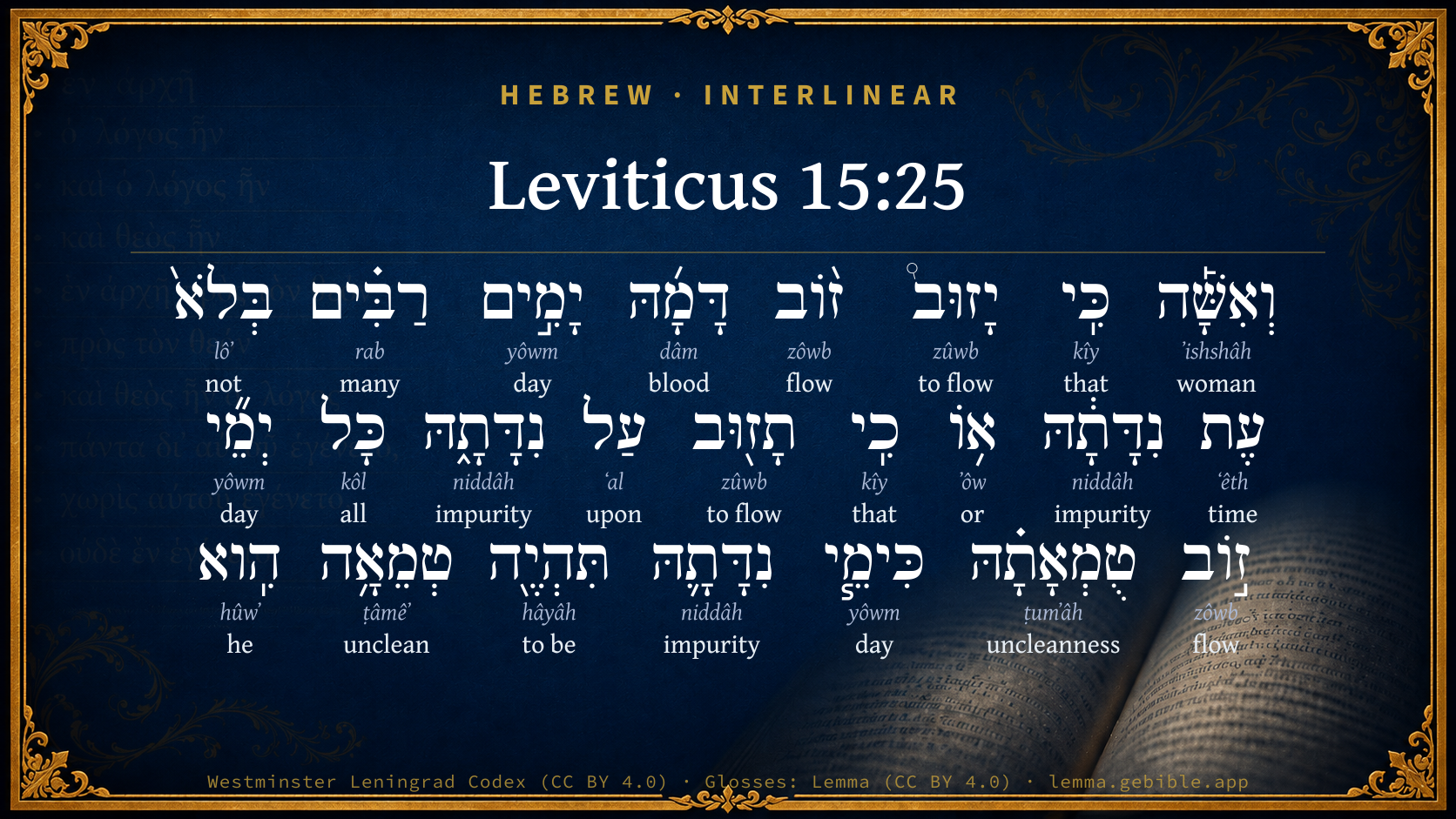
Hebrew (Westminster Leningrad Codex) Leviticus 15:25 appears in the Hebrew Old Testament. The text above is from the Westminster Leningrad Codex. Each word links to its Strong’s number, a concise gloss, and parsing drawn from the Open Scriptures Hebrew Bible morphology. Click any word for its full Brown-Driver-Briggs (BDB) entry.
Download image
Cite this verse

Leviticus 15:25 (World English Bible). Public Domain. Lemma interlinear Bible study tool, https://lemma.gebible.app/v/leviticus/15/25.

Show BibTeX & RIS
BibTeX
RIS
English Translation
"'If a woman has a discharge of her blood many days not in the time of her period, or if she has a discharge beyond the time of her period; all the days of the discharge of her uncleanness shall be as in the days of her period: she is unclean.
World English Bible · Public Domain
Download a study sheet

One document with this verse’s original text, its word-by-word gloss line, the meaning frame, cross-references with their text, attributed commentary, and full source and license credits — printable, and it pastes into notes with its structure intact.

This verse Autodidact and up

Study sheet (.html) Plain text (.txt)

A passage Seminary Student

Up to 50 verses in one chapter. A passage sheet keeps up to 6 commentary sources and 12 cross-references per verse, in the order this page ranks them, and says so on the sheet whenever that leaves anything out. Ask for a single verse and you get the Autodidact verse sheet above.

Everything on this page stays free to read, with no account — the sheet is a download of what is already on screen, not access to it.

Want to remove ads? Support Godless Engineer
Compare translations 3

The same verse in 3 English versions, stacked beneath the original-language interlinear above. Click any original word for its lexicon entry.

Each is an independent rendering of the whole verse — the interlinear is not word-aligned to these translations.

Highlighted words mark where these versions differ — a whole-verse word diff, not a word-by-word alignment.

  • World English Bible Public Domain
    "'If a woman has a discharge of her blood many days not in the time of her period, or if she has a discharge beyond the time of her period; all the days of the discharge of her uncleanness shall be as in the days of her period: she is unclean.
  • King James Version Public Domain
    And if a woman have an issue of her blood many days out of the time of her separation, or if it run beyond the time of her separation; all the days of the issue of her uncleanness shall be as the days of her separation: she shall be unclean.
  • unfoldingWord Literal Text CC BY-SA 4.0
    And a woman, when a flow of her blood flows many days when not the time of her menstruation, or when she flows beyond her menstruation, all the days of the flow of her uncleanness shall be like the days of her menstruation. She unclean.

unfoldingWord Literal Text — © unfoldingWord, licensed CC BY-SA 4.0. Word-aligned USFM3 via Door43 (git.door43.org/unfoldingWord/en_ult).

Versions to compare (up to 4)

3 of 4 selected

Show all 18 translations

Every available English version of this verse, each an independent rendering of the whole verse.

  • World English Bible Public Domain
    "'If a woman has a discharge of her blood many days not in the time of her period, or if she has a discharge beyond the time of her period; all the days of the discharge of her uncleanness shall be as in the days of her period: she is unclean.
  • Berean Standard Bible Public Domain
    When a woman has a discharge of her blood for many days at a time other than her menstrual period, or if it continues beyond her period, she will be unclean all the days of her unclean discharge, just as she is during the days of her menstruation.
  • Majority Standard Bible Public Domain
    When a woman has a discharge of her blood for many days at a time other than her menstrual period, or if it continues beyond her period, she will be unclean all the days of her unclean discharge, just as she is during the days of her menstruation.
  • King James Version Public Domain
    And if a woman have an issue of her blood many days out of the time of her separation, or if it run beyond the time of her separation; all the days of the issue of her uncleanness shall be as the days of her separation: she shall be unclean.
  • American Standard Version (1901) Public Domain
    And if a woman have an issue of her blood many days not in the time of her impurity, or if she have an issue beyond the time of her impurity; all the days of the issue of her uncleanness she shall be as in the days of her impurity: she is unclean.
  • Revised Version (1885) Public Domain
    And if a woman have an issue of her blood many days not in the time of her impurity, or if she have an issue beyond the time of her impurity; all the days of the issue of her uncleanness she shall be as in the days of her impurity: she is unclean.
  • Geneva Bible (1599) Public Domain
    Also when a womans issue of blood runneth long time besides the time of her floures, or when she hath an issue, longer then her floures, all the dayes of the issue of her vncleannesse shee shalbe vncleane, as in the time of her floures.
  • Douay-Rheims (1899) Public Domain
    The woman that hath an issue of blood many days out of her ordinary time, or that ceaseth not to flow after the monthly courses, as long as she is subject to this disease, shall be unclean, in the same manner as if she were in her flowers.
  • Young's Literal Translation Public Domain
    `And when a woman's issue of blood floweth many days within the time of her separation, or when it floweth over her separation -- all the days of the issue of her uncleanness are as the days of her separation; she `is' unclean.
  • Literal Standard Version CC BY-SA 4.0
    And when a woman’s discharge of blood flows many days within the time of her separation, or when it flows over her separation—all the days of the discharge of her uncleanness are as the days of her separation; she [is] unclean.
  • Unlocked Literal Bible CC BY-SA 4.0
    If a woman has a flow of blood for many days that is not in the time of her menstruation, or if she has a flow beyond the time of her menstruation, during all the days of the flow of her uncleanness, she will be as if she were in the days of her period. She is unclean.
  • unfoldingWord Literal Text CC BY-SA 4.0
    And a woman, when a flow of her blood flows many days when not the time of her menstruation, or when she flows beyond her menstruation, all the days of the flow of her uncleanness shall be like the days of her menstruation. She unclean.
  • Darby Bible Public Domain
    And if a woman have her flux of blood many days out of the time of her separation, or if she have the flux beyond the time of her separation, all the days of the flux of her uncleanness shall she be as [in] the days of her separation: she is unclean.
  • World Messianic Bible Public Domain
    “‘If a woman has a discharge of her blood many days not in the time of her period, or if she has a discharge beyond the time of her period, all the days of the discharge of her uncleanness shall be as in the days of her period. She is unclean.
  • Webster's Bible Public Domain
    And if a woman shall have an issue of her blood many days out of the time of her separation, or if it shall run beyond the time of her separation; all the days of the issue of her uncleanness shall be as the days of her separation: she shall be unclean.
  • Free Bible Version CC BY-SA 4.0
    When a woman has a discharge of blood for several days when it's not the time for her period, or if it continues past her period, she will be unclean for the whole time she is bleeding, not just for the days of her period.
  • Bible in Basic English Public Domain
    And if a woman has a flow of blood for a long time, not at the time when she generally has it, or if the flow goes on longer than the normal time, she will be unclean while the flow of blood goes on, as she is at other normal times.
  • JPS Tanakh (1917) Public Domain
    And if a woman have an issue of her blood many days not in the time of her impurity, or if she have an issue beyond the time of her impurity; all the days of the issue of her uncleanness she shall be as in the days of her impurity: she is unclean.

Literal Standard Version (2020), Covenant Press — licensed CC BY-SA 4.0. Text via the HelloAO Bible API (eBible.org). Unlocked Literal Bible (unfoldingWord) — licensed CC BY-SA 4.0. Text via the HelloAO Bible API (eBible.org). unfoldingWord Literal Text — © unfoldingWord, licensed CC BY-SA 4.0. Word-aligned USFM3 via Door43 (git.door43.org/unfoldingWord/en_ult). Free Bible Version, Dr. Jonathan Gallagher — licensed CC BY-SA 4.0. Text via the HelloAO Bible API (eBible.org).

Word by word

More ways to search: Search by grammar → Find every occurrence → Compare this word →

Practice this passage: Drill this verse → Learn its vocabulary →

ז֨וֹב
zôwb
H2101
“flow of”
Noun, Common, Masculine, Singular, Construct
Part of Speech
Noun
Type
Common
Gender
Masculine
Number
Singular
State
Construct
Full BDB Definition

Origin: from H2100

TWOT: 534a

a flow, issue, discharge, flux - semen, discharge (venereal disease) (of men) - issue, flux (of woman)
  1. וְאִשָּׁ֡ה ʼishshâh H802 “and · woman” Conjunction + Noun, Common, Feminine, Singular, Absolute
  2. כִּֽי kîy H3588 “that” Conjunction
  3. יָזוּב֩ zûwb H2100 “to flow” Verb, Qal, Imperfect, 3rd Person, Masculine, Singular
  4. דָּמָ֜הּ dâm H1818 “blood · her” Noun, Common, Masculine, Singular, Construct + Suffix, Personal, 3rd Person, Feminine, Singular
  5. יָמִ֣ים yôwm H3117 “days” Noun, Common, Masculine, Plural, Absolute
  6. רַבִּ֗ים rab H7227 “many” Adjective, Adjective, Masculine, Plural, Absolute
  7. בְּלֹא֙ lôʼ H3808 “in/at · not” Preposition + Particle, Negative
  8. עֶת ʻêth H6256 “time of” Noun, Common, Both, Singular, Construct
  9. נִדָּתָ֔הּ niddâh H5079 “impurity · her” Noun, Common, Feminine, Singular, Construct + Suffix, Personal, 3rd Person, Feminine, Singular
  10. א֥וֹ ʼôw H176 “or” Conjunction
  11. כִֽי kîy H3588 “that” Conjunction
  12. תָז֖וּב zûwb H2100 “to flow” Verb, Qal, Imperfect, 3rd Person, Feminine, Singular
  13. עַל ʻal H5921 “upon” Preposition
  14. נִדָּתָ֑הּ niddâh H5079 “impurity · her” Noun, Common, Feminine, Singular, Construct + Suffix, Personal, 3rd Person, Feminine, Singular
  15. כָּל kôl H3605 “all of” Noun, Common, Masculine, Singular, Construct
  16. יְמֵ֞י yôwm H3117 “days of” Noun, Common, Masculine, Plural, Construct
  17. ז֣וֹב zôwb H2101 “flow of” Noun, Common, Masculine, Singular, Construct
  18. טֻמְאָתָ֗הּ ṭumʼâh H2932 “uncleanness · her” Noun, Common, Feminine, Singular, Construct + Suffix, Personal, 3rd Person, Feminine, Singular
  19. כִּימֵ֧י yôwm H3117 “like/as · days of” Preposition + Noun, Common, Masculine, Plural, Construct
  20. נִדָּתָ֛הּ niddâh H5079 “impurity · her” Noun, Common, Feminine, Singular, Construct + Suffix, Personal, 3rd Person, Feminine, Singular
  21. תִּהְיֶ֖ה hâyâh H1961 “to be” Verb, Qal, Imperfect, 3rd Person, Feminine, Singular
  22. טְמֵאָ֥ה ṭâmêʼ H2931 “unclean” Adjective, Adjective, Feminine, Singular, Absolute
  23. הִֽוא hûwʼ H1931 “he” Pronoun, Personal, 3rd Person, Feminine, Singular

About this verse

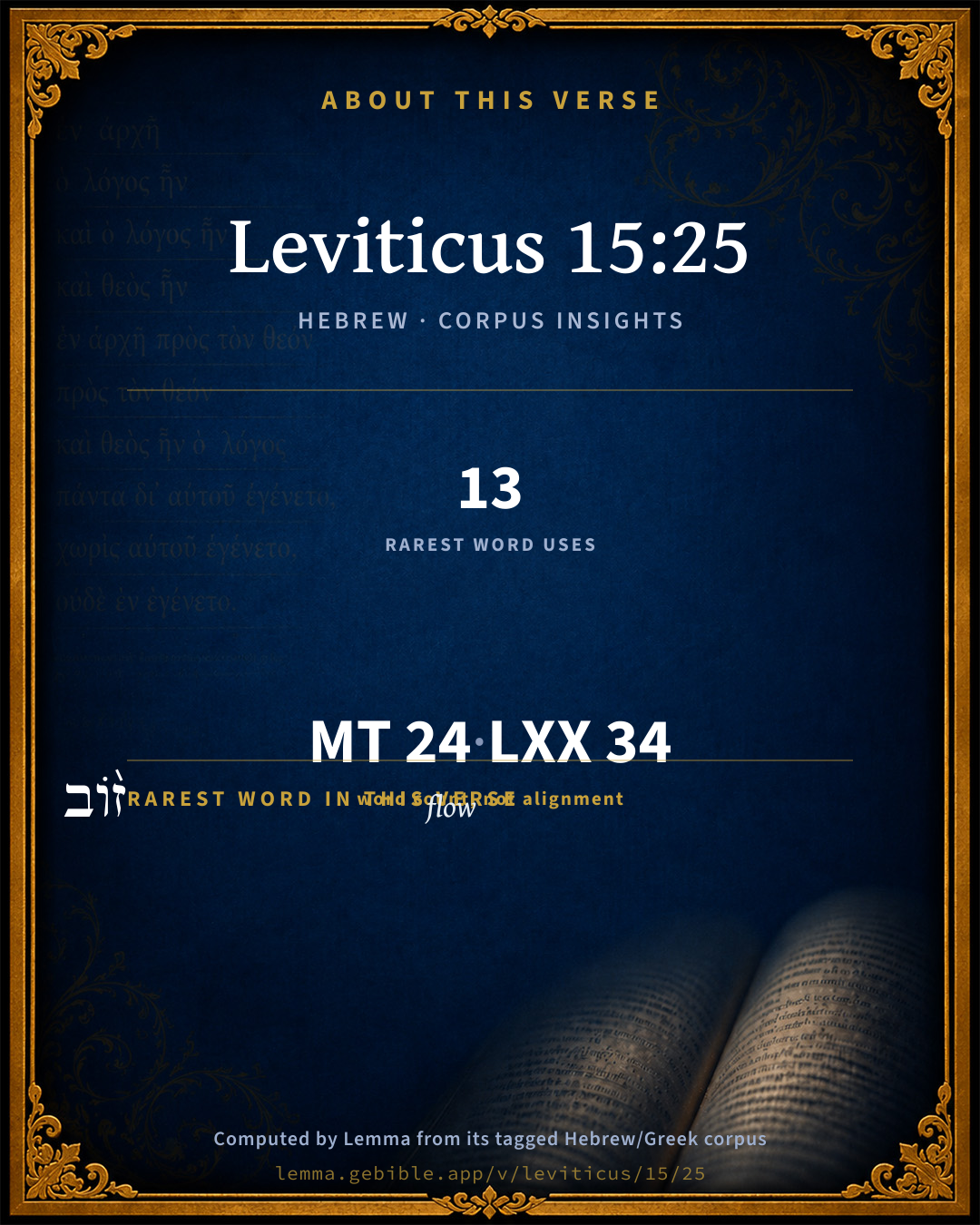
These counts appear in no published source. They are computed here, from the morphology-tagged text and Lemma’s own curated glosses. What Lemma adds →

24
words
17
distinct lemmas
Pentateuch
section

Notable vocabulary

The rarest word here is ז֨וֹב flow H2101 — appearing just 13 times in the whole Hebrew Bible.

Shared distinctive vocabulary

ז֨וֹב flow H2101 occurs in 10 verses of the Hebrew Bible. Also found in:

Grammatical profile

  • 3 verbs
  • 13 nouns
  • 2 adjectives
  • 1 pronoun
  • 1 preposition
  • 3 conjunctions
  • 1 particle

Verb forms

  • יָזוּב֩ Qal · Imperfect
  • תָז֖וּב Qal · Imperfect
  • תִּהְיֶ֖ה Qal · Imperfect

Repetition

Words recur within this verse — often emphatic in Hebrew:

  • יָמִ֣ים day H3117 ×3
  • נִדָּתָ֔הּ impurity H5079 ×3
  • יָזוּב֩ to flow H2100 ×2
  • ז֨וֹב flow H2101 ×2
  • כִּֽי that H3588 ×2

Hebrew & Septuagint length

In English translation the verse runs 51 words from the Hebrew and 48 from the Septuagint (LXX English) — closely comparable.

A rough comparison of the two English renderings, which tokenize alike — not a word-level alignment.

Word counts can differ between the Hebrew and the Greek without any difference in meaning — e.g. the Hebrew direct-object marker אֵת has no separate Greek word, and Greek often adds the article ὁ.

In the original languages it is 24 Hebrew tokens and 34 Greek tokens — but the two are counted differently (Hebrew bundles its prefixes and suffixes into one token; the Greek is in lemma form), so that isn’t a like-for-like length.

Cross-references

5

Topical passages linked to Leviticus 15:25 in the Treasury of Scripture Knowledge — connected by theme and wording, ordered by reader-vote popularity; previews shown in the World English Bible.

  • Matthew 9:20 Behold, a woman who had an issue of blood for twelve years came behind him, and touched the tassels of his garment;
  • Mark 5:25 A certain woman, who had an issue of blood for twelve years,
  • Luke 8:43 A woman who had a flow of blood for twelve years, who had spent all her living on physicians, and could not be healed by any,
  • Leviticus 15:19–24 "'If a woman has a discharge, and her discharge in her flesh is blood, she shall be in her impurity seven days: and whoever touches her shall be unclean until the evening.
  • Mark 7:20–23 He said, "That which proceeds out of the man, that defiles the man.

Cross-references courtesy of OpenBible.info (CC BY 4.0).

Hebrew and Greek witnesses Masoretic Hebrew ↔ Greek Septuagint

The same verse in the two great witnesses to the Old Testament, shown verse-for-verse.

These are two independent witnesses, not word-aligned to each other, and the Septuagint is shown in lemma (dictionary) form.

Hebrew Leviticus 15:25 Masoretic · Westminster Leningrad Codex

וְאִשָּׁ֡ה כִּֽי יָזוּב֩ ז֨וֹב דָּמָ֜הּ יָמִ֣ים רַבִּ֗ים בְּלֹא֙ עֶת נִדָּתָ֔הּ א֥וֹ כִֽי תָז֖וּב עַל נִדָּתָ֑הּ כָּל יְמֵ֞י ז֣וֹב טֻמְאָתָ֗הּ כִּימֵ֧י נִדָּתָ֛הּ תִּהְיֶ֖ה טְמֵאָ֥ה הִֽוא

"'If a woman has a discharge of her blood many days not in the time of her period, or if she has a discharge beyond the time of her period; all the days of the discharge of her uncleanness shall be as in the days of her period: she is unclean.

World English Bible · Public Domain

Greek LXX Leviticus 15:25 Septuagint · lemma form

καί γυνή ἐάν ῥέω ῥύσις αἷμα ἡμέρα πολύς οὐ ἐν καιρός ὁ ἄφεδρος αὐτός ἐάν καί ῥέω μετά ὁ ἄφεδρος αὐτός πᾶς ὁ ἡμέρα ῥύσις ἀκαθαρσία αὐτός καθάπερ ὁ ἡμέρα ὁ ἄφεδρος ἀκάθαρτος εἰμί

And if a woman have an issue of blood many days, not in the time of her separation; if the blood should also flow after her separation, all the days of the issue of her uncleanness shall be as the days of her separation: she shall be unclean.

LXX2012 (modern English Septuagint) · Public Domain

Hebrew: Westminster Leningrad Codex (CC BY 4.0). Greek: Septuagint (public domain); English from LXX2012 (modern English Septuagint) (Public Domain). How the Septuagint differs from the Hebrew →

Targum (Aramaic paraphrase)

2

The Targum is the ancient Jewish Aramaic paraphrase of the Hebrew Scriptures — an interpretive translation, not the Hebrew text itself. Onkelos (literal) and Pseudo-Jonathan (expansive) render the Torah, and Jonathan the Prophets. Coverage is partial: where no permissively-licensed English translation exists for a verse, only the Aramaic is shown. This is verse-level text, not a word-by-word alignment to the Hebrew.

  1. Targum Onkelos Torah (Genesis–Deuteronomy)
    וְאִתְּתָא אֲרֵי יְדוּב דוֹב דְמָהּ יוֹמִין סַגִיאִין בְּלָא עִדַן רִחוּקָהּ אוֹ אֲרֵי תְדוּב עַל רִחוּקָהּ כָּל יוֹמֵי דוֹב סוֹבְתָהּ כְּיוֹמֵי רִחוּקָהּ תְּהֵי מְסָאֳבָא הִיא

    (no public-domain English translation for this verse)

    Targum Onkelos — Aramaic: “Onkelos Genesis” (public domain); “Onkelos Exodus” (public domain); “Onkelos Leviticus” (public domain); “Onkelos Numbers” (public domain); “Onkelos Deuteronomy” (public domain). English: “Sefaria Community Translation” (CC0 1.0 (public-domain dedication)); “J.W. Etheridge. The Targums of Onkelos and Jonathan Ben Uzziel on the Pentateuch. London: Longmans, Green, 1862” (public domain). Text via Sefaria.

  2. Targum Pseudo-Jonathan Torah (Genesis–Deuteronomy)
    וְאִינְתְּתָא אֲרוּם יִדוֹב דוֹב אַדְמָא יוֹמִין תְּלָתָא בְּלָא אֲשׁוּנֵי רִיחוּקָהּ אוֹ אֲרוּם מִידוֹב בָּתַר יוֹמֵי רִיחוּקָהּ כָּל יוֹמֵי דוֹב סְאוֹבְתָּא תְּהֵי מְסָאָבָא לְדִמְשַׁמֵשׁ עִמָהּ מְטוֹל דִמְסָאָבָא הִיא

    But a woman who hath a defluxion of blood three days beyond the time of her separation, or when it floweth after the days of her separation, all the days of the uncleanness of her defluxion shall she be unclean; he who lieth with her shall be unclean.

    Targum Pseudo-Jonathan — Aramaic: “Targum Jonathan on Genesis” (public domain); “Targum Jonathan on Exodus” (public domain); “Targum Jonathan on Leviticus” (public domain); “Targum Jonathan on Numbers” (public domain); “Targum Jonathan on Deuteronomy” (public domain). English: “The Targum of Jonathan ben Uzziel, trans. J. W. Etheridge, London, 1862” (public domain). Text via Sefaria.

Commentary

Notes on Leviticus 15:25 from classic Christian and Jewish commentators (each source and its license shown beneath its notes). The classic Christian expositions comment on the surrounding passage and are grouped to its opening verse, so a note may address several verses; the Jewish commentaries on the Tanakh (Rashi and others) are per-verse, so they appear only where the commentator wrote on this verse.

Lemma curates 59 commentaries, every one of them public domain or Creative Commons licensed, each selected and text-cleaned for this edition rather than reprinted as found. About our sources →

Trapp's Complete Commentary

John Trapp

Lev 15:25 And if a woman have an issue of her blood many days out of the time of her separation, or if it run beyond the time of her separation; all the days of the issue of her uncleanness shall be as the days of her separation: she [shall be] unclean.

Ver. 25. Have an issue.] As she had in Mar 5:25.

John Trapp, A Commentary or Exposition upon All the Books of the Old and New Testament (1647–1656) — public domain. Text from a community e-Sword module.

Tyndale Open Study Notes

Tyndale Open Resources

15:25-29 Normal menstruation required no offering from the woman (15:19-24). A discharge of blood that exceeded seven days required a cleansing ceremony similar to that for the man cleansed of a bodily discharge (15:13-15; see also Matt 9:20-22).

Tyndale Open Study Notes — © Tyndale Open Resources, licensed CC BY-SA 4.0. Text via the HelloAO Bible API.

Geneva Bible (1599)

Geneva Bible translators

Hebrew, separation.

Geneva Bible (1599) marginal notes — public domain. Text via Bolls.life.

Ellicott's Commentary for English Readers

(25) Have an issue . . . many days.—The last case is that of a chronic issue, arising from a derangement in the constitution. This is the kind of complaint from which the woman suffered who came to Christ (Mat_9:20; Luk_8:44). As long as she suffered from it, which lasted sometimes for many years, she defiled and was defiling in the same way as in her menses.

A Bible Commentary for English Readers, edited by Charles John Ellicott (1878–1897) — public domain. Text from a community e-Sword module.

The Cambridge Bible for Schools and Colleges

gen. ed. J. J. S. Perowne

25–30. If the issue be abnormal, it is of the nature of a disease, and is treated in the same manner as the first case (Lev_15:2-15). The woman in the Gospel (Mat_9:20; Mar_5:25; Luk_8:43) was thus afflicted.

The Cambridge Bible for Schools and Colleges (gen. ed. J. J. S. Perowne; Cambridge University Press, 1878–1918) — public domain. Text from a community e-Sword module.

John Gill's Exposition

Every bed whereon she lieth all the days of her issue shall be unto her as the bed of her separation,.... As defiled and as defiling as that, Lev 15:20,

and whatsoever she sitteth upon shall be unclean, as the uncleanness of her separation; as such were when she was in that condition, see Lev 15:20.

John Gill's Exposition of the Whole Bible (1746–1763) — public domain (CC PDM 1.0). Text via the HelloAO Bible API.

Haydock's Catholic Bible Commentary

Blood, hæmorrhoids. (Menochius) --- Flowers. Hebrew, "all the days of the issue of her uncleanness shall be as the days of her separation. She shall be unclean."

George Leo Haydock (1774–1849), Haydock's Catholic Family Bible and Commentary, 1859 edition — public domain. Excludes Psalms (Douay-Rheims chapter numbering differs from Protestant) and Deuterocanonical books (Catholic canon only).

Matthew Poole's English Annotations

The time of her separation, to wit, the seven days mentioned Lev 12:2, as suppose she had the emerods, &c.

Matthew Poole's English Annotations on the Holy Bible (1683–1685) — public domain. Text from a community e-Sword/MySword module.

Whedon's Commentary on the Bible

Daniel D. Whedon

25. Issue of blood many days — For the miraculous healing of the bloody flux see Mar_5:25-34, notes. Scarcely second to the physical discomfort of this ailment was the burdensomeness of the ceremonial defilement, secluding the person from society, and putting her nurses and physicians in peril of the same defilement.

Daniel D. Whedon (gen. ed.), Commentary on the Old and New Testaments (1874–1909) — public domain. Text from a community e-Sword module.

The Pulpit Commentary

Vers. 25-30. The fifth case of an issue that of excessive menstruation, or menstruation occurring at the wrong time. This was probably the disease of the woman "who had an issue of blood". (Mat_9:20 Mar_5:25 Luk_8:43)

Ver. 25. The figure of the "woman which was diseased with an issue of blood twelve years

seems to rise up before us as we read, this verse. Jesus was going on an errand of mercy to heal the daughter of Jairus, and as he went the people thronged him. "And a certain woman, which had an issue of blood twelve years, and had suffered many things of many physicians, and had spent all that she had, and was nothing bettered, but rather grew worse, when she had heard of Jesus, came in the press behind, and touched his garment". (Mar_5:25-27)

I THE WOMAN"S STATE OF CEREMONIAL UNCLEANNESS. For twelve years she had not been allowed within the precincts of the temple, and had been unable, therefore, to take part in the public worship of God as appointed in the books of Moses. And during the whole of the same long period she had been in a state of separation from all about her: whoever touched her became unclean; the bed she lay upon was unclean; the seats that she sat upon were unclean; whoever touched the bed that she lay upon or the seat that she sat upon was unclean. No wonder if for this reason alone "she had spent nil her living upon physicians". (Luk_8:43)

II HER STATE OF PHYSICAL SUFFERING. She was afflicted with an exhausting disease, wasting her vital powers, and she suffered not only from that cause, but also from the vain attempts made by many physicians to relieve her, as well as from the anxiety of mind inseparable from her state of ceremonial impurity.

III WHAT SHE SOUGHT. Not to be cleansed as by a priest this could not be until she had been cured bat to be healed as by a physician. "For she said, If I may touch but his clothes, I shall be whole". (Mar_5:28) The Great Physician accepts her, and fulfils her desire; for however imperfect her faith might be, and. however uninstructed she might herself be, yet there was faith in her sufficient "to make her whole". (Mat_9:22)

IV HOW THE HEALING WAS WROUGHT. The cure was effected by the power of Christ conveyed through the touch of his garment, on the condition of the woman"s faith. In each of the miracles he uses such means as he thinks fit, and often different means, probably with the purpose in each case of awaking the spirit of the person to be healed so as to become capable of receiving the spiritual gift. As in the case of the lepers on whom he laid his hand, instead of becoming himself unclean, he becomes the channel of renewed life and health to those whom he touches.

V THE CEREMONIAL CLEANSING STILL TO BE EFFECTED. As the leper, after he had been healed by our Lord, had to "go and show himself to the priest, and offer the gift that Moses commanded", (Mat_8:4) so no doubt the woman cured of the issue of blood had to fulfill the legal requirement for her cleansing, by offering her sin offering and her burnt offering on the eighth day after her healing.

VI SPIRITUAL APPLICATION OF THE MIRACLE. Sin can only be healed by the power of God through Christ brought into spiritual contact with the soul of the sinner, and there must be something of faith and love in the heart of the sinner, however imperfect its manifestation may be, in order that that spiritual contact between God"s Spirit and his spirit may take place,

The Pulpit Commentary (1880–1919), ed. H.D.M. Spence-Jones & Joseph S. Exell — public domain. Text from a community e-Sword module.

Keil & Delitzsch

C. F. Keil & F. Delitzsch

Diseased issue from a woman. - If an issue of blood in a woman flowed many days away from (not in) the time of her monthly uncleanness, or if it flowed beyond her monthly uncleanness, she was to be unclean as long as her unclean issue continued, just as in the days of her monthly uncleanness, and she defiled her couch as well as everything upon which she sat, as in the other case, also every one who touched either her or these things.

Keil & Delitzsch — Biblical Commentary on the Old Testament (1861–1891) — public domain (CC PDM 1.0). Text via the HelloAO Bible API. (Old Testament only.)

unfoldingWord translationNotes

Door43 World Missions Community

she will be as if she were in the days of her period

This means that if the woman bleeds from her womb at any time other than her regular menstruation time, she is still unclean just like during her menstruation.

She is unclean ... Whoever touches ... will be unclean

People whom other people may not touch are spoken of as if they were physically unclean. (See: Metaphor)

everything on which she sits will be unclean

Objects that other people must not touch are spoken of as if they were physically unclean. (See: Metaphor)

translationWords

blood

unfoldingWord translationNotes — © Distant Shores Media and the Door43 World Missions Community, licensed CC BY-SA 4.0. Source: git.door43.org/Door43/en_tn.

Rashi

Rabbi Shlomo Yitzchaki (Rashi)

‎ימים רבים [AND IF A WOMAN HAVE AN ISSUE OF HER BLOOD] MANY DAYS — at least three days (since the plural ימים suggests at least two days, the word רבים, “more", must imply at least three days) (cf. Sifra, Metzora Parashat Zavim, Section 5 9),

בלא עת נדתה OUT OF THE TIME OF HER SEPARATION — i. e. at least three days immediately after the seven normal days of her separation have expired.

או כי תזוב OR IF SHE HAS A FLOW during these (the above mentioned) three days,

על נדתה BEYOND THE TIME OF HER SEPARATION — i. e. being remote (distant) from her time of separation by one intervening day — this woman (such a woman) is, in both cases, termed a זבה and the law regarding her is decreed in this section that follows; and it is not like the law of a נדה, because she (the former) requires the counting of seven clean days (i. e. her uncleanness does not end until she has counted שבעה נקיים, seven consecutive days that are clean of any flux; cf. v. 28) and a sacrifice on the following day (cf. v. 29); whilst the נדה does not require the counting of the clean days (i. e. התורה ‎מן nor does she require a sacrifice) but she remains seven days in her separation and no longer irrespective as to whether she has or has not seen a show of blood (i. e. even if there is a flow on the seventh day and it then ceases she is still clean on the eighth day after having immersed herself). And they (our Rabbis) in expounding this section in the Sifra explain. There are eleven days intervening between the end of one,נדה-period and the beginning of the next נדה-period, so that if she sees blood on three immersed herself. And they (our Rabbis) in expounding this section (Sifra, Metzora Parashat Zavim, Chapter 8 2-3) derived the Halacha of the eleven days that intervene between the expiration of one נדה period and the commencement of another ‎נדה period — i. e. that as a result of any three consecutive days that she sees blood within these eleven days she shall be (come under the law of) a זבה and not a נדה.

Rashi on the Tanakh — English translations: “The Judaica Press complete Tanach with Rashi, translated by A. J. Rosenberg” (CC BY 4.0); “Pentateuch with Rashi's commentary by M. Rosenbaum and A.M. Silbermann, 1929-1934” (public domain); “The Metsudah Tanach series, Lakewood, N.J” (CC BY 4.0); and “The Book of Joshua, Metsudah Publications, 1997” (CC BY 4.0). Text via Sefaria.

Lesson kit

Teaching starters — assembled from the data on this page, not authored interpretation. Every prompt links to the verse data it draws on. Edit before teaching.

Leviticus, in the Pentateuch, opens this verse with 24 words (17 distinct Hebrew lemmas). Its most distinctive word is zôwb (“flow”). A historical commentator’s framing appears above. Read the whole chapter for the surrounding context.

Discussion questions

  1. How does “flow” (zôwb) shape what this verse is saying?
  2. How does Leviticus 15:2, which shares the word «flow», read alongside this verse?
  3. What does the repetition of “day” (3× in this one verse) do in this verse?
  4. The translations on this page render this verse differently — a whole-verse word diff, not a word-by-word alignment. What might account for the different wordings?
  5. «יָזוּב֩» is a Qal Imperfect verb. How does that grammatical form shape the action described?
  6. Compare how Trapp's Complete Commentary and Tyndale Open Study Notes read this verse. Where do they agree or differ?

Things to notice

Reading settings

Reading text

Shown beneath each verse's original-language words.

Old Testament
Old Testament edition

Read the OT as the Masoretic Hebrew (MT) or the Greek Septuagint (LXX).

English shown for the Greek Septuagint (in the Hebrew ↔ Greek comparison).

Comparing translations? Open the Compare panel on any verse page to stack up to four side by side.