2 Kings 25:10

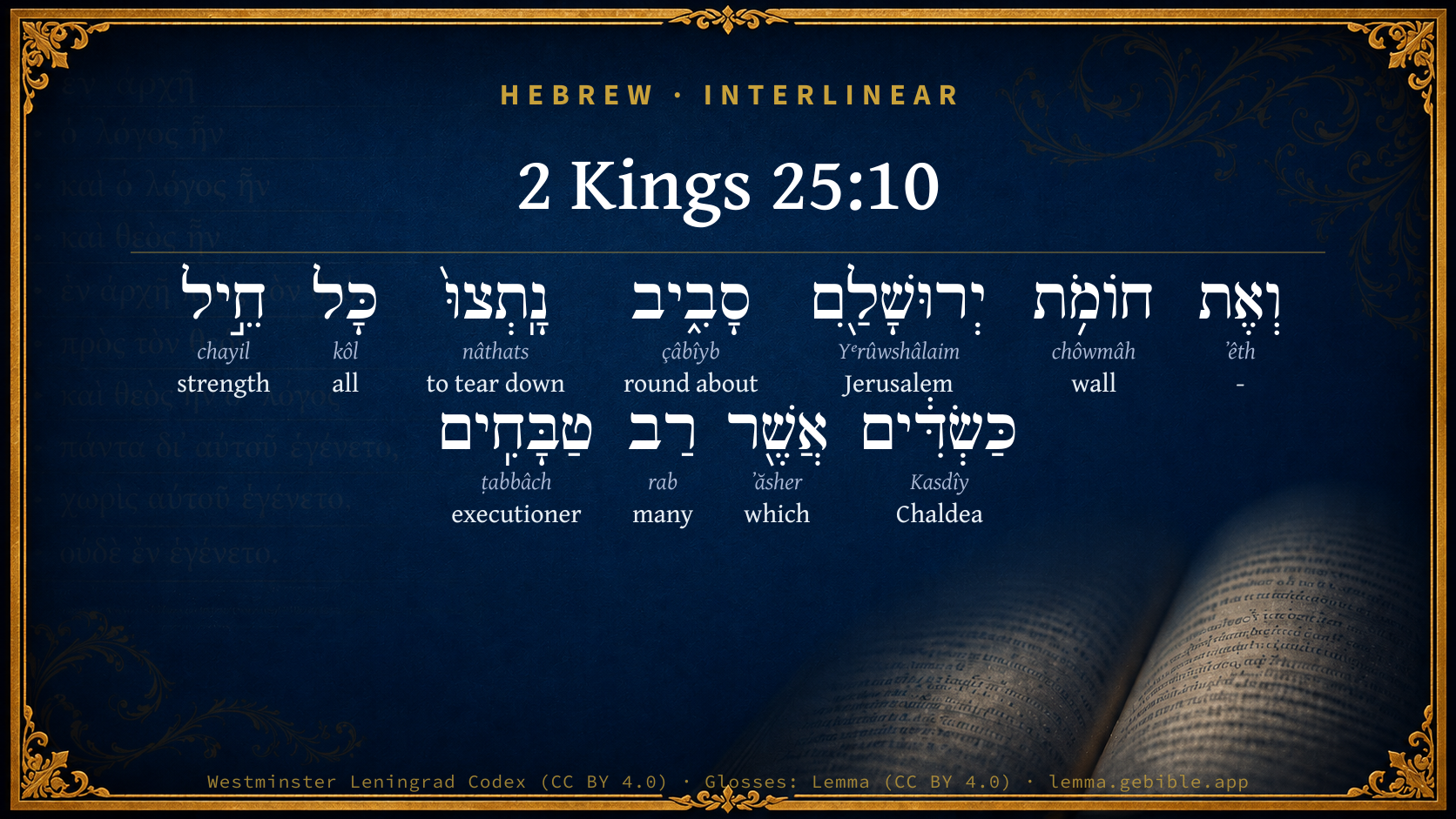
Hebrew (Westminster Leningrad Codex) 2 Kings 25:10 appears in the Hebrew Old Testament. The text above is from the Westminster Leningrad Codex. Each word links to its Strong’s number, a concise gloss, and parsing drawn from the Open Scriptures Hebrew Bible morphology. Click any word for its full Brown-Driver-Briggs (BDB) entry.
Download image
Cite this verse

2 Kings 25:10 (World English Bible). Public Domain. Lemma interlinear Bible study tool, https://lemma.gebible.app/v/2-kings/25/10.

Show BibTeX & RIS
BibTeX
RIS
English Translation
All the army of the Chaldeans, who were [with] the captain of the guard, broke down the walls of Jerusalem round about.
World English Bible · Public Domain
Download a study sheet

One document with this verse’s original text, its word-by-word gloss line, the meaning frame, cross-references with their text, attributed commentary, and full source and license credits — printable, and it pastes into notes with its structure intact.

This verse Autodidact and up

Study sheet (.html) Plain text (.txt)

A passage Seminary Student

Up to 50 verses in one chapter. A passage sheet keeps up to 6 commentary sources and 12 cross-references per verse, in the order this page ranks them, and says so on the sheet whenever that leaves anything out. Ask for a single verse and you get the Autodidact verse sheet above.

Everything on this page stays free to read, with no account — the sheet is a download of what is already on screen, not access to it.

Want to remove ads? Support Godless Engineer
Compare translations 3

The same verse in 3 English versions, stacked beneath the original-language interlinear above. Click any original word for its lexicon entry.

Each is an independent rendering of the whole verse — the interlinear is not word-aligned to these translations.

Highlighted words mark where these versions differ — a whole-verse word diff, not a word-by-word alignment.

  • World English Bible Public Domain
    All the army of the Chaldeans, who were [with] the captain of the guard, broke down the walls of Jerusalem round about.
  • King James Version Public Domain
    And all the army of the Chaldees, that were with the captain of the guard, brake down the walls of Jerusalem round about.
  • unfoldingWord Literal Text CC BY-SA 4.0
    And all of the army of the Chaldeans who the chief of the guards tore down the walls of Jerusalem all around.

unfoldingWord Literal Text — © unfoldingWord, licensed CC BY-SA 4.0. Word-aligned USFM3 via Door43 (git.door43.org/unfoldingWord/en_ult).

Versions to compare (up to 4)

3 of 4 selected

Show all 18 translations

Every available English version of this verse, each an independent rendering of the whole verse.

  • World English Bible Public Domain
    All the army of the Chaldeans, who were [with] the captain of the guard, broke down the walls of Jerusalem round about.
  • Berean Standard Bible Public Domain
    And the whole army of the Chaldeans under the captain of the guard broke down the walls around Jerusalem.
  • Majority Standard Bible Public Domain
    And the whole army of the Chaldeans under the captain of the guard broke down the walls around Jerusalem.
  • King James Version Public Domain
    And all the army of the Chaldees, that were with the captain of the guard, brake down the walls of Jerusalem round about.
  • American Standard Version (1901) Public Domain
    And all the army of the Chaldeans, that were `with' the captain of the guard, brake down the walls of Jerusalem round about.
  • Revised Version (1885) Public Domain
    And all the army of the Chaldeans, that were with the captain of the guard, brake down the walls of Jerusalem round about.
  • Geneva Bible (1599) Public Domain
    And all the armie of the Caldees that were with the chiefe stewarde, brake downe the walles of Ierusalem round about.
  • Douay-Rheims (1899) Public Domain
    And all the army of the Chaldees, which was with the commander of the troops, broke down the walls of Jerusalem round about.
  • Young's Literal Translation Public Domain
    and the walls of Jerusalem round about have all the forces of the Chaldeans, who `are' with the chief of the executioners, broken down.
  • Literal Standard Version CC BY-SA 4.0
    and all the forces of the Chaldeans, who [are] with the chief of the executioners, have broken down the walls of Jerusalem all around.
  • Unlocked Literal Bible CC BY-SA 4.0
    As for all the walls around Jerusalem, all the army of the Babylonians who were under the commander of the bodyguard destroyed them.
  • unfoldingWord Literal Text CC BY-SA 4.0
    And all of the army of the Chaldeans who the chief of the guards tore down the walls of Jerusalem all around.
  • Darby Bible Public Domain
    And all the army of the Chaldeans that were with the captain of the body-guard broke down the walls of Jerusalem round about.
  • World Messianic Bible Public Domain
    All the army of the Kasdim, who were with the captain of the guard, broke down the walls around Jerusalem.
  • Webster's Bible Public Domain
    And all the army of the Chaldees, that were with the captain of the guard, broke down the walls of Jerusalem on all sides.
  • Free Bible Version CC BY-SA 4.0
    The whole Babylonian army under the commander of the guard knocked down the walls around Jerusalem.
  • Bible in Basic English Public Domain
    And the walls round Jerusalem were broken down by the Chaldaean army which was with the captain.
  • JPS Tanakh (1917) Public Domain
    And all the army of the Chaldeans, that were with the captain of the guard, broke down the walls of Jerusalem round about.

Literal Standard Version (2020), Covenant Press — licensed CC BY-SA 4.0. Text via the HelloAO Bible API (eBible.org). Unlocked Literal Bible (unfoldingWord) — licensed CC BY-SA 4.0. Text via the HelloAO Bible API (eBible.org). unfoldingWord Literal Text — © unfoldingWord, licensed CC BY-SA 4.0. Word-aligned USFM3 via Door43 (git.door43.org/unfoldingWord/en_ult). Free Bible Version, Dr. Jonathan Gallagher — licensed CC BY-SA 4.0. Text via the HelloAO Bible API (eBible.org).

Word by word

More ways to search: Search by grammar → Find every occurrence → Compare this word →

Practice this passage: Drill this verse → Learn its vocabulary →

About this verse

These counts appear in no published source. They are computed here, from the morphology-tagged text and Lemma’s own curated glosses. What Lemma adds →

11
words
11
distinct lemmas
Historical
section

Shared distinctive vocabulary

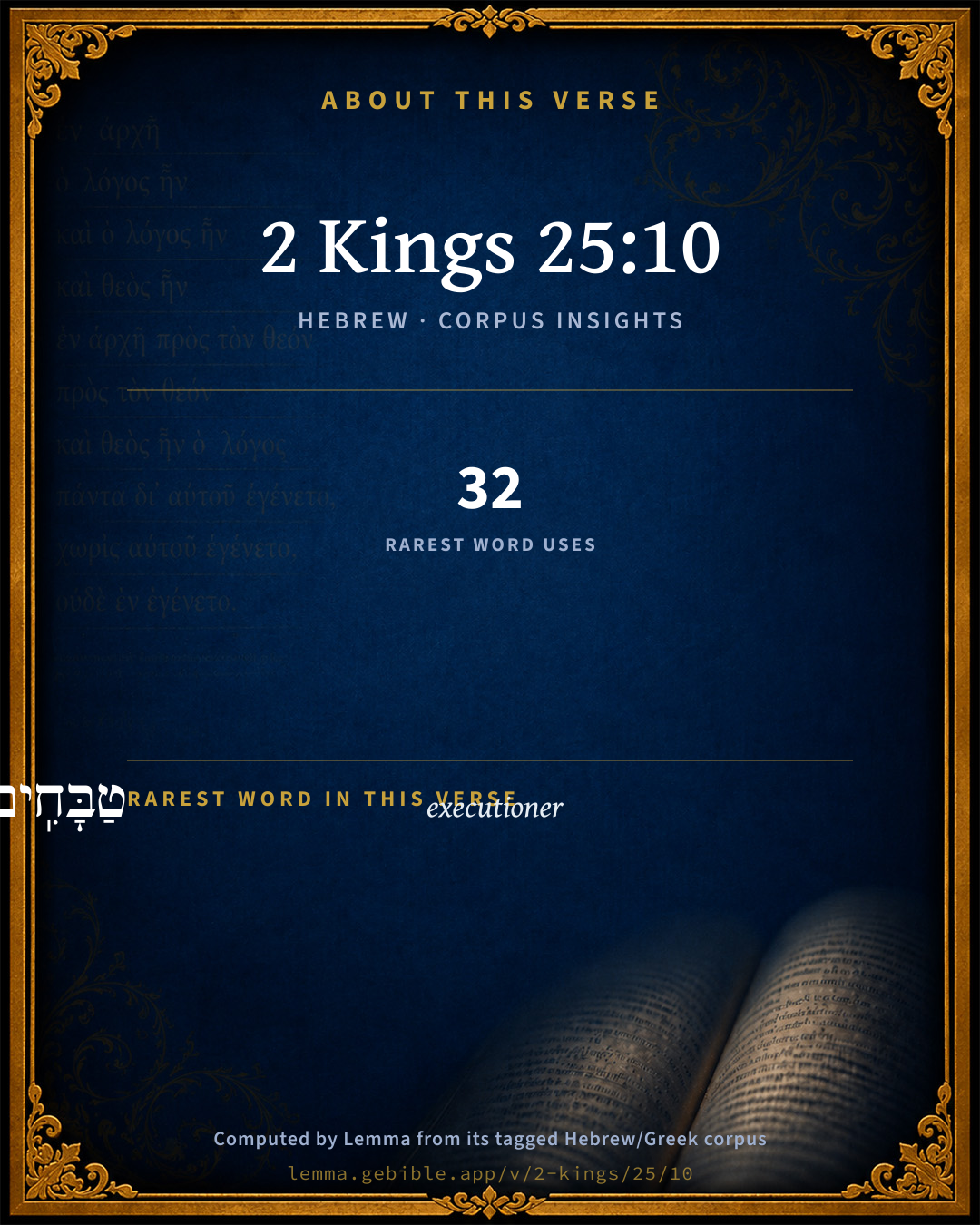
טַבָּחִֽים executioner H2876 occurs in 32 verses of the Hebrew Bible. Also found in:

Grammatical profile

  • 1 verb
  • 8 nouns
  • 2 particles

Verb forms

  • נָֽתְצוּ֙ Qal · Perfect

Hebrew & Septuagint length

In English translation the verse runs 22 words from the Hebrew and 14 from the Septuagint (LXX English) — the Septuagint runs noticeably shorter here. See the side-by-side →

A rough comparison of the two English renderings, which tokenize alike — not a word-level alignment.

Word counts can differ between the Hebrew and the Greek without any difference in meaning — e.g. the Hebrew direct-object marker אֵת has no separate Greek word, and Greek often adds the article ὁ.

Cross-references

4

Topical passages linked to 2 Kings 25:10 in the Treasury of Scripture Knowledge — connected by theme and wording, ordered by reader-vote popularity; previews shown in the World English Bible.

  • Nehemiah 1:3 They said to me, The remnant who are left of the captivity there in the province are in great affliction and reproach: the wall of Jerusalem also is broken down, and the gates of it are burned with fire.
  • Jeremiah 5:10 Go up on her walls, and destroy; but don't make a full end: take away her branches; for they are not Yahweh's.
  • Jeremiah 39:8 The Chaldeans burned the king's house, and the houses of the people, with fire, and broke down the walls of Jerusalem.
  • Jeremiah 52:14–23 All the army of the Chaldeans, who were with the captain of the guard, broke down all the walls of Jerusalem round about.

Cross-references courtesy of OpenBible.info (CC BY 4.0).

Hebrew and Greek witnesses Masoretic Hebrew ↔ Greek Septuagint

The same verse in the two great witnesses to the Old Testament, shown verse-for-verse.

Here the Septuagint runs noticeably shorter than the Hebrew — LXX2012 (modern English Septuagint) 14 words vs World English Bible 22. A rough length comparison of the two English translations, not a word-level alignment — read both below.

These are two independent witnesses, not word-aligned to each other, and the Septuagint is shown in lemma (dictionary) form.

Hebrew 2 Kings 25:10 Masoretic · Westminster Leningrad Codex

וְאֶת חוֹמֹ֥ת יְרוּשָׁלִַ֖ם סָבִ֑יב נָֽתְצוּ֙ כָּל חֵ֣יל כַּשְׂדִּ֔ים אֲשֶׁ֖ר רַב טַבָּחִֽים

All the army of the Chaldeans, who were [with] the captain of the guard, broke down the walls of Jerusalem round about.

World English Bible · Public Domain

Greek LXX 2 Kings 25:10 Septuagint · lemma form

ὁ ἀρχιμάγειρος

And the force of the Chaldeans pulled down the wall of Jerusalem round about.

LXX2012 (modern English Septuagint) · Public Domain

Hebrew: Westminster Leningrad Codex (CC BY 4.0). Greek: Septuagint (public domain); English from LXX2012 (modern English Septuagint) (Public Domain). How the Septuagint differs from the Hebrew →

Targum (Aramaic paraphrase)

1

The Targum is the ancient Jewish Aramaic paraphrase of the Hebrew Scriptures — an interpretive translation, not the Hebrew text itself. Onkelos (literal) and Pseudo-Jonathan (expansive) render the Torah, and Jonathan the Prophets. Coverage is partial: where no permissively-licensed English translation exists for a verse, only the Aramaic is shown. This is verse-level text, not a word-by-word alignment to the Hebrew.

  1. Targum Jonathan Prophets (Joshua–Malachi)
    וְיַת שׁוּרֵי יְרוּשְׁלֵם סְחוֹר סְחוֹר תְּרָעוּ כָּל מַשִׁרְיַת כַּסְדָאֵי דְעִם רַב קָטוֹלַיָא:

    (no public-domain English translation for this verse)

    Targum Jonathan — Aramaic: “Mikraot Gedolot” (public domain). English: “Sefaria Community Translation” (CC0 1.0 (public-domain dedication)); “London "Chaldee Paraphrase," 1871” (public domain). Text via Sefaria.

Commentary

Notes on 2 Kings 25:10 from classic Christian and Jewish commentators (each source and its license shown beneath its notes). The classic Christian expositions comment on the surrounding passage and are grouped to its opening verse, so a note may address several verses; the Jewish commentaries on the Tanakh (Rashi and others) are per-verse, so they appear only where the commentator wrote on this verse.

Lemma curates 59 commentaries, every one of them public domain or Creative Commons licensed, each selected and text-cleaned for this edition rather than reprinted as found. About our sources →

Trapp's Complete Commentary

John Trapp

2Ki 25:10 And all the army of the Chaldees, that [were with] the captain of the guard, brake down the walls of Jerusalem round about.

Ver. 10. And all the army of the Chaldees.] Hic lege, et luge. Those of the captivity bewailed the destruction of Jerusalem by an annual fast. {Zec 7:5 Psa 137:1-9} The Jews at this day, when they build a house, leave one part of it unfinished, in remembrance that Jerusalem and the temple lie desolate. At least they leave about a yard square of the house unplastered, on which they write in great letters, Si oblitus fuero, Ierusalem, "If I forget thee, O Jerusalem, let my right hand forget her cunning"; or else these words, Zecher lechorban, The memory of the desolation. {a}

{a} Leo Modena.

John Trapp, A Commentary or Exposition upon All the Books of the Old and New Testament (1647–1656) — public domain. Text from a community e-Sword module.

Adam Clarke's Commentary

Verse 10. Brake down the walls] In the same fifth month, Jer 1:3, the walls of Jerusalem being razed to the ground, all that were left in the city, and all that had fled over formerly to Nebuchadnezzar, and all the common people of the city, with all the king's treasures, those of the nobles, and the whole furniture of the temple, did Nebuzar-adan carry off to Babylon. See Jer 39:8-9; Jer 52:14; Jer 52:23. And thus was Judah carried away out of her own land, four hundred and sixty-eight years after David began to reign over it; from the division of the ten tribes three hundred and eighty-eight years; and from the destruction of the kingdom of Israel, one hundred and thirty-four years; A.M. 3416, and before Christ five hundred and ninety. And thus ends what is called the fifth age of the world. See USHER'S Annals.

Adam Clarke's Commentary on the Bible (1810–1826) — public domain. Text from a community e-Sword/MySword module.

Ellicott's Commentary for English Readers

(10) With the captain.—The preposition, though wanting in the common Hebrew text, is found in many MSS. and the old versions, as well as Jeremiah 52

A Bible Commentary for English Readers, edited by Charles John Ellicott (1878–1897) — public domain. Text from a community e-Sword module.

Whedon's Commentary on the Bible

Daniel D. Whedon

10. Brake down the walls — And in that ruined state they remained till the time of Nehemiah. Neh_1:3; Neh_2:17.

Daniel D. Whedon (gen. ed.), Commentary on the Old and New Testaments (1874–1909) — public domain. Text from a community e-Sword module.

The Pulpit Commentary

And all the army of the Chaldees, that were with the captain of the guard, brake down the walls of Jerusalem round about. A complete demolition is not intended. When the exiles returned, and even in the time of Neh_2:13, Neh_2:15, much of the wall was still standing, and the circuit was easily traced. Probably the Babylonians did not do more than break one or two large breaches in the wall, as Joash had done (2Ki_14:13) when he took Jerusalem in the reign of Amaziah.

The Pulpit Commentary (1880–1919), ed. H.D.M. Spence-Jones & Joseph S. Exell — public domain. Text from a community e-Sword module.

Lesson kit

Teaching starters — assembled from the data on this page, not authored interpretation. Every prompt links to the verse data it draws on. Edit before teaching.

2 Kings, in the Historical, opens this verse with 11 words (11 distinct Hebrew lemmas). Its most distinctive word is ṭabbâch (“executioner”). The Greek Septuagint runs shorter here. A historical commentator’s framing appears above. Read the whole chapter for the surrounding context.

Discussion questions

  1. The word ṭabbâch carries the sense “executioner.” How does it shape the verse?
  2. Genesis 37:36 shares the word «executioner» with this verse. How do the two illuminate each other?
  3. Compared with the Hebrew, the Septuagint runs shorter here. What questions does that raise?
  4. The translations on this page render this verse differently — a whole-verse word diff, not a word-by-word alignment. What might account for the different wordings?
  5. The verb «נָֽתְצוּ֙» is Qal Perfect. How does its form color the action?
  6. Reading how Trapp's Complete Commentary and Adam Clarke's Commentary read this verse, where do the two commentators agree and where do they part?

Things to notice

Reading settings

Reading text

Shown beneath each verse's original-language words.

Old Testament
Old Testament edition

Read the OT as the Masoretic Hebrew (MT) or the Greek Septuagint (LXX).

English shown for the Greek Septuagint (in the Hebrew ↔ Greek comparison).

Comparing translations? Open the Compare panel on any verse page to stack up to four side by side.