

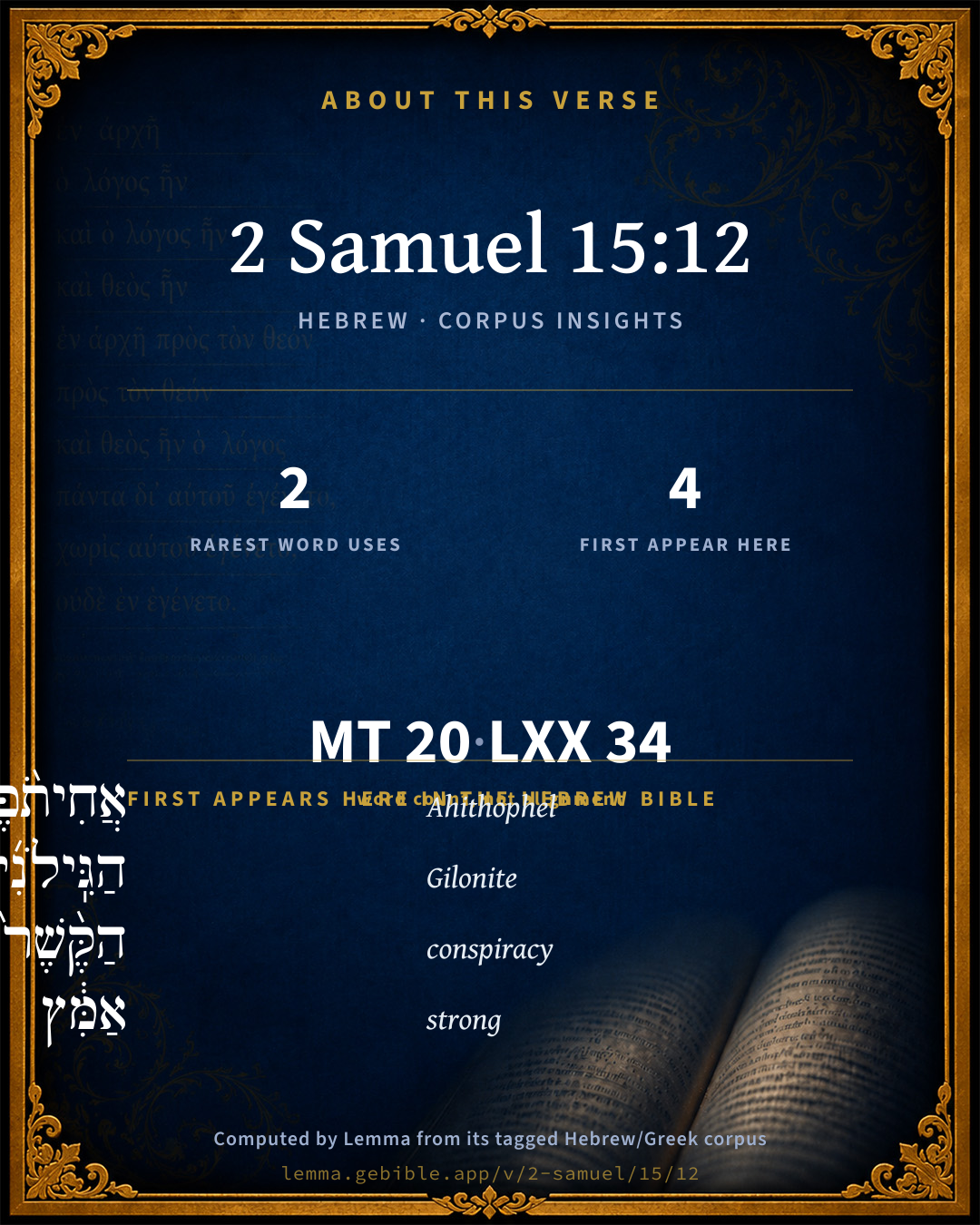
2 Samuel 15:12

Hebrew (Westminster Leningrad Codex) 2 Samuel 15:12 appears in the Hebrew Old Testament. The text above is from the Westminster Leningrad Codex. Each word links to its Strong’s number, a concise gloss, and parsing drawn from the Open Scriptures Hebrew Bible morphology. Click any word for its full Brown-Driver-Briggs (BDB) entry.
Download image
Cite this verse

2 Samuel 15:12 (World English Bible). Public Domain. Lemma interlinear Bible study tool, https://lemma.gebible.app/v/2-samuel/15/12.

Show BibTeX & RIS
BibTeX
RIS
English Translation
Absalom sent for Ahithophel the Gilonite, David's counselor, from his city, even from Giloh, while he was offering the sacrifices. The conspiracy was strong; for the people increased continually with Absalom.
World English Bible · Public Domain
Highlights
  • 4 first appearances in the Hebrew Bible
Full analysis ↓
Download a study sheet

One document with this verse’s original text, its word-by-word gloss line, the meaning frame, cross-references with their text, attributed commentary, and full source and license credits — printable, and it pastes into notes with its structure intact.

This verse Autodidact and up

Study sheet (.html) Plain text (.txt)

A passage Seminary Student

Up to 50 verses in one chapter. A passage sheet keeps up to 6 commentary sources and 12 cross-references per verse, in the order this page ranks them, and says so on the sheet whenever that leaves anything out. Ask for a single verse and you get the Autodidact verse sheet above.

Everything on this page stays free to read, with no account — the sheet is a download of what is already on screen, not access to it.

Want to remove ads? Support Godless Engineer
Compare translations 3

The same verse in 3 English versions, stacked beneath the original-language interlinear above. Click any original word for its lexicon entry.

Each is an independent rendering of the whole verse — the interlinear is not word-aligned to these translations.

Highlighted words mark where these versions differ — a whole-verse word diff, not a word-by-word alignment.

  • World English Bible Public Domain
    Absalom sent for Ahithophel the Gilonite, David's counselor, from his city, even from Giloh, while he was offering the sacrifices. The conspiracy was strong; for the people increased continually with Absalom.
  • King James Version Public Domain
    And Absalom sent for Ahithophel the Gilonite, David's counselor, from his city, even from Giloh, while he offered sacrifices. And the conspiracy was strong; for the people increased continually with Absalom.
  • unfoldingWord Literal Text CC BY-SA 4.0
    And Absalom sent Ahithophel the Gilonite, the counselor of David, from his city, from Giloh, while he sacrificed the sacrifices. And it happened, the conspiracy strong, and the people were going and many with Absalom.

unfoldingWord Literal Text — © unfoldingWord, licensed CC BY-SA 4.0. Word-aligned USFM3 via Door43 (git.door43.org/unfoldingWord/en_ult).

Versions to compare (up to 4)

3 of 4 selected

Show all 18 translations

Every available English version of this verse, each an independent rendering of the whole verse.

  • World English Bible Public Domain
    Absalom sent for Ahithophel the Gilonite, David's counselor, from his city, even from Giloh, while he was offering the sacrifices. The conspiracy was strong; for the people increased continually with Absalom.
  • Berean Standard Bible Public Domain
    While Absalom was offering the sacrifices, he sent for Ahithophel the Gilonite, David’s counselor, to come from his hometown of Giloh. So the conspiracy gained strength, and Absalom’s following kept increasing.
  • Majority Standard Bible Public Domain
    While Absalom was offering the sacrifices, he sent for Ahithophel the Gilonite, David’s counselor, to come from his hometown of Giloh. So the conspiracy gained strength, and Absalom’s following kept increasing.
  • King James Version Public Domain
    And Absalom sent for Ahithophel the Gilonite, David's counselor, from his city, even from Giloh, while he offered sacrifices. And the conspiracy was strong; for the people increased continually with Absalom.
  • American Standard Version (1901) Public Domain
    And Absalom sent for Ahithophel the Gilonite, David's counsellor, from his city, even from Giloh, while he was offering the sacrifices. And the conspiracy was strong; for the people increased continually with Absalom.
  • Revised Version (1885) Public Domain
    And Absalom sent for Ahithophel the Gilonite, David’s counsellor, from his city, even from Giloh, while he offered the sacrifices. And the conspiracy was strong; for the people increased continually with Absalom.
  • Geneva Bible (1599) Public Domain
    Also Absalom sent for Ahithophel the Gilonite Dauids counseller, from his citie Giloh, while he offred sacrifices: and the treason was great: for the people encreased still with Absalom.
  • Douay-Rheims (1899) Public Domain
    Absalom also sent for Achitophel the Gilonite, David's counsellor, from his city Gilo. And while he was offering sacrifices, there was a strong conspiracy, and the people running together increased with Absalom.
  • Young's Literal Translation Public Domain
    and Absalom sendeth Ahithophel the Gilonite, a counsellor of David, out of his city, out of Gilo, in his sacrificing sacrifices; and the conspiracy is strong, and the people are going and increasing with Absalom.
  • Literal Standard Version CC BY-SA 4.0
    and Absalom sends Ahithophel the Gilonite, a counselor of David, out of his city, out of Gilo, in his sacrificing sacrifices; and the conspiracy is strong, and the people are going and increasing with Absalom.
  • Unlocked Literal Bible CC BY-SA 4.0
    While Absalom offered sacrfices, he sent for Ahithophel from his hometown of Giloh. He was David's counselor. Absalom's conspiracy was strong, for the people following Absalom were constantly increasing.
  • unfoldingWord Literal Text CC BY-SA 4.0
    And Absalom sent Ahithophel the Gilonite, the counselor of David, from his city, from Giloh, while he sacrificed the sacrifices. And it happened, the conspiracy strong, and the people were going and many with Absalom.
  • Darby Bible Public Domain
    And Absalom sent for Ahithophel the Gilonite, David's counsellor, from his city, from Giloh, while he offered the sacrifices. And the conspiracy gathered strength; and the people increased continually with Absalom.
  • World Messianic Bible Public Domain
    Absalom sent for Ahithophel the Gilonite, David’s counselor, from his city, even from Giloh, while he was offering the sacrifices. The conspiracy was strong, for the people increased continually with Absalom.
  • Webster's Bible Public Domain
    And Absalom sent for Ahithophel the Gilonite, David's counselor, from his city, even from Giloh, while he offered sacrifices. And the conspiracy was strong; for the people increased continually with Absalom.
  • Free Bible Version CC BY-SA 4.0
    While Absalom was offering sacrifices, he sent for Ahithophel the Gilonite, David's advisor, asking him to come from Giloh, the town where he lived. The conspiracy grew stronger, and Absalom's followers went on increasing.
  • Bible in Basic English Public Domain
    And Absalom sent for Ahithophel the Gilonite, one of David's helpers, from Giloh his town, while he was making the offerings. And the design against David became strong, for more and more people were joined to Absalom.
  • JPS Tanakh (1917) Public Domain
    And Absalom sent for Ahithophel the Gilonite, David's counsellor, from his city, even from Giloh, while he offered the sacrifices. And the conspiracy was strong; for the people increased continually with Absalom.

Literal Standard Version (2020), Covenant Press — licensed CC BY-SA 4.0. Text via the HelloAO Bible API (eBible.org). Unlocked Literal Bible (unfoldingWord) — licensed CC BY-SA 4.0. Text via the HelloAO Bible API (eBible.org). unfoldingWord Literal Text — © unfoldingWord, licensed CC BY-SA 4.0. Word-aligned USFM3 via Door43 (git.door43.org/unfoldingWord/en_ult). Free Bible Version, Dr. Jonathan Gallagher — licensed CC BY-SA 4.0. Text via the HelloAO Bible API (eBible.org).

Word by word

More ways to search: Search by grammar → Find every occurrence → Compare this word →

Practice this passage: Drill this verse → Learn its vocabulary →

הַגִּֽילֹנִ֜י
Gîylônîy
H1526
“the · Gilonite”
Particle, Definite Article + Noun, Gentilic, Masculine, Singular, Absolute
Part of Speech
Particle + Noun
Type
Gentilic
Gender
Masculine
Number
Singular
State
Absolute
Full BDB Definition

Origin: patrial from H1542

TWOT: None

Gilonite = "gentilic of preceding" - an inhabitant of Giloh
  1. וַיִּשְׁלַ֣ח shâlach H7971 “and · to send” Conjunction + Verb, Qal, Sequential Imperfect, 3rd Person, Masculine, Singular
  2. אַ֠בְשָׁלוֹם ʼĂbîyshâlôwm H53 “Absalom” Noun, Proper
  3. אֶת ʼêth H853 “-” Particle, Direct Object
  4. אֲחִיתֹ֨פֶל ʼĂchîythôphel H302 “Ahithophel” Noun, Proper
  5. יוֹעֵ֣ץ yâʻats H3289 “counseling” Verb, Qal, Participle Active, Masculine, Singular, Construct
  6. דָּוִ֗ד Dâvid H1732 “David” Noun, Proper
  7. מֵֽעִירוֹ֙ ʻîyr H5892 “from · city · his” Preposition + Noun, Common, Feminine, Singular, Construct + Suffix, Personal, 3rd Person, Masculine, Singular
  8. מִגִּלֹ֔ה Gilôh H1542 “from · Giloh” Preposition + Noun, Proper
  9. בְּזָבְח֖וֹ zâbach H2076 “in/at · to sacrifice · him” Preposition + Verb, Qal, Infinitive Construct + Suffix, Personal, 3rd Person, Masculine, Singular
  10. אֶת ʼêth H853 “-” Particle, Direct Object
  11. הַזְּבָחִ֑ים zebach H2077 “the · sacrifices” Particle, Definite Article + Noun, Common, Masculine, Plural, Absolute
  12. וַיְהִ֤י hâyâh H1961 “and · to be” Conjunction + Verb, Qal, Sequential Imperfect, 3rd Person, Masculine, Singular
  13. הַקֶּ֨שֶׁר֙ qesher H7195 “the · conspiracy” Particle, Definite Article + Noun, Common, Masculine, Singular, Absolute
  14. אַמִּ֔ץ ʼammîyts H533 “strong” Adjective, Adjective, Masculine, Singular, Absolute
  15. וְהָעָ֛ם ʻam H5971 “and · the · people” Conjunction + Particle, Definite Article + Noun, Common, Masculine, Singular, Absolute
  16. הוֹלֵ֥ךְ hâlak H1980 “walking” Verb, Qal, Participle Active, Masculine, Singular, Absolute
  17. וָרָ֖ב rab H7227 “and · many” Conjunction + Adjective, Adjective, Masculine, Singular, Absolute
  18. אֶת ʼêth H854 “with” Preposition
  19. אַבְשָׁלֽוֹם ʼĂbîyshâlôwm H53 “Absalom” Noun, Proper

About this verse

These counts appear in no published source. They are computed here, from the morphology-tagged text and Lemma’s own curated glosses. What Lemma adds →

20
words
18
distinct lemmas
Historical
section

Notable vocabulary

The rarest word here is הַגִּֽילֹנִ֜י Gilonite H1526 — appearing just 2 times in the whole Hebrew Bible.

First appearance in Scripture

These words make their first canonical appearance in the Hebrew Bible here:

  • אֲחִיתֹ֨פֶל Ahithophel H302
  • הַגִּֽילֹנִ֜י Gilonite H1526
  • הַקֶּ֨שֶׁר֙ conspiracy H7195
  • אַמִּ֔ץ strong H533

Shared distinctive vocabulary

הַגִּֽילֹנִ֜י Gilonite H1526 occurs in 2 verses of the Hebrew Bible. Also found in:

Grammatical profile

  • 5 verbs
  • 10 nouns
  • 2 adjectives
  • 1 preposition
  • 2 particles

Verb forms

  • וַיִּשְׁלַ֣ח Qal · Sequential Imperfect
  • יוֹעֵ֣ץ Qal · Participle Active
  • בְּזָבְח֖וֹ Qal · Infinitive Construct
  • וַיְהִ֤י Qal · Sequential Imperfect
  • הוֹלֵ֥ךְ Qal · Participle Active

Repetition

A word recurs within this verse — often emphatic in Hebrew:

  • אַ֠בְשָׁלוֹם Absalom H53 ×2

Hebrew & Septuagint length

In English translation the verse runs 31 words from the Hebrew and 34 from the Septuagint (LXX English) — closely comparable.

A rough comparison of the two English renderings, which tokenize alike — not a word-level alignment.

Word counts can differ between the Hebrew and the Greek without any difference in meaning — e.g. the Hebrew direct-object marker אֵת has no separate Greek word, and Greek often adds the article ὁ.

In the original languages it is 20 Hebrew tokens and 34 Greek tokens — but the two are counted differently (Hebrew bundles its prefixes and suffixes into one token; the Greek is in lemma form), so that isn’t a like-for-like length.

Cross-references

21

Topical passages linked to 2 Samuel 15:12 in the Treasury of Scripture Knowledge — connected by theme and wording, ordered by reader-vote popularity; previews shown in the World English Bible.

  • 2 Samuel 15:31 One told David, saying, Ahithophel is among the conspirators with Absalom. David said, Yahweh, please turn the counsel of Ahithophel into foolishness.
  • Psalms 41:9 Yes, my own familiar friend, in whom I trusted, Who ate bread with me, Has lifted up his heel against me.
  • Joshua 15:51 and Goshen, and Holon, and Giloh; eleven cities with their villages.
  • Psalms 55:12–14 For it was not an enemy who insulted me, Then I could have endured it. Neither was it he who hated me who raised himself up against me, Then I would have hid myself from him.
  • Titus 1:16 They profess that they know God, but by their works they deny him, being abominable, disobedient, and unfit for any good work.
  • 2 Samuel 17:14 Absalom and all the men of Israel said, The counsel of Hushai the Archite is better than the counsel of Ahithophel. For Yahweh had ordained to defeat the good counsel of Ahithophel, to the intent that Yahweh might bring evil on Absalom.
  • 2 Samuel 17:23 When Ahithophel saw that his counsel was not followed, he saddled his donkey, and arose, and got him home, to his city, and set his house in order, and hanged himself; and he died, and was buried in the tomb of his father.
  • 1 Kings 21:12 They proclaimed a fast, and set Naboth on high among the people.
  • Proverbs 21:27 The sacrifice of the wicked is an abomination: How much more, when he brings it with a wicked mind!
  • Numbers 23:1 Balaam said to Balak, Build me here seven altars, and prepare me here seven bulls and seven rams.
  • Numbers 23:14 He took him into the field of Zophim, to the top of Pisgah, and built seven altars, and offered up a bull and a ram on every altar.
  • Numbers 23:30 Balak did as Balaam had said, and offered up a bull and a ram on every altar.
  • 2 Samuel 16:20–23 Then said Absalom to Ahithophel, Give your counsel what we shall do.
  • 1 Kings 21:9 She wrote in the letters, saying, Proclaim a fast, and set Naboth on high among the people:
  • 1 Chronicles 27:33 Ahithophel was the king's counselor: and Hushai the Archite was the king's friend:
  • Psalms 3:1–2 Yahweh, how my adversaries have increased! Many are those who rise up against me.
  • Psalms 43:1–2 Vindicate me, God, and plead my cause against an ungodly nation. Oh, deliver me from deceitful and wicked men.
  • Psalms 50:16–21 But to the wicked God says, "What right do you have to declare my statutes, That you have taken my covenant on your lips,
  • Isaiah 1:10–16 Hear the word of Yahweh, you rulers of Sodom! Listen to the law of our God, you people of Gomorrah!
  • Micah 7:5–6 Don't trust in a neighbor. Don't put confidence in a friend. With the woman lying in your embrace, Be careful of the words of your mouth!
  • John 13:18 I don't speak concerning all of you. I know whom I have chosen. But that the Scripture may be fulfilled, 'He who eats bread with me has lifted up his heel against me.'

Cross-references courtesy of OpenBible.info (CC BY 4.0).

Hebrew and Greek witnesses Masoretic Hebrew ↔ Greek Septuagint

The same verse in the two great witnesses to the Old Testament, shown verse-for-verse.

These are two independent witnesses, not word-aligned to each other, and the Septuagint is shown in lemma (dictionary) form.

Hebrew 2 Samuel 15:12 Masoretic · Westminster Leningrad Codex

וַיִּשְׁלַ֣ח אַ֠בְשָׁלוֹם אֶת אֲחִיתֹ֨פֶל הַגִּֽילֹנִ֜י יוֹעֵ֣ץ דָּוִ֗ד מֵֽעִירוֹ֙ מִגִּלֹ֔ה בְּזָבְח֖וֹ אֶת הַזְּבָחִ֑ים וַיְהִ֤י הַקֶּ֨שֶׁר֙ אַמִּ֔ץ וְהָעָ֛ם הוֹלֵ֥ךְ וָרָ֖ב אֶת אַבְשָׁלֽוֹם

Absalom sent for Ahithophel the Gilonite, David's counselor, from his city, even from Giloh, while he was offering the sacrifices. The conspiracy was strong; for the people increased continually with Absalom.

World English Bible · Public Domain

Greek LXX 2 Samuel 15:12 Septuagint · lemma form

καί ἀποστέλλω αβεσσαλωμ καί καλέω ὁ αχιτοφελ ὁ γελμωναῖος ὁ σύμβουλος δαυίδ ἐκ ὁ πόλις αὐτός ἐκ γωλα ἐν ὁ θυσιάζω αὐτός καί γίγνομαι σύστρεμμα ἰσχυρός καί ὁ λαός πορεύομαι καί πολύς μετά αβεσσαλωμ

And Abessalom sent to Achitophel the Theconite, the counsellor of David, from his city, from Gola, where he was sacrificing: and there was a strong conspiracy; and the people with Abessalom were increasingly numerous.

LXX2012 (modern English Septuagint) · Public Domain

Hebrew: Westminster Leningrad Codex (CC BY 4.0). Greek: Septuagint (public domain); English from LXX2012 (modern English Septuagint) (Public Domain). How the Septuagint differs from the Hebrew →

Targum (Aramaic paraphrase)

1

The Targum is the ancient Jewish Aramaic paraphrase of the Hebrew Scriptures — an interpretive translation, not the Hebrew text itself. Onkelos (literal) and Pseudo-Jonathan (expansive) render the Torah, and Jonathan the Prophets. Coverage is partial: where no permissively-licensed English translation exists for a verse, only the Aramaic is shown. This is verse-level text, not a word-by-word alignment to the Hebrew.

  1. Targum Jonathan Prophets (Joshua–Malachi)
    וּשְׁלַח אַבְשָׁלוֹם יַת אֲחִיתוֹפֶל גִילוֹנָאָה מָלִיכָא דְדָוִד מִקַרְתֵּיהּ מִגִלֹה בְּדַבָּחוּתֵיהּ יַת דִבְחַיָא וַהֲוָה מַרְדָא תַּקִיף וְעַמָא אָזֵיל וְסַגִי עִם אַבְשָׁלוֹם:

    (no public-domain English translation for this verse)

    Targum Jonathan — Aramaic: “Mikraot Gedolot” (public domain). English: “Sefaria Community Translation” (CC0 1.0 (public-domain dedication)); “London "Chaldee Paraphrase," 1871” (public domain). Text via Sefaria.

Commentary

Notes on 2 Samuel 15:12 from classic Christian and Jewish commentators (each source and its license shown beneath its notes). The classic Christian expositions comment on the surrounding passage and are grouped to its opening verse, so a note may address several verses; the Jewish commentaries on the Tanakh (Rashi and others) are per-verse, so they appear only where the commentator wrote on this verse.

Lemma curates 59 commentaries, every one of them public domain or Creative Commons licensed, each selected and text-cleaned for this edition rather than reprinted as found. About our sources →

Trapp's Complete Commentary

John Trapp

2Sa 15:12 And Absalom sent for Ahithophel the Gilonite, David’s counsellor, from his city, [even] from Giloh, while he offered sacrifices. And the conspiracy was strong; for the people increased continually with Absalom.

Ver. 12. And Absalom sent for Ahithophel the Gilonite.] Who doubtless of all his virtues made best vice of his dissimulation; as our historian saith of that Earl of Warwick in Edward VI’s days. See on 2Sa 15:10. Some think that Ahithophel joined with Absalom against David, in revenge of the abuse done by him to Bathsheba, - who is supposed to be Ahithophel’s grand-daughter, - and the murdering of Uriah, her husband.

For the people increased continually with Absalom.] Bewitched by his flatteries, as 2Sa 15:6, affecting novelties, αει γαρ το παρον βαρυ, {a} and incensed by Absalom’s boutefeaus, whose work was to black and blast good David and his government; but above all, God’s holy hand was in it for the chastising of David, according to what had been forethreatened.

{a} Thucyd.

John Trapp, A Commentary or Exposition upon All the Books of the Old and New Testament (1647–1656) — public domain. Text from a community e-Sword module.

Joseph Benson's Commentary

2Sa 15:12. Absalom sent for Ahithophel, David’s counsellor — None are more capable of doing mischief to kings than those who have been of their privy council, and know their secrets. It is supposed by the Jews that Ahithophel was incensed against David for his conduct to Bath-sheba, who they think, was his grand-daughter, being the daughter of Eliam, 2Sa 11:3, and Eliam the son of Ahithophel, 2Sa 23:34. It doubtless must have been matter of great surprise and inexpressible affliction to David, to find the two men, whom of all others he seems to have most loved and confided in, combining against him, and compassing his death, Absalom and Ahithophel, his son and his counsellor. While he offered sacrifices — Or, rather, after he had offered sacrifices: for it seems he sent for him while he sat at dinner. And the conspiracy was strong — Ahithophel was too cunning to discover himself till he saw all things favourable and prosperous on the part of Absalom: and they both very well judged that his accession to the conspiracy, in those circumstances, was the likeliest means to ensure its success. For the people increased continually — Most of whom, it is probable, intended no harm at first, perhaps not even to divest David of his crown and dignity, much less to take away his life; but only to substitute Absalom as a coadjutor to him, for the executing of the royal authority during David’s life, and to be his successor after his death. However, it is evident they did proceed so far, at last, as to design to kill David for their own greater security. For so Ahithophel advised, and they all consented to it, 2Sa 17:2; 2Sa 17:4; which shows how dangerous it is to go out of the right way; for we do not know down what horrid precipices we may fall afterward. And it may serve as a warning to us never to begin any thing that is wrong, which may lead us to commit that in the issue which we abhorred at the first, when we find we cannot be safe in one wickedness, unless we commit a greater.

Joseph Benson's Commentary on the Old and New Testaments (1811–1818) — public domain. Text from a community e-Sword module.

Tyndale Open Study Notes

Tyndale Open Resources

15:12 Ahithophel was Bathsheba’s grandfather (cp. 11:3; 23:34); years later, he might still have been angry over what David did to his granddaughter. • Giloh was located in the region of Hebron (Josh 15:51, 54).

Tyndale Open Study Notes — © Tyndale Open Resources, licensed CC BY-SA 4.0. Text via the HelloAO Bible API.

Geneva Bible (1599)

Geneva Bible translators

Hebrew, went and increased.

Geneva Bible (1599) marginal notes — public domain. Text via Bolls.life.

Jamieson, Fausset & Brown

Robert Jamieson, A. R. Fausset & David Brown

Absalom sent for Ahithophel--who he knew was ready to join the revolt, through disgust and revenge, as Jewish writers assert, at David's conduct towards Bath-sheba, who was his granddaughter.

Giloh--near Hebron.

the conspiracy was strong--The rapid accession of one place after another in all parts of the kingdom to the party of the insurgents, shows that deep and general dissatisfaction existed at this time against the person and government of David. The remnant of Saul's partisans, the unhappy affair of Bath-sheba, the overbearing insolence and crimes of Joab, negligence and obstruction in the administration of justice--these were some of the principal causes that contributed to the success of this widespread insurrection.

Jamieson, Fausset & Brown — Commentary Critical and Explanatory on the Whole Bible (1871) — public domain (CC PDM 1.0). Text via the HelloAO Bible API.

Adam Clarke's Commentary

Verse 12. Sent for Ahithophel] When Absalom got him, he in effect got the prime minister of the kingdom to join him.

Adam Clarke's Commentary on the Bible (1810–1826) — public domain. Text from a community e-Sword/MySword module.

Ellicott's Commentary for English Readers

(12) Sent for Ahithophel.—Giloh, the city of Ahithophel, was one of the groups of towns just south of Hebron (Jos_15:51), and Ahithophel may have gone there in readiness to be summoned by Absalom. Why he deserted David does not appear. It has been conjectured that he was aggrieved at David’s treatment of Bath-sheba, who is supposed to have been his granddaughter. Bath-sheba’s father was Eliam (2Sa_11:3) and Ahithophel had a son Eliam (2Sa_23:34), but there is no evidence that these were the same, and if they had been, Ahithophel probably would have felt honoured rather than aggrieved that his daughter should have been made queen. It is more likely that Ahithophel and many others of the tribe of Judah were alienated because, in the rapidly growing empire of David, their relative importance was of necessity constantly diminishing. It is noteworthy that the rebellion was cradled in Judah, and seems to have found there its chief strength.

There is a difference of opinion whether Psalms 41 was written on this occasion; but its ninth verse certainly applies very pointedly to Ahithophel; and his conduct, both in his treachery and his suicide, forms a striking parallel to that of Judas, to whom this verse is applied in Joh_13:18. Many writers also consider that Psalms 55 was composed with reference to Ahithophel.

While he offered sacrifices.—Absalom had arranged these, apparently with pomp and circumstance, to continue through several days. This gave time for the conspiracy to gain strength, and the accompanying feasting allowed Absalom an excellent opportunity for using his popular arts, and with such success that “the people increased continually with Absalom.”

A Bible Commentary for English Readers, edited by Charles John Ellicott (1878–1897) — public domain. Text from a community e-Sword module.

The Cambridge Bible for Schools and Colleges

gen. ed. J. J. S. Perowne

12. Gilonite] Formed from Giloh, as Shilonite (1Ki_11:29) from Shiloh. Giloh was one of a group of cities in the mountains of Judah, to the south or south-west of Hebron (Jos_15:51).

sent for Ahithophel] The sense is no doubt right, but it cannot be got out of the existing text. Probably some word has dropped out; the original reading may have been sent and called Ahithophel.

Ahithophel has justly been regarded as a type of the arch-traitor Judas. Even if the words “mine own familiar friend in whom I trusted which did eat of my bread, hath lifted up his heel against me” (Psa_41:9, quoted in Joh_13:18), were not written of Ahithophel, the parallel between his treachery and suicide, and the treachery and suicide of Judas, is too striking to be neglected.

while he offered sacrifices] While he offered the sacrifices. In order to give time for his adherents to gather, Absalom celebrated the sacrifice, which was the ostensible object of his journey. To Ahithophel, who no doubt had already been sounded, he sent a special invitation to join him.

The Cambridge Bible for Schools and Colleges (gen. ed. J. J. S. Perowne; Cambridge University Press, 1878–1918) — public domain. Text from a community e-Sword module.

John Gill's Exposition

And Absalom sent for Ahithophel, the Gilonite, David's counsellor,.... To advise with about this treasonable affair he was engaged in, and to get out of him David's secrets, who was reckoned the best counsellor in the land; and he might rather hope he would come to him, if he was the grandfather of Bathsheba, as say the Jews, Sa2 11:3; since he might be disgusted with and resent David's adultery with Bathsheba his granddaughter, and the murder of her husband Uriah: him he sent for:

from his city, even from Giloh; a city in the tribe of Judah, in the mountainous part of it, near to Hebron, where Absalom now was; and, according to Bunting (i), twenty miles from Jerusalem, see Jos 15:48,

while he offered sacrifices; not Ahithophel, but Absalom, his peace offerings at Hebron, to which he invited Ahithophel to come and partake of:

and the conspiracy was strong; or there was a great number in the conspiracy, who were assembled together:

for the people increased continually with Absalom; being drawn to him by the comeliness of his person, his affable behaviour, the pomp and magnificence in which he appeared, the great number of the principal inhabitants of Jerusalem with him, and he the king's eldest son, and so heir to the crown; whereas it might begin to be rumoured about, that David designed Solomon, a son of Bathsheba, a young prince, to be his successor, which did not meet with general approbation at first.

(i) Travels, &c. p. 149.

John Gill's Exposition of the Whole Bible (1746–1763) — public domain (CC PDM 1.0). Text via the HelloAO Bible API.

Albert Barnes' Notes on the Bible

Ahithophel - It has been with great probability supposed that Ahithophel was estranged from David by personal resentment for his conduct in the matter of Bath-sheba and Uriah (see 2Sa 11:3).

While he offered sacrifices - Rather, that Absalom sent for Ahithophel to be present when he offered the sacrifices; the intention being that all who partook of the sacrifice should be bound together to prosecute the enterprise. Absalom, too, would take advantage of the excitement of the great feast to inflame the ardour of the guests, and pledge them irrevocably to his cause.

Albert Barnes' Notes on the Bible (1834–1885) — public domain. Text from a community e-Sword/MySword module.

Haydock's Catholic Bible Commentary

Achitophel, the grandfather of Bethsabee; to revenge whose dishonour, he had instigated the young prince to revolt, and had planned his rebellion; (Salien) so that he was every ready to lend his assistance. (Calmet)

George Leo Haydock (1774–1849), Haydock's Catholic Family Bible and Commentary, 1859 edition — public domain. Excludes Psalms (Douay-Rheims chapter numbering differs from Protestant) and Deuterocanonical books (Catholic canon only).

Matthew Poole's English Annotations

Ahithophel is thought to have been the author, or, at least, the fomenter of this rebellion; either because he was discontented with David, for which there might be many reasons; or because he saw the father was old and nigh his end, and he thought it best policy to worship the rising sun, and to follow the young prince, whom he observed to have so great an interest in the hearts of the people, and whom he supposed he could easily manage as he pleased, which he could not do with David.

While he offered sacrifices; which he did not in devotion to God, for he neither feared God, nor reverenced man; nor to implore God’s favour and assistance against his father, which he knew was a vain thing to expect; but merely that upon this pretence he might call great numbers of the people together, whereof many would come to join with him in the worship of God, and most to partake of the feasts which were made of the remainders of the sacrifices, according to the manner.

Matthew Poole's English Annotations on the Holy Bible (1683–1685) — public domain. Text from a community e-Sword/MySword module.

Whedon's Commentary on the Bible

Daniel D. Whedon

12. Ahithophel the Gilonite — So called from Giloh, his native city in the southern hills of Judah. In nothing was the strength of Absalom’s conspiracy more manifest than in his attaching to his cause a man of so much influence as this wisest of David’s counsellors. His counsel was as an oracle of God, (2Sa_16:23,) and nothing seemed to disturb David more than the information that Ahithophel was among his foes. 2Sa_15:31.

The manner of Absalom’s sending for him, as here stated, seems to indicate that he was already privy to the plot. He had perhaps become disaffected toward David on account of his seduction of Bathsheba, his granddaughter.

Giloh — Somewhere to the south of Hebron, but its site is unknown. See at Jos_15:51.

While he offered sacrifices — That is, while Absalom was offering the sacrifices connected with the festival which he made for his followers. “When we reflect,” says Ewald, “that the men who played the most important parts under Absalom — his general, Amasa, who was a near relative of Joab and of David, and Ahithophel, a citizen of Giloh — belonged to the tribe of Judah, and that the insurrection itself sprung into being at Hebron, the ancient capital of Judah, it becomes certain that some discontent in David’s own tribe here came into play.”

Daniel D. Whedon (gen. ed.), Commentary on the Old and New Testaments (1874–1909) — public domain. Text from a community e-Sword module.

The Pulpit Commentary

Ahithophel the Gilonite. The desertion of David by Ahithophel is in every way remarkable, even if he were Bathsheba"s grandfather. (see note on 2Sa_11:3) For he was far too subtle a man to have joined the conspiracy unless he bad felt reasonably sure that it would be successful. Successful it would have been had his advice been followed; but so correctly did he estimate the result if David were allowed time to gather his friends, that, when his counsel was rejected, he withdrew immediately to Giloh, and committed suicide. Still if the revolt had been successful, it would have involved, if not the death of Bathsheba, yet certainly that of her sons, and the exclusion of Ahithophel"s great-grandchildren from the throne. In Psalm 41., written at this time, we learn what were David"s feelings when he heard the news of this conspiracy, and Ahithophel is the familiar friend, in whom he had trusted, and who had eaten at his table, but now raised up his heel to kick at him. In Joh_13:18 the words are quoted of Judas Iscariot, of whom Ahithophel was a type in his treachery and in his death by his own hand. The translation, "sent for Ahithophel," cannot be maintained. The Hebrew is "sent Ahithophel," but for what purpose or on what embassy is not mentioned. As thus something must have dropped out of the Hebrew text, it possibly may be the preposition "for," as this gives a good sense. For Giloh, Ahithophel"s town, was situated a few miles to the south of Hebron, (Jos_15:51) and Ahithophel had probably been working there secretly for Absalom for some time. As David"s counsellor, his proper place of residence would have been Jerusalem, but the conspiracy had been kept so secret that he had been able to get away without suspicion. He is now summoned to Absalom"s side, and his presence there brings in so many adherents that a rapid march on Jerusalem might have put David into their power. The Revised Version is right in translating, while he offered the sacrifices; namely, those which he had vowed, and which were the reason given for his visit to Hebron.

The Pulpit Commentary (1880–1919), ed. H.D.M. Spence-Jones & Joseph S. Exell — public domain. Text from a community e-Sword module.

John Wesley's Explanatory Notes

Sacrifices - Which he did not in devotion to God; but merely that upon this pretense he might call great numbers of people together.

John Wesley, Explanatory Notes Upon the Whole Bible (1754–1765) — public domain. Text via the GEBible commentary corpus.

Keil & Delitzsch

C. F. Keil & F. Delitzsch

Moreover, Absalom sent for Ahithophel, David's councillor, to come from his own town Giloh, when he offered the sacrifices. The unusual construction of את ישׁלח with מעירו may be explained from the pregnant character of the expression: he sent and bade come, i.e., he summoned Ahithophel out of his city. Giloh, Ahithophel's home, was upon the mountains of Judah, to the south or south-west of Hebron (see at Jos 15:51). Ahithophel had no doubt been previously initiated into Absalom's plans, and had probably gone to his native city, merely that he might come to him with the greater ease; since his general place of abode, as king's councillor, must have been in Jerusalem. "And the conspiracy became strong; for the people multiplied continually with Absalom" (the latter is a circumstantial clause). These words give a condensed summary of the result of the enterprise.

Keil & Delitzsch — Biblical Commentary on the Old Testament (1861–1891) — public domain (CC PDM 1.0). Text via the HelloAO Bible API. (Old Testament only.)

Lesson kit

Teaching starters — assembled from the data on this page, not authored interpretation. Every prompt links to the verse data it draws on. Edit before teaching.

2 Samuel, in the Historical, opens this verse with 20 words (18 distinct Hebrew lemmas). Its most distinctive word is Gîylônîy (“Gilonite”). A historical commentator’s framing appears above. Read the whole chapter for the surrounding context.

Discussion questions

  1. The word Gîylônîy carries the sense “Gilonite.” How does it shape the verse?
  2. 4 words here appear for the first time in Scripture. What is being introduced at this debut?
  3. 2 Samuel 23:34 shares the word «Gilonite» with this verse. How do the two illuminate each other?
  4. “Absalom” occurs 2× in this one verse. What is the effect of the repetition?
  5. The translations on this page render this verse differently — a whole-verse word diff, not a word-by-word alignment. What might account for the different wordings?
  6. The verb «וַיִּשְׁלַ֣ח» is Qal Sequential Imperfect. How does its form color the action?
  7. Reading how Trapp's Complete Commentary and Joseph Benson's Commentary read this verse, where do the two commentators agree and where do they part?

Things to notice

Reading settings

Reading text

Shown beneath each verse's original-language words.

Old Testament
Old Testament edition

Read the OT as the Masoretic Hebrew (MT) or the Greek Septuagint (LXX).

English shown for the Greek Septuagint (in the Hebrew ↔ Greek comparison).

Comparing translations? Open the Compare panel on any verse page to stack up to four side by side.