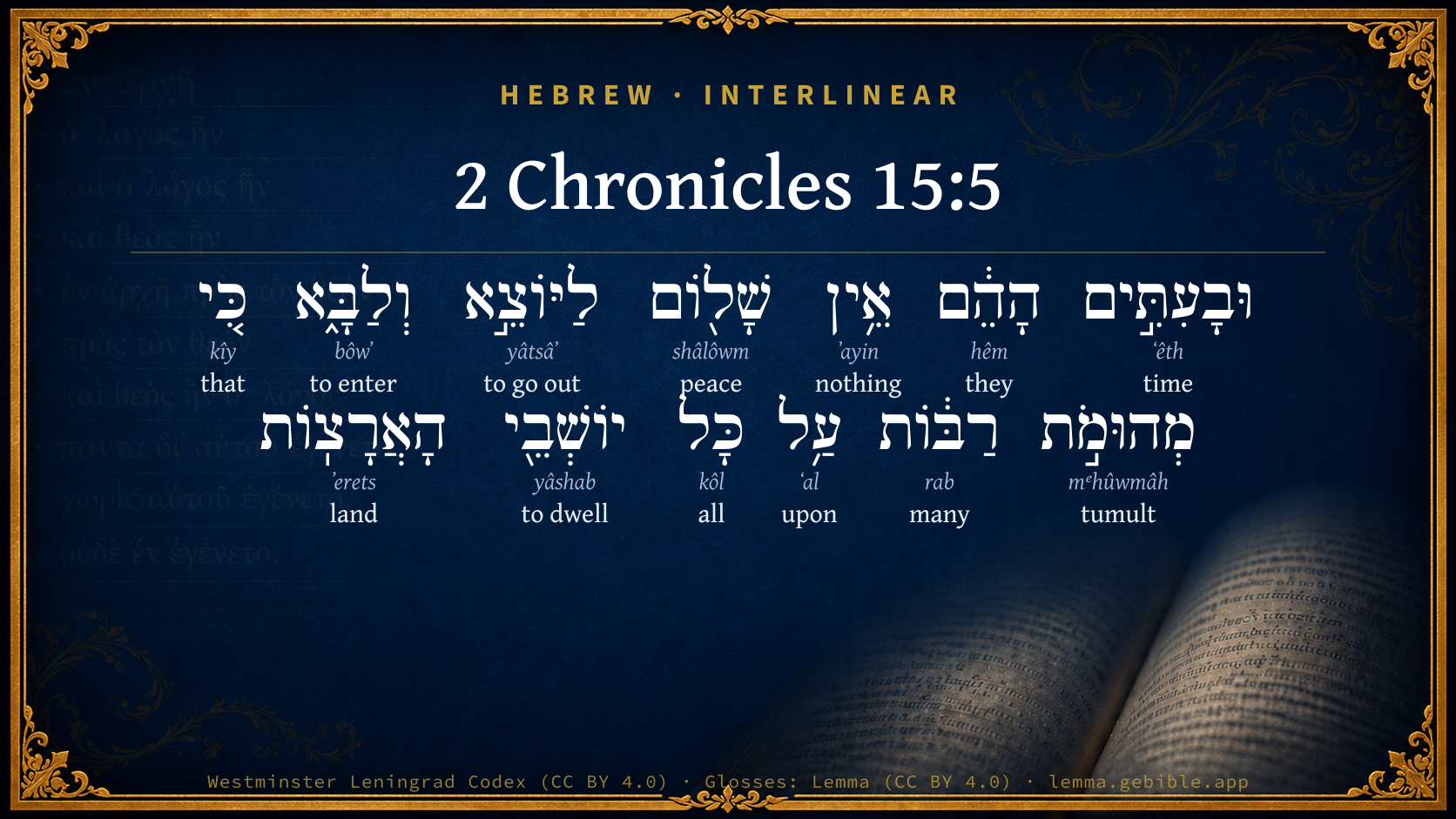
2 Chronicles 15:5

Hebrew (Westminster Leningrad Codex) 2 Chronicles 15:5 appears in the Hebrew Old Testament. The text above is from the Westminster Leningrad Codex. Each word links to its Strong’s number, a concise gloss, and parsing drawn from the Open Scriptures Hebrew Bible morphology. Click any word for its full Brown-Driver-Briggs (BDB) entry.
Download image
Cite this verse

2 Chronicles 15:5 (World English Bible). Public Domain. Lemma interlinear Bible study tool, https://lemma.gebible.app/v/2-chronicles/15/5.

Show BibTeX & RIS
BibTeX
RIS
English Translation
In those times there was no peace to him who went out, nor to him who came in; but great vexations were on all the inhabitants of the lands.
World English Bible · Public Domain
Download a study sheet

One document with this verse’s original text, its word-by-word gloss line, the meaning frame, cross-references with their text, attributed commentary, and full source and license credits — printable, and it pastes into notes with its structure intact.

This verse Autodidact and up

Study sheet (.html) Plain text (.txt)

A passage Seminary Student

Up to 50 verses in one chapter. A passage sheet keeps up to 6 commentary sources and 12 cross-references per verse, in the order this page ranks them, and says so on the sheet whenever that leaves anything out. Ask for a single verse and you get the Autodidact verse sheet above.

Everything on this page stays free to read, with no account — the sheet is a download of what is already on screen, not access to it.

Want to remove ads? Support Godless Engineer
Compare translations 3

The same verse in 3 English versions, stacked beneath the original-language interlinear above. Click any original word for its lexicon entry.

Each is an independent rendering of the whole verse — the interlinear is not word-aligned to these translations.

Highlighted words mark where these versions differ — a whole-verse word diff, not a word-by-word alignment.

  • World English Bible Public Domain
    In those times there was no peace to him who went out, nor to him who came in; but great vexations were on all the inhabitants of the lands.
  • King James Version Public Domain
    And in those times there was no peace to him that went out, nor to him that came in, but great vexations were upon all the inhabitants of the countries.
  • unfoldingWord Literal Text CC BY-SA 4.0
    And in those times there was no peace for one going out, nor for one coming in; for great dismay was upon all the inhabitants of the lands.

unfoldingWord Literal Text — © unfoldingWord, licensed CC BY-SA 4.0. Word-aligned USFM3 via Door43 (git.door43.org/unfoldingWord/en_ult).

Versions to compare (up to 4)

3 of 4 selected

Show all 18 translations

Every available English version of this verse, each an independent rendering of the whole verse.

  • World English Bible Public Domain
    In those times there was no peace to him who went out, nor to him who came in; but great vexations were on all the inhabitants of the lands.
  • Berean Standard Bible Public Domain
    In those days there was no safety for travelers, because the residents of the lands had many conflicts.
  • Majority Standard Bible Public Domain
    In those days there was no safety for travelers, because the residents of the lands had many conflicts.
  • King James Version Public Domain
    And in those times there was no peace to him that went out, nor to him that came in, but great vexations were upon all the inhabitants of the countries.
  • American Standard Version (1901) Public Domain
    And in those times there was no peace to him that went out, nor to him that came in; but great vexations were upon all the inhabitants of the lands.
  • Revised Version (1885) Public Domain
    And in those times there was no peace to him that went out, nor to him that came in, but great vexations were upon all the inhabitants of the lands.
  • Geneva Bible (1599) Public Domain
    And in that time there was no peace to him, that did goe out and goe in: but great troubles were to all the inhabitants of the earth.
  • Douay-Rheims (1899) Public Domain
    At that time there shall be no peace to him that goeth out and cometh in, but terrors on every side among all the inhabitants of the earth.
  • Young's Literal Translation Public Domain
    and in those times there is no peace to him who is going out, and to him who is coming in, for many troubles `are' on all the inhabitants of the lands,
  • Literal Standard Version CC BY-SA 4.0
    and in those times there is no peace for him who is going out, and for him who is coming in, for many troubles [are] on all the inhabitants of the lands,
  • Unlocked Literal Bible CC BY-SA 4.0
    In those times there was no peace for him who traveled away, nor for him who traveled to here; instead, great troubles were on all the inhabitants of the lands.
  • unfoldingWord Literal Text CC BY-SA 4.0
    And in those times there was no peace for one going out, nor for one coming in; for great dismay was upon all the inhabitants of the lands.
  • Darby Bible Public Domain
    And in those times there [was] no peace to him that went out nor to him that came in, but great disturbances were amongst all the inhabitants of the countries.
  • World Messianic Bible Public Domain
    In those times there was no peace to him who went out, nor to him who came in; but great troubles were on all the inhabitants of the lands.
  • Webster's Bible Public Domain
    And in those times there was no peace to him that went out, nor to him that came in, but great vexations were upon all the inhabitants of the countries.
  • Free Bible Version CC BY-SA 4.0
    During those times travel was dangerous, for all the inhabitants of the lands were in great turmoil. People everywhere had terrible problems.
  • Bible in Basic English Public Domain
    In those times there was no peace for him who went out or for him who came in, but great trouble was on all the people of the lands.
  • JPS Tanakh (1917) Public Domain
    And in those times there was no peace to him that went out, nor to him that came in, but great discomfitures were upon all the inhabitants of the lands.

Literal Standard Version (2020), Covenant Press — licensed CC BY-SA 4.0. Text via the HelloAO Bible API (eBible.org). Unlocked Literal Bible (unfoldingWord) — licensed CC BY-SA 4.0. Text via the HelloAO Bible API (eBible.org). unfoldingWord Literal Text — © unfoldingWord, licensed CC BY-SA 4.0. Word-aligned USFM3 via Door43 (git.door43.org/unfoldingWord/en_ult). Free Bible Version, Dr. Jonathan Gallagher — licensed CC BY-SA 4.0. Text via the HelloAO Bible API (eBible.org).

Word by word

More ways to search: Search by grammar → Find every occurrence → Compare this word →

Practice this passage: Drill this verse → Learn its vocabulary →

מְהוּמֹ֣ת
mᵉhûwmâh
H4103
“tumults”
Noun, Common, Feminine, Plural, Absolute
Part of Speech
Noun
Type
Common
Gender
Feminine
Number
Plural
State
Absolute
Full BDB Definition

Origin: from H1949

TWOT: 486a

tumult, confusion, disquietude, discomfiture, destruction, trouble, vexed, vexation - tumult, confusion, disturbance, turmoil, disquietude, panic - discomfiture
  1. וּבָעִתִּ֣ים ʻêth H6256 “and · in/at the · times” Conjunction + Preposition, Determined + Noun, Common, Both, Plural, Absolute
  2. הָהֵ֔ם hêm H1992 “the · they” Particle, Definite Article + Pronoun, Personal, 3rd Person, Masculine, Plural
  3. אֵ֥ין ʼayin H369 “nothing” Particle, Negative
  4. שָׁל֖וֹם shâlôwm H7965 “peace” Noun, Common, Masculine, Singular, Absolute
  5. לַיּוֹצֵ֣א yâtsâʼ H3318 “to/for the · going out” Preposition, Determined + Verb, Qal, Participle Active, Masculine, Singular, Absolute
  6. וְלַבָּ֑א bôwʼ H935 “and · to/for the · entering” Conjunction + Preposition, Determined + Verb, Qal, Participle Active, Masculine, Singular, Absolute
  7. כִּ֚י kîy H3588 “that” Conjunction
  8. רַבּ֔וֹת rab H7227 “many” Adjective, Adjective, Feminine, Plural, Absolute
  9. עַ֥ל ʻal H5921 “upon” Preposition
  10. כָּל kôl H3605 “all of” Noun, Common, Masculine, Singular, Construct
  11. יוֹשְׁבֵ֖י yâshab H3427 “dwelling” Verb, Qal, Participle Active, Masculine, Plural, Construct
  12. הָאֲרָצֽוֹת ʼerets H776 “the · lands” Particle, Definite Article + Noun, Common, Both, Plural, Absolute

About this verse

These counts appear in no published source. They are computed here, from the morphology-tagged text and Lemma’s own curated glosses. What Lemma adds →

13
words
13
distinct lemmas
Historical
section

Notable vocabulary

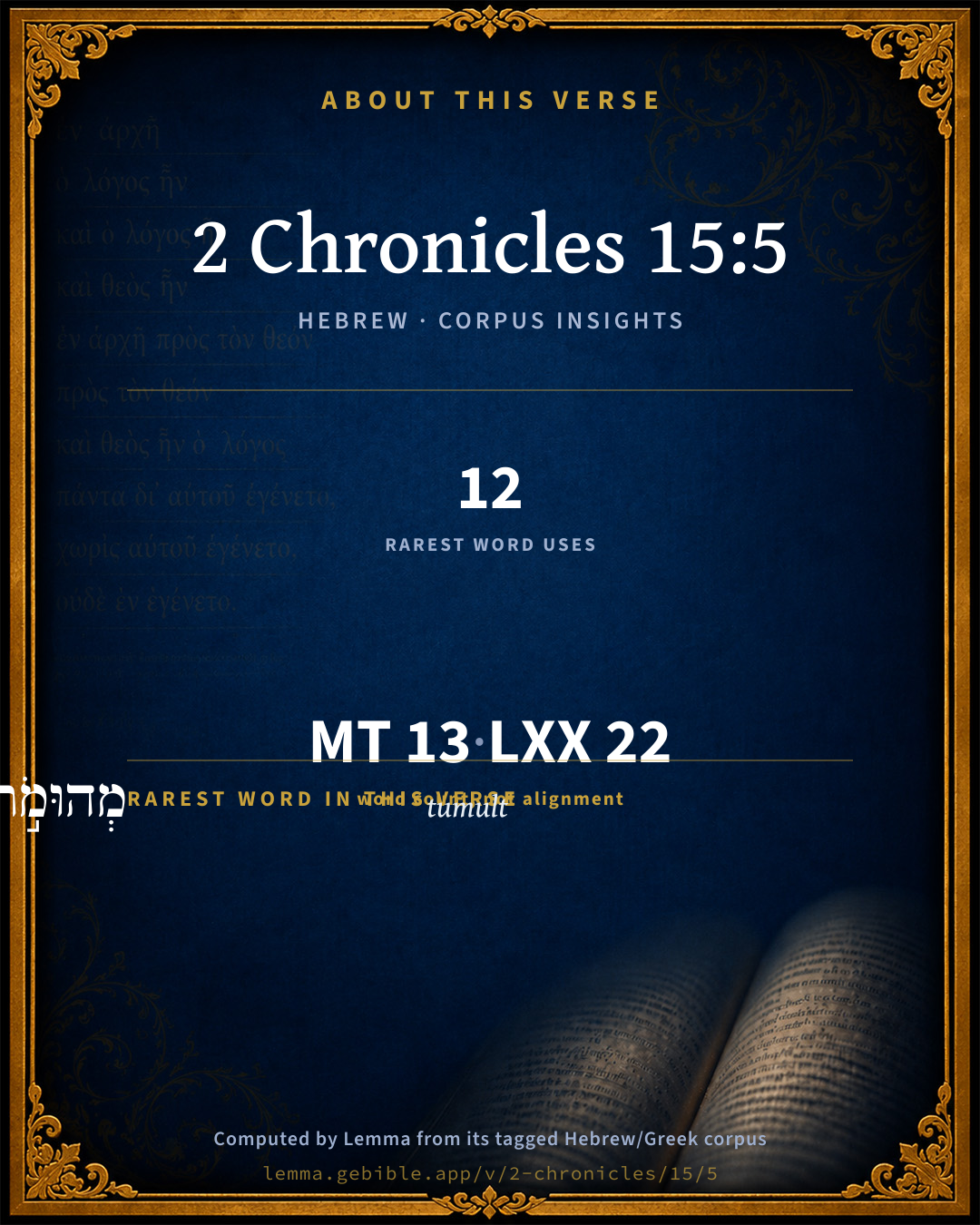
The rarest word here is מְהוּמֹ֣ת tumult H4103 — appearing just 12 times in the whole Hebrew Bible.

Shared distinctive vocabulary

מְהוּמֹ֣ת tumult H4103 occurs in 12 verses of the Hebrew Bible. Also found in:

Grammatical profile

  • 3 verbs
  • 5 nouns
  • 1 adjective
  • 1 pronoun
  • 1 preposition
  • 1 conjunction
  • 1 particle

Verb forms

  • לַיּוֹצֵ֣א Qal · Participle Active
  • וְלַבָּ֑א Qal · Participle Active
  • יוֹשְׁבֵ֖י Qal · Participle Active

Hebrew & Septuagint length

In English translation the verse runs 29 words from the Hebrew and 30 from the Septuagint (LXX English) — closely comparable.

A rough comparison of the two English renderings, which tokenize alike — not a word-level alignment.

Word counts can differ between the Hebrew and the Greek without any difference in meaning — e.g. the Hebrew direct-object marker אֵת has no separate Greek word, and Greek often adds the article ὁ.

In the original languages it is 13 Hebrew tokens and 22 Greek tokens — but the two are counted differently (Hebrew bundles its prefixes and suffixes into one token; the Greek is in lemma form), so that isn’t a like-for-like length.

Cross-references

5

Topical passages linked to 2 Chronicles 15:5 in the Treasury of Scripture Knowledge — connected by theme and wording, ordered by reader-vote popularity; previews shown in the World English Bible.

  • Judges 5:6 In the days of Shamgar the son of Anath, In the days of Jael, the highways were unoccupied, The travelers walked through byways.
  • Psalms 121:8 Yahweh will keep your going out and your coming in, From this time forth, and forevermore.
  • 1 Samuel 13:6 When the men of Israel saw that they were in a strait (for the people were distressed), then the people did hide themselves in caves, and in thickets, and in rocks, and in coverts, and in pits.
  • Matthew 24:6–7 You will hear of wars and rumors of wars. See that you aren't troubled, for all this must happen, but the end is not yet.
  • Luke 21:25 There will be signs in the sun, moon, and stars; and on the earth anxiety of nations, in perplexity for the roaring of the sea and the waves;

Cross-references courtesy of OpenBible.info (CC BY 4.0).

Hebrew and Greek witnesses Masoretic Hebrew ↔ Greek Septuagint

The same verse in the two great witnesses to the Old Testament, shown verse-for-verse.

These are two independent witnesses, not word-aligned to each other, and the Septuagint is shown in lemma (dictionary) form.

Hebrew 2 Chronicles 15:5 Masoretic · Westminster Leningrad Codex

וּבָעִתִּ֣ים הָהֵ֔ם אֵ֥ין שָׁל֖וֹם לַיּוֹצֵ֣א וְלַבָּ֑א כִּ֚י מְהוּמֹ֣ת רַבּ֔וֹת עַ֥ל כָּל יוֹשְׁבֵ֖י הָאֲרָצֽוֹת

In those times there was no peace to him who went out, nor to him who came in; but great vexations were on all the inhabitants of the lands.

World English Bible · Public Domain

Greek LXX 2 Chronicles 15:5 Septuagint · lemma form

καί ἐν ἐκεῖνος ὁ καιρός οὐ εἰμί εἰρήνη ὁ ἐκπορεύομαι καί ὁ εἰςπορεύομαι ὅτι ἔκστασις κύριος ἐπί πᾶς ὁ καταοἰκέω ὁ χώρα

And in that time there is no peace to one going out, or to one coming in, for the terror of the Lord is upon all that inhabit the lands.

LXX2012 (modern English Septuagint) · Public Domain

Hebrew: Westminster Leningrad Codex (CC BY 4.0). Greek: Septuagint (public domain); English from LXX2012 (modern English Septuagint) (Public Domain). How the Septuagint differs from the Hebrew →

Commentary

Notes on 2 Chronicles 15:5 from classic Christian and Jewish commentators (each source and its license shown beneath its notes). The classic Christian expositions comment on the surrounding passage and are grouped to its opening verse, so a note may address several verses; the Jewish commentaries on the Tanakh (Rashi and others) are per-verse, so they appear only where the commentator wrote on this verse.

Lemma curates 59 commentaries, every one of them public domain or Creative Commons licensed, each selected and text-cleaned for this edition rather than reprinted as found. About our sources →

Trapp's Complete Commentary

John Trapp

2Ch 15:5 And in those times [there was] no peace to him that went out, nor to him that came in, but great vexations [were] upon all the inhabitants of the countries.

Ver. 5. And in those times there was no peace,] i.e., After their apostasy from God, and their revolt from the house of David, they have had an ill time of it, being harrowed with continual wars and oppressions. And were not we in as bad condition recently here in England? Blessed be God for better times!

John Trapp, A Commentary or Exposition upon All the Books of the Old and New Testament (1647–1656) — public domain. Text from a community e-Sword module.

Joseph Benson's Commentary

2Ch 15:5. In those times — When Israel lived in the gross neglect of God and his law; there was no peace to him that went out, &c. — Men could not go abroad about their private business without great danger; as it was in the days of Shamgar, the events of which time are a good comment on this text, Jdg 5:6. Great vexations were upon all the inhabitants of the countries — Hebrew, Of these countries: that is, the various parts of the land of Israel, both within and without Jordan.

Joseph Benson's Commentary on the Old and New Testaments (1811–1818) — public domain. Text from a community e-Sword module.

Tyndale Open Study Notes

Tyndale Open Resources

15:5 it was not safe to travel: Cp. Judg 5:6-8; Zech 8:10.

Tyndale Open Study Notes — © Tyndale Open Resources, licensed CC BY-SA 4.0. Text via the HelloAO Bible API.

Adam Clarke's Commentary

Verse 5. But great vexations] Does not our Lord allude to this and the following verse in Mt 24:6-7; Mt 24:9; Mt 24:13?

Adam Clarke's Commentary on the Bible (1810–1826) — public domain. Text from a community e-Sword/MySword module.

Ellicott's Commentary for English Readers

(5) And in those times.—The “many days” cf. 2Ch_15:3; the times of national unfaithfulness.

There was no peace . . . came in.—(See Jdg_5:6; Jdg_5:11; Jdg_6:11.)

But great vexations.—For great confusions (mehûmôth). (See Deu_28:20, where mehûmah, “confusion” or “discomfiture,” is foretold as a punishment of apostacy. Here the meaning seems to be tumults, as in Amo_3:9. “The countries” are the territories or provinces of Israel, as in 2Ch_34:33.

A Bible Commentary for English Readers, edited by Charles John Ellicott (1878–1897) — public domain. Text from a community e-Sword module.

The Cambridge Bible for Schools and Colleges

gen. ed. J. J. S. Perowne

5. vexations] Rather, afflictions; cp. Act_12:1, “to vex (R.V. ‘to afflict’) certain of the Church.”

of the countries] R.V. of the lands. The reference is probably to the Israelite territory only; cp. 2Ch_11:23 (R.V.); 2Ch_34:33; and 1Ch_13:2 (R.V. mg.).

The Cambridge Bible for Schools and Colleges (gen. ed. J. J. S. Perowne; Cambridge University Press, 1878–1918) — public domain. Text from a community e-Sword module.

John Gill's Exposition

And in those times there was no peace to him that went out nor to him that came in,.... There was no safety in going abroad for travellers from one part to another on account of trade and business, the highways being infested with thieves and robbers:

but great vexations were upon all the inhabitants of the countries; of the country villages, which were deserted, because of the plunders and depredations of them, Jdg 5:6.

John Gill's Exposition of the Whole Bible (1746–1763) — public domain (CC PDM 1.0). Text via the HelloAO Bible API.

Haydock's Catholic Bible Commentary

Cometh in, in public or private transactions. See Leviticus xxvi. 36.

George Leo Haydock (1774–1849), Haydock's Catholic Family Bible and Commentary, 1859 edition — public domain. Excludes Psalms (Douay-Rheims chapter numbering differs from Protestant) and Deuterocanonical books (Catholic canon only).

Matthew Poole's English Annotations

In those times; when Israel lived in the gross neglect and contempt of God, and his law and worship.

No peace to him that went out, nor to him that came in; men could not go abroad about their private occasions without great danger; as it was in the days of Shamgar, Jdg 5:6, which is a good comment upon this text.

Of the countries, Heb. of these countries, i.e. the divers parts of the land of Israel, both within and without Jordan.

Matthew Poole's English Annotations on the Holy Bible (1683–1685) — public domain. Text from a community e-Sword/MySword module.

Whedon's Commentary on the Bible

Daniel D. Whedon

5. No peace… but great vexations — As when the highways were untravelled, (Jdg_5:6,) and the people sought asylum in the mountains and caves. Jdg_6:2.

The countries — The various districts of the land of Israel.

Daniel D. Whedon (gen. ed.), Commentary on the Old and New Testaments (1874–1909) — public domain. Text from a community e-Sword module.

John Wesley's Explanatory Notes

In those times - When Israel lived in the gross neglect of God and his law. No peace - Men could not go abroad about their private occasions without great danger; as it was in the days of Shamgar, Judg. v, 6.

John Wesley, Explanatory Notes Upon the Whole Bible (1754–1765) — public domain. Text via the GEBible commentary corpus.

Keil & Delitzsch

C. F. Keil & F. Delitzsch

"And in these times is no peace to those going out or to those coming in." Free peaceful intercommunication is interfered with (cf. Jdg 5:6; Jdg 6:2), but great terrors upon all inhabitants of the lands (הערצות are, according to the usage of the chronicler, the various districts of the land of Israel).

Keil & Delitzsch — Biblical Commentary on the Old Testament (1861–1891) — public domain (CC PDM 1.0). Text via the HelloAO Bible API. (Old Testament only.)

Rashi

Rabbi Shlomo Yitzchaki (Rashi)

And in those times in those numerous days for Israel, [when they were] without a true God there was no peace for anyone going or coming, etc. Concerning Rehoboam it is written (above 12: 2): “Shishak, the king of Egypt, marched against Jerusalem, for they had betrayed the Lord.” Abijah also experienced many turmoils.

Rashi on the Tanakh — English translations: “The Judaica Press complete Tanach with Rashi, translated by A. J. Rosenberg” (CC BY 4.0); “Pentateuch with Rashi's commentary by M. Rosenbaum and A.M. Silbermann, 1929-1934” (public domain); “The Metsudah Tanach series, Lakewood, N.J” (CC BY 4.0); and “The Book of Joshua, Metsudah Publications, 1997” (CC BY 4.0). Text via Sefaria.

Lesson kit

Teaching starters — assembled from the data on this page, not authored interpretation. Every prompt links to the verse data it draws on. Edit before teaching.

2 Chronicles, in the Historical, opens this verse with 13 words (13 distinct Hebrew lemmas). Its most distinctive word is mᵉhûwmâh (“tumult”). A historical commentator’s framing appears above. Read the whole chapter for the surrounding context.

Discussion questions

  1. The word mᵉhûwmâh carries the sense “tumult.” How does it shape the verse?
  2. How does Deuteronomy 7:23, which shares the word «tumult», read alongside this verse?
  3. The translations on this page render this verse differently — a whole-verse word diff, not a word-by-word alignment. What might account for the different wordings?
  4. «לַיּוֹצֵ֣א» is a Qal Participle Active verb. How does that grammatical form shape the action described?
  5. Compare how Trapp's Complete Commentary and Joseph Benson's Commentary read this verse. Where do they agree or differ?

Things to notice

Reading settings

Reading text

Shown beneath each verse's original-language words.

Old Testament
Old Testament edition

Read the OT as the Masoretic Hebrew (MT) or the Greek Septuagint (LXX).

English shown for the Greek Septuagint (in the Hebrew ↔ Greek comparison).

Comparing translations? Open the Compare panel on any verse page to stack up to four side by side.