Amos 3:15

Hebrew (Westminster Leningrad Codex) Amos 3:15 appears in the Hebrew Old Testament. The text above is from the Westminster Leningrad Codex. Each word links to its Strong’s number, a concise gloss, and parsing drawn from the Open Scriptures Hebrew Bible morphology. Click any word for its full Brown-Driver-Briggs (BDB) entry.
Download image
Cite this verse

Amos 3:15 (World English Bible). Public Domain. Lemma interlinear Bible study tool, https://lemma.gebible.app/v/amos/3/15.

Show BibTeX & RIS
BibTeX
RIS
English Translation
I will strike the winter house with the summer house; And the houses of ivory will perish, And the great houses will have an end," says Yahweh.
World English Bible · Public Domain
Download a study sheet

One document with this verse’s original text, its word-by-word gloss line, the meaning frame, cross-references with their text, attributed commentary, and full source and license credits — printable, and it pastes into notes with its structure intact.

This verse Autodidact and up

Study sheet (.html) Plain text (.txt)

A passage Seminary Student

Up to 50 verses in one chapter. A passage sheet keeps up to 6 commentary sources and 12 cross-references per verse, in the order this page ranks them, and says so on the sheet whenever that leaves anything out. Ask for a single verse and you get the Autodidact verse sheet above.

Everything on this page stays free to read, with no account — the sheet is a download of what is already on screen, not access to it.

Want to remove ads? Support Godless Engineer
Compare translations 3

The same verse in 3 English versions, stacked beneath the original-language interlinear above. Click any original word for its lexicon entry.

Each is an independent rendering of the whole verse — the interlinear is not word-aligned to these translations.

Highlighted words mark where these versions differ — a whole-verse word diff, not a word-by-word alignment.

  • World English Bible Public Domain
    I will strike the winter house with the summer house; And the houses of ivory will perish, And the great houses will have an end," says Yahweh.
  • King James Version Public Domain
    And I will smite the winter house with the summer house; and the houses of ivory shall perish, and the great houses shall have an end, saith the LORD.
  • unfoldingWord Literal Text CC BY-SA 4.0
    I will destroy the winter house with the summer house. The houses of ivory will perish, and the large houses will vanish— this is Yahweh’s declaration.”

unfoldingWord Literal Text — © unfoldingWord, licensed CC BY-SA 4.0. Word-aligned USFM3 via Door43 (git.door43.org/unfoldingWord/en_ult).

Versions to compare (up to 4)

3 of 4 selected

Show all 18 translations

Every available English version of this verse, each an independent rendering of the whole verse.

  • World English Bible Public Domain
    I will strike the winter house with the summer house; And the houses of ivory will perish, And the great houses will have an end," says Yahweh.
  • Berean Standard Bible Public Domain
    I will tear down the winter house along with the summer house; the houses of ivory will also perish, and the great houses will come to an end,” declares the LORD.
  • Majority Standard Bible Public Domain
    I will tear down the winter house along with the summer house; the houses of ivory will also perish, and the great houses will come to an end,” declares the LORD.
  • King James Version Public Domain
    And I will smite the winter house with the summer house; and the houses of ivory shall perish, and the great houses shall have an end, saith the LORD.
  • American Standard Version (1901) Public Domain
    And I will smite the winter-house with the summer-house; and the houses of ivory shall perish, and the great houses shall have an end, saith Jehovah.
  • Revised Version (1885) Public Domain
    And I will smite the winter house with the summer house; and the houses of ivory shall perish, and the great houses shall have an end, saith the LORD.
  • Geneva Bible (1599) Public Domain
    And I wil smite the winter house with the sommer house, and the houses of yuorie shall perish, and the great houses shalbe consumed, sayth the Lord.
  • Douay-Rheims (1899) Public Domain
    And I will strike the winter house with the summer house: and the houses of ivory shall perish, and many houses shall be destroyed, saith the Lord.
  • Young's Literal Translation Public Domain
    And I have smitten the winter-house with the summer-house, And perished have houses of ivory, And consumed have been many houses, An affirmation of Jehovah!
  • Literal Standard Version CC BY-SA 4.0
    And I have struck the winter-house with the summer-house, || And houses of ivory have perished, || And many houses have been consumed,” || A declaration of YHWH!
  • Unlocked Literal Bible CC BY-SA 4.0
    I will destroy the winter house with the summer house. The houses of ivory will perish, and the large houses will vanish, —this is Yahweh's declaration.”
  • unfoldingWord Literal Text CC BY-SA 4.0
    I will destroy the winter house with the summer house. The houses of ivory will perish, and the large houses will vanish— this is Yahweh’s declaration.”
  • Darby Bible Public Domain
    And I will smite the winter-house with the summer-house; and the houses of ivory shall perish, and many houses shall have an end, saith Jehovah.
  • World Messianic Bible Public Domain
    I will strike the winter house with the summer house; and the houses of ivory will perish, and the great houses will have an end,” says the LORD.
  • Webster's Bible Public Domain
    And I will smite the winter-house with the summer-house; and the houses of ivory shall perish, and the great houses shall have an end, saith the LORD.
  • Free Bible Version CC BY-SA 4.0
    I will tear down their winter houses and their summer houses as well, their houses filled with ivory will be ruined—their many houses will be destroyed.
  • Bible in Basic English Public Domain
    And I will send destruction on the winter house with the summer house; the ivory houses will be falling down and the great houses will come to an end, says the Lord.
  • JPS Tanakh (1917) Public Domain
    And I will smite the winter-house with the summer-house; and the houses of ivory shall perish, and the great houses shall have an end, saith the LORD.

Literal Standard Version (2020), Covenant Press — licensed CC BY-SA 4.0. Text via the HelloAO Bible API (eBible.org). Unlocked Literal Bible (unfoldingWord) — licensed CC BY-SA 4.0. Text via the HelloAO Bible API (eBible.org). unfoldingWord Literal Text — © unfoldingWord, licensed CC BY-SA 4.0. Word-aligned USFM3 via Door43 (git.door43.org/unfoldingWord/en_ult). Free Bible Version, Dr. Jonathan Gallagher — licensed CC BY-SA 4.0. Text via the HelloAO Bible API (eBible.org).

Word by word

More ways to search: Search by grammar → Find every occurrence → Compare this word →

Practice this passage: Drill this verse → Learn its vocabulary →

וְסָפ֛וּ
çûwph
H5486
“and · to cease”
Conjunction + Verb, Qal, Sequential Perfect, 3rd Person, Common, Plural
Part of Speech
Conjunction + Verb
Stem
Qal
Form
Sequential Perfect
Person
3rd Person
Gender
Common
Number
Plural
Full BDB Definition

Origin: a primitive root

TWOT: 1478

to cease, come to an end - (Qal) to come to an end - (Hiphil) to make an end
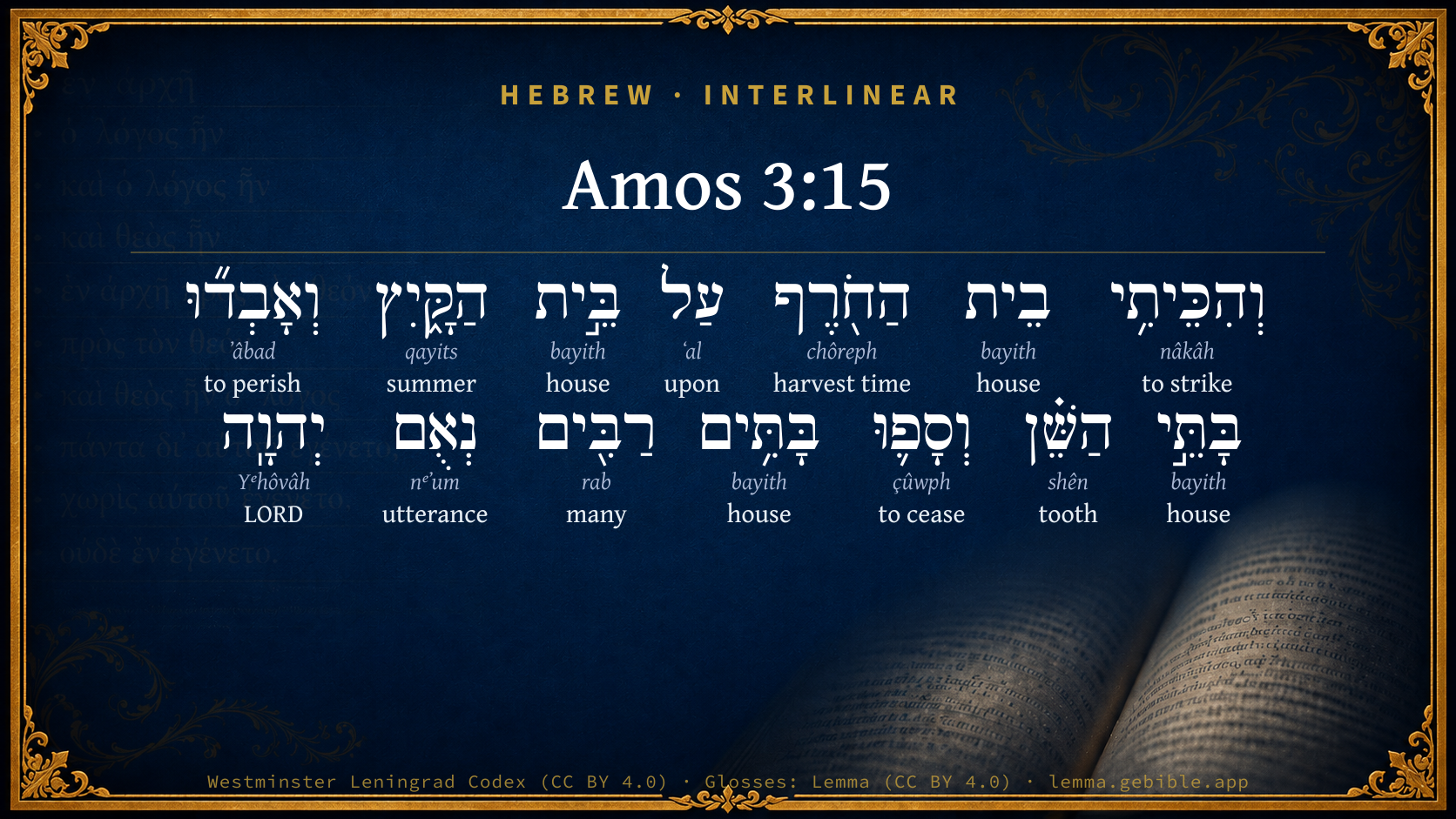
  1. וְהִכֵּיתִ֥י nâkâh H5221 “and · to strike” Conjunction + Verb, Hiphil, Sequential Perfect, 1st Person, Common, Singular
  2. בֵית bayith H1004 “house of” Noun, Common, Masculine, Singular, Construct
  3. הַחֹ֖רֶף chôreph H2779 “the · harvest time” Particle, Definite Article + Noun, Common, Masculine, Singular, Absolute
  4. עַל ʻal H5921 “upon” Preposition
  5. בֵּ֣ית bayith H1004 “house of” Noun, Common, Masculine, Singular, Construct
  6. הַקָּ֑יִץ qayits H7019 “the · summer” Particle, Definite Article + Noun, Common, Masculine, Singular, Absolute
  7. וְאָבְד֞וּ ʼâbad H6 “and · to perish” Conjunction + Verb, Qal, Sequential Perfect, 3rd Person, Common, Plural
  8. בָּתֵּ֣י bayith H1004 “houses of” Noun, Common, Masculine, Plural, Construct
  9. הַשֵּׁ֗ן shên H8127 “the · tooth” Particle, Definite Article + Noun, Common, Both, Singular, Absolute
  10. בָּתִּ֥ים bayith H1004 “houses” Noun, Common, Masculine, Plural, Absolute
  11. רַבִּ֖ים rab H7227 “many” Adjective, Adjective, Masculine, Plural, Absolute
  12. נְאֻם nᵉʼum H5002 “utterance of” Noun, Common, Masculine, Singular, Construct
  13. יְהוָֽה Yᵉhôvâh H3068 “LORD” Noun, Proper

About this verse

These counts appear in no published source. They are computed here, from the morphology-tagged text and Lemma’s own curated glosses. What Lemma adds →

14
words
11
distinct lemmas
Prophets
section

Notable vocabulary

The rarest word here is וְסָפ֛וּ to cease H5486 — appearing just 6 times in the whole Hebrew Bible.

Shared distinctive vocabulary

וְסָפ֛וּ to cease H5486 occurs in 6 verses of the Hebrew Bible. Also found in:

Grammatical profile

  • 3 verbs
  • 9 nouns
  • 1 adjective
  • 1 preposition

Verb forms

  • וְהִכֵּיתִ֥י Hiphil · Sequential Perfect
  • וְאָבְד֞וּ Qal · Sequential Perfect
  • וְסָפ֛וּ Qal · Sequential Perfect

Repetition

A word recurs within this verse — often emphatic in Hebrew:

  • בֵית house H1004 ×4

Hebrew & Septuagint length

In English translation the verse runs 27 words from the Hebrew and 24 from the Septuagint (LXX English) — closely comparable.

A rough comparison of the two English renderings, which tokenize alike — not a word-level alignment.

Word counts can differ between the Hebrew and the Greek without any difference in meaning — e.g. the Hebrew direct-object marker אֵת has no separate Greek word, and Greek often adds the article ὁ.

In the original languages it is 14 Hebrew tokens and 23 Greek tokens — but the two are counted differently (Hebrew bundles its prefixes and suffixes into one token; the Greek is in lemma form), so that isn’t a like-for-like length.

Cross-references

7

Topical passages linked to Amos 3:15 in the Treasury of Scripture Knowledge — connected by theme and wording, ordered by reader-vote popularity; previews shown in the World English Bible.

  • 1 Kings 22:39 Now the rest of the acts of Ahab, and all that he did, and the ivory house which he built, and all the cities that he built, aren't they written in the book of the chronicles of the kings of Israel?
  • Jeremiah 36:22 Now the king was sitting in the winter-house in the ninth month: and [there was a fire in] the brazier burning before him.
  • Amos 6:11 "For, behold, Yahweh commands, and the great house will be smashed to pieces, And the little house into bits.
  • Judges 3:20 Ehud came to him; and he was sitting by himself alone in the cool upper room. Ehud said, I have a message from God to you. He arose out of his seat.
  • Isaiah 5:9 In my ears, Yahweh of Hosts says: "Surely many houses will be desolate, Even great and beautiful, unoccupied.
  • Psalms 45:8 All your garments smell like myrrh, aloes, and cassia. Out of ivory palaces stringed instruments have made you glad.
  • Amos 3:11 Therefore thus says the Lord Yahweh: "An adversary will overrun the land; And he will pull down your strongholds, And your fortresses will be plundered."

Cross-references courtesy of OpenBible.info (CC BY 4.0).

Hebrew and Greek witnesses Masoretic Hebrew ↔ Greek Septuagint

The same verse in the two great witnesses to the Old Testament, shown verse-for-verse.

These are two independent witnesses, not word-aligned to each other, and the Septuagint is shown in lemma (dictionary) form.

Hebrew Amos 3:15 Masoretic · Westminster Leningrad Codex

וְהִכֵּיתִ֥י בֵית הַחֹ֖רֶף עַל בֵּ֣ית הַקָּ֑יִץ וְאָבְד֞וּ בָּתֵּ֣י הַשֵּׁ֗ן וְסָפ֛וּ בָּתִּ֥ים רַבִּ֖ים נְאֻם יְהוָֽה

I will strike the winter house with the summer house; And the houses of ivory will perish, And the great houses will have an end," says Yahweh.

World English Bible · Public Domain

Greek LXX Amos 3:15 Septuagint · lemma form

συνχέω καί πατάσσω ὁ οἶκος ὁ περίπτερος ἐπί ὁ οἶκος ὁ θερινός καί ἀποὀλλύω οἶκος ἐλεφάντινος καί προςτίθημι οἶκος ἕτερος πολύς λέγω κύριος

I will crush and strike the turreted-house upon the summer-house; and the ivory-houses shall be destroyed, and many other houses also, says the Lord.

LXX2012 (modern English Septuagint) · Public Domain

On this verse, Haydock's Catholic Bible Commentary discusses the Septuagint’s reading. Read the note in Commentary ↓

Hebrew: Westminster Leningrad Codex (CC BY 4.0). Greek: Septuagint (public domain); English from LXX2012 (modern English Septuagint) (Public Domain). How the Septuagint differs from the Hebrew →

Targum (Aramaic paraphrase)

1

The Targum is the ancient Jewish Aramaic paraphrase of the Hebrew Scriptures — an interpretive translation, not the Hebrew text itself. Onkelos (literal) and Pseudo-Jonathan (expansive) render the Torah, and Jonathan the Prophets. Coverage is partial: where no permissively-licensed English translation exists for a verse, only the Aramaic is shown. This is verse-level text, not a word-by-word alignment to the Hebrew.

  1. Targum Jonathan Prophets (Joshua–Malachi)
    וְאֶמְחֵי בֵּית סִתְוָא עַל בֵּית קַיְטָא וְיֵיבְדוּן בָּתִּין דִמְכַבְּשִׁין בְּשֵׁן דְפִיל וִיסוּפוּן בָּתִּין סַגִיאִין אֲמַר יְיָ:

    (no public-domain English translation for this verse)

    Targum Jonathan — Aramaic: “Mikraot Gedolot” (public domain). English: “Sefaria Community Translation” (CC0 1.0 (public-domain dedication)); “London "Chaldee Paraphrase," 1871” (public domain). Text via Sefaria.

Commentary

Notes on Amos 3:15 from classic Christian and Jewish commentators (each source and its license shown beneath its notes). The classic Christian expositions comment on the surrounding passage and are grouped to its opening verse, so a note may address several verses; the Jewish commentaries on the Tanakh (Rashi and others) are per-verse, so they appear only where the commentator wrote on this verse.

Lemma curates 59 commentaries, every one of them public domain or Creative Commons licensed, each selected and text-cleaned for this edition rather than reprinted as found. About our sources →

Trapp's Complete Commentary

John Trapp

Amo 3:15 And I will smite the winter house with the summer house; and the houses of ivory shall perish, and the great houses shall have an end, saith the LORD.

Ver. 15. And I will smite the winter house with the summer house] Heb. upon the summer house, I will lay them both on one heap; they shall one dash against the other. To have change of houses or of rooms in one house fit for the several seasons is not unlawful, so we set them not up by wrong dealing, nor set our hearts upon them ( Haec sunt quae nos invitos faciunt mori); for so we are apt to do (as Charles V, emperor, told the Duke of Venice, who had showed him his stately palace), and this brings a curse.

And the houses of ivory] i.e. decked and enamelled, checkered and entrailed with ivory ( eboratus), as some sense it. Ahab had made him an ivory house, Heb. a house of tooth, i.e. of elephant’s tooth: so did other kings (likely) after him. The Porphyrogeniti in Constantinople were born in a room made of porphyry, a precious stone, &c. All must down together.

John Trapp, A Commentary or Exposition upon All the Books of the Old and New Testament (1647–1656) — public domain. Text from a community e-Sword module.

The Biblical Illustrator

Joseph S. Exell

Amo_3:15

And I will smite the winter house with the summer house; and the houses of ivory shall perish, and the great houses shall have an end, saith the Lord.

The houses of ivory

A devout attention to the passing operations of providence is repaid abundantly in our increased knowledge of God, as a mans character is discerned by his deeds; and as We are wont to say, Actions speak louder than words, so the character of God is learned by His providence. A due attention to both revelations of God--in His Word and in His works--will be found of essential service to the better understanding and embrace of both. Gods works are the dramatic parable; the practical commentary upon His Word--they reflect light severally on each other. The obscurities of providence are elucidated by Scripture, and the declarations of Scripture are verified by providence. We are apt to be peculiarly affected at the spectacle of fallen greatness. When by calamity or death God calls upon princes to remember that they are but men, we are proportionably affected by their visitation. Let us earnestly pray that the Lord may make this voice of departed royalty a proclamation of warning to all our souls, that so the bereavement which has clothed the nation in the form of mourning may be the means of bringing real sorrow after a godly sort into our hearts. (Joseph B. Owen, M. A.)

The Biblical Illustrator, edited by Joseph S. Exell (c. 1880s–1900s) — public domain. Text from a community e-Sword module.

Tyndale Open Study Notes

Tyndale Open Resources

3:15 Ivory represents the immense, ill-gotten wealth of the rich. Archaeologists have found some of these ivory inlays in the ruins of Samaria.

Tyndale Open Study Notes — © Tyndale Open Resources, licensed CC BY-SA 4.0. Text via the HelloAO Bible API.

Jamieson, Fausset & Brown

Robert Jamieson, A. R. Fausset & David Brown

winter . . . summer house-- (Jdg 3:20; Jer 36:22). Winter houses of the great were in sheltered positions facing the south to get all possible sunshine, summer houses in forests and on hills, facing the east and north.

houses of ivory--having their walls, doors, and ceilings inlaid with ivory. So Ahab's house (Kg1 22:39; Psa 45:8).

Next: Amos Chapter 4

Jamieson, Fausset & Brown — Commentary Critical and Explanatory on the Whole Bible (1871) — public domain (CC PDM 1.0). Text via the HelloAO Bible API.

Adam Clarke's Commentary

Verse 15. I will smite the winter house with the summer house] I will not only destroy the poor habitations and villages in the country, but I will destroy those of the nobility and gentry as well as the lofty palaces in the fortified cities in which they dwell in the winter season, as those light and elegant seats in which they spend the summer season. Dr. Shaw observes that "the hills and valleys round about Algiers are all over beautified with gardens and country seats, whither the inhabitants of better fashion retire during the heats of the summer season. They are little white houses, shaded with a variety of fruit trees and evergreens, which beside shade and retirement, afford a gay and delightful prospect toward the sea. The gardens are all well stocked with melons, fruits, and pot herbs of all kinds; and (which is chiefly regarded in these hot countries) each of them enjoys a great command of water."

And the houses of ivory] Those remarkable for their magnificence and their ornaments, not built of ivory, but in which ivory vessels, ornaments, and inlaying abounded. Thus, then, the winter houses and the summer houses, the great houses and the houses of uncommon splendour, shall all perish. There should be a total desolation in the land. No kind of house should be a refuge, and no kind of habitation should be spared. Ahab had at Samaria a house that was called the ivory house, 1Kg 22:39. This may be particularly referred to in this place. We cannot suppose that a house constructed entirely of ivory can be intended.

Adam Clarke's Commentary on the Bible (1810–1826) — public domain. Text from a community e-Sword/MySword module.

John Calvin's Commentaries

Amos shows again that in vain the great people trusted in their wealth and fortified places; for these could not hinder God from drawing them forth to punishment. As then abundance blinds men, and as they imagine themselves to be as it were inaccessible, especially when dwelling in great palaces, the Prophet here declares, that these houses would be no impediment to prevent God’s vengeance to break through; I will then destroy the winter-house together with the summer-house. Amos no doubt intended by this paraphrase to designate the palaces. The poor deem it enough to have a cottage both for winter and summer; for they change not the parts of their buildings, so as to inhabit the hotter in winter, and to refresh themselves in the colder during summer: no such advantage is possessed by the poor, for they are content with the same dwelling through life. But as the rich sought warmth in winter, and had their summer compartments, the Prophet says, that their large and magnificent buildings would be no protection to the rich, for God’s vengeance would penetrate through them; I will destroy then the winter with the summer house

And then he says, Fail shall the houses of ivory. We now see more clearly that the Prophet speaks here against the rich and the wealthy, who inhabited splendid and magnificent palaces. Perish then shall the houses of ivory and fail shall the great houses; some say, many houses, but improperly; for the Prophet continues the same idea; and as he had before mentioned houses of ivory so he now calls them great houses; for they were not only built for use and convenience, like common and plebeian houses, but also for show and display; for the rich, we know, are ever lavish and profuse, not only in their table and dress, but also in their palaces. This is the meaning. Now follows —

John Calvin's Commentaries (1540-1563) — public domain. Text from the Calvin Translation Society English edition (1840s-50s) via the Christian Classics Ethereal Library (ccel.org). Calvin's coverage is partial (roughly two-thirds of the Bible); uncommented books and verses are honest gaps, never fabricated. The 19th-century editor's footnotes and remarks are omitted so the notes are faithfully Calvin's own voice.

Ellicott's Commentary for English Readers

(15) Houses.—It is uncertain whether by “winter and summer houses” are meant two classes of royal abodes, or different chambers of the same house (Jdg_3:20; Jer_36:22, are compatible with either). “Ivory houses” mean mansions adorned with ivory. For “great houses” should be read many houses.

A Bible Commentary for English Readers, edited by Charles John Ellicott (1878–1897) — public domain. Text from a community e-Sword module.

The Cambridge Bible for Schools and Colleges

gen. ed. J. J. S. Perowne

15. the winter house] See Jer_36:22.

with the summer house] Eglon (Jdg_3:20) had a “cool upper story,” i.e. an additional apartment, built on the flat roof of the house, with latticed windows, allowing free circulation for the air (cf. Moore, Judges, pp. 96, 97 f.); but here separate buildings, such as the wealthy might be able to indulge in, appear to be intended. Both terms are to be understood collectively, and not confined to the royal palaces alone. An interesting illustration of the passage has been supplied recently by an almost contemporary inscription from Zinjirli, near Aleppo, in which Bar-rekûb, king of Sham’al, vassal (lit. servant, 2Ki_16:7) of Tiglath-pileser (תגלתפליסר), says he has beautified his father’s house in honour of his ancestors, the kings of Sham’al (i.e. as a mausoleum), “and it is for them a summer-house and a winter-house[149]” (i.e. for perpetual use).

[149] פהא בית שתוא להם והא בית כיצא (Sachau in the Sitzungsberichte of the Berlin Academy, 22 Oct. 1896, p.1052).

houses of ivory] i.e. houses of which the walls were panelled or inlaid with ivory (cf. Psa_45:8; also ch. Amo_6:4). Ahab (1Ki_22:39), it seems, had found imitators.

the great houses] rather many houses (R.V. marg.): cf. Isa_5:9. “The desolation should be wide as well as mighty” (Pusey).

The Cambridge Bible for Schools and Colleges (gen. ed. J. J. S. Perowne; Cambridge University Press, 1878–1918) — public domain. Text from a community e-Sword module.

Albert Barnes' Notes on the Bible

And I will smite the winter house with the summer house - Upon idolatry, there follow luxury and pride. “So wealthy were they,” says Jerome, “as to possess two sorts of houses, “the winter house” being turned to the south, the “summer house” to the north, so that, according to the variety of the seasons, they might temper to them the heat and cold.” Yet of these luxuries, (so much more natural in the East where summer-heat is so intense, and there is so little provision against cold) the only instance expressly recorded, besides this place, is “the winter house” of Jehoiakim. In Greece and Rome , the end was attained, as with us, by north and south rooms in the same house. These, which Amos rebukes, were like our town and country houses, separate residences, since they were to be destroyed, one on the other. “Ivory houses” were houses, paneled, or inlaid, with ivory. Such a palace Ahab built 1Ki 22:39. Even Solomon “in all his glory” had but an ivory throne 1Ki 10:18. Else “ivory palaces” Psa 45:8 are only mentioned, as part of the symbolic glory of the King of glory, the Christ. He adds, “and the great (or many) houses shall have an end, saith the Lord.” So prosperous were they in outward show, when Amos foretold their destruction. The desolation should be wide as well as mighty. All besides should pass away, and the Lord alone abide in that Day. : “What then shall we, if we would be right-minded, learn hence? How utterly nothing will all earthly brightness avail, all wealth, glory, or ought besides of luxury, if the love of God is lacking, and righteousness be not prized by us! For “treasures of wickedness profit nothing; but righteousness delivereth from death” Pro 10:2.

Albert Barnes' Notes on the Bible (1834–1885) — public domain. Text from a community e-Sword/MySword module.

Haydock's Catholic Bible Commentary

Winter. Septuagint, "winged house," to keep off cold, (St. Jerome) or to give air. (Calmet) --- Summer-house. The noblemen had such is cooler regions. (Menochius) --- The kings of Persia passed the summer at Ecbatana. (Xen. Cyr. viii.) --- Palladius (i. 12.) orders that the summer apartments must look to the north. --- Ivory. Many ornaments of this nature appeared in them, (Calmet) whence Achab’s palace was so called, 3 Kings xxii. 39. (Haydock)

George Leo Haydock (1774–1849), Haydock's Catholic Family Bible and Commentary, 1859 edition — public domain. Excludes Psalms (Douay-Rheims chapter numbering differs from Protestant) and Deuterocanonical books (Catholic canon only).

Matthew Poole's English Annotations

I will smite; by the greatness of the desolation it shall appear that God did smite, though by the Assyrian; or perhaps it may refer to the earthquake foretold two years before it came, Amo 1:1.

The winter house; which probably was in the chief city, where the rich and great men retired in the winter time, as more for their delight than the country, horrid and cold, and stripped of its glory.

The summer house; the houses of pleasure, where the nobles and rich men of Israel spent the summer time.

The houses of ivory; not built with, but beautified with ivory, or the elephant’s tooth, called here and elsewhere, by way of eminency, the tooth.

Shall perish; by the violence of the enemies, these stately houses shall be ransacked first, and pulled down next, and left in rubbish.

The great houses; or many, for the word includes both. The magnificent palaces of princes and the nobles of Israel

shall have an end; shall cease for ever, either be utterly wasted, or cease to be theirs whose once they were.

Saith the Lord; all this shall infallibly come to pass and be fulfilled in due time.

Matthew Poole's English Annotations on the Holy Bible (1683–1685) — public domain. Text from a community e-Sword/MySword module.

The Pulpit Commentary

The winter house. The luxurious habits of kings and princes had led them to have different houses for the various seasons of the year, facing north or south as the case might be. (comp. Jud_1:3:20; Jer_36:22) Septuagint, ton oikon topteron, "the turreted house," which Jerome explains, Domum pinnatam, eo quod ostiola habeat per fenestras, et quasi pinnas, ad magnitudinem frigoris depellendam. Houses of ivory; panelled or inlaid with ivory, such as Ahab. (1Ki_22:39) Solomon"s throne was thus decorated. (1Ki_10:18; comp. Psa_45:8) (For the Assyrian practice of veneering in ivory, see Rawlinson, "Ancient Monarchies," 1:463; comp. also Homer, "Od.," 4:73; Virgil, "AEneid," 6:895.) The great houses; better, many houses; Septuagint, eteroi oikoi polloi, "many other houses." Not only palaces, but many private houses, shall be destroyed. (Isa_5:9, where the same words are used)

The Pulpit Commentary (1880–1919), ed. H.D.M. Spence-Jones & Joseph S. Exell — public domain. Text from a community e-Sword module.

John Wesley's Explanatory Notes

The winter-house - Which probably was in the chief city, whither the great men retired in the winter. The summer-house - The houses of pleasure, where the nobles and rich men spent the summer time. Of ivory - Beautified with ivory.

John Wesley, Explanatory Notes Upon the Whole Bible (1754–1765) — public domain. Text via the GEBible commentary corpus.

unfoldingWord translationNotes

Door43 World Missions Community

the winter house with the summer house

Some of the wealthy people had two houses: one that they lived in during the winter and one that they lived in during the summer. This refers to any winter and summer houses. AT: "the houses they live in during the winter and the houses they live in during the summer" (See: Generic Noun Phrases)

The houses of ivory will perish

God speaks of the houses being destroyed as if they were alive and would die. AT: "The houses of ivory will be destroyed" or "The houses of ivory will collapse" (See: Personification)

The houses of ivory

"the houses that are decorated with ivory." This refers to houses that had decorations made of ivory on the walls and furniture. Ivory was very expensive, so only the wealthy people had things decorated with ivory.

ivory

the teeth and horns of large animals

the large houses will vanish

"the large houses will exist no more." Here "vanish" represents being destroyed. AT: "the large houses will be destroyed" (See: Metaphor)

this is Yahweh's declaration

Yahweh speaks of himself by name to express the certainty of what he is declaring. See how you translated this in Amos 2:11. AT: "this is what Yahweh has declared" or "this is what I, Yahweh, have declared" (See: First, Second, or Third Person)

translationWords

perish

unfoldingWord translationNotes — © Distant Shores Media and the Door43 World Missions Community, licensed CC BY-SA 4.0. Source: git.door43.org/Door43/en_tn.

Rashi

Rabbi Shlomo Yitzchaki (Rashi)

the winter house with the summer house—Since they were delicate, the wealthy people would build for themselves two houses, one for the winter and one for the summer.

ivory houses—Which are paneled with ivory. [from Jonathan]

Rashi on the Tanakh — English translations: “The Judaica Press complete Tanach with Rashi, translated by A. J. Rosenberg” (CC BY 4.0); “Pentateuch with Rashi's commentary by M. Rosenbaum and A.M. Silbermann, 1929-1934” (public domain); “The Metsudah Tanach series, Lakewood, N.J” (CC BY 4.0); and “The Book of Joshua, Metsudah Publications, 1997” (CC BY 4.0). Text via Sefaria.

Lesson kit

Teaching starters — assembled from the data on this page, not authored interpretation. Every prompt links to the verse data it draws on. Edit before teaching.

Amos, in the Prophets, opens this verse with 14 words (11 distinct Hebrew lemmas). Its most distinctive word is çûwph (“to cease”). A historical commentator’s framing appears above. Read the whole chapter for the surrounding context.

Discussion questions

  1. What does “to cease” (çûwph) contribute to the verse as a whole?
  2. How does Esther 9:28, which shares the word «to cease», read alongside this verse?
  3. What does the repetition of “house” (4× in this one verse) do in this verse?
  4. The translations on this page render this verse differently — a whole-verse word diff, not a word-by-word alignment. What might account for the different wordings?
  5. «וְהִכֵּיתִ֥י» is a Hiphil Sequential Perfect verb. How does that grammatical form shape the action described?
  6. Compare how Trapp's Complete Commentary and The Biblical Illustrator read this verse. Where do they agree or differ?

Things to notice

Reading settings

Reading text

Shown beneath each verse's original-language words.

Old Testament
Old Testament edition

Read the OT as the Masoretic Hebrew (MT) or the Greek Septuagint (LXX).

English shown for the Greek Septuagint (in the Hebrew ↔ Greek comparison).

Comparing translations? Open the Compare panel on any verse page to stack up to four side by side.