

Psalms 123:3

Hebrew (Westminster Leningrad Codex) Psalms 123:3 appears in the Hebrew Old Testament. The text above is from the Westminster Leningrad Codex. Each word links to its Strong’s number, a concise gloss, and parsing drawn from the Open Scriptures Hebrew Bible morphology. Click any word for its full Brown-Driver-Briggs (BDB) entry.
Download image
Cite this verse

Psalms 123:3 (World English Bible). Public Domain. Lemma interlinear Bible study tool, https://lemma.gebible.app/v/psalms/123/3.

Show BibTeX & RIS
BibTeX
RIS
English Translation
Have mercy on us, Yahweh, have mercy on us, For we have endured much contempt.
World English Bible · Public Domain
Download a study sheet

One document with this verse’s original text, its word-by-word gloss line, the meaning frame, cross-references with their text, attributed commentary, and full source and license credits — printable, and it pastes into notes with its structure intact.

This verse Autodidact and up

Study sheet (.html) Plain text (.txt)

A passage Seminary Student

Up to 50 verses in one chapter. A passage sheet keeps up to 6 commentary sources and 12 cross-references per verse, in the order this page ranks them, and says so on the sheet whenever that leaves anything out. Ask for a single verse and you get the Autodidact verse sheet above.

Everything on this page stays free to read, with no account — the sheet is a download of what is already on screen, not access to it.

Want to remove ads? Support Godless Engineer
Compare translations 3

The same verse in 3 English versions, stacked beneath the original-language interlinear above. Click any original word for its lexicon entry.

Each is an independent rendering of the whole verse — the interlinear is not word-aligned to these translations.

Highlighted words mark where these versions differ — a whole-verse word diff, not a word-by-word alignment.

  • World English Bible Public Domain
    Have mercy on us, Yahweh, have mercy on us, For we have endured much contempt.
  • King James Version Public Domain
    Have mercy upon us, O LORD, have mercy upon us: for we are exceedingly filled with contempt.
  • unfoldingWord Literal Text CC BY-SA 4.0
    Be gracious to us, Yahweh, be gracious to us, for we are greatly satiated with contempt.

unfoldingWord Literal Text — © unfoldingWord, licensed CC BY-SA 4.0. Word-aligned USFM3 via Door43 (git.door43.org/unfoldingWord/en_ult).

Versions to compare (up to 4)

3 of 4 selected

Show all 18 translations

Every available English version of this verse, each an independent rendering of the whole verse.

  • World English Bible Public Domain
    Have mercy on us, Yahweh, have mercy on us, For we have endured much contempt.
  • Berean Standard Bible Public Domain
    Have mercy on us, O LORD, have mercy, for we have endured much contempt.
  • Majority Standard Bible Public Domain
    Have mercy on us, O LORD, have mercy, for we have endured much contempt.
  • King James Version Public Domain
    Have mercy upon us, O LORD, have mercy upon us: for we are exceedingly filled with contempt.
  • American Standard Version (1901) Public Domain
    Have mercy upon us, O Jehovah, have mercy upon us; For we are exceedingly filled with contempt.
  • Revised Version (1885) Public Domain
    Have mercy upon us, O LORD, have mercy upon us: for we are exceedingly filled with contempt.
  • Geneva Bible (1599) Public Domain
    Haue mercie vpon vs, O Lord, haue mercie vpon vs: for we haue suffered too much contempt.
  • Douay-Rheims (1899) Public Domain
    Jerusalem, which is built as a city, which is compact together.
  • Young's Literal Translation Public Domain
    Favour us, O Jehovah, favour us, For greatly have we been filled with contempt,
  • Literal Standard Version CC BY-SA 4.0
    Favor us, O YHWH, favor us, || For we have been greatly filled with contempt,
  • Unlocked Literal Bible CC BY-SA 4.0
    Have mercy on us, Yahweh, have mercy on us, for we are filled with humiliation.
  • unfoldingWord Literal Text CC BY-SA 4.0
    Be gracious to us, Yahweh, be gracious to us, for we are greatly satiated with contempt.
  • Darby Bible Public Domain
    Be gracious unto us, O Jehovah, be gracious unto us; for we are exceedingly filled with contempt.
  • World Messianic Bible Public Domain
    Have mercy on us, LORD, have mercy on us, for we have endured much contempt.
  • Webster's Bible Public Domain
    Have mercy upon us, O LORD, have mercy upon us; for we are exceedingly filled with contempt.
  • Free Bible Version CC BY-SA 4.0
    Please have mercy on us, Lord, have mercy. We've had enough of people's contempt.
  • Bible in Basic English Public Domain
    Have mercy on us, O Lord, have mercy on us: for all men are looking down on us.
  • JPS Tanakh (1917) Public Domain
    Be gracious unto us, O LORD, be gracious unto us; for we are full sated with contempt.

Literal Standard Version (2020), Covenant Press — licensed CC BY-SA 4.0. Text via the HelloAO Bible API (eBible.org). Unlocked Literal Bible (unfoldingWord) — licensed CC BY-SA 4.0. Text via the HelloAO Bible API (eBible.org). unfoldingWord Literal Text — © unfoldingWord, licensed CC BY-SA 4.0. Word-aligned USFM3 via Door43 (git.door43.org/unfoldingWord/en_ult). Free Bible Version, Dr. Jonathan Gallagher — licensed CC BY-SA 4.0. Text via the HelloAO Bible API (eBible.org).

Word by word

More ways to search: Search by grammar → Find every occurrence → Compare this word →

Practice this passage: Drill this verse → Learn its vocabulary →

About this verse

These counts appear in no published source. They are computed here, from the morphology-tagged text and Lemma’s own curated glosses. What Lemma adds →

7
words
6
distinct lemmas
Wisdom
section

Notable vocabulary

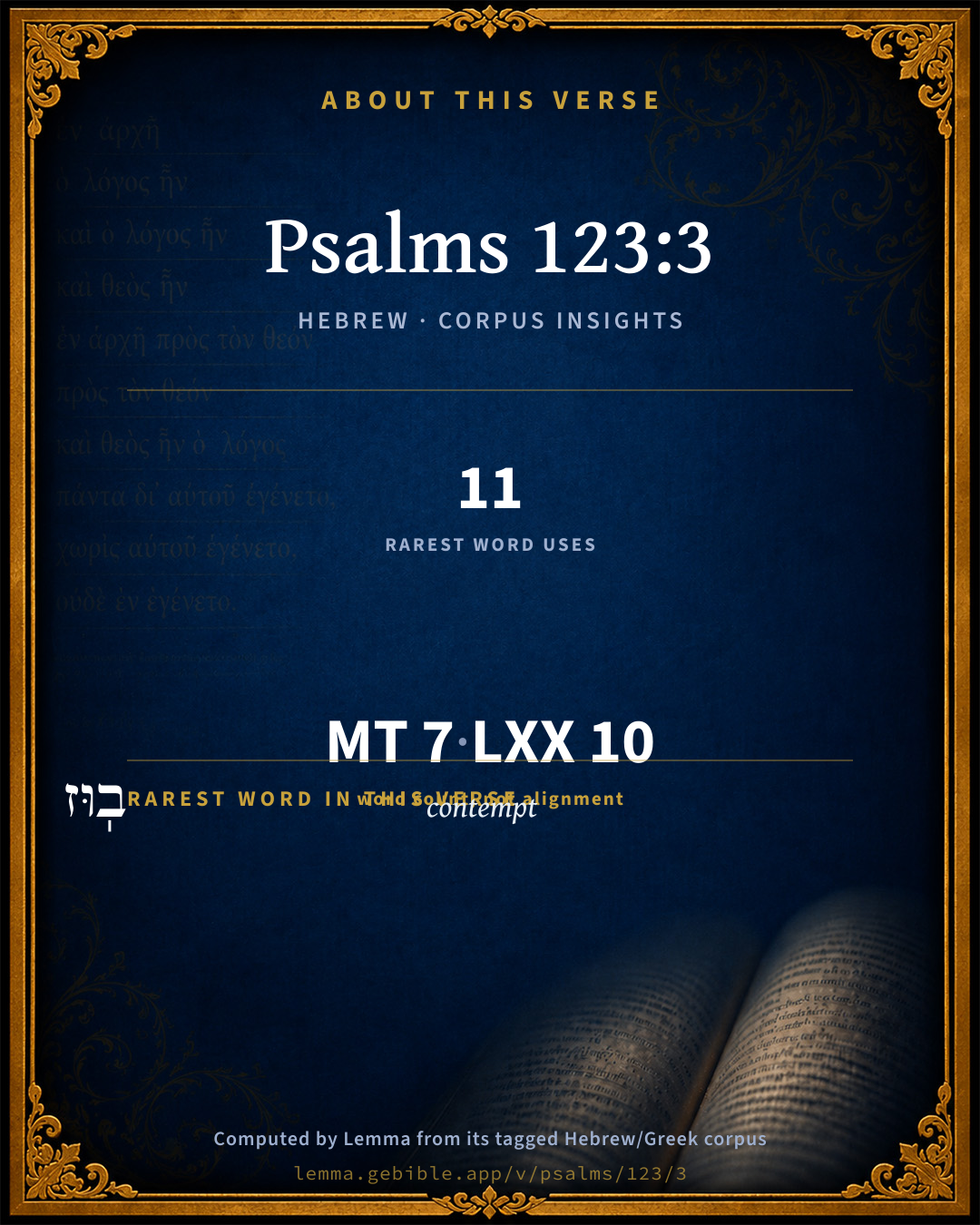
The rarest word here is בֽוּז contempt H937 — appearing just 11 times in the whole Hebrew Bible.

Shared distinctive vocabulary

בֽוּז contempt H937 occurs in 11 verses of the Hebrew Bible. Also found in:

Grammatical profile

  • 3 verbs
  • 2 nouns
  • 1 adjective
  • 1 conjunction

Verb forms

  • חָנֵּ֣נוּ Qal · Imperative
  • חָנֵּ֑נוּ Qal · Imperative
  • שָׂבַ֥עְנוּ Qal · Perfect

Repetition

A word recurs within this verse — often emphatic in Hebrew:

  • חָנֵּ֣נוּ to be gracious H2603 ×2

Hebrew & Septuagint length

In English translation the verse runs 15 words from the Hebrew and 17 from the Septuagint (LXX English) — closely comparable.

A rough comparison of the two English renderings, which tokenize alike — not a word-level alignment.

Word counts can differ between the Hebrew and the Greek without any difference in meaning — e.g. the Hebrew direct-object marker אֵת has no separate Greek word, and Greek often adds the article ὁ.

In the original languages it is 7 Hebrew tokens and 10 Greek tokens — but the two are counted differently (Hebrew bundles its prefixes and suffixes into one token; the Greek is in lemma form), so that isn’t a like-for-like length.

Cross-references

11

Topical passages linked to Psalms 123:3 in the Treasury of Scripture Knowledge — connected by theme and wording, ordered by reader-vote popularity; previews shown in the World English Bible.

  • Psalms 57:1 Be merciful to me, God, be merciful to me, For my soul takes refuge in you. Yes, in the shadow of your wings, I will take refuge, Until disaster has passed.
  • Luke 18:11–13 The Pharisee stood and prayed to himself like this: 'God, I thank you, that I am not like the rest of men, extortioners, unrighteous, adulterers, or even like this tax collector.
  • Psalms 89:50–51 Remember, Lord, the reproach of your servants, How I bear in my heart the taunts of all the mighty peoples,
  • Nehemiah 4:2–4 He spoke before his brothers and the army of Samaria, and said, What are these feeble Jews doing? will they fortify themselves? will they sacrifice? will they make an end in a day? will they revive the stones out of the heaps of rubbish, seeing they are burned?
  • Psalms 4:1 Answer me when I call, God of my righteousness. Give me relief from my distress. Have mercy on me, and hear my prayer.
  • Psalms 56:1–2 Be merciful to me, God, for man wants to swallow me up. All day long, he attacks and oppresses me.
  • Psalms 69:13–16 But as for me, my prayer is to you, Yahweh, in an acceptable time. God, in the abundance of your loving kindness, answer me in the truth of your salvation.
  • Isaiah 53:3 He was despised, and rejected by men; a man of suffering, and acquainted with disease: and as one from whom men hide their face he was despised; and we didn't respect him.
  • Luke 16:14 The Pharisees, who were lovers of money, also heard all these things, and they scoffed at him.
  • Luke 23:35 The people stood watching. The rulers with them also scoffed at him, saying, "He saved others. Let him save himself, if this is the Christ of God, his chosen one!"
  • Psalms 44:13–16 You make us a reproach to our neighbors, A scoffing and a derision to those who are around us.

Cross-references courtesy of OpenBible.info (CC BY 4.0).

Hebrew and Greek witnesses Masoretic Hebrew ↔ Greek Septuagint

The same verse in the two great witnesses to the Old Testament, shown verse-for-verse.

You’re reading Greek Psalm 122 (Hebrew Psalm 123). The Septuagint counts the superscription, so verse numbers can differ from the Hebrew — chapter-level alignment, not verse-by-verse. Numbering follows Rahlfs.

These are two independent witnesses, not word-aligned to each other, and the Septuagint is shown in lemma (dictionary) form.

Hebrew Psalms 123:3 Masoretic · Westminster Leningrad Codex

חָנֵּ֣נוּ יְהוָ֣ה חָנֵּ֑נוּ כִּֽי רַ֝֗ב שָׂבַ֥עְנוּ בֽוּז

Have mercy on us, Yahweh, have mercy on us, For we have endured much contempt.

World English Bible · Public Domain

Greek LXX Greek Psalm 122:3 Septuagint · lemma form

ἐλεέω ἐγώ κύριος ἐλεέω ἐγώ ὅτι ἐπί πολύς πίμπλημι ἐξουδένωσις

Have pity upon us, O Lord, have pity upon us: for we are exceedingly filled with contempt.

LXX2012 (modern English Septuagint) · Public Domain

Hebrew: Westminster Leningrad Codex (CC BY 4.0). Greek: Septuagint (public domain); English from LXX2012 (modern English Septuagint) (Public Domain). How the Septuagint differs from the Hebrew →

Commentary

Notes on Psalms 123:3 from classic Christian and Jewish commentators (each source and its license shown beneath its notes). The classic Christian expositions comment on the surrounding passage and are grouped to its opening verse, so a note may address several verses; the Jewish commentaries on the Tanakh (Rashi and others) are per-verse, so they appear only where the commentator wrote on this verse.

Lemma curates 59 commentaries, every one of them public domain or Creative Commons licensed, each selected and text-cleaned for this edition rather than reprinted as found. About our sources →

Trapp's Complete Commentary

John Trapp

Psa 123:3 Have mercy upon us, O LORD, have mercy upon us: for we are exceedingly filled with contempt.

Ver. 3. Have mercy upon us, O Lord, have mercy] This is preces fundere, coelum tundere, misericordiam extorquere, as Tertullian hath it; to wring mercy out of God’s holy hands, by our utmost importunity.

For we are exceedingly filled with contempt] We are made the very scum and scorn of our proud imperious enemies. This the nature of man is very impatient of, and can hardly brook; for there is none so mean but holdeth himself worthy of some regard; and a reproachful scorn showeth an utter disrespect, which issueth from the very superfluity of malice.

John Trapp, A Commentary or Exposition upon All the Books of the Old and New Testament (1647–1656) — public domain. Text from a community e-Sword module.

Joseph Benson's Commentary

Psa 123:3-4. Have mercy upon us, O Lord — O be gracious unto us, and in much mercy help and save us; for we are exceedingly filled with contempt — Loaded with opprobrious words and injuries. Our soul is exceedingly filled with the contempt of the proud — With the scornful and contemptuous carriage of thine and our enemies, who live in great ease and glory, while we, thy people, are overwhelmed with manifold calamities.

Joseph Benson's Commentary on the Old and New Testaments (1811–1818) — public domain. Text from a community e-Sword module.

J. A. Alexander on Psalms

Joseph Addison Alexander

3. (Psa 123:3) Have mercy upon us, 0 Jehovah, have mercy upon us; for greatly are we sated with contempt. This petition forms the centre of the psalm, to which what goes before is introductory, and what follows supplementary. The contempt is that of heathen neighbours, and especially that of the Samaritans, which is expressly mentioned in the history. See Neh 1:3; Neh 2:19.

Joseph Addison Alexander, The Psalms Translated and Explained (1850) — public domain. Text from a community e-Sword module.

Geneva Bible (1599)

Geneva Bible translators

He declareth that when the faithful are so full, that they can no more endure the oppressions and scornings of the wicked, there is always help above, if with hungry desires they call for it.

Geneva Bible (1599) marginal notes — public domain. Text via Bolls.life.

Adam Clarke's Commentary

Verse 3. Have mercy upon us, O Lord] Chastise us no more; we will no more revolt against thee.

We are exceedingly filled with contempt.] We not only suffer grievously from our captivity, but are treated in the most contemptuous manner by our masters.

Adam Clarke's Commentary on the Bible (1810–1826) — public domain. Text from a community e-Sword/MySword module.

John Calvin's Commentaries

3. Have mercy upon us, O Jehovah! etc. The Psalmist prosecutes and confirms the preceding doctrine. He had said that the godly, finding themselves utterly broken in spirit and cast down, intently directed their eyes to the hand of God: now he adds that they are filled with reproach. From this we learn that the wicked not only assaulted them by such ways of violence as suggested themselves to their minds, but that by their mockery they as it were trampled under foot the children of God. The repetition of the prayer, Have mercy upon us, which is a sign of vehement and ardent desire, indicates that they were reduced to the last degree of misery. When insult is added to wrongs, there is nothing which inflicts a deeper wound upon well constituted minds. The Prophet therefore complains chiefly of that, as if it were the consummation of all calamities. He says that rich and proud men treated the Church with insolent triumph; for it commonly happens that those who are elevated hi the world, look down with contempt upon the people of God. The lustre of their he. hour and power dazzles their eyes, so that they make no account of God’s spiritual kingdom: yea, the more the wicked prosper and are smiled on by fortune, to the greater extent does their pride swell, and the more violently does it throw off its foam. This passage teaches us, that it is no new thing for the Church to be held in contempt by the children of this world who abound in riches. The epithet proud is justly applied to the same persons who are described as rich; for wealth engenders pride of heart. Farther, as we see that in old time the Church of God was covered with reproaches, and pointed at with the finger of scorn, we ought not to be discouraged if the world despise us, nor should we allow our faith to be shaken by the wicked when they assault us with their scoffs, yea, even defame us with their injurious and insulting language. We must always bear in mind what is here recorded, that the heart not of one man only, or of a few, but of the whole Church, was filled not merely with the violence, cruelty, craft, and other evil doings of the wicked, but also with reproaches and mockery. It is also to be remembered, that all the loftiness and pride existing in the world are here represented as in opposition to the Church, so that she is accounted as nothing better than “the filth of the world and the offscouring of all things,” as the Apostle Paul declares in 1 Corinthians. 4:13. When the same thing happens to us at the present day, let us leave the wicked to swell with their pride until they burst; and let it suffice us to know, that we are notwithstanding precious in the sight of God. By the verb cloy, especially as it is emphatically repeated, the Prophet intended to express a long continued oppression, which filled the hearts of the godly with weariness and sorrow. How necessary the lesson taught in this text is in our own day, it requires no lengthened discussion to demonstrate. We see the Church destitute of all worldly protection, and lying under the feet of her enemies, who abound in riches, and are armed with dreadful power. We see the Papists boldly rising up, and with all their might pouring forth their mockeries against us and the whole service of God. On the other hand, there are mingled amongst us, and flying about everywhere, Epicureans, who deride our simplicity. There are also many giants, who overwhelm us with reproaches; and this baseness has lasted from the time that the Gospel began to emerge from the corruption’s of Popery even to the present day. What then remains to be done, but that, finding ourselves environed with darkness on all sides, we seek the light of life in heaven? and that our soul, although it may be filled to satiety with all kinds of reproaches, breathe forth prayers to God for deliverance with the importunity of the famished?

John Calvin's Commentaries (1540-1563) — public domain. Text from the Calvin Translation Society English edition (1840s-50s) via the Christian Classics Ethereal Library (ccel.org). Calvin's coverage is partial (roughly two-thirds of the Bible); uncommented books and verses are honest gaps, never fabricated. The 19th-century editor's footnotes and remarks are omitted so the notes are faithfully Calvin's own voice.

Ellicott's Commentary for English Readers

(3) Exceedingly filled.—Or, sated more than enough.

A Bible Commentary for English Readers, edited by Charles John Ellicott (1878–1897) — public domain. Text from a community e-Sword module.

The Cambridge Bible for Schools and Colleges

gen. ed. J. J. S. Perowne

3. Have mercy upon us] Be gracious unto us.

for we are exceedingly filled with contempt] Contumely has been as it were the daily food with which we have been crammed to loathing. Cp. Lam_3:15; Lam_3:30; Psa_80:5.

3, 4. The plea of suffering Israel, scorned and despised by its insolent neighbours.

The Cambridge Bible for Schools and Colleges (gen. ed. J. J. S. Perowne; Cambridge University Press, 1878–1918) — public domain. Text from a community e-Sword module.

John Gill's Exposition

Have mercy upon us, O Lord, have mercy upon us,.... Merit is not pleaded; for, though servants, they knew they were unprofitable ones: but mercy is asked; whether by the awakened sinner, under first convictions, or by the backsliding professor, for forgiveness of sins, under a sense of them, or as under the correcting: and chastising hand of God for them: and which is repeated, to show the state of their case, which requires mercy, and in haste; and the eagerness of their spirit, and the earnestness of their suit, their prayer being the effectual fervent prayer of a righteous man;

for we are exceedingly filled with contempt; by reason of meanness in outward circumstances, the common lot of God's people; and therefore are reckoned the faith of the world, and the offscouring of all things: and on account of their religion, which wicked men make a jest of; reckon an engine of state, to keep people in awe of the civil magistrate; or a piece of priestcraft, to serve the lucrative views of a set of men; or as mere cant and enthusiasm, and a gloomy melancholy business, which none but fools will give into; and particularly on account of peculiar doctrines embraced, which are branded as novel, irrational, and licentious; and ordinances, which entirely depend on the sovereign will of the institutor of them. For these things, and the like, contempt was plentifully poured upon them; they had enough of it, and too much, so much that they could not bear it; it was become intolerable and loathsome, and the more, as it had been a long time continued on them. So Aben Ezra and Kimchi interpret the word, rendered "exceedingly", of a long time.

John Gill's Exposition of the Whole Bible (1746–1763) — public domain (CC PDM 1.0). Text via the HelloAO Bible API.

Albert Barnes' Notes on the Bible

Have mercy upon us, O Lord, have mercy upon us - The language of earnest pleading, repeating with emphasis the object of the prayer. The supplicants are represented as standing and urging this petition, feeling that help could come only from God; looking only to him; and watching his countenance, as servants do their master’s.

For we are exceedingly filled - The Hebrew word used here means to be saturated; to have the appetite fully satisfied - as applied to one who is hungry or thirsty. Then it comes to mean to be entirely full, and the idea here is, that as much contempt had been thrown upon them as could be; they could experience no more.

With contempt - Contempt has been shown us in every possible way. We are thoroughly despised.

Albert Barnes' Notes on the Bible (1834–1885) — public domain. Text from a community e-Sword/MySword module.

Matthew Poole's English Annotations

With opprobrious words and injuries.

Matthew Poole's English Annotations on the Holy Bible (1683–1685) — public domain. Text from a community e-Sword/MySword module.

The Treasury of David

Charles H. Spurgeon

Ver. 3. Have mercy upon us, O Lord, have mercy upon us. He hangs upon the word "mercy, "and embodies it in a vehement prayer: the very word seems to hold him, and he harps upon it. It is well for us to pray about everything, and turn everything into prayer; and especially when we are reminded of a great necessity we should catch at it as a keynote, and pitch our tune to it. The reduplication of the prayer before us is meant to express the eagerness of the Psalmist's spirit and his urgent need: what he needed speedily he begs for importunately. Note that he has left the first person singular for the plural. All the saints need mercy; they all seek it; they shall all have it, therefore we pray"have mercy upon us". A slave when corrected looks to his master's hand that the punishment may cease, and even so we look to the Lord for mercy, and entreat for it with all our hearts. Our contemptuous opponents will have no mercy upon us; let us not ask it at their hands, but turn to the God of mercy, and seek his aid alone.

"For we are exceedingly filled with contempt, "and this is an acid which eats into the soul. Observe the emphatic words. Contempt is bitterness, wormwood mingled with gall; he that feels it may well cry for mercy to his God. Filled with contempt, as if the bitter wine had been poured in till it was up to the brim. This had become the chief thought of their minds, the peculiar sorrow of their hearts. Excluding all other feelings, a sense of scorn monopolized the soul and made it unutterably wretched. Another word is added adverbiallyexceedingly filled. Filled even to running over, as if pressed down and then heaped up. A little contempt they could bear, but now they were satiated with it, and weary of it. Do we wonder at the threefold mention of mercy when this master evil was in the ascendant? Nothing is more wounding, embittering, festering than disdain. When our companions make little of us we are far too apt to make little of ourselves and of the consolations prepared for us. Oh to be filled with communion, and then contempt will run off from us, and never be able to fill us with its biting vinegar.

Ver. 3. Have mercy upon us, O Lord, have mercy upon us! Note how a godly man speaks. He does not say, "Have mercy upon me, O Lord have mercy upon me! because I am disgraced; "but, "Have mercy upon us, O Lord, for we are filled with contempt!" The godly man is not so grieved for his own and individual contempt as he is for the general contempt of the good and faithful. There is an accord of the godly, not only in the cross, but also in groanings, and in the invocation of divine grace. Wolfgang Musculus.

Ver. 3. For we are exceedingly filled. The Hebrew word here used means "to be saturated"; to have the appetite fully satisfiedas applied to one who is hungry or thirsty. Then it comes to mean to be entirely full, and the idea here is, that as much contempt had been thrown upon them as could be: they could experience no more. Albert Barnes.

Ver. 3. We are exceedingly filled with contempt. Men of the world regard the Temple Pilgrims and their religion with the quiet smile of disdain, wondering that those who have so much to engage them in a present life should be weak enough to concern themselves about frames and feelings, about an unseen God, and unknown eternity; and this is a trial they find it hard to bear. Their soul, too, is filled exceedingly with the scorning of those that are at ease. The prosperous of their neighbours declare that they have found the world a generous and happy scene to all who deserve its gifts. Poverty and sorrow they attribute to unworthiness alone. "Let them exert themselves" is the unfeeling cry; "let them bestir themselves instead of praying, and with them as with us it will soon be well"; and these words of harsh and unfeeling ignorance aye like poison to the wounds of the bleeding heart. They have further "the contempt of the proud" to mourn; of those who give expression to their fierce disdain by assailing them with words of contumely, and who seek to draw them by reproaches both from peace and from piety. These are still the trials of Zion's worshippers: silent contempt, open misrepresentation, fierce opposition. Religion, their last comfort, is despised; peace, their first desire, is denied. Anxious to devote themselves in the spirit of humble and earnest piety to the duties of their appointed sphere, they find enemies in open outcry and array against them. But God is their refuge, and to him they go. Robert Nisbet.

Ver. 3,4. The second strophe takes up the "have mercy upon us, " as it were in echo. It begins with a "Kyrie eleison", which is confirmed in a crescendo manner after the form of steps. Franz Delitszch.

Ver. 3 (first portion). The Sinner's Litany. The Saint's Entreaty.

Ver. 3 (second portion). The world's contempt, the abundance of it, the reason of it, the bitterness of it, the comfort under it.

Ver. 3,4.

1. The occasion of the prayer: the contempt of men. This is often the most difficult to bear.

(a) Because it is most unreasonable. Why ridicule men

for yielding to their own convictions of what is

right?

(b) Most undeserved. True religion injures no man, but

seeks the good of all.

(c) Most profane. To reproach the people of God because

they are his people is to reproach God himself.

2. The subject of the prayer.

(a) The prayer: is not for justice, which might be

desired, but for mercy.

(b) The plea: "For we are, "etc. The reproaches of men

are an encouragement to look for special help from

God. The harp hung upon the willows sends forth its

sweetest tones. The less it is in human hands the

more freely it is played upon by the Spirit of God.

G.R.

Psalms 123:4*

Charles H. Spurgeon's The Treasury of David (1869–1885) — public domain. Psalms only. Text from a community e-Sword/MySword module.

Whedon's Commentary on the Bible

Daniel D. Whedon

3, 4. Exceedingly filled—Satiated, overflowed with abundance. Their enemies were at ease, (Psa_123:4;) the word denoting, in its bad sense, those who live carelessly, indifferently as to religion or the sufferings of others, and only for self-gratification: a state of supreme selfishness and worthlessness of character, which, though not in itself expressing overt crime, hardens the soul to all vice and sin. Jer_48:11; Amo_6:1; Zec_1:15; comp. Luk_12:19-20. They were also proud, haughty, which always implies contempt and hard heartedness toward inferiors. These were Israel’s oppressors, who contemned them, trod them under foot, and scorned, or made a jest and derision of them. Thus is it with the world toward the Church, but will not God hear and avenge his elect, who cry unto him day and night?

Daniel D. Whedon (gen. ed.), Commentary on the Old and New Testaments (1874–1909) — public domain. Text from a community e-Sword module.

The Pulpit Commentary

Have mercy upon us, O Lord; have mercy upon us. The cry is repeated for greater emphasis. For we are exceedingly filled with contempt. This expression can scarcely be said to fix the date of the psalm, since hatred and contempt were the usual feelings wherewith the Jews were regarded by their neighbors. But the time of Nehemiah would certainly be no unsuitable date. (see Neh_4:4)

Vers. 3, 4. Contempt a sore trial.

The returned exiles found the contemptuous treatment of their neighbors the hardest thing to bear. Contempt is always hard to bear; but it is hardest to bear when we have an inward and painful conviction that we are so weak and poor that the contempt is in no way unreasonable. Those are just the times when we want a kindly word and a sign of confidence and hope, and then we feel most deeply if, instead, we are scorned, made a laughingstock, and disheartened. That was the case with our Divine Lord. On the cross he needed the sign of love and word of sympathy; instead he had to bear the scorn and contempt which the psalmist suggestively anticipated for him. (Psa_22:6-8) The returned exiles had a similar experience. In their time of frailty a little neighborly help would have been so much to them. It would have given them quietness, security, and the cheer of sympathy. Instead of this, contempt humbled them, made them anxious, plucked out hopefulness, and filled them with fear. Contempt is a moral atmosphere in which nothing good or beautiful ever grew yet, or ever will grow. Hope the best of men, and you help them. Despise them and expect failure for them, and you crush them.

I CONTEMPT, WHEN IT IS UNREASONABLE, CAN BE BORNE. It is sometimes a mere product of malice and envy. There is no real ground for it, and we may know that there is no ground. We may properly cherish the consciousness of our power and worth; and then we can appraise the contempt of the envious at its true value, it cannot hurt us. The contempt is weak, it is not we who are weak. And the contempt will fail, not we. "What can harm you if ye be followers of that which is good?" The world despises the godly. It is no matter; the future is with the godly.

II CONTEMPT, WHEN IT IS REASONABLE, IS PAINFULLY DEPRESSING. Because it exaggerates our own sense of weakness, and so still further weakens us. Our sense of disability and insufficiency is oftentimes a great distress to us, and makes the struggle of life too hard for us. Precisely what we need is some sign of confidence, some kindly encouraging word, the cheer of some one who can see things more hopefully than we can. Consequently, we feel all the more deeply when our weakness is only despised; we hear loud and confident prophecies of our speedy failure, and men raise the laugh which crushes hearts more than open scorn. Then what can we do but turn from man to God? R.T.

The Pulpit Commentary (1880–1919), ed. H.D.M. Spence-Jones & Joseph S. Exell — public domain. Text from a community e-Sword module.

Keil & Delitzsch

C. F. Keil & F. Delitzsch

The second strophe takes up the "be gracious unto us" as it were in echo. It begins with a Kyrie eleison, which is confirmed in a crescendo manner after the form of steps. The church is already abundantly satiated with ignominy. רב is an abstract "much," and רבּה, Psa 62:3, something great (vid., Bצttcher, Lehrbuch, ֗624). The subjectivizing, intensive להּ accords with Psa 120:6 - probably an indication of one and the same author. בּוּז is strengthened by לעג, like בּז in Eze 36:4. The article of הלּעג is restrospectively demonstrative: full of such scorn of the haughty (Ew. ֗290, d). הבּוּז is also retrospectively demonstrative; but since a repetition of the article for the fourth time would have been inelegant, the poet here says לגאיונים with the Lamed, which serves as a circumlocution of the genitive. The Masora reckons this word among the fifteen "words that are written as one and are to be read as two." The Kerמ runs viz., לגאי יונים, superbis oppressorum (יונים, part. Kal, like היּונה Zep 3:1, and frequently). But apart from the consideration that instead of גּאי, from the unknown גּאה, it might more readily be pointed גּאי, from גּאה (a form of nouns indicating defects, contracted גּא), this genitival construction appears to be far-fetched, and, inasmuch as it makes a distinction among the oppressors, inappropriate. The poet surely meant לגאיונים or לגּאיונים. This word גּאיון (after the form רעיון, אביון, עליון) is perhaps an intentional new formation of the poet. Saadia interprets it after the Talmudic לגיון, legio; but how could one expect to find such a Grecized Latin word (λεγεών) in the Psalter! dunash ben-Labrat (about 960) regards גאיונים as a compound word in the signification of הגּאים היונים. In fact the poet may have chosen the otherwise unused adjectival form גּאיונים because it reminds one of יונים, although it is not a compound word like דּביונים. If the Psalm is a Maccabaean Psalm, it is natural to find in לגאיונים an allusion to the despotic domination of the יונים.

Keil & Delitzsch — Biblical Commentary on the Old Testament (1861–1891) — public domain (CC PDM 1.0). Text via the HelloAO Bible API. (Old Testament only.)

unfoldingWord translationNotes

Door43 World Missions Community

Have mercy on us

The abstract noun "mercy" can be stated as an action. See how you translated a similar phrase in Psalms 123:2. AT: "act mercifully toward us" (See: Abstract Nouns)

we are filled ... We are more than full

These two phrases have similar meaning, with the second increasing the intensity of the first. (See: Parallelism)

we are filled with humiliation

Here humiliation is spoken of as if it were something that could be fill up a person. "we are very disgraced" (See: Metaphor)

We are more than full

This idiom means that the amount is excessive, in a negative sense. AT: "We have had too much" (See: Idiom)

of the scoffing ... and with the contempt

There two phrases have very similar meanings and are used together to emphasize how much they have been mocked by the people. (See: Parallelism)

scoffing

"mocking" or "insults"

the insolent

This refers to the insolent people. AT: "rude and arrogant people" (See: Nominal Adjectives)

the proud

This refers to the proud people. AT: "the people who are proud" (See: Nominal Adjectives)

translationWords

mercy

humiliate

contempt

proud

unfoldingWord translationNotes — © Distant Shores Media and the Door43 World Missions Community, licensed CC BY-SA 4.0. Source: git.door43.org/Door43/en_tn.

Lesson kit

Teaching starters — assembled from the data on this page, not authored interpretation. Every prompt links to the verse data it draws on. Edit before teaching.

Psalms, in the Wisdom, opens this verse with 7 words (6 distinct Hebrew lemmas). Its most distinctive word is bûwz (“contempt”). A historical commentator’s framing appears above. Read the whole chapter for the surrounding context.

Discussion questions

  1. The word bûwz carries the sense “contempt.” How does it shape the verse?
  2. How does Genesis 38:23, which shares the word «contempt», read alongside this verse?
  3. What does the repetition of “to be gracious” (2× in this one verse) do in this verse?
  4. The translations on this page render this verse differently — a whole-verse word diff, not a word-by-word alignment. What might account for the different wordings?
  5. «חָנֵּ֣נוּ» is a Qal Imperative verb. How does that grammatical form shape the action described?
  6. Compare how Trapp's Complete Commentary and Joseph Benson's Commentary read this verse. Where do they agree or differ?

Things to notice

Reading settings

Reading text

Shown beneath each verse's original-language words.

Old Testament
Old Testament edition

Read the OT as the Masoretic Hebrew (MT) or the Greek Septuagint (LXX).

English shown for the Greek Septuagint (in the Hebrew ↔ Greek comparison).

Comparing translations? Open the Compare panel on any verse page to stack up to four side by side.