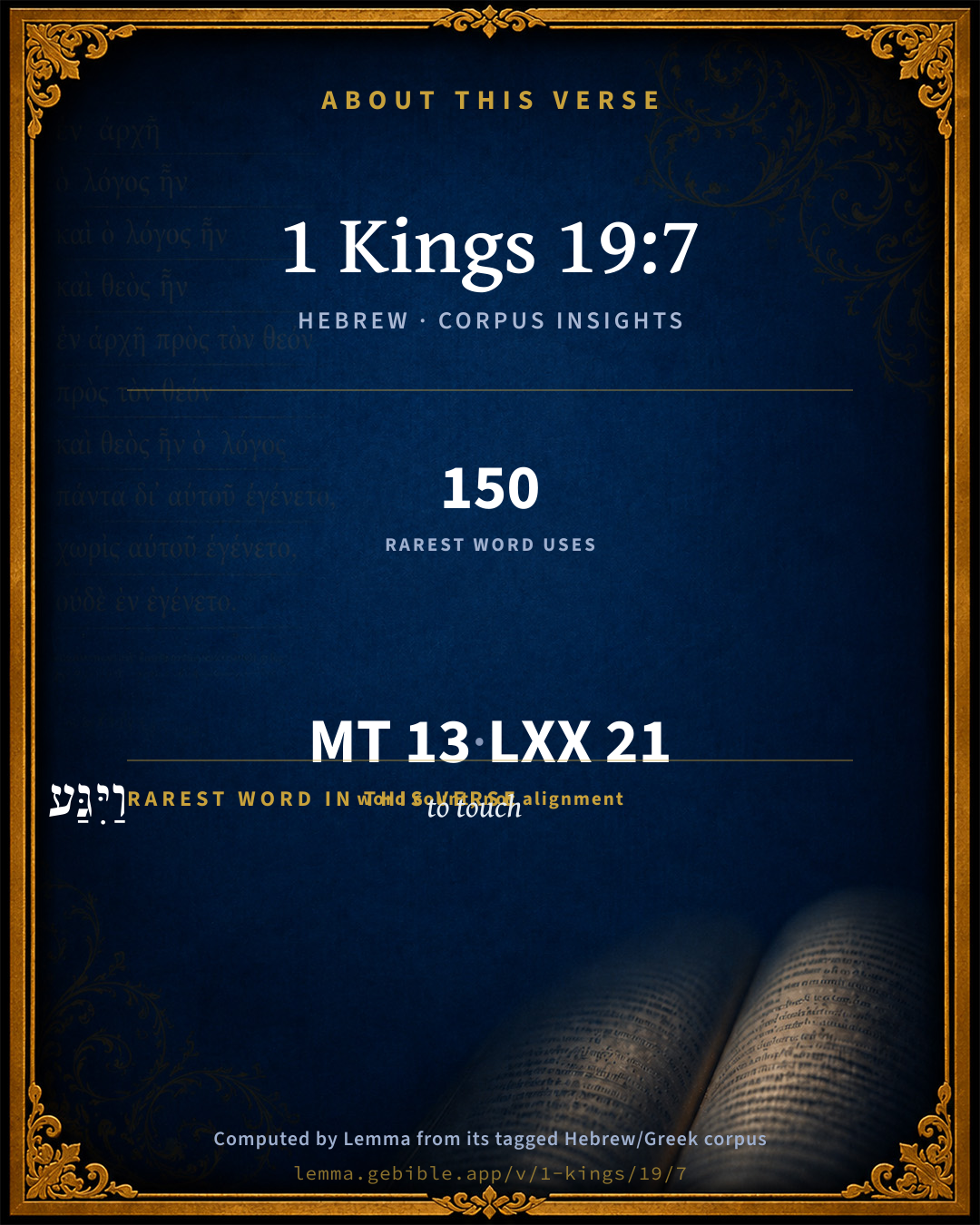
1 Kings 19:7

Hebrew (Westminster Leningrad Codex) 1 Kings 19:7 appears in the Hebrew Old Testament. The text above is from the Westminster Leningrad Codex. Each word links to its Strong’s number, a concise gloss, and parsing drawn from the Open Scriptures Hebrew Bible morphology. Click any word for its full Brown-Driver-Briggs (BDB) entry.
Download image
Cite this verse

1 Kings 19:7 (World English Bible). Public Domain. Lemma interlinear Bible study tool, https://lemma.gebible.app/v/1-kings/19/7.

Show BibTeX & RIS
BibTeX
RIS
English Translation
The angel of Yahweh came again the second time, and touched him, and said, Arise and eat, because the journey is too great for you.
World English Bible · Public Domain
Download a study sheet

One document with this verse’s original text, its word-by-word gloss line, the meaning frame, cross-references with their text, attributed commentary, and full source and license credits — printable, and it pastes into notes with its structure intact.

This verse Autodidact and up

Study sheet (.html) Plain text (.txt)

A passage Seminary Student

Up to 50 verses in one chapter. A passage sheet keeps up to 6 commentary sources and 12 cross-references per verse, in the order this page ranks them, and says so on the sheet whenever that leaves anything out. Ask for a single verse and you get the Autodidact verse sheet above.

Everything on this page stays free to read, with no account — the sheet is a download of what is already on screen, not access to it.

Want to remove ads? Support Godless Engineer
Compare translations 3

The same verse in 3 English versions, stacked beneath the original-language interlinear above. Click any original word for its lexicon entry.

Each is an independent rendering of the whole verse — the interlinear is not word-aligned to these translations.

Highlighted words mark where these versions differ — a whole-verse word diff, not a word-by-word alignment.

  • World English Bible Public Domain
    The angel of Yahweh came again the second time, and touched him, and said, Arise and eat, because the journey is too great for you.
  • King James Version Public Domain
    And the angel of the LORD came again the second time, and touched him, and said, Arise and eat; because the journey is too great for thee.
  • unfoldingWord Literal Text CC BY-SA 4.0
    And the angel of Yahweh returned a second time, and he touched him and said, “Arise, eat! For the journey too much for you.”

unfoldingWord Literal Text — © unfoldingWord, licensed CC BY-SA 4.0. Word-aligned USFM3 via Door43 (git.door43.org/unfoldingWord/en_ult).

Versions to compare (up to 4)

3 of 4 selected

Show all 18 translations

Every available English version of this verse, each an independent rendering of the whole verse.

  • World English Bible Public Domain
    The angel of Yahweh came again the second time, and touched him, and said, Arise and eat, because the journey is too great for you.
  • Berean Standard Bible Public Domain
    A second time the angel of the LORD returned and touched him, saying, “Get up and eat, or the journey will be too much for you.”
  • Majority Standard Bible Public Domain
    A second time the angel of the LORD returned and touched him, saying, “Get up and eat, or the journey will be too much for you.”
  • King James Version Public Domain
    And the angel of the LORD came again the second time, and touched him, and said, Arise and eat; because the journey is too great for thee.
  • American Standard Version (1901) Public Domain
    And the angel of Jehovah came again the second time, and touched him, and said, Arise and eat, because the journey is too great for thee.
  • Revised Version (1885) Public Domain
    And the angel of the LORD came again the second time, and touched him, and said, Arise and eat; because the journey is too great for thee.
  • Geneva Bible (1599) Public Domain
    And the Angel of the Lord came againe the second time, and touched him, and sayd, Vp, and eate: for thou hast a great iourney.
  • Douay-Rheims (1899) Public Domain
    And the angel of the Lord came again the second time, and touched him, and said to him: Arise, eat: for thou hast yet a great way to go.
  • Young's Literal Translation Public Domain
    And the messenger of Jehovah turneth back a second time, and cometh against him, and saith, `Rise, eat, for the way is too great for thee;'
  • Literal Standard Version CC BY-SA 4.0
    And the messenger of YHWH turns back a second time, and is reaching toward him, and says, “Rise, eat, for the way is too great for you”;
  • Unlocked Literal Bible CC BY-SA 4.0
    The angel of Yahweh came again a second time and touched him and said, “Get up and eat, because the journey will be too much for you.”
  • unfoldingWord Literal Text CC BY-SA 4.0
    And the angel of Yahweh returned a second time, and he touched him and said, “Arise, eat! For the journey too much for you.”
  • Darby Bible Public Domain
    And the angel of Jehovah came again the second time, and touched him, and said, Arise, eat; for the journey is too great for thee.
  • World Messianic Bible Public Domain
    The LORD’s angel came again the second time, and touched him, and said, “Arise and eat, because the journey is too great for you.”
  • Webster's Bible Public Domain
    And the angel of the LORD came again the second time, and touched him, and said, Arise and eat, because the journey is too great for thee.
  • Free Bible Version CC BY-SA 4.0
    The angel of the Lord returned a second time and touched him, and said, “Get up and eat, otherwise the journey will be too much for you.”
  • Bible in Basic English Public Domain
    And the angel of the Lord came again a second time, and touching him said, Get up and have some food, or the journey will be overmuch for your strength.
  • JPS Tanakh (1917) Public Domain
    And the angel of the LORD came again the second time, and touched him, and said: 'Arise and eat; because the journey is too great for thee.'

Literal Standard Version (2020), Covenant Press — licensed CC BY-SA 4.0. Text via the HelloAO Bible API (eBible.org). Unlocked Literal Bible (unfoldingWord) — licensed CC BY-SA 4.0. Text via the HelloAO Bible API (eBible.org). unfoldingWord Literal Text — © unfoldingWord, licensed CC BY-SA 4.0. Word-aligned USFM3 via Door43 (git.door43.org/unfoldingWord/en_ult). Free Bible Version, Dr. Jonathan Gallagher — licensed CC BY-SA 4.0. Text via the HelloAO Bible API (eBible.org).

Word by word

More ways to search: Search by grammar → Find every occurrence → Compare this word →

Practice this passage: Drill this verse → Learn its vocabulary →

וַיִּגַּע
nâgaʻ
H5060
“and · to touch”
Conjunction + Verb, Qal, Sequential Imperfect, 3rd Person, Masculine, Singular
Part of Speech
Conjunction + Verb
Stem
Qal
Form
Sequential Imperfect
Person
3rd Person
Gender
Masculine
Number
Singular
Full BDB Definition

Origin: a primitive root

TWOT: 1293

to touch, reach, strike - (Qal) - to touch - to strike - to reach, extend to - to be stricken - stricken (participle) - (Niphal) to be stricken, be defeated - (Piel) to strike - (Pual) to be stricken (by disease) - (Hiphil) to cause to touch, reach, approach, arrive - to cause to touch, apply - to reach, extend, attain, arrive, come - to approach (of time) - to befall (of fate)
  1. וַיָּשָׁב֩ shûwb H7725 “and · to return” Conjunction + Verb, Qal, Sequential Imperfect, 3rd Person, Masculine, Singular
  2. מַלְאַ֨ךְ mălʼâk H4397 “messenger of” Noun, Common, Masculine, Singular, Construct
  3. יְהוָ֤ה Yᵉhôvâh H3068 “LORD” Noun, Proper
  4. שֵׁנִית֙ shênîy H8145 “second” Adjective, Ordinal number, Feminine, Singular, Absolute
  5. וַיֹּ֖אמֶר ʼâmar H559 “and · to say” Conjunction + Verb, Qal, Sequential Imperfect, 3rd Person, Masculine, Singular
  6. ק֣וּם qûwm H6965 “rise” Verb, Qal, Imperative, 2nd Person, Masculine, Singular
  7. אֱכֹ֑ל ʼâkal H398 “eat” Verb, Qal, Imperative, 2nd Person, Masculine, Singular
  8. כִּ֛י kîy H3588 “that” Conjunction
  9. רַ֥ב rab H7227 “many” Adjective, Adjective, Masculine, Singular, Absolute
  10. מִמְּךָ֖ min H4480 “from · you” Preposition + Suffix, Personal, 2nd Person, Masculine, Singular
  11. הַדָּֽרֶךְ derek H1870 “the · way” Particle, Definite Article + Noun, Common, Both, Singular, Absolute

About this verse

These counts appear in no published source. They are computed here, from the morphology-tagged text and Lemma’s own curated glosses. What Lemma adds →

13
words
12
distinct lemmas
Historical
section

Grammatical profile

  • 5 verbs
  • 3 nouns
  • 2 adjectives
  • 2 prepositions
  • 1 conjunction

Verb forms

  • וַיָּשָׁב֩ Qal · Sequential Imperfect
  • וַיִּגַּע Qal · Sequential Imperfect
  • וַיֹּ֖אמֶר Qal · Sequential Imperfect
  • ק֣וּם Qal · Imperative
  • אֱכֹ֑ל Qal · Imperative

Hebrew & Septuagint length

In English translation the verse runs 25 words from the Hebrew and 25 from the Septuagint (LXX English) — the same length.

A rough comparison of the two English renderings, which tokenize alike — not a word-level alignment.

Word counts can differ between the Hebrew and the Greek without any difference in meaning — e.g. the Hebrew direct-object marker אֵת has no separate Greek word, and Greek often adds the article ὁ.

In the original languages it is 13 Hebrew tokens and 21 Greek tokens — but the two are counted differently (Hebrew bundles its prefixes and suffixes into one token; the Greek is in lemma form), so that isn’t a like-for-like length.

Hebrew and Greek witnesses Masoretic Hebrew ↔ Greek Septuagint

The same verse in the two great witnesses to the Old Testament, shown verse-for-verse.

These are two independent witnesses, not word-aligned to each other, and the Septuagint is shown in lemma (dictionary) form.

Hebrew 1 Kings 19:7 Masoretic · Westminster Leningrad Codex

וַיָּשָׁב֩ מַלְאַ֨ךְ יְהוָ֤ה שֵׁנִית֙ וַיִּגַּע בּ֔וֹ וַיֹּ֖אמֶר ק֣וּם אֱכֹ֑ל כִּ֛י רַ֥ב מִמְּךָ֖ הַדָּֽרֶךְ

The angel of Yahweh came again the second time, and touched him, and said, Arise and eat, because the journey is too great for you.

World English Bible · Public Domain

Greek LXX 1 Kings 19:7 Septuagint · lemma form

καί ἐπιστρέφω ὁ ἄγγελος κύριος ἐκ δεύτερος καί ἅπτομαι αὐτός καί εἶπον αὐτός ἀναἵστημι ἐσθίω ὅτι πολύς ἀπό σύ ὁ ὁδός

And the angel of the Lord returned again, and touched him, and said to him, Arise, and eat, for the journey is far from you.

LXX2012 (modern English Septuagint) · Public Domain

On this verse, The Pulpit Commentary discusses the Septuagint’s reading. Read the note in Commentary ↓

Hebrew: Westminster Leningrad Codex (CC BY 4.0). Greek: Septuagint (public domain); English from LXX2012 (modern English Septuagint) (Public Domain). How the Septuagint differs from the Hebrew →

Targum (Aramaic paraphrase)

1

The Targum is the ancient Jewish Aramaic paraphrase of the Hebrew Scriptures — an interpretive translation, not the Hebrew text itself. Onkelos (literal) and Pseudo-Jonathan (expansive) render the Torah, and Jonathan the Prophets. Coverage is partial: where no permissively-licensed English translation exists for a verse, only the Aramaic is shown. This is verse-level text, not a word-by-word alignment to the Hebrew.

  1. Targum Jonathan Prophets (Joshua–Malachi)
    וְתַב מַלְאָכָא דַייָ תִּנְיָנוּת וּקְרֵיב בֵּיהּ וַאֲמַר לֵיהּ קוּם אֱכוֹל אֲרֵי סַגִי מִנָךְ אוֹרְחָא:

    (no public-domain English translation for this verse)

    Targum Jonathan — Aramaic: “Mikraot Gedolot” (public domain). English: “Sefaria Community Translation” (CC0 1.0 (public-domain dedication)); “London "Chaldee Paraphrase," 1871” (public domain). Text via Sefaria.

Commentary

Notes on 1 Kings 19:7 from classic Christian and Jewish commentators (each source and its license shown beneath its notes). The classic Christian expositions comment on the surrounding passage and are grouped to its opening verse, so a note may address several verses; the Jewish commentaries on the Tanakh (Rashi and others) are per-verse, so they appear only where the commentator wrote on this verse.

Lemma curates 59 commentaries, every one of them public domain or Creative Commons licensed, each selected and text-cleaned for this edition rather than reprinted as found. About our sources →

Trapp's Complete Commentary

John Trapp

1Ki 19:7 And the angel of the LORD came again the second time, and touched him, and said, Arise [and] eat; because the journey [is] too great for thee.

Ver. 7. Because the journey is too great for thee.] Fill thee, therefore, that thou mayest the better hold out. Do we the like for our souls, when at the holy ordinances, where the Angel of the covenant seemeth to say to us, as in Son 5:1, "Eat, O friend: drink, yea, drink abundantly, O beloved!"

John Trapp, A Commentary or Exposition upon All the Books of the Old and New Testament (1647–1656) — public domain. Text from a community e-Sword module.

The Biblical Illustrator

Joseph S. Exell

1Ki_19:7

Arise and eat, because the journey is too great for thee.

The weary child

1. Now, what is all this but the Lord nursing His own child? Elijah has come to one of those crises which occur in every ones life, when he stands in need of special tending and treatment; and the Father which is in Heaven is giving them. He is giving them none the less truly, that at the stage of our text it is the bodily condition of Elijah with which the Lord is dealing, and nothing higher or further. It was mostly this which was wrong just then, and it is this therefore that the Lord proceeds first of all to put right. But while the text thus speaks to us of the pity of God, and tells us how wide-winged and close-brooding it is, the text also points us to wise methods of dealing with ourselves in like circumstances. The Great Physician may well leave something of our restorations to be wrought by self-treatment when He has indicated the course which that treatment ought to take. Now, the body has its own share, and not a small one, even in our spiritual history. Our dejection and melancholy, our very unbelief, have frequently no higher or more mysterious source than the disturbance of this material machine of nerves and muscles through which the spirit deals with the outer world. For the sake of our souls themselves, therefore, those conditions of body which tell back unhappily upon the spirit ought, where they are preventable or removable, to be prevented or removed. Dejection is no virtue, but a weakness and humiliation.

2. When the Lord was comforting Elijah in that lonely place one days journey south of Beersheba, there was being transacted there a living parable of things that lie within the higher sphere of purely spiritual experience. Every Christian of us has his journey before him. Every Christian of us has his weariness not far off within him. Every Christian of us has his Lords provision brought to his bolster, with the kindly call, Arise and eat, because the journey is too great for thee. The Lord knoweth right well how great it is, and He knoweth well how great our weariness at any time is.

3. You are thinking of seasons of spiritual recruiting more special still than any I have named. One more interval passes, and you are purposing again to sit down together to commemorate the accomplishment, in sacrificial blood, of the most wondrous journey that was ever travelled by human foot in this sorely travelled world. For, to be like us, to understand us and to save us, He would have His mortal journey too; and it was great, and often He was weary, and often He was refreshed. With thoughts of that journey filling His own heart, and wishing that they may fill your own, He is summoning you again to sit down with Himself, and to nourish your flagging graces by more touching fellowship with Himself, over the emblems of the love which has made you to be His. (J. A. Kerr Bain, M. A.)

Heart-weariness in the journey of life

1. The first remark which I would make concerning this heart-weariness in the journey of life is that it does not necessarily betoken any estrangement from God. It is, indeed, true that life naturally becomes flat, stale, and unprofitable to the sated worldling. But it is also true that moods of depression and despondency come even to the most pious souls, and are sometimes even associated with a sorrow born of sympathy with the mind of God.

2. The second remark which I would make regarding this spiritual fatigue is that it is often due, in large measure, to physical causes. And this fact ought to teach us two lessons. The first is a lesson of sympathetic forbearance. The young ought to make large allowance for the aged, and the strong for the weak. And the second lesson is one of physical prudence. Seeing that the connection between the body and the spirit is so close and subtle, it is our duty to keep our bodies as healthy as we possibly can. The laws of health are the laws of God.

3. We ought to welcome and avail ourselves of those messengers whom God sends to revive and help us in the journey of life. But there are other messengers and ministries--more homely and familiar--which may be even as angels of God to help us when our hearts are worn and weary. Sometimes the words of a well-known hymn, sung in the house of prayer, will cheer our drooping spirits and put new life into our steps. There are also pleasures of literature in general which are not to be despised; many an old man and many an invalid could tell us that their books do much to lighten for them the burden of their infirmities. Music, too, gives its own peculiar refreshment. Science, and poetry, and art, and humour, and the relaxation afforded by simple, innocent pleasures--why should we despise such things as these in their true and proper place? Love is a great freshener of human life. So long as we are really useful and helpful to those whom we love, life cannot altogether lose its zest.

4. I remark that God has miraculously provided for us all a special food for the sustenance and refreshment of our souls. Christ is the Bread of Life which came down from heaven. (T. Campbell Finlayson, D. D.)

Juniper trees

In experiences of weariness and discouragement and times of despair, when it seems to us that we are of no use in the world, and are doing nothing in the world, or only blundering and doing harm in the world, there come the juniper tree and the angel; God puts rest-places in our lives; God gives us angels food and tells us that in the strength of that food we are to rise up and go on our journey. I want you to look with me for a few moments this morning at some of these restplaces, some of these juniper trees of life.

1. And first I put sleep, because God put it first. When Elijah was tired and despairing and discouraged, God put him to sleep. Sometimes the most religious service a man can render himself or the world is to go to sleep. But how many busy people think really the time spent in sleep is wasted! They begrudge all the time that is spent asleep. But the Lord God so made us that we need to put one-third of our time in sleep. And He knew what He was about. Thanks to God for sleep, that is itself a symbol of death; sleep, that is the promise of a new awakening, and so gives us the suggestion of that great awakening when we shall rise refreshed and invigorated for the eternal day! The father takes the tired child in his arms and rocks him into unconsciousness of all the sin and sorrow and weariness and burden of life. Do not think of it as wasted time! Do not think of it as something lost out of life! Take it as God means we shall--as Gods great gift.

2. Next to sleep I put amusement as one of Gods juniper trees and as a part of Gods angelic food. You remember the three things which the Book of Proverbs says about merriment, which is the lightest form of amusement: first, that a merry heart is a continual feast; second, that a merry heart maketh a glad countenance; and, thirdly, that a merry heart doeth good like a medicine. The merry heart cheers the heart and so makes the face radiant, and, because the face is radiant, therefore the merry soul imparts radiance to others. Merriment, amusement, laughter, just having a good time, is one of Gods juniper trees that He plants for us, and when we are discouraged and distressed He means that we shall take advantage of it.

3. The home is one of Gods juniper trees. We are all conscious, I am sure, that womans sphere, whatever that flexible globe may be, is getting bigger and bigger; women are going into all sorts of industrial activities, and giving men pretty hard work by competition; into all sorts of charitable activities, which men are quite ready to leave to the women altogether. Now, on the whole, this is a distinct advance--The larger life of woman is something to be welcomed and to be rejoiced in; and yet, like every increasing growth, it has its perils also. It does sometimes threaten to impair the usefulness of the home. In the Divine order men are the soldiers; the battle of life ought to be done by the men.

4. The Church ought to be a juniper tree and a resting-place. Dr. Parkhurst has said, The Church is not the ministers field, but the ministers force. The Church ought to be not merely a working Church, but a rest-giving Church also; and when men and women come to the Church, they ought to be able to find there some angels food, some real rest, some inspiration that will send them back into life with new vigour for their new toils. The Sabbath chimes ring no sweeter song than this, Come unto Me, and rest!

5. And then there is the quiet hour. At Wellesley College, in Massachusetts--a young ladies college--there are twenty minutes reserved in every day for a quiet hour. During that twenty minutes every young lady is expected to be in her room; there is to be no passing through the halls; there is to be no life of conversation, no laughter. What the young lady does in her room is between herself, her own conscience, and her God. She may read, she may study, she may pray, she may think, she may do what she likes; only she must not disturb other pupils in other rooms. For twenty minutes a quiet time. We ought to have our quiet hour; at least, we will say, our quiet quarter of an hour. (Lyman Abbott, D. D.)

The journey is too great for thee.--

The journey of life

In regard to the journey of life God says, It is too great for thee. It is beyond thy natural powers. Thou needest supernatural strength to enable thee to accomplish it. Men are slow to admit their weakness, especially when they are young and inexperienced. They are full of courage, and they are terrified neither by desert nor by mountain. It is well to begin life in this high spirit. Every young man needs a little of the dare-devil disposition in order to distinguish himself. Courage is a magnificent quality. But men are always chastened by experience. Many an Alpine climber has started up a high mountain with sublime confidence in his skill of foot and in his powers of endurance. But when he reached a certain height his nerve failed. The journey was too great for him. The text has been illustrated by ten thousand men. Livingstone consecrated himself to African exploration. He performed two journeys, but the third was too great for him. His health failed. Two of his servants deserted him, and they took with them his medicine chest. I never dreamed, he wrote, that I should lose my precious quinine. One of the last entries in his journal was: I am pale, bloodless, and weak from bleeding profusely ever since the 31st of March last. An artery gives off a copious stream, and takes away my strength; oh how I long to be permitted by the Over Power to finish my work! When he could work no longer, he was carried on a frame of wood with some grass and a blanket upon it. And when he could endure to be carried no further, his faithful servants built him a little hut, and in that rude structure he died. He was a great traveller. He contributed much to our knowledge of Central Africa. The coloured races owe him a mighty debt of gratitude. He was one of the bravest of Christian men. But the journey of African exploration was too great for him. Arctic exploration, again, has had an intense fascination for navigators, sea rovers, and scientific men. Time would fail us to tell of all the brave men, from Frobisher to Franklin, and from Franklin to Lieutenant Greeley, who have penetrated into the regions of ice. Some have returned to tell the tale of their experience, and others have been frozen to death. But they have not succeeded in reaching the North Pole. The secret still remains to tempt the heroism of the men of the future. For the navigators of all nations the journey of Arctic exploration has been too great. In 1870 the late Napoleon of France declared war against William of Germany. Germany was united, and under the leadership of Protestant Prussia she was destined to change the balance of power in Europe. Napoleon was afraid, and resolved to fight in the hope that he would conquer and retain the leadership of Europe himself. The issue proved, however, that he had sadly miscalculated his strength. In a few weeks he had to lay down his sword at the feet of the German Emperor. The journey of aggressive warfare was too great for him.

1. Take the Christian life. During the last ten years there has been a revival of evangelism. By a variety of methods the ungodly have been reached, and thousands have been brought into the Church. I rejoice in this fact with all my heart. But the Churches have not been strengthened by these accessions as some of us hoped they would be. Popular missions attract the weaker members of the community. These people are feeble in original temperament, and some of them have made themselves utterly weak by the evil habits which they have pursued. The journey of the Christian life is too great for people who pursue such habits as these.

2. Take ministerial life. Here is a minister. He entered the sacred profession while he was yet young. He had a keen sense of responsibility, and he was very susceptible in regard to external discipline; and these two things kept him right for ten or fifteen years. After that he allowed his spiritual life to go down, and then his constitutional weakness began to show itself. An intellectual tendency led him astray. In the end he resigned the ministry. He looked back from the Gospel plough, and since then he has not been fit for the kingdom of God. The journey of ministerial life was too great for him.

3. Take the enthusiast. He is sanguine in regard to everything fresh. If any new form of religious activity is started he is fascinated by it at once. But after a time he loses his interest in it. The journey of an unbroken Christian devotion is too great for the spasmodic enthusiastic.

4. Take the practical Christian life. Individual effort is at a discount. Organised effort is the order of the day. Men have the notion that they can do but little unless they act in a crowd and make a display. Some day there will be a reaction in favour of quiet, instructive, and individual modes of service, and the sooner it comes the better. But we must not wait for ideal conditions in which to do our duty. Men will associate, and we must learn to act in association. We have a multiplicity of organisations, and we must help to work them. The temper of the age is practical, and we must sympathise with it. We must serve Christ In the social ways and habits of the generation. We shall do it at some sacrifice of our views and feelings, but we must bear that for Christs sake. (T. Allen.)

Gods considerateness of our frailty

Careless and cruel drivers often load their horses beyond their strength, and the poor creature tugs and pulls until he drops. Daring and foolish engineers will put too much pressure on their boilers, or try to force more power from an engine than it can provide. But our Master guarantees that tasks shall be balanCed with the precise strength we possess. He knoweth our frame: He remembereth that we are but dust. He knows the exact pressure we can stand. He knows the utmost load we can lift. He is a faithful Creator, because an abiding Sustainer. (Helps for Speakers.)

The Biblical Illustrator, edited by Joseph S. Exell (c. 1880s–1900s) — public domain. Text from a community e-Sword module.

Joseph Benson's Commentary

1Ki 19:7. Arise and eat, because the journey is too great for thee — Above thy strength; now especially, when thou art faint, weary, and fasting. God knows what he designs us for, though we do not; what services, what trials; and will take care for us, when we, for want of foresight, cannot for ourselves, that we be furnished for them with grace sufficient. He that appoints what the voyage shall be, will victual the ship accordingly.

Joseph Benson's Commentary on the Old and New Testaments (1811–1818) — public domain. Text from a community e-Sword module.

Geneva Bible (1599)

Geneva Bible translators

He declareth that except God had nourished him miraculously, it had not been possible for him to have gone this journey.

Geneva Bible (1599) marginal notes — public domain. Text via Bolls.life.

Adam Clarke's Commentary

Verse 7. The journey is too great for thee.] From Beer-sheba to Horeb was about one hundred and fifty miles.

Adam Clarke's Commentary on the Bible (1810–1826) — public domain. Text from a community e-Sword/MySword module.

The Cambridge Bible for Schools and Colleges

gen. ed. J. J. S. Perowne

7. because the journey is too great for thee] No mention has yet been made of the distance or place to which Elijah meant to go. It seems therefore more natural to conclude that the flight into the wilderness had been undertaken by the prophet merely because he thought that he would there be less likely to be found. And he appears to have made no preparation for a journey, but to have started without any store of food. In consequence of direction or prompting given during his rest he went forward to Horeb. No place was so suitable for a divine communication as that which was hallowed by God’s appearance unto Moses. The Vulgate rendering seems to imply what has been here said, that the direction for the future journey was a divine communication ‘grandis enim tibi restat via.’

The Cambridge Bible for Schools and Colleges (gen. ed. J. J. S. Perowne; Cambridge University Press, 1878–1918) — public domain. Text from a community e-Sword module.

John Gill's Exposition

And the angel of the Lord came again the second time, and touched him,.... In order to awake him out of sleep:

and said unto him, arise, and eat, because the journey is too great for thee; which he had to go to Horeb, without eating more than he had; and there were no provisions to be had in a common way and manner in his road thither.

John Gill's Exposition of the Whole Bible (1746–1763) — public domain (CC PDM 1.0). Text via the HelloAO Bible API.

Albert Barnes' Notes on the Bible

Arise and eat ... - i. e., “Eat a second time, for otherwise the journey will be beyond thy powers.” “The journey” was not simply a pilgrimage to Horeb, which was less than 200 miles distant, and might have been reached in six or seven days. It was to be a wandering in the wilderness, not unlike that of the Israelites when they came out of Egypt; only it was to last forty days instead of forty years.

Albert Barnes' Notes on the Bible (1834–1885) — public domain. Text from a community e-Sword/MySword module.

Haydock's Catholic Bible Commentary

Go. Hebrew, "the journey is too great for thee," without this support. (Haydock) --- He spent forty days in this journey, as he did not follow the straitest road. Horeb is only about fifty leagues from Bersabee. (Calmet) --- He might have travelled thither in four or five days. (Menochius)

George Leo Haydock (1774–1849), Haydock's Catholic Family Bible and Commentary, 1859 edition — public domain. Excludes Psalms (Douay-Rheims chapter numbering differs from Protestant) and Deuterocanonical books (Catholic canon only).

Matthew Poole's English Annotations

i.e. Above thy strength, now especially when thou art faint, and weary, and fasting.

Matthew Poole's English Annotations on the Holy Bible (1683–1685) — public domain. Text from a community e-Sword/MySword module.

Whedon's Commentary on the Bible

Daniel D. Whedon

7. The journey is too great for thee — Too long for thee to accomplish without the nourishment of this God-given food. It is likely that Elijah commenced the desert journey with the purpose of going to Mount Horeb, but after the wearisome travel of a day he lay down despairing and exhausted, and wished to die. Then was given Divine help to finish his journey, for amid the sacred solitudes of Horeb God would teach him a lesson not to be forgotten.

Daniel D. Whedon (gen. ed.), Commentary on the Old and New Testaments (1874–1909) — public domain. Text from a community e-Sword module.

The Pulpit Commentary

And the angel of the Lord came again the second time, and touched him i.e., to awaken him. It was the food was to strengthen him, and said, Arise and eat Probably he had eaten but little the first time, for sorrow and weariness; because the journey is too great for thee. The LXX. oti pollh ajpov and the Vulgate grandis enim tibi restat via, which Bahr follows, seem hardly so true to the Hebrew idiom as the A.V rendering. Keil cites Vatablus, iter est majus quam pro viribus tuis. It is very improbable that (Rawlinson al.) the journey to Horeb was now suggested to him for the first time by the angel.

Arise and eat." Though this was supernatural food, so far as we can see miraculously provided, and in any case of preternatural efficacy, yet it must be taken and eaten in the ordinary way. Elijah might have been endued with strength for his desert journey without the aid of any material elements. The angel"s touch or even the word of the Lord would surely have sufficed. (Jud_1:6:21; Eze_2:2 Eze_3:24; Luk_7:7) Instead of which a cake is baken on the coals, and he must rise and eat thereof, eat thereof twice. God works by means, and it is for man to use them. It is presumption to expect God to dispense with them because He can do so.

The Pulpit Commentary (1880–1919), ed. H.D.M. Spence-Jones & Joseph S. Exell — public domain. Text from a community e-Sword module.

John Wesley's Explanatory Notes

Angel of the Lord, &c. - He needed not to complain of the unkindness of men, when it was thus made up by the ministration of angels. Wherever God's children are, they are still under their father's eye.

John Wesley, Explanatory Notes Upon the Whole Bible (1754–1765) — public domain. Text via the GEBible commentary corpus.

unfoldingWord translationNotes

Door43 World Missions Community

will be too much for you

"will be too difficult for you."

he traveled in the strength of that food forty days and forty nights

"that food gave him energy to travel for 40 days and 40 nights" (See: Numbers)

translationWords

angel

Yahweh

Horeb

God

unfoldingWord translationNotes — © Distant Shores Media and the Door43 World Missions Community, licensed CC BY-SA 4.0. Source: git.door43.org/Door43/en_tn.

Lesson kit

Teaching starters — assembled from the data on this page, not authored interpretation. Every prompt links to the verse data it draws on. Edit before teaching.

1 Kings, in the Historical, opens this verse with 13 words (12 distinct Hebrew lemmas). Its most distinctive word is nâgaʻ (“to touch”). A historical commentator’s framing appears above. Read the whole chapter for the surrounding context.

Discussion questions

  1. How does “to touch” (nâgaʻ) shape what this verse is saying?
  2. These translations render this verse differently; the difference is in the English rendering, not the original. What questions does that raise?
  3. The verb «וַיָּשָׁב֩» is Qal Sequential Imperfect. How does its form color the action?
  4. Reading how Trapp's Complete Commentary and The Biblical Illustrator read this verse, where do the two commentators agree and where do they part?

Things to notice

Reading settings

Reading text

Shown beneath each verse's original-language words.

Old Testament
Old Testament edition

Read the OT as the Masoretic Hebrew (MT) or the Greek Septuagint (LXX).

English shown for the Greek Septuagint (in the Hebrew ↔ Greek comparison).

Comparing translations? Open the Compare panel on any verse page to stack up to four side by side.