
Daniel 11:13

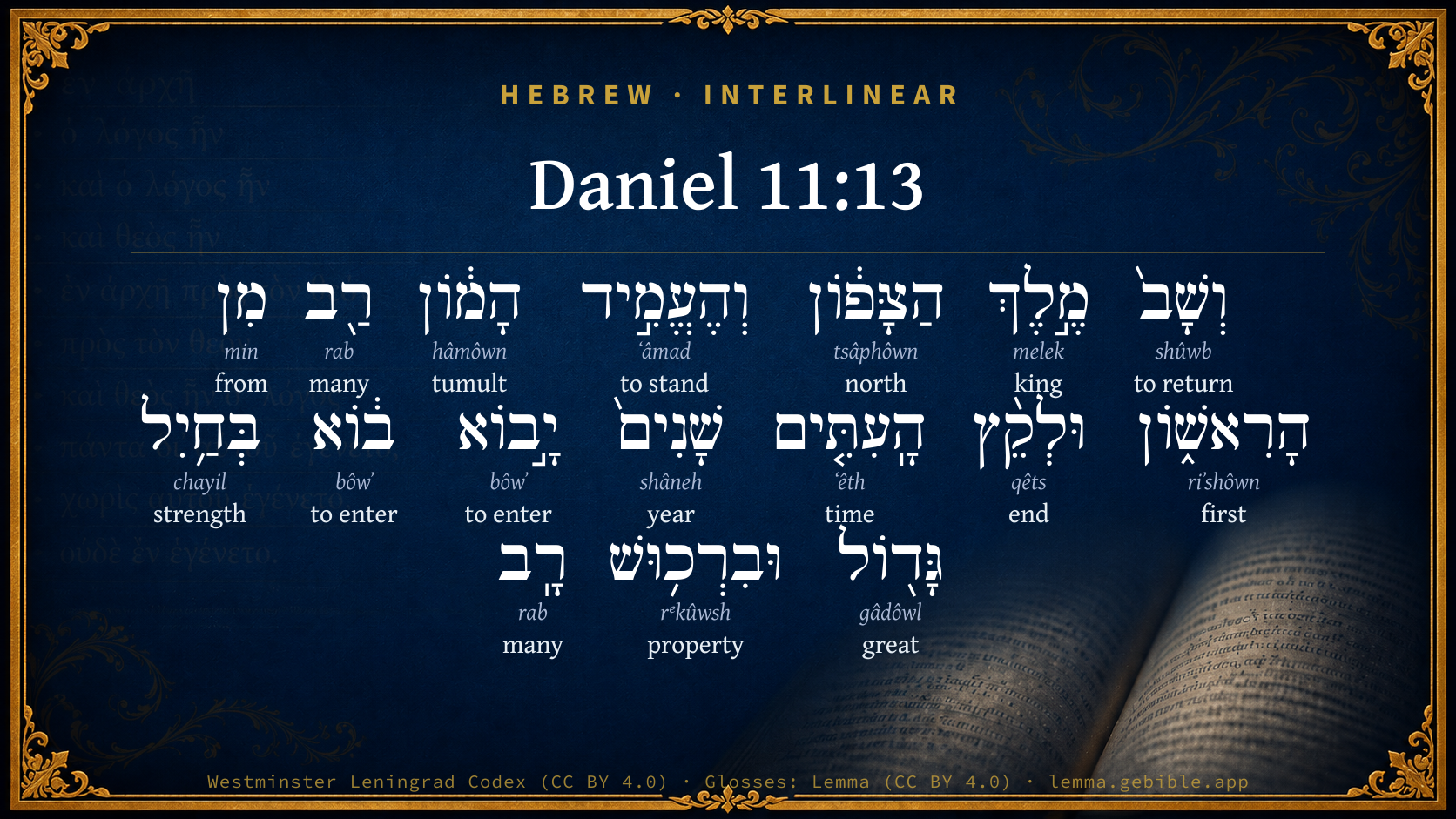
Hebrew (Westminster Leningrad Codex) Daniel 11:13 appears in the Hebrew Old Testament. The text above is from the Westminster Leningrad Codex. Each word links to its Strong’s number, a concise gloss, and parsing drawn from the Open Scriptures Hebrew Bible morphology. Click any word for its full Brown-Driver-Briggs (BDB) entry.
Download image
Cite this verse

Daniel 11:13 (World English Bible). Public Domain. Lemma interlinear Bible study tool, https://lemma.gebible.app/v/daniel/11/13.

Show BibTeX & RIS
BibTeX
RIS
English Translation
The king of the north shall return, and shall set forth a multitude greater than the former; and he shall come on at the end of the times, [even of] years, with a great army and with much substance.
World English Bible · Public Domain
Download a study sheet

One document with this verse’s original text, its word-by-word gloss line, the meaning frame, cross-references with their text, attributed commentary, and full source and license credits — printable, and it pastes into notes with its structure intact.

This verse Autodidact and up

Study sheet (.html) Plain text (.txt)

A passage Seminary Student

Up to 50 verses in one chapter. A passage sheet keeps up to 6 commentary sources and 12 cross-references per verse, in the order this page ranks them, and says so on the sheet whenever that leaves anything out. Ask for a single verse and you get the Autodidact verse sheet above.

Everything on this page stays free to read, with no account — the sheet is a download of what is already on screen, not access to it.

Want to remove ads? Support Godless Engineer
Compare translations 3

The same verse in 3 English versions, stacked beneath the original-language interlinear above. Click any original word for its lexicon entry.

Each is an independent rendering of the whole verse — the interlinear is not word-aligned to these translations.

Highlighted words mark where these versions differ — a whole-verse word diff, not a word-by-word alignment.

  • World English Bible Public Domain
    The king of the north shall return, and shall set forth a multitude greater than the former; and he shall come on at the end of the times, [even of] years, with a great army and with much substance.
  • King James Version Public Domain
    For the king of the north shall return, and shall set forth a multitude greater than the former, and shall certainly come after certain years with a great army and with much riches.
  • unfoldingWord Literal Text CC BY-SA 4.0
    For the king of the North will again raise a multitude, greater than the first. At the end of some years, he will surely come with a great army and much equipment.

unfoldingWord Literal Text — © unfoldingWord, licensed CC BY-SA 4.0. Word-aligned USFM3 via Door43 (git.door43.org/unfoldingWord/en_ult).

Versions to compare (up to 4)

3 of 4 selected

Show all 18 translations

Every available English version of this verse, each an independent rendering of the whole verse.

  • World English Bible Public Domain
    The king of the north shall return, and shall set forth a multitude greater than the former; and he shall come on at the end of the times, [even of] years, with a great army and with much substance.
  • Berean Standard Bible Public Domain
    For the king of the North will raise another army, larger than the first, and after some years he will advance with a great army and many supplies.
  • Majority Standard Bible Public Domain
    For the king of the North will raise another army, larger than the first, and after some years he will advance with a great army and many supplies.
  • King James Version Public Domain
    For the king of the north shall return, and shall set forth a multitude greater than the former, and shall certainly come after certain years with a great army and with much riches.
  • American Standard Version (1901) Public Domain
    And the king of the north shall return, and shall set forth a multitude greater than the former; and he shall come on at the end of the times, `even of' years, with a great army and with much substance.
  • Revised Version (1885) Public Domain
    And the king of the north shall return, and shall set forth a multitude greater than the former; and he shall come on at the end of the times, even of years, with a great army and with much substance.
  • Geneva Bible (1599) Public Domain
    For the King of the North shall returne, and shall set foorth a greater multitude then afore, and shall come foorth (after certeine yeeres) with a mightie armie, and great riches.
  • Douay-Rheims (1899) Public Domain
    For the king of the north shall return and shall prepare a multitude much greater than before: and in the end of times and years, be shall come in haste with a great army, and much riches.
  • Young's Literal Translation Public Domain
    `And the king of the north hath turned back, and hath caused a multitude to stand, greater than the first, and at the end of the times a second time he doth certainly come in with a great force, and with much substance;
  • Literal Standard Version CC BY-SA 4.0
    And the king of the north has turned back, and has caused a multitude to stand, greater than the first, and at the end of the times a second time he certainly comes in with a great force, and with much substance;
  • Unlocked Literal Bible CC BY-SA 4.0
    Then the king of the North will raise up another army, greater than the first. After some years, the king of the North will surely come with a great army supplied with much equipment.
  • unfoldingWord Literal Text CC BY-SA 4.0
    For the king of the North will again raise a multitude, greater than the first. At the end of some years, he will surely come with a great army and much equipment.
  • Darby Bible Public Domain
    For the king of the north shall return, and shall set forth a multitude greater than the former; and shall certainly come at the end of the times of years with a great army and with much substance.
  • World Messianic Bible Public Domain
    The king of the north will return, and will send out a multitude greater than the former. He will come on at the end of the times, even of years, with a great army and with abundant supplies.
  • Webster's Bible Public Domain
    For the king of the north shall return, and shall set forth a multitude greater than the former, and shall certainly come after certain years with a great army and with much riches.
  • Free Bible Version CC BY-SA 4.0
    Years later the king of the north will once again raise an army, even larger than before, and will invade with this huge army, accompanied by plenty of supplies.
  • Bible in Basic English Public Domain
    And again the king of the north will get together an army greater than the first; and he will make an attack on him at the end of years, with a great army and much wealth.
  • JPS Tanakh (1917) Public Domain
    And the king of the north shall again set forth a multitude, greater than the former; and he shall come on at the end of the times, even of years, with a great army and with much substance.

Literal Standard Version (2020), Covenant Press — licensed CC BY-SA 4.0. Text via the HelloAO Bible API (eBible.org). Unlocked Literal Bible (unfoldingWord) — licensed CC BY-SA 4.0. Text via the HelloAO Bible API (eBible.org). unfoldingWord Literal Text — © unfoldingWord, licensed CC BY-SA 4.0. Word-aligned USFM3 via Door43 (git.door43.org/unfoldingWord/en_ult). Free Bible Version, Dr. Jonathan Gallagher — licensed CC BY-SA 4.0. Text via the HelloAO Bible API (eBible.org).

Word by word

More ways to search: Search by grammar → Find every occurrence → Compare this word →

Practice this passage: Drill this verse → Learn its vocabulary →

וּבִרְכ֥וּשׁ
rᵉkûwsh
H7399
“and · in/at · property”
Conjunction + Preposition + Noun, Common, Masculine, Singular, Absolute
Part of Speech
Conjunction + Preposition + Noun
Type
Common
Gender
Masculine
Number
Singular
State
Absolute
Full BDB Definition

Origin: from pass part of H7408

TWOT: 2167b

property, goods, possessions - property, goods - general term for all movable goods - of livestock - of stores, utensils, etc
  1. וְשָׁב֙ shûwb H7725 “and · to return” Conjunction + Verb, Qal, Sequential Perfect, 3rd Person, Masculine, Singular
  2. מֶ֣לֶךְ melek H4428 “king of” Noun, Common, Masculine, Singular, Construct
  3. הַצָּפ֔וֹן tsâphôwn H6828 “the · north” Particle, Definite Article + Noun, Common, Feminine, Singular, Absolute
  4. וְהֶעֱמִ֣יד ʻâmad H5975 “and · to stand” Conjunction + Verb, Hiphil, Sequential Perfect, 3rd Person, Masculine, Singular
  5. הָמ֔וֹן hâmôwn H1995 “tumult” Noun, Common, Masculine, Singular, Absolute
  6. רַ֖ב rab H7227 “many” Adjective, Adjective, Masculine, Singular, Absolute
  7. מִן min H4480 “from” Preposition
  8. הָרִאשׁ֑וֹן riʼshôwn H7223 “the · first” Particle, Definite Article + Adjective, Ordinal number, Masculine, Singular, Absolute
  9. וּלְקֵ֨ץ qêts H7093 “and · to/for · end of” Conjunction + Preposition + Noun, Common, Masculine, Singular, Construct
  10. הָֽעִתִּ֤ים ʻêth H6256 “the · times” Particle, Definite Article + Noun, Common, Both, Plural, Absolute
  11. שָׁנִים֙ shâneh H8141 “years” Noun, Common, Feminine, Plural, Absolute
  12. יָ֣בוֹא bôwʼ H935 “to enter” Verb, Qal, Imperfect, 3rd Person, Masculine, Singular
  13. ב֔וֹא bôwʼ H935 “to enter” Verb, Qal, Infinitive Absolute
  14. בְּחַ֥יִל chayil H2428 “in/at · strength” Preposition + Noun, Common, Masculine, Singular, Absolute
  15. גָּד֖וֹל gâdôwl H1419 “great” Adjective, Adjective, Masculine, Singular, Absolute
  16. רָֽב rab H7227 “many” Adjective, Adjective, Masculine, Singular, Absolute

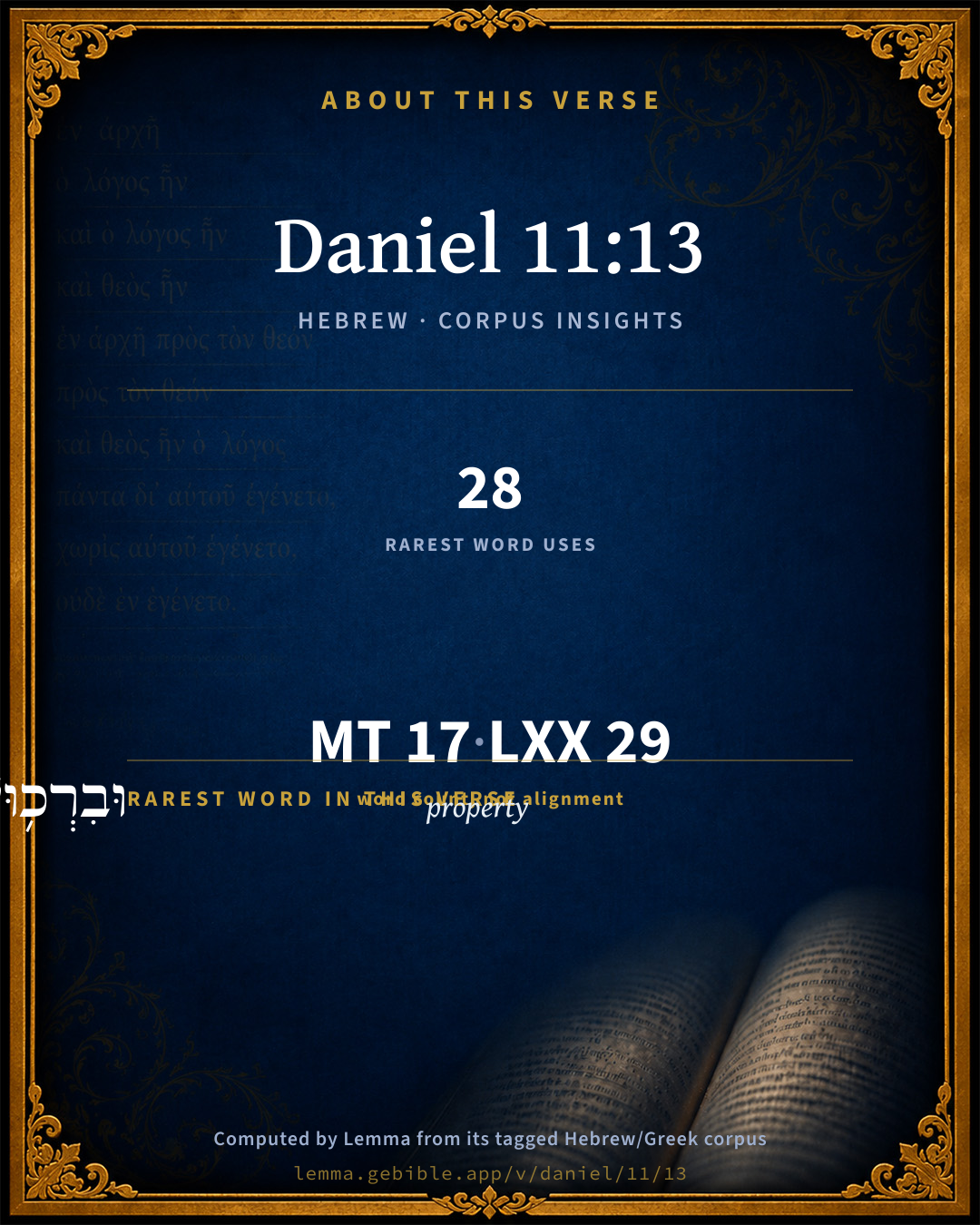
About this verse

These counts appear in no published source. They are computed here, from the morphology-tagged text and Lemma’s own curated glosses. What Lemma adds →

17
words
15
distinct lemmas
Prophets
section

Shared distinctive vocabulary

וּבִרְכ֥וּשׁ property H7399 occurs in 27 verses of the Hebrew Bible. Also found in:

Grammatical profile

  • 4 verbs
  • 8 nouns
  • 4 adjectives
  • 1 preposition

Verb forms

  • וְשָׁב֙ Qal · Sequential Perfect
  • וְהֶעֱמִ֣יד Hiphil · Sequential Perfect
  • יָ֣בוֹא Qal · Imperfect
  • ב֔וֹא Qal · Infinitive Absolute

Repetition

Words recur within this verse — often emphatic in Hebrew:

  • רַ֖ב many H7227 ×2
  • יָ֣בוֹא to enter H935 ×2

Hebrew & Septuagint length

In English translation the verse runs 39 words from the Hebrew and 38 from the Septuagint (LXX English) — closely comparable.

A rough comparison of the two English renderings, which tokenize alike — not a word-level alignment.

Word counts can differ between the Hebrew and the Greek without any difference in meaning — e.g. the Hebrew direct-object marker אֵת has no separate Greek word, and Greek often adds the article ὁ.

In the original languages it is 17 Hebrew tokens and 29 Greek tokens — but the two are counted differently (Hebrew bundles its prefixes and suffixes into one token; the Greek is in lemma form), so that isn’t a like-for-like length.

Cross-references

3

Topical passages linked to Daniel 11:13 in the Treasury of Scripture Knowledge — connected by theme and wording, ordered by reader-vote popularity; previews shown in the World English Bible.

  • Daniel 4:16 let his heart be changed from man's, and let a animal's heart be given to him; and let seven times pass over him.
  • Daniel 12:7 I heard the man clothed in linen, who was above the waters of the river, when he held up his right hand and his left hand to heaven, and swore by him who lives forever that it shall be for a time, times, and a half; and when they have made an end of breaking in pieces the power of the holy people, all these things shall be finished.
  • Daniel 11:6–7 At the end of years they shall join themselves together; and the daughter of the king of the south shall come to the king of the north to make an agreement: but she shall not retain the strength of her arm; neither shall he stand, nor his arm; but she shall be given up, and those who brought her, and he who became the father of her, and he who strengthened her in those times.

Cross-references courtesy of OpenBible.info (CC BY 4.0).

Hebrew and Greek witnesses Masoretic Hebrew ↔ Greek Septuagint

The same verse in the two great witnesses to the Old Testament, shown verse-for-verse.

These are two independent witnesses, not word-aligned to each other, and the Septuagint is shown in lemma (dictionary) form.

Hebrew Daniel 11:13 Masoretic · Westminster Leningrad Codex

וְשָׁב֙ מֶ֣לֶךְ הַצָּפ֔וֹן וְהֶעֱמִ֣יד הָמ֔וֹן רַ֖ב מִן הָרִאשׁ֑וֹן וּלְקֵ֨ץ הָֽעִתִּ֤ים שָׁנִים֙ יָ֣בוֹא ב֔וֹא בְּחַ֥יִל גָּד֖וֹל וּבִרְכ֥וּשׁ רָֽב

The king of the north shall return, and shall set forth a multitude greater than the former; and he shall come on at the end of the times, [even of] years, with a great army and with much substance.

World English Bible · Public Domain

Greek LXX Daniel 11:13 Septuagint · lemma form

καί ἐπιστρέφω βασιλεύς βορέας καί συνἄγω πόλις συναγωγή μέγας παρά ὁ πρῶτος κατά συντέλεια καιρός ἐνιαυτός καί εἰςἔρχομαι εἰς αὐτός ἐπί αὐτός ἐν ὄχλος πολύς καί ἐν χρῆμα πολύς

For the king of the north shall return, and bring a multitude greater than the former, and at the end of the times of years an invading army shall come with a great force, and with much substance.

LXX2012 (modern English Septuagint) · Public Domain

On this verse, The Pulpit Commentary discusses the Septuagint’s reading. Read the note in Commentary ↓

Hebrew: Westminster Leningrad Codex (CC BY 4.0). Greek: Septuagint (public domain); English from LXX2012 (modern English Septuagint) (Public Domain). How the Septuagint differs from the Hebrew →

Commentary

Notes on Daniel 11:13 from classic Christian and Jewish commentators (each source and its license shown beneath its notes). The classic Christian expositions comment on the surrounding passage and are grouped to its opening verse, so a note may address several verses; the Jewish commentaries on the Tanakh (Rashi and others) are per-verse, so they appear only where the commentator wrote on this verse.

Lemma curates 59 commentaries, every one of them public domain or Creative Commons licensed, each selected and text-cleaned for this edition rather than reprinted as found. About our sources →

Trapp's Complete Commentary

John Trapp

Dan 11:13 For the king of the north shall return, and shall set forth a multitude greater than the former, and shall certainly come after certain years with a great army and with much riches.

Ver. 13. For the king of the north.] Antiochus the Great.

Shall return,.] After Philopator’s death, to fight against his young son and successor Epiphanes.

And shall set forth a multitude greater than the former.] Gathered out of the upper parts of Babylon. He called in the help also of Philip, king of Macedon, and other princes. His army is said to have consisted of three hundred thousand footmen, besides horses and elephants. {a}

And shall certainly come.] Heb., By coming he shall come, i.e., surely, swiftly, suddenly; but to small purpose.

And with much riches.] Gold, silver, purple, silks, ivory, as Florus {b} and Gellius {c} testify.

{a} Jerome.

{b} Lib. ii. cap. 8.

{c} Lib. v. cap. 5.

John Trapp, A Commentary or Exposition upon All the Books of the Old and New Testament (1647–1656) — public domain. Text from a community e-Sword module.

Joseph Benson's Commentary

Dan 11:13. For the king of the north shall return — It is here foretold that the war should be renewed between the two kings of the north and south, and that it should be begun by the former, who should attempt another invasion of Egypt. This came to pass accordingly, about fourteen years after. For Antiochus, having taken and slain the rebel Achæus, and put an end to the Asiatic war in which he had been engaged, and during which, by his martial exploits against the Medes, Parthians, and others, he had acquired a distinguished reputation throughout Asia and Europe; and having also reduced and settled the eastern parts in their obedience, he found himself at leisure to prosecute any enterprise he might think proper to undertake. And Ptolemy Philopater having died of intemperance and debauchery, and being succeeded by his son Ptolemy Epiphanes, now a child of only four or five years old, he judged it a favourable opportunity for recovering his lost provinces. Taking advantage, therefore, of the infancy of Ptolemy, he returned to invade Egypt, and set forth a multitude greater than the former, engaging Philip, king of Macedon, in his interest, and bringing with him powerful forces from the east; with much riches — With abundant supplies of all necessary provisions for his army; and especially with beasts of burden for removing their baggage, for that is the proper sense of the word רכושׂ, here rendered riches. Polybius informs us, that from the king of Bactria, and from the king of India, he received so many elephants as made up his number one hundred and fifty, besides provisions and riches. Jerome affirms, from ancient authors, that he gathered together an incredible army out of the countries beyond Babylon; and, contrary to the league, he marched with his army, Ptolemy Philopater being dead, against his son, who was then a child.

Joseph Benson's Commentary on the Old and New Testaments (1811–1818) — public domain. Text from a community e-Sword module.

Keil & Delitzsch

C. F. Keil & F. Delitzsch

This thought is expanded and proved in these verses. - Dan 11:13. The king of the north returns to his own land, gathers a host together more numerous than before, and shall then, at the end of the times of years, come again with a more powerful army and with a great train. רכוּשׁ, that which is acquired, the goods, is the train necessary for the suitable equipment of the army-"the condition to a successful warlike expedition" (Kran.). The definition of time corresponding to the בּעתּים in Dan 11:6 is specially to be observed: שׁנים העתּים לקץ הע (at the end of times, years), in which שׁנים is to be interpreted (as ימים with שׁבעים, Dan 10:3-4, and other designations of time) as denoting that the `itiym stretch over years, are times lasting during years. העתּים, with the definite article, are in prophetic discourse the times determined by God.

Dan 11:14

In those times shall many rise up against the king of the south (על עמד as Dan 8:20); also עמך פריצי בּני, the violent people of the nation (of the Jews), shall raise themselves against him. פריצים .mih ts בּני are such as belong to the classes of violent men who break through the barriers of the divine law (Eze 18:10). These shall raise themselves חזון להעמיד, to establish the prophecy, i.e., to bring it to an accomplishment. ha`amiyd = qayeem, Eze 13:6, as עמד = קוּם in Daniel, and generally in the later Hebrew. Almost all interpreters since Jerome have referred this to Daniel's vision of the oppression under Antiochus Epiphanes, Dan 8:9-14, Dan 11:23. This is so far right, as the apostasy of one party among the Jews from the law of their fathers, and their adoption of heathen customs, contributed to bring about that oppression with which the theocracy was visited by Antiochus Epiphanes; but the limiting of the חזון to those definite prophecies is too narrow. חזון without the article is prophecy in undefined generality, and is to be extended to all the prophecies which threatened the people of Israel with severe chastisements and sufferings on account of their falling away from the law and their apostasy from their God. ונכשׁלוּ, they shall stumble, fall. "The falling away shall bring to them no gain, but only the sufferings and tribulation prophesied of" (Kliefoth).

Dan 11:15

In this verse, with ויבא the בּוא eht וי יבוא, Dan 11:13, is again assumed, and the consequence of the war announced. סוללה שׁפך, to heap up an entrenchment; cf. Eze 4:2; Kg2 19:32. מבצרות עיר, city of fortifications, without the article, also collectively of the fortresses of the kingdom of the south generally. Before such power the army, i.e., the war-strength, of the south shall not maintain its ground; even his chosen people shall not possess strength necessary for this.

Keil & Delitzsch — Biblical Commentary on the Old Testament (1861–1891) — public domain (CC PDM 1.0). Text via the HelloAO Bible API. (Old Testament only.)

Geneva Bible (1599)

Geneva Bible translators

After the death of Ptolemy Philopater, who left Ptolemeus Epiphanes his heir.

Geneva Bible (1599) marginal notes — public domain. Text via Bolls.life.

Jamieson, Fausset & Brown

Robert Jamieson, A. R. Fausset & David Brown

return--renew the war.

after certain years--fourteen years after his defeat at Raphia. Antiochus, after successful campaigns against Persia and India, made war with Ptolemy Epiphanes, son of Philopater, a mere child.

Jamieson, Fausset & Brown — Commentary Critical and Explanatory on the Whole Bible (1871) — public domain (CC PDM 1.0). Text via the HelloAO Bible API.

Adam Clarke's Commentary

Verse 13. The king of the north shall return - after certain years] In about fourteen years Antiochus did return, Philopater being dead, and his son Ptolemy Epiphanes being then a minor. He brought a much larger army and more riches; these he had collected in a late eastern expedition.

Adam Clarke's Commentary on the Bible (1810–1826) — public domain. Text from a community e-Sword/MySword module.

John Calvin's Commentaries

Here the angel prophesies of other wars. For he first describes the war which was carried on by Antiochus against the Egyptians, after the death of Philopater, who left as his heir, a little son named Ptolemy Epiphanes. When, therefore, he perceived the land deprived of its king, he drew up an army and invaded Egypt. As the Egyptians had no strength to resist him, an embassy was sent to Rome; and we know how eager the Romans were to become involved in all the business of the world. With the view of extending their empire still further and wider, they sent immediately to Antiochus the Great, and commanded him to desist from the war; but after many trials he failed of success, until he engaged in a very desperate battle with Scopas, and at length obtained a victory. In the meantime, the Egyptians were far from idle: although they hoped to be able to subdue the empire of Antiochus by the assistance of the Senate, yet they carefully fitted out an armament of their own under their General Scopas, who was successful in many of his plans, but was finally defeated in the borders of Judea. The angel now describes this war. The king of Syria shall return, he says; meaning, after the death of Ptolemy Philopator, he rested for a while, because he had been unsuccessful with his forces, and they were so entirely disorganized that he had no confidence in the success of any expedition. But he thought Egypt would give him no trouble, as it had lost its head and was like a lifeless corpse. Then he was elevated with fresh confidence, and returned to Egypt. And he shall arrange a greater multitude than at the first He had a large and powerful army, as we have said, and a noble armament of cavalry: he had 70,000 foot, and was still collecting greater forces. The angel signifies the future arrival of the king of Syria, after the interval of a certain time. At the end of the times of the years he shall surely come, that is he shall break forth. The angel seems to use this expression for the sake of increasing its certainty; for he at first despised the Romans in consequence of their great distance from him, and he had no fear of what afterwards occurred. He never supposed they had such boldness in them as to cross the sea against him.

John Calvin's Commentaries (1540-1563) — public domain. Text from the Calvin Translation Society English edition (1840s-50s) via the Christian Classics Ethereal Library (ccel.org). Calvin's coverage is partial (roughly two-thirds of the Bible); uncommented books and verses are honest gaps, never fabricated. The 19th-century editor's footnotes and remarks are omitted so the notes are faithfully Calvin's own voice.

Ellicott's Commentary for English Readers

(13) Shall return.—In this and the next two verses the causes are mentioned to which the failure of the southern king was due. He returns some years after his defeat to take revenge, and brings with him a larger army than he had on the previous occasion.

Much riches—i.e., all that is necessary for the maintenance of a large army; literally, anything acquired. This has been explained of the invasion of Egypt by Antiochus and Philip of Macedon, some thirteen or fourteen years after the battle of Raphia, when Ptolemy Epiphanes, a mere child, had succeeded his father, Philopator. On the hypothesis that these chapters refer to this period, it is surprising that there should be no allusion to the religious persecutions to which the Jews in Egypt had been subjected by Ptolemy Philopator, who, after his victory at Raphia, attempted to enter the Holy Place, as is mentioned in the Third Book of Maccabees. It should be remembered that the Jews suffered considerably from both parties during the whole of this period; but though the prophecy is supposed to have been written for their comfort and encouragement at this very juncture, yet not a word is said which bears allusion to them.

A Bible Commentary for English Readers, edited by Charles John Ellicott (1878–1897) — public domain. Text from a community e-Sword module.

The Cambridge Bible for Schools and Colleges

gen. ed. J. J. S. Perowne

13. Twelve years after the battle of Raphia, in 205, Ptolemy Philopator died, leaving a son aged 4 years, who succeeded him on the throne as Ptolemy V. (Epiphanes). Antiochus had meanwhile been gaining the series of successes in Persia, Bactria, Asia Minor, and even in India, which earned him the epithet of the ‘Great.’ Returning from the East, in the same year in which Philopator died, he concluded an alliance with Philip, king of Macedon, for a joint attack upon the infant king of Egypt, and partition of his foreign possessions between them (Polyb. xv. 20; cf. Jer. ad loc.). Details of the war are not known, the part of Polybius’ history which described it being lost. We only learn from Justin (xxxi. 1) that he invaded Phœnicia and Syria; and from Polybius (xvi. 18, 40) that he captured Gaza, after a stout resistance.

shall return, &c.] shall again raise a multitude, greater than the former, with allusion to the forces by which he achieved his successes in Persia and the East. Jerome (quoting probably from Porphyry) speaks of the immense army which he brought back with him from the East.

and he shall come on at the end of the times, (even of) years] after 12 years, at the end of his conquests in Persia, Bactria, &c.

with much substance] the allusion is to the baggage, implements of war, &c., belonging to a well-appointed army. The word used (רכוש) denotes especially such possessions as stores, furniture, implements, &c.: see 1Ch_27:31, 2Ch_20:25 (‘riches’—of an invading army), 2Ch_21:14 (R.V.), 17; Ezr_1:4; Ezr_1:6 (‘goods’).

The Cambridge Bible for Schools and Colleges (gen. ed. J. J. S. Perowne; Cambridge University Press, 1878–1918) — public domain. Text from a community e-Sword module.

John Gill's Exposition

For the king of the north shall return,.... As Antiochus king of Syria did, upon the death of Ptolemy Philopator, who was succeeded by his son Ptolemy Epiphanes, a minor of five years of age: Antiochus took the advantage of this minority, and entered into a league with Philip king of Macedon, to divide the kingdom of Egypt between them; and marched an army into Coelesyria and Palestine, and made himself master of those countries:

and shall set forth a multitude greater than the former; bring a larger army into the field than he had done before, which Jerom says he brought out of the upper parts of Babylon; some say it consisted of three hundred thousand footmen, besides horsemen and elephants:

and shall certainly come (after certain years) with a great army, and with much riches; with all manner of provisions to supply his numerous army, and all proper accommodations for it; money to pay his soldiers, and beasts of burden to carry their baggage from place to place: this was about fourteen years after the former battle, as Dr. Prideaux (p) observes; and, according to Bishop Usher's annals, thirteen years.

(p) Connexion, par. 2. B. 2. p. 140.

John Gill's Exposition of the Whole Bible (1746–1763) — public domain (CC PDM 1.0). Text via the HelloAO Bible API.

Albert Barnes' Notes on the Bible

For the king of the north shall return - That is, he shall come again into the regions of Coelo-Syria and Palestine, to recover them if possible from the power of the Egyptian king.

And shall set forth a multitude greater than the former - Than he had in the former war when he was defeated. The fact was, that Antiochus, in this expedition, brought with him the forces with which he had successfully invaded the East, and the army had been raised for that purpose, and was much larger than that with which he had formerly attacked Ptolemy. See Prideaux, iii. 163-165.

And shall certainly come after certain years with a great army - This occurred 203 b.c., fourteen years after the former war. - Prideaux, iii. 19.

With much riches - Obtained in his conquests in Parthia and other portions of the East. See Prideaux, “ut supra.” The “history” of Antiochus corresponds precisely with the statement here.

Albert Barnes' Notes on the Bible (1834–1885) — public domain. Text from a community e-Sword/MySword module.

Haydock's Catholic Bible Commentary

Times, seventeen years after the battle of Raphia. When Philopator was dead, and his son Epiphanes not above five years old, Antiochus and Philip of Macedon basely attempted to divide his dominions. Scopas engaged Antiochus, but lost the battle, and all that Philopator had recovered. (Calmet) --- Many revolted in Egypt on account of the arrogance of Agathocles, who ruled in the king’s name. (ver. 14.) (St. Jerome)

George Leo Haydock (1774–1849), Haydock's Catholic Family Bible and Commentary, 1859 edition — public domain. Excludes Psalms (Douay-Rheims chapter numbering differs from Protestant) and Deuterocanonical books (Catholic canon only).

Matthew Poole's English Annotations

Antiochus the Great shall raise great forces, even from Babylon and Media; Philopater being dead, and Ptolemy Epiphanes his son yet a child, under whom Agathocles, a dissolute, proud person, hated of all, governed Egypt as his viceroy.

Matthew Poole's English Annotations on the Holy Bible (1683–1685) — public domain. Text from a community e-Sword/MySword module.

Whedon's Commentary on the Bible

Daniel D. Whedon

13. Antiochus the Great, after thirteen years in which he had pushed his conquests even into Ionia (not “India,” as is generally supposed) and accumulated great wealth, gathered again an even greater army than before and moved against Egypt upon the death of the former Ptolemy and the accession of his young son, Ptolemy Epiphanes. The result was a complete victory and the annexation to the Syrian territory of the portions of Palestine and Philistia formerly claimed by Egypt.

Much riches — R.V., “much substance.” This is a general term equivalent to “stuff” or “goods.” Its use in Dan_11:24; Dan_11:28, and elsewhere, would seem to exclude the meaning “weapons,” which many modern scholars, following Hitzig, prefer.

Daniel D. Whedon (gen. ed.), Commentary on the Old and New Testaments (1874–1909) — public domain. Text from a community e-Sword module.

The Pulpit Commentary

For the king of the north shall return, and shall set forth a multitude greater than the former, and shall certainly come after certain years with a great army and with much riches. The LXX does not differ essentially from this, only polewv comes in unnecessarily by a blunder the less to be understood, as there seems no word which can have occasioned the misreading, unless it is simply a blunder of hearing for pollhn; but against this is the fact that Paulus Tellensis has medeenatha. There is also the limitation of the period after which the king of the north will return to "one year" (kairou ejniautou), "a period of a year." Theodotion is closer to the Massoretic. The Peshitta is closer than either of the Greek versions, as neither of them attempts to give, "coming he shall come," which it does. The Vulgate is like Theodotion. The reference here is to the second expedition against Egypt, undertaken by Antiochus after the death of Philopator. After his victory at Raphia, Ptolemy resumed his life of self-indulgence. Antiochus endeavoured to build up his empire by curbing the Parthians; then, after an interval of fourteen years, he once more invaded the territories of the Egyptian monarch. This second invasion resulted in Antiochus gaining possession of all Palestine.

The Pulpit Commentary (1880–1919), ed. H.D.M. Spence-Jones & Joseph S. Exell — public domain. Text from a community e-Sword module.

unfoldingWord translationNotes

Door43 World Missions Community

General Information:

The angel continues speaking to Daniel.

a great army supplied with much equipment

This can also be stated in active form. AT: "a great army that has much equipment" (See: Active or Passive)

translationWords

king

raise

unfoldingWord translationNotes — © Distant Shores Media and the Door43 World Missions Community, licensed CC BY-SA 4.0. Source: git.door43.org/Door43/en_tn.

Lesson kit

Teaching starters — assembled from the data on this page, not authored interpretation. Every prompt links to the verse data it draws on. Edit before teaching.

Daniel, in the Prophets, opens this verse with 17 words (15 distinct Hebrew lemmas). Its most distinctive word is rᵉkûwsh (“property”). A historical commentator’s framing appears above. Read the whole chapter for the surrounding context.

Discussion questions

  1. The word rᵉkûwsh carries the sense “property.” How does it shape the verse?
  2. How does Genesis 12:5, which shares the word «property», read alongside this verse?
  3. What does the repetition of “many” (2× in this one verse) do in this verse?
  4. These translations render this verse differently. What is at stake in choosing one wording over another?
  5. «וְשָׁב֙» is a Qal Sequential Perfect verb. How does that grammatical form shape the action described?
  6. Compare how Trapp's Complete Commentary and Joseph Benson's Commentary read this verse. Where do they agree or differ?

Things to notice

Reading settings

Reading text

Shown beneath each verse's original-language words.

Old Testament
Old Testament edition

Read the OT as the Masoretic Hebrew (MT) or the Greek Septuagint (LXX).

English shown for the Greek Septuagint (in the Hebrew ↔ Greek comparison).

Comparing translations? Open the Compare panel on any verse page to stack up to four side by side.