
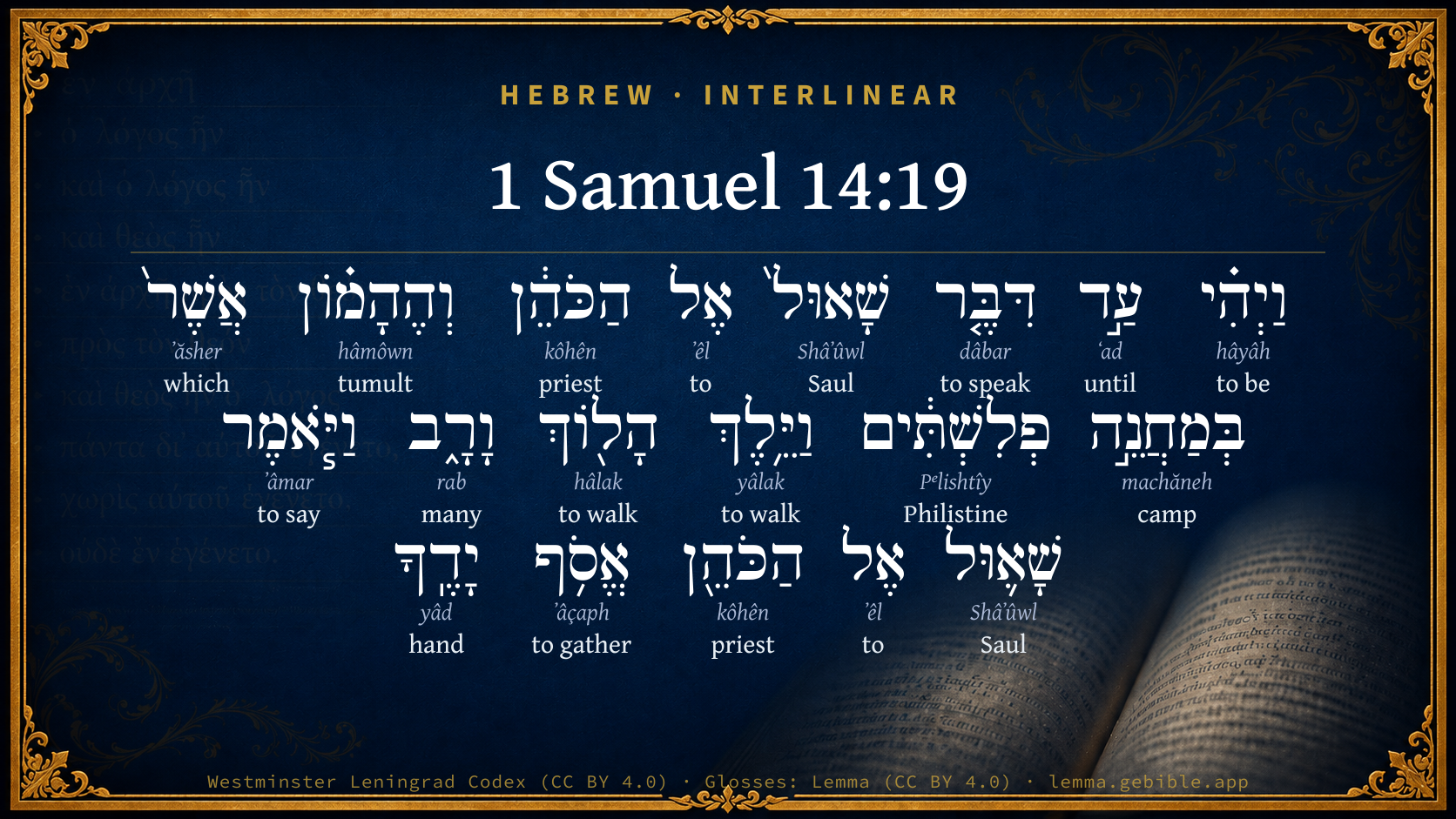
1 Samuel 14:19

Hebrew (Westminster Leningrad Codex) 1 Samuel 14:19 appears in the Hebrew Old Testament. The text above is from the Westminster Leningrad Codex. Each word links to its Strong’s number, a concise gloss, and parsing drawn from the Open Scriptures Hebrew Bible morphology. Click any word for its full Brown-Driver-Briggs (BDB) entry.
Download image
Cite this verse

1 Samuel 14:19 (World English Bible). Public Domain. Lemma interlinear Bible study tool, https://lemma.gebible.app/v/1-samuel/14/19.

Show BibTeX & RIS
BibTeX
RIS
English Translation
It happened, while Saul talked to the priest, that the tumult that was in the camp of the Philistines went on and increased: and Saul said to the priest, Withdraw your hand.
World English Bible · Public Domain
Download a study sheet

One document with this verse’s original text, its word-by-word gloss line, the meaning frame, cross-references with their text, attributed commentary, and full source and license credits — printable, and it pastes into notes with its structure intact.

This verse Autodidact and up

Study sheet (.html) Plain text (.txt)

A passage Seminary Student

Up to 50 verses in one chapter. A passage sheet keeps up to 6 commentary sources and 12 cross-references per verse, in the order this page ranks them, and says so on the sheet whenever that leaves anything out. Ask for a single verse and you get the Autodidact verse sheet above.

Everything on this page stays free to read, with no account — the sheet is a download of what is already on screen, not access to it.

Want to remove ads? Support Godless Engineer
Compare translations 3

The same verse in 3 English versions, stacked beneath the original-language interlinear above. Click any original word for its lexicon entry.

Each is an independent rendering of the whole verse — the interlinear is not word-aligned to these translations.

Highlighted words mark where these versions differ — a whole-verse word diff, not a word-by-word alignment.

  • World English Bible Public Domain
    It happened, while Saul talked to the priest, that the tumult that was in the camp of the Philistines went on and increased: and Saul said to the priest, Withdraw your hand.
  • King James Version Public Domain
    And it came to pass, while Saul talked unto the priest, that the noise that was in the host of the Philistines went on and increased: and Saul said unto the priest, Withdraw thine hand.
  • unfoldingWord Literal Text CC BY-SA 4.0
    And it happened, while Saul spoke to the priest, that the tumult that in the camp of the Philistines, that going, it went and became great. And Saul said to the priest, “Withdraw your hand.”

unfoldingWord Literal Text — © unfoldingWord, licensed CC BY-SA 4.0. Word-aligned USFM3 via Door43 (git.door43.org/unfoldingWord/en_ult).

Versions to compare (up to 4)

3 of 4 selected

Show all 18 translations

Every available English version of this verse, each an independent rendering of the whole verse.

  • World English Bible Public Domain
    It happened, while Saul talked to the priest, that the tumult that was in the camp of the Philistines went on and increased: and Saul said to the priest, Withdraw your hand.
  • Berean Standard Bible Public Domain
    While Saul was talking to the priest, the commotion in the Philistine camp continued to increase. So Saul said to the priest, “Withdraw your hand.”
  • Majority Standard Bible Public Domain
    While Saul was talking to the priest, the commotion in the Philistine camp continued to increase. So Saul said to the priest, “Withdraw your hand.”
  • King James Version Public Domain
    And it came to pass, while Saul talked unto the priest, that the noise that was in the host of the Philistines went on and increased: and Saul said unto the priest, Withdraw thine hand.
  • American Standard Version (1901) Public Domain
    And it came to pass, while Saul talked unto the priest, that the tumult that was in the camp of the Philistines went on and increased: and Saul said unto the priest, Withdraw thy hand.
  • Revised Version (1885) Public Domain
    And it came to pass, while Saul talked unto the priest, that the tumult that was in the camp of the Philistines went on and increased: and Saul said unto the priest, Withdraw thine hand.
  • Geneva Bible (1599) Public Domain
    And while Saul talked vnto the Priest, the noyse that was in the hoste of the Philistims, spred farther abroade, and encreased: therefore Saul said vnto the Priest, Withdraw thine hand.
  • Douay-Rheims (1899) Public Domain
    And while Saul spoke to the priest, there arose a great uproar in the camp of the Philistines: and it increased by degrees, and was heard more clearly. And Saul said to the priest: Draw in thy hand.
  • Young's Literal Translation Public Domain
    And it cometh to pass, while Saul spake unto the priest, that the noise which `is' in the camp of the Philistines goeth on, going on and becoming great, and Saul saith unto the priest, `Remove thy hand.'
  • Literal Standard Version CC BY-SA 4.0
    And it comes to pass, while Saul spoke to the priest, that the noise which [is] in the camp of the Philistines goes on, going on and becoming great, and Saul says to the priest, “Remove your hand.”
  • Unlocked Literal Bible CC BY-SA 4.0
    While Saul was talking to the priest, the commotion in the camp of the Philistines was continuing and increasing. Then Saul said to the priest, “Withdraw your hand.”
  • unfoldingWord Literal Text CC BY-SA 4.0
    And it happened, while Saul spoke to the priest, that the tumult that in the camp of the Philistines, that going, it went and became great. And Saul said to the priest, “Withdraw your hand.”
  • Darby Bible Public Domain
    And it came to pass while Saul talked to the priest, that the noise which was in the camp of the Philistines went on and increased; and Saul said to the priest, Withdraw thy hand.
  • World Messianic Bible Public Domain
    While Saul talked to the priest, the tumult that was in the camp of the Philistines went on and increased; and Saul said to the priest, “Withdraw your hand!”
  • Webster's Bible Public Domain
    And it came to pass while Saul talked to the priest, that the noise that was in the host of the Philistines went on, and increased: and Saul said to the priest, Withdraw thy hand.
  • Free Bible Version CC BY-SA 4.0
    But as Saul was speaking to the priest, the commotion coming from the Philistine camp grew louder and louder. So Saul told the priest, “Forget it!”
  • Bible in Basic English Public Domain
    Now while Saul was talking to the priest, the noise in the tents of the Philistines became louder and louder; and Saul said to the priest, Take back your hand.
  • JPS Tanakh (1917) Public Domain
    And it came to pass, while Saul talked unto the priest, that the tumult that was in the camp of the Philistines went on and increased; and Saul said unto the priest: 'Withdraw thy hand.'

Literal Standard Version (2020), Covenant Press — licensed CC BY-SA 4.0. Text via the HelloAO Bible API (eBible.org). Unlocked Literal Bible (unfoldingWord) — licensed CC BY-SA 4.0. Text via the HelloAO Bible API (eBible.org). unfoldingWord Literal Text — © unfoldingWord, licensed CC BY-SA 4.0. Word-aligned USFM3 via Door43 (git.door43.org/unfoldingWord/en_ult). Free Bible Version, Dr. Jonathan Gallagher — licensed CC BY-SA 4.0. Text via the HelloAO Bible API (eBible.org).

Word by word

More ways to search: Search by grammar → Find every occurrence → Compare this word →

Practice this passage: Drill this verse → Learn its vocabulary →

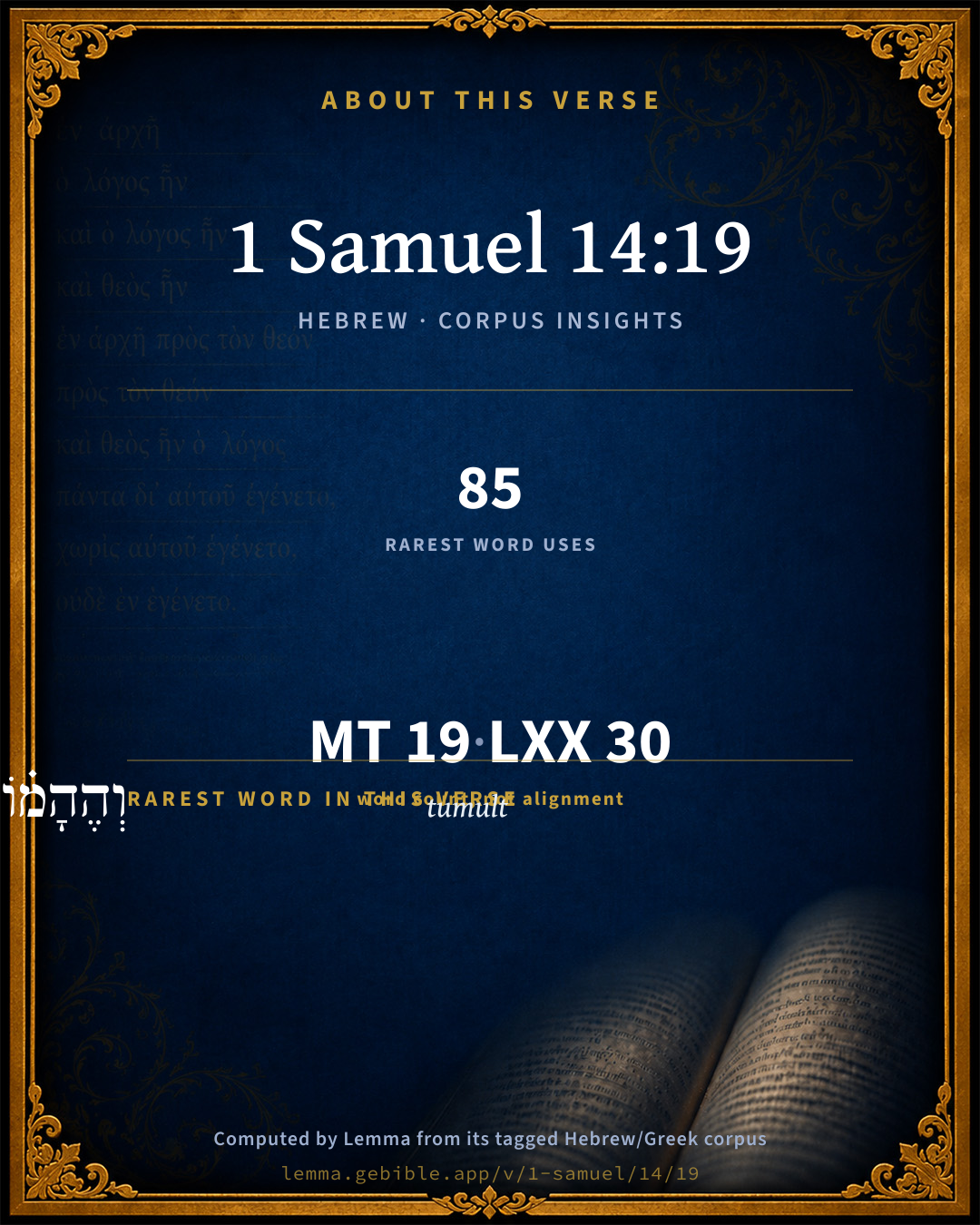
וְהֶהָמ֗וֹן
hâmôwn
H1995
“and · the · tumult”
Conjunction + Particle, Definite Article + Noun, Common, Masculine, Singular, Absolute
Part of Speech
Conjunction + Particle + Noun
Type
Common
Gender
Masculine
Number
Singular
State
Absolute
Full BDB Definition

Origin: from H1993

TWOT: 505a

(Qal) murmur, roar, crowd, abundance, tumult, sound - sound, murmur, rush, roar - tumult, confusion - crowd, multitude - great number, abundance - abundance, wealth
  1. וַיְהִ֗י hâyâh H1961 “and · to be” Conjunction + Verb, Qal, Sequential Imperfect, 3rd Person, Masculine, Singular
  2. עַ֣ד ʻad H5704 “until” Preposition
  3. דִּבֶּ֤ר dâbar H1696 “to speak” Verb, Piel, Perfect, 3rd Person, Masculine, Singular
  4. שָׁאוּל֙ Shâʼûwl H7586 “Saul” Noun, Proper
  5. אֶל ʼêl H413 “to” Preposition
  6. הַכֹּהֵ֔ן kôhên H3548 “the · priest” Particle, Definite Article + Noun, Common, Masculine, Singular, Absolute
  7. אֲשֶׁר֙ ʼăsher H834 “which” Particle, Relative
  8. בְּמַחֲנֵ֣ה machăneh H4264 “in/at · camp of” Preposition + Noun, Common, Both, Singular, Construct
  9. פְלִשְׁתִּ֔ים Pᵉlishtîy H6430 “Philistines” Noun, Gentilic, Masculine, Plural, Absolute
  10. וַיֵּ֥לֶךְ yâlak H3212 “and · to walk” Conjunction + Verb, Qal, Sequential Imperfect, 3rd Person, Masculine, Singular
  11. הָל֖וֹךְ hâlak H1980 “to walk” Verb, Qal, Infinitive Absolute
  12. וָרָ֑ב rab H7227 “and · many” Conjunction + Adjective, Adjective, Masculine, Singular, Absolute
  13. וַיֹּ֧אמֶר ʼâmar H559 “and · to say” Conjunction + Verb, Qal, Sequential Imperfect, 3rd Person, Masculine, Singular
  14. שָׁא֛וּל Shâʼûwl H7586 “Saul” Noun, Proper
  15. אֶל ʼêl H413 “to” Preposition
  16. הַכֹּהֵ֖ן kôhên H3548 “the · priest” Particle, Definite Article + Noun, Common, Masculine, Singular, Absolute
  17. אֱסֹ֥ף ʼâçaph H622 “gather” Verb, Qal, Imperative, 2nd Person, Masculine, Singular
  18. יָדֶֽךָ yâd H3027 “hand · your” Noun, Common, Both, Singular, Construct + Suffix, Personal, 2nd Person, Masculine, Singular

About this verse

These counts appear in no published source. They are computed here, from the morphology-tagged text and Lemma’s own curated glosses. What Lemma adds →

19
words
16
distinct lemmas
Historical
section

Grammatical profile

  • 6 verbs
  • 8 nouns
  • 1 adjective
  • 3 prepositions
  • 1 particle

Verb forms

  • וַיְהִ֗י Qal · Sequential Imperfect
  • דִּבֶּ֤ר Piel · Perfect
  • וַיֵּ֥לֶךְ Qal · Sequential Imperfect
  • הָל֖וֹךְ Qal · Infinitive Absolute
  • וַיֹּ֧אמֶר Qal · Sequential Imperfect
  • אֱסֹ֥ף Qal · Imperative

Repetition

Words recur within this verse — often emphatic in Hebrew:

  • שָׁאוּל֙ Saul H7586 ×2
  • הַכֹּהֵ֔ן priest H3548 ×2
  • אֶל to H413 ×2

Hebrew & Septuagint length

In English translation the verse runs 32 words from the Hebrew and 34 from the Septuagint (LXX English) — closely comparable.

A rough comparison of the two English renderings, which tokenize alike — not a word-level alignment.

Word counts can differ between the Hebrew and the Greek without any difference in meaning — e.g. the Hebrew direct-object marker אֵת has no separate Greek word, and Greek often adds the article ὁ.

In the original languages it is 19 Hebrew tokens and 30 Greek tokens — but the two are counted differently (Hebrew bundles its prefixes and suffixes into one token; the Greek is in lemma form), so that isn’t a like-for-like length.

Cross-references

6

Topical passages linked to 1 Samuel 14:19 in the Treasury of Scripture Knowledge — connected by theme and wording, ordered by reader-vote popularity; previews shown in the World English Bible.

  • Numbers 27:21 He shall stand before Eleazar the priest, who shall inquire for him by the judgment of the Urim before Yahweh: at his word shall they go out, and at his word they shall come in, both he, and all the children of Israel with him, even all the congregation.
  • 1 Samuel 14:24 The men of Israel were distressed that day; for Saul had adjured the people, saying, Cursed be the man who eats any food until it be evening, and I be avenged on my enemies. So none of the people tasted food.
  • Joshua 9:14 The men took of their provision, and didn't ask counsel at the mouth of Yahweh.
  • 1 Samuel 13:11 Samuel said, What have you done? Saul said, Because I saw that the people were scattered from me, and that you didn't come within the days appointed, and that the Philistines assembled themselves together at Michmash;
  • Psalms 106:13 They soon forgot his works. They didn't wait for his counsel,
  • Isaiah 28:16 therefore thus says the Lord Yahweh, Behold, I lay in Zion for a foundation a stone, a tried stone, a precious corner -[stone] of sure foundation: he who believes shall not be in haste.

Cross-references courtesy of OpenBible.info (CC BY 4.0).

Hebrew and Greek witnesses Masoretic Hebrew ↔ Greek Septuagint

The same verse in the two great witnesses to the Old Testament, shown verse-for-verse.

These are two independent witnesses, not word-aligned to each other, and the Septuagint is shown in lemma (dictionary) form.

Hebrew 1 Samuel 14:19 Masoretic · Westminster Leningrad Codex

וַיְהִ֗י עַ֣ד דִּבֶּ֤ר שָׁאוּל֙ אֶל הַכֹּהֵ֔ן וְהֶהָמ֗וֹן אֲשֶׁר֙ בְּמַחֲנֵ֣ה פְלִשְׁתִּ֔ים וַיֵּ֥לֶךְ הָל֖וֹךְ וָרָ֑ב וַיֹּ֧אמֶר שָׁא֛וּל אֶל הַכֹּהֵ֖ן אֱסֹ֥ף יָדֶֽךָ

It happened, while Saul talked to the priest, that the tumult that was in the camp of the Philistines went on and increased: and Saul said to the priest, Withdraw your hand.

World English Bible · Public Domain

Greek LXX 1 Samuel 14:19 Septuagint · lemma form

καί γίγνομαι ὡς λαλέω σαούλ πρός ὁ ἱερεύς καί ὁ ἦχος ἐν ὁ παρεμβολή ὁ ἀλλόφυλος πορεύομαι πορεύομαι καί πληθύνω καί εἶπον σαούλ πρός ὁ ἱερεύς συνἄγω ὁ χείρ σύ

And it came to pass while Saul was speaking to the priest, that the sound in the camp of the Philistines continued to increase greatly; and Saul said to the priest, Withdraw your hands.

LXX2012 (modern English Septuagint) · Public Domain

Hebrew: Westminster Leningrad Codex (CC BY 4.0). Greek: Septuagint (public domain); English from LXX2012 (modern English Septuagint) (Public Domain). How the Septuagint differs from the Hebrew →

Targum (Aramaic paraphrase)

1

The Targum is the ancient Jewish Aramaic paraphrase of the Hebrew Scriptures — an interpretive translation, not the Hebrew text itself. Onkelos (literal) and Pseudo-Jonathan (expansive) render the Torah, and Jonathan the Prophets. Coverage is partial: where no permissively-licensed English translation exists for a verse, only the Aramaic is shown. This is verse-level text, not a word-by-word alignment to the Hebrew.

  1. Targum Jonathan Prophets (Joshua–Malachi)
    וַהֲוָה עַד דְמַלֵיל שָׁאוּל עִם כַּהֲנָא וְהָמוֹנָא דִבְמַשִׁרְיַת פְּלִשְׁתָּאֵי אָזֵיל מֵיזַל וְסָגֵי וַאֲמַר שָׁאוּל לְכַהֲנָא קָרֵיב אֵיפוֹדָא:

    (no public-domain English translation for this verse)

    Targum Jonathan — Aramaic: “Mikraot Gedolot” (public domain). English: “Sefaria Community Translation” (CC0 1.0 (public-domain dedication)); “London "Chaldee Paraphrase," 1871” (public domain). Text via Sefaria.

Commentary

Notes on 1 Samuel 14:19 from classic Christian and Jewish commentators (each source and its license shown beneath its notes). The classic Christian expositions comment on the surrounding passage and are grouped to its opening verse, so a note may address several verses; the Jewish commentaries on the Tanakh (Rashi and others) are per-verse, so they appear only where the commentator wrote on this verse.

Lemma curates 59 commentaries, every one of them public domain or Creative Commons licensed, each selected and text-cleaned for this edition rather than reprinted as found. About our sources →

Trapp's Complete Commentary

John Trapp

1Sa 14:19 And it came to pass, while Saul talked unto the priest, that the noise that [was] in the host of the Philistines went on and increased: and Saul said unto the priest, Withdraw thine hand.

Ver. 19. Withdraw thine hand.] Words of profane impiety: q.d., it is now no time to consult with God, for we know well enough what we have to do, and will take our opportunity.

John Trapp, A Commentary or Exposition upon All the Books of the Old and New Testament (1647–1656) — public domain. Text from a community e-Sword module.

Geneva Bible (1599)

Geneva Bible translators

Let the Ephod alone: for I have no leisure now to ask counsel of God, Num. 27:21.

Geneva Bible (1599) marginal notes — public domain. Text via Bolls.life.

Jamieson, Fausset & Brown

Robert Jamieson, A. R. Fausset & David Brown

Withdraw thine hand--The priest, invested with the ephod, prayed with raised and extended hands. Saul perceiving that the opportunity was inviting, and that God appeared to have sufficiently declared in favor of His people, requested the priest to cease, that they might immediately join in the contest. The season for consultation was past--the time for prompt action was come.

Jamieson, Fausset & Brown — Commentary Critical and Explanatory on the Whole Bible (1871) — public domain (CC PDM 1.0). Text via the HelloAO Bible API.

Adam Clarke's Commentary

Verse 19. While Saul talked unto the priest] Before he had made an end of consulting him, the increasing noise of the panic-struck Philistines called his attention; and finding there was no time to lose, he immediately collected his men and fell on them.

Adam Clarke's Commentary on the Bible (1810–1826) — public domain. Text from a community e-Sword/MySword module.

Ellicott's Commentary for English Readers

(19) Withdraw thine hand.—The instinct of the general, as we should expect from the character of Saul, soon got the better of his first desire for some Divine guidance. His watchful eye saw that the confusion in the Philistine camp was increasing; now was the moment for his little compact force to throw itself into the melée; so he at once bids Ahijah, the priest of the Lord, to put up the Urim and Thummim, and no longer to seek higher counsel, for the hour was come to fight rather than to pray. This has been the general interpretation of Saul’s action here. Wordsworth quotes Bishop Andrewes, saying, “There are some who with Saul will call for the Ark, and will presently cry ‘Away with it !’ that is, will begin their prayers, and break them off in the midst on every occasion.” And Bishop Hall: “Saul will consult the Ark; hypocrites, when they have leisure, will perhaps be holy. But when the tumult was aroused, Saul’s piety decreased. ‘Withdraw thine hand,’ he said; the Ark must give place to arms.’”

A Bible Commentary for English Readers, edited by Charles John Ellicott (1878–1897) — public domain. Text from a community e-Sword module.

The Cambridge Bible for Schools and Colleges

gen. ed. J. J. S. Perowne

19. Withdraw thine hand] Desist from the inquiry. With characteristic impatience Saul would not wait for God’s answer.

The Cambridge Bible for Schools and Colleges (gen. ed. J. J. S. Perowne; Cambridge University Press, 1878–1918) — public domain. Text from a community e-Sword module.

John Gill's Exposition

And it came to pass, while Saul talked with the priest,.... With Ahiah about bringing the ark, and inquiring before it:

that the noise that was in the host of the Philistines went on, and increased; the shrieks and cries of those that were beat down and trampled upon, and were bruised and wounded; and indeed the cry of the whole host, being alarmed with the enemy being upon them, or among them; and it seems that not only their motions could be seen, but the noise of them heard at this distance:

and Saul said unto the priest, withdraw thine hand; from putting on the ephod, or opening the breastplate of Urim and Thummim, or placing the ark in a proper position, to inquire before it, or from lifting up both hands in prayer for direction. Saul by the noise he heard concluded the army of the Philistines was routed, and therefore there was no need to consult the Lord, and he had no leisure for it; no time was to be lost, the advantage was to be taken directly, and the enemy pursued, to complete the victory. The Jews look upon this as a piece of profaneness in Saul, as no doubt it was, and reckon it one of the sins for which his kingdom was not prolonged (o).

(o) Vajikra Rabba & Midrash Tillim apud Abarbinel in loc.

John Gill's Exposition of the Whole Bible (1746–1763) — public domain (CC PDM 1.0). Text via the HelloAO Bible API.

Albert Barnes' Notes on the Bible

Withdraw thine hand - i. e., “Desist from what thou art about.” Saul in his impatience to join the battle would not wait for the answer from God, which he had desired Ahijah to inquire for; just as later 1Sa 14:35 he would not wait to finish the altar which he had begun to build. Had he now waited he would doubtless have avoided the error into which he fell.

Albert Barnes' Notes on the Bible (1834–1885) — public domain. Text from a community e-Sword/MySword module.

Haydock's Catholic Bible Commentary

Hand. He prayed with his hands extended. Saul believed that God had sufficiently intimated his will, by affording such a favourable opportunity. "The best of omens is to revenge our country’s wrongs." (Hector. Iliad.) (Menochius) --- Optimis auspiciis ea geri, quæ pro Reip. salute fierent, was the observation of Q. F. Maximus. Senect. (Calmet) --- Saul did not wait for God’s answer, and therefore had nearly lost his son by a rash vow, and by too eager zeal. (Worthington)

George Leo Haydock (1774–1849), Haydock's Catholic Family Bible and Commentary, 1859 edition — public domain. Excludes Psalms (Douay-Rheims chapter numbering differs from Protestant) and Deuterocanonical books (Catholic canon only).

Matthew Poole's English Annotations

Trouble not thyself in putting on the breastplate, with the ephod, to inquire of God; for I now plainly discern the matter; the business calls not for prayer, but for action. But if it did so, there was the more need of God’s direction and blessing, that they might act with more success. Herein therefore he shows his impatience in waiting upon God; his hypocrisy, in pretending to religion; and yet his profaneness, in neglecting and despising it.

Matthew Poole's English Annotations on the Holy Bible (1683–1685) — public domain. Text from a community e-Sword/MySword module.

Whedon's Commentary on the Bible

Daniel D. Whedon

19. While Saul talked unto the priest — The increasing noise and consternation of the enemy led Saul to countermand his order to Ahiah, and hasten on to the battle.

Withdraw thine hand — Desist from doing what I have told thee. The people must not linger now to inquire of Jehovah.

Daniel D. Whedon (gen. ed.), Commentary on the Old and New Testaments (1874–1909) — public domain. Text from a community e-Sword module.

The Pulpit Commentary

Withdraw thine hand. Saul, impatient of delay, cannot wait till the will of God is made known to him. There would have been no real loss of time, and he might have been saved from the errors which marred the happiness of the deliverance. But this precipitancy very well shows the state of Saul"s mind.

The Pulpit Commentary (1880–1919), ed. H.D.M. Spence-Jones & Joseph S. Exell — public domain. Text from a community e-Sword module.

John Wesley's Explanatory Notes

Withdraw - Trouble not thyself to inquire; for I now plainly discern the matter.

John Wesley, Explanatory Notes Upon the Whole Bible (1754–1765) — public domain. Text via the GEBible commentary corpus.

Lesson kit

Teaching starters — assembled from the data on this page, not authored interpretation. Every prompt links to the verse data it draws on. Edit before teaching.

1 Samuel, in the Historical, opens this verse with 19 words (16 distinct Hebrew lemmas). Its most distinctive word is hâmôwn (“tumult”). A historical commentator’s framing appears above. Read the whole chapter for the surrounding context.

Discussion questions

  1. The word hâmôwn carries the sense “tumult.” How does it shape the verse?
  2. How does Numbers 27:21, which shares this passage’s theme, read alongside this verse?
  3. What does the repetition of “Saul” (2× in this one verse) do in this verse?
  4. These translations render this verse differently; the difference is in the English rendering, not the original. What questions does that raise?
  5. «וַיְהִ֗י» is a Qal Sequential Imperfect verb. How does that grammatical form shape the action described?
  6. Compare how Trapp's Complete Commentary and Geneva Bible (1599) read this verse. Where do they agree or differ?

Things to notice

Reading settings

Reading text

Shown beneath each verse's original-language words.

Old Testament
Old Testament edition

Read the OT as the Masoretic Hebrew (MT) or the Greek Septuagint (LXX).

English shown for the Greek Septuagint (in the Hebrew ↔ Greek comparison).

Comparing translations? Open the Compare panel on any verse page to stack up to four side by side.