
Daniel 11:3

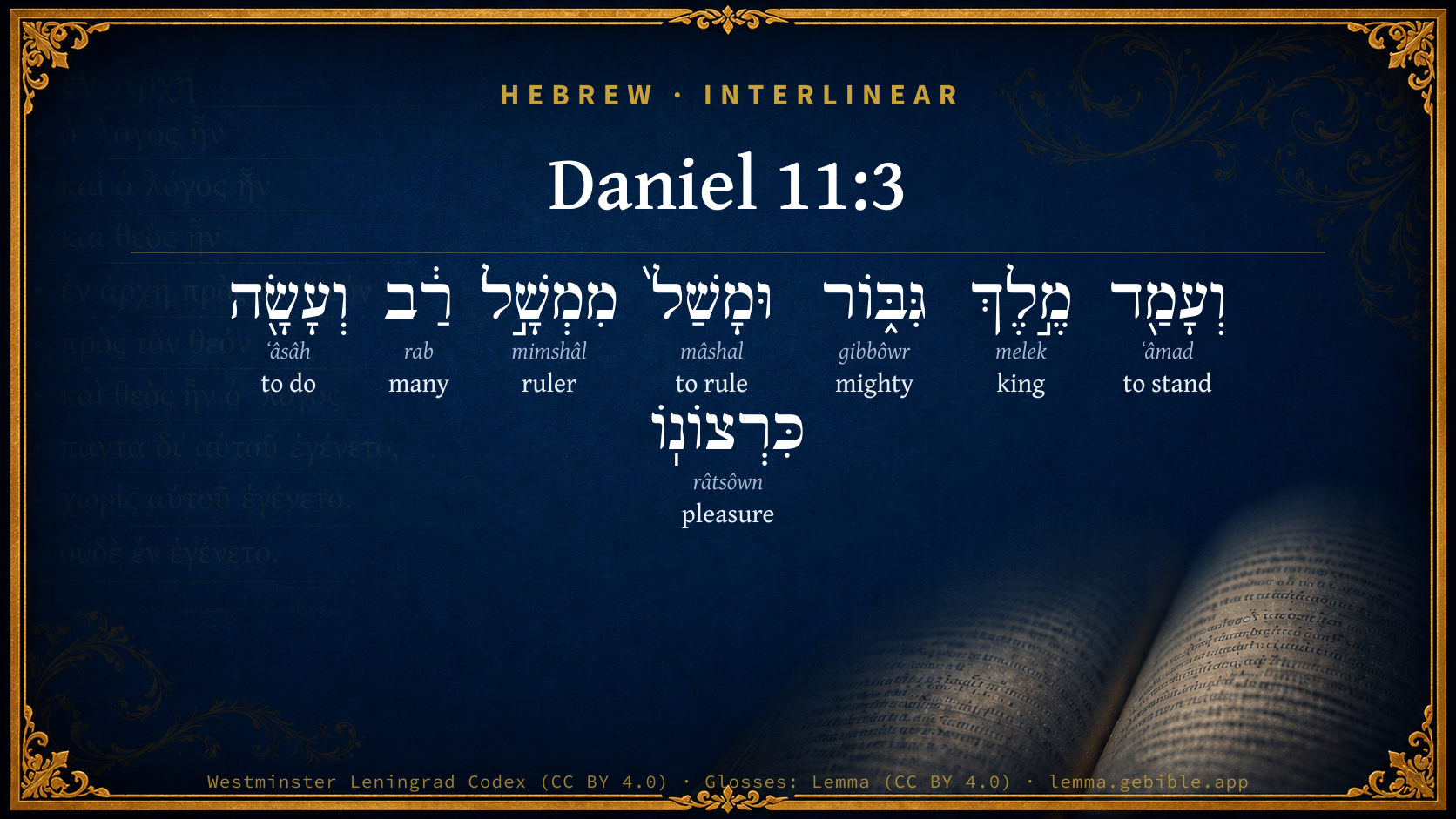
Hebrew (Westminster Leningrad Codex) Daniel 11:3 appears in the Hebrew Old Testament. The text above is from the Westminster Leningrad Codex. Each word links to its Strong’s number, a concise gloss, and parsing drawn from the Open Scriptures Hebrew Bible morphology. Click any word for its full Brown-Driver-Briggs (BDB) entry.
Download image
Cite this verse

Daniel 11:3 (World English Bible). Public Domain. Lemma interlinear Bible study tool, https://lemma.gebible.app/v/daniel/11/3.

Show BibTeX & RIS
BibTeX
RIS
English Translation
A mighty king shall stand up, who shall rule with great dominion, and do according to his will.
World English Bible · Public Domain
Download a study sheet

One document with this verse’s original text, its word-by-word gloss line, the meaning frame, cross-references with their text, attributed commentary, and full source and license credits — printable, and it pastes into notes with its structure intact.

This verse Autodidact and up

Study sheet (.html) Plain text (.txt)

A passage Seminary Student

Up to 50 verses in one chapter. A passage sheet keeps up to 6 commentary sources and 12 cross-references per verse, in the order this page ranks them, and says so on the sheet whenever that leaves anything out. Ask for a single verse and you get the Autodidact verse sheet above.

Everything on this page stays free to read, with no account — the sheet is a download of what is already on screen, not access to it.

Want to remove ads? Support Godless Engineer
Compare translations 3

The same verse in 3 English versions, stacked beneath the original-language interlinear above. Click any original word for its lexicon entry.

Each is an independent rendering of the whole verse — the interlinear is not word-aligned to these translations.

Highlighted words mark where these versions differ — a whole-verse word diff, not a word-by-word alignment.

  • World English Bible Public Domain
    A mighty king shall stand up, who shall rule with great dominion, and do according to his will.
  • King James Version Public Domain
    And a mighty king shall stand up, that shall rule with great dominion, and do according to his will.
  • unfoldingWord Literal Text CC BY-SA 4.0
    Then a mighty king will arise, and he will rule with great dominion and do according to his desires.

unfoldingWord Literal Text — © unfoldingWord, licensed CC BY-SA 4.0. Word-aligned USFM3 via Door43 (git.door43.org/unfoldingWord/en_ult).

Versions to compare (up to 4)

3 of 4 selected

Show all 18 translations

Every available English version of this verse, each an independent rendering of the whole verse.

  • World English Bible Public Domain
    A mighty king shall stand up, who shall rule with great dominion, and do according to his will.
  • Berean Standard Bible Public Domain
    Then a mighty king will arise, who will rule with great authority and do as he pleases.
  • Majority Standard Bible Public Domain
    Then a mighty king will arise, who will rule with great authority and do as he pleases.
  • King James Version Public Domain
    And a mighty king shall stand up, that shall rule with great dominion, and do according to his will.
  • American Standard Version (1901) Public Domain
    And a mighty king shall stand up, that shall rule with great dominion, and do according to his will.
  • Revised Version (1885) Public Domain
    And a mighty king shall stand up, that shall rule with great dominion, and do according to his will.
  • Geneva Bible (1599) Public Domain
    But a mightie King shall stand vp, that shall rule with great dominion, and doe according to his pleasure.
  • Douay-Rheims (1899) Public Domain
    But there shall rise up a strong king, and shall rule with great power: and he shall do what he pleaseth.
  • Young's Literal Translation Public Domain
    And a mighty king hath stood, and he hath ruled a great dominion, and hath done according to his will;
  • Literal Standard Version CC BY-SA 4.0
    And a mighty king has stood, and he has ruled a great dominion, and has done according to his will;
  • Unlocked Literal Bible CC BY-SA 4.0
    A mighty king will rise up who will rule a very great kingdom, and he will act according to his desires.
  • unfoldingWord Literal Text CC BY-SA 4.0
    Then a mighty king will arise, and he will rule with great dominion and do according to his desires.
  • Darby Bible Public Domain
    And a mighty king shall stand up that shall rule with great dominion, and do according to his will.
  • World Messianic Bible Public Domain
    A mighty king will stand up, who will rule with great dominion, and do according to his will.
  • Webster's Bible Public Domain
    And a mighty king shall stand up, that shall rule with great dominion, and do according to his will.
  • Free Bible Version CC BY-SA 4.0
    Then a mighty king will come to power. He will rule with great authority and do whatever he wants.
  • Bible in Basic English Public Domain
    And a strong king will come to power, ruling with great authority and doing whatever is his pleasure.
  • JPS Tanakh (1917) Public Domain
    And a mighty king shall stand up, that shall rule with great dominion, and do according to his will.

Literal Standard Version (2020), Covenant Press — licensed CC BY-SA 4.0. Text via the HelloAO Bible API (eBible.org). Unlocked Literal Bible (unfoldingWord) — licensed CC BY-SA 4.0. Text via the HelloAO Bible API (eBible.org). unfoldingWord Literal Text — © unfoldingWord, licensed CC BY-SA 4.0. Word-aligned USFM3 via Door43 (git.door43.org/unfoldingWord/en_ult). Free Bible Version, Dr. Jonathan Gallagher — licensed CC BY-SA 4.0. Text via the HelloAO Bible API (eBible.org).

Word by word

More ways to search: Search by grammar → Find every occurrence → Compare this word →

Practice this passage: Drill this verse → Learn its vocabulary →

About this verse

These counts appear in no published source. They are computed here, from the morphology-tagged text and Lemma’s own curated glosses. What Lemma adds →

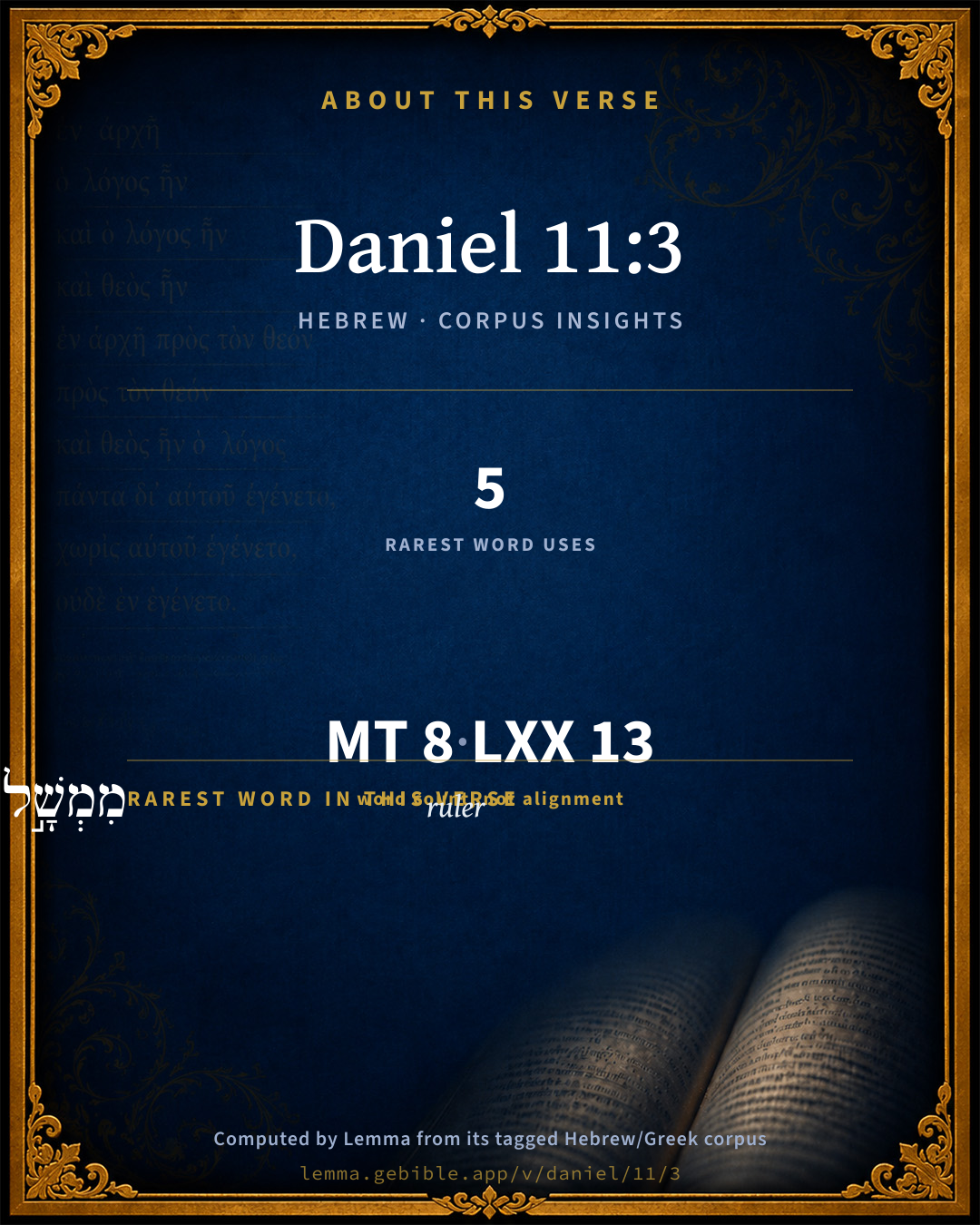
8
words
8
distinct lemmas
Prophets
section

Notable vocabulary

The rarest word here is מִמְשָׁ֣ל ruler H4474 — appearing just 5 times in the whole Hebrew Bible.

Shared distinctive vocabulary

מִמְשָׁ֣ל ruler H4474 occurs in 5 verses of the Hebrew Bible. Also found in:

Grammatical profile

  • 3 verbs
  • 3 nouns
  • 2 adjectives

Verb forms

  • וְעָמַ֖ד Qal · Sequential Perfect
  • וּמָשַׁל֙ Qal · Sequential Perfect
  • וְעָשָׂ֖ה Qal · Sequential Perfect

Hebrew & Septuagint length

In English translation the verse runs 18 words from the Hebrew and 24 from the Septuagint (LXX English) — closely comparable.

A rough comparison of the two English renderings, which tokenize alike — not a word-level alignment.

Word counts can differ between the Hebrew and the Greek without any difference in meaning — e.g. the Hebrew direct-object marker אֵת has no separate Greek word, and Greek often adds the article ὁ.

In the original languages it is 8 Hebrew tokens and 13 Greek tokens — but the two are counted differently (Hebrew bundles its prefixes and suffixes into one token; the Greek is in lemma form), so that isn’t a like-for-like length.

Cross-references

10

Topical passages linked to Daniel 11:3 in the Treasury of Scripture Knowledge — connected by theme and wording, ordered by reader-vote popularity; previews shown in the World English Bible.

  • Daniel 11:16 But he who comes against him shall do according to his own will, and none shall stand before him; and he shall stand in the glorious land, and in his hand shall be destruction.
  • Daniel 11:36 The king shall do according to his will; and he shall exalt himself, and magnify himself above every god, and shall speak marvelous things against the God of gods; and he shall prosper until the indignation be accomplished; for that which is determined shall be done.
  • Daniel 8:21 The rough male goat is the king of Greece: and the great horn that is between his eyes is the first king.
  • Daniel 5:19 and because of the greatness that he gave him, all the peoples, nations, and languages trembled and feared before him: whom he would he killed, and whom he would he kept alive; and whom he would he raised up, and whom he would he put down.
  • Daniel 7:6 After this I saw, and, behold, another, like a leopard, which had on its back four wings of a bird; the animal had also four heads; and dominion was given to it.
  • Daniel 4:35 All the inhabitants of the earth are reputed as nothing; and he does according to his will in the army of heaven, and among the inhabitants of the earth; and none can stay his hand, or tell him, What do you?
  • Daniel 8:4–14 I saw the ram pushing westward, and northward, and southward; and no animals could stand before him, neither was there any who could deliver out of his hand; but he did according to his will, and magnified himself.
  • Ephesians 1:11 in whom also we were assigned an inheritance, having been foreordained according to the purpose of him who works all things after the counsel of his will;
  • Hebrews 2:4 God also bearing witness with them, both by signs and wonders, and by various works of power, and by gifts of the Holy Spirit, according to his own will?
  • James 1:18 Of his own will he brought us forth by the word of truth, that we should be a kind of first fruits of his creatures.

Cross-references courtesy of OpenBible.info (CC BY 4.0).

Hebrew and Greek witnesses Masoretic Hebrew ↔ Greek Septuagint

The same verse in the two great witnesses to the Old Testament, shown verse-for-verse.

These are two independent witnesses, not word-aligned to each other, and the Septuagint is shown in lemma (dictionary) form.

Hebrew Daniel 11:3 Masoretic · Westminster Leningrad Codex

וְעָמַ֖ד מֶ֣לֶךְ גִּבּ֑וֹר וּמָשַׁל֙ מִמְשָׁ֣ל רַ֔ב וְעָשָׂ֖ה כִּרְצוֹנֽוֹ

A mighty king shall stand up, who shall rule with great dominion, and do according to his will.

World English Bible · Public Domain

Greek LXX Daniel 11:3 Septuagint · lemma form

καί ἵστημι βασιλεύς δυνατός καί κυριεύω κυριεία πολύς καί ποιέω καθώς ἄν βούλομαι

An there shall rise up a mighty king, and he shall be lord of a great empire, and shall do according to his will.

LXX2012 (modern English Septuagint) · Public Domain

Hebrew: Westminster Leningrad Codex (CC BY 4.0). Greek: Septuagint (public domain); English from LXX2012 (modern English Septuagint) (Public Domain). How the Septuagint differs from the Hebrew →

Commentary

Notes on Daniel 11:3 from classic Christian and Jewish commentators (each source and its license shown beneath its notes). The classic Christian expositions comment on the surrounding passage and are grouped to its opening verse, so a note may address several verses; the Jewish commentaries on the Tanakh (Rashi and others) are per-verse, so they appear only where the commentator wrote on this verse.

Lemma curates 59 commentaries, every one of them public domain or Creative Commons licensed, each selected and text-cleaned for this edition rather than reprinted as found. About our sources →

Trapp's Complete Commentary

John Trapp

Dan 11:3 And a mighty king shall stand up, that shall rule with great dominion, and do according to his will.

Ver. 3. But a mighty king shall stand up.] Alexander the Great, the founder of the Greek monarchy; who, with thirty thousand footmen, and five thousand horsemen, overran and subdued a great part of the habitable world. See Dan 8:1-27. The devil, by his oracles, foretold him of his victories, having stolen his skill out of this prophecy of Daniel.

John Trapp, A Commentary or Exposition upon All the Books of the Old and New Testament (1647–1656) — public domain. Text from a community e-Sword module.

Joseph Benson's Commentary

Dan 11:3-4. And a mighty king shall stand up, &c. — Namely, from among the Grecians; that shall rule with great dominion — This is evidently descriptive of Alexander the Great; of the rapidity and success of whose conquests: See on Dan 7:6; Dan 8:5-6. His success was indeed universal, none being able to put a stop to the progress of his victories. So great was his dominion, that he ruled not only over Greece and the whole Persian empire, but likewise added India to his conquests. And that he did according to his will, is a fact too well known to require any particular proof; for none, not even his friends, dared to contradict or oppose him, or if they did, like Clytus and Calisthenes, they paid for it with their lives. And when he shall stand up — When he shall be in the height of his prosperity. Wintle renders it, when he shall be established; his kingdom shall be broken — Alexander died in Babylon, having lived only thirty-two years and eight months, of which he reigned twelve years and eight months. In so short a time did this sun of glory rise and set! And shall be divided toward the four winds of heaven — This is very significantly expressive of the vast empire which Alexander had brought under subjection to himself, being divided at his death among his four chief captains: see note on Dan 7:6; Dan 8:8. And not to his posterity — For these, with all his family, were cut off in a few years after his death. “His wife Statira, the daughter of Darius, was murdered out of jealousy by his other wife Roxana; and her body was thrown into a well, and earth cast upon it. His natural brother Aridæus, who succeeded him in the throne by the name of Philip, was, together with his wife Eurydice, killed by the command of Olympias, the mother of Alexander, after he had borne the title of king six years and some months: and not long after Olympias herself was slain in revenge by the soldiers of Cassander. Alexander Ægus, his son by Roxana, in the fourteenth year of his age was privately murdered, together with his mother, in the castle of Amphipolis, by order of Cassander. In the second year after this, Hercules, the other son of Alexander, by Barcine, the widow of Memnon, was also, with his mother, privately murdered by Polysperchon. Such was the miserable end of Alexander’s family! After which the governors assumed, each in his province, the title of king, from which they had abstained as long as any just heir of Alexander was surviving. Thus was Alexander’s kingdom broken and divided, not to his posterity, but it was plucked up even for others.” — Bishop Newton.

Joseph Benson's Commentary on the Old and New Testaments (1811–1818) — public domain. Text from a community e-Sword module.

Keil & Delitzsch

C. F. Keil & F. Delitzsch

But only brief notices, characterizing its nature, were given regarding the Macedonian kingdom, which agree with the prophecies Dan 7:6 and Dan 8:5-8, Dan 8:21-22, without adding new elements. The founder of the kingdom is called גּבּור מלך, "brave king," "hero-king," and his kingdom "a great dominion." Of his government it is said כּרצונו עשׂה, he does, rules, according to his will (cf. Dan 8:4), so that his power might be characterized as irresistible and boundless self-will. Similarly Curtius writes of him (x. 5. 35): Fatendum est, cum plurimum virtuti debuerit, plus debuisse fortunae, quam solus omnium mortalium in potestate habuit. Hujus siquidem beneficio agere videbatur gentibus quidquid placebat. By the כ in כּעמדו the coming of the king and the destruction of his kingdom are stated as synchronous, so as to express with great force the shortness of its duration. עמדו is not to be otherwise interpreted than עמד in Dan 11:3, and is thus not to be translated: "when he thus stands up," sc. in the regal power described in Dan 11:3 (Kran.), or: "on the pinnacle of his might" (Hv.), but: "when (or as) he has made his appearance, his kingdom shall be broken." In the words, also, there does not lie the idea "that he himself in his life-time is deprived of this throne and his kingdom by a violent catastrophe" (Kran.); for the destruction of the kingdom does not necessarily include in it the putting to death of the ruler. The thought is only this: "when he has appeared and founded a great dominion, his kingdom shall be immediately broken." תּשּׁבר (shall be broken) is chosen with reference to Dan 8:8, "toward the four winds of heaven." We may neither supply תחץ (shall be divided) to לאחריתו ולא (and not to his posterity), nor is this latter expression "connected with תחץ in pregnant construction;" for תחץ, from חצה, signifies to divide, from which we are not to assume the idea of to allot, assign. We have simply to supply היא in the sense of the verb. subst., shall be, as well here as in the following clause, כמשׁלו ולא. The אחרית e signifies here as little as in Amo 4:2; Amo 9:1, posterity = זרע, but remnant, that which is left behind, the survivors of the king, by which we are to understand not merely his sons, but all the members of his family. כמשׁלו ולא, "and it shall not be according to the dominion which he ruled." This thought, corresponding to בכחו ולא in Dan 8:22, is the natural conclusion from the idea of division to all the four winds, which the falling asunder into several or many small kingdoms involves. הנּתשׁ, "shall be plucked up" (of plants from the earth), denotes the rooting up of that which is table, the destroying and dissolving of the kingdom into portions. In this division it shall pass to others מלּבד־אלּה, "with the exclusion of those" (the אחרית), the surviving members of the family of Alexander. To ולאחרים (and for others) supply תּהיה (shall be).

In Dan 11:4, accordingly, the prophetic thought is expressed, that the Javanic kingdom, as soon as the brave king has founded a great dominion, shall be broken to pieces and divided toward the four winds of heaven, so that its separate parts, without reaching to the might of the broken kingdom, shall be given not to the survivors of the family of the founder, but to strangers. This was historically fulfilled in the fact, that after the sudden death of Alexander his son Hercules was not recognised by his generals as successor on the throne, but was afterwards murdered by Polysperchon; his son also born by Roxana, along with his guardian Philip Arideus, met the same fate; but the generals, after they had at first divided the kingdom into more than thirty parts, soon began to war with each other, the result of which was, that at last four larger kingdoms were firmly established. Cf. Diod. Sic. xx. 28, xix. 105; Pausan. ix. 7; Justini hist. xv. 2, and Appiani Syr. c. 51.

Keil & Delitzsch — Biblical Commentary on the Old Testament (1861–1891) — public domain (CC PDM 1.0). Text via the HelloAO Bible API. (Old Testament only.)

Tyndale Open Study Notes

Tyndale Open Resources

11:3 The mighty king was Alexander the Great (see study note on 8:21, 336–323 BC), who conquered much of the known world in thirteen years, from Greece to India and from far into the north to Egypt in the south.

Tyndale Open Study Notes — © Tyndale Open Resources, licensed CC BY-SA 4.0. Text via the HelloAO Bible API.

Geneva Bible (1599)

Geneva Bible translators

That is, Alexander the great.

Geneva Bible (1599) marginal notes — public domain. Text via Bolls.life.

Jamieson, Fausset & Brown

Robert Jamieson, A. R. Fausset & David Brown

mighty king . . . do according to his will--answering to the he-goat's "notable horn" (Dan 8:6-7, Dan 8:21). Alexander invaded Persia 334 B.C., to avenge the wrongs of Greece on Persia for Xerxes' past invasion (as Alexander said in a letter to Darius Codomanus, ARRIAN, Alexander. 2.14.7).

Jamieson, Fausset & Brown — Commentary Critical and Explanatory on the Whole Bible (1871) — public domain (CC PDM 1.0). Text via the HelloAO Bible API.

Adam Clarke's Commentary

Verse 3. A mighty king shall stand up] This was Alexander the Great. It is not said that this mighty king shall stand up against Xerxes, for he was not born till one hundred years after that monarch; but simply that he should stand up, i.e., that he should reign in Greece.

Adam Clarke's Commentary on the Bible (1810–1826) — public domain. Text from a community e-Sword/MySword module.

John Calvin's Commentaries

This refers to Alexander of Macedon. I have already shortly stated the reason why the angel passed over all the Persian kings from Artabanus to the last Darius, they did not engage in any contests with the Jews up to Xerxes But when Alexander invaded Asia, he struck the Jews with terror, as well as all other nations. He came like lightning, and it is by no means surprising that the Jews should be frightened at his arrival, because, as we formerly expressed it, he flew with amazing swiftness. Alexander then rose up, not only by the riches and might of his warlike preparations, but he necessarily inspired the Jews with trepidation when they perceived their inability to resist him, and thus he was deservedly hostile to them, because, from the very beginning, they had despised his empire. Josephus also informs us how he was moved at the sight of the high priest, and how he determined to mitigate his rage against the Jews. For when he was at home, before passing over into Asia, the vision of the high priest was offered to him, for God had sent his angel under that disguise. Alexander supposed it to be some deity; but when the high priest met him in procession, the vision returned to his recollection, and he was struck as if he had seen God appearing to him from heaven. Whatever was the object of this occurrence, Alexander clearly came into Judea with the intention of utterly destroying the whole nation. This is the reason why the angel carefully predicts this change. A brave king, therefore, shall stand up, and rule with extensive dominion, and do according to his pleasure; that is, he shall succeed as if he had all the events of the war under his own hand and according to his own pleasure, as the event itself most fully proved. It follows: —

John Calvin's Commentaries (1540-1563) — public domain. Text from the Calvin Translation Society English edition (1840s-50s) via the Christian Classics Ethereal Library (ccel.org). Calvin's coverage is partial (roughly two-thirds of the Bible); uncommented books and verses are honest gaps, never fabricated. The 19th-century editor's footnotes and remarks are omitted so the notes are faithfully Calvin's own voice.

Ellicott's Commentary for English Readers

(3) A mighty king.—No clue is given to show over what nation this king reigns. According to the context he might be either a Greek or a Persian, or he might belong to a kingdom not yet mentioned. Those who explain what follows to refer to the Ptolemies and Seleucidæ identify him with Alexander the Great, and compare with this verse Dan_7:6; Dan_8:5-8; Dan_8:21-22. Certainly the self-will spoken of in this verse was characteristic of Alexander (comp. also Dan_8:4), but there was nothing in the context which makes it necessary to limit the passage to him. Some autocrat may arise “in the latter times” to whom it will apply with greater force than it did to Alexander.

A Bible Commentary for English Readers, edited by Charles John Ellicott (1878–1897) — public domain. Text from a community e-Sword module.

The Cambridge Bible for Schools and Colleges

gen. ed. J. J. S. Perowne

3. Alexander the Great (b.c. 336–323). The writer, passing over the intermediate Persian rulers, hastens to the period when the course of events begins to affect the Jews, limiting what he has to say respecting the whole of the Persian empire, and the founder of the Greek empire, to a single verse in each case.

a warrior king] The regular meaning of gibbôr (‘mighty man’) in Heb.: e.g. 2Sa_1:9; 2Sa_23:8, 1Ki_1:8; 1Ki_1:10, Isa_42:13, &c.

do according to his will] carry out whatever he wishes: an expression implying the possession of irresistible and irresponsible power. Cf. Quintus Curtius x. 5, 35, ‘Huius [fortunae] beneficio agere videbatur gentibus quidquid placebat.’ Comp. on Dan_8:4; and below Dan_11:16; Dan_11:36.

The Cambridge Bible for Schools and Colleges (gen. ed. J. J. S. Perowne; Cambridge University Press, 1878–1918) — public domain. Text from a community e-Sword module.

John Gill's Exposition

And a mighty king shall stand up,.... Not in Persia, but in Greece; Alexander the great, who rose up a hundred years after the above expedition of Xerxes, and "stood" and flourished, and conquered all he attacked, none being able to resist him; and is rightly called a "mighty king", a very powerful one: this is the notable horn in the he goat, which being exasperated by the ram, the Persians, and their invasion of Greece, pushed at them, and destroyed them, Dan 8:5, that shall rule with great dominion; not in Greece only but in the whole world, at least as he thought, and really did over a very great part of it; for, as Jerome says, having conquered the Illyrians, Thracians, Greece, and Thebes, he passed into Asia; and, having put to flight the generals of Darius, he took the city of Sardis, and afterwards India.

And do according to his will; not only in his own army, sacrificing his best friends at his pleasure; but with his enemies, conquering whom he would, none being able to withstand him; all things succeeded to his wish; whatever he attempted he performed. His historian (o) says of him,

"that it must be owned he owed much to virtue, but more to fortune, which alone of all mortals he had in his power;''

since, by the benefit of it, he seemed to do with nations whatever he pleased; he was sovereign in all things, and set himself to be worshipped as a deity.

(o) Curtius, l. 10. c. 5.

John Gill's Exposition of the Whole Bible (1746–1763) — public domain (CC PDM 1.0). Text via the HelloAO Bible API.

Albert Barnes' Notes on the Bible

And a mighty king shall stand up - So far as the language here is concerned, it is not said whether this would be in Persia, as a successor of the “fourth king” Dan 11:2, or whether it would be in some other part of the world. The next verse, however, shows that the reference is to Alexander the Great - for to no other one is it applicable. There were several monarchs of Persia, indeed, that succeeded Xerxes before the kingdom was invaded and subdued by Alexander (see the notes at Dan 11:2), and these are here entirely passed over without being alluded to. It must be admitted, that one who should have read this prophecy before the events had occurred would have inferred naturally that this “mighty king that should stand up” would appeal immediately after the “fourth, “and probably that he would be his successor in the realm; but it may be remarked,

(a) that the language here is not inconsistent with the facts in the case - it being literally true that such a “mighty king” did “stand up” who “ruled with great dominion, and according to his will;”

(b) that there was no necessity in the prophetic history of referring to the acts of these intermediate kings of Persia, since they did not contribute at all to the result - it being well known that the reason alleged by Alexander for his invasion of the Persian empire was not anything which they had done, but the wrongs sustained by Greece in consequence of the invasion by Xerxes and his predecessor. The real succession of events in the case was that last invasion of Greece by Xerxes, and the consequent invasion of the Persian empire by Alexander. It was these transactions which the angel evidently meant to connect together, and hence, all that was intermediate was omitted. Thus Alexander, in his letter to Darius, says: “Your ancestors entered into Macedonia, and the other parts of Greece, and did us damage, when they had received no affront from us as the cause of it; and now I, created general of the Grecians, provoked by you, and desirous of avenging the injury done by the Persians, have passed over into Asia.” - Arrian, Exped. Alex. i. 2.

That shall rule with great dominion - That shall have a wide and extended empire. The language here would apply to any of the monarchs of Persia that succeeded Xerxes, but it would be more strictly applicable to Alexander the Great than to any prince of ancient or modern times. The whole world, except Greece, was supposed to be subject to the power of Persia; and it was one of the leading and avowed purposes of Darius and Xerxes in invading Greece, by adding that to their empire, to have the earth under their control. When, therefore, Alexander had conquered Persia, it was supposed that he had subdued the world; nor was it an unnatural feeling that, having done this, he, whose sole principle of action was ambition, should sit down and weep because there were no more worlds to conquer. In fact, he then swayed a scepter more extended and mighty than any before him had done, and it is with peculiar propriety that the language here is used in regard to him.

And do according to his will - Would be an arbitrary prince. This also was true of the Persian kings, and of Oriental despots generally; but it was eminently so of Alexander - who, in subduing kingdoms, conquering mighty armies, controlling the million under his sway, laying the foundations of cities, and newly arranging the boundaries of empires, seemed to consult only his own will, and felt that everything was to be subordinate to it. It is said that this passage was shown to Alexander by the high priest of the Jews, and that these prophecies did much to conciliate his favor toward the Hebrew people.

Albert Barnes' Notes on the Bible (1834–1885) — public domain. Text from a community e-Sword/MySword module.

Haydock's Catholic Bible Commentary

A strong king: Alexander. (Challoner) --- The sequel clearly points him out. Before fifteen years had elapsed, his mother, brother, and children were slain. Arideus, his brother, was declared regent till it should be seen what Rozanna should bring forth. After the death of those who might be heirs of Alexander, four general took the title of kings. Others governed in different places, but were destroyed by degrees.

George Leo Haydock (1774–1849), Haydock's Catholic Family Bible and Commentary, 1859 edition — public domain. Excludes Psalms (Douay-Rheims chapter numbering differs from Protestant) and Deuterocanonical books (Catholic canon only).

Matthew Poole's English Annotations

This was Alexander the Great, the he-goat, who, moved with choler for the Persian invasion, run down the ram and stamped on it, and got a golden fleece from him by that, and after many victories; afterward he did according to his will, even what he would without controlment, by any. See Dan 8:7,8.

Matthew Poole's English Annotations on the Holy Bible (1683–1685) — public domain. Text from a community e-Sword/MySword module.

Whedon's Commentary on the Bible

Daniel D. Whedon

3. A mighty king — This was Alexander the Great, as identified in the next verse. It is not stated that this king succeeds Xerxes immediately. He was in fact separated from him by several rulers. Alexander himself, however, affirms that his invasion of Persia was in revenge for Xerxes’s invasion of Greece; and thus historically “Xerxes began the struggle which on the field of history has for its climax and consummation Alexander’s conquest of Persia” (Urquhart).

Daniel D. Whedon (gen. ed.), Commentary on the Old and New Testaments (1874–1909) — public domain. Text from a community e-Sword module.

The Pulpit Commentary

And a mighty king shall stand up, that shall rule with groat dominion, and do according to his will. None of the versions imply any difference of reading. The Hebrew implies that the king was a mighty warrior. All critics are agreed that here the reference is to Alexander the Great. This does not mean that Alexander immediately followed Xerxes, but that his expedition was the revenge for that of Xerxes. Alexander, in his answer to Darius Codomannus, justified his invasion of Persia by referring back to Xerxes" invasion of Greece. The two expeditions, that which Xerxes made into Greece, and that of Alexander into Persia, might be regarded as causally connected.

The Pulpit Commentary (1880–1919), ed. H.D.M. Spence-Jones & Joseph S. Exell — public domain. Text from a community e-Sword module.

John Wesley's Explanatory Notes

A mighty king - Alexander the great.

John Wesley, Explanatory Notes Upon the Whole Bible (1754–1765) — public domain. Text via the GEBible commentary corpus.

Scofield Reference Notes

C. I. Scofield

king Alexander the Great, B.C. 332. See Dan 8:5-8; Dan 8:21; Dan 8:22.

The Scofield Reference Bible (1917 edition), notes by C. I. Scofield — public domain. Text from a community e-Sword module.

unfoldingWord translationNotes

Door43 World Missions Community

General Information:

The angel continues speaking to Daniel.

A mighty king will rise up

The idea of rising up or standing is often used for someone who becomes powerful. AT: "A mighty king will begin to reign" (See: Metaphor)

who will rule a very great kingdom

Possible meanings are 1) that the size of this kingdom would be very great, or 2) that the king would rule his kingdom with very great power.

his kingdom will be broken and divided

This can be stated in active form. AT: "his kingdom will break apart and divide" or "his kingdom will break apart into pieces" (See: Active or Passive)

the four winds of heaven

See how you translated this in Daniel 7:2.

but not to his own descendants

The idea of not being divided and shared out is implied here. AT: "but it will not be divided for his own descendants" or "but it will not be shared by his own descendants" (See: Ellipsis)

his kingdom will be uprooted for others besides his descendants

The kingdom is spoken of as if it were a plant that someone destroyed by uprooting it. This idea can be expressed in active form. AT: "another power will uproot and destroy his kingdom and others who are not his descendants will rule over it" (See: Active or Passive and Metaphor)

translationWords

king

raise

kingdom

heaven

descend

power

unfoldingWord translationNotes — © Distant Shores Media and the Door43 World Missions Community, licensed CC BY-SA 4.0. Source: git.door43.org/Door43/en_tn.

Rashi

Rabbi Shlomo Yitzchaki (Rashi)

And a mighty king will arise in Greece, viz. Alexander of Macedon.

and do according to his will with Darius the king of Persia, and he will slay him and receive his kingdom, and the Persians will be enslaved by the heathens [the Greeks.

Rashi on the Tanakh — English translations: “The Judaica Press complete Tanach with Rashi, translated by A. J. Rosenberg” (CC BY 4.0); “Pentateuch with Rashi's commentary by M. Rosenbaum and A.M. Silbermann, 1929-1934” (public domain); “The Metsudah Tanach series, Lakewood, N.J” (CC BY 4.0); and “The Book of Joshua, Metsudah Publications, 1997” (CC BY 4.0). Text via Sefaria.

Lesson kit

Teaching starters — assembled from the data on this page, not authored interpretation. Every prompt links to the verse data it draws on. Edit before teaching.

Daniel, in the Prophets, opens this verse with 8 words (8 distinct Hebrew lemmas). Its most distinctive word is mimshâl (“ruler”). A historical commentator’s framing appears above. Read the whole chapter for the surrounding context.

Discussion questions

  1. The word mimshâl carries the sense “ruler.” How does it shape the verse?
  2. 2 Kings 20:13 shares the word «ruler» with this verse. How do the two illuminate each other?
  3. These translations render this verse differently; the difference is in the English rendering, not the original. What questions does that raise?
  4. The verb «וְעָמַ֖ד» is Qal Sequential Perfect. How does its form color the action?
  5. Reading how Trapp's Complete Commentary and Joseph Benson's Commentary read this verse, where do the two commentators agree and where do they part?

Things to notice

Reading settings

Reading text

Shown beneath each verse's original-language words.

Old Testament
Old Testament edition

Read the OT as the Masoretic Hebrew (MT) or the Greek Septuagint (LXX).

English shown for the Greek Septuagint (in the Hebrew ↔ Greek comparison).

Comparing translations? Open the Compare panel on any verse page to stack up to four side by side.