
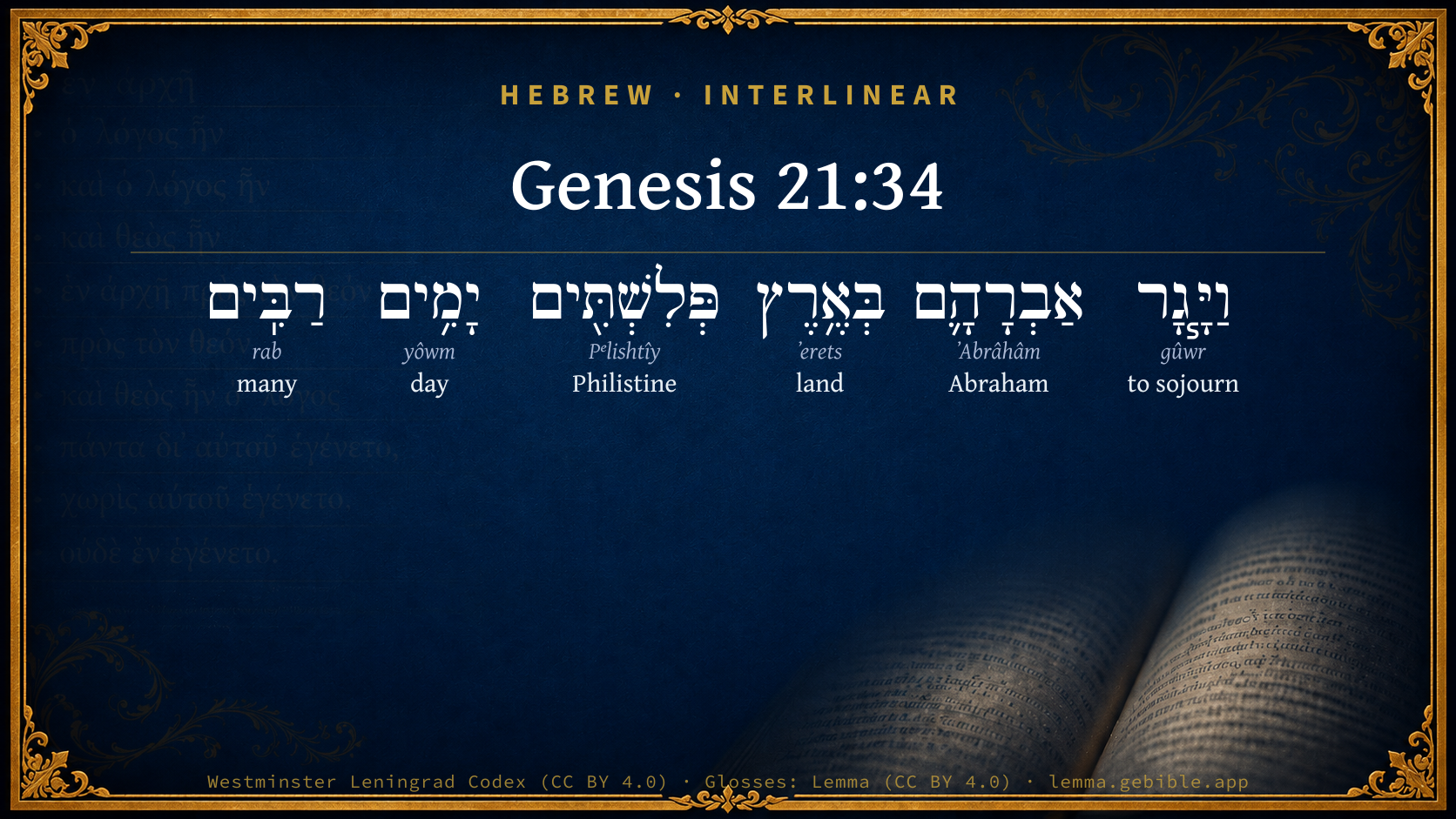
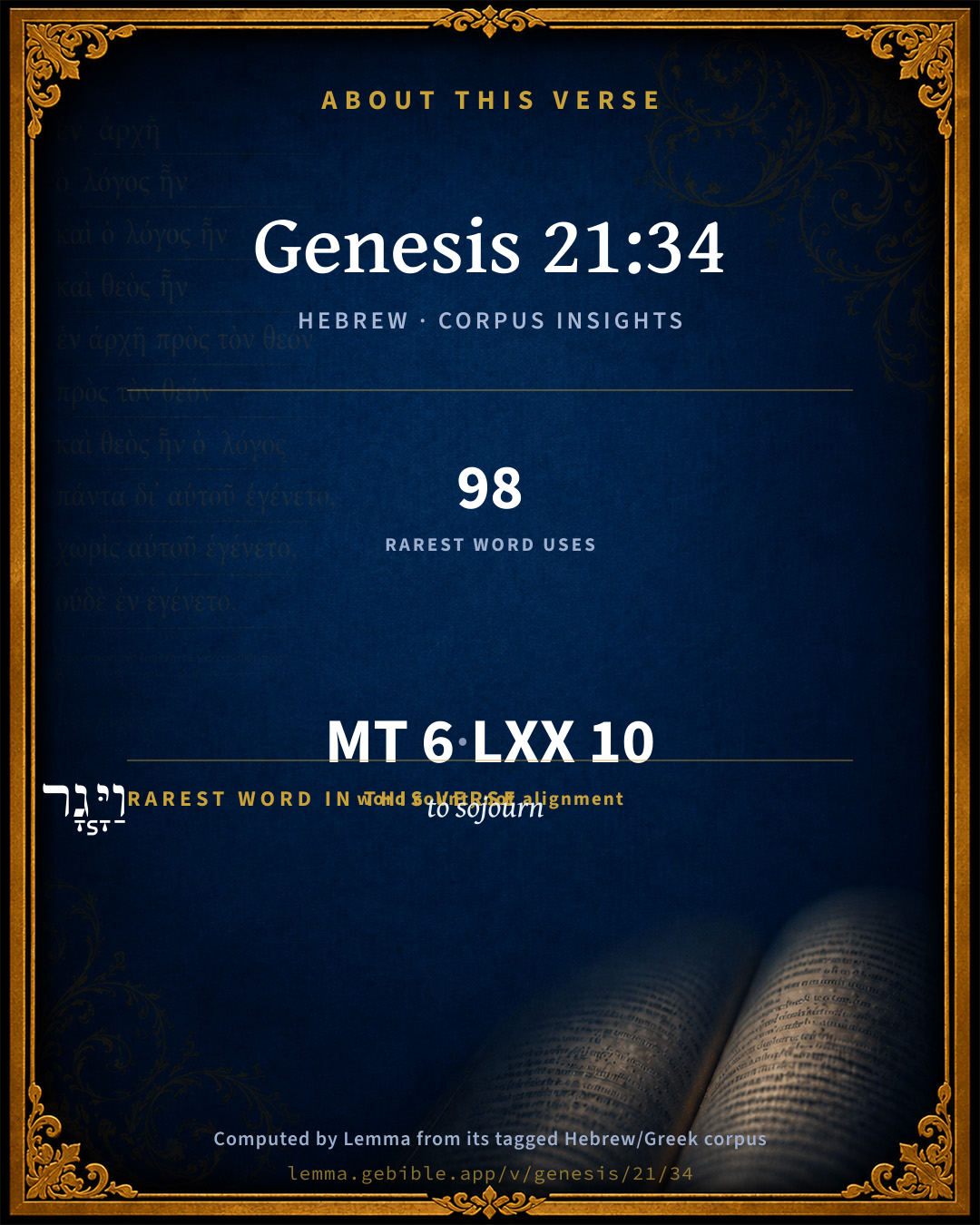
Genesis 21:34

Hebrew (Westminster Leningrad Codex) Genesis 21:34 appears in the Hebrew Old Testament. The text above is from the Westminster Leningrad Codex. Each word links to its Strong’s number, a concise gloss, and parsing drawn from the Open Scriptures Hebrew Bible morphology. Click any word for its full Brown-Driver-Briggs (BDB) entry.
Download image
Cite this verse

Genesis 21:34 (World English Bible). Public Domain. Lemma interlinear Bible study tool, https://lemma.gebible.app/v/genesis/21/34.

Show BibTeX & RIS
BibTeX
RIS
English Translation
Abraham lived as a foreigner in the land of the Philistines many days.
World English Bible · Public Domain
Download a study sheet

One document with this verse’s original text, its word-by-word gloss line, the meaning frame, cross-references with their text, attributed commentary, and full source and license credits — printable, and it pastes into notes with its structure intact.

This verse Autodidact and up

Study sheet (.html) Plain text (.txt)

A passage Seminary Student

Up to 50 verses in one chapter. A passage sheet keeps up to 6 commentary sources and 12 cross-references per verse, in the order this page ranks them, and says so on the sheet whenever that leaves anything out. Ask for a single verse and you get the Autodidact verse sheet above.

Everything on this page stays free to read, with no account — the sheet is a download of what is already on screen, not access to it.

Want to remove ads? Support Godless Engineer
Compare translations 3

The same verse in 3 English versions, stacked beneath the original-language interlinear above. Click any original word for its lexicon entry.

Each is an independent rendering of the whole verse — the interlinear is not word-aligned to these translations.

Highlighted words mark where these versions differ — a whole-verse word diff, not a word-by-word alignment.

  • World English Bible Public Domain
    Abraham lived as a foreigner in the land of the Philistines many days.
  • King James Version Public Domain
    And Abraham sojourned in the Philistines' land many days.
  • unfoldingWord Literal Text CC BY-SA 4.0
    Then Abraham sojourned in the land of the Philistines many days.

unfoldingWord Literal Text — © unfoldingWord, licensed CC BY-SA 4.0. Word-aligned USFM3 via Door43 (git.door43.org/unfoldingWord/en_ult).

Versions to compare (up to 4)

3 of 4 selected

Show all 18 translations

Every available English version of this verse, each an independent rendering of the whole verse.

  • World English Bible Public Domain
    Abraham lived as a foreigner in the land of the Philistines many days.
  • Berean Standard Bible Public Domain
    And Abraham resided in the land of the Philistines for a long time.
  • Majority Standard Bible Public Domain
    And Abraham resided in the land of the Philistines for a long time.
  • King James Version Public Domain
    And Abraham sojourned in the Philistines' land many days.
  • American Standard Version (1901) Public Domain
    And Abraham sojourned in the land of the Philistines many days.
  • Revised Version (1885) Public Domain
    And Abraham sojourned in the land of the Philistines many days.
  • Geneva Bible (1599) Public Domain
    And Abraham was a stranger in the Philistims land a long season.
  • Douay-Rheims (1899) Public Domain
    And he was a sojourner in the land of the Palestines many days.
  • Young's Literal Translation Public Domain
    and Abraham sojourneth in the land of the Philistines many days.
  • Literal Standard Version CC BY-SA 4.0
    and Abraham sojourns in the land of the Philistines many days.
  • Unlocked Literal Bible CC BY-SA 4.0
    Abraham remained as a foreigner in the land of the Philistines many days.
  • unfoldingWord Literal Text CC BY-SA 4.0
    Then Abraham sojourned in the land of the Philistines many days.
  • Darby Bible Public Domain
    And Abraham sojourned in the Philistines' land many days.
  • World Messianic Bible Public Domain
    Abraham lived as a foreigner in the land of the Philistines many days.
  • Webster's Bible Public Domain
    And Abraham sojourned in the land of the Philistines many days.
  • Free Bible Version CC BY-SA 4.0
    Abraham lived in the country of the Philistines for a long time.
  • Bible in Basic English Public Domain
    And Abraham went on living in the land of the Philistines as in a strange country.
  • JPS Tanakh (1917) Public Domain
    And Abraham sojourned in the land of the Philistines many days.

Literal Standard Version (2020), Covenant Press — licensed CC BY-SA 4.0. Text via the HelloAO Bible API (eBible.org). Unlocked Literal Bible (unfoldingWord) — licensed CC BY-SA 4.0. Text via the HelloAO Bible API (eBible.org). unfoldingWord Literal Text — © unfoldingWord, licensed CC BY-SA 4.0. Word-aligned USFM3 via Door43 (git.door43.org/unfoldingWord/en_ult). Free Bible Version, Dr. Jonathan Gallagher — licensed CC BY-SA 4.0. Text via the HelloAO Bible API (eBible.org).

Word by word

More ways to search: Search by grammar → Find every occurrence → Compare this word →

Practice this passage: Drill this verse → Learn its vocabulary →

וַיָּ֧גָר
gûwr
H1481
“and · to sojourn”
Conjunction + Verb, Qal, Sequential Imperfect, 3rd Person, Masculine, Singular
Part of Speech
Conjunction + Verb
Stem
Qal
Form
Sequential Imperfect
Person
3rd Person
Gender
Masculine
Number
Singular
Full BDB Definition

Origin: a primitive root

TWOT: 330 , 332

to sojourn, abide, dwell in, dwell with, remain, inhabit, be a stranger, be continuing, surely - (Qal) - to sojourn, dwell for a time - to abide, stay, temporarily dwell - (Hithpolel) - to seek hospitality with - to assemble oneself - to stir up trouble, strife, quarrel, gather together - (Qal) - to stir up strife - to quarrel - (Hithpolel) to excite oneself - to dread, fear, stand in awe, be afraid - (Qal) - to fear, be afraid - to be in awe, stand in awe
  1. אַבְרָהָ֛ם ʼAbrâhâm H85 “Abraham” Noun, Proper
  2. בְּאֶ֥רֶץ ʼerets H776 “in/at · land of” Preposition + Noun, Common, Both, Singular, Construct
  3. פְּלִשְׁתִּ֖ים Pᵉlishtîy H6430 “Philistines” Noun, Gentilic, Masculine, Plural, Absolute
  4. יָמִ֥ים yôwm H3117 “days” Noun, Common, Masculine, Plural, Absolute
  5. רַבִּֽים rab H7227 “many” Adjective, Adjective, Masculine, Plural, Absolute

About this verse

These counts appear in no published source. They are computed here, from the morphology-tagged text and Lemma’s own curated glosses. What Lemma adds →

6
words
6
distinct lemmas
Pentateuch
section

Grammatical profile

  • 1 verb
  • 4 nouns
  • 1 adjective

Verb forms

  • וַיָּ֧גָר Qal · Sequential Imperfect

Hebrew & Septuagint length

In English translation the verse runs 13 words from the Hebrew and 11 from the Septuagint (LXX English) — closely comparable.

A rough comparison of the two English renderings, which tokenize alike — not a word-level alignment.

Word counts can differ between the Hebrew and the Greek without any difference in meaning — e.g. the Hebrew direct-object marker אֵת has no separate Greek word, and Greek often adds the article ὁ.

In the original languages it is 6 Hebrew tokens and 10 Greek tokens — but the two are counted differently (Hebrew bundles its prefixes and suffixes into one token; the Greek is in lemma form), so that isn’t a like-for-like length.

Cross-references

6

Topical passages linked to Genesis 21:34 in the Treasury of Scripture Knowledge — connected by theme and wording, ordered by reader-vote popularity; previews shown in the World English Bible.

  • Genesis 20:1 Abraham traveled from there toward the land of the South, and lived between Kadesh and Shur. He lived as a foriegner in Gerar.
  • 1 Chronicles 29:15 For we are strangers before you, and foreigners, as all our fathers were: our days on the earth are as a shadow, and there is no abiding.
  • Psalms 39:12 "Hear my prayer, Yahweh, and give ear to my cry. Don't be silent at my tears. For I am a stranger with you, A foreigner, as all my fathers were.
  • Hebrews 11:9 By faith, he lived as an alien in the land of promise, as in a land not his own, dwelling in tents, with Isaac and Jacob, the heirs with him of the same promise.
  • Hebrews 11:13 These all died in faith, not having received the promises, but having seen them and embraced them from afar, and having confessed that they were strangers and pilgrims on the earth.
  • 1 Peter 2:11 Beloved, I beg you as foreigners and pilgrims, to abstain from fleshly lusts, which war against the soul;

Cross-references courtesy of OpenBible.info (CC BY 4.0).

Hebrew and Greek witnesses Masoretic Hebrew ↔ Greek Septuagint

The same verse in the two great witnesses to the Old Testament, shown verse-for-verse.

These are two independent witnesses, not word-aligned to each other, and the Septuagint is shown in lemma (dictionary) form.

Hebrew Genesis 21:34 Masoretic · Westminster Leningrad Codex

וַיָּ֧גָר אַבְרָהָ֛ם בְּאֶ֥רֶץ פְּלִשְׁתִּ֖ים יָמִ֥ים רַבִּֽים

Abraham lived as a foreigner in the land of the Philistines many days.

World English Bible · Public Domain

Greek LXX Genesis 21:34 Septuagint · lemma form

παραοἰκέω δέ αβρααμ ἐν ὁ γῆ ὁ φυλιστιιμ ἡμέρα πολύς

And Abraam sojourned in the land of the Phylistines many days.

LXX2012 (modern English Septuagint) · Public Domain

Hebrew: Westminster Leningrad Codex (CC BY 4.0). Greek: Septuagint (public domain); English from LXX2012 (modern English Septuagint) (Public Domain). How the Septuagint differs from the Hebrew →

Targum (Aramaic paraphrase)

1

The Targum is the ancient Jewish Aramaic paraphrase of the Hebrew Scriptures — an interpretive translation, not the Hebrew text itself. Onkelos (literal) and Pseudo-Jonathan (expansive) render the Torah, and Jonathan the Prophets. Coverage is partial: where no permissively-licensed English translation exists for a verse, only the Aramaic is shown. This is verse-level text, not a word-by-word alignment to the Hebrew.

  1. Targum Onkelos Torah (Genesis–Deuteronomy)
    וְאִתּוֹתָב אַבְרָהָם בְּאַרַע פְּלִשְׁתָּאֵי יוֹמִין סַגִּיאִין

    (no public-domain English translation for this verse)

    Targum Onkelos — Aramaic: “Onkelos Genesis” (public domain); “Onkelos Exodus” (public domain); “Onkelos Leviticus” (public domain); “Onkelos Numbers” (public domain); “Onkelos Deuteronomy” (public domain). English: “Sefaria Community Translation” (CC0 1.0 (public-domain dedication)); “J.W. Etheridge. The Targums of Onkelos and Jonathan Ben Uzziel on the Pentateuch. London: Longmans, Green, 1862” (public domain). Text via Sefaria.

Commentary

Notes on Genesis 21:34 from classic Christian and Jewish commentators (each source and its license shown beneath its notes). The classic Christian expositions comment on the surrounding passage and are grouped to its opening verse, so a note may address several verses; the Jewish commentaries on the Tanakh (Rashi and others) are per-verse, so they appear only where the commentator wrote on this verse.

Lemma curates 59 commentaries, every one of them public domain or Creative Commons licensed, each selected and text-cleaned for this edition rather than reprinted as found. About our sources →

Trapp's Complete Commentary

John Trapp

Gen 21:34 And Abraham sojourned in the Philistines’ land many days.

Ver. 34. Many days.] Twenty-five years at least: for so old was Isaac when he went to be sacrificed. Some halcyons God vouchsafes to his "afflicted, and tossed with tempest"; {Isa 54:11} some rest and repose to his poor pilgrims. Laus Deo .

John Trapp, A Commentary or Exposition upon All the Books of the Old and New Testament (1647–1656) — public domain. Text from a community e-Sword module.

Jamieson, Fausset & Brown

Robert Jamieson, A. R. Fausset & David Brown

Abraham sojourned in the Philistines' land--a picture of pastoral and an emblem of Christian life.

Next: Genesis Chapter 22

Jamieson, Fausset & Brown — Commentary Critical and Explanatory on the Whole Bible (1871) — public domain (CC PDM 1.0). Text via the HelloAO Bible API.

Ellicott's Commentary for English Readers

(34) In the Philistines’ land—In Gen_21:32 Abimelech on returning to Gerar is said to have gone back “into the land of the Philistines!’ But Beer-sheba also in a general way belonged to his dominions, and Abraham dwelt there in peace by reason of the treaty which existed between him and the Philistine king.

A Bible Commentary for English Readers, edited by Charles John Ellicott (1878–1897) — public domain. Text from a community e-Sword module.

The Pulpit Commentary

And Abraham sojourned in the Philistines" land many days. The apparent contradiction between the statement of this verse and that of Ver. 32 may be removed by supposing either,

(1) that as the land of the Philistines had no fixed boundary toward the desert, Beersheba may at this time have been claimed for the kingdom of Gerar (Keil); or,

(2) that as Beersheba was situated on the confines of the Philistines" territory, Abraham must frequently have sojourned in their country while pasturing his flocks (Rosenm

The Pulpit Commentary (1880–1919), ed. H.D.M. Spence-Jones & Joseph S. Exell — public domain. Text from a community e-Sword module.

Keil & Delitzsch

C. F. Keil & F. Delitzsch

Abraham sojourned a long time there in the Philistines' land. There Isaac was probably born, and grew up to be a young man (Gen 22:6), capable of carrying the wood for a sacrifice; cf. Gen 22:19. The expression "in the land of the Philistines" appears to be at variance with Gen 21:32, where Abimelech and Phicol are said to have returned to the land of the Philistines. But the discrepancy is easily reconciled, on the supposition that at that time the land of the Philistines had no fixed boundary, at all events, towards the desert. Beersheba did not belong to Gerar, the kingdom of Abimelech in the stricter sense; but the Philistines extended their wanderings so far, and claimed the district as their own, as is evident from the fact that Abimelech's people had taken the well from Abraham. On the other hand, Abraham with his numerous flocks would not confine himself to the Wady es Seba, but must have sought for pasture-ground in the whole surrounding country; and as Abimelech had given him full permission to dwell in his land (Gen 20:15), he would still, as heretofore, frequently come as far as Gerar, so that his dwelling at Beersheba (Gen 22:19) might be correctly described as sojourning (nomadizing) in the land of the Philistines.

Keil & Delitzsch — Biblical Commentary on the Old Testament (1861–1891) — public domain (CC PDM 1.0). Text via the HelloAO Bible API. (Old Testament only.)

Rashi

Rabbi Shlomo Yitzchaki (Rashi)

ימים רבים MANY DAYS (or, MORE DAYS) — More than those he sojourned in Hebron: in Hebron he had stayed 25 years and here 26. For he was 75 years old when he left Haran (Genesis 12:4), and of that same year it is said (Genesis 13:18) “And he came and dwelt by the terebinths of Mamre [which are in Hebron]” — for we do not find that he had settled down anywhere prior to settling there (at Hebron), since in every place where he went he was only like a traveller who pitches his camp and then goes on journeying, as it is said, (Genesis 13:12:6) “And Abraham passed on”; (Genesis 12:8) “And Abraham removed from thence”; (Genesis 12:10) “And there was a famine in the land and Abraham went down to Egypt”. In Egypt, too, he stayed only three months, for Pharaoh sent him away (Genesis 12:20). Immediately (Genesis 13:3) “He went on his journeys” until (Genesis 13:18) “He came and dwelt by the terebinths of Mamre which are in Hebron”. There he resided until Sodom was overthrown, and immediately afterwards (Genesis 20:1) “Abraham journeyed from thence” on account of the shame he felt at Lot’s doings and came to the land of the Philistines. He was then 99 years old, because it was on the third day of his circumcision that the angels came to him. Consequently you have 25 years from the time he settled in Hebron (the year he left his father’s house) until he came to the land of the Philistines. Now, here it is written that he sojourned in the land of the Philistines ימים רבים more days, which means more than the preceding days in Hebron. Scripture does not intend by these words to leave the number indefinite, but to state it explicitly, for if the “more days” exceeded the former period in Hebron by two years or more, it would have said so plainly, so that you must admit that the excess was only one year — that gives 26 years in the land of the Philistines. He immediately left there and returned to Hebron, and that year was 12 years before the Binding of Isaac. All this is explained in Seder Olam (See Note on Genesis 10:25).

Rashi on the Tanakh — English translations: “The Judaica Press complete Tanach with Rashi, translated by A. J. Rosenberg” (CC BY 4.0); “Pentateuch with Rashi's commentary by M. Rosenbaum and A.M. Silbermann, 1929-1934” (public domain); “The Metsudah Tanach series, Lakewood, N.J” (CC BY 4.0); and “The Book of Joshua, Metsudah Publications, 1997” (CC BY 4.0). Text via Sefaria.

Lesson kit

Teaching starters — assembled from the data on this page, not authored interpretation. Every prompt links to the verse data it draws on. Edit before teaching.

Genesis, in the Pentateuch, opens this verse with 6 words (6 distinct Hebrew lemmas). Its most distinctive word is gûwr (“to sojourn”). A historical commentator’s framing appears above. Read the whole chapter for the surrounding context.

Discussion questions

  1. The word gûwr carries the sense “to sojourn.” How does it shape the verse?
  2. Genesis 20:1 shares this passage’s theme. How do the two illuminate each other?
  3. These translations render this verse differently. What is at stake in choosing one wording over another?
  4. The verb «וַיָּ֧גָר» is Qal Sequential Imperfect. How does its form color the action?
  5. Reading how Trapp's Complete Commentary and Jamieson, Fausset & Brown read this verse, where do the two commentators agree and where do they part?

Things to notice

Reading settings

Reading text

Shown beneath each verse's original-language words.

Old Testament
Old Testament edition

Read the OT as the Masoretic Hebrew (MT) or the Greek Septuagint (LXX).

English shown for the Greek Septuagint (in the Hebrew ↔ Greek comparison).

Comparing translations? Open the Compare panel on any verse page to stack up to four side by side.