
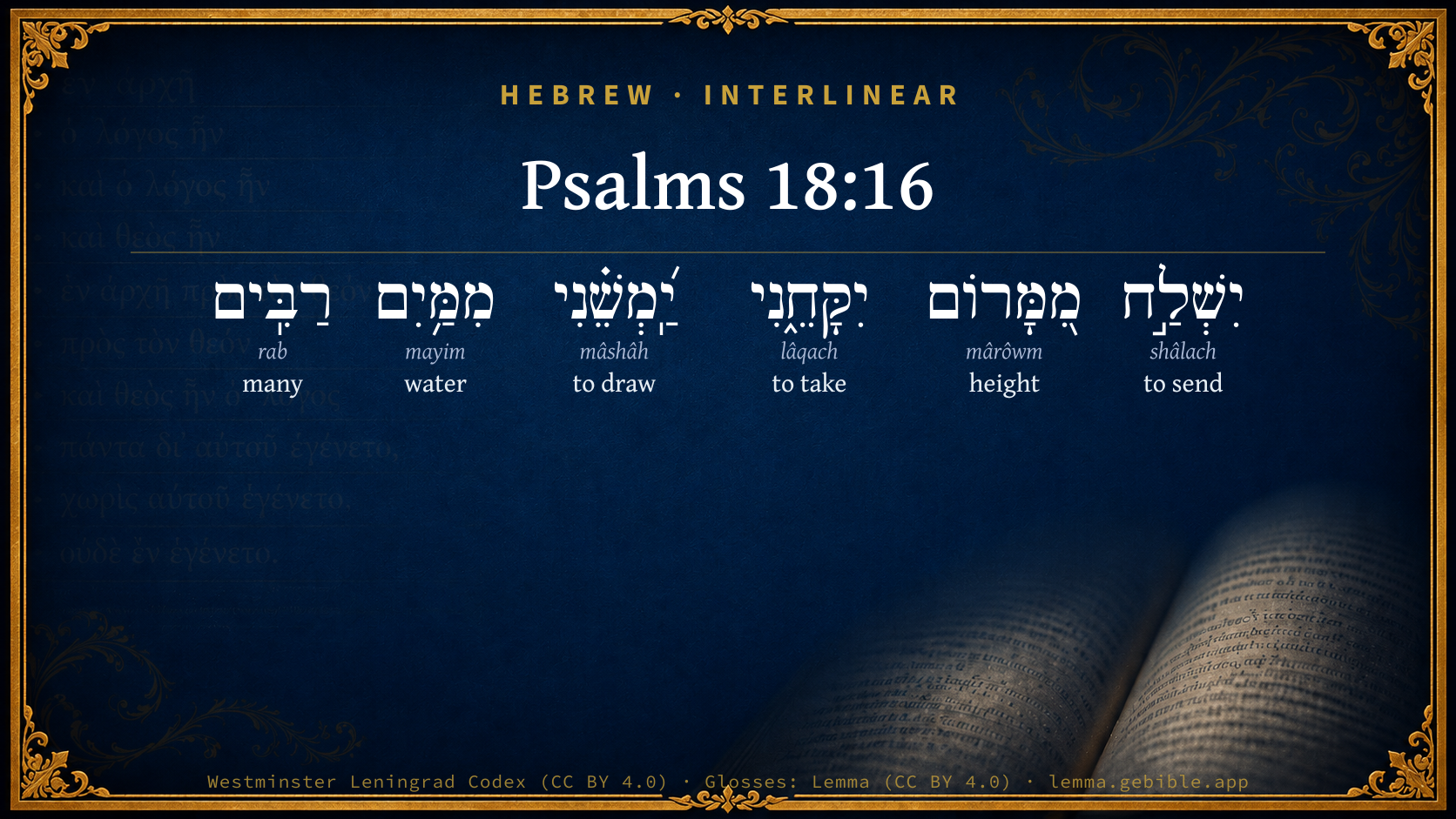
Psalms 18:16

Hebrew (Westminster Leningrad Codex) Psalms 18:16 appears in the Hebrew Old Testament. The text above is from the Westminster Leningrad Codex. Each word links to its Strong’s number, a concise gloss, and parsing drawn from the Open Scriptures Hebrew Bible morphology. Click any word for its full Brown-Driver-Briggs (BDB) entry.
Download image
Cite this verse

Psalms 18:16 (World English Bible). Public Domain. Lemma interlinear Bible study tool, https://lemma.gebible.app/v/psalms/18/16.

Show BibTeX & RIS
BibTeX
RIS
English Translation
He sent from on high. He took me. He drew me out of many waters.
World English Bible · Public Domain
Download a study sheet

One document with this verse’s original text, its word-by-word gloss line, the meaning frame, cross-references with their text, attributed commentary, and full source and license credits — printable, and it pastes into notes with its structure intact.

This verse Autodidact and up

Study sheet (.html) Plain text (.txt)

A passage Seminary Student

Up to 50 verses in one chapter. A passage sheet keeps up to 6 commentary sources and 12 cross-references per verse, in the order this page ranks them, and says so on the sheet whenever that leaves anything out. Ask for a single verse and you get the Autodidact verse sheet above.

Everything on this page stays free to read, with no account — the sheet is a download of what is already on screen, not access to it.

Want to remove ads? Support Godless Engineer
Compare translations 3

The same verse in 3 English versions, stacked beneath the original-language interlinear above. Click any original word for its lexicon entry.

Each is an independent rendering of the whole verse — the interlinear is not word-aligned to these translations.

Highlighted words mark where these versions differ — a whole-verse word diff, not a word-by-word alignment.

  • World English Bible Public Domain
    He sent from on high. He took me. He drew me out of many waters.
  • King James Version Public Domain
    He sent from above, he took me, he drew me out of many waters.
  • unfoldingWord Literal Text CC BY-SA 4.0
    He stretched out from the height, he took hold of me. He drew me out of many waters.

unfoldingWord Literal Text — © unfoldingWord, licensed CC BY-SA 4.0. Word-aligned USFM3 via Door43 (git.door43.org/unfoldingWord/en_ult).

Versions to compare (up to 4)

3 of 4 selected

Show all 18 translations

Every available English version of this verse, each an independent rendering of the whole verse.

  • World English Bible Public Domain
    He sent from on high. He took me. He drew me out of many waters.
  • Berean Standard Bible Public Domain
    He reached down from on high and took hold of me; He drew me out of deep waters.
  • Majority Standard Bible Public Domain
    He reached down from on high and took hold of me; He drew me out of deep waters.
  • King James Version Public Domain
    He sent from above, he took me, he drew me out of many waters.
  • American Standard Version (1901) Public Domain
    He sent from on high, he took me; He drew me out of many waters.
  • Revised Version (1885) Public Domain
    He sent from on high, he took me; he drew me out of many waters.
  • Geneva Bible (1599) Public Domain
    He hath sent downe from aboue and taken mee: hee hath drawen mee out of many waters.
  • Douay-Rheims (1899) Public Domain
    Then the fountains of waters appeared, and the foundations of the world were discovered: At thy rebuke, O Lord, at the blast of the spirit of thy wrath.
  • Young's Literal Translation Public Domain
    He sendeth from above -- He taketh me, He draweth me out of many waters.
  • Literal Standard Version CC BY-SA 4.0
    He sends from above—He takes me, || He draws me out of many waters.
  • Unlocked Literal Bible CC BY-SA 4.0
    He reached down from above; he took hold of me! He pulled me out of the surging water.
  • unfoldingWord Literal Text CC BY-SA 4.0
    He stretched out from the height, he took hold of me. He drew me out of many waters.
  • Darby Bible Public Domain
    He reached forth from above, he took me, he drew me out of great waters:
  • World Messianic Bible Public Domain
    He sent from on high. He took me. He drew me out of many waters.
  • Webster's Bible Public Domain
    \\18:15\\Then the channels of waters were seen, and the foundations of the world were uncovered at thy rebuke, O LORD, at the blast of the breath of thy nostrils.
  • Free Bible Version CC BY-SA 4.0
    He reached down his hand from above and grabbed hold of me. He pulled me out of the deep water.
  • Bible in Basic English Public Domain
    He sent from on high, he took me, pulling me out of great waters.
  • JPS Tanakh (1917) Public Domain
    (18-17) He sent from on high, He took me; He drew me out of many waters.

Literal Standard Version (2020), Covenant Press — licensed CC BY-SA 4.0. Text via the HelloAO Bible API (eBible.org). Unlocked Literal Bible (unfoldingWord) — licensed CC BY-SA 4.0. Text via the HelloAO Bible API (eBible.org). unfoldingWord Literal Text — © unfoldingWord, licensed CC BY-SA 4.0. Word-aligned USFM3 via Door43 (git.door43.org/unfoldingWord/en_ult). Free Bible Version, Dr. Jonathan Gallagher — licensed CC BY-SA 4.0. Text via the HelloAO Bible API (eBible.org).

Word by word

More ways to search: Search by grammar → Find every occurrence → Compare this word →

Practice this passage: Drill this verse → Learn its vocabulary →

About this verse

These counts appear in no published source. They are computed here, from the morphology-tagged text and Lemma’s own curated glosses. What Lemma adds →

6
words
6
distinct lemmas
Wisdom
section

Notable vocabulary

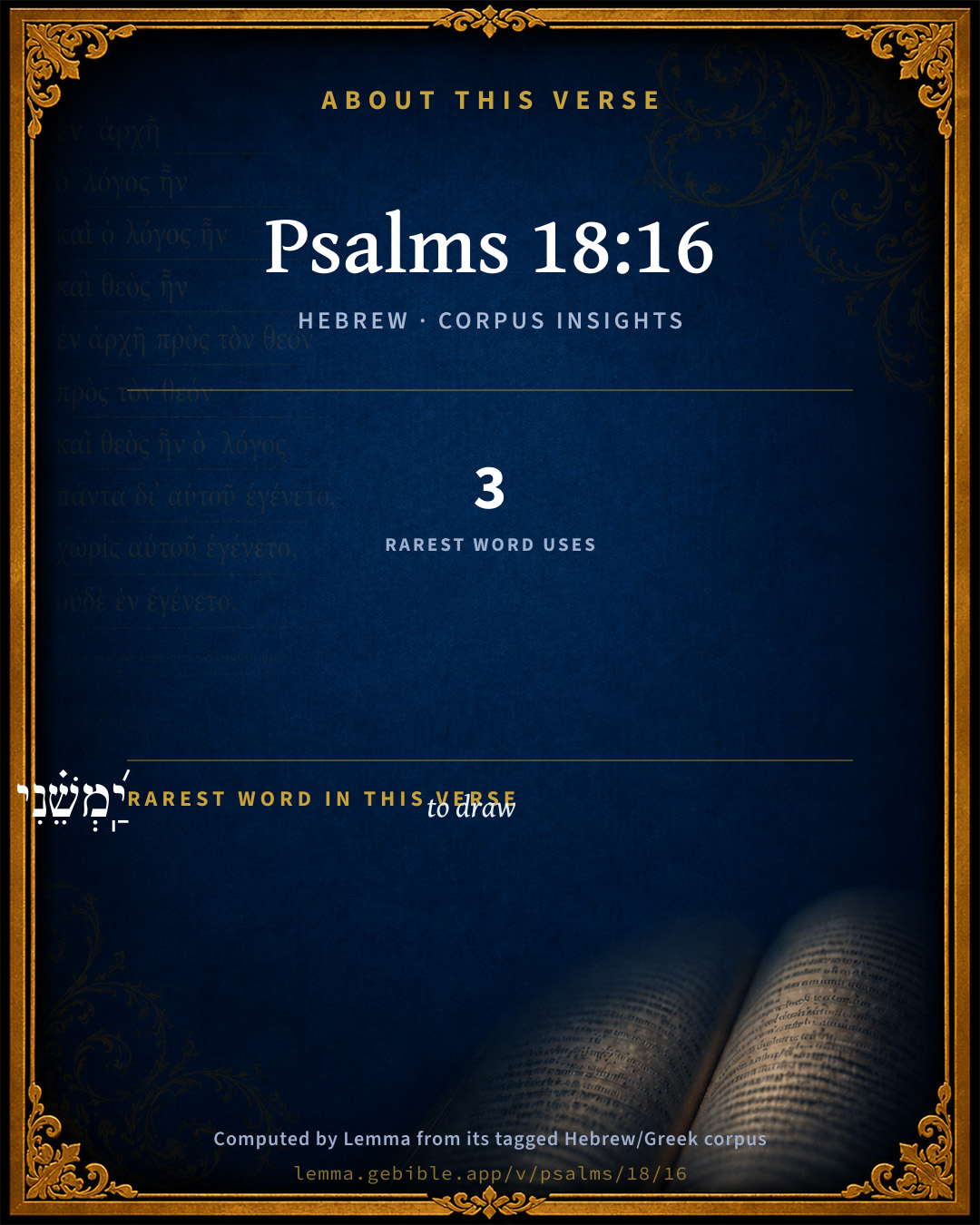
The rarest word here is יַֽ֝מְשֵׁ֗נִי to draw H4871 — appearing just 3 times in the whole Hebrew Bible.

Shared distinctive vocabulary

יַֽ֝מְשֵׁ֗נִי to draw H4871 occurs in 3 verses of the Hebrew Bible. Also found in:

Grammatical profile

  • 3 verbs
  • 2 nouns
  • 1 adjective

Verb forms

  • יִשְׁלַ֣ח Qal · Imperfect
  • יִקָּחֵ֑נִי Qal · Imperfect
  • יַֽ֝מְשֵׁ֗נִי Hiphil · Imperfect

Hebrew & Septuagint length

In English translation the verse runs 15 words from the Hebrew and 17 from the Septuagint (LXX English) — closely comparable.

A rough comparison of the two English renderings, which tokenize alike — not a word-level alignment.

Word counts can differ between the Hebrew and the Greek without any difference in meaning — e.g. the Hebrew direct-object marker אֵת has no separate Greek word, and Greek often adds the article ὁ.

Cross-references

9

Topical passages linked to Psalms 18:16 in the Treasury of Scripture Knowledge — connected by theme and wording, ordered by reader-vote popularity; previews shown in the World English Bible.

  • 2 Samuel 22:17 He sent from on high, he took me; He drew me out of many waters;
  • Psalms 144:7 Stretch out your hand from above, Rescue me, and deliver me out of great waters, Out of the hands of foreigners;
  • Psalms 57:3 He will send from heaven, and save me, He rebukes the one who is pursuing me. Selah. God will send out his loving kindness and his truth.
  • Jonah 2:5–6 The waters surrounded me, Even to the soul. The deep was around me. The weeds were wrapped around my head.
  • Psalms 18:43 You have delivered me from the strivings of the people. You have made me the head of the nations. A people whom I have not known shall serve me.
  • Exodus 2:10 The child grew, and she brought him to Pharaoh's daughter, and he became her son. She named him Moses, and said, "Because I drew him out of the water."
  • Psalms 32:6 For this, let everyone who is godly pray to you in a time when you may be found. Surely when the great waters overflow, they shall not reach to him.
  • Psalms 40:1–3 I waited patiently for Yahweh. He turned to me, and heard my cry.
  • Revelation 17:15 He said to me, "The waters which you saw, where the prostitute sits, are peoples, multitudes, nations, and languages.

Cross-references courtesy of OpenBible.info (CC BY 4.0).

Hebrew and Greek witnesses Masoretic Hebrew ↔ Greek Septuagint

The same verse in the two great witnesses to the Old Testament, shown verse-for-verse.

You’re reading Greek Psalm 17 (Hebrew Psalm 18). The Septuagint counts the superscription, so verse numbers can differ from the Hebrew — chapter-level alignment, not verse-by-verse. Numbering follows Rahlfs.

These are two independent witnesses, not word-aligned to each other, and the Septuagint is shown in lemma (dictionary) form.

Hebrew Psalms 18:16 Masoretic · Westminster Leningrad Codex

יִשְׁלַ֣ח מִ֭מָּרוֹם יִקָּחֵ֑נִי יַֽ֝מְשֵׁ֗נִי מִמַּ֥יִם רַבִּֽים

He sent from on high. He took me. He drew me out of many waters.

World English Bible · Public Domain

Greek LXX Greek Psalm 17:16 Septuagint · lemma form

καί ὁράω ὁ πηγή ὁ ὕδωρ καί ἀνακαλύπτω ὁ θεμέλιον ὁ οἰκέω ἀπό ἐπιτίμησις σύ κύριος ἀπό ἔμπνευσις πνεῦμα ὀργή σύ

He sent from on high and took me, he drew me to himself out of many waters.

LXX2012 (modern English Septuagint) · Public Domain

Hebrew: Westminster Leningrad Codex (CC BY 4.0). Greek: Septuagint (public domain); English from LXX2012 (modern English Septuagint) (Public Domain). How the Septuagint differs from the Hebrew →

Commentary

Notes on Psalms 18:16 from classic Christian and Jewish commentators (each source and its license shown beneath its notes). The classic Christian expositions comment on the surrounding passage and are grouped to its opening verse, so a note may address several verses; the Jewish commentaries on the Tanakh (Rashi and others) are per-verse, so they appear only where the commentator wrote on this verse.

Lemma curates 59 commentaries, every one of them public domain or Creative Commons licensed, each selected and text-cleaned for this edition rather than reprinted as found. About our sources →

Trapp's Complete Commentary

John Trapp

Psa 18:16 He sent from above, he took me, he drew me out of many waters.

Ver. 16. He sent from above, he took me] He rescued me as by a hand reached me from heaven. Deus εκ μηχανης, or, he sent his angels to secure me.

He drew me out of many waters] As he had once done Moses, Exo 2:10, who there hence also had his name. Musaeus, for the same cause, calleth him υδχογενης, water spring.

John Trapp, A Commentary or Exposition upon All the Books of the Old and New Testament (1647–1656) — public domain. Text from a community e-Sword module.

The Biblical Illustrator

Joseph S. Exell

Psa_18:16

He sent from above, He took me, He drew me out of many waters.

Divine interpositions

We are not as those who believe in two co-existent forces, each supreme, one of whom shall create disasters, and the other distribute blessings. The prince of evil is, according to our faith, subordinate to the great Lord of all. Everywhere is God, and in all things His hand is present; in the things which seem to us evil, as well as in the events which appear to us good, God is at work. We freely admit that we do not understand this, and therefore we do not attempt to explain it; but we believe and adore. We need not try to justify the ways of God with men, for He asks no defence at our hands. If there is a providence, why are such terrible evils permitted?

I. Miraculous interpositions in the calamities of this life are not to be expected.

1. Such interpositions would change the whole arrangement of the world.

2. If interpositions were given to save the lives of godly men alone, as some would have it, then this world would become the place of judgment, which it is not intended to be.

3. If God were to interpose in the case of all calamities it would involve many evils. It would encourage idleness, neglect of sanitary laws, carelessness, etc.

4. Divine interpositions of a miraculous sort would not be attended with the advantage to the ungodly which we might suppose, because if there were miracles of mercy on the behalf of Gods people to snatch them from a watery grave or other perils, then we might expect to have, and naturally should have, miracles of judgment too.

II. Providential interpositions are frequent among Gods people. They come in the way of deliverance from floods of trouble. He took me, He drew me out of many waters. He does this not by miracles. He violates no law of nature, but yet delivers in a marvellous way. He does not quench the violence of the flame, yet a precious life is saved from a burning building. The Lord allows all the forces of nature to drive on in their ordinary course, and yet the outcome of it all is, that His servant is delivered and his prayers are answered. This He does in various ways. The sick are restored to health. Business is made to prosper. Enemies are turned to friends, or they die, like Haman. Then believe in the unexpected. Believe that God will do for you something which you know nothing about. The Lord always has a plan in reserve. (C. H. Spurgeon.)

Deliverance out of deep waters

The testimonies of experience are always welcome to us. In sickness, those of the experienced physician. In battle, those of the proved commander. This Psalm seems to be a leaf taken out of Davids private diary.

I. Let us inquire whence it was that God took David. He sent from above, He took me, He drew me out of many waters. The term waters is used in the Scriptures to express a state of trouble and mental disquietude. Apart from the naturalness of the imago as descriptive of something which overwhelms, and desolates, and lays waste, to an Eastern mind this image would have a peculiar force and beauty; for in the mountainous parts of Judea, even as in Switzerland to this very day, the people were liable to sudden inundations, which would sweep away flocks and herds, towns and villages, in their disastrous and overwhelming torrent. Well, David says, God drew me out of many waters; intimating, first, his deliverance from the depths of outward danger. And as from many dangers, so from many sorrows had God taken David out. Think of the sorrow of his exile, the sorrows so many and terrible that came upon him through his great sin. And yet God took him out of them all. But sickness, bereavement, exile were not Davids deepest waters; but sin, the displeasure of God, merited condemnation for his offences, who could hold up the bead in such waters? A wounded spirit who can bear? The image in the text is commonly used in connection with Davids sins. The penitential Psalms will be found to abound with such allusions. Out of the depths have I cried, etc. I am come unto deep waters. Thou hast afflicted me with all Thy waves. His sins had plunged him into many deep waters. And as with sorrows, so with sins, have we not known a like experience to that of David? May not the same confession of misery which they caused us, and of Gods God, says Bunyan, gracious deliverance out of them, come truly from our lips? God, says Bunyan, will sometimes cleave a saint with a wedge of his own timber, that is, He will make him feel the consequences of his own sin, in order that the bitterness of his distress may draw him to a better choice. But to draw a struggling man out of the waters and to take no further care of him--to leave him on the brink of the same pit, and liable again to make shipwreck in the same sea, this is not the way of Him whose work is perfect and therefore we inquire, not only whence God took David, but--

II. Whither He took him. This David beautifully expresses in the 40th Psalm. He brought me up also out of an horrible pit, out of the miry clay, and set my feet upon a rock, and established my goings. Here, then, we have the deliverance perfected. Not only is he raised from the depths, but he is exalted to the heights; not only is he drawn out of the waters, but be is set upon a rock. Fear is superseded by the tranquilities of the promise; a calm conscience stills the agitations of despair. In all your afflictions, therefore, whether of mind, body, or estate, trust to the arm which once drew you out of the waters. You are safe where He would draw you; it is even to the rock of His protection, to the secret of His pavilion, to the covering of His arm, to the tower of His great name. And so your comfort is, that if the waters be many, the succours shall be ninny. God will send from above; grace from above to deliver you, promises from above to cheer you, a Spirit from above to guide you, a Saviour from above to defend and bless you. When your race is over, when your struggles are finished, and when you are landed safely on the eternal shores, then to the God of all grace shall you sing this song of praise. He sent from above, He took me, He drew me out of many waters. (Daniel Moore, M. A.)

Saved from the depths

Jewels long hidden under the lava flood at Pompeii have been recovered undimmed, and divers have recently been searching for valuable gems lost in the sea near Trieste in 1822. When the river overflowed the summer palace of the Shah of Persia at Lar he fled in such haste that his jewels were forgotten. An astute officer of the court gave orders that the banks of the river were to be searched when the flood had subsided, and by this means he restored the jewels to his master, and was rewarded by being promoted to high rank. (W. Y. Fullerton.)

The Biblical Illustrator, edited by Joseph S. Exell (c. 1880s–1900s) — public domain. Text from a community e-Sword module.

Joseph Benson's Commentary

Psa 18:16-18. He sent from above — This may either denote, in general, that God assisted him by his divine power to overcome and deliver himself from his enemies, and thereby extricate himself from his troubles, or that he sent his angels from heaven to protect and rescue him from the many dangers that surrounded him; which he figuratively calls drawing him out of great waters — Afflictions and great calamities being frequently represented by deep waters and floods in the sacred writings. Or, as Theodoret thinks, by these waters, he means the strong enemies mentioned in the next verse. They prevented me in the day of my calamity — They were too crafty for me, and had almost surprised me, coming upon me suddenly, unawares, when I was unprepared and helpless; and would have destroyed me, had not God upheld and supported me when I was in danger of perishing. But God was my stay — They could not prevent him; and, what a staff is to one who is ready to fall, that was God to me in the time of my extremity.

Joseph Benson's Commentary on the Old and New Testaments (1811–1818) — public domain. Text from a community e-Sword module.

J. A. Alexander on Psalms

Joseph Addison Alexander

17. (Psa 18:16). He will send from, above, he will take me, he will draw me out of many waters. Here again the writer seems to take his stand between the inception and the consummation of the great deliverance, and to speak just as he might have spoken while it was in progress. "All this he has done in preparation, and now he is about to send," etc. This seems to be a more satisfactory explanation of the future forms than to make them simple presents, and still more than to make them preterites, which is wholly arbitrary and ungrammatical, although the acts described by these futures were in fact past al the time of composition. To send from above in our idiom means to send a messenger; but in Hebrew this verb is the one used with hand, where we say stretch out, e. g. in the parallel passage Psa 144:7. (See also Gen 8:9; Gen 48:14). The noun, however, is sometimes omitted, and the verb used absolutely to express the sense of the whole phrase, as in 2Sa 6:6, Psa 57:4 (3). From above, from on high, from the height or high place, i.e. heaven, the place of God's manifested presence. There is peculiar beauty in the word translated draw, which is the root of the name Moses, and occurs, besides the place before us, only in the explanation of that name recorded by himself, Exo 2:10. The choice of this unusual expression here involves an obvious allusion both to the historical fact and the typical meaning of the deliverance of Moses, and a kind of claim upon the part of David to be regarded as another Moses.

Joseph Addison Alexander, The Psalms Translated and Explained (1850) — public domain. Text from a community e-Sword module.

Geneva Bible (1599)

Geneva Bible translators

Out of sundry and great dangers.

Geneva Bible (1599) marginal notes — public domain. Text via Bolls.life.

Jamieson, Fausset & Brown

Robert Jamieson, A. R. Fausset & David Brown

from above--As seated on a throne, directing these terrible scenes, God--

sent--His hand (Psa 144:7), reached down to His humble worshipper, and delivered him.

many waters--calamities (Job 30:14; Psa 124:4-5).

Jamieson, Fausset & Brown — Commentary Critical and Explanatory on the Whole Bible (1871) — public domain (CC PDM 1.0). Text via the HelloAO Bible API.

Adam Clarke's Commentary

Verse 16. He drew me out of many waters.] Here the allusion is still carried on. The waters thus poured out were sweeping the people away; but God, by a miraculous interference, sent and drew David out. Sometimes waters are used to denote multitudes of people; and here the word may have that reference; multitudes were gathered together against David, but God delivered him from them all. This seems to be countenanced by the following verse.

Adam Clarke's Commentary on the Bible (1810–1826) — public domain. Text from a community e-Sword/MySword module.

John Calvin's Commentaries

16. He sent down from above. Here there is briefly shown the drift of the sublime and magnificent narrative which has now passed under our review, namely, to teach us that David at length emerged from the profound abyss of his troubles, neither by his own skill, nor by the aid of men, but that he was drawn out of them by the hand of God. When God defends and preserves us wonderfully and by extraordinary means, he is said in Scripture language to send down succor from above; and this sending is set in opposition to human and earthly aids, on which we usually place a mistaken and an undue confidence. I do not disapprove of the opinion of those who consider this as referring to the angels, but I understand it in a more general sense; for by whatever means we are preserved, it is God who having his creatures ready at his nod to do his will, appoints them to take charge of us, and girds or prepares them for succouring us. But, although every kind of aid comes from heaven, David, with good reason, affirms that God had stretched out his hand from on high to deliver him. In speaking thus, he meant to place the astonishing benefit referred to, by way of eminence, above others of a more common kind; and besides, there is in this expression a tacit comparison between the unusual exercise of the power of God here celebrated, and the common and ordinary means by which he succours his people. When he says, that God drew him out of great waters, it is a metaphorical form of expression. By comparing the cruelty of his enemies to impetuous torrents, by which he might have been swallowed up a hundred times, he expresses more clearly the greatness of the danger; as if he had said, I have, contrary to the expectation of men, escaped, and been delivered from a deep abyss in which I was ready to be overwhelmed. In the following verse he expresses the thing simply and without a figure, declaring that he had been delivered from a strong enemy, Bishop Patrick paraphrases the verse thus:— “He delivered me first from that mighty giant, Goliath, and then from Saul, whose power I was not able to withstand; and afterwards from the Philistines and Syrians, and many other nations, whose forces were far superior unto mine, and whose hatred instigated them to do all they could to destroy me.”

John Calvin's Commentaries (1540-1563) — public domain. Text from the Calvin Translation Society English edition (1840s-50s) via the Christian Classics Ethereal Library (ccel.org). Calvin's coverage is partial (roughly two-thirds of the Bible); uncommented books and verses are honest gaps, never fabricated. The 19th-century editor's footnotes and remarks are omitted so the notes are faithfully Calvin's own voice.

Ellicott's Commentary for English Readers

(16) He drew me.—By an exquisite transition from the real to the figurative the poet conceives of these parted waters as the “floods of affliction” (Psa_18:5), from which Jehovah has rescued him by means of the very storm which was sent, in answer to his prayer, to overwhelm his enemies. Render at once more literally and forcibly, “He laid hold of me and drew me out of great waters.” The conception undoubtedly is that the “gates of death” are under these floods, and those being now parted, the sufferer can be reached and rescued.

Psa_18:17-19 show trifling variations between the two copies of the psalm.

A Bible Commentary for English Readers, edited by Charles John Ellicott (1878–1897) — public domain. Text from a community e-Sword module.

The Cambridge Bible for Schools and Colleges

gen. ed. J. J. S. Perowne

16. He sent from above] R.V., He sent from on high: but it seems better to render, He reached forth from on high, as the writer of Psa_144:7 understood the words. He stretched out His hand and caught hold of the sinking man, and drew him out of the floods of calamity which were overwhelming him (Psa_18:4).

drew me] The word is found elsewhere only in Exo_2:10, to which there may be an allusion. ‘He drew me out of the great waters of distress, as He drew Moses out of the waters of the Nile, to be the deliverer of His people.’ For many or great waters as an emblem of danger, cp. Psa_32:6, Psa_66:12, Psa_69:2-3.

16–19. The deliverance which was the object of Jehovah’s manifestation of His power.

The Cambridge Bible for Schools and Colleges (gen. ed. J. J. S. Perowne; Cambridge University Press, 1878–1918) — public domain. Text from a community e-Sword module.

John Gill's Exposition

He delivered me from my strong enemy,.... Which, as it may respect David, may be understood of Goliath the Philistine champion, who was a man of war from his youth; or Saul, king of Israel; and, as it may respect David's antitype, may design either the chief priests, Scribes, and Pharisees, who were men of power and influence; or more especially Satan, the strong man armed, with all his principalities and powers; or, likewise death, the last enemy, from whose pains and cords he was loosed when raised from the dead, and when he was delivered from every other strong enemy;

and from them which hated me; from the old serpent the devil, between whom and him there has been a lasting enmity; and from the world, the people of the Jews, particularly the Pharisees, who bore an implacable hatred to Christ;

for they were too strong for me; as Goliath and Saul were too strong for David of himself, so Christ's enemies were too strong for him; not as God, for he is the mighty God, the Almighty, and stronger than the strong man armed, but as man; for in his human nature he had a sinless weakness, which showed itself in his agonies in the garden; or a natural weakness, through which he was crucified; and this weak nature of Christ Satan attacked, and got an advantage over, and brought it to the dust of death, which is meant by his bruising his heel, though by it he got a broken head. But though Christ's enemies were too strong for him, considered merely as man, they not being, at least many of them, flesh and blood, but principalities and powers; yet being helped by his Father, and supported by his divine nature, he overcame them, and was delivered from them.

John Gill's Exposition of the Whole Bible (1746–1763) — public domain (CC PDM 1.0). Text via the HelloAO Bible API.

Albert Barnes' Notes on the Bible

He sent from above - He interposed to save me. All these manifestations of the divine interposition were from above, or from heaven; all came from God.

He took me - He took hold on me; he rescued me.

He drew me out of many waters - Margin, great waters. Waters are often expressive of calamity and trouble, Psa 46:3; Psa 69:1; Psa 73:10; Psa 124:4-5. The meaning here is, that God had rescued him out of the many troubles and dangers that encompassed him, as if he had fallen into the sea and was in danger of perishing.

Albert Barnes' Notes on the Bible (1834–1885) — public domain. Text from a community e-Sword/MySword module.

Matthew Poole's English Annotations

He sent angels, or assistance otherwise.

Matthew Poole's English Annotations on the Holy Bible (1683–1685) — public domain. Text from a community e-Sword/MySword module.

The Treasury of David

Charles H. Spurgeon

Ver. 16. Now comes the rescue. The Author is divine, He sent; the work is heavenly, from above; the deliverance is marvellous, He drew me out of many waters. Here David was like another Moses, drawn from the water; and thus are all believers like their Lord, whose baptism in many waters of agony and in his own blood has redeemed us from the wrath to come. Torrents of evil shall not drown the man whose God sitteth upon the floods to restrain their fury.

Ver. 16. He sent from above, etc. He "sent" angels, or assistance otherwise. Matthew Poole.

Ver. 16. He took. God's grasp cannot be broken. None can pluck his chosen out of his hand. William S. Plumer.

Ver. 16. Drew me out of many waters. This hath reference to Moses' case, who was "drawn out of the water, "and thereupon called Mosheh (Ex 2:10); that word Mashah is used here by David, and nowhere else in Scripture. "Waters, "signify troubles, and sometimes multitudes of people. H. Ainsworth.

Ver. 16. The Christian, like Moses, "one taken out of the water." The whole verse a noble subject; may be illustrated by life of Moses.

Psalms 18:17*

Charles H. Spurgeon's The Treasury of David (1869–1885) — public domain. Psalms only. Text from a community e-Sword/MySword module.

Whedon's Commentary on the Bible

Daniel D. Whedon

16. He sent from above—See the full expression, Psa_144:7. The dawn of the psalmist’s deliverance breaks from on high.

He drew me out of many waters—An expression probably borrowed by David from the deliverance of Moses from the waters of the Nile. A hand “from above” drew him out. The verb משׁה, (to draw out,) occurs nowhere else but in Exo_2:10, and 2Sa_22:17. “Many waters” symbolically denote multitudes of people, especially of different tongues, (Rev_17:15,) such as composed ancient armies. Jer_47:2

Daniel D. Whedon (gen. ed.), Commentary on the Old and New Testaments (1874–1909) — public domain. Text from a community e-Sword module.

The Pulpit Commentary

He sent from above, he took me, he drew me out of many waters. While destruction thus came upon David"s enemies (vers. 12-14), God"s protecting hand was stretched out to save David himself, who was carefully "taken" and tenderly "drawn" forth from among the "many waters," i.e. the dangers and difficulties which threatened him. Some commentators see in the words used sent, he took me, he drew me a tacit reference to Exo_2:5, Exo_2:10, and, by implication, a sort of parallel between the deliverance of David from his foes and that of Moses from the waters of the Nile (Kay, Hengstenberg, "Speaker"s Commentary").

The Pulpit Commentary (1880–1919), ed. H.D.M. Spence-Jones & Joseph S. Exell — public domain. Text from a community e-Sword module.

Keil & Delitzsch

C. F. Keil & F. Delitzsch

(Heb.: 18:17-20) Then Jahve stretches out His hand from above into the deep chasm and draws up the sinking one. The verb שׁלח occurs also in prose (Sa2 6:6) without יד (Psa 57:4, cf. on the other hand the borrowed passage, Psa 144:7) in the signification to reach (after anything). The verb משׁה, however, is only found in one other instance, viz., Exo 2:10, as the root (transferred from the Egyptian into the Hebrew) of the name of Moses, and even Luther saw in it an historical allusion, "He hath made a Moses of me," He hath drawn me out of great (many) waters, which had well nigh swallowed me up, as He did Moses out of the waters of the Nile, in which he would have perished. This figurative language is followed, in Psa 18:18, by its interpretation, just as in Psa 144:7 the "great waters" are explained by מיּד בּני נכר, which, however, is not suitable here, or at least is too limited.

With Psa 18:17 the hymn has reached the climax of epic description, from which it now descends in a tone that becomes more and more lyrical. In the combination איבי עז, עז is not an adverbial accusative, but an adjective, like רוּחך טובה Psa 143:10, and ὁ ἀνὴρ ἀγαθός (Hebrerbrief S. 353). כּי introduces the reason for the interposition of the divine omnipotence, viz., the superior strength of the foe and the weakness of the oppressed one. On the day of his איד, i.e., (vid., on Psa 31:12) his load or calamity, when he was altogether a homeless and almost defenceless fugitive, they came upon him (קדּם Psa 17:13), cutting off all possible means of delivering himself, but Jahve became the fugitive's staff (Psa 23:4) upon which he leaned and kept himself erect. By the hand of God, out of straits and difficulties he reached a broad place, out of the dungeon of oppression to freedom, for Jahve had delighted in him, he was His chosen and beloved one. חפץ has the accent on the penult here, and Metheg as a sign of the lengthening (העמדה) beside the ē, that it may not be read ĕ.

(Note: In like manner Metheg is placed beside the ee of the final closed syllable that has lost the tone in חפץ Psa 22:9, ותּחולל Psa 90:2, vid., Isaiah S. 594 note.)

The following strophe tells the reason of his pleasing God and of His not allowing him to perish. This כּי חפץ בּי (for He delighted in me) now becomes the primary thought of the song.

Keil & Delitzsch — Biblical Commentary on the Old Testament (1861–1891) — public domain (CC PDM 1.0). Text via the HelloAO Bible API. (Old Testament only.)

unfoldingWord translationNotes

Door43 World Missions Community

He reached down ... he took hold ... He pulled me

The word "He" in these verses refers to Yahweh.

surging water

Here the Psalmist speaks of the dangers of his enemies as if they were huge waves or forceful waters, from which Yahweh has rescued him. (See: Metaphor)

unfoldingWord translationNotes — © Distant Shores Media and the Door43 World Missions Community, licensed CC BY-SA 4.0. Source: git.door43.org/Door43/en_tn.

Rashi

Rabbi Shlomo Yitzchaki (Rashi)

And the depths of the water appeared when the sea split.

the foundations of the world were laid bare for all the waters in the world split.

by the blast from the blowing.

Rashi on the Tanakh — English translations: “The Judaica Press complete Tanach with Rashi, translated by A. J. Rosenberg” (CC BY 4.0); “Pentateuch with Rashi's commentary by M. Rosenbaum and A.M. Silbermann, 1929-1934” (public domain); “The Metsudah Tanach series, Lakewood, N.J” (CC BY 4.0); and “The Book of Joshua, Metsudah Publications, 1997” (CC BY 4.0). Text via Sefaria.

Lesson kit

Teaching starters — assembled from the data on this page, not authored interpretation. Every prompt links to the verse data it draws on. Edit before teaching.

Psalms, in the Wisdom, opens this verse with 6 words (6 distinct Hebrew lemmas). Its most distinctive word is mâshâh (“to draw”). A historical commentator’s framing appears above. Read the whole chapter for the surrounding context.

Discussion questions

  1. How does “to draw” (mâshâh) shape what this verse is saying?
  2. Exodus 2:10 shares the word «to draw» with this verse. How do the two illuminate each other?
  3. The translations on this page render this verse differently — a whole-verse word diff, not a word-by-word alignment. What might account for the different wordings?
  4. The verb «יִשְׁלַ֣ח» is Qal Imperfect. How does its form color the action?
  5. Reading how Trapp's Complete Commentary and The Biblical Illustrator read this verse, where do the two commentators agree and where do they part?

Things to notice

Reading settings

Reading text

Shown beneath each verse's original-language words.

Old Testament
Old Testament edition

Read the OT as the Masoretic Hebrew (MT) or the Greek Septuagint (LXX).

English shown for the Greek Septuagint (in the Hebrew ↔ Greek comparison).

Comparing translations? Open the Compare panel on any verse page to stack up to four side by side.