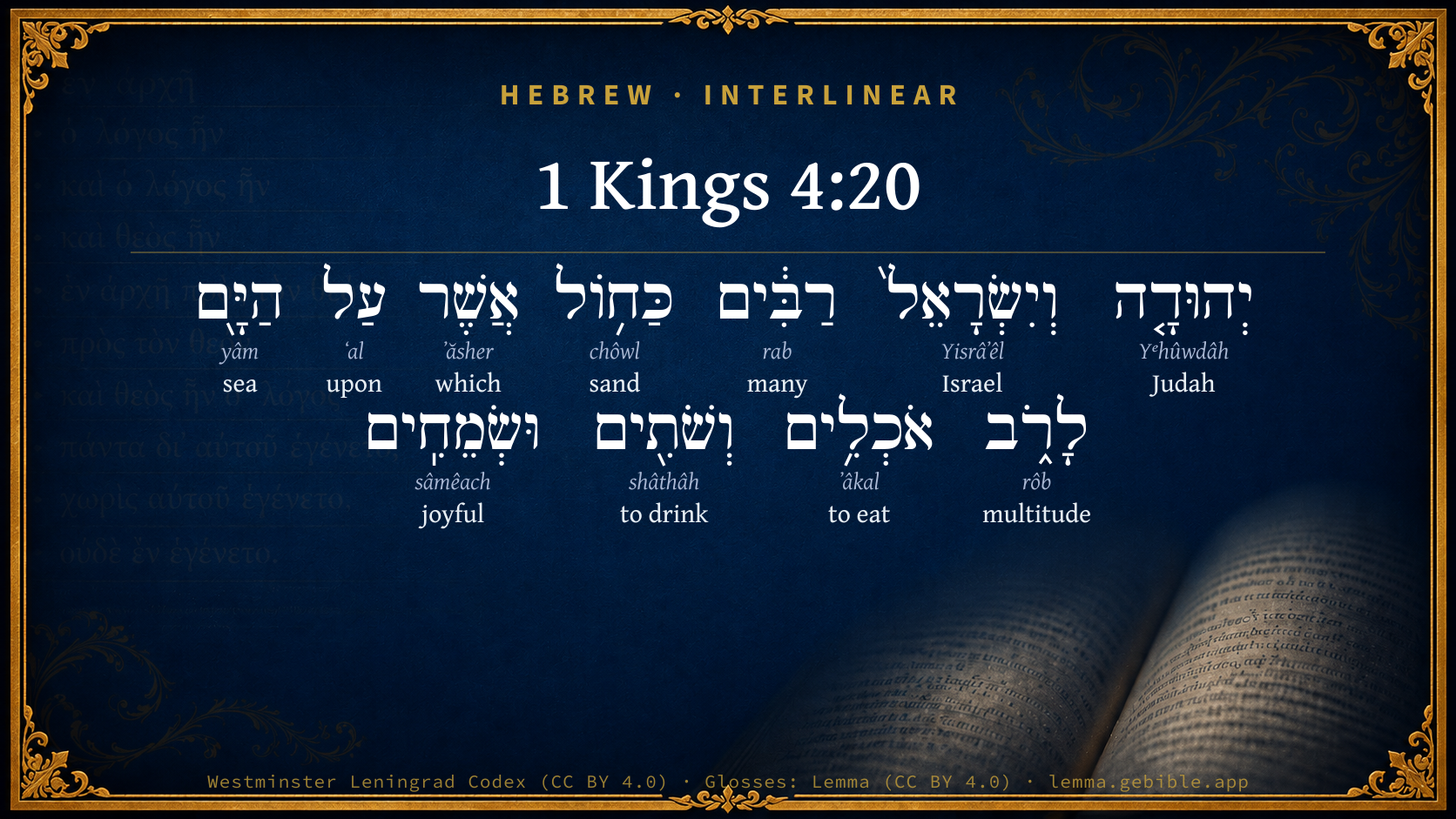
1 Kings 4:20

Hebrew (Westminster Leningrad Codex) 1 Kings 4:20 appears in the Hebrew Old Testament. The text above is from the Westminster Leningrad Codex. Each word links to its Strong’s number, a concise gloss, and parsing drawn from the Open Scriptures Hebrew Bible morphology. Click any word for its full Brown-Driver-Briggs (BDB) entry.
Download image
Cite this verse

1 Kings 4:20 (World English Bible). Public Domain. Lemma interlinear Bible study tool, https://lemma.gebible.app/v/1-kings/4/20.

Show BibTeX & RIS
BibTeX
RIS
English Translation
Judah and Israel were many as the sand which is by the sea in multitude, eating and drinking and making merry.
World English Bible · Public Domain
Download a study sheet

One document with this verse’s original text, its word-by-word gloss line, the meaning frame, cross-references with their text, attributed commentary, and full source and license credits — printable, and it pastes into notes with its structure intact.

This verse Autodidact and up

Study sheet (.html) Plain text (.txt)

A passage Seminary Student

Up to 50 verses in one chapter. A passage sheet keeps up to 6 commentary sources and 12 cross-references per verse, in the order this page ranks them, and says so on the sheet whenever that leaves anything out. Ask for a single verse and you get the Autodidact verse sheet above.

Everything on this page stays free to read, with no account — the sheet is a download of what is already on screen, not access to it.

Want to remove ads? Support Godless Engineer
Compare translations 3

The same verse in 3 English versions, stacked beneath the original-language interlinear above. Click any original word for its lexicon entry.

Each is an independent rendering of the whole verse — the interlinear is not word-aligned to these translations.

Highlighted words mark where these versions differ — a whole-verse word diff, not a word-by-word alignment.

  • World English Bible Public Domain
    Judah and Israel were many as the sand which is by the sea in multitude, eating and drinking and making merry.
  • King James Version Public Domain
    Judah and Israel were many, as the sand which is by the sea in multitude, eating and drinking, and making merry.
  • unfoldingWord Literal Text CC BY-SA 4.0
    Judah and Israel numerous, like the sand that at the sea for abundance, eating and drinking and rejoicing.

unfoldingWord Literal Text — © unfoldingWord, licensed CC BY-SA 4.0. Word-aligned USFM3 via Door43 (git.door43.org/unfoldingWord/en_ult).

Versions to compare (up to 4)

3 of 4 selected

Show all 18 translations

Every available English version of this verse, each an independent rendering of the whole verse.

  • World English Bible Public Domain
    Judah and Israel were many as the sand which is by the sea in multitude, eating and drinking and making merry.
  • Berean Standard Bible Public Domain
    The people of Judah and Israel were as numerous as the sand on the seashore, and they were eating and drinking and rejoicing.
  • Majority Standard Bible Public Domain
    The people of Judah and Israel were as numerous as the sand on the seashore, and they were eating and drinking and rejoicing.
  • King James Version Public Domain
    Judah and Israel were many, as the sand which is by the sea in multitude, eating and drinking, and making merry.
  • American Standard Version (1901) Public Domain
    Judah and Israel were many as the sand which is by the sea in multitude, eating and drinking and making merry.
  • Revised Version (1885) Public Domain
    Judah and Israel were many, as the sand which is by the sea in multitude, eating and drinking and making merry.
  • Geneva Bible (1599) Public Domain
    Iudah and Israel were many, as the sand of the sea in number, eating, drinking, and making merry.
  • Douay-Rheims (1899) Public Domain
    Juda and Israel were innumerable, as the sand of the sea in multitude: eating and drinking, and rejoicing.
  • Young's Literal Translation Public Domain
    Judah and Israel `are' many, as the sand that `is' by the sea for multitude, eating and drinking and rejoicing.
  • Literal Standard Version CC BY-SA 4.0
    Judah and Israel [are] many, as the sand that [is] by the sea for multitude, eating and drinking and rejoicing.
  • Unlocked Literal Bible CC BY-SA 4.0
    Judah and Israel were as numerous as the sand by the sea. They were eating and drinking and were happy.
  • unfoldingWord Literal Text CC BY-SA 4.0
    Judah and Israel numerous, like the sand that at the sea for abundance, eating and drinking and rejoicing.
  • Darby Bible Public Domain
    Judah and Israel were many, as the sand which is by the sea in multitude, eating and drinking and making merry.
  • World Messianic Bible Public Domain
    Judah and Israel were numerous as the sand which is by the sea in multitude, eating and drinking and making merry.
  • Webster's Bible Public Domain
    Judah and Israel were many, as the sand which is by the sea in multitude, eating and drinking, and making merry.
  • Free Bible Version CC BY-SA 4.0
    Judah and Israel had become as numerous as the sand on the seashore. They ate, they drank, they were happy.
  • Bible in Basic English Public Domain
    Judah and Israel were as great in number as the sand by the seaside, and they took their food and drink with joy in their hearts.
  • JPS Tanakh (1917) Public Domain
    Judah and Israel were many, as the sand which is by the sea in multitude, eating and drinking and making merry.

Literal Standard Version (2020), Covenant Press — licensed CC BY-SA 4.0. Text via the HelloAO Bible API (eBible.org). Unlocked Literal Bible (unfoldingWord) — licensed CC BY-SA 4.0. Text via the HelloAO Bible API (eBible.org). unfoldingWord Literal Text — © unfoldingWord, licensed CC BY-SA 4.0. Word-aligned USFM3 via Door43 (git.door43.org/unfoldingWord/en_ult). Free Bible Version, Dr. Jonathan Gallagher — licensed CC BY-SA 4.0. Text via the HelloAO Bible API (eBible.org).

Word by word

More ways to search: Search by grammar → Find every occurrence → Compare this word →

Practice this passage: Drill this verse → Learn its vocabulary →

וּשְׂמֵחִֽים
sâmêach
H8056
“and · joyful”
Conjunction + Adjective, Adjective, Masculine, Plural, Absolute
Part of Speech
Conjunction + Adjective
Type
Adjective
Gender
Masculine
Number
Plural
State
Absolute
Full BDB Definition

Origin: from H8055

TWOT: 2268a

joyful, merry, glad - joyful, showing joy - you who rejoice (substantive)
  1. יְהוּדָ֤ה Yᵉhûwdâh H3063 “Judah” Noun, Proper
  2. וְיִשְׂרָאֵל֙ Yisrâʼêl H3478 “and · Israel” Conjunction + Noun, Proper
  3. רַבִּ֔ים rab H7227 “many” Adjective, Adjective, Masculine, Plural, Absolute
  4. כַּח֥וֹל chôwl H2344 “like/as the · sand” Preposition, Determined + Noun, Common, Masculine, Singular, Absolute
  5. אֲשֶׁר ʼăsher H834 “which” Particle, Relative
  6. עַל ʻal H5921 “upon” Preposition
  7. הַיָּ֖ם yâm H3220 “the · sea” Particle, Definite Article + Noun, Common, Masculine, Singular, Absolute
  8. לָרֹ֑ב rôb H7230 “to/for · multitude” Preposition + Noun, Common, Both, Singular, Absolute
  9. אֹכְלִ֥ים ʼâkal H398 “eating” Verb, Qal, Participle Active, Masculine, Plural, Absolute
  10. וְשֹׁתִ֖ים shâthâh H8354 “and · drinking” Conjunction + Verb, Qal, Participle Active, Masculine, Plural, Absolute

About this verse

These counts appear in no published source. They are computed here, from the morphology-tagged text and Lemma’s own curated glosses. What Lemma adds →

11
words
11
distinct lemmas
Historical
section

Notable vocabulary

The rarest word here is וּשְׂמֵחִֽים joyful H8056 — appearing just 20 times in the whole Hebrew Bible.

Shared distinctive vocabulary

וּשְׂמֵחִֽים joyful H8056 occurs in 20 verses of the Hebrew Bible. Also found in:

Grammatical profile

  • 2 verbs
  • 5 nouns
  • 2 adjectives
  • 1 preposition
  • 1 particle

Verb forms

  • אֹכְלִ֥ים Qal · Participle Active
  • וְשֹׁתִ֖ים Qal · Participle Active

Hebrew & Septuagint length

In English translation the verse runs 21 words from the Hebrew and 28 from the Septuagint (LXX English) — closely comparable.

A rough comparison of the two English renderings, which tokenize alike — not a word-level alignment.

Word counts can differ between the Hebrew and the Greek without any difference in meaning — e.g. the Hebrew direct-object marker אֵת has no separate Greek word, and Greek often adds the article ὁ.

Cross-references

16

Topical passages linked to 1 Kings 4:20 in the Treasury of Scripture Knowledge — connected by theme and wording, ordered by reader-vote popularity; previews shown in the World English Bible.

  • Genesis 22:17 that in blessing I will bless you, and in multiplying I will multiply your seed as the stars of the heavens, and as the sand which is on the seashore. Your seed will possess the gate of his enemies.
  • 1 Kings 3:8 Your servant is in the midst of your people which you have chosen, a great people, that can't be numbered nor counted for multitude.
  • Genesis 32:12 You said, 'I will surely do you good, and make your seed as the sand of the sea, which can't be numbered because there are so many.'"
  • Genesis 13:16 I will make your offspring as the dust of the earth, so that if a man can number the dust of the earth, then your seed may also be numbered.
  • Genesis 15:5 Yahweh brought him outside, and said, "Look now toward the sky, and count the stars, if you are able to count them." He said to Abram, "So shall your seed be."
  • 1 Samuel 30:16 When he had brought him down, behold, they were spread abroad over all the ground, eating and drinking, and dancing, because of all the great spoil that they had taken out of the land of the Philistines, and out of the land of Judah.
  • 1 Chronicles 12:39 They were there with David three days, eating and drinking; for their brothers had made preparation for them.
  • Job 1:18 While he was still speaking, there came also another, and said, "Your sons and your daughters were eating and drinking wine in their eldest brother's house,
  • Psalms 72:3–7 The mountains shall bring prosperity to the people. The hills bring the fruit of righteousness.
  • Proverbs 14:28 In the multitude of people is the king's glory, But in the lack of people is the destruction of the prince.
  • Ecclesiastes 2:24 There is nothing better for a man than that he should eat and drink, and make his soul enjoy good in his labor. This also I saw, that it is from the hand of God.
  • Isaiah 22:13 and behold, joy and gladness, killing oxen and killing sheep, eating flesh and drinking wine: let us eat and drink, for tomorrow we shall die.
  • Micah 4:4 But they will sit every man under his vine and under his fig tree; And no one will make them afraid: For the mouth of Yahweh of Hosts has spoken.
  • Zechariah 3:10 In that day,' says Yahweh of hosts, 'you will invite every man his neighbor under the vine and under the fig tree.'"
  • Zechariah 9:15 Yahweh of Hosts will defend them; And they will destroy and overcome with sling-stones; And they will drink, and roar as through wine; And they will be filled like bowls, Like the corners of the altar.
  • Acts 2:46 Day by day, continuing steadfastly with one accord in the temple, and breaking bread at home, they took their food with gladness and singleness of heart,

Cross-references courtesy of OpenBible.info (CC BY 4.0).

Hebrew and Greek witnesses Masoretic Hebrew ↔ Greek Septuagint

The same verse in the two great witnesses to the Old Testament, shown verse-for-verse.

These are two independent witnesses, not word-aligned to each other, and the Septuagint is shown in lemma (dictionary) form.

Hebrew 1 Kings 4:20 Masoretic · Westminster Leningrad Codex

יְהוּדָ֤ה וְיִשְׂרָאֵל֙ רַבִּ֔ים כַּח֥וֹל אֲשֶׁר עַל הַיָּ֖ם לָרֹ֑ב אֹכְלִ֥ים וְשֹׁתִ֖ים וּשְׂמֵחִֽים

Judah and Israel were many as the sand which is by the sea in multitude, eating and drinking and making merry.

World English Bible · Public Domain

Greek LXX 1 Kings 4:20 Septuagint · lemma form
27 And thus the officers provided king Solomon: and they execute every one in his month all the orders for the table of the king, they omit nothing.

LXX2012 (modern English Septuagint) · Public Domain

On this verse, Keil & Delitzsch discusses the Septuagint’s reading. Read the note in Commentary ↓

Hebrew: Westminster Leningrad Codex (CC BY 4.0). Greek: Septuagint (public domain); English from LXX2012 (modern English Septuagint) (Public Domain). How the Septuagint differs from the Hebrew →

Targum (Aramaic paraphrase)

1

The Targum is the ancient Jewish Aramaic paraphrase of the Hebrew Scriptures — an interpretive translation, not the Hebrew text itself. Onkelos (literal) and Pseudo-Jonathan (expansive) render the Torah, and Jonathan the Prophets. Coverage is partial: where no permissively-licensed English translation exists for a verse, only the Aramaic is shown. This is verse-level text, not a word-by-word alignment to the Hebrew.

  1. Targum Jonathan Prophets (Joshua–Malachi)
    יְהוּדָה וְיִשְׂרָאֵל סַגִיאִין כְחָלָא דְעַל יַמָא לִסְגֵי אָכְלִין וְשָׁתָן וְחָדָן:

    (no public-domain English translation for this verse)

    Targum Jonathan — Aramaic: “Mikraot Gedolot” (public domain). English: “Sefaria Community Translation” (CC0 1.0 (public-domain dedication)); “London "Chaldee Paraphrase," 1871” (public domain). Text via Sefaria.

Commentary

Notes on 1 Kings 4:20 from classic Christian and Jewish commentators (each source and its license shown beneath its notes). The classic Christian expositions comment on the surrounding passage and are grouped to its opening verse, so a note may address several verses; the Jewish commentaries on the Tanakh (Rashi and others) are per-verse, so they appear only where the commentator wrote on this verse.

Lemma curates 59 commentaries, every one of them public domain or Creative Commons licensed, each selected and text-cleaned for this edition rather than reprinted as found. About our sources →

Matthew Henry's Commentary

Such a kingdom, and such a court, surely never any prince had, as Solomon's are here described to be.

I. Such a kingdom. Never did the crown of Israel shine so brightly as it did when Solomon wore it, never in his father's days, never in the days of any of his successors; nor was that kingdom ever so glorious a type of the kingdom of the Messiah as it was then. The account here given of it is such as fully answers the prophecies which we have concerning it in Ps. 72, which is a psalm for Solomon, but with reference to Christ. 1. The territories of his kingdom were large and its tributaries many; so it was foretold that he should have dominion from sea to sea, Psa 72:8-11. Solomon reigned not only over all Israel, who were his subjects by choice, but over all the neighbouring kingdoms, who were his subjects by constraint. All the princes from the river Euphrates, north-east to the border of Egypt south-west, not only added to his honour by doing him homage and holding their crowns from him, but added to his wealth by serving him, and bringing him presents, Kg1 4:21. David, by his successful wars, compelled them to this subjection, and Solomon, by his admirable wisdom, made it easy and reasonable; for it is fit that the fool should be servant to the wise in heart. If they gave him presents, he gave them instructions, and still taught the people knowledge, not only his own people, but those of other nations: and wisdom is better than gold. He had peace on all sides, Kg1 4:24. None of all the nations that were subject to him offered to shake off his yoke, or to give him any disturbance, but rather thought themselves happy in their dependence upon him. Herein his kingdom typified the Messiah's; for to him it is promised that he shall have the heathen for his inheritance and that princes shall worship him, Isa 49:6, Isa 49:7; Isa 53:12. 2. The subjects of his kingdom and its inhabitants, were many and cheerful. (1.) They were numerous and country was exceedingly populous (Kg1 4:20): Judah and Israel were many, and that good land was sufficient to maintain them all. They were as the sand of the sea in multitude. Now was fulfilled the promise made to Abraham concerning the increase of his seed (Gen 22:17), as well as that concerning the extent of their dominion, Gen 15:18. This was their strength and beauty, the honour of their prince, the terror of their enemies, and an advancement of the wealth of the nation. If they grew so numerous that the place was any where too strait for them, they might remove with advantage into the countries that were subject to them. God's spiritual Israel are many, at least they will be so when they come all together, Rev 7:9. (2.) They were easy, they dwelt safely, or with confidence and assurance (Kg1 4:25), not jealous of their king or of his officers, not disaffected either to him or one to another, nor under any apprehension or danger from enemies foreign or domestic. They were happy and knew it, safe and willing to think themselves so. They dwelt every man under his vine and fig-tree. Solomon invaded no man's property, took not to himself their vineyards and olive-yards, as sometimes was the manner of the king (Sa1 8:14), but what they had they could call their own: he protected every man in the possession and enjoyment of his property. Those that had vines and fig-trees ate the fruit of them themselves; and so great was the peace of the country that they might, if they pleased, dwell as safely under the shadow of them as within the walls of a city. Or, because it was usual to have vines by the sides of their houses (Psa 128:3), they are said to dwell under their vines. (3.) They were cheerful in the use of their plenty, eating and drinking, and making merry, Kg1 4:20. Solomon did not only keep a good table himself, but enabled all his subjects, according to their rank, to do so too, and taught them that God gave them their abundance that they might use it soberly and pleasantly, not that they might hoard it up. There is nothing better than for a man to eat the labour of his hands (Ecc 2:24), and that with a merry heart, Ecc 9:7. His father, in the Psalms, had led his people into the comforts of communion with God, and now he led them into the comfortable use of the good things of this life. This pleasant posture of Israel's affairs extended, in place, from Dan to Beer-sheba - no part of the country was exposed nor upon any account uneasy; and it continued a long time, all the days of Solomon, without any material interruption. Go where you would, you might see all the marks of plenty, peace, and satisfaction. The spiritual peace, and joy, and holy security, of all the faithful subjects of the Lord Jesus were typified by this. The kingdom of God is not, as Solomon's was, meat and drink, but, what is infinitely better, righteousness, and peace, and joy in the Holy Ghost.

II. Such a court Solomon kept as can scarcely be paralleled. We may guess at the vast number of his attendants, and the great resort there was to him, by the provision that was made daily for his table. Of bread there were so many measures of flour and meal as, it is computed, would richly serve 3000 men (Carellus computes above 4800 men), and the provision of flesh (Kg1 4:23) was rather more in proportion. What vast quantities were here of beef, mutton, and venison, and the choicest of all fatted things, as some read that which we translate fatted fowl! Ahasuerus, once in his reign, made a great feast, to show the riches of his kingdom, Est 1:3, Est 1:4. But it was much more the honour of Solomon that he kept a constant table and a very noble one, not of dainties or deceitful meats (he himself witnessed against them, Pro 23:3), but substantial food, for the entertainment of those who came to hear his wisdom. Thus Christ fed those whom he taught, 5000 at a time, more than ever Solomon's table would entertain at once: and all believers have in him a continual feast. Herein he far outdoes Solomon, that he feeds all his subjects, not with the bread that perishes, but with that which endures to eternal life. It added much both to the strength and glory of Solomon's kingdom that he had such abundance of horses, 40,000 for chariots and 12,000 for his troops, 1000 horse, perhaps, in every tribe, for the preserving of the public peace, Kg1 4:26. God had commanded that their king should not multiply horses (Deu 17:16), nor, according to the account here given, considering the extent and wealth of Solomon's kingdom, did he multiply horses in proportion to his neighbours; for we find even the Philistines bringing into the field 30,000 chariots (Sa1 13:5) and the Syrians at least 40,000 horse, Sa2 10:18. The same officers that provided for his house provided also for his stable, Kg1 4:27, Kg1 4:28. Every one knew his place, and work, and time; and so this great court was kept without confusion. Solomon, that had vast incomes, lived at a vast expense, and perhaps wrote that with application to himself, Ecc 5:11. When goods increase those are increased that eat them; and what good is there to the owners thereof, saving the beholding of them with their eyes, unless withal they have the satisfaction of doing good with them?

Matthew Henry's Commentary on the Whole Bible (1708–1710) — public domain (CC PDM 1.0). Text via the HelloAO Bible API.

Trapp's Complete Commentary

John Trapp

1Ki 4:20 Judah and Israel [were] many, as the sand which [is] by the sea in multitude, eating and drinking, and making merry.

Ver. 20. As the sand which is by the sea.] A proverbial expression, and hyperbolical. See Gen 22:17; Gen 32:12.

Eating and drinking, and making merry.] They were in a plentiful and comfortable condition; so and much more are all Christ’s subjects, who do "eat their meat with joy, and drink their wine with gladness, because God now accepteth their works"; they have the "white stone," the "new name," enough and enough to make them everlastingly merry amidst all crosses and casualties.

John Trapp, A Commentary or Exposition upon All the Books of the Old and New Testament (1647–1656) — public domain. Text from a community e-Sword module.

Albert Barnes' Notes on the Bible

There is some doubt about the proper arrangement of the remainder of this chapter. The best alteration, if we alter the Hebrew order at all, would be to place 1Ki 4:20-21 after 1Ki 4:25.

Many ... - See 1Ki 3:8 note; and compare Psa 127:1-5, which is traditionally ascribed to Solomon, and which celebrates the populousness and security of Israel in his day.

Albert Barnes' Notes on the Bible (1834–1885) — public domain. Text from a community e-Sword/MySword module.

Joseph Benson's Commentary

1Ki 4:20. As the sand which is on the sea-shore — An hyperbolical expression to signify a vast number. Eating and drinking, &c. — In perfect security, and highly satisfied. Jeshurun now began to wax fat, as Moses foresaw would be the case, and soon kicked; soon forsook God who made him, and lightly esteemed the rock of his salvation, Deu 32:15. This even Solomon himself did. What individual, or what nation, can bear continual prosperity and plenty?

Joseph Benson's Commentary on the Old and New Testaments (1811–1818) — public domain. Text from a community e-Sword module.

Whedon's Commentary on the Bible

Daniel D. Whedon

SOLOMON’S WEALTH AND WISDOM, 1Ki_4:20-34.

20. The statements of this verse are calculated to enhance in the mind of the reader the glory of Solomon’s reign. “The general tone of the records of his reign is that of jubilant delight, as though it were indeed a golden day following on the iron and brazen age of the warlike David.” — Stanley.

As the sand — Thus fulfilling the promise made to Abraham. See marginal references.

Eating… drinking… making merry — Evidences of a happy, peaceful, and prosperous administration.

Daniel D. Whedon (gen. ed.), Commentary on the Old and New Testaments (1874–1909) — public domain. Text from a community e-Sword module.

Keil & Delitzsch

C. F. Keil & F. Delitzsch

In Kg1 4:20 the account of Solomon's officers is closed by a general remark as to the prosperous condition of the whole nation; though we miss the copula Vav at the commencement. The words, "Judah and Israel were numerous as the sand by the sea," indicate that the promise given to the patriarchs (Gen 22:17, cf. Gen 32:13) had been fulfilled. To this there is appended in Kg1 5:1 the remark concerning the extent of Solomon's sway, which prepares the way for what follows, and shows how the other portion of the promise, "thy seed will possess the gates of its enemies," had been fulfilled. - The first fourteen verses of 1 Kings 5 are therefore connected by the lxx, Vulg., Luther, and others with 1 Kings 4. It is not till Kg1 5:15 that a new section begins.

Keil & Delitzsch — Biblical Commentary on the Old Testament (1861–1891) — public domain (CC PDM 1.0). Text via the HelloAO Bible API. (Old Testament only.)

Tyndale Open Study Notes

Tyndale Open Resources

4:20-21 God’s promise to Abraham (Gen 15:18-21; 17:8; 22:17) finds historical fulfillment in his blessing of Solomon. The surrounding lands conquered by David and Solomon (2 Chr 8:3) remained loyal to Solomon. They sent tribute money . . . and continued to serve him throughout his long reign.

Tyndale Open Study Notes — © Tyndale Open Resources, licensed CC BY-SA 4.0. Text via the HelloAO Bible API.

Geneva Bible (1599)

Geneva Bible translators

They lived in all peace and security.

Geneva Bible (1599) marginal notes — public domain. Text via Bolls.life.

Adam Clarke's Commentary

Verse 20. Eating and drinking, and making merry.] They were very comfortable, very rich, very merry, and very corrupt. And this full feeding and dissipation led to a total corruption of manners.

Adam Clarke's Commentary on the Bible (1810–1826) — public domain. Text from a community e-Sword/MySword module.

Ellicott's Commentary for English Readers

(20) Were many.—The description of the condition of the people here and in 1Ki_4:25, as multiplied in numbers, and living in festivity and peace, is evidently designed to specify not only their general prosperity and wealth, but also the fact noticed in 1Ki_9:20-22, that at this time they were a dominant race, relieved from all burden of labour, and ruling over the subject races, now reduced to complete subjection and serfship. (That it was otherwise hereafter is clear from the complaints to Rehoboam in 1Ki_12:4.) Now, for the first time, did Israel enter on full possession of the territory promised in the days of the Conquest (Jos_1:4), and so into the complete fulfilment of the promise to Abraham, alluded to in the words, “many as the sand which is by the sea in multitude” (Gen_22:17).

A Bible Commentary for English Readers, edited by Charles John Ellicott (1878–1897) — public domain. Text from a community e-Sword module.

The Cambridge Bible for Schools and Colleges

gen. ed. J. J. S. Perowne

20. eating and drinking, and making merry] Words added to the description of the increased population to mark the great prosperity of the land. There was abundance everywhere, and none to make them afraid. Cf. below, 1Ki_4:25.

The Cambridge Bible for Schools and Colleges (gen. ed. J. J. S. Perowne; Cambridge University Press, 1878–1918) — public domain. Text from a community e-Sword module.

John Gill's Exposition

Ten fat oxen,.... Such as were kept up in the stall and fatted:

and twenty oxen out of the pastures; which were killed as they were taken from thence, and not put up to be fed:

and an hundred sheep; out of the folds:

beside harts, and roebucks, and fallow deer; which were clean creatures, according to the Levitical law, Deu 14:5; these were hunted in fields, or taken out of the park, or were presents from other countries; so that here was plenty of beef, mutton, and venison: for the spiritual application of this to the antitypical Solomon, and his provisions, see Mat 22:4;

and fatted fowl; such as we call capons (a); some Jewish writers (b), because of the likeness of sound in the word here used, take them to be Barbary fowls, or such as were brought from that country: there is a sort of birds called which were without a voice, that neither heard men, nor knew their voice (c).

(a) So David de Pomis, Tzemach David, fol. 12. 3. and some in Kimchi in loc. (b) Baal Aruch & R. Elias Levit. Tishbi, in voce (c) Scholia in Aristoph. Aves, p. 550.

John Gill's Exposition of the Whole Bible (1746–1763) — public domain (CC PDM 1.0). Text via the HelloAO Bible API.

Haydock's Catholic Bible Commentary

Multitude. We may suppose seven millions; though, if the calculation of Chronicles be more accurate, they were much more numerous. See 2 Kings xxiv. 9. (Haydock)

George Leo Haydock (1774–1849), Haydock's Catholic Family Bible and Commentary, 1859 edition — public domain. Excludes Psalms (Douay-Rheims chapter numbering differs from Protestant) and Deuterocanonical books (Catholic canon only).

The Pulpit Commentary

SOLOMON"S RULE, STATE, AND WISDOM. The remainder of this chapter, which de-scribes to us the extent and character of Solomon"s sway (vv. 20, 21, 24, 25), the pomp and provision of his household (vv. 22, 23, 26-28), and his profound and varied wisdom (vv. 29-34), has every appearance of a compilation from different sources. It scarcely has the order and coherence which we should find in the narrative of a single writer.

Judah and Israel were many, as the sand which is by the sea in multitude a reminiscence of Gen_13:16 Gen_22:17 Gen_32:12 (cf. ch. 3:8). In the reign of Solomon these promises had their fulfilment, eating and drinking, and making merry. Cf. 1Sa_30:16. The Hebrew here begins a new chapter. The LXX omits vers. 20, 21, 25, 26, and places vers. 27, 28, "and those officers," etc., after the list of prefects, ver. 19.

HOMILETICS.

Vers. 20-25.

The Golden Age.

It has been cynically said that men always place the golden age in the past or in the future. Possibly they are not so far wrong after all. For, if our historian is true, there has been such a period in the history of the world. And if the Holy Gospel is true, there will be such a period hereafter. The reign of Solomon was the Augustan, the golden age, of Israel. The reign of Jesus, of which Solomon"s empire was a foreshadowing, will be the golden age of the world. Let us then consider what light the first period the past throws upon the future; in what respects, that is to say, the sway of Solomon is a type and prefigurement of the holy and beneficent rule of our Redeemer. Observe

I THE MONARCH.

1. He was the wisest of men. This was the root of the universal prosperity. He was capax imperii; he had the understanding to judge that great people. (1Ki_3:9) From a throne stablished in equity and intelligence (Psa_72:2) flowed a tide of blessing through the land. But "Messiah the Prince" is the Incarnation of Wisdom. He is "made unto us wisdom". (1Co_1:30) In Him "are hid all the treasures of wisdom and knowledge". (Col_2:3) He is "the wisdom of God". (1Co_1:24)

2. He ruled in the fear of the Lord. The precept of his father (2Sa_23:3) was not forgotten. (1Ki_3:6-9) Compare the account of Messiah"s reign the reign of the Branch of the root of Jesse in Isa_2:2-5. This "King shall reign in righteousness". (Isa_32:1)

II THE EMPIRE.

1. Its extent. He had dominion from "the river to the border of Egypt," "from Tiphsali even to Azzah." The petty kings brought presents and did fealty. Now observe how Psalm 72., descriptive or prophetic of the reign of Solomon, is also prophetic of the reign of our blessed Lord. Of Him alone is it strictly true that "He shall have dominion from sea to sea," etc. (ver. 8), that "all kings shall fall down before Him," etc. True, His enemies do not yet "lick the dust" (ver. 9), for "we see not yet all things put under Him," but we know that all power is given to Him in heaven and in earth, (Mat_28:18) and that "the kingdoms of this world" shall "become the kingdoms of our Lord and of his Christ". (Rev_11:15)

2. Its duration. Solomon"s was a long reign, and would have been much longer (1Ki_3:14) had he been faithful But He who shall possess "the throne of his father David shall reign over the house of Jacob forever, and of his kingdom there shall be no end" (Luk_1:32, Luk_1:33; cf. Dan_2:44 Dan_7:14, Dan_7:27; Psa_145:13; Mic_4:7)

III THE SUBJECTS.

1. Their number. They were "many," "as the sand which is by the sea in multitude." Compare Dan_7:10, "ten thousand times ten thousand stood before him," and Rev_5:11 Rev_7:9, "a great multitude which no man could number.

2. Their character. Solomon"s sway extended over Gentiles as well as Jews (vers. 21, 24). A foreshadowing of the inclusion of Gentiles in the kingdom of Christ. In the one fold, two flocks. (Joh_10:16) Compare Act_26:23 Act_28:28; Rom_11:15; Eph_3:6 Eph_2:14, etc. There are three particulars, however, in which the subjects of our Lord will differ from those of Solomon.

(1) There will be no bondage, no forced labour, none to bear burdens.

(2) The free labour of love will require no rest. (1Ki_5:14) The servants who serve Him "rest not day and night", (Rev_4:8) yet keep perpetual sabbath (Heb_4:9)

(3) All shall be holy. No Jeroboam shall "lift up his hand" against the Lord. He shall be all and in all.

IV THE REIGN.

1. It was peaceful (ver. 24; cf. 1Ki_5:4 and 1Ch 32:9). In Messiah"s reign they shall "beat theft swords into ploughshares," (etc. Isa_2:4) Into His court "neither foe entereth nor friend departeth. He is the King and Prince of Peace. (Heb_7:2)

2. It was joyous and prosperous. "Eating and drinking and making merry." Ibi festivitas sine fine (Augustine). And Athanasius speaks twn aJgiwn kailwn ajei eJortazontwn. The vine and the fig tree may remind us of the tree of life with its twelve manner of fruits; the security (ver. 25) of the pillars in the temple of God. (Rev_3:12) "In his days Israel shall dwell safely" (Jer_23:6; cf. Isa_11:6-9) That golden age lasted "all the days of Solomon" (ver. 23). That which is to come shall be coeternal with the endless life of the Son of God Heb_7:16; Joh_14:19; Psa_16:11.

HOMILIES BY J. WAITE. Vers. 20-25.

A Prosperous Reign.

This chapter presents a general view of the prosperity of Solomon"s reign, much of which was owing to the extraordinary, glory of the reign of David. Such a rule as David"s sowed seeds of blessing m the land which it was Solomon"s privilege to reap. David united the kingdoms of Judah and Israel, and Solomon came into quiet possession of the completed commonwealth. David laid the foundation, Solomon developed the fabric and adorned it. Each succeeding generation inherits the good stored up for it by those that went before. Happy they who are the descendants of a noble ancestry. If it is true that "the sins of the fathers are visited on the children," etc., equally true is it that "the good men do lives after them.

We all reap the fruits of the care and toll and suffering of our fathers. "Other men labour and we enter into their labours." The text suggests

I THE GRANDEUR OF A MULTITUDINOUS PEOPLE. "Judah and Israel were many, etc. What is the secret of the feeling of solemnity akin to awe with which we gaze upon a vast concourse of human beings? It is the fulness of life not mere physical force, but thinking, emotional life, with all its latent capacities that impresses us. But think of a great nation what a world of busy, many-sided life is here! What complex relations; what slumbering energies; what rich resources; what mines of undeveloped thought; what tides of feeling; what boundless possibilities of good or evil, of glory or of shame! Consider the mutual action and reaction of the individual and corporate life in such a nation; the conditions of its well being; the tremendous responsibility of those who are set to guide its forces, to guard its interests, to control its destinies. We can understand the trembling of spirit Moses felt when he looked on the thronging host of Israel in the wilderness. "Wherefore layest thou the burden of all this people upon me?" etc.. (Num_11:11) So with Solomon is able to judge this thy so great a people?". (1Ki_3:9) Rulers who show that they are alive to the dread significance of their position claim our deepest sympathy. Well may we pray for them (1Ti_2:2) that they may be inspired by the right spirit, prompted by purest motives, never allowed to fall into the sin

Of making their high place the lawless perch Of winged ambitions.

II THE FAR REACHING INFLUENCE OF A WISE AND RIGHTEOUS RULE. "And Solomon reigned over all kingdoms," etc. (ver. 21). These were tributary kingdoms. It was not the division of one great empire into many provinces, but the recognition by outlying principalities of the superior sovereignty of the Hebrew monarch. What was the cause of this widespread influence? Won by force of arms in David"s reign, it was retained, probably, by force of good government and beneficent policy. Israel presented an example of a well-ordered state entered, under Solomon, On a remarkable career as a commercial people Solomon himself a royal merchant. Note his sagacity in "makingaffinity" with the king of Egypt, (1Ki_3:1) and in his treaty with Hiram, king of Tyre (ch. 5.) This was the secret of Solomon"s influence. As far as we can judge, it was not so much the result of overmastering force, but of a policy by which the bonds of mutual confidence and helpfulness were strengthened. We are reminded that this is the real stability of any nation the spirit of justice, integrity, beneficence that inspires it, coupled with the disposition to form friendly and helpful relations. The influence that arises from the display of military strength not worthy to be compared with this. "Righteousness exalteth a nation". (Pro_14:8) "The throne is established by righteousness". (Pro_16:12) Every nation is strong and influential just in proportion as its internal order and external relations are conformed to the law of righteousness.

III THE PEACE THAT IS THE RESULT OF RIGHTEOUSNESS. "He had peace on all sides round about him" (ver. 24). This was the fulfilment of a prophecy that attended his very birth. David, the "man of war," yearned for a time of peace, and the yearning expressed itself in the names he gave his sons Absalom, "the father of peace;" Shelomoh, Solomon, "the peaceful one." The peacefulness of Solomon"s reign was the natural outcome of his own personal characteristics, and of the policy he adopted. "When a man"s ways please the Lord, he maketh even his enemies to be at peace with him". (Pro_16:7) False maxim of international life, "If you want peace prepare for war multiply the means and provocations of strife! Maintain an attitude of distrust, defiance, menace! Men have strange confidence in the pacifying effect of desolating force. They "make a solitude and call it peace," forgetting that tranquillity thus gained does but cover with a deceptive veil the latent seeds of hostility and revenge. How much better the Scripture idea, "The work of righteousness shall be peace," etc.; (Isa_32:17) "The fruit of righteousness is sown in peaceof them that make peace". (Jam_3:18)

IV THE SECURITY THAT SPRINGS FROM PEACE (ver. 25). "And Judah and Israel dwelt safely," etc. this became almost a proverbial expression (2Ki_18:8; Mic_4:4; Zec_3:10) Suggests the quiet enjoyment of the good of life, the fruit of honest labour, under the protection of impartial law. This is the result of peace. Often urged that war is an education in some of the nobler elements of national character; safeguard against luxury and indolent self indulgence, etc. But may not these good results be bought at too terrible a price? Are there no other fields for the healthy development of a nation"s energies? no foes of ignorance, and vice, and social wrong, to say nothing of forms of beneficent world wide enterprise, that call them forth in manly exercise? It is the reign of peace that fosters the industries that enrich the life of a people, and the beneficent activities that beautify it. "Tis this that "makes the country flourish and the city smile." The happy condition of things here described is said to have lasted through "all the days of Solomon;" chiefly true of the earlier part of his reign. Sins and disasters involved the latter part in gloom. So far, however, we have in it a prophecy of the reign of David"s "greater Son." Psalm 72. has its partial fulfilment in the days of Solomon; but the grandeur of its prophetic meaning is realized only in the surpassing glory of His kingdom who is the true "Prince of righteousness and peace. W.

The Pulpit Commentary (1880–1919), ed. H.D.M. Spence-Jones & Joseph S. Exell — public domain. Text from a community e-Sword module.

Kretzmann's Popular Commentary

Paul E. Kretzmann

Solomon’s Riches and Power

v. 20. Judah and Israel were many, as the sand which is by the sea in multitude, according to the prophecy of Jehovah, Gen 22:17, eating and drinking and making merry, happy under the wise and beneficent rule of Solomon,

v. 21. And Solomon reigned over all kingdoms from the river, the great river Euphrates, unto the land of the Philistines, in the southwest, along the Mediterranean, and unto the border of Egypt, in the south; they brought presents, they were tributary vassals, and served Solomon all the days of his life.

v. 22. And Solomon’s provision for one day, the food which he needed for his big royal establishment, was thirty measures of fine flour, and threescore measures of meal, the total amount of flour having been computed to be 171 bushels, or enough for 28,000 pounds of bread,

v. 23. ten fat oxen, those especially fattened for the table, and twenty oxen out of the pastures, such as were not fattened, and an hundred sheep, beside harts, and roebucks, gazelles, and fallow-deer, antelopes, and fatted fowl. This gave a total daily consumption of meat amounting to some 20,000 pounds.

v. 24. For he had dominion over all the region on this side the river, from Tiphsah, a large and populous town on the west bank of the Euphrates, even to Azzah, or Gaza, on the border of the Philistines, in the extreme southwestern section, over all the kings on this side the river; and he had peace on all sides round about him, none of the surrounding nations dared to take up arms against him.

v. 25. And Judah and Israel dwelt safely, every man under his vine and under his fig-tree, in a state of happy security, from Dan even to Beersheba, all the days of Solomon; his reign completed, also in this respect, the Golden Age of Israel’s history.

v. 26. And Solomon had forty thousand stalls of horses for his chariots, four thousand horses for his fourteen hundred chariots, and twelve thousand horsemen, his cavalry serving to strengthen his standing army very materially.

v. 27. And those officers, the twelve enumerated above, provided victual for King Solomon and for all that came to King Solomon’s table, every man in his month: they lacked nothing.

v. 28. Barley also, which took the place of oats, and straw for the horses and dromedaries, literally, "swift beasts," coursers. probably used for conveying urgent messages, brought they unto the place where the officers were, in the various towns where horses were stationed, every man according to his charge. There was universal prosperity and general contentment under the reign of Solomon.

Paul E. Kretzmann, Popular Commentary of the Bible (1921–1924) — public domain. Text from a community e-Sword module.

unfoldingWord translationNotes

Door43 World Missions Community

Judah and Israel were as numerous as the sand by the sea

The speaker uses exaggeration to say that there were so many people that it would be impossible to count them all. The words "Judah" and "Israel" are metonyms for the people who lived in Judah and Israel. AT: "There were as many people in Judah and Israel as there are grains of sand by the sea" or "there were more people in Judah and Israel than a person could count" (See: Hyperbole and Generalization and Metonymy)

the River

"the Euphrates River"

thirty cors

A cor is a unit of dry measure. (See: Biblical Volume)

deer, gazelles, roebucks

four-legged animals that run fast (See: Translate Unknowns)

deer

more than one of these animals

fattened fowl

"birds that people fed so they would become fat"

translationWords

Judah

Israel

Solomon

kingdom

Philistines

Egypt

tribute

servant

life

cow

ewe

unfoldingWord translationNotes — © Distant Shores Media and the Door43 World Missions Community, licensed CC BY-SA 4.0. Source: git.door43.org/Door43/en_tn.

Lesson kit

Teaching starters — assembled from the data on this page, not authored interpretation. Every prompt links to the verse data it draws on. Edit before teaching.

1 Kings, in the Historical, opens this verse with 11 words (11 distinct Hebrew lemmas). Its most distinctive word is sâmêach (“joyful”). A historical commentator’s framing appears above. Read the whole chapter for the surrounding context.

Discussion questions

  1. What does “joyful” (sâmêach) contribute to the verse as a whole?
  2. How does Deuteronomy 16:15, which shares the word «joyful», read alongside this verse?
  3. These translations render this verse differently. What is at stake in choosing one wording over another?
  4. «אֹכְלִ֥ים» is a Qal Participle Active verb. How does that grammatical form shape the action described?
  5. Compare how Matthew Henry's Commentary and Trapp's Complete Commentary read this verse. Where do they agree or differ?

Things to notice

Reading settings

Reading text

Shown beneath each verse's original-language words.

Old Testament
Old Testament edition

Read the OT as the Masoretic Hebrew (MT) or the Greek Septuagint (LXX).

English shown for the Greek Septuagint (in the Hebrew ↔ Greek comparison).

Comparing translations? Open the Compare panel on any verse page to stack up to four side by side.