Genesis 26:14

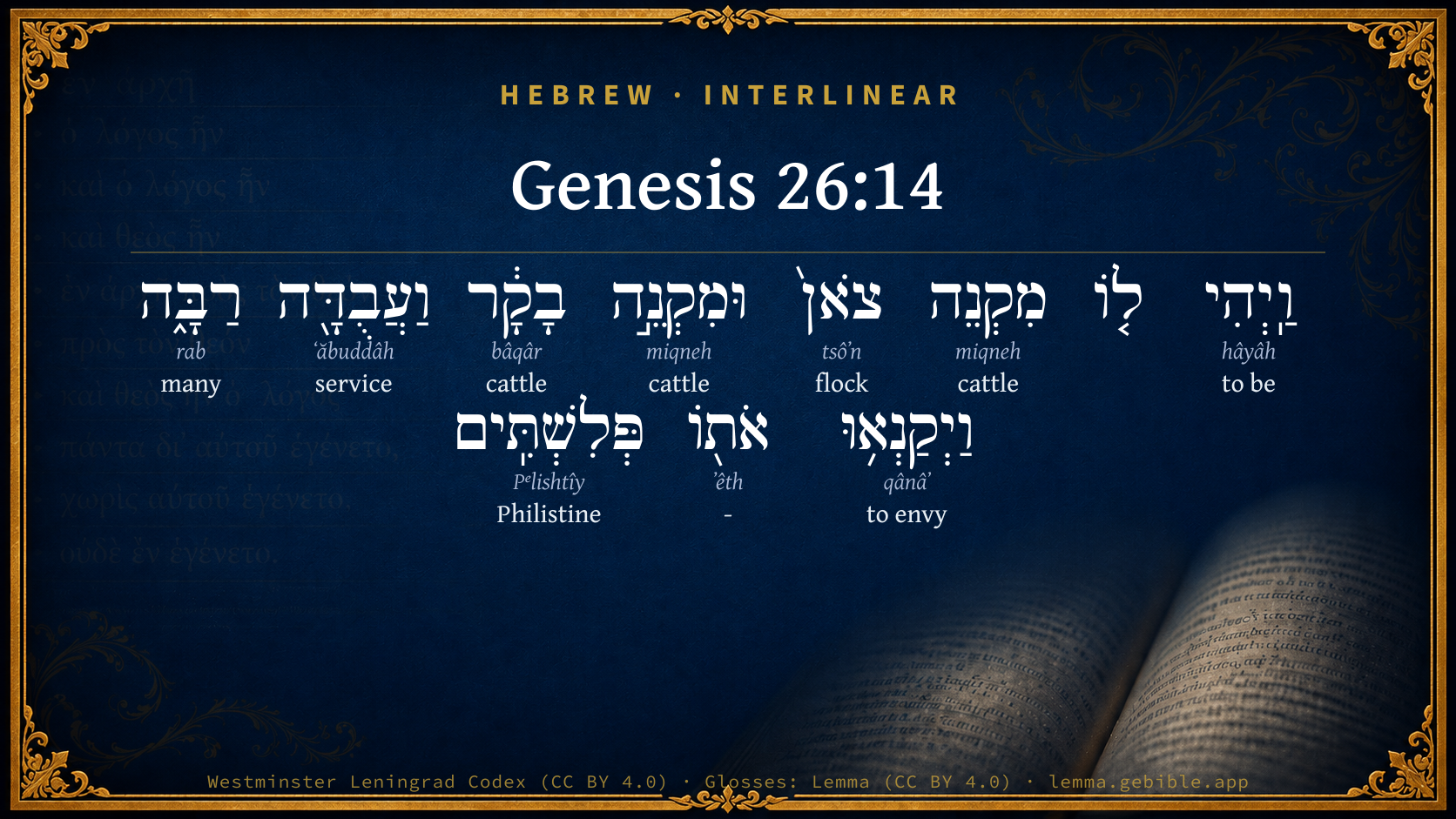
Hebrew (Westminster Leningrad Codex) Genesis 26:14 appears in the Hebrew Old Testament. The text above is from the Westminster Leningrad Codex. Each word links to its Strong’s number, a concise gloss, and parsing drawn from the Open Scriptures Hebrew Bible morphology. Click any word for its full Brown-Driver-Briggs (BDB) entry.
Download image
Cite this verse

Genesis 26:14 (World English Bible). Public Domain. Lemma interlinear Bible study tool, https://lemma.gebible.app/v/genesis/26/14.

Show BibTeX & RIS
BibTeX
RIS
English Translation
He had possessions of flocks, possessions of herds, and a great household. The Philistines envied him.
World English Bible · Public Domain
Highlights
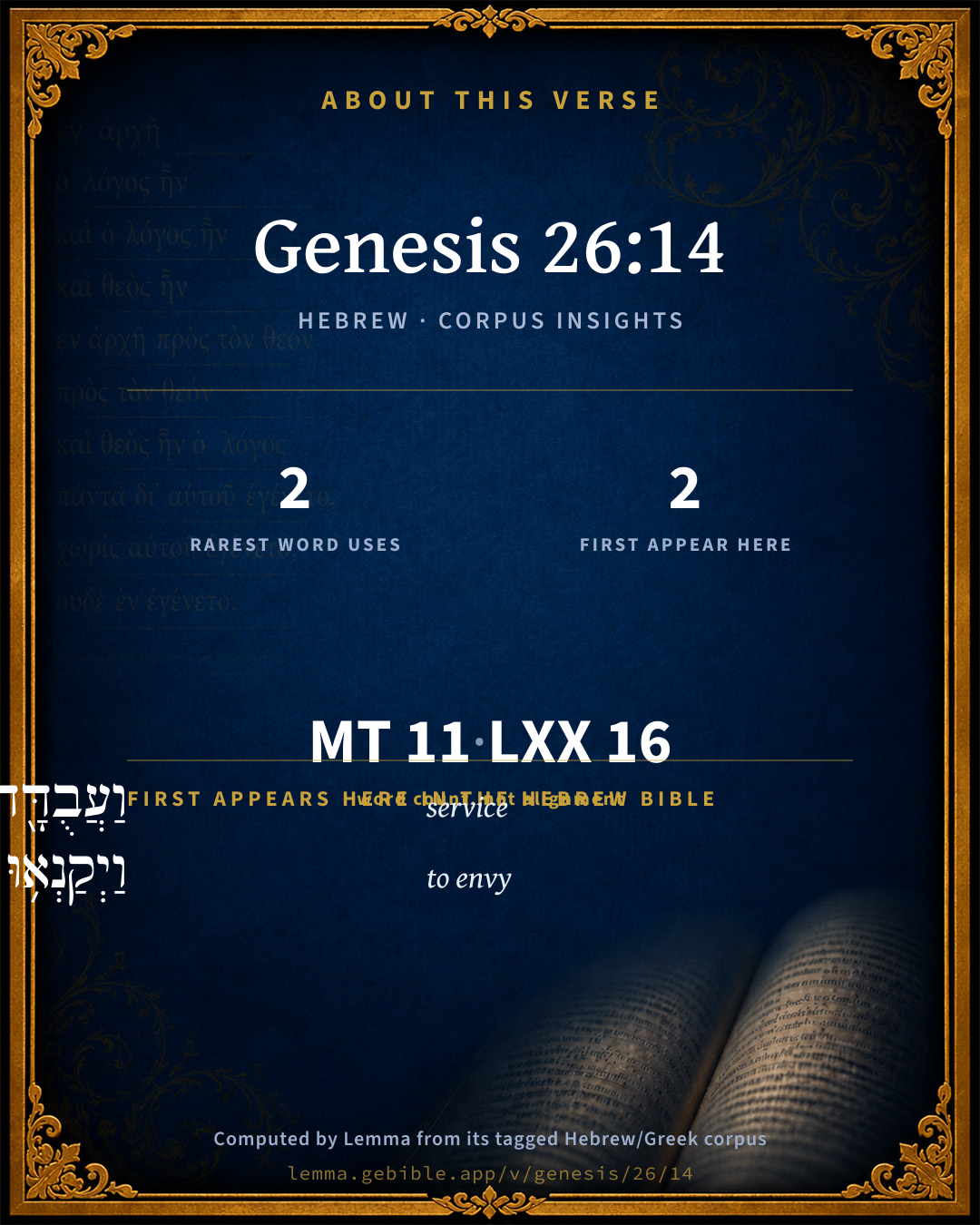
  • 2 first appearances in the Hebrew Bible
Full analysis ↓
Download a study sheet

One document with this verse’s original text, its word-by-word gloss line, the meaning frame, cross-references with their text, attributed commentary, and full source and license credits — printable, and it pastes into notes with its structure intact.

This verse Autodidact and up

Study sheet (.html) Plain text (.txt)

A passage Seminary Student

Up to 50 verses in one chapter. A passage sheet keeps up to 6 commentary sources and 12 cross-references per verse, in the order this page ranks them, and says so on the sheet whenever that leaves anything out. Ask for a single verse and you get the Autodidact verse sheet above.

Everything on this page stays free to read, with no account — the sheet is a download of what is already on screen, not access to it.

Want to remove ads? Support Godless Engineer
Compare translations 3

The same verse in 3 English versions, stacked beneath the original-language interlinear above. Click any original word for its lexicon entry.

Each is an independent rendering of the whole verse — the interlinear is not word-aligned to these translations.

Highlighted words mark where these versions differ — a whole-verse word diff, not a word-by-word alignment.

  • World English Bible Public Domain
    He had possessions of flocks, possessions of herds, and a great household. The Philistines envied him.
  • King James Version Public Domain
    For he had possession of flocks, and possession of herds, and great store of servants: and the Philistines envied him.
  • unfoldingWord Literal Text CC BY-SA 4.0
    And he had possession of flocks and possession of herds and many servants. So the Philistines envied him,

unfoldingWord Literal Text — © unfoldingWord, licensed CC BY-SA 4.0. Word-aligned USFM3 via Door43 (git.door43.org/unfoldingWord/en_ult).

Versions to compare (up to 4)

3 of 4 selected

Show all 18 translations

Every available English version of this verse, each an independent rendering of the whole verse.

  • World English Bible Public Domain
    He had possessions of flocks, possessions of herds, and a great household. The Philistines envied him.
  • Berean Standard Bible Public Domain
    He owned so many flocks and herds and servants that the Philistines envied him.
  • Majority Standard Bible Public Domain
    He owned so many flocks and herds and servants that the Philistines envied him.
  • King James Version Public Domain
    For he had possession of flocks, and possession of herds, and great store of servants: and the Philistines envied him.
  • American Standard Version (1901) Public Domain
    And he had possessions of flocks, and possessions of herds, and a great household. And the Philistines envied him.
  • Revised Version (1885) Public Domain
    and he had possessions of flocks, and possessions of herds, and a great household: and the Philistines envied him.
  • Geneva Bible (1599) Public Domain
    For he had flockes of sheepe, and heards of cattell, and a mightie housholde: therefore the Philistims had enuy at him.
  • Douay-Rheims (1899) Public Domain
    And he had possessions of sheep and of herds, and a very great family. Wherefore the Palestines envying him,
  • Young's Literal Translation Public Domain
    and he hath possession of a flock, and possession of a herd, and an abundant service; and the Philistines envy him,
  • Literal Standard Version CC BY-SA 4.0
    and he has possession of a flock, and possession of a herd, and an abundant service; and the Philistines envy him,
  • Unlocked Literal Bible CC BY-SA 4.0
    He had many sheep and cattle, and a large household. The Philistines envied him.
  • unfoldingWord Literal Text CC BY-SA 4.0
    And he had possession of flocks and possession of herds and many servants. So the Philistines envied him,
  • Darby Bible Public Domain
    And he had possessions of flocks, and possessions of herds, and a great number of servants; and the Philistines envied him.
  • World Messianic Bible Public Domain
    He had possessions of flocks, possessions of herds, and a great household. The Philistines envied him.
  • Webster's Bible Public Domain
    For he had possession of flocks, and possession of herds, and very many servants: And the Philistines envied him.
  • Free Bible Version CC BY-SA 4.0
    He owned many flocks of sheep and herds of cattle, as well as many slaves. He had so much that the Philistines became jealous of him.
  • Bible in Basic English Public Domain
    For he had great wealth of flocks and herds and great numbers of servants; so that the Philistines were full of envy.
  • JPS Tanakh (1917) Public Domain
    And he had possessions of flocks, and possessions of herds, and a great household; and the Philistines envied him.

Literal Standard Version (2020), Covenant Press — licensed CC BY-SA 4.0. Text via the HelloAO Bible API (eBible.org). Unlocked Literal Bible (unfoldingWord) — licensed CC BY-SA 4.0. Text via the HelloAO Bible API (eBible.org). unfoldingWord Literal Text — © unfoldingWord, licensed CC BY-SA 4.0. Word-aligned USFM3 via Door43 (git.door43.org/unfoldingWord/en_ult). Free Bible Version, Dr. Jonathan Gallagher — licensed CC BY-SA 4.0. Text via the HelloAO Bible API (eBible.org).

Word by word

More ways to search: Search by grammar → Find every occurrence → Compare this word →

Practice this passage: Drill this verse → Learn its vocabulary →

וַעֲבֻדָּ֖ה
ʻăbuddâh
H5657
“and · service”
Conjunction + Noun, Common, Feminine, Singular, Absolute
Part of Speech
Conjunction + Noun
Type
Common
Gender
Feminine
Number
Singular
State
Absolute
Full BDB Definition

Origin: pass part of H5647

TWOT: 1553d

service, household servants
  1. וַֽיְהִי hâyâh H1961 “and · to be” Conjunction + Verb, Qal, Sequential Imperfect, 3rd Person, Masculine, Singular
  2. מִקְנֵה miqneh H4735 “cattle of” Noun, Common, Masculine, Singular, Construct
  3. צֹאן֙ tsôʼn H6629 “flock” Noun, Common, Both, Singular, Absolute
  4. וּמִקְנֵ֣ה miqneh H4735 “and · cattle of” Conjunction + Noun, Common, Masculine, Singular, Construct
  5. בָקָ֔ר bâqâr H1241 “cattle” Noun, Common, Both, Singular, Absolute
  6. רַבָּ֑ה rab H7227 “many” Adjective, Adjective, Feminine, Singular, Absolute
  7. וַיְקַנְא֥וּ qânâʼ H7065 “and · to envy” Conjunction + Verb, Piel, Sequential Imperfect, 3rd Person, Masculine, Plural
  8. אֹת֖וֹ ʼêth H853 “- · him” Particle, Direct Object + Suffix, Personal, 3rd Person, Masculine, Singular
  9. פְּלִשְׁתִּֽים Pᵉlishtîy H6430 “Philistines” Noun, Gentilic, Masculine, Plural, Absolute

About this verse

These counts appear in no published source. They are computed here, from the morphology-tagged text and Lemma’s own curated glosses. What Lemma adds →

11
words
9
distinct lemmas
Pentateuch
section

Notable vocabulary

The rarest word here is וַעֲבֻדָּ֖ה service H5657 — appearing just 2 times in the whole Hebrew Bible.

First appearance in Scripture

These words make their first canonical appearance in the Hebrew Bible here:

  • וַעֲבֻדָּ֖ה service H5657
  • וַיְקַנְא֥וּ to envy H7065

Shared distinctive vocabulary

וַעֲבֻדָּ֖ה service H5657 occurs in 2 verses of the Hebrew Bible. Also found in:

Grammatical profile

  • 2 verbs
  • 6 nouns
  • 1 adjective
  • 1 preposition
  • 1 particle

Verb forms

  • וַֽיְהִי Qal · Sequential Imperfect
  • וַיְקַנְא֥וּ Piel · Sequential Imperfect

Repetition

A word recurs within this verse — often emphatic in Hebrew:

  • מִקְנֵה cattle H4735 ×2

Hebrew & Septuagint length

In English translation the verse runs 16 words from the Hebrew and 19 from the Septuagint (LXX English) — closely comparable.

A rough comparison of the two English renderings, which tokenize alike — not a word-level alignment.

Word counts can differ between the Hebrew and the Greek without any difference in meaning — e.g. the Hebrew direct-object marker אֵת has no separate Greek word, and Greek often adds the article ὁ.

In the original languages it is 11 Hebrew tokens and 16 Greek tokens — but the two are counted differently (Hebrew bundles its prefixes and suffixes into one token; the Greek is in lemma form), so that isn’t a like-for-like length.

Cross-references

13

Topical passages linked to Genesis 26:14 in the Treasury of Scripture Knowledge — connected by theme and wording, ordered by reader-vote popularity; previews shown in the World English Bible.

  • Genesis 37:11 His brothers envied him; but his father kept this saying in mind.
  • Genesis 12:16 He dealt well with Abram for her sake. He had sheep, and oxen, and male donkeys, and men-servants, and maid-servants, and female donkeys, and camels.
  • Genesis 13:2 Abram was very rich in cattle, in silver, and in gold.
  • 1 Samuel 18:9 Saul eyed David from that day and forward.
  • Job 1:3 His possessions also were seven thousand sheep, three thousand camels, five hundred yoke of oxen, five hundred she-donkeys, and a very great household; so that this man was the greatest of all the children of the east.
  • Job 5:2 For resentment kills the foolish man, And jealousy kills the simple.
  • Job 42:12 So Yahweh blessed the latter end of Job more than his beginning. He had fourteen thousand sheep, six thousand camels, one thousand yoke of oxen, and a thousand female donkeys.
  • Psalms 112:3 Wealth and riches are in his house. His righteousness endures forever.
  • Psalms 144:13–14 Our barns are full, filled with all kinds of provision. Our sheep bring forth thousands and ten thousands in our fields.
  • Proverbs 10:22 Yahweh's blessing brings wealth, And he adds no trouble to it.
  • Proverbs 27:4 Wrath is cruel, And anger is overwhelming; But who is able to stand before jealousy?
  • Ecclesiastes 4:4 Then I saw all the labor and achievement that is the envy of a man's neighbor. This also is vanity and a striving after wind.
  • Psalms 112:10 The wicked will see it, and be grieved. He shall gnash with his teeth, and melt away. The desire of the wicked will perish.

Cross-references courtesy of OpenBible.info (CC BY 4.0).

Hebrew and Greek witnesses Masoretic Hebrew ↔ Greek Septuagint

The same verse in the two great witnesses to the Old Testament, shown verse-for-verse.

These are two independent witnesses, not word-aligned to each other, and the Septuagint is shown in lemma (dictionary) form.

Hebrew Genesis 26:14 Masoretic · Westminster Leningrad Codex

וַֽיְהִי ל֤וֹ מִקְנֵה צֹאן֙ וּמִקְנֵ֣ה בָקָ֔ר וַעֲבֻדָּ֖ה רַבָּ֑ה וַיְקַנְא֥וּ אֹת֖וֹ פְּלִשְׁתִּֽים

He had possessions of flocks, possessions of herds, and a great household. The Philistines envied him.

World English Bible · Public Domain

Greek LXX Genesis 26:14 Septuagint · lemma form

γίγνομαι δέ αὐτός κτῆνος πρόβατον καί κτῆνος βοῦς καί γεώργιον πολύς ζηλόω δέ αὐτός ὁ φυλιστιιμ

And he had cattle of sheep, and cattle of oxen, and many tilled lands, and the Phylistines envied him.

LXX2012 (modern English Septuagint) · Public Domain

On this verse, The Pulpit Commentary discusses the Septuagint’s reading. Read the note in Commentary ↓

Hebrew: Westminster Leningrad Codex (CC BY 4.0). Greek: Septuagint (public domain); English from LXX2012 (modern English Septuagint) (Public Domain). How the Septuagint differs from the Hebrew →

Targum (Aramaic paraphrase)

2

The Targum is the ancient Jewish Aramaic paraphrase of the Hebrew Scriptures — an interpretive translation, not the Hebrew text itself. Onkelos (literal) and Pseudo-Jonathan (expansive) render the Torah, and Jonathan the Prophets. Coverage is partial: where no permissively-licensed English translation exists for a verse, only the Aramaic is shown. This is verse-level text, not a word-by-word alignment to the Hebrew.

  1. Targum Onkelos Torah (Genesis–Deuteronomy)
    וַהֲוָה לֵהּ גֵּיתֵי עָנָא וְגֵיתֵי תוֹרִין וּפָלְחָנָא (נ''י וַעֲבוּדָה) סַגְיָא וְקַנִּיאוּ בֵהּ פְּלִשְׁתָּאֵי

    (no public-domain English translation for this verse)

    Targum Onkelos — Aramaic: “Onkelos Genesis” (public domain); “Onkelos Exodus” (public domain); “Onkelos Leviticus” (public domain); “Onkelos Numbers” (public domain); “Onkelos Deuteronomy” (public domain). English: “Sefaria Community Translation” (CC0 1.0 (public-domain dedication)); “J.W. Etheridge. The Targums of Onkelos and Jonathan Ben Uzziel on the Pentateuch. London: Longmans, Green, 1862” (public domain). Text via Sefaria.

  2. Targum Pseudo-Jonathan Torah (Genesis–Deuteronomy)
    וַהֲווֹ לֵיהּ גֵיתֵי עָאן תוֹרִין וּפוּלְחָנָא סַגִיאָה וְקַנִיאוּ יָתֵיהּ פְּלִשְׁתָּאֵי

    And he had flocks of sheep, and herds of cattle, and great cultivation; and the Philistaee envied him.

    Targum Pseudo-Jonathan — Aramaic: “Targum Jonathan on Genesis” (public domain); “Targum Jonathan on Exodus” (public domain); “Targum Jonathan on Leviticus” (public domain); “Targum Jonathan on Numbers” (public domain); “Targum Jonathan on Deuteronomy” (public domain). English: “The Targum of Jonathan ben Uzziel, trans. J. W. Etheridge, London, 1862” (public domain). Text via Sefaria.

Commentary

Notes on Genesis 26:14 from classic Christian and Jewish commentators (each source and its license shown beneath its notes). The classic Christian expositions comment on the surrounding passage and are grouped to its opening verse, so a note may address several verses; the Jewish commentaries on the Tanakh (Rashi and others) are per-verse, so they appear only where the commentator wrote on this verse.

Lemma curates 59 commentaries, every one of them public domain or Creative Commons licensed, each selected and text-cleaned for this edition rather than reprinted as found. About our sources →

Trapp's Complete Commentary

John Trapp

Gen 26:14 For he had possession of flocks, and possession of herds, and great store of servants: and the Philistines envied him.

Ver. 14. And the Philistines envied him.] Envy is the constant companion of prosperity, as David felt and complained. Succoth and Pennel contemn Gideon, out of envy of his victory; Joseph’s brethren cannot abide him, because more favoured of his father. Korah maligneth Moses; Saul, David; the Pharisees, our Saviour; their malice wilfully crossing their consciences. Caligula sacrificed to Neptune and Envy, ne sibi, ut ipse dicebat, invideretur. {a} He thought other men sick, like him, of his disease (as the devil accused God of envy to our first parents); for certainly there was not a more envious person living than he; witness his throwing down the statues of all famous men, and defacing their titles; forbidding any new to be set up without his leave and liking. So that tiger, Tiberius, laid hold, with his spiteful teeth, on all the excellent spirits of his time: he put a poet to death, for making an excellent tragedy; {b} and banished a certain architect, for building an elaborate porch at Rome, which he could not choose but admire and reward with money. Nero envied all men that were any whit gracious with the people. {c} Valentinian hated all that were well apparelled, or well learned, or wealthy, or noble {d} Fortibus etiam detrahere solebat, ut solus videretur bonis artibus eminere, saith Ammianus. {e} Germanicus had not any more deadly enemies than his own ornaments, {f} and his adversaries (as here Isaac’s) had - nothing to complain of him, more than his greatness. So true is that of Salust; {g} Difficillimum inter mortales est, gloria invidiam vincere. Hercules had not more ado with Hydra than a good man shall have with this beast. Envied he shall be of his neighbour, for his labour and right work. {Ecc 4:4} "This is also vanity, and vexation of spirit."

{a} Dio in Vita Caligula.

{b} Sueton., cap. 3 and 4. Lucano, quod arte poetics clarus erat vetitum fuit, ne carmen faceret.

{c} Dio in Neron.

{d} Seneca.

{e} Am. Marcell., lib. xxx. cap. 29.

{f} Tacitus.

{g} Salust in Catil.

John Trapp, A Commentary or Exposition upon All the Books of the Old and New Testament (1647–1656) — public domain. Text from a community e-Sword module.

The Biblical Illustrator

Joseph S. Exell

Gen_26:14-16

The Philistines envied him

The prosperous are subject to envy

1.

Great estates subject the best of men to envy.

2. Philistine spirits envy all increase of good to the Church of God (Gen_26:14).

3. Men fearless of God make no scruple of doing the greatest injuries to His servants.

4. All the saints right, persuades not the wicked from doing wrong.

5. A malicious spirit destroyeth that which itself needeth, only to mischief the righteous man.

6. Water-mercies are very great, therefore would the wicked take them from the just (Gen_26:15). (G. Hughes, B. D.)

Lessons

1. Powers as well as peasants join together to afflict the saints.

2. Worldly men in power would not suffer the godly to prosper by them.

3. Exilement is the best which wicked powers allow to saints.

4. Gods greatning of His saints causeth the powers of the world to diminish them (Gen_26:16). (G. Hughes, B. D.)

No worldly blessing is unalloyed

Isaacs prosperity was not unalloyed. He suffered from envy. Be sure of this, that for every blessing man pays a price. If the world has gained in medical skill, it has lost that simple life which made it unnecessary. If we heap possessions round us we lose quiet, we get anxiety. Every man pays a price for his advantages, for talents, for property, for high station; he bids adieu to rest, being public property. It was so with Isaac. He had great possessions, and the Philistines envied him. We are told that he met the envy with patience, and removed from well to well. At last the Philistines desisted. Thus patience wears the world out. Endurance, meekness, the gospel spirit, this is the only true weapon against the world. Hence, Christianity can have no addition. It is final. There is nothing beyond this--Love your enemies. Isaac like Christ had conquered by meekness; and then it was that there was shed abroad in his heart that deep peace which is most profound in the midst of storm, the peace of God which passeth all understanding. (F. W. Robertson, M. A.)

The Biblical Illustrator, edited by Joseph S. Exell (c. 1880s–1900s) — public domain. Text from a community e-Sword module.

Tyndale Open Study Notes

Tyndale Open Resources

26:14-16 The Philistines envied Isaac’s prosperity and filled his wells with dirt. The king then ordered Isaac to leave that region because he was too powerful for them (cp. 21:22-23).

Tyndale Open Study Notes — © Tyndale Open Resources, licensed CC BY-SA 4.0. Text via the HelloAO Bible API.

Geneva Bible (1599)

Geneva Bible translators

The malicious envy always the graces of God in others.

Geneva Bible (1599) marginal notes — public domain. Text via Bolls.life.

Adam Clarke's Commentary

Verse 14. He had possession of flocks] He who blessed him in the increase of his fields blessed him also in the increase of his flocks; and as he had extensive possessions, so he must have many hands to manage such concerns: therefore it is added, he had great store of servants - he had many domestics, some born in his house, and others purchased by his money.

Adam Clarke's Commentary on the Bible (1810–1826) — public domain. Text from a community e-Sword/MySword module.

John Calvin's Commentaries

14. And the Philistines envied him. We are taught by this history that the blessings of God which pertain to the present earthly life are never pure and perfect, but are mixed with some troubles, lest quiet and indulgence should render us negligent. Wherefore, let us all learn not too ardently to desire great wealth. If the rich are harassed by any cause of disquietude, let them know that they are roused by the Lord, lest they should fall fast asleep in the midst of their pleasures; and let the poor enjoy this consolation, that their poverty is not without its advantages. For it is no light good to live free from envy, tumults, and strifes. Should any one raise the objection, that it can by no means be regarded as a favor, that God, in causing Isaac to abound in wealth, exposed him to envy, to contentions, and to many troubles; there is a ready answer, that not all the troubles with which God exercises his people, in any degree prevent the benefits which he bestows upon them from retaining the taste of his paternal love. Finally, he so attempers the favor which he manifests towards his children in this world, that he stirs them up, as with sharp goads, to the consideration of a celestial life. It was not, however, a slight trial, that the simple element of water, which is the common property of all animals, was denied to the holy patriarch; with how much greater patience ought we to bear our less grievous sufferings! If, however, at any time we are angry at being unworthily injured; let us remember that, at least, we are not so cruelly treated as holy Isaac was, when he had to contend for water. Besides, not only was he deprived of the element of water, but the wells which his father Abraham had dug for himself and his posterity were filled up. This, therefore, was the extreme of cruelty, not only to defraud a stranger of every service due to him, but even to take from him what had been obtained by the labor of his own father, and what he possessed without inconvenience to any one.

John Calvin's Commentaries (1540-1563) — public domain. Text from the Calvin Translation Society English edition (1840s-50s) via the Christian Classics Ethereal Library (ccel.org). Calvin's coverage is partial (roughly two-thirds of the Bible); uncommented books and verses are honest gaps, never fabricated. The 19th-century editor's footnotes and remarks are omitted so the notes are faithfully Calvin's own voice.

Ellicott's Commentary for English Readers

(14) Great store of servants.—Marg., husbandry. In Job_1:3 the word is rendered household in the text, and husbandry again in the margin. Literally it means making employment, and answers to our word business. But if in a man’s life there is much activity and plenty to do, there must be people to do it, and profits made whereby to maintain them. And thus the translation, “great store of servants,” gives the sense; but we see besides that Isaac kept them all actively employed,

A Bible Commentary for English Readers, edited by Charles John Ellicott (1878–1897) — public domain. Text from a community e-Sword module.

The Cambridge Bible for Schools and Colleges

gen. ed. J. J. S. Perowne

14. and a great household] i.e. a large number of slaves and attendants.

The Cambridge Bible for Schools and Colleges (gen. ed. J. J. S. Perowne; Cambridge University Press, 1878–1918) — public domain. Text from a community e-Sword module.

John Gill's Exposition

For all the wells which his father's servants had digged, in the days of Abraham his father,.... For the watering of his flocks and herds, see Gen 21:25,

the Philistines had stopped them, and filled them with earth; that they might be of no use; and this they did through envy to him, and is mentioned as a proof of it.

John Gill's Exposition of the Whole Bible (1746–1763) — public domain (CC PDM 1.0). Text via the HelloAO Bible API.

Matthew Poole's English Annotations

Great store of servants; or rather, of husbandry, as this word is elsewhere used; of corn-fields, vineyards, &c.; for he is describing his riches, which then consisted in the two things here expressed, cattle and lands, which he diligently and successfully managed, Gen 26:12.

Matthew Poole's English Annotations on the Holy Bible (1683–1685) — public domain. Text from a community e-Sword/MySword module.

Whedon's Commentary on the Bible

Daniel D. Whedon

14. Flocks… herds… servants… envied — These four words speak volumes. Prosperity and abundance excite the envy of ignoble natures.

Daniel D. Whedon (gen. ed.), Commentary on the Old and New Testaments (1874–1909) — public domain. Text from a community e-Sword module.

The Pulpit Commentary

For he had (literally, there was to him) possession of flocks, and possession of herds, and great store of servants: gewrgia polla (LXX), i.e. much husbandry, the abstract being put for the concrete, "implying all manner of work and service belonging to a family, and so servants and tillage of all sorts" (Ainsworth); but the reference rather seems to be to the number of his household, or domestic slaves, plurimum familiae (Vulgate) and the Philistines envied him. The patriarch"s possessions (mikneh, from kanah, to acquire) excited jealous feeling (from root kana, to burn) in the breasts of his neighbors (cf. Ecc_4:4)

The Pulpit Commentary (1880–1919), ed. H.D.M. Spence-Jones & Joseph S. Exell — public domain. Text from a community e-Sword module.

Rashi

Rabbi Shlomo Yitzchaki (Rashi)

וְעֲבֻדָּה רבה means a great many things to do (i. e. great undertakings) O. F. ouvraine. The word עֲבוׂדָה denotes one thing to be done whereas עֲבֻדָּה denotes many things to be done (a collective noun)

Rashi on the Tanakh — English translations: “The Judaica Press complete Tanach with Rashi, translated by A. J. Rosenberg” (CC BY 4.0); “Pentateuch with Rashi's commentary by M. Rosenbaum and A.M. Silbermann, 1929-1934” (public domain); “The Metsudah Tanach series, Lakewood, N.J” (CC BY 4.0); and “The Book of Joshua, Metsudah Publications, 1997” (CC BY 4.0). Text via Sefaria.

Ramban (Nachmanides)

Rabbi Moshe ben Nachman (Ramban / Nachmanides)

AND HE HAD POSSESSIONS OF FLOCKS, AND POSSESSIONS OF HERDS, AND A GREAT HOUSEHOLD, meaning she-asses and camels, he-asses, and men-servants and handmaids. Now Scripture mentions these but not silver and gold, as it says concerning Abraham, 13:2. because the wealth which he amassed in the land of the Philistines consisted of flocks and a great household. And the Philistines were jealous of him in this matter. This is the meaning of that which Abimelech says to Isaac, For thou art become much mightier than we. The king said to him, “I, too, who am the king do not have in my home such flocks and domestics as you, and it is a disgrace to us that your household is greater than that of the king.”

Ramban (Nachmanides) on the Tanakh — English translation: “Commentary on the Torah by Ramban (Nachmanides). Translated and annotated by Charles B. Chavel. New York, Shilo Pub. House, 1971-1976” (CC BY 4.0). Text via Sefaria.

Radak

Rabbi David Kimhi (Radak)

ויהי לו מקנה צאן ומקנה בקר, he had acquired both flocks of sheep and herds of cattle. Both words מקנה have the vowel tzeyreh indicating that they are in a construct mode.

ועבודה רבה, he also engaged extensively in agriculture. Compare Proverbs 12,11, עובד אדמתו, “tilling his own land.” Compare also Genesis 4,11 כי תעבוד את האדמה, “when you till the soil.”

ויקנאו אתו, they were jealous of him on account of his astounding success. The absence of the dagesh in the letter נ indicates that this is an intransitive mode of the verb קנא.

Radak on the Tanakh — English translations: “Sefaria Community Translation” (CC0 1.0 (public-domain dedication)); “Eliyahu Munk, HaChut Hameshulash” (CC BY 4.0); “Rabbi Mike Feuer, Jerusalem Anthology” (CC BY 4.0); and “R. David Kimhi on the first book of Psalms, Translated by R.G. Finch, London, 1919” (public domain). Text via Sefaria.

Lesson kit

Teaching starters — assembled from the data on this page, not authored interpretation. Every prompt links to the verse data it draws on. Edit before teaching.

Genesis, in the Pentateuch, opens this verse with 11 words (9 distinct Hebrew lemmas). Its most distinctive word is ʻăbuddâh (“service”). A historical commentator’s framing appears above. Read the whole chapter for the surrounding context.

Discussion questions

  1. The word ʻăbuddâh carries the sense “service.” How does it shape the verse?
  2. 2 words make their first appearance in Scripture here. What does this debut establish?
  3. How does Job 1:3, which shares the word «service», read alongside this verse?
  4. What does the repetition of “cattle” (2× in this one verse) do in this verse?
  5. These translations render this verse differently; the difference is in the English rendering, not the original. What questions does that raise?
  6. «וַֽיְהִי» is a Qal Sequential Imperfect verb. How does that grammatical form shape the action described?
  7. Compare how Trapp's Complete Commentary and The Biblical Illustrator read this verse. Where do they agree or differ?

Things to notice

Reading settings

Reading text

Shown beneath each verse's original-language words.

Old Testament
Old Testament edition

Read the OT as the Masoretic Hebrew (MT) or the Greek Septuagint (LXX).

English shown for the Greek Septuagint (in the Hebrew ↔ Greek comparison).

Comparing translations? Open the Compare panel on any verse page to stack up to four side by side.