
Joshua 24:7

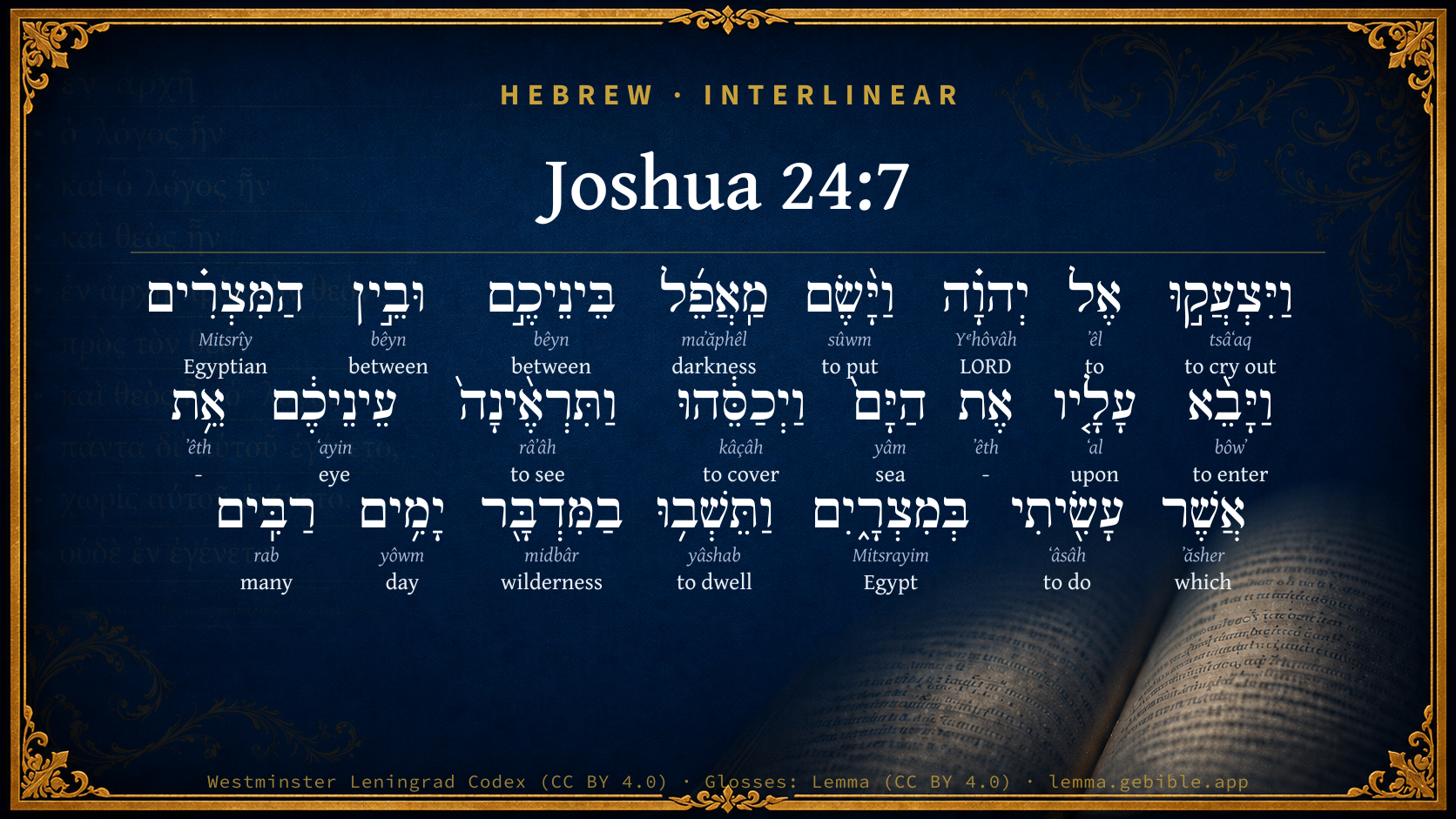
Hebrew (Westminster Leningrad Codex) Joshua 24:7 appears in the Hebrew Old Testament. The text above is from the Westminster Leningrad Codex. Each word links to its Strong’s number, a concise gloss, and parsing drawn from the Open Scriptures Hebrew Bible morphology. Click any word for its full Brown-Driver-Briggs (BDB) entry.
Download image
Cite this verse

Joshua 24:7 (World English Bible). Public Domain. Lemma interlinear Bible study tool, https://lemma.gebible.app/v/joshua/24/7.

Show BibTeX & RIS
BibTeX
RIS
English Translation
When they cried out to Yahweh, he put darkness between you and the Egyptians, and brought the sea on them, and covered them; and your eyes saw what I did in Egypt: and you lived in the wilderness many days.
World English Bible · Public Domain
Highlights
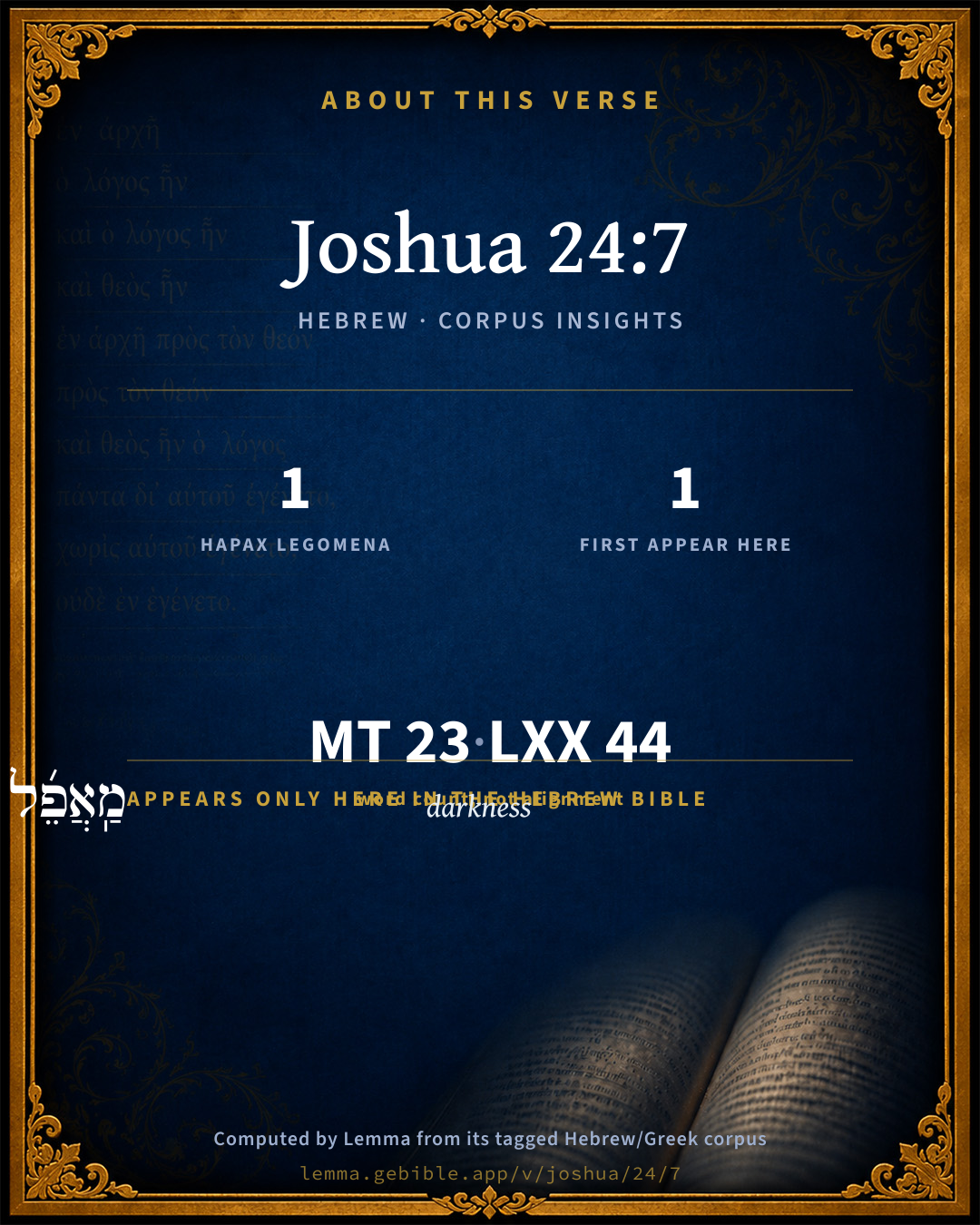
  • 1 hapax legomenon — only here in the Hebrew Bible
  • 1 first appearance in the Hebrew Bible
Full analysis ↓
Download a study sheet

One document with this verse’s original text, its word-by-word gloss line, the meaning frame, cross-references with their text, attributed commentary, and full source and license credits — printable, and it pastes into notes with its structure intact.

This verse Autodidact and up

Study sheet (.html) Plain text (.txt)

A passage Seminary Student

Up to 50 verses in one chapter. A passage sheet keeps up to 6 commentary sources and 12 cross-references per verse, in the order this page ranks them, and says so on the sheet whenever that leaves anything out. Ask for a single verse and you get the Autodidact verse sheet above.

Everything on this page stays free to read, with no account — the sheet is a download of what is already on screen, not access to it.

Want to remove ads? Support Godless Engineer
Compare translations 3

The same verse in 3 English versions, stacked beneath the original-language interlinear above. Click any original word for its lexicon entry.

Each is an independent rendering of the whole verse — the interlinear is not word-aligned to these translations.

Highlighted words mark where these versions differ — a whole-verse word diff, not a word-by-word alignment.

  • World English Bible Public Domain
    When they cried out to Yahweh, he put darkness between you and the Egyptians, and brought the sea on them, and covered them; and your eyes saw what I did in Egypt: and you lived in the wilderness many days.
  • King James Version Public Domain
    And when they cried unto the LORD, he put darkness between you and the Egyptians, and brought the sea upon them, and covered them; and your eyes have seen what I have done in Egypt: and ye dwelt in the wilderness a long season.
  • unfoldingWord Literal Text CC BY-SA 4.0
    And they cried out to Yahweh, and he put darkness between you and the Egyptians, and he brought the sea over him and covered him. And your eyes saw what I did against Egypt. And you dwelled in the wilderness many days.

unfoldingWord Literal Text — © unfoldingWord, licensed CC BY-SA 4.0. Word-aligned USFM3 via Door43 (git.door43.org/unfoldingWord/en_ult).

Versions to compare (up to 4)

3 of 4 selected

Show all 18 translations

Every available English version of this verse, each an independent rendering of the whole verse.

  • World English Bible Public Domain
    When they cried out to Yahweh, he put darkness between you and the Egyptians, and brought the sea on them, and covered them; and your eyes saw what I did in Egypt: and you lived in the wilderness many days.
  • Berean Standard Bible Public Domain
    So your fathers cried out to the LORD, and He put darkness between you and the Egyptians, over whom He brought the sea and engulfed them. Your very eyes saw what I did to the Egyptians. Then you lived in the wilderness for a long time.
  • Majority Standard Bible Public Domain
    So your fathers cried out to the LORD, and He put darkness between you and the Egyptians, over whom He brought the sea and engulfed them. Your very eyes saw what I did to the Egyptians. Then you lived in the wilderness for a long time.
  • King James Version Public Domain
    And when they cried unto the LORD, he put darkness between you and the Egyptians, and brought the sea upon them, and covered them; and your eyes have seen what I have done in Egypt: and ye dwelt in the wilderness a long season.
  • American Standard Version (1901) Public Domain
    And when they cried out unto Jehovah, he put darkness between you and the Egyptians, and brought the sea upon them, and covered them; and your eyes saw what I did in Egypt: and ye dwelt in the wilderness many days.
  • Revised Version (1885) Public Domain
    And when they cried out unto the LORD, he put darkness between you and the Egyptians, and brought the sea upon them, and covered them; and your eyes saw what I did in Egypt: and ye dwelt in the wilderness many days.
  • Geneva Bible (1599) Public Domain
    Then they cryed vnto the Lord, and he put a darkenesse betweene you and the Egyptians, and brought the sea vpon them, and couered them: so your eyes haue seene what I haue done in Egypt also ye dwelt in the wildernesse a long season.
  • Douay-Rheims (1899) Public Domain
    And the children of Israel cried to the Lord: and he put darkness between you and the Egyptians, and brought the sea upon them, and covered them. Your eyes saw all that I did in Egypt, and you dwelt in the wilderness a long time:
  • Young's Literal Translation Public Domain
    and they cry unto Jehovah, and He setteth thick darkness between you and the Egyptians, and bringeth on them the sea, and covereth them, and your eyes see that which I have done in Egypt; and ye dwell in a wilderness many days.
  • Literal Standard Version CC BY-SA 4.0
    and they cry to YHWH, and He sets thick darkness between you and the Egyptians, and brings the sea over him, and covers them, and your eyes see that which I have done in Egypt; and you dwell in a wilderness [for] many days.
  • Unlocked Literal Bible CC BY-SA 4.0
    When your ancestors called out to Yahweh, he put darkness between you and the Egyptians. He brought the sea to come over them and cover them. You saw what I did in Egypt. Then you lived in the wilderness for a long time.
  • unfoldingWord Literal Text CC BY-SA 4.0
    And they cried out to Yahweh, and he put darkness between you and the Egyptians, and he brought the sea over him and covered him. And your eyes saw what I did against Egypt. And you dwelled in the wilderness many days.
  • Darby Bible Public Domain
    Then they cried to Jehovah, and he put darkness between you and the Egyptians, and brought the sea upon them, and covered them; and your eyes saw what I did in Egypt; and ye dwelt in the wilderness a long time.
  • World Messianic Bible Public Domain
    When they cried out to the LORD, he put darkness between you and the Egyptians, and brought the sea on them, and covered them; and your eyes saw what I did in Egypt. You lived in the wilderness many days.
  • Webster's Bible Public Domain
    And when they cried to the LORD, he put darkness between you and the Egyptians, and brought the sea upon them, and covered them; and your eyes have seen what I have done in Egypt: and ye dwelt in the wilderness a long season.
  • Free Bible Version CC BY-SA 4.0
    Your forefathers called out to the Lord for help, and he placed darkness between you and the Egyptians. Then he brought the sea back over them and they drowned. You saw what I did with your own eyes in Egypt. Then you lived for many years in the wilderness.
  • Bible in Basic English Public Domain
    And at their cry, the Lord made it dark between you and the Egyptians, and made the sea go over them, covering them with its waters; your eyes have seen what I did in Egypt: then for a long time you were living in the waste land.
  • JPS Tanakh (1917) Public Domain
    And when they cried out unto the LORD, He put darkness between you and the Egyptians, and brought the sea upon them, and covered them; and your eyes saw what I did in Egypt; and ye dwelt in the wilderness many days.

Literal Standard Version (2020), Covenant Press — licensed CC BY-SA 4.0. Text via the HelloAO Bible API (eBible.org). Unlocked Literal Bible (unfoldingWord) — licensed CC BY-SA 4.0. Text via the HelloAO Bible API (eBible.org). unfoldingWord Literal Text — © unfoldingWord, licensed CC BY-SA 4.0. Word-aligned USFM3 via Door43 (git.door43.org/unfoldingWord/en_ult). Free Bible Version, Dr. Jonathan Gallagher — licensed CC BY-SA 4.0. Text via the HelloAO Bible API (eBible.org).

Word by word

More ways to search: Search by grammar → Find every occurrence → Compare this word →

Practice this passage: Drill this verse → Learn its vocabulary →

מַֽאֲפֵ֜ל
maʼăphêl
H3990
“darkness”
Noun, Common, Masculine, Singular, Absolute
Part of Speech
Noun
Type
Common
Gender
Masculine
Number
Singular
State
Absolute
Full BDB Definition

Origin: from the same as H651

TWOT: 145e

darkness
  1. וַיִּצְעֲק֣וּ tsâʻaq H6817 “and · to cry out” Conjunction + Verb, Qal, Sequential Imperfect, 3rd Person, Masculine, Plural
  2. אֶל ʼêl H413 “to” Preposition
  3. יְהוָ֗ה Yᵉhôvâh H3068 “LORD” Noun, Proper
  4. וַיָּ֨שֶׂם sûwm H7760 “and · to put” Conjunction + Verb, Qal, Sequential Imperfect, 3rd Person, Masculine, Singular
  5. בֵּינֵיכֶ֣ם bêyn H996 “between · you” Preposition + Suffix, Personal, 2nd Person, Masculine, Plural
  6. וּבֵ֣ין bêyn H996 “and · between” Conjunction + Preposition
  7. הַמִּצְרִ֗ים Mitsrîy H4713 “the · Egyptians” Particle, Definite Article + Noun, Gentilic, Masculine, Plural, Absolute
  8. וַיָּבֵ֨א bôwʼ H935 “and · to enter” Conjunction + Verb, Hiphil, Sequential Imperfect, 3rd Person, Masculine, Singular
  9. עָלָ֤יו ʻal H5921 “upon · him” Preposition + Suffix, Personal, 3rd Person, Masculine, Singular
  10. אֶת ʼêth H853 “-” Particle, Direct Object
  11. הַיָּם֙ yâm H3220 “the · sea” Particle, Definite Article + Noun, Common, Masculine, Singular, Absolute
  12. וַיְכַסֵּ֔הוּ kâçâh H3680 “and · to cover · him” Conjunction + Verb, Piel, Sequential Imperfect, 3rd Person, Masculine, Singular + Suffix, Personal, 3rd Person, Masculine, Singular
  13. וַתִּרְאֶ֨ינָה֙ râʼâh H7200 “and · to see” Conjunction + Verb, Qal, Sequential Imperfect, 3rd Person, Feminine, Plural
  14. עֵינֵיכֶ֔ם ʻayin H5869 “eyes · your” Noun, Common, Both, Dual, Construct + Suffix, Personal, 2nd Person, Masculine, Plural
  15. אֵ֥ת ʼêth H853 “-” Particle, Direct Object
  16. אֲשֶׁר ʼăsher H834 “which” Particle, Relative
  17. עָשִׂ֖יתִי ʻâsâh H6213 “to do” Verb, Qal, Perfect, 1st Person, Common, Singular
  18. בְּמִצְרָ֑יִם Mitsrayim H4714 “in/at · Egypt” Preposition + Noun, Proper
  19. וַתֵּשְׁב֥וּ yâshab H3427 “and · to dwell” Conjunction + Verb, Qal, Sequential Imperfect, 2nd Person, Masculine, Plural
  20. בַמִּדְבָּ֖ר midbâr H4057 “in/at the · wilderness” Preposition, Determined + Noun, Common, Masculine, Singular, Absolute
  21. יָמִ֥ים yôwm H3117 “days” Noun, Common, Masculine, Plural, Absolute
  22. רַבִּֽים rab H7227 “many” Adjective, Adjective, Masculine, Plural, Absolute

About this verse

These counts appear in no published source. They are computed here, from the morphology-tagged text and Lemma’s own curated glosses. What Lemma adds →

23
words
21
distinct lemmas
Historical
section

Notable vocabulary

1 hapax legomenon — a word that appears only here in the entire Hebrew Bible:

  • מַֽאֲפֵ֜ל darkness H3990

First appearance in Scripture

This word makes its first canonical appearance in the Hebrew Bible here:

  • מַֽאֲפֵ֜ל darkness H3990

Shared distinctive vocabulary

וַיִּצְעֲק֣וּ to cry out H6817 occurs in 53 verses of the Hebrew Bible. Also found in:

Grammatical profile

  • 7 verbs
  • 8 nouns
  • 1 adjective
  • 4 prepositions
  • 3 particles

Verb forms

  • וַיִּצְעֲק֣וּ Qal · Sequential Imperfect
  • וַיָּ֨שֶׂם Qal · Sequential Imperfect
  • וַיָּבֵ֨א Hiphil · Sequential Imperfect
  • וַיְכַסֵּ֔הוּ Piel · Sequential Imperfect
  • וַתִּרְאֶ֨ינָה֙ Qal · Sequential Imperfect
  • עָשִׂ֖יתִי Qal · Perfect
  • וַתֵּשְׁב֥וּ Qal · Sequential Imperfect

Repetition

A word recurs within this verse — often emphatic in Hebrew:

  • בֵּינֵיכֶ֣ם between H996 ×2

Hebrew & Septuagint length

In English translation the verse runs 40 words from the Hebrew and 52 from the Septuagint (LXX English) — closely comparable.

A rough comparison of the two English renderings, which tokenize alike — not a word-level alignment.

Word counts can differ between the Hebrew and the Greek without any difference in meaning — e.g. the Hebrew direct-object marker אֵת has no separate Greek word, and Greek often adds the article ὁ.

In the original languages it is 23 Hebrew tokens and 44 Greek tokens — but the two are counted differently (Hebrew bundles its prefixes and suffixes into one token; the Greek is in lemma form), so that isn’t a like-for-like length.

Cross-references

13

Topical passages linked to Joshua 24:7 in the Treasury of Scripture Knowledge — connected by theme and wording, ordered by reader-vote popularity; previews shown in the World English Bible.

  • Deuteronomy 4:34 Or has God tried to go and take him a nation from the midst of [another] nation, by trials, by signs, and by wonders, and by war, and by a mighty hand, and by an outstretched arm, and by great terrors, according to all that Yahweh your God did for you in Egypt before your eyes?
  • Exodus 14:10 When Pharaoh drew near, the children of Israel lifted up their eyes, and behold, the Egyptians were marching after them; and they were very afraid. The children of Israel cried out to Yahweh.
  • Exodus 14:20 It came between the camp of Egypt and the camp of Israel; and there was the cloud and the darkness, yet gave it light by night: and the one didn't come near the other all the night.
  • Exodus 14:27–28 Moses stretched out his hand over the sea, and the sea returned to its strength when the morning appeared; and the Egyptians fled against it. Yahweh overthrew the Egyptians in the midst of the sea.
  • Exodus 14:31 Israel saw the great work which Yahweh did to the Egyptians, and the people feared Yahweh; and they believed in Yahweh, and in his servant Moses.
  • Nehemiah 9:12–21 Moreover in a pillar of cloud you led them by day; and in a pillar of fire by night, to give them light in the way in which they should go.
  • Psalms 95:9–10 When your fathers tempted me, Tested me, and saw my work.
  • Numbers 14:33–34 Your children shall be wanderers in the wilderness forty years, and shall bear your prostitution, until your dead bodies be consumed in the wilderness.
  • Deuteronomy 1:46 So you abode in Kadesh many days, according to the days that you abode [there].
  • Deuteronomy 29:2 Moses called to all Israel, and said to them, You have seen all that Yahweh did before your eyes in the land of Egypt to Pharaoh, and to all his servants, and to all his land;
  • Joshua 5:6 For the children of Israel walked forty years in the wilderness, until all the nation, even the men of war who came forth out of Egypt, were consumed, because they didn't listen to the voice of Yahweh: to whom Yahweh swore that he wouldn't let them see the land which Yahweh swore to their fathers that he would give us, a land flowing with milk and honey.
  • Acts 13:17–18 The God of this people chose our fathers, and exalted the people when they stayed as aliens in the land of Egypt, and with an uplifted arm, he led them out of it.
  • Hebrews 3:17 With whom was he displeased forty years? Wasn't it with those who sinned, whose bodies fell in the wilderness?

Cross-references courtesy of OpenBible.info (CC BY 4.0).

Hebrew and Greek witnesses Masoretic Hebrew ↔ Greek Septuagint

The same verse in the two great witnesses to the Old Testament, shown verse-for-verse.

These are two independent witnesses, not word-aligned to each other, and the Septuagint is shown in lemma (dictionary) form.

Hebrew Joshua 24:7 Masoretic · Westminster Leningrad Codex

וַיִּצְעֲק֣וּ אֶל יְהוָ֗ה וַיָּ֨שֶׂם מַֽאֲפֵ֜ל בֵּינֵיכֶ֣ם וּבֵ֣ין הַמִּצְרִ֗ים וַיָּבֵ֨א עָלָ֤יו אֶת הַיָּם֙ וַיְכַסֵּ֔הוּ וַתִּרְאֶ֨ינָה֙ עֵינֵיכֶ֔ם אֵ֥ת אֲשֶׁר עָשִׂ֖יתִי בְּמִצְרָ֑יִם וַתֵּשְׁב֥וּ בַמִּדְבָּ֖ר יָמִ֥ים רַבִּֽים

When they cried out to Yahweh, he put darkness between you and the Egyptians, and brought the sea on them, and covered them; and your eyes saw what I did in Egypt: and you lived in the wilderness many days.

World English Bible · Public Domain

Greek LXX Joshua 24:7 Septuagint · lemma form

καί ἀναβοάω πρός κύριος καί δίδωμι νεφέλη καί γνόφος ἀνά μέσος ἐγώ καί ἀνά μέσος ὁ αἰγύπτιος καί ἐπιἄγω ἐπί αὐτός ὁ θάλασσα καί καλύπτω αὐτός καί ὁράω ὁ ὀφθαλμός σύ ὅσος ποιέω κύριος ἐν γῆ αἴγυπτος καί εἰμί ἐν ὁ ἔρημος ἡμέρα πολύς

And we cried aloud to the Lord; and he put a cloud and darkness between us and the Egyptians, and he brought the sea upon them, and covered them; and your eyes have seen all that the Lord did in the land of Egypt; and you⌃ were in the wilderness many days.

LXX2012 (modern English Septuagint) · Public Domain

Hebrew: Westminster Leningrad Codex (CC BY 4.0). Greek: Septuagint (public domain); English from LXX2012 (modern English Septuagint) (Public Domain). How the Septuagint differs from the Hebrew →

Targum (Aramaic paraphrase)

1

The Targum is the ancient Jewish Aramaic paraphrase of the Hebrew Scriptures — an interpretive translation, not the Hebrew text itself. Onkelos (literal) and Pseudo-Jonathan (expansive) render the Torah, and Jonathan the Prophets. Coverage is partial: where no permissively-licensed English translation exists for a verse, only the Aramaic is shown. This is verse-level text, not a word-by-word alignment to the Hebrew.

  1. Targum Jonathan Prophets (Joshua–Malachi)
    וּצְעִיקוּ קֳדָם יְיָ וְשַׁוִי קְבָלָא בֵּינֵיכוֹן וּבֵין מִצְרָאֵי וְאַיְתֵי עֲלוֹהִי יַת יַמָא וַחֲפָנוּן וַחֲזָאָה עֵינֵיכוֹן יַת דִי עַבְדֵית בְּמִצְרַיִם וִיתֵיבְתּוּן בְּמַדְבְּרָא יוֹמִין סַגִיאִין:

    (no public-domain English translation for this verse)

    Targum Jonathan — Aramaic: “Mikraot Gedolot” (public domain). English: “Sefaria Community Translation” (CC0 1.0 (public-domain dedication)); “London "Chaldee Paraphrase," 1871” (public domain). Text via Sefaria.

Commentary

Notes on Joshua 24:7 from classic Christian and Jewish commentators (each source and its license shown beneath its notes). The classic Christian expositions comment on the surrounding passage and are grouped to its opening verse, so a note may address several verses; the Jewish commentaries on the Tanakh (Rashi and others) are per-verse, so they appear only where the commentator wrote on this verse.

Lemma curates 59 commentaries, every one of them public domain or Creative Commons licensed, each selected and text-cleaned for this edition rather than reprinted as found. About our sources →

Trapp's Complete Commentary

John Trapp

Jos 24:7 And when they cried unto the LORD, he put darkness between you and the Egyptians, and brought the sea upon them, and covered them; and your eyes have seen what I have done in Egypt: and ye dwelt in the wilderness a long season.

Ver. 7. And ye dwelt in the wilderness a long season.] Where ye had pluviam escatilem et petram aquatilem, as Tertullian phraseth it: never was prince so served in his greatest pomp as ye were all that while.

John Trapp, A Commentary or Exposition upon All the Books of the Old and New Testament (1647–1656) — public domain. Text from a community e-Sword module.

Joseph Benson's Commentary

Jos 24:7. Your eyes hare seen what I have done in Egypt — He speaks this to the elders, (Jos 24:1,) who were such not only in power and dignity, but many of them by age; and as there were not sixty years past since the plagues were inflicted on Egypt, it is probable that a considerable number of those present had been witnesses of them, and had seen with their own eyes the Egyptians lie dead upon the sea-shore, Exo 14:30. And, not being twenty years old at that time, they were exempted from the dreadful sentence denounced and executed upon all that were older.

Joseph Benson's Commentary on the Old and New Testaments (1811–1818) — public domain. Text from a community e-Sword module.

Tyndale Open Study Notes

Tyndale Open Resources

24:7 Even though the older Israelites present here had been children at the time of the Exodus, they had seen the events with their very own eyes.

Tyndale Open Study Notes — © Tyndale Open Resources, licensed CC BY-SA 4.0. Text via the HelloAO Bible API.

Geneva Bible (1599)

Geneva Bible translators

Or, a cloud.

Even forty years.

Geneva Bible (1599) marginal notes — public domain. Text via Bolls.life.

The Cambridge Bible for Schools and Colleges

gen. ed. J. J. S. Perowne

7. when they cried unto the Lord] The Israelites were encamped on the western shore of the Red Sea, when suddenly a cry of alarm ran through the vast multitude. Over the ridges of the desert hills were seen the well-known horses, the terrible chariots of the Egyptian host; “Pharaoh pursued after the children of Israel, and they were sore afraid.”

he put darkness] “He settide derknessis bitwix çou and Egipcians,” Wyclif. A grand, poetical description. In the midst of the terror and perplexity of the Israelites the Angel of God, who went before them in the pillar of cloud and fire, stationed himself behind them so as to deepen the gloom in which the Egyptians were advancing, and afford light and encouragement to the Israelites. Comp. Exo_14:20; Psa_78:12-14.

and brought the sea upon them] Determined to prevent the escape of their prey, the Egyptians had rushed on amidst the pitchy darkness that surrounded them into the pass between the walls of water standing up on either side of the Chosen People, but the hand of Moses was uplifted, and straightway the waters began to break and give way, and the sea to return in his strength. The engulphing waves closed over them; all efforts to escape were fruitless; horse and chariot and horseman “sank like lead in the mighty waters” (Exo_15:10).

and covered them] “And hilide hem,” Wyclif. A good illustration of the meaning of the A. S. hélen = to cover, conceal, whence the word Hell, the covered place, the invisible underworld.

your eyes have seen] The trembling panic-stricken host stood still and saw “the salvation of the Lord” (Exo_14:13), and the great work which He did upon the Egyptians (Exo_14:31).

a long season] Even forty years, a year for each day the spies had been engaged in searching out the land” (Num_14:33-34), during which time every one of the generation from twenty years old and upwards died, and their carcases lay bleaching in the wilderness (1Co_10:5; Heb_3:17).

The Cambridge Bible for Schools and Colleges (gen. ed. J. J. S. Perowne; Cambridge University Press, 1878–1918) — public domain. Text from a community e-Sword module.

John Gill's Exposition

And when they cried unto the Lord,.... That is, the Israelites, being in the utmost distress, the sea before them, Pharaoh's large host behind them, and the rocks on each side of them; see Exo 14:10,

he put darkness between you and the Egyptians; the pillar of cloud, the dark side of which was turned to the Egyptians, and which was the reason of their following the Israelites into the sea; for not being able to see their way, knew not where they were; see Exo 14:20,

and brought the sea upon them, and covered them; or "upon him, and covered him" (y); on Pharaoh, as Kimchi; or on Egypt; that is, the Egyptians or on everyone of them, as Jarchi, none escaped; see Exo 14:26,

and your eyes have seen what I have done in Egypt; what signs and wonders were wrought there, before they were brought out of it, and what he had done to and upon the Egyptians at the Red sea; some then present had been eyewitnesses of them:

and ye dwelt in the wilderness a long season; forty years, where they had the law given them, were preserved from many evils and enemies, were fed with manna, and supplied with the necessaries of life, were led about and instructed, and at length brought out of it.

(y) "super eum, et operuit eum", Munster, Vatablus, Pagninus, Montanus.

John Gill's Exposition of the Whole Bible (1746–1763) — public domain (CC PDM 1.0). Text via the HelloAO Bible API.

Matthew Poole's English Annotations

He speaketh this to the elders, Jos 24:1, who were so, not only by power and dignity, but many of them by age; and there being now not sixty years past since those Egyptian plagues, it is very probable that a considerable number of those here present had seen those things in Egypt, and being not twenty years old, were exempted from that dreadful sentence of destruction, passed upon all who were then of more years standing, Num 14.

Matthew Poole's English Annotations on the Holy Bible (1683–1685) — public domain. Text from a community e-Sword/MySword module.

Whedon's Commentary on the Bible

Daniel D. Whedon

7. Ye dwelt in the wilderness — This was true of the adults of the nation, many of whom were born there. Joshua gives no hint of the painful cause of their long sojourn in the wilderness.

Daniel D. Whedon (gen. ed.), Commentary on the Old and New Testaments (1874–1909) — public domain. Text from a community e-Sword module.

The Pulpit Commentary

And when they cried unto the Lord. This fact is taken, without addition or amplification, from Exo_14:10-12. The original has unto Jehovah, for "unto the Lord." He put darkness. (see Exo_14:19, Exo_14:20) The occurrence, which there is most striking and miraculous, is here briefly related. But the miracle is presupposed, although its precise nature is not stated. You. This identification of the Israel of Joshua"s day with their forefathers is common in this book. (see notes on Jos_6:21, dec.) A long season. Literally, many days. Here, again, there is no discrepancy between the books of Moses and this epitome of their contents. If both this speech and the Pentateuch were a clumsy patchwork, made up of scraps of this narrative and that, flung together at random, this masterly abstract of the contents of the Pentateuch is little short of a miracle. Whatever may be said of the rest of the narrative, this speech of Joshua"s must have been written subsequently to the appearance of the books of Moses in their present form. But is there any trace of the later Hebrew in this chapter more than any other?

The Pulpit Commentary (1880–1919), ed. H.D.M. Spence-Jones & Joseph S. Exell — public domain. Text from a community e-Sword module.

unfoldingWord translationNotes

Door43 World Missions Community

General Information:

Joshua continues quoting what Yahweh said about his dealings with his people.

your ancestors ... you

Yahweh continually alternates between these two phrases, which both refer to all the Israelites, past and present. The word "you" is plural throughout this speech and refers to the entire nation of Israel. (See: Forms of You)

the sea

This refers to the Sea of Reeds.

in the wilderness

an uninhabited area, a desert

translationWords

Yahweh

darkness

Egypt

desert

unfoldingWord translationNotes — © Distant Shores Media and the Door43 World Missions Community, licensed CC BY-SA 4.0. Source: git.door43.org/Door43/en_tn.

Rashi

Rabbi Shlomo Yitzchaki (Rashi)

And He brought the sea upon “him.” He brought the sea upon each individual among them. If it happened that one of them ran away, in order not to enter the sea, a sea-wave would pursue him and catch him.

Rashi on the Tanakh — English translations: “The Judaica Press complete Tanach with Rashi, translated by A. J. Rosenberg” (CC BY 4.0); “Pentateuch with Rashi's commentary by M. Rosenbaum and A.M. Silbermann, 1929-1934” (public domain); “The Metsudah Tanach series, Lakewood, N.J” (CC BY 4.0); and “The Book of Joshua, Metsudah Publications, 1997” (CC BY 4.0). Text via Sefaria.

Lesson kit

Teaching starters — assembled from the data on this page, not authored interpretation. Every prompt links to the verse data it draws on. Edit before teaching.

Joshua, in the Historical, opens this verse with 23 words (21 distinct Hebrew lemmas). Its most distinctive word is maʼăphêl (“darkness”). A historical commentator’s framing appears above. Read the whole chapter for the surrounding context.

Discussion questions

  1. The word maʼăphêl carries the sense “darkness.” How does it shape the verse?
  2. 1 word here appears nowhere else in the Hebrew Bible. Why might the author reach for such rare wording?
  3. This is the first place “darkness” appears in Scripture (first appears here). What does its debut here establish?
  4. How does Genesis 4:10, which shares the word «to cry out», read alongside this verse?
  5. What does the repetition of “between” (2× in this one verse) do in this verse?
  6. The translations on this page render this verse differently — a whole-verse word diff, not a word-by-word alignment. What might account for the different wordings?
  7. «וַיִּצְעֲק֣וּ» is a Qal Sequential Imperfect verb. How does that grammatical form shape the action described?
  8. Compare how Trapp's Complete Commentary and Joseph Benson's Commentary read this verse. Where do they agree or differ?

Things to notice

  • 1 word in this verse appears nowhere else in the Hebrew Bible.
  • 1 word makes its first canonical appearance in Scripture here.
  • This verse counts 23 Hebrew ↔ 44 Greek words.
  • These translations choose different wording for 20 words in this verse.
  • “between” occurs 2× in this single verse.

Reading settings

Reading text

Shown beneath each verse's original-language words.

Old Testament
Old Testament edition

Read the OT as the Masoretic Hebrew (MT) or the Greek Septuagint (LXX).

English shown for the Greek Septuagint (in the Hebrew ↔ Greek comparison).

Comparing translations? Open the Compare panel on any verse page to stack up to four side by side.